反内卷

Search documents
外资看好中国资产:A股步入“慢牛”新阶段
Jiang Nan Shi Bao· 2026-02-25 02:46
Core Viewpoint - The A-share market is entering a "slow bull" phase, shifting from valuation recovery to profit-driven growth, with artificial intelligence identified as a core investment area for 2026 [1][2]. Group 1: Market Outlook - Foreign institutions express optimism about the A-share market, indicating a transition to a "slow bull" phase driven by substantial improvements in corporate profitability rather than mere valuation expansion [2][3]. - The profitability growth rate for the CSI 300 index is projected to reach 6%-7% in 2026, supported by increased R&D investment and a potential recovery in the real estate market [3][4]. - The trend of foreign capital allocation towards Chinese assets is expected to continue, with significant room for increase as global institutional investors currently hold low positions in Chinese equities [4][5]. Group 2: Investment Themes - The artificial intelligence sector is unanimously regarded as a key investment direction, with expectations of significant growth in AI infrastructure and applications in 2026 [6][7]. - The "anti-involution" theme, particularly in the photovoltaic industry, and the "going abroad" theme, focusing on companies with high overseas revenue, are also highlighted as areas of interest [7][8]. - New consumption trends, driven by private enterprises and characterized by experiential consumption, are anticipated to gain traction, alongside a potential recovery in traditional consumption [7][8]. Group 3: Defensive Strategies - High-quality dividend stocks and assets with healthy cash flows are emphasized as important components of a defensive investment strategy [8][9]. - A "barbell strategy" is suggested, balancing high-growth sectors like AI and advanced manufacturing with stable income-generating assets [8][9].


化工牛再刷新高!化工ETF(516020)大涨2.8%连续6日强势吸金
Mei Ri Jing Ji Xin Wen· 2026-02-25 02:43
Group 1 - The A-share market is experiencing a strong performance, with the chemical sector reaching new highs in its current rebound, as evidenced by the chemical ETF (516020) rising over 2.8% [1] - Over the past six trading days, more than 200 million yuan has flowed into the chemical ETF (516020), indicating active positioning for the post-holiday market [1] - According to Guangfa Securities, the chemical industry typically follows a five-year cycle, and the current phase is expected to benefit from reduced capital expenditure growth, anti-involution measures, overseas interest rate cuts, and domestic demand expansion [1] Group 2 - Guohai Securities suggests that anti-involution measures may lead to a revaluation of the Chinese chemical industry, with potential for significant slowdown in global chemical capacity expansion [1] - The Chinese chemical industry has abundant operating cash flow, and a slowdown in expansion could significantly enhance potential dividend yields, transforming the industry from a "cash-consuming beast" to a "money-making tree" [1] - The changes on the supply side are expected to halt the decline in industry prosperity, with chemical stocks likely to exhibit both high elasticity and high dividend advantages [1] Group 3 - The chemical ETF (516020) and its linked fund (012537) track the CSI segmented chemical industry theme index, covering popular themes such as AI computing power, anti-involution, robotics, and new energy [2] - Nearly 50% of the ETF's holdings are concentrated in large-cap leading stocks, including Wanhua Chemical and Salt Lake Industry, allowing investors to capitalize on strong investment opportunities [2] - The remaining 50% of the holdings are diversified across leading stocks in sub-sectors such as phosphate fertilizers, fluorine chemicals, and nitrogen fertilizers, providing comprehensive exposure to investment opportunities in the chemical sector [2]
综合晨报-20260225
Guo Tou Qi Huo· 2026-02-25 02:13
gtaxinstitute@essence.com.cn 2026年02月25日 【原油】 24日晚,伊朗外长阿拉格齐表示,基于上一轮谈判达成的共识,伊朗将在日内瓦与美方恢复对话, 并决心在最短时间内达成一项公平合理的协议。API数据显示,美国原油库存意外大增超千万桶,然 油价在升至阶段性高位后仍然表现偏强。美国持续保持军事威慑,目前冲突整体仍处于可控范围, 未来美伊局势走向仍将主导油价波动。 【责金属】 隔夜贵金属有所回落。白宫关于伊朗问题表态称特朗普的首要选择始终是通过外交途径解决问题, 但在必要时也会准备动用致命或力。特朗普新征收的10%的全球关税开始生效,自宫正在制定行政令 以提高税率。短期地缘谈判和关税政策均处于关键节点,贵金属等待进一步驱动。 【铜】 隔夜铜价走高,市场权衡国内节后旺季消费强弱并评估美国关税风险。短线价格博弈在中短期均线 密集区。昨日国内上海铜升水250元,广东贴水150元,SMM节后首份库存报告增加15.49万吨至50万 吨以上,增幅斜率与往年近似。2602合约交割,延续近月合约跨期反套策略,单边铜价有调至MA60 日均线以吸引买盘的可能。 【铝】 隔夜沪铝延续震荡。昨日华东、中 ...
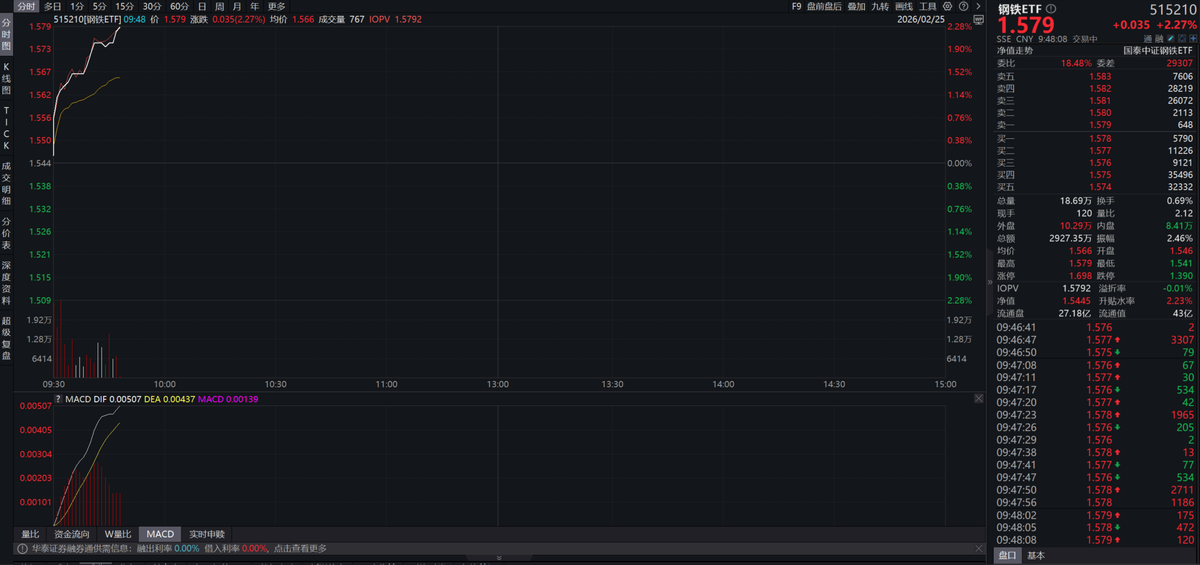
“反内卷”与成本让利共振,钢铁板块迎来估值修复窗口
Mei Ri Jing Ji Xin Wen· 2026-02-25 02:02
Core Viewpoint - The steel sector is at a turning point characterized by low expectations, a bottoming out of fundamentals, and upcoming catalysts, with the only steel ETF (515210) rising over 2% [1] Supply Side: "Anti-Competition" Policy Implementation and Capacity Management Acceleration - The "anti-competition" policy in the steel industry is becoming actionable, with clearer requirements for supply control in the new growth stabilization plan [2] - Environmental inspections are ongoing, leading to accelerated exit of non-compliant capacities, which is expected to enhance industry concentration [2] - The market share of the eight major construction state-owned enterprises has increased from 41% at the end of 2022 to 51% by the end of 2025, indicating a trend towards resource concentration among leading firms [2] Cost Side: Iron Ore Supply Easing and Profit Transfer to Downstream - The long-standing issue of the steel industry being constrained by upstream iron ore is changing, with new large mines coming online [3] - Current port iron ore inventory has reached 169 million tons, nearing historical highs, indicating a loosening supply [3] - The profit distribution within the steel industry is shifting, with iron ore profits expected to decrease, allowing for improved profitability in the finished steel segment [3] Inventory and Price: Low Inventory and Price Stabilization Establishing an Upward Foundation - This year's winter storage efforts are weaker than in previous years, resulting in total inventory at near historical lows, which reduces post-holiday destocking pressure [4] - Steel prices have stabilized at around 3200 yuan/ton, indicating a bottoming out, and any demand or supply-side catalysts could lead to significant price increases [4] - The upcoming demand peak in March, following the late Lunar New Year, is expected to boost trade sentiment and increase the likelihood of a strong market opening [4] Demand Side: Internal and External Demand Expected to Create Synergy - External demand remains resilient due to manufacturing expansions in Southeast Asia and continued loose policies in Europe and the U.S. [5][6] - Domestic demand is anticipated to stabilize as the real estate sector shows signs of recovery after a prolonged downturn [6] - New emerging sectors, such as oil and gas and nuclear power, are expected to contribute to incremental demand for steel products [6] Investment Opportunity: Steel ETF (515210) as a Strategic Tool - The steel ETF (515210) provides a diversified investment approach to capture the sector's recovery potential amid "anti-competition" and cost reduction dynamics [7] - The current absolute valuation of the steel sector has improved from undervaluation to a moderately low position, indicating potential for absolute returns [7] - The ETF tracks leading companies with stable profit characteristics, making it a core investment choice for capturing both short-term trading opportunities and long-term value in the steel sector [7]

让竞争回归价值创造主场(有感而发)
Ren Min Ri Bao· 2026-02-24 22:28
Core Viewpoint - The essence of competition is the ability to create value, and the "anti-involution" policy signals a shift towards rational competition focused on innovation, quality, and service rather than price wars [1] Group 1: Current Industry Challenges - Some industries still experience "involution," leading to continuous pressure on profit margins, as companies remain trapped in outdated competitive strategies focused on scale and cost reduction [1] - Despite having a complete industrial system and advanced technology, certain sectors have not fully escaped the mindset of "winning by volume," resulting in a cycle of increasing losses [1] Group 2: Policy Measures - The "anti-involution" policy reflects a governance approach that combines strict regulation with institutional support, aiming to clarify competitive boundaries while injecting momentum into industry development [2] - Regulatory efforts are focused on addressing industry anomalies through enhanced antitrust and anti-unfair competition enforcement, creating a fair competitive environment, especially for small and medium-sized enterprises [2] Group 3: Future Directions - Returning competition to the realm of value creation is a systematic project that requires persistent effort and collaboration across fiscal, financial, and talent support, tailored to industry characteristics [3] - As the "anti-involution" actions deepen, a healthy and orderly competitive ecosystem is expected to form, driving innovation and quality development, which will enhance China's position in global competition [3]
“卷价格”如何转向“优价值”(产经视野)
Ren Min Ri Bao· 2026-02-24 22:25
Core Viewpoint - The Chinese government is intensifying efforts to regulate "involutionary" competition and promote a unified national market, shifting from rule-setting to institutionalized regulation in 2026 [1][2]. Group 1: Regulatory Actions - Since the beginning of 2026, regulatory bodies have conducted over ten actions to address "involutionary" competition, focusing on potential monopoly risks among leading enterprises [2]. - The State Administration for Market Regulation has explicitly prohibited leading companies from engaging in practices such as capacity agreements and price fixing during discussions with top photovoltaic companies [2]. - Recent irrational competitive behaviors among platform enterprises, particularly in the food delivery sector, have drawn regulatory scrutiny due to practices like "subsidy dumping" and "choose one from two" [2][3]. Group 2: Policy Framework and Implementation - The regulatory framework for addressing "involutionary" competition has been continuously improved, forming a comprehensive governance loop covering pre-, mid-, and post-implementation stages [3]. - The focus of regulatory enforcement in 2026 will be on institutionalization and normalization, with an emphasis on inter-departmental collaboration and industry self-regulation [3][4]. Group 3: Market Transition - The shift in focus from "price competition" to "quality and innovation" is aimed at fostering high-quality competition across various sectors, including photovoltaic and new energy vehicles [4][5]. - The revision of pricing laws and the introduction of rules for internet platform pricing behavior are designed to curb unfair pricing practices and clarify market competition boundaries [4]. Group 4: Economic Implications - The return to reasonable pricing is expected to enhance profit margins, creating a positive cycle where profits drive research and development, ultimately leading to higher quality outputs [5][7]. - The government aims to resolve the issue of oversupply and improve price relationships, which are essential for transitioning from "involutionary" competition to "value-oriented" competition [5][6]. Group 5: Future Outlook - The regulatory approach in 2026 will emphasize a systematic and precise strategy, focusing on innovation encouragement, intellectual property protection, and quality standards [8]. - The expectation is that positive changes will manifest within a year in key industries, although the maturation of the entire market ecosystem may take 2 to 3 years [8].
化工板块观点汇报及近况更新
2026-02-24 14:16
2025 年 7 月份是化工行业行情的起点,这一时间点具有必然性和偶然性。首 先,从供给端来看,2025 年整个化工行业的新增产能基本落地或进入产能消 化阶段,各子行业的产能增速大幅下降,甚至未来几年可能出现供给收缩。这 种边际变化在报表上暂时未显现,但对市场影响深远。其次,2025 年 7 月中 央财经会议上,习近平总书记特别强调反内卷政策,这一政策导向对市场情绪 产生了积极影响。此外,当时化工板块股票位置、盈利和估值均较低,机构配 化工行业产能过剩问题若仅依靠市场化出清,要么不可行,要么代价过 大。需要通过提高标准和双碳政策引导来逐步实现反内卷,而不是像过 去那样一刀切地进行供给侧改革。 炼化和煤化工板块表现最佳的原因在于其产品种类丰富且体量大,具备 显著的成本优势,是双碳政策和反内卷政策的最先受益者,且在化工 ETF 中的权重较高,受政策影响的概率更大。 预计这波化工行情将持续两到三年甚至更长时间,由于反内卷及双碳政 策等慢变量因素影响,将使得整个过程更加持久。从供给端优化开始, 到盈利修复,再到需求迸发式增长,各个子行业将逐步迎来供不应求局 面。 化工行业产能增速大幅下降,未来几年可能出现供给收缩,但 ...
公募基金指数跟踪周报(2026.02.09-2026.02.13):地缘关税扰动并存,市场结构趋势延续-20260224
HWABAO SECURITIES· 2026-02-24 10:08
Report Industry Investment Rating No relevant content provided. Core Viewpoints of the Report - In the short - term, the event disturbances during the Spring Festival holiday do not strongly drive a comprehensive market rise. The market may continue its characteristics of structural differentiation and high - level volatility. The logic of price increases due to anti - involution, geopolitical disturbances, and supply - demand mismatches in the AI supply chain will run through the whole year. Attention should be paid to long - position opportunities in细分 fields. However, the Two Sessions will be held on March 4th, and the detailed 15th Five - Year Plan will be finalized, which means that the policy - favorable expectations for technology and growth will be realized. One needs to beware of the decline risk after the growth style's good news is exhausted. With the in - depth and continuous promotion of anti - involution policies, the demand side will stabilize under the tone of fiscal stimulus and economic recovery. The reversal of the supply - demand contradiction may consolidate the performance inflection point of leading industry companies. Focus on the mid - stream industries with profitability repair and ROE improvement [3][14]. - The bond market has both bullish and bearish factors. After the Spring Festival, the concentrated maturity of reverse repurchases may put some pressure on short - term market liquidity, but the central bank is likely to maintain a supportive attitude, and the liquidity disturbance is probably controllable. The supply pressure of local bonds will decrease after the festival. However, the yield of the 10 - year Treasury bond has fallen below 1.8%, and the resistance to further decline has increased. The purchasing power of institutional allocation funds may decline after the festival, and the market game will intensify before the Two Sessions with a low probability of interest rate cuts. Although the relative value of coupon allocation still exists, the downward space for bond yields of various maturities may be limited [4][15]. Summary by Relevant Catalogs 1. Weekly Market Observation 1.1. Equity Market Review and Observation - During the week before the Spring Festival holiday (2026.02.09 - 2026.02.13), the Shanghai and Shenzhen 300 rose 0.36%, the CSI 500 rose 1.88%, and the ChiNext Index rose 1.22%. The market had some enthusiasm, but the sentiment was restrained, and the trading volume did not effectively increase, remaining at around 2 trillion. The rebound hotspots were concentrated in the TMT and media industries. Pan - technology stocks were significantly repaired, and there was a concentrated rise in sub - directions such as diesel generators and gas turbines related to the North American computing power power outage. The market was still mainly characterized by a structural trend, and all market mainlines were basically centered around the AI narrative [12]. - During the Spring Festival holiday, the US tariff unconstitutional ruling and the Middle East situation injected new uncertainties into the market. The US Supreme Court ruled that Trump's imposition of reciprocal tariffs under the International Emergency Economic Powers Act was unconstitutional. Trump's administration then announced a 10% temporary tariff on imported goods for 150 days starting from February 24th and later proposed to raise it to 15%. The US - Iran negotiation was completed without a substantial agreement, and Trump threatened a "limited - scale" military strike on Iran. The release of the US December PCE inflation data and the Fed's FOMC meeting minutes weakened the market's expectation of an optimistic Fed interest rate cut [13]. - Domestically, the long - holiday consumption data was mixed. The travel traffic reached a new high, highlighting the prosperity of the service - based tourism consumption economy, but there was internal structural differentiation. The overall consumption showed the characteristics of increasing volume but decreasing price, and traditional consumption in areas such as film and real estate was weak, while consumption in areas such as return - home tourism, outbound tourism under visa - free policies, and smart wearable devices was strong. The popularity of humanoid robots and AI applications during the Spring Festival Gala is expected to continuously boost the market's enthusiasm for technology [14]. 1.2. Pan - Fixed - Income Market Review and Observation - In the week before the Spring Festival holiday (2026.02.09 - 2026.02.14), the bond market performed well. The yield of the 1 - year Treasury bond decreased by 0.62BP to 1.31%, the yield of the 10 - year Treasury bond decreased by 2.03BP to 1.79%, and the yield of the 30 - year Treasury bond decreased by 0.50BP to 2.25%. Driven by the pre - holiday allocation demand, the bond market continued its oscillatory recovery trend [15]. - The US Treasury yield curve flattened last week (2026.02.09 - 2026.02.23). The 1 - year US Treasury yield rose 5BP to 3.50%, the 2 - year yield fell 7BP to 3.43%, and the 10 - year yield fell 19BP to 4.03%. The decline in long - term US Treasury yields was mainly due to the speech of the National Economic Council Chairman suggesting a possible downturn in the employment market and the lower - than - expected CPI growth in January, which reduced inflation expectations. Although the January employment data was better than expected, as the US stock market continued to weaken and market risk appetite decreased, some funds flowed into the bond market, leading to a significant decline in long - term US Treasury yields [17]. - The CSI REITs Total Return Index rose 0.41% during the week before the Spring Festival holiday (2026.02.09 - 2026.02.13), closing at 1047.08 points, with most sectors rising, especially in consumption and data centers. In the primary market, 4 new public REITs made progress last week: Huatai Three Gorges Clean Energy REIT was under feedback, CITIC Construction First Agricultural Food Group Commercial Real Estate REIT and Guotai Haitong Chongbang Commercial Real Estate REIT were accepted, and AVIC Beijing Changbao Rental Housing REIT was under inquiry [17]. 2. Fund Index Performance Tracking 2.1. Equity Strategy Theme - Based Index - **Active Stock Fund Selection Index**: The index selects 15 funds each period, with equal - weight allocation for each fund. The core positions select active equity funds based on performance competitiveness and style stability within value, balanced, and growth styles, and the style distribution is roughly balanced according to the style distribution of the CSI Equity - Oriented Fund Index (930950.CSI). The performance benchmark is the CSI Equity - Oriented Fund Index (930950.CSI) [21][22]. 2.2. Investment Style - Based Index - **Value Stock Fund Selection Index**: The value style includes both deep - value and quality - value styles. The index selects 10 funds of deep - value, quality - value, and balanced - value styles based on multi - period style classification. The performance benchmark is the CSI 800 Value Index (H30356.CSI) [25]. - **Balanced Stock Fund Selection Index**: Balanced - style fund managers balance the valuation and growth of individual stocks and switch to more cost - effective stocks when the cost - performance of held stocks decreases. The index selects 10 relatively balanced and value - growth style funds based on multi - period style classification. The performance benchmark is the CSI 800 (000906.SH) [25]. - **Growth Stock Fund Selection Index**: The growth style aims to capture the double - click opportunities of performance and valuation of high - growth companies and discover "dark - horse" companies in high - potential fields. The index selects 10 funds of active - growth, quality - growth, and balanced - growth styles based on multi - period style classification. The performance benchmark is the 800 Growth Index (H30355.CSI) [28]. 2.3. Industry Theme - Based Index - **Pharmaceutical Stock Fund Selection Index**: The index selects funds based on the intersection market value ratio of the fund's equity holdings and the constituent stocks of the representative index (CITIC Pharmaceutical). Funds with an average purity of no less than 60% in the past 3 years or since establishment are selected. An evaluation system is established, and 15 funds are selected to form the index. The performance benchmark is the pharmaceutical theme fund index (fitted by Huabao Securities' fund research and investment platform) [31][32]. - **Consumption Stock Fund Selection Index**: The index selects funds based on the intersection market value ratio of the fund's equity holdings and the constituent stocks of representative indices (CITIC Automobile, Home Appliances, Commerce and Retail, Consumer Services, Textile and Apparel, Food and Beverage, Agriculture, Forestry, Animal Husbandry and Fishery). Funds with an average purity of no less than 50% in the past 3 years or since establishment are selected. An evaluation system is established, and 10 funds are selected to form the index. The performance benchmark is the consumption theme fund index (fitted by Huabao Securities' fund research and investment platform) [32]. - **Technology Stock Fund Selection Index**: The index selects funds based on the intersection market value ratio of the fund's equity holdings and the constituent stocks of representative indices (CITIC Electronics, Communications, Computer, Media). Funds with an average purity of no less than 60% in the past 3 years or since establishment are selected. An evaluation system is established, and 10 funds are selected to form the index. The performance benchmark is the technology theme fund index (fitted by Huabao Securities' fund research and investment platform) [36]. - **High - end Manufacturing Stock Fund Selection Index**: The index selects funds based on the intersection market value ratio of the fund's equity holdings and the constituent stocks of representative indices (CITIC Construction, Light Industry Manufacturing, Machinery, Power Equipment and New Energy, National Defense and Military Industry, Electronics, Communications). Funds with an average purity of no less than 50% in the past 3 years or since establishment are selected. An evaluation system is established, and 10 funds are selected to form the index. The performance benchmark is the high - end manufacturing theme fund index (fitted by Huabao Securities' fund research and investment platform) [41]. - **Cyclical Stock Fund Selection Index**: The index selects funds based on the intersection market value ratio of the fund's equity holdings and the constituent stocks of representative indices (CITIC Petroleum and Petrochemical, Coal, Non - ferrous Metals, Steel, Building Materials, Basic Chemicals, Banks, Non - bank Finance, Real Estate, Comprehensive Finance). Funds with an average purity of no less than 50% in the past 3 years or since establishment are selected. An evaluation system is established, and 5 funds are selected to form the index. The performance benchmark is the cyclical theme fund index (fitted by Huabao Securities' fund research and investment platform) [44]. 2.4. Money - Market Enhancement Index - **Money - Market Enhancement Strategy Index**: The index aims at liquidity management, pursuing a curve that surpasses money - market funds and is smooth and upward. It mainly allocates money - market funds with relatively good performance and inter - bank certificate of deposit index funds among passive index - bond funds. The performance benchmark is the CSI Money - Market Fund Index (H11025.CSI) [46]. 2.5. Pure - Bond Index - **Short - Term Bond Fund Selection Index**: The index aims at liquidity management, pursuing a smooth and upward curve while ensuring drawdown control. It mainly allocates 5 funds with stable long - term returns, strict drawdown control, and significant absolute - return ability. The performance benchmark is 50% * Short - Term Pure - Bond Fund Index + 50% * Ordinary Money - Market Fund Index [50]. - **Medium - and Long - Term Bond Fund Selection Index**: The index invests in medium - and long - term pure - bond funds, pursuing stable returns while controlling drawdowns. It aims for excess returns relative to the medium - and long - term bond fund index and a stable upward net - value curve. It selects 5 funds each period, balancing coupon strategies and band - trading operations, adjusting the duration and the ratio of credit - bond funds and interest - rate - bond funds according to market conditions [51]. 2.6. Fixed - Income Plus Index - **Low - Volatility Fixed - Income Plus Selection Index**: The equity center of the index is positioned at 10%. It selects 10 fixed - income plus funds each period, focusing on those with an equity center (total equity position considering convertible - bond and stock holdings) of less than 15% in the past three years and recently. It considers both the risk - return ratio and the holding experience. The performance benchmark is 10% CSI 800 Index + 90% ChinaBond New Composite Full - Price Index (CBA00303.CS) [55]. - **Medium - Volatility Fixed - Income Plus Selection Index**: The equity center of the index is positioned at 20%. It selects 5 fixed - income plus funds each period, choosing those with an equity center between 15% and 25% in the past three years and recently. It focuses on the risk - return ratio and selects funds with certain performance elasticity. The performance benchmark is 20% CSI 800 Index + 80% ChinaBond New Composite Full - Price Index (CBA00303.CS) [58]. - **High - Volatility Fixed - Income Plus Selection Index**: The equity center of the index is positioned at 30%. It selects 5 fixed - income plus funds each period, choosing those with an equity center between 25% and 35% in the past three years and recently. It focuses on the risk - return ratio and selects funds with certain performance elasticity, mainly screening for funds that can obtain stable returns on the bond side without credit downgrading and have strong stock - picking ability and offensive ability on the equity side. The performance benchmark is 30% CSI 800 Index + 70% ChinaBond New Composite Full - Price Index (CBA00303.CS) [61]. 2.7. Other Pan - Fixed - Income Index - **Convertible - Bond Fund Selection Index**: The index selects bond - type funds with the average proportion of convertible - bond investment in bond market value of no less than 60% in the latest period and no less than 80% in the past four quarters as the sample space. An evaluation system is established from the fund - product, fund - manager, and fund - company dimensions, considering factors such as long - and short - term returns, drawdowns, risk - adjusted returns, and the timing and bond - selection abilities of fund managers. Five funds are selected to form the index [64]. - **QDII Bond Fund Selection Index**: The underlying assets of QDII bond funds are overseas bonds, covering regions such as the world, Asia, and emerging markets, with investment targets including Chinese - funded US dollar bonds and US dollar bonds. According to credit ratings, they are usually divided into investment - grade and high - yield products. Six funds with stable returns and good risk control are selected to form the index [67]. - **REITs Fund Selection Index**: The underlying assets of REITs are mainly mature, high - quality, and stable - operating infrastructure projects with relatively clear cash - flow expectations and relatively limited unit - net - value volatility. Ten funds with stable operations, reasonable valuations, and certain elasticity are selected to form the index according to the underlying asset types [68].
国投期货黑色金属日报-20260224
Guo Tou Qi Huo· 2026-02-24 10:08
Report Industry Investment Ratings - The operation ratings for various products are as follows: - Thread steel, hot-rolled coil, iron ore, coke, and coking coal are rated ☆☆☆, indicating a more distinct long/short trend and a relatively appropriate current investment opportunity [1] - Silicon manganese is not clearly rated, and silicon iron is marked with unclear symbols [1] Core Viewpoints - The overall demand for steel products is weak, and the market sentiment is sluggish, with the disk under short-term pressure. The supply of iron ore is in excess, but there is an expectation of marginal improvement in demand. Coke and coking coal are likely to fluctuate widely, and silicon manganese and silicon iron prices are affected by oversupply and the "anti-involution" concept [2][3][4] Summary by Related Catalogs Steel - The disk continued to decline today. During the Spring Festival, the demand for building materials basically stagnated, the apparent demand for thread steel dropped to zero, and the inventory accumulation was lower than the same period in previous years. The demand for hot-rolled coil also declined, and the inventory continued to accumulate. Due to poor steel mill profits and insufficient downstream acceptance capacity, the molten iron production remained at a relatively low level. The overall domestic demand is still weak, and steel exports remain high. The demand expectation is poor, and the market sentiment is sluggish, with the disk under short-term pressure [2] Iron Ore - The disk fell today. The global shipment increased significantly month-on-month, and the domestic port inventory is at a historical high, with heavy concerns about oversupply. The molten iron production increased slightly at a low level before the festival, and it is expected to continue the resumption trend after the festival, with certain restocking needs. Overall, there is an expectation of marginal improvement in iron ore demand, but the pressure of oversupply is relatively greater, and the disk price is still under pressure [3] Coke - The price continued to decline during the day. The coking profit is average, and the daily output decreased slightly. The coke inventory increased slightly, and the purchasing willingness of traders is average. Overall, the supply of carbon elements is abundant, the downstream molten iron remains at a low level in the off-season, the steel profit level is average, and the price pressure on raw materials is still strong. The coke disk has a premium, and the coking coal disk has a premium over Mongolian coal. It is likely to fluctuate widely [4] Coking Coal - The price continued to decline during the day. The customs clearance volume of Mongolian coal was 1,333 vehicles yesterday. The production of coking coal mines increased slightly, and the spot auction transactions are inversely proportional to the disk fluctuations. Affected by the relatively volatile disk price, the transaction price mainly decreased slightly, and the terminal inventory increased significantly. The total coking coal inventory increased significantly, and the production end inventory increased slightly. The winter storage demand is coming to an end. Overall, it is likely to fluctuate widely [6] Silicon Manganese - The price fluctuated during the day. Attention should be paid to the impact of Ghana's ban on the export of unprocessed manganese ore. The spot manganese ore transaction price increased slightly, and the disk entered a non-arbitrage space, with relatively limited downward space. The manganese ore port inventory may start to slowly increase, and the mine shipment increased month-on-month, but the mine cost has increased compared with previous years, and the price concession space may be relatively limited. The demand-side molten iron production remains at a seasonal low level. The weekly silicon manganese production increased slightly, and there is hardly any significant downward driving force. The silicon manganese inventory increased slightly, and the price is affected by oversupply and the repeated fermentation of the "anti-involution" concept [7] Silicon Iron - The price fluctuated during the day. The power cost in some production areas has indeed decreased, the semi-coke price remained flat, and the main production areas are still mainly in losses, but the profit in the Inner Mongolia production area has turned positive. The demand-side molten iron production remains at a low level in the off-season. The export demand remains above 30,000 tons, with little marginal impact. The metal magnesium production increased month-on-month, and the secondary demand increased marginally. The overall demand still has resilience. The silicon iron supply changed little, and the inventory decreased slightly. The price is affected by oversupply and the repeated fermentation of the "anti-involution" concept [8]
【公募基金】地缘关税扰动并存,市场结构趋势延续——公募基金指数跟踪周报(2026.02.09-2026.02.13)
华宝财富魔方· 2026-02-24 09:23
Investment Insights - The equity market showed some heat before the Spring Festival holiday (February 9-13, 2026), with the Shanghai Composite Index rising by 0.36%, the CSI 500 up by 1.88%, and the ChiNext Index increasing by 1.22%. However, market sentiment remained restrained, and trading volume did not effectively expand, staying around 2 trillion [3][5][6] - The holiday period introduced uncertainties due to the U.S. Supreme Court ruling on tariffs and the Middle East situation, impacting market dynamics. The U.S. inflation data exceeded expectations, with core PCE inflation rising to 3%, and the Fed's FOMC minutes indicated a cautious stance on further rate cuts, reducing optimistic expectations for monetary easing [4][6] - Domestic consumption data during the holiday was mixed, with travel traffic reaching a historical high, indicating a robust service economy focused on tourism. However, there was internal structural differentiation, with traditional sectors like film and real estate underperforming, while sectors like travel and smart wearable devices thrived [5][6] Fixed Income Market Insights - The bond market performed well in the week leading up to the Spring Festival (February 9-14, 2026), with the 1-year government bond yield decreasing by 0.62 basis points to 1.31%, the 10-year yield down by 2.03 basis points to 1.79%, and the 30-year yield down by 0.50 basis points to 2.25%. This performance was driven by pre-holiday demand for bond allocation [7][8] - There are mixed factors in the bond market, with potential short-term liquidity pressure due to the upcoming reverse repos. However, historical trends suggest that the central bank may maintain a supportive stance, making liquidity disturbances likely manageable [2][7] - The current 10-year government bond yield has fallen below 1.8%, indicating increased resistance to further declines. The market may experience reduced demand for bond purchases post-holiday, especially with the upcoming Two Sessions and a low probability of rate cuts [2][7] Sector Performance - The technology and media sectors were the main rebound hotspots, with a notable recovery in technology stocks. The market's main narrative continues to revolve around AI developments, with specific sectors like power generation and gas turbines seeing collective gains [3][6] - The upcoming Two Sessions on March 4 is expected to finalize the detailed planning for the 14th Five-Year Plan, which may solidify positive policy expectations for technology growth. However, there is a caution against overextending growth expectations, which could lead to a market correction [6][7]