
AI投资

Search documents
留给联储摇摆的时间已经不多
Xin Lang Cai Jing· 2025-11-29 01:34
Group 1 - The article discusses the potential implications of the Federal Reserve's hawkish stance and its impact on the market, particularly in relation to Bitcoin's recent price drop [3][4] - It highlights the internal polarization within the Federal Reserve, with some officials adopting hawkish views while others remain dovish, complicating the decision-making process [4][5] - The article suggests that the current economic environment does not allow for a one-size-fits-all solution, leading to uncertainty in the Fed's actions [5][6] Group 2 - The article reflects on Jerome Powell's past challenges, including market volatility and communication issues, which have influenced his decision-making [6][7] - It emphasizes the historical trend of interest rates, suggesting that they are unlikely to remain stagnant and will eventually break out of the current range [11][20] - The article draws parallels between the U.S. and Chinese real estate markets, indicating that both are facing unique challenges and potential recovery paths [13][16]


2026年股权投资市场怎么走?最新研判来了
Shang Hai Zheng Quan Bao· 2025-11-28 13:29
Core Insights - The 19th China Investment Annual Conference highlighted trends in the private equity market, emphasizing the importance of economic, political, and technological drivers in asset allocation, with expectations for stability until 2026 [1] - The report indicated a significant increase in newly established venture capital funds, reaching 1.78 trillion yuan in the first three quarters of 2025, a year-on-year increase of 10.25%, and investment events totaling 912 billion yuan, up 19.98% [1] Group 1: Investment Trends - The report predicts three major trends in asset allocation: industry concentration, regional decoupling, and stable allocation [1] - The participation of state-owned capital in venture capital has reached a stable phase, with state-owned platforms and guiding funds accounting for 59% of the funding structure by Q3 2025 [2] - The willingness of listed companies to invest in private equity funds has decreased, with average annual contributions dropping from 288 million yuan to 192 million yuan from 2022-2023 to 2024 [3] Group 2: M&A and Fund Dynamics - The Chinese M&A fund market is expected to grow significantly, with a focus on cash flow and operational management, presenting numerous opportunities due to a favorable financing environment and increasing demand for corporate restructuring [4] - S funds are becoming a critical component of the market, with a peak in global S transactions in the first half of 2025, indicating a growing demand for secondary fund transactions [5][6] - The report suggests that the Chinese hard technology sector will undergo a competitive phase, with a shift from scale to technological innovation and a focus on building systematic capabilities [7][8]
大行看好!中国科技资产仍存在超预期空间
中国基金报· 2025-11-28 12:51
Core Viewpoint - The capital expenditure demand in the AI investment sector is shifting from US suppliers to Chinese suppliers, indicating significant growth potential for Chinese technology assets, particularly in the domestic substitution direction [1][2]. Group 1: Chinese Technology Assets - Chinese technology assets, especially in the domestic substitution sector, are expected to have unexpected growth potential despite short-term market volatility [2]. - The US's entry into a rate-cutting cycle will lead to increased market liquidity, prompting funds to pursue assets with higher potential returns [2]. - Chinese assets are currently underrepresented in global allocations, indicating significant room for increased investment [2]. - The recognition of China's model capabilities by global tech companies, particularly in the open-source field, is a positive sign for the future [2]. Group 2: Hardware Breakthroughs - By 2025, capital expenditure demand in the AI investment sector is expected to gradually shift from overseas suppliers to domestic suppliers [3]. - The current trend among Chinese tech companies is moving from hoarding imported hardware to actively embracing domestic solutions, which is optimistic for the AI industry [3]. - As leading companies begin large-scale procurement of domestic servers equipped with local chips, profits and capital will flow back to local suppliers, creating a virtuous cycle for technological breakthroughs [3]. Group 3: Global AI Market Dynamics - The global model market has transitioned from a "hundred schools of thought" to a commercialization phase, with a focus on vertical companies [4]. - The funding focus in the AI market is expected to shift towards hardware, with anticipation for the emergence of application-level breakthrough products [4]. - The integration phase of the global model market is nearly complete, with only a few institutions remaining in model development [4]. - Vertical industry data will become key to creating differentiated advantages as model capabilities become more homogeneous [4]. Group 4: AI Commercialization - The path to AI commercialization is clearer for B-end applications compared to C-end applications, making implementation easier [6][7]. - In the e-commerce sector, AI can replace traditional models, reducing operational costs significantly [6]. - The logic behind B-end commercialization is clear and reasonable, focusing on cost savings rather than creating entirely new AI revenue streams [7]. - C-end commercialization faces challenges due to unclear directions and intense competition, with user willingness to pay being low in the Chinese market [7].

国泰海通|有色:大鹏一日同风起——金属行业2026年年度策略
国泰海通证券研究· 2025-11-28 08:56
Group 1: Copper and Aluminum - The demand for copper is expected to rise due to liquidity easing from the Federal Reserve's interest rate cuts and increased physical demand from AI investments, particularly in data centers and power grids, leading to a sustained upward trend in copper prices [1] - The copper supply-demand imbalance persists, and the valuation of the copper sector remains relatively low, suggesting a positive investment opportunity [1] - The aluminum industry is projected to maintain a tight supply-demand balance, which will support aluminum prices and allow leading companies to achieve good profit levels due to their resource management and supply chain strategies [1] Group 2: Precious Metals - The long-term trend of "de-dollarization" is driving some countries to reduce their holdings of U.S. Treasury bonds and increase their gold reserves, a trend that is expected to continue despite easing U.S.-China trade tensions [2] - The Federal Reserve's interest rate cuts are accelerating this process, with expectations of rising precious metal prices in 2025 and beyond [2] - The upcoming U.S. midterm elections may lead to more aggressive rate cuts from the new Federal Reserve chair, further supporting the bullish outlook for precious metals [2] Group 3: Energy Metals - The demand for lithium is anticipated to return to a tight balance by 2026, driven by growth in energy storage and power demand, with a projected demand growth rate of approximately 50% from energy storage and nearly 20% from power batteries [3] - The global lithium demand is expected to grow by 24.2%, while supply growth is estimated at 18.1%, indicating a shift from a loose balance to a tight balance in the lithium market [3] - The upward trend in lithium prices is expected as the market transitions to a tighter supply-demand scenario [3] Group 4: Rare Earth Materials - Domestic rare earth prices are at a cyclical low, with expectations for a continued upward trend due to supply constraints and increasing demand from sectors like electric vehicles and wind power [4] - The demand for neodymium-iron-boron is projected to grow significantly, with estimates of 29% growth from the electric vehicle sector and 18% from wind power [4] - The tightening of supply, coupled with rising overseas prices, is likely to enhance the profitability and valuation of domestic rare earth magnet manufacturers [4]

业内专家:科技巨头“债务洪流”无虞,信贷市场足可消化
智通财经网· 2025-11-28 00:43
Group 1 - Concerns about oversupply in the credit market due to large-scale bond issuance by tech giants like Meta Platforms Inc. and Alphabet Inc. are considered premature [1] - The recent bond issuances are driven by significant AI-related investment needs, raising fears of a potential market sell-off due to rapid debt growth [1] - Iain Stealey from JPMorgan Asset Management noted that while there has been some market impact, the overall concerns are exaggerated, as these companies generate substantial annual revenues [1][2] Group 2 - Large tech companies have minimal debt, making them attractive credit targets, with Alphabet's credit rating being higher than that of France [2] - The entry of companies like Apple and Microsoft into the European market is expected to generate significant buying demand due to their high credit ratings [3] Group 3 - Overall optimism in the credit market is expressed, with expectations that bond yields and healthy balance sheets will provide support through 2026 [4] - The attractiveness of lower-rated bonds is questioned, as the risk-reward ratio does not justify seeking yield down the credit curve [4] - AT1 bonds have performed strongly this year, with expectations that this trend will continue into 2026 [4]


2026 年外汇展望报告:看空美元,看多贝塔资产-FX 2026 Outlook Presentation_ Bearish Dollar, Bullish Beta. Tue Nov 25 2025
2025-11-27 05:43
Summary of Key Points from the Conference Call Industry Overview - The conference call focuses on the **Global FX (Foreign Exchange) Market** outlook for 2026, emphasizing a **bearish dollar** and a **bullish beta** environment. Core Insights and Arguments 1. **Bearish Dollar Outlook**: The dollar is expected to have a bearish bias in the first half of 2026 due to factors such as Federal Reserve asymmetries, twin deficits, and a global recovery, although its weakness may be constrained by US economic resilience [6][8][17]. 2. **Currency Predictions**: Key currency forecasts include EUR/USD at 1.20, USD/JPY at 164, and USD/CNY at 7.05 [6][8]. 3. **Global Economic Recovery**: The macroeconomic landscape in 2026 is characterized by procyclicality, synchronized central bank inactivity, and a focus on fiscal policy and AI adoption impacts [6][8][36]. 4. **High Beta/Yielding Currencies**: Preference is given to high beta and yielding currencies, with expectations that DM (Developed Markets) high-yielders like NOK and AUD will benefit from growth pick-up [6][8][36]. 5. **FX Carry Trades**: FX carry trades are anticipated to perform well amid low volatility and central bank inactivity, with a focus on carry-efficient hedges for risk markets [6][8][36]. 6. **US Policy Risks**: US policy remains a significant source of FX risk, with a shift in focus from tariffs to fiscal policy and the Fed's framework [6][8][64]. 7. **AI Impact**: The adoption of AI is expected to influence FX markets, with carry trades linked to AI commodity exporters like AUD and CLP [6][8][52]. 8. **Fiscal Differentiation**: Fiscal differentiation is highlighted as a critical factor, with CHF showing the best fiscal metrics among reserve currencies [49][132]. Additional Important Insights 1. **Historical Context**: The dollar's performance has historically correlated with net foreign direct investment (FDI) rather than net equity inflows, indicating a complex relationship between currency strength and investment flows [54][90]. 2. **Market Sentiment**: FX volatility is expected to remain subdued, but historical patterns suggest limited further downside from current low levels [44][46]. 3. **Trade Recommendations**: Specific trade recommendations include maintaining USD shorts, buying AUD/USD, and various options strategies involving EUR/GBP and NOK/JPY [9][8][17]. 4. **Growth Forecasts**: The growth forecasts for 2026 are skewed to the upside, driven by the lagged effects of prior global monetary easing and easier financial conditions [18][19]. 5. **Structural Issues**: The US faces unresolved macro issues, such as the divergence between resilient GDP growth and a softening labor market [30][32]. This summary encapsulates the key points discussed in the conference call, providing a comprehensive overview of the anticipated trends and risks in the FX market for 2026.

华银基金:当前处于“牛市第二阶段”的整固期,12月两大事件将成为破局关键
Sou Hu Cai Jing· 2025-11-27 01:31
Group 1 - The A-share market is experiencing ongoing fluctuations, with the Shanghai Composite Index trading around key levels, leading to cautious investor sentiment [1] - The uncertainty surrounding the Federal Reserve's policy and the impact of U.S. stock market adjustments are key concerns for market direction [1][2] - The upcoming release of the November CPI data on the day of the December Federal Reserve meeting may serve as a critical point for global risk appetite [2] Group 2 - The U.S. job market shows signs of weakness, with slowing job additions and a slight increase in the unemployment rate, while persistent inflation complicates the Federal Reserve's decision-making [2] - The recent adjustment in the U.S. stock market, particularly in the tech sector, has led to a reassessment of AI investment narratives, revealing doubts about capital expenditure effectiveness and valuation pressures [3] - The A-share technology sector is particularly affected by the U.S. market's downturn, with significant declines in semiconductor and AI-related industries [3] Group 3 - The domestic economy is characterized by stronger price recovery than demand improvement, with mixed signals from various economic indicators [4] - Despite some positive signs, such as a rise in October CPI and a halt in PPI's negative growth, there are concerns about the low growth rate of social financing and a decline in real estate sales [4] - The government continues to implement "bottom-line" monetary and fiscal policies, including an expansion of technology innovation loans and early issuance of special bonds, although the overall stimulus expectations remain limited [4] Group 4 - The market outlook suggests continued volatility with a potential for stabilization, awaiting key decisions from the Central Economic Work Conference and clarity on the Federal Reserve's interest rate path [5] - The current market adjustment may provide opportunities for mid-term positioning, especially if the market experiences overshooting [5]
《周末小结系列》: 英伟达季报爆炸、比特币跳水、美联储分裂——市场到底在怕什么?
Xin Lang Cai Jing· 2025-11-25 08:40
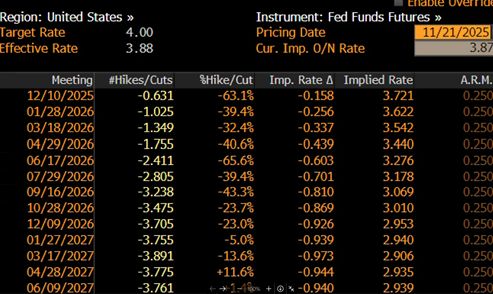
Group 1 - The core point of the article is that while recent labor data indicates a slowing U.S. economy, it is not yet at a critical point, and the Federal Reserve's decision on interest rate cuts is becoming more contentious among its members [2][25]. - The September labor data showed non-farm payrolls increased by 119,000 and private sector jobs rose by 97,000, with a two-month downward revision of 33,000, indicating a mixed but not alarming labor market [2][25]. - The unemployment rate rose to 4.4%, higher than expected, primarily due to an increase in labor force participation, which is not considered a negative sign [2][25]. Group 2 - There is a growing divide within the Federal Reserve, with hawkish members opposing a rate cut in December, while some members support it, leading to fluctuating market expectations [2][3]. - Following comments from Williams, a key Fed official, the probability of a December rate cut surged back to around 65%, indicating a shift in sentiment towards a potential easing of monetary policy [3][5]. - Even if a rate cut does not occur in December, the market anticipates that it will be postponed to January, suggesting a continuation of the easing trend [5]. Group 3 - Nvidia's recent earnings report initially alleviated concerns about the AI investment bubble and the labor market, but subsequent skepticism arose from a critical analysis of its financial structure [6][7]. - The critical analysis raised three main concerns: increasing accounts receivable turnover days, a 32% rise in inventory, and declining prices in GPU rental markets, suggesting potential demand weakness [8][9]. - Despite these concerns, it is argued that it may be premature to label the situation as a bubble, as the data may reflect transitional issues rather than a fundamental decline in demand [9]. Group 4 - The market is currently facing fears related to MSTR (MicroStrategy), as MSCI questions the classification of Bitcoin treasury companies, which could lead to significant passive selling pressure [10][12]. - MSTR could face up to $8 billion in potential passive selling if it is removed from indices, but its average trading volume suggests it may not significantly disrupt the market [12]. - MSTR's convertible debt does not pose an immediate liquidation risk, as it matures in 2028, allowing for potential recovery in a favorable market environment [12][14]. Group 5 - The article concludes that the current market downturn is driven more by mechanical deleveraging from quantitative funds rather than fundamental economic weaknesses, suggesting that future market dips could present buying opportunities [25][26].

宝城期货股指期货早报-20251125
Bao Cheng Qi Huo· 2025-11-25 02:22
Report Summary 1) Report Industry Investment Rating No relevant information provided. 2) Core View of the Report - The short - term market competition intensifies, and the stock index will mainly fluctuate within a range in the short term. However, in the long - term, the stock index is not pessimistic, and there is strong support below after a significant short - term correction [5]. 3) Summary According to Related Catalogs Variety View Reference - Financial Futures Stock Index Sector - For IH2512, the short - term view is "oscillation", the medium - term view is "oscillation", the intraday view is "weak", and the reference view is "range oscillation". The core logic is that the willingness of funds to settle increases in the short term [1]. - For IF, IH, IC, and IM, the intraday view is "weak", the medium - term view is "oscillation", and the reference view is "range oscillation". The core logic is that the policy expectation driving the stock market to rise has declined in the short term, the risk appetite of technology stocks has decreased, and there is a demand for technical consolidation of the stock index. However, in the long - term, the policy and capital factors remain positive [5]. Main Variety Price Market Driving Logic - Financial Futures Stock Index Sector - Yesterday, the stock indexes fluctuated and consolidated. The total trading volume of the Shanghai, Shenzhen, and Beijing stock markets was 1740.3 billion yuan, a decrease of 243.3 billion yuan from the previous day. The short - term policy expectation has declined, and the risk preference of technology stocks has decreased due to the risk of profit realization in global AI investment. In the short term, there is a demand for technical consolidation of the stock index, and the willingness of funds to leave the market to avoid risks has increased. In the long - term, the policy and capital factors remain positive, and the stock index is not pessimistic [5].
AI扩张催生史上最大科技债务潮 信用市场风险加剧
智通财经网· 2025-11-24 16:02
华尔街警告称,随着大型科技公司掀起史无前例的发债潮,全球信用市场或在未来几年面临"供给消化 不良"的风险,并可能对欧美两地的债市造成压力。若Alphabet(GOOG.US,GOOGL.US)、 Meta(META.US)等公司的巨额发债节奏延续至2026年,原本已创纪录的年度发行规模可能进一步推高 利差,引发市场对AI投资回报与资产泡沫的更深疑虑。 智通财经APP获悉,根据摩根士丹利预计,科技巨头为扩建人工智能和数据中心基础设施,至2028年可 能累积筹集多达1.5 万亿美元的债务资金。这意味着债市整体利差可能被动上升,因为债券投资者开始 质疑,在近期科技股波动加剧、AI投资热潮升温的背景下,他们是否获得了足够的风险补偿。 摩根大通策略师Matthew Bailey警告称,大规模数据中心融资可能导致美元与欧元市场"双向供给过 剩"。今年已有多笔巨量发行刷新纪录:Alphabet(GOOG.US,GOOGL.US)在美国融资175亿美元,在欧洲 则发行65亿欧元;Meta(META.US)发债规模更高达300亿美元,订单簿峰值达1250亿美元,为历史之 最;甲骨文(ORCL.US)也完成了180亿美元的大额发 ...


