通胀预期

Search documents
大越期货贵金属早报-20251226
Da Yue Qi Huo· 2025-12-26 02:24
1. Report Industry Investment Rating - No information provided in the report. 2. Core Views of the Report - During the Christmas holiday, gold prices were boosted by silver prices. Gold futures had a price of 1008.76, and the spot price was 1002.92, with a basis of -5.84, indicating that the spot was at a discount to the futures. The gold futures warehouse receipts remained unchanged at 93711 kilograms. The 20 - day moving average was upward, and the K - line was above the 20 - day moving average. The main positions were net long, but the long positions of the main players decreased. With overseas stock markets closed in many places, attention should be paid to China's industrial enterprise profits above designated size in November and Japan's unemployment rate in November. The gold - silver ratio was at a low level, providing support for gold prices [4]. - During the Christmas holiday, Shanghai silver prices rose significantly again, while the London market did not follow up after the holiday. The silver futures price was 17397, and the spot price was 17433, with a basis of +6, indicating that the spot was at a premium to the futures. The Shanghai silver futures warehouse receipts decreased by 29532 kilograms to 852417 kilograms. The 20 - day moving average was upward, and the K - line was above the 20 - day moving average. The main positions were net long, and the long positions of the main players increased. Domestic silver prices rose independently and significantly during the Christmas holiday, and the Shanghai silver premium continued to expand. With overseas Christmas holidays, abnormal price increases were still possible, and silver prices remained strong under the support of funds, but there was a risk of high premiums in silver funds [5]. - After Trump took office, the world entered a period of extreme turmoil and change. The inflation expectation shifted to the economic recession expectation, making it difficult for gold prices to decline. Recently, the Fed's interest rate cuts and the optimistic expectation of the Russia - Ukraine peace talks had a combined impact, and with concerns about liquidity, there was still upward momentum for gold prices, but it was limited [9]. - Silver prices mainly followed gold prices. The tariff concern had a stronger impact on silver prices, and there was a risk of an enlarged increase in silver prices. There were both positive and negative factors affecting silver prices, such as global turmoil and inflation concerns on the positive side, and the Fed's internal divergence and the optimistic expectation of the Russia - Ukraine peace talks on the negative side [13][14]. 3. Summary According to the Directory 3.1. Previous Day's Review - The report provides the previous day's closing, highest, lowest, price changes, and price change percentages of various precious metal products, including Shanghai gold 2602, Shanghai silver 2602, COMEX gold 2602, etc. For example, Shanghai gold 2602 closed at 1008.76, with a high of 1014.28, a low of 1003.12, a price change of -3.90, and a price change percentage of -0.39% [16]. 3.2. Daily Tips - Attention should be paid to Japan's unemployment rate, Tokyo CPI, industrial output, and retail sales in November; China's industrial enterprise profits above designated size from January to November; and a news conference by the National Development and Reform Commission [15]. 3.3. Today's Focus - At 07:30, Japan's November unemployment rate, job - seeking ratio, and December Tokyo CPI; at 07:50, Japan's November industrial output preliminary value and retail sales; the stock markets in Japan, South Korea, Australia, Germany, France, the UK, Italy, and Canada are closed all day; the first Guangdong - Hong Kong - Macao Greater Bay Area Low - altitude Economy High - quality Development Conference is held at an undetermined time; at 10:30, the National Development and Reform Commission holds a news conference to introduce the work related to the national venture capital guidance fund; on Saturday at 09:30, China's industrial enterprise profits above designated size from January to November are announced [15]. 3.4. Fundamental Data - **Gold**: The fundamental situation is neutral. The basis shows that the spot is at a discount to the futures, which is bearish. The unchanged warehouse receipts are also bearish. The upward 20 - day moving average and the K - line above it are bullish. The main net long position with a decrease in long positions is also bullish [4]. - **Silver**: The fundamental situation is neutral. The basis shows that the spot is at a premium to the futures, which is neutral. The decrease in warehouse receipts is bullish. The upward 20 - day moving average and the K - line above it are bullish. The main net long position with an increase in long positions is bullish [5]. 3.5. Position Data - **Shanghai Gold**: On December 25, 2025, the long positions of the top 20 were 189,259, a decrease of 3,766 or 1.95% compared to the previous day; the short positions were 55,546, a decrease of 501 or 0.89%; the net positions were 133,713, a decrease of 3,265 or 2.38% [30]. - **Shanghai Silver**: On December 25, 2025, the long positions of the top 20 were 393,810, a decrease of 8,438 or 2.10% compared to the previous day; the short positions were 306,880, a decrease of 4,494 or 1.44%; the net positions were 86,930, a decrease of 3,944 or 4.34% [32]. - **SPDR Gold ETF**: The ETF holdings turned to an increase [34]. - **Silver ETF**: The ETF holdings decreased slightly [36]. - **Shanghai Gold Warehouse Receipts**: There was a slight increase [38]. - **COMEX Gold Warehouse Receipts**: There was a slight increase and remained at a high level [39]. - **Shanghai Silver Warehouse Receipts**: Continued to decrease slightly and were at the lowest level in the past six years [41]. - **COMEX Silver Warehouse Receipts**: Continued to decrease [41].
低利率,破局——2026年债市展望
2025-12-26 02:12
Summary of Conference Call on Bond Market Outlook for 2026 Industry Overview - The conference call discusses the bond market outlook for 2026, highlighting the challenges and strategies for investors in a low-interest-rate environment. The overall sentiment indicates a cautious approach due to systemic issues in financing and market dynamics. Key Points and Arguments Market Performance and Trends - The bond market in 2025 performed below expectations, with a loose funding environment but continued market volatility, indicating a mismatch between financial expansion and real economy financing [1][2] - Credit bonds are expected to see a reduction in asset scarcity in 2025, with high-yield new bonds being scarce and credit spreads narrowing [1][3] - The recommendation is to focus on municipal bonds with maturities of three years or less, particularly in liquid regions, to achieve higher yields [1][10] Investment Strategies - The investment strategy is shifting from capital gains to prioritizing coupon income due to changing investor expectations in a low-interest-rate environment [2][8] - Caution is advised as the bond market is likely to experience sideways movement with limited investment opportunities, emphasizing the importance of stable net asset growth [6][8] - Financial institutions are moving towards long-term, low-volatility assets, such as local government bonds and short-term credit bonds, rather than relying on capital gains from the bond market [5] Interest Rate Outlook - The likelihood of significant interest rate declines is low unless the central bank takes measures to manage debt supply, which is uncertain [4] - The consensus is that the funding environment will not tighten significantly in 2026, as the central bank has no need to actively tighten monetary policy [9] Credit Bonds and Convertible Bonds - The credit bond market is expected to remain stable, with a focus on short-term municipal bonds due to anticipated resolution of municipal debt issues by 2027 [10] - The convertible bond market is likely to remain in a state of supply-demand imbalance, with opportunities for investors to engage in strategies like strong redemption or adjustment clauses [11] New Financial Products - Innovative products such as credit bond ETFs and multi-strategy fixed-income products are highlighted as areas of potential growth, alongside themes like green finance and technology finance [7] Operational Recommendations - For interest rate bonds, a defensive trading strategy is recommended, focusing on quick entry and exit based on market expectations [13] - The overall strategy should transition from high elasticity to stable net asset growth, with attention to the evolving landscape of fixed-income products and credit innovations [12][13] Additional Important Insights - The enthusiasm of banks for bond investments has decreased, indicating limitations in their capacity to allocate bonds effectively [3] - The changing macroeconomic environment and financing structure have created challenges for banks, impacting their ability to participate actively in the bond market [3][5] This summary encapsulates the critical insights and recommendations from the conference call regarding the bond market outlook for 2026, emphasizing the need for cautious and strategic investment approaches in a challenging economic landscape.
日本2年期国债标售疲软,市场预计通胀或倒逼央行“更猛烈加息”
Hua Er Jie Jian Wen· 2025-12-25 09:43
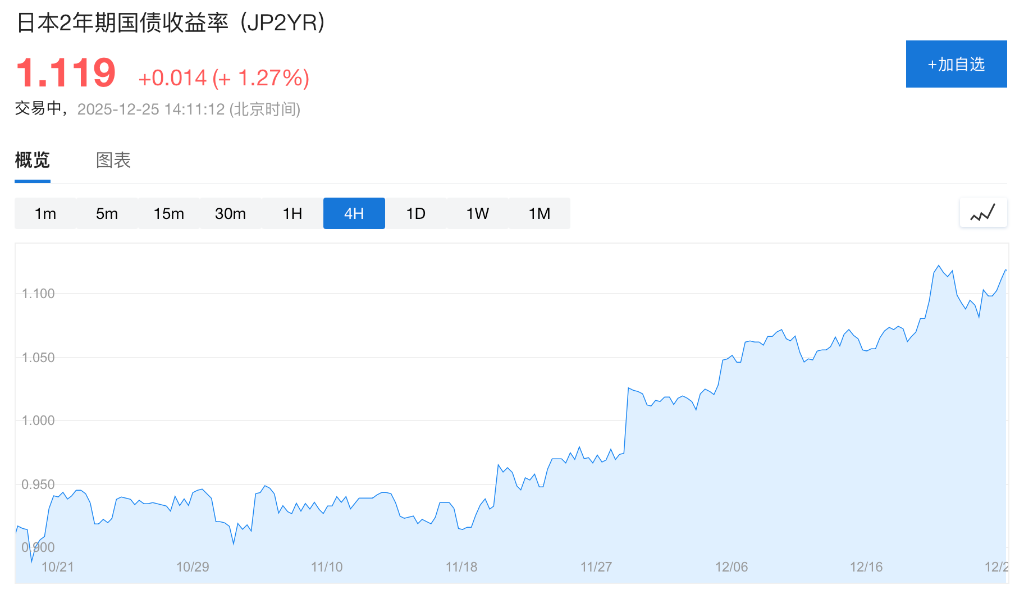
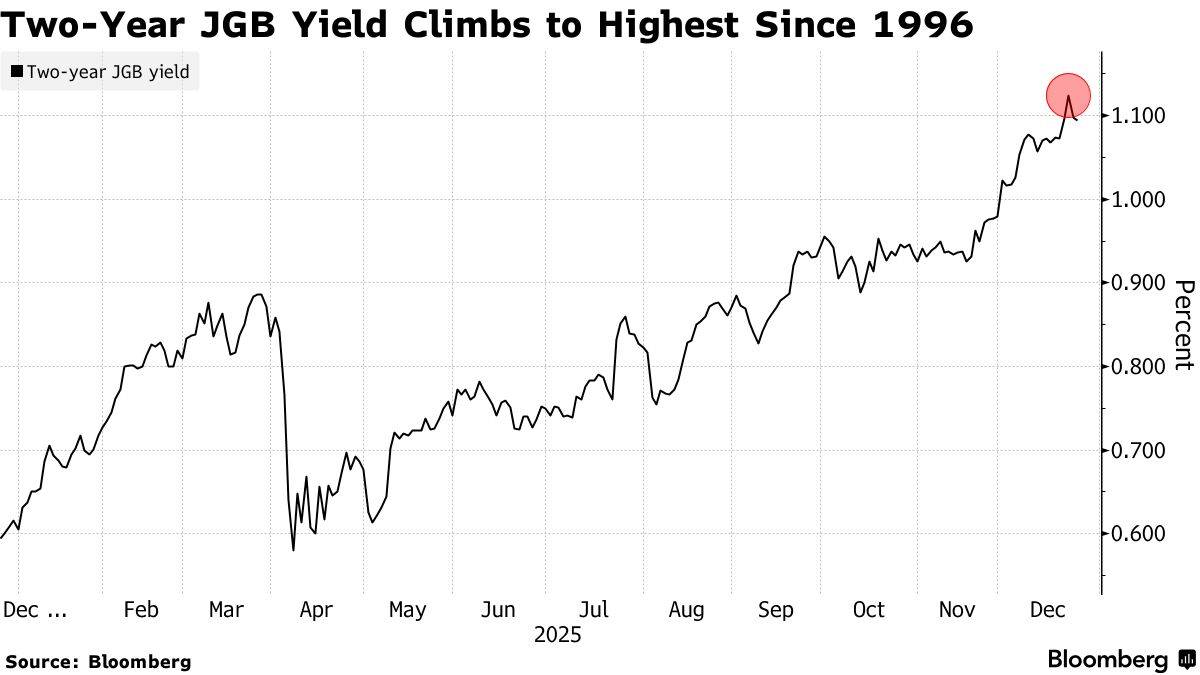
Core Viewpoint - The market is experiencing increased inflation expectations and pressure from the depreciation of the yen, leading to a potential need for the Bank of Japan to adopt a more aggressive interest rate hike strategy, which has resulted in weak demand for the 2-year Japanese government bond auction held on December 25 [1][4]. Group 1: Auction Results - The bid-to-cover ratio for the 2-year bond auction was only 3.26, down from 3.53 in the previous auction and below the 12-month average of 3.65, indicating weak demand [1]. - Following the auction results, the yield on the 2-year government bond rose by 2.5 basis points to 1.125%, marking the highest level since 1996 [1]. Group 2: Market Sentiment - The weak auction results highlight market unease regarding the Bank of Japan's policy stance, with the 10-year breakeven inflation rate reaching its highest level since data collection began in 2004 [4]. - There are concerns that the Bank of Japan is lagging behind inflation trends, which may lead investors to avoid 2-year bonds due to their sensitivity to such risks [5]. Group 3: Interest Rate Expectations - The market anticipates a possibility of another interest rate hike by the Bank of Japan before September next year, as indicated by overnight index swaps [5]. - The Bank of Japan's recent verbal warnings regarding the yen's depreciation have somewhat alleviated the pressure, but the auction results remain a key indicator of market sentiment towards the central bank's policies [5]. Group 4: Bond Issuance Plans - Investors are concerned about the government's bond issuance plans related to the fiscal year 2026 budget, which is expected to be approved soon [6]. - Major dealers have expressed a desire to increase the issuance of 2-year, 5-year, and 10-year bonds in the next fiscal year while calling for a reduction in the sale of ultra-long-term bonds [6]. - The new issuance of ultra-long-term bonds may be reduced to approximately 17 trillion yen (about 109 billion USD), the lowest level in 17 years [6].

全球投行上调韩国2026年通胀预期
Xin Lang Cai Jing· 2025-12-25 06:45
上个月,韩国央行发表了最新的明年通胀展望,将预测值从之前的1.9%提高到2.1%。 根据对包括主要投资银行在内的37家机构的预测,明年韩国的消费者通胀率的预测中值为2%。这比上 月底公布的1.9%上升了0.1个百分点。 周四公布的行业数据显示,主要金融机构上调了韩国2026年通胀预期,原因是韩元兑美元汇率持续疲 软。 接受调查的14家机构上调了预测,只有3家下调。其余机构维持预期不变。 不过,在外汇当局的强力口头干预下,周三韩元兑美元的汇率出现了三年多以来最大的单日升幅。 责任编辑:于健 SF069 根据对包括主要投资银行在内的37家机构的预测,明年韩国的消费者通胀率的预测中值为2%。这比上 月底公布的1.9%上升了0.1个百分点。 接受调查的14家机构上调了预测,只有3家下调。其余机构维持预期不变。 上个月,韩国央行发表了最新的明年通胀展望,将预测值从之前的1.9%提高到2.1%。 韩国央行还警告说,如果韩元继续疲软,消费者通胀率可能上升到2%左右。 韩元兑美元汇率近几周在年内低点附近徘徊,继上个月跌破1450关口后,本周一度接近1500关口。 韩国央行还警告说,如果韩元继续疲软,消费者通胀率可能上升到2% ...
TMGM:日本两年期国债拍卖在即,市场观望情绪浓厚?
Sou Hu Cai Jing· 2025-12-25 04:49
Core Viewpoint - The Japanese bond market is closely watching the upcoming two-year government bond auction, which is seen as a critical indicator of investor sentiment amid rising inflation and discussions on potential further tightening by the Bank of Japan [1] Group 1: Auction Context - The auction occurs less than a week after the Bank of Japan raised its policy interest rate to a 30-year high, with no clear guidance on future tightening from Governor Kazuo Ueda [1] - The two-year government bond yield reached its highest level since 1996 earlier this week, indicating a market re-evaluation of future policy paths [1] - The 10-year breakeven inflation rate has risen to its highest level since 2004, reflecting sustained increases in medium- to long-term inflation expectations [1] Group 2: Market Sentiment - Market sentiment is cautious due to concerns over the speed of the central bank's policy response and the upward adjustment of inflation expectations and neutral interest rates [4] - Despite verbal warnings from Japanese authorities regarding exchange rates, the yen's depreciation and rising yields have not fully stabilized the market [4] - Overnight index swaps indicate a possibility of another rate hike by the Bank of Japan before September next year [4] Group 3: Auction Expectations - The upcoming auction may be the first issuance of two-year bonds with yields exceeding 1%, but uncertainty remains due to the recent rate hike and unclear policy outlook [4] - Traders currently price in the next 25 basis point rate hike only by September 2026 [4] - Investors are also focused on the upcoming fiscal year 2026 budget proposal, which is expected to increase the issuance of two-year, five-year, and ten-year bonds while reducing ultra-long bond issuance [4] Group 4: Auction Metrics - The auction results will be announced on Thursday at 12:35 Tokyo time, with key metrics such as bid-to-cover ratio and the "tail" between average and minimum accepted prices being closely monitored [5] - The previous auction in November had a bid-to-cover ratio of 3.53, which will serve as a benchmark for assessing market sentiment [5] - Increased issuance of two-year bonds may lead to a higher risk of short-term paper losses [5]
大越期货贵金属早报-20251225
Da Yue Qi Huo· 2025-12-25 02:09
1. Report Industry Investment Rating - No information about the industry investment rating is provided in the report. 2. Core Viewpoints - For gold, the dollar once hit a nearly three - month low, and gold briefly rose above $4500 before falling back. The US three major stock indexes had a five - day winning streak, European trading was light, and US Treasury yields fell across the board. The COMEX gold futures closed down 0.01% at $4505.4 per ounce. With the Christmas holiday, many overseas markets are closed, and there is still a possibility of an abnormal rally. The gold price retreated after reaching the $4500 mark, with high - level profit - taking. The premium of Shanghai gold has converged to - 5.86 yuan/gram. [4] - For silver, overseas trading was light, but domestic precious metals were fully promoted. Coupled with the impact of the silver fund, Shanghai silver soared. The COMEX silver futures closed up 1.04% at $71.875 per ounce. During the Christmas holiday, the domestic silver price rose significantly independently and fell back at night. The premium of Shanghai silver once expanded to 1400 yuan/gram, and domestic sentiment was extremely high. With overseas Christmas holidays, an abnormal rally is still possible, and the silver price remains strong with the support of funds, but there is a high - premium risk in the silver fund. [5] 3. Summary by Directory 3.1. Previous Day's Review - Gold: The dollar hit a near - three - month low, gold rose above $4500 and then fell back. The US three major stock indexes had a five - day winning streak, European trading was light, US Treasury yields fell, the 10 - year US Treasury yield dropped 2.73 basis points to 4.136%, the dollar index rose 0.06% to 97.95, and the offshore RMB appreciated against the dollar to 7.0076. The COMEX gold futures closed down 0.01% at $4505.4 per ounce. [4] - Silver: Overseas trading was light, domestic precious metals were promoted, and with the impact of the silver fund, Shanghai silver soared. The US three major stock indexes had a five - day winning streak, European trading was light, US Treasury yields fell, the 10 - year US Treasury yield dropped 2.73 basis points to 4.136%, the dollar index rose 0.06% to 97.95, and the offshore RMB appreciated against the dollar to 7.0076. The COMEX silver futures closed up 1.04% at $71.875 per ounce. [5] 3.2. Daily Tips - Gold: The Christmas holiday means most overseas markets are closed, but pay attention to the speech of the Bank of Japan governor. The gold price retreated after reaching $4500 with high - level profit - taking. The premium of Shanghai gold has converged to - 5.86 yuan/gram. Although most overseas markets are closed, an abnormal rally cannot be ruled out, so operate with caution. [4] - Silver: During the Christmas holiday, the domestic silver price rose significantly independently and fell back at night. The premium of Shanghai silver once expanded to 1400 yuan/gram, and domestic sentiment was extremely high. With overseas Christmas holidays, an abnormal rally is still possible. With the support of funds, the silver price remains strong, but considering the high - premium risk in the silver fund, operate with caution. [5] 3.3. Today's Focus - All day: Christmas, South Korean stocks, Hong Kong stocks, European stocks, US stocks, etc. are closed. Trading of the Malaysian BMD's palm oil futures contracts, the ICE's Brent crude contracts, and the CME's precious metals, US crude, foreign exchange, and agricultural product contracts is suspended all day. - Time to be determined: Bank of Japan Governor Kazuo Ueda will give a speech at the Japan Business Federation. - 15:00: The Ministry of Commerce will hold its 4th regular press conference in December. [14] 3.4. Fundamental Data - Gold: The basis is - 6.3, with the spot at a discount to the futures, which is bearish. The gold futures warehouse receipts are 93711 kilograms, an increase of 1995 kilograms, which is bearish. [4] - Silver: The basis is - 4, with the spot at a premium to the futures, which is neutral. The Shanghai silver futures warehouse receipts are 881949 kilograms, a decrease of 17714 kilograms, which is bullish. [5] 3.5. Position Data - Gold: The main net position is long, and the main long positions increased. The 20 - day moving average is upward, and the K - line is above the 20 - day moving average, both of which are bullish. [4] - Silver: The main net position is long, but the main long positions decreased. The 20 - day moving average is upward, and the K - line is above the 20 - day moving average, both of which are bullish. [5]
国财政部长贝森特支持在通胀率稳步回落至2%之后,重新审视美联储的这一通胀目标,贝森特建议,可以讨论将其转变为一个目标区间
Sou Hu Cai Jing· 2025-12-24 16:00
Core Viewpoint - The article discusses the potential change in the Federal Reserve's inflation target from a fixed 2% to a flexible range, suggesting this could be a strategic move to ease economic pressures and facilitate lower interest rates [3][5][9]. Group 1: Federal Reserve's Inflation Target - Scott Bessenet, a notable figure in economic circles, proposes that the Federal Reserve should consider adjusting its long-standing 2% inflation target to a range of 1.5% to 2.5% or even 1% to 3% [3][5]. - The current core PCE inflation rate remains stubbornly around 2.7% to 2.8%, indicating that maintaining the 2% target is increasingly challenging [5][9]. - Changing the target to a range could allow the Federal Reserve to declare success even with current inflation levels, potentially leading to earlier interest rate cuts [7][9]. Group 2: Economic Implications - The U.S. national debt has reached approximately $36 trillion, with annual interest payments exceeding $1 trillion, which is more than military spending [7][9]. - Adjusting the inflation target could relieve pressure on the Treasury to manage debt repayments, benefiting various economic sectors, including the stock market and businesses reliant on borrowing [9][11]. - However, this change may negatively impact savers and those holding cash, as a higher inflation target would accelerate the depreciation of money's value [9][12]. Group 3: Market Reactions and Future Considerations - Analysts on Wall Street recognize the implications of this potential policy shift, understanding it as a precursor to a broader economic policy change [11][12]. - The article raises concerns about the long-term trust in the Federal Reserve's ability to manage inflation if targets are adjusted in response to economic pressures [9][12]. - The discussion highlights a psychological battle regarding expectations, suggesting that if the market reacts favorably, the proposed changes could indeed be implemented [12][14].
有色金属专场-2026年度策略会
2025-12-24 12:57
Summary of Key Points from Conference Call Industry Overview - The conference call primarily discusses the precious metals market, focusing on gold, silver, platinum, and palladium, in the context of geopolitical risks and economic policies, particularly under the Trump 2.0 administration [1][4][3]. Core Insights and Arguments Gold Market - Gold prices are expected to rise due to inflation expectations and economic stagnation driven by the Trump 2.0 policy, which includes reciprocal tariffs [1][4]. - The demand for gold jewelry is declining due to high prices, while central bank purchases are slowing down. However, ETF investments are becoming a significant support factor for gold demand [5][6]. - The new gold tax policy differentiates between investment and non-investment uses, increasing the tax burden on jewelry, which is likely to reduce domestic jewelry consumption in the upcoming quarters [6]. Silver Market - The silver market has been in a supply deficit for five consecutive years, with expectations for a seventh year of supply shortfall in 2025. This is supported by increased ETF investments and insufficient inventory liquidity, which is driving up silver prices [7]. - The fundamental strength of silver contrasts with gold, which is more influenced by macroeconomic factors [7]. Platinum and Palladium - Both platinum and palladium are experiencing supply deficits, with platinum facing a more severe situation. Platinum's demand is diversified, particularly in the new energy vehicle sector, giving it more upward price elasticity compared to palladium [8][10]. Economic Policies and Predictions - The U.S. government may implement loose monetary and fiscal policies ahead of the midterm elections in 2026, which could further boost gold prices [11]. - The Federal Reserve's monetary policy impact on gold prices is diminishing, with geopolitical risks and U.S. debt issues becoming more significant factors in gold pricing logic [2][15]. Future Price Predictions - Gold prices are projected to range between $3,900 and $4,800 per ounce in 2026, with an average price expected to reach around $4,500 per ounce [15]. - Silver prices could reach between $56 and $64 per ounce, depending on the gold price trajectory [16]. Additional Important Insights - The geopolitical landscape, particularly the Russia-Ukraine conflict, will significantly influence future gold prices. A resolution to this conflict could lower geopolitical risk but may not prevent inflation expectations from rising [13]. - The long-term target for gold could reach $6,000 per ounce, although achieving this in the short term remains uncertain [18]. - The copper market is also discussed, highlighting supply constraints and the impact of U.S. tariffs on copper prices, with expectations of a supply gap in 2026 [19][24]. This summary encapsulates the key points discussed in the conference call, providing insights into the precious metals market and the broader economic context influencing these trends.
单日狂飙1050元!白银“杀疯了”,涨幅碾压黄金成新宠
Xin Lang Cai Jing· 2025-12-24 05:26
Core Viewpoint - The recent surge in silver prices is attributed to a combination of macroeconomic factors, industrial demand, and valuation corrections, positioning silver as a strong investment option beyond just being a "shadow" of gold [1][5]. Group 1: Silver's Performance - On December 24, silver prices surged by 1,050 yuan per kilogram, averaging 17,405 yuan per kilogram, with a significant increase of 6.84% [1]. - International silver prices reached 72.189 USD per ounce, marking a 1.03% increase and hitting a historical high of 72.701 USD per ounce [1]. - Year-to-date, silver has seen a cumulative increase of 150%, significantly outperforming gold's 72% rise [1]. Group 2: Drivers of Silver's Surge - The surge in silver is driven by three main factors: macroeconomic uncertainty, industrial demand, and valuation recovery [1]. - Global economic uncertainties and rising inflation expectations have increased the demand for silver as a dual-purpose asset, serving both as an inflation hedge and an industrial metal [2]. - Industrial demand for silver is growing, particularly in the photovoltaic sector, where each gigawatt of solar capacity requires approximately 10 tons of silver, and in electronics, where silver is essential for components in 5G devices and electric vehicles [2]. Group 3: Valuation Metrics - The gold-silver ratio has improved from 104:1 to 64:1, indicating that silver has become relatively cheaper compared to gold, attracting more investment [3]. - Historically, when the gold-silver ratio falls below 50:1, silver prices tend to peak, suggesting that there is still room for growth at the current ratio of 64:1 [3]. Group 4: Investment Considerations - While the recent price surge may attract investors, silver's volatility is notably higher than that of gold, with potential for significant price drops [4]. - Silver's liquidity is somewhat lower than gold, which may affect the speed of transactions and lead to price discrepancies in large trades [4]. - Long-term prospects for silver remain strong, supported by ongoing growth in the photovoltaic and electronics industries, which underpin its industrial demand [4]. Conclusion - The current rise in silver prices reflects a genuine reassessment of its industrial value and safe-haven attributes, marking a significant shift in market perception [5].

1224黄金点评:黄金短线波动加剧,盘中突破4500关口
Xin Lang Cai Jing· 2025-12-24 03:17
Core Viewpoint - The precious metals market continues to show strength, with gold prices surpassing $4500 per ounce, driven by strong economic data and ongoing interest in rate cuts from the U.S. President [2][6]. Economic Data - The U.S. GDP for Q3 grew significantly by 4.3%, marking the fastest growth in two years, primarily due to robust consumer spending [2][6]. - The PCE price index for the U.S. showed a year-on-year quarterly increase of 2.9%, aligning with expectations but higher than the previous value of 2.6%, which may suppress future rate cut expectations from the Federal Reserve [2][6]. Market Reactions - Following the strong GDP data, there was a temporary weakening in precious metals, but the market quickly recovered, with gold, silver, and copper all showing strength [2][6]. - The U.S. President has reiterated the desire for the next Federal Reserve Chair to consider rate cuts when the economy and markets are performing well, rather than preemptively acting due to inflation concerns [2][6]. Investment Implications - Given the resilient economic performance and potential for continued monetary easing from the Federal Reserve, alongside fluctuating geopolitical conditions, gold remains a significant asset allocation option [2][6].