春季躁动

Search documents
沪指八连阳成交放大 融资余额创历史新高
Zheng Quan Shi Bao· 2025-12-26 22:49
Group 1 - The A-share market continues to strengthen, with the Shanghai Composite Index rising for eight consecutive days, marking a significant trend similar to the one observed in April near the 3000-point level [1] - The total trading volume for the week reached 9.83 trillion yuan, the highest in nearly six weeks, with a daily trading volume surpassing 2 trillion yuan on Friday [1] - Margin financing saw a significant increase, with a net purchase of over 41.3 billion yuan, the highest in 11 weeks, bringing the financing balance to a historical high of 2.53 trillion yuan [1] Group 2 - The electronics sector received over 10.7 billion yuan in net financing, while the communication sector saw over 7.1 billion yuan, and the power equipment sector gained over 6.7 billion yuan in net financing [1] - Major sectors such as defense, machinery, and basic chemicals also experienced substantial net inflows, with power equipment receiving over 49.2 billion yuan and electronics over 47.1 billion yuan [1] - Only the banking and coal sectors experienced slight net outflows, indicating a strong preference for growth sectors [1] Group 3 - Looking ahead, the market is expected to follow a "cross-year market" pattern, with large-cap stocks leading the way, followed by small-cap stocks, as historical trends suggest [2] - The technology sector is anticipated to remain a key focus, with expectations of significant returns, while commodities are showing signs of a bullish trend [2] - The aerospace equipment sector has seen a remarkable increase, with the index rising 18.25% this week and 83.85% year-to-date, indicating strong investor interest [2] Group 4 - Recent developments in the aerospace sector include the launch of the Commercial Space Industry Alliance Innovation Fund and the successful launch of the Long March 8 rocket, which is expected to drive rapid expansion in the industry [3] - The upcoming measures to support the G60 Science and Technology Corridor in the Yangtze River Delta are set to take effect from January 1, 2026, further boosting the aerospace sector [3] - The commercial rocket sector is projected to undergo a transformation by 2026, marking a significant shift towards reusable rockets in China [3]
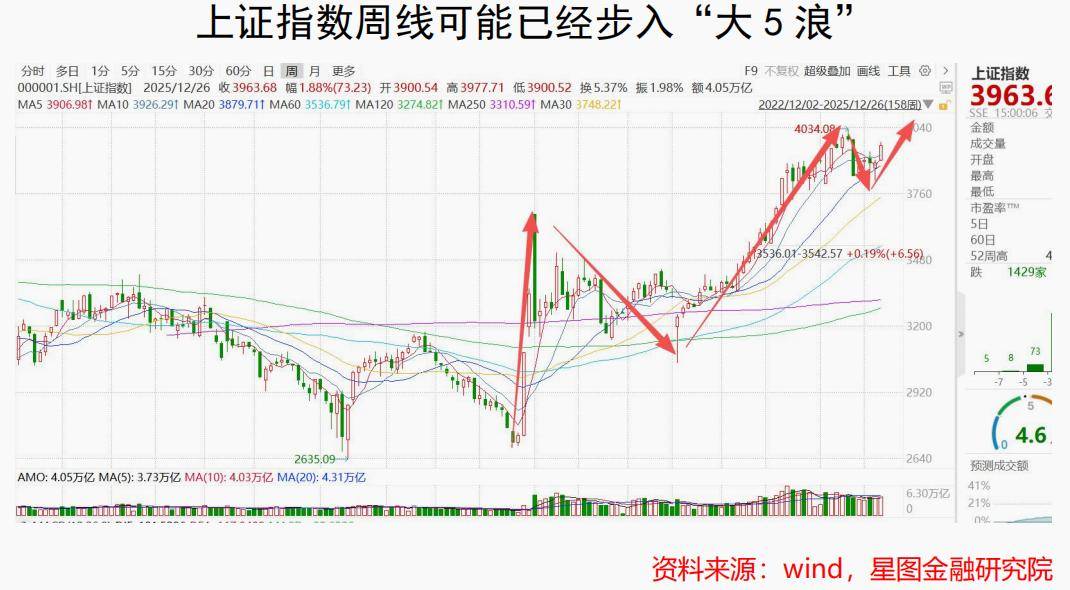
大5浪启动!这个板块能涨到明年,赶紧配置一些!
Sou Hu Cai Jing· 2025-12-26 16:46
今日A股继续强势。截至收盘,上证指数涨0.1%报3963.68点,深证成指涨0.54%报13603.89点,创业板指涨0.14%报3243.88点,北证50涨0.35%报1463.04 点,在没有北向资金的情况下,全市场成交额高达2.16万亿元,较上日成交额放量2165亿元。板块题材上,海南、锂矿、贵金属、商业航天板块活跃, 造纸、CPO调整。 就本周来看,A股简直势不可挡,三大指数均录得5连阳,上证指数、深证成指、创业板指分别累计上涨1.88%、3.53%和3.9%,而上证指数更是出现了 罕见的"8连阳",整体赚钱效应极佳。 A股之所以会大涨,从基本面上看,随着上周五日本央行利率决议的不确定性落地,短期利空出尽,致使资金风险偏好抬升,而美股科技方向的接连反 弹也让市场对于AI泡沫论的担忧情绪有所缓解,再考虑到当前临近年尾,市场对于"春季躁动"的预期日趋强烈,由此便引发部分资金率先进场布局,继 而引发了市场的做多热情。而随着场外资金的不断买入,我们认为"春季躁动"行情可能已经开始。 以可重复使用火箭技术为例,它是降低发射成本的关键,如蓝箭航天朱雀三号、天兵科技天龙三号等项目持续推进。技术成熟后有望将发射成本降 ...

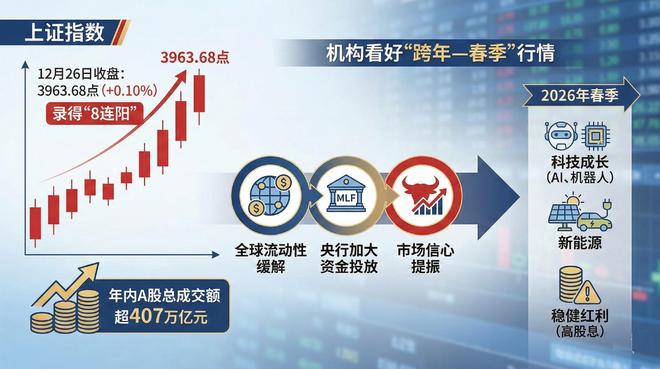
沪指录得“8连阳” 机构看好“跨年—春季”行情
Zhong Guo Jing Ying Bao· 2025-12-26 14:22
Core Viewpoint - The A-share market is experiencing a sustained upward trend, with the Shanghai Composite Index achieving an 8-day consecutive rise, attributed to multiple favorable factors both domestically and internationally [2][3]. Group 1: Market Performance - As of December 26, the Shanghai Composite Index closed at 3963.68 points, up 0.10%, marking the longest consecutive rise of the year since December 17 [2]. - The total trading volume of the A-share market exceeded 407 trillion yuan, setting a new annual record as of December 23 [3]. Group 2: Monetary Policy and Liquidity - The People's Bank of China (PBOC) announced a 400 billion yuan operation of one-year Medium-term Lending Facility (MLF) to maintain reasonable liquidity in the banking system, resulting in a net injection of 100 billion yuan for December [3]. - The PBOC's actions are aimed at stabilizing the funding environment, with a focus on maintaining a relatively stable and ample liquidity state [3]. Group 3: Seasonal Market Trends - The "cross-year-spring" market phenomenon is characterized by seasonal trends in the A-share market, often occurring from December to February, driven by improved liquidity, favorable policies, and increased risk appetite [4]. - Historical data indicates that significant market movements typically begin in December and are influenced by multiple factors rather than just calendar effects [4]. Group 4: Investment Opportunities - Analysts suggest that the current market environment is conducive to structural opportunities in the technology sector, particularly in AI applications and cyclical sectors like chemicals and non-ferrous metals [7]. - The central economic work conference emphasized innovation and the development of new growth drivers, which may further support investment in technology and related sectors [7]. Group 5: Future Market Outlook - The market is expected to see a rotation among sectors, with technology stocks likely to remain a key investment focus in 2026, alongside sectors such as new energy, consumption, and military [7]. - Investors are advised to pay close attention to industry cycles and market sentiment to optimize asset allocation in the evolving market landscape [7].
李迅雷:居民资金会否缺席明春行情?|立方大家谈
Sou Hu Cai Jing· 2025-12-26 06:02
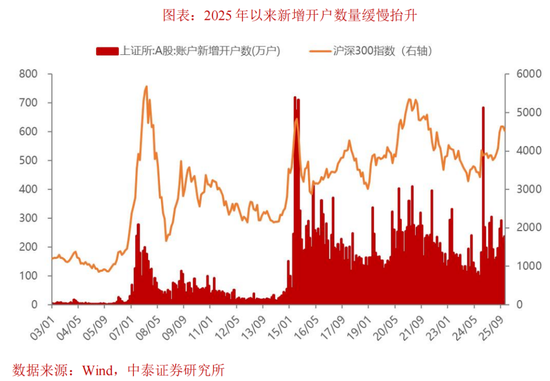
那么,居民资金入市缓慢的深层原因是什么?如何看待未来增量资金的空间?在岁末年初的日历效应下,居民资金是否会缺席"春季躁动"行情? 居民资金行为透视:"去杠杆化"特征 与2015年"杠杆疯牛"的狂热或2020年核心资产抱团时期的"借基入市"不同,2025年的居民入市行为呈现出显著的 "去杠杆化"的特征。当前居民资金的"慢", 并非市场缺乏流动性,而是居民资产配置偏好在当前宏观背景之下正在经历一些历史性变化。 第一,新增开户数量提升速度不及以前。2025年11月新增开户数为238万户,较7月低点有所回暖,但这一水平仅相当于2019年3月上一轮牛市初期的202万 户。这远低于2020年7月"基金热潮"时的405万户,更不及2015年牛市水平。 李迅雷 | 立方大家谈专栏作者 引言 通过对比2020年白酒消费、2021年新能源、2025年科技这三轮主线行情,可以发现一个显著特征:本轮科技结构性行情中,无论是机构资金还是散户资金的 入场节奏都表现得"相对克制",流入加速度明显趋缓。 同时,杠杆资金净买入强度仍明显弱于2019-2020那种"单边净加仓"状态,更像是"观望、分段加仓",右侧追涨扩张程度并不高。而与居民资金 ...
中泰证券:居民资金会否缺席明春行情?
Xin Lang Cai Jing· 2025-12-26 05:22
Core Viewpoint - The current investment behavior of residents in the stock market is characterized by a "de-leveraging" trend, reflecting a cautious approach to asset allocation amid macroeconomic changes, contrasting sharply with previous market exuberance periods [1][41]. Group 1: Resident Investment Behavior - The number of new account openings in November 2025 was 2.38 million, showing a recovery from the July low but still significantly lower than previous bull market levels, indicating a slow entry of retail investors [2][41]. - The current market activity is primarily driven by the activation of dormant accounts rather than new retail investors entering the market, with a focus on systematic investment rather than speculative trading [4][44]. - The financing net buying ratio has returned to positive territory, indicating a slight recovery in leveraged funds, but the intensity remains weaker compared to the strong net buying phases of 2019-2020 [5][47]. Group 2: Changes in Fund Flows - The structure of resident fund flows is changing, with a significant shift towards passive investment products like ETFs, which accounted for approximately 72% of new fund issuance in 2025, reflecting a preference for lower-cost investment options [7][49]. - The total issuance of new funds from January to November 2025 was about 530.8 billion yuan, with a monthly average of 48.3 billion yuan, indicating a lack of enthusiasm in the fund issuance market [7][47]. - The net subscription of stock ETFs remained strong, with a single-month net subscription reaching 177.2 billion yuan in April, highlighting the attractiveness of low-cost investment tools for residents [9][49]. Group 3: Economic Context and Implications - The slow entry of resident funds is primarily due to the negative feedback from the wealth effect caused by declining real estate prices, which has led to a cautious outlook on future income and increased preference for savings [10][52]. - As of November 2025, cumulative new resident savings deposits reached 12.06 trillion yuan, continuing a trend of high savings since 2022, with a significant portion in fixed-term deposits reflecting risk aversion [12][52]. - The decline in real estate values has resulted in a substantial reduction in household wealth, leading to a defensive accumulation of cash and deposits among residents [13][53]. Group 4: Future Capital Inflows - Insurance funds saw a significant increase in stock and securities investments, with a quarterly growth of 863.9 billion yuan in Q3 2025, indicating a strong entry of institutional capital into the market [22][61]. - The projected incremental capital from insurance funds for 2026 is estimated to be around 620 billion yuan, driven by regulatory changes and the need for higher returns in a low-interest-rate environment [24][63]. - The upcoming maturity of high-yield deposits from 2025 to 2026 is expected to create a significant shift in capital flows, potentially leading to increased investment in equity markets as residents seek better returns [25][68]. Group 5: Seasonal Market Trends - The spring season historically shows a significant increase in market activity, with a notable rise in retail investor participation and liquidity, driven by seasonal effects and credit expansion [30][69]. - The financing net buying ratio typically peaks in January, indicating a period of heightened activity and potential for thematic investments during the spring [32][71].

居民资金会否缺席明春行情?
李迅雷金融与投资· 2025-12-26 05:06
Core Viewpoint - The article discusses the current state of resident capital entering the market, highlighting a trend of "de-leveraging" and cautious investment behavior among residents, contrasting it with previous market cycles where there was more aggressive entry of funds [1][12][16]. Group 1: Resident Capital Behavior - The pace of new account openings has slowed, with November 2025 seeing 2.38 million new accounts, which is significantly lower than the 4.05 million during the 2020 fund craze and the 2.02 million in March 2019 at the start of the last bull market [2]. - The current market activity indicates that the majority of new capital is coming from the activation of dormant accounts rather than new investors entering the market in a panic [6]. - The financing net buying ratio has returned to positive territory, indicating a slight recovery in leveraged funds, but the intensity remains weaker compared to the aggressive net buying seen in 2019-2020 [7]. Group 2: Structural Changes in Investment Preferences - There is a notable shift towards passive investment products, with 72% of new funds issued in 2025 being passive index funds, reflecting a growing preference for lower-cost investment options among residents [11]. - The high management fees associated with actively managed funds have led to a "scar tissue effect" among residents, making them more cautious about investing in equities [12]. - The trend of residents moving towards fixed-term deposits indicates a risk-averse mindset, driven by the negative wealth effect from declining real estate prices [15][16]. Group 3: Insurance Capital and Market Dynamics - Insurance capital has seen a significant increase, with a quarterly growth of 863.99 billion yuan in Q3 2025, indicating a strong entry into the market [26]. - Regulatory changes have facilitated insurance capital's ability to invest in equities, with a projected annual increment of 620 billion yuan in 2026 [28]. - The pressure on the liability side of insurance companies is driving them to seek higher dividend-paying assets to cover the gap between their costs and returns [28]. Group 4: Market Outlook and Seasonal Trends - The upcoming spring season is expected to see a "spring rally," characterized by a structural loosening of funds and increased participation from retail investors, albeit at a more cautious pace compared to previous years [35]. - Historical data shows that the spring season typically favors small-cap and growth stocks, with an average rally of around 15% [38]. - The article suggests that the current market dynamics will likely lead to a more gradual and sustained rally, with specific sectors such as technology and consumer goods expected to perform well [42][43].

首席联合电话会-消费专场
2025-12-26 02:12
Summary of Conference Call Records Industry and Company Focus Home Appliances Industry - The tightening of national subsidy policies is focusing on core categories such as black and white appliances, which supports companies like Midea, Haier, TCL Electronics, and Hisense Visual. However, competition remains fierce for brands like Hisense Home Appliances and Gree Electric, with better investment opportunities expected after Q1 [1][4] Pet Industry - The pet industry continues to experience high single-digit growth, with pet food growth around 10%. Online channels, particularly Douyin and Pinduoduo, are seeing significant growth, while offline channels face pressure. The industry is expected to add approximately 4 million new pet owners in 2025, driving demand [5][6] - Head brands are growing significantly faster than the industry average, while smaller brands are struggling, often focusing on offline channels to maintain profitability. The trend is increasingly favoring market concentration towards head brands [6] Education Industry - China Oriental Education is benefiting from post-pandemic expansion and a national focus on employment, with double-digit growth in enrollment numbers. The company specializes in vocational education with a high employment rate, which provides a competitive advantage. New training programs are rapidly growing, and the company is expanding into emerging fields [8][10] Pharmaceutical Industry - The pharmaceutical industry is focusing on the small nucleic acid supply chain, with Novartis's Inqisiran entering medical insurance but facing capacity shortages. Companies that meet FDA audit standards and enter multinational supply chains, such as Lianhua Technology and Chen Da Pharmaceutical, are recommended for attention [11] Food and Beverage Industry - The food and beverage industry is seeing trends towards spring excitement, health directions, new products, and cyclical growth. Health products and oatmeal sectors are performing well, with companies like Dongpeng Beverage expected to grow over 20% next year [12][13] Light Industry - The light industry is adopting a dual strategy focusing on both domestic and international sales. The two-wheeler market is performing well, and solid-state batteries may drive growth in the electric vehicle sector. The industry is expected to have a positive outlook in the near future [14] Key Points and Arguments Home Appliances - The 2026 home appliance replacement policy will focus more on traditional large appliances, reducing the variety of small appliances eligible for subsidies. The overall subsidy amount may decrease, but support for core categories is expected to remain stable or even increase [2] Pet Industry - The pet industry is facing a bottleneck in product innovation, with most developments being minor improvements. There is a consensus on the need for functional and specialized products, requiring more investment in consumer education and brand building [5][6][7] Education Industry - The company expects to achieve a revenue of 1 billion yuan in 2026, with a projected compound profit growth rate of 15%-20% over the next three years. The current valuation is low, with a high dividend rate, making it a recommended investment target [9][10] Pharmaceutical Industry - The small nucleic acid supply chain is critical, with China being the largest production market. The industry faces challenges in meeting quality standards for FDA compliance, making it essential to focus on companies that can meet these standards [11] Food and Beverage Industry - Companies with strong operational momentum are expected to perform well, and the white liquor sector is seen as having good investment value [12][13] Light Industry - The light industry is expected to see sales growth due to inventory levels being low and potential technological effects in the upcoming quarters [14][15] Globalization and Export Markets - The export market is influenced by the appreciation of the RMB and pessimistic expectations regarding the US real estate market. However, long-term focus should be on new product development and self-owned brands [17][18] Pulp Industry - The pulp sector is expected to have significant elasticity in the first half of next year due to external factors affecting wood chip supply and no new capacity expansion, leading to potential price increases [19][20]
盘前必读丨国投白银LOF再出手:限购100元;深交所对向日葵下发关注函
Di Yi Cai Jing· 2025-12-25 23:16
Market Overview - The current market is undergoing a valuation repair and asset rotation driven trend [1][8] - A-shares are expected to experience a "spring rally" if three conditions are met: reasonable valuation levels, a loose liquidity environment, and effective catalysts to boost risk appetite [8] Regulatory Developments - The State Administration for Market Regulation is set to release the "Food Commissioned Production Supervision Management Measures" to address issues related to commissioned production practices, ensuring food safety responsibilities are clearly defined [3] - A new industry standard for e-commerce platforms regarding mandatory product certification verification has been implemented, aimed at enhancing consumer rights and promoting high-quality platform economy development [3] Industry Specific Updates - Four leading silicon wafer companies have significantly raised their prices, with an average increase of 12%, attributed to substantial rises in upstream silicon material costs [4] - The National Tobacco Monopoly Administration is seeking opinions on a draft notice to strengthen electronic cigarette production capacity regulation, emphasizing a market demand-oriented approach [5] Company Announcements - Dongguan Securities has indicated that the market is currently in a phase of valuation repair and asset rotation [8] - The Shenzhen Stock Exchange has issued a letter of concern to Sunflower regarding its acquisition plans, requesting clarification on potential impacts on competition and independence due to legal issues faced by the target company [6]


七连阳!沪指剑指4000点,春季躁动提前点燃?
Guo Ji Jin Rong Bao· 2025-12-25 15:11
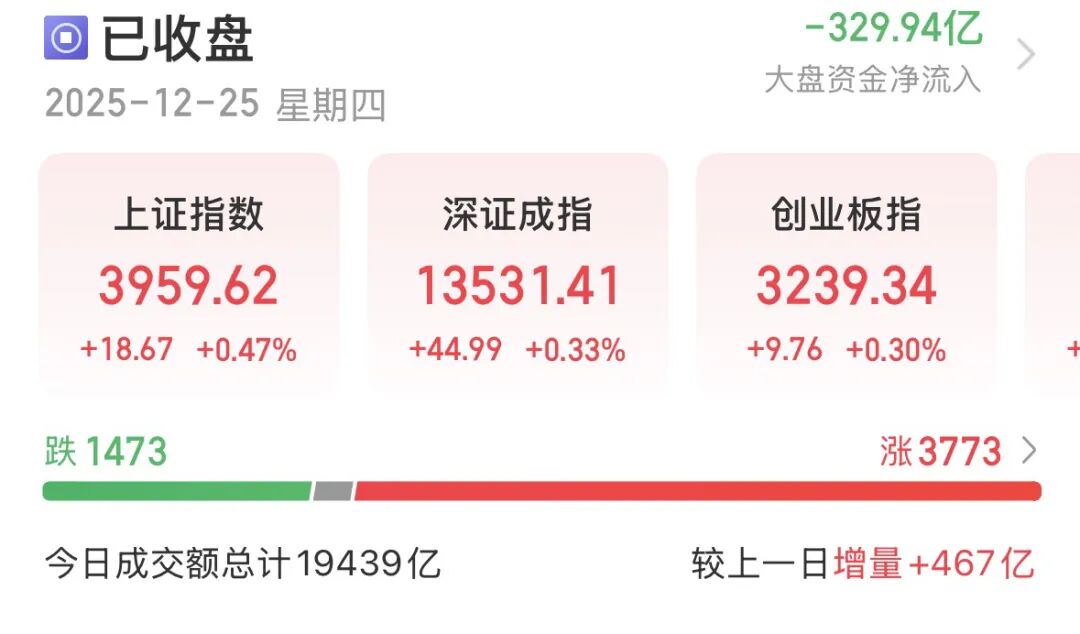
隔夜美股喜气洋洋,12月25日,A股也量价温和齐升,沪指七连阳,日成交额增至1.94万亿元,3773只个股收涨,航天板块表现亮眼。 受访人士指出,当前市场分歧仍大、主线未明,但万亿成交显示情绪偏乐观,"春季躁动"行情或提前启动。操作上建议均衡配置,兼顾政策+景气双轮驱 动的赛道与防御板块。 国防军工掀涨停潮 今日,沪指收涨0.47%报3959.62点;创业板指先抑后扬,收涨0.3%报3239.34点;深证成指收涨0.33%。沪深300、上证50、北证50微红,科创50微跌。 成交放量。全天成交额1.94万亿元,较上一交易日增加近467亿元;杠杆资金同步升温,截至12月24日,沪深京三市两融余额升至2.54万亿元。 | 名称 | @ | 涨幅% ↓ | 涨停家数 | 跌停家数 | 成交额 | 年初至今涨幅% | 5日涨幅% | | --- | --- | --- | --- | --- | --- | --- | --- | | 国防军工(申万) | | 2.91 | 10 | 1 | 1451亿 | 29.05 | 6.45 | | 轻工制造(申万) | | 1.59 | 10 | 0 | 353亿 | 21 ...
华源晨会精粹20251225-20251225
Hua Yuan Zheng Quan· 2025-12-25 14:38
Group 1: Food and Beverage Industry - The report indicates a gradual recovery in the food and beverage sector, with soft drinks and snacks leading the recovery, followed by the catering supply chain, condiments, dairy products, beer, and finally, liquor [2][9][10] - The analysis draws parallels with Japan's 1990s consumption differentiation, highlighting that successful industries often address demand pain points and have low penetration rates [10][11] - Investment strategies focus on sectors with stabilizing ROA and potential valuation recovery, emphasizing price as the primary selection logic, while volume is secondary [11][12] Group 2: Construction and Building Materials - The construction sector is expected to experience a "spring rally" in 2026, supported by historical investment patterns and major national projects [13][14] - The report highlights three core investment themes: major national projects, high-dividend low-valuation state-owned enterprises, and private construction firms leveraging cash flow for new growth areas [14][15] - Infrastructure investment data shows a decline in both narrow and broad infrastructure investment, indicating a need for policy support to stabilize the sector [15][16] Group 3: Real Estate Industry - The real estate sector continues to face pressure, with significant declines in new housing sales and investment, despite government efforts to promote high-quality development [18][20] - The report notes that the Ministry of Housing and Urban-Rural Development emphasizes maintaining a balance in supply and demand, which is crucial for economic stability [20][22] - Specific data indicates a 31.4% year-on-year decline in real estate development investment and a 26.1% drop in sales revenue, highlighting ongoing challenges in the market [20][21] Group 4: Electronics and Robotics - The report on Changying Precision emphasizes the introduction of employee stock ownership and stock option plans to enhance long-term development confidence and attract core talent [23][24] - The company is positioned as a leader in solder paste printing equipment, with a focus on high-end product demand driven by AI trends [33][34] - New product lines, including dispensing and packaging equipment, are expected to contribute to growth, with significant revenue increases anticipated [34][36] Group 5: Media Industry - The report on Giant Legend highlights the rapid growth of its IPs, particularly the "Zhou Classmate" and "Liu Genghong," which have gained substantial popularity on social media platforms [28][29] - The company is expanding its strategic investments to enhance collaboration with international stars and develop consumer products linked to its IPs [29][30] - Future growth is expected through a diversified approach that integrates emotional value into various products and experiences, positioning the company as a "disseminator of happiness" [30][31] Group 6: Mechanical and Building Materials - The report on Kaige Precision Machine outlines the company's leadership in solder paste printing equipment and its expansion into new product categories driven by AI [33][34] - The company is expected to see significant growth in its new product lines, including flexible automation equipment, which are crucial for enhancing manufacturing efficiency [34][36] - Profit forecasts indicate strong growth potential, with expected net profits increasing significantly over the next few years [36]