
适度宽松货币政策

Search documents
LPR连续5个月按兵不动,分析师预计:年内仍有下调可能
Sou Hu Cai Jing· 2025-10-20 19:26
Core Viewpoint - The increasing external volatility and the impact of the US high tariff policy on global trade and China's exports may become more pronounced in the fourth quarter, necessitating stronger measures to stabilize growth and employment [1] Group 1: Economic Indicators - Investment and consumption growth rates have shown a downward trend, highlighting the need for increased efforts to stabilize growth and employment in the fourth quarter [1] - There is potential for policy interest rates and LPR (Loan Prime Rate) quotes to be lowered within the year [1] Group 2: Monetary Policy Outlook - The Federal Reserve resumed interest rate cuts in September and may continue to do so, reducing the constraints on domestic implementation of a moderately loose monetary policy [1] - Wang Qing, Chief Macro Analyst at Dongfang Jincheng, anticipates that the central bank may implement a new round of interest rate cuts and reserve requirement ratio reductions before the end of the year, which could lead to adjustments in LPR for both short and long-term maturities [1]
中国LPR连续5个月按兵不动 专家称有下调空间
Zhong Guo Xin Wen Wang· 2025-10-20 08:24
Core Points - The Loan Prime Rate (LPR) in China has remained unchanged for five consecutive months, with the one-year LPR at 3.0% and the five-year LPR at 3.5% [1] - The stability in LPR aligns with market expectations, as the central bank's policy rates have also remained stable [1] - There is a lack of motivation for banks to lower LPR quotes due to historical low net interest margins [1] Future Outlook - External volatility is increasing, with U.S. high tariff policies potentially impacting global trade and China's exports in the fourth quarter [2] - There is a rising necessity for policies to stabilize growth and employment, particularly in boosting domestic demand and stabilizing the real estate market [2] - The possibility of LPR adjustments exists, as the Federal Reserve has resumed interest rate cuts, which may weaken constraints on China's monetary policy [2] - A potential reduction in LPR could lead to lower loan rates for businesses and residents, stimulating internal financing demand and supporting consumption and investment in the fourth quarter [2]
LPR连续5个月“按兵不动”,降息窗口仍需等待
Di Yi Cai Jing· 2025-10-20 05:38
Core Viewpoint - The Loan Prime Rate (LPR) remains unchanged for October, reflecting stable policy rates and ongoing pressure on bank interest margins, indicating limited room for LPR reduction in the near term [1][2][3]. Group 1: LPR Stability - The LPR for both 1-year and 5-year terms remains at 3.0% and 3.5% respectively, unchanged for five consecutive months, aligning with market expectations [1][2]. - The stability of the central bank's 7-day reverse repurchase rate at 1.40% since May limits the basis for LPR reduction, as it has not changed [2]. - Bank interest margin pressures are increasing due to ongoing efforts to reduce costs for the real economy, with the net interest margin of commercial banks dropping to 1.42% by Q2 2025, down 10 basis points from the previous year [2]. Group 2: Economic Context - The need for stable growth has increased due to external pressures, such as high tariffs from the U.S. affecting global trade and domestic investment and consumption slowing down [4]. - The People's Bank of China (PBOC) has indicated a commitment to maintaining a moderately loose monetary policy to support consumption and effective investment [4]. Group 3: Future Monetary Policy Directions - Experts suggest that there is potential for targeted LPR reductions before the end of the year to stimulate domestic demand and stabilize the real estate market [5][6]. - The PBOC may utilize various monetary policy tools, including reverse repos and MLF operations, to enhance liquidity and support key sectors [6]. - External factors, such as the potential for continued interest rate cuts by the Federal Reserve, may provide a conducive environment for domestic monetary easing [6][7].
宏观数据观察:东海观察三季度GDP增速放缓,经济整体稳健增长
Dong Hai Qi Huo· 2025-10-20 05:31
Group 1: Report Industry Investment Rating - Not provided Group 2: Core Viewpoints of the Report - The GDP growth in the third quarter met market expectations, with the economy growing steadily. The GDP in the first three quarters of 2025 was 10,150.36 billion yuan, a year-on-year increase of 5.2% at constant prices. The GDP in the third quarter increased by 4.8% year-on-year, in line with market expectations, and 1.1% quarter-on-quarter, also meeting expectations. Although the economic growth rate slowed down in the third quarter, it was higher than market expectations [1][2]. - In September, the domestic demand economic data declined overall and were lower than market expectations. The investment continued to slow down significantly and was lower than market expectations, the consumption growth rate continued to decline but met market expectations, and industrial production accelerated significantly in the short term [2]. - Currently, on the demand side, the investment side continues to slow down in the short term. The real - estate market is recovering slowly due to limited policy stimulus, and investment in real estate, infrastructure, and manufacturing continues to slow down. The overall demand for domestic commodities has slowed down and fallen short of market expectations. On the supply side, due to strong foreign demand and good exports, industrial production has accelerated. The domestic commodity supply - demand situation shows weak demand and relatively abundant supply in the short term, and the support for the prices of domestic - demand - oriented bulk commodities has weakened significantly [2][9]. - The data released this time basically met market expectations, having little short - term impact on the domestic - demand - oriented bulk commodity market. In the medium and long term, more proactive fiscal policies and moderately loose monetary policies are expected, and incremental stimulus policies may be introduced in the fourth quarter, which is beneficial to the recovery of the domestic market. Overseas, the U.S. trade policy is generally easing, but short - term tariff risks have increased, leading to significant differentiation in the prices of external - demand - oriented commodities such as non - ferrous metals and energy, and the support for precious metals has increased due to rising risk - aversion demand [2][4][9] Group 3: Summary According to Relevant Contents GDP and Overall Economic Situation - The GDP in the first three quarters of 2025 was 10,150.36 billion yuan, a year - on - year increase of 5.2% at constant prices. The GDP in the third quarter increased by 4.8% year - on - year and 1.1% quarter - on - quarter, both in line with market expectations. The economic growth rate in the third quarter slowed down but was higher than market expectations [1][2] Domestic Demand Economic Data in September - Consumption: The year - on - year growth rate of social consumer goods retail总额 in September was 3.0%, in line with market expectations but a 0.7 - percentage - point decrease from the previous value [1][2][5] - Industrial Added Value: The year - on - year growth rate of the added value of large - scale industrial enterprises in September was 6.5%, much higher than the expected 5.0% and a 1.3 - percentage - point increase from the previous value. The growth was mainly due to strong short - term external demand and an increase in the operating rate of industrial enterprises [1][4] - Fixed - Asset Investment: From January to September, fixed - asset investment was - 0.5%, far lower than the expected 0.1% and a 1 - percentage - point decrease from the previous value. Among them, infrastructure investment, manufacturing investment, and real - estate investment all showed different degrees of slowdown [1][2][5] Real - Estate Market - Investment: In September, real - estate development investment decreased by 21.3% year - on - year, with the decline widening by 1.3 percentage points from the previous month. The real - estate investment side remains weak due to strict control of incremental policies [1][6] - Sales: The year - on - year growth rate of the floor area of commercial housing sales in September was - 11.9%, with the decline widening by 0.9 percentage points from the previous value; the year - on - year growth rate of commercial housing sales was - 12.4%, with the decline narrowing by 2.4 percentage points from the previous value. Although the real - estate market is slowly recovering, the recovery is slow due to limited policy stimulus [1][6] Infrastructure Investment - In September, infrastructure investment decreased by 4.6% year - on - year, with the decline narrowing by 1.3 percentage points from the previous value. Due to the constraints of local debt resolution on project reserves and funds for traditional infrastructure, infrastructure investment continued to slow down [1][8] Manufacturing Investment - In September, manufacturing investment decreased by 1.9% year - on - year, with the decline widening by 0.6 percentage points from the previous value. Due to high base effects, tariff uncertainties, and a marginal decline in policy support, manufacturing investment continued to slow down [1][8] Impact on Commodities - Demand Side: Short - term investment continues to slow down, and the overall demand for domestic commodities has slowed down and fallen short of market expectations [2][9] - Supply Side: Due to strong foreign demand and good exports, industrial production has accelerated, and the supply of domestic commodities remains relatively abundant [2][9] - Price Impact: The support for the prices of domestic - demand - oriented bulk commodities has weakened significantly. The prices of external - demand - oriented commodities such as non - ferrous metals and energy have shown significant differentiation, and the support for precious metals has increased due to rising risk - aversion demand [2][4][9]
三部门调整海南离岛旅客免税购物政策;特朗普与泽连斯基再度会面|南财早新闻
2 1 Shi Ji Jing Ji Bao Dao· 2025-10-17 23:19
Group 1 - The Hainan duty-free shopping policy has been adjusted, increasing the number of duty-free product categories from 45 to 47, allowing domestic products like clothing and ceramics to be sold duty-free starting November 1 [1] - The State Council has emphasized the need to enhance green trade and improve logistics efficiency, with a focus on reducing costs and increasing investment in logistics infrastructure [1] - China's fiscal revenue has shown a gradual recovery, with a total public budget revenue of 16.39 trillion yuan in the first three quarters, reflecting a year-on-year growth of 0.5% [1] Group 2 - The 138th Canton Fair is currently ongoing, attracting over 32,000 exhibitors, with a record number of high-quality enterprises participating [2] - A new tax policy will be implemented from November 1, 2025, providing a 50% VAT refund for electricity products generated from offshore wind power [2] - The China Express Development Index increased by 3.9% year-on-year in September, with an expected 12% growth in express delivery volume [2] Group 3 - The China Securities Regulatory Commission has released new corporate governance guidelines, which will take effect on January 1, 2026, focusing on limiting significant adverse impacts from competition among listed companies [3] - In September, the number of new margin trading accounts reached 205,400, marking a 12.24% month-on-month increase and a 288% year-on-year increase [3] - The company Cambrian Technology reported a 1332.52% year-on-year increase in revenue for Q3, reaching 1.727 billion yuan [4] Group 4 - Zijin Mining reported Q3 revenue of 86.489 billion yuan, a year-on-year increase of 8.14%, with a net profit of 17.056 billion yuan, up 52.25% [4] - Alibaba and Ant Group announced a joint investment of $925 million to acquire a commercial office building in Hong Kong [5] - The U.S. stock market saw all three major indices rise, with the Dow Jones increasing by 0.52% [5]

专家解读:金融支持实体经济政策落实到位 适度宽松特点明显
Xin Hua Wang· 2025-10-17 06:54
Core Insights - The People's Bank of China released financial statistics for the first three quarters, indicating a stable growth in key financial metrics [1] Group 1: Loan and Money Supply - As of the end of September, the balance of RMB loans reached 270.39 trillion yuan, reflecting a year-on-year growth of 6.6% [1] - The broad money supply (M2) increased by 8.4% year-on-year, which is 1.5 percentage points higher than the same period last year [1] Group 2: Social Financing - The total social financing stock grew by 8.7% year-on-year, surpassing the growth rate of the previous year by 0.7 percentage points [1]

第四季度国债发行安排公布,30年国债ETF(511090)盘中成交超59亿
Sou Hu Cai Jing· 2025-10-09 06:35
Group 1 - The 30-year Treasury ETF (511090) has increased by 0.26%, with the latest price at 117.7 yuan, indicating active market trading with a turnover of 19.63% and a transaction volume of 5.991 billion yuan [1] - As of September 30, the average daily trading volume for the 30-year Treasury ETF over the past month was 9.609 billion yuan, reflecting strong liquidity [1] - The latest scale of the 30-year Treasury ETF reached 30.484 billion yuan, with a net inflow of 139 million yuan recently, and a total of 297 million yuan net inflow over the last four trading days [1] Group 2 - The Ministry of Finance announced plans for the issuance of government bonds in the fourth quarter of 2025, including key term bonds and two super long-term special bonds with maturities of 50 years and 20 years, scheduled for auction on October 10 and October 14 [1] - Analysts expect that the domestic central bank will continue to implement a moderately loose monetary policy, which will support the bond market amid ongoing economic structural adjustments [2] - The 30-year Treasury ETF closely tracks the China Bond 30-Year Treasury Index, which consists of publicly issued 30-year treasury bonds, serving as a benchmark for investment performance in this category [2]
注意!10月LPR或将下调20-30BP?!房贷利率可能跌破3%…
Sou Hu Cai Jing· 2025-10-03 12:51
Core Viewpoint - The recent U.S. government shutdown is expected to increase uncertainty in the U.S. economy and financial markets, potentially reinforcing expectations for a Federal Reserve interest rate cut in October [1][3]. Group 1: Monetary Policy Implications - Analysts suggest that if the government shutdown persists for several days, the Federal Reserve may lean towards adopting a more accommodative monetary policy [3]. - The expectation of a 20-30 basis point (BP) reduction in the Loan Prime Rate (LPR) by October is seen as a necessary response to both internal and external economic conditions [5]. - The central bank has signaled a preference for "moderately accommodative monetary policy" to stimulate economic activity, particularly in light of declining consumption and fixed asset investment growth [5]. Group 2: Impact on Housing Market - The strong correlation between LPR and mortgage rates means that a reduction in LPR will directly impact mortgage costs, benefiting both new and existing borrowers [6]. - For a new mortgage of 1.4 million yuan over 30 years, a 30 BP reduction in LPR from 3.6% to 3.3% would lower monthly payments from approximately 6,353 yuan to 6,048 yuan, saving about 110,000 yuan in interest over 30 years [6]. - Existing mortgage holders will also benefit, with potential reductions in monthly payments leading to increased disposable income, which could boost downstream consumption in sectors like home appliances and renovations [7]. Group 3: Future Market Dynamics - The possibility of mortgage rates falling below 3% is feasible under certain conditions, which could lead to structural changes in the real estate market [8]. - An influx of first-time buyers could alleviate inventory pressures for developers, with a projected 15-20% increase in cash flow for leading real estate companies [8]. - Long-term, the release of pent-up demand for improved housing could drive product quality improvements among developers, aligning with the "housing is for living, not for speculation" policy [8]. Group 4: Economic Outlook and Policy Coordination - A successful LPR cut in October could serve as a key driver for economic stability in the fourth quarter, with expectations for manufacturing investment growth to exceed 6% [10]. - The dual effect of reduced housing costs and increased consumer spending could lead to a rebound in retail sales growth to around 5% [10]. - Effective coordination between fiscal and monetary policies will be crucial for maximizing the impact of the interest rate cut, with a focus on infrastructure investment and strict regulation of real estate speculation [11].
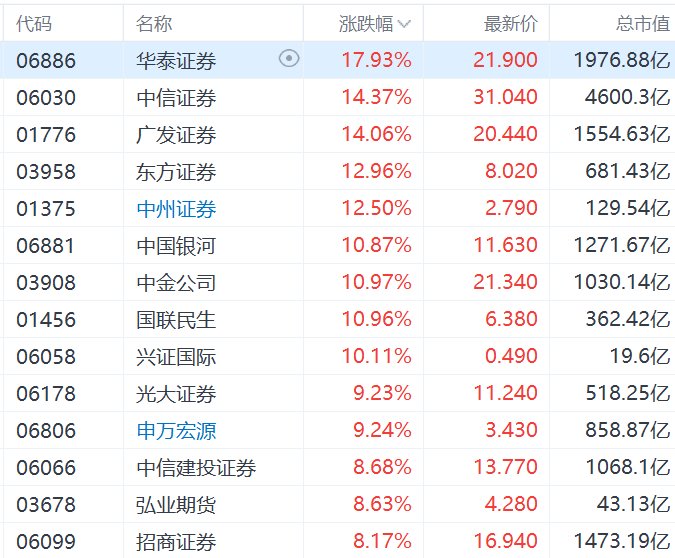
中资券商股全线飙升
Ge Long Hui· 2025-09-29 06:10
Group 1 - The core viewpoint of the news is that Chinese brokerage stocks in the Hong Kong market have surged significantly, driven by the central bank's announcement of a more accommodative monetary policy [1] - Huatai Securities saw a nearly 18% increase, while Citic Securities and GF Securities rose over 14% [1][2] - Other notable gains include Dongfang Securities and Zhongzhou Securities, both up over 12%, and China Galaxy, CICC, Guolian Minsheng, and Xingsheng International, all rising over 10% [1][2] Group 2 - The central bank's meeting emphasized the need to implement a moderately accommodative monetary policy, encouraging financial institutions to increase credit supply [1] - The policy aims to effectively utilize securities, fund, and insurance company swap facilities, as well as stock repurchase and refinancing [1]
中国央行货币政策委员会:落实落细适度宽松货币政策
Zhong Guo Xin Wen Wang· 2025-09-26 13:29
Core Viewpoint - The People's Bank of China (PBOC) emphasizes the implementation of a moderately accommodative monetary policy to stabilize economic growth and maintain reasonable price levels [1][2] Group 1: Monetary Policy Implementation - The PBOC's monetary policy committee meeting highlighted the need for effective execution of monetary policy measures to enhance their impact [1] - The meeting called for strengthening counter-cyclical adjustments and improving the dual function of monetary policy tools in terms of both quantity and structure [1] - There is a focus on increasing the foresight, targeting, and effectiveness of monetary policy based on domestic and international economic conditions [1] Group 2: Financial Market Stability - The PBOC aims to enhance the resilience of the foreign exchange market and stabilize market expectations to prevent excessive fluctuations in the exchange rate [1] - The meeting emphasized the importance of observing and assessing the bond market from a macro-prudential perspective, particularly regarding changes in long-term yields [1] - The PBOC plans to utilize structural monetary policy tools to support key areas such as technological innovation, consumption, small and micro enterprises, and foreign trade [1] Group 3: Real Estate Market Support - The PBOC intends to promote the effective implementation of financial policies to revitalize existing real estate and land, thereby stabilizing the real estate market [2] - There is a commitment to improving the foundational financial systems for real estate and assisting in the development of a new model for real estate growth [2] - The PBOC aims to enhance the capacity for economic and financial management under open conditions, focusing on risk prevention [2]