
信用债投资

Search documents
机构:信用债投资策略上以中短久期为主,信用债ETF基金(511200)冲击3连涨
Sou Hu Cai Jing· 2025-10-23 03:35
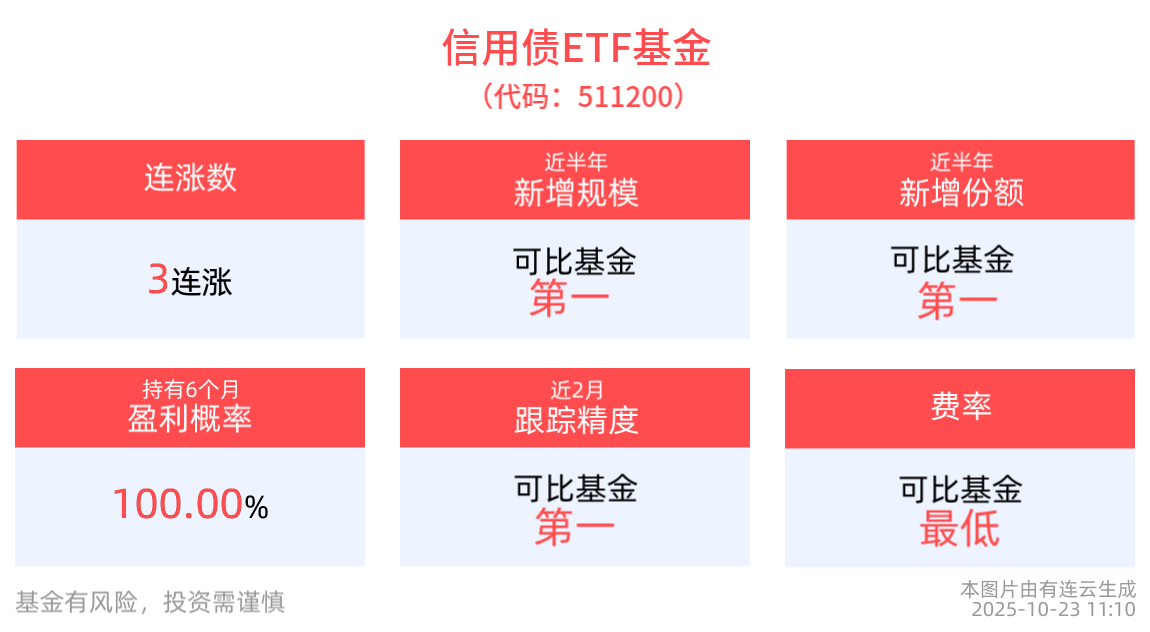
Core Viewpoint - The credit bond ETF (511200) has shown significant growth in both liquidity and scale, indicating strong market performance and investor interest [1][4]. Group 1: Performance Metrics - As of October 23, 2025, the credit bond ETF has increased by 0.05%, marking a three-day consecutive rise, with the latest price at 100.59 yuan [1]. - The fund's average daily trading volume over the past week is 9.549 billion yuan, ranking first among comparable funds [1]. - In the last six months, the fund's shares have increased by 16 million, and its scale has grown by 16.202 billion yuan, demonstrating substantial growth [1]. Group 2: Profitability - Since its inception, the credit bond ETF has experienced a maximum consecutive monthly increase of five months, with a maximum increase of 1.62% [1]. - The fund has a weekly profit percentage of 66.67%, and the historical probability of profit over a six-month holding period is 100% [1]. - Over the past three months, the fund has outperformed its benchmark with an annualized return of 0.06%, ranking first among comparable funds [1]. Group 3: Fee Structure and Tracking Accuracy - The management fee for the credit bond ETF is 0.15%, and the custody fee is 0.05%, which are the lowest among comparable funds [4]. - As of October 22, 2025, the fund's tracking error over the past two months is 0.005%, indicating the highest tracking accuracy among comparable funds [4]. Group 4: Investment Strategy and Composition - The credit bond ETF primarily selects underlying bonds that are AAA-rated and have large issuance scales, with the majority being from high-quality central and state-owned enterprises [4]. - Currently, the fund consists of 338 underlying bonds with maturities ranging from 0 to 30 years, covering various durations and reflecting a characteristic of medium to short-duration credit bonds [4]. - Analysts recommend maintaining moderate participation in credit bond investments, focusing on medium to short durations while also including highly liquid long-duration bonds to avoid excessive chasing of price increases [4].

信用周观察系列:攻守兼备
HUAXI Securities· 2025-10-21 05:05
1. Report Industry Investment Rating No relevant content provided. 2. Core Viewpoints of the Report - Amid the repeated Sino - US tariff issues from October 13 - 17, the market risk appetite declined, and the bond market sentiment continued to improve. Credit bond yields generally decreased, and credit spreads mostly narrowed. Institutions remained cautiously bullish on credit bonds, preferring high - coupon and relatively safe varieties. However, due to factors such as seasonal patterns and the pending public fund fee regulations, this round of credit bond recovery may not be as smooth as the previous one. Therefore, it is recommended to focus on medium - and short - duration coupon - bearing credit bonds for both offense and defense [1][2]. - For general credit bonds, 1 - 3 - year AA and AA(2) urban investment bonds are recommended, which balance liquidity and coupon. For bank capital bonds, it is advisable to choose medium - and short - duration hedging varieties and avoid rushing to increase duration [3]. 3. Summary According to the Directory 3.1 Urban Investment Bonds: Structural Recovery, Market Favors 1 - 3 - Year AA(2) Varieties - **Primary Market**: In October, the net financing of urban investment bonds remained low, but the issuance sentiment improved. The issuance rate reversed its upward trend and declined, with the proportion of issuance within 3 years increasing. From October 1 - 19, the issuance was 171.8 billion yuan, with a net inflow of 9.4 billion yuan. The weighted average issuance rates for bonds within 1 year, 1 - 3 years, and 3 - 5 years decreased by 8.2bp, 3.5bp, and 2.8bp respectively compared to September [30]. - **Secondary Market**: Intermediate - term bonds performed well, and the sentiment of long - term bonds also improved. Yields of 3 - 5Y bonds of various grades mostly decreased by 2 - 6bp, and credit spreads mostly compressed by 4 - 7bp. The yields of 10Y AA and above bonds decreased by 2 - 4bp. The 1 - 3 - year bonds had significantly increased trading volume, and the AA(2) varieties were favored by the market, with over 700 single - week transactions and an average low - valuation trading margin of 1.8bp [31][35]. 3.2 Industrial Bonds: Net Financing Increased Year - on - Year, Issuance Sentiment Recovered - **Primary Market**: From October 1 - 19, the issuance of industrial bonds was 301.8 billion yuan, with a net financing of 140.8 billion yuan, both increasing year - on - year. The proportion of long - duration bond issuance increased, and the issuance sentiment improved. The proportion of full - field multiples above 3 times rose from 14% to 20%, and the proportion of 2 - 3 times increased from 29% to 32% [38]. - **Secondary Market**: The buying sentiment weakened, with the TKN proportion decreasing from 77% to 72% and the low - valuation proportion dropping from 75% to 62%. The trading duration increased, with the trading proportions of 1 - 2 - year and 3 - 5 - year bonds increasing by 2pct and 4pct respectively, while the 1 - year trading proportion decreased by 9pct [40]. 3.3 Bank Capital Bonds: Yields Declined Across the Board, Trading Sentiment Weakened - **Primary Market**: In October 2025, Suzhou Bank issued 4.5 billion yuan of 5 + 5 - year secondary capital bonds (issuance rate not yet announced), and Weifang Bank issued 1.5 billion yuan of 5 + N - year perpetual bonds with an issuance rate of 2.90% [43]. - **Secondary Market**: Yields of bank capital bonds decreased by 0 - 7bp, and spreads narrowed across the board. The 2Y AA+ and below secondary capital bonds, 2Y and 4Y perpetual bonds performed well, with yields decreasing by 4 - 7bp and spreads narrowing by 7 - 8bp. However, the trading sentiment weakened. The TKN proportions of secondary capital bonds and perpetual bonds decreased to 61% and 56% respectively, and the low - valuation proportions dropped to 65% and below [43][46].
信用债市场周观察:2~3Y中等资质主体攻守兼备
Orient Securities· 2025-10-20 05:12
Group 1 - The core view of the report emphasizes that the 2-3 year medium-rated entities remain suitable for investment, balancing both defensive and offensive strategies. Current high-grade, short-duration spreads have compressed to very low levels, with some high liquidity central enterprises' valuations nearly indistinguishable from similar-term government bonds, indicating limited room for further compression [6][9]. - The report notes that the absolute yield attractiveness of high-grade, medium-term spreads has diminished, with most spreads now below 2.2%. There are still some medium to low-rated entities yielding between 2.15% and 2.3% that can be explored, as evidenced by recent performance [6][9]. - The report highlights that the credit bond market's attention is currently low, with a strong preference for controlling duration and maintaining liquidity, leading to weak buying power. The focus remains on 2-3 year medium-rated entities [6][9]. Group 2 - The weekly review indicates a rebound in issuance volume post-holiday, with net financing increasing to 184.7 billion yuan, marking a return to levels close to 200 billion yuan after a two-month period [11][13]. - The report states that credit spreads across various grades and maturities have continued to narrow, with the average spread compression around 1-3 basis points, while low-rated and long-term bonds remained stable [11][17]. - The report also mentions that the average credit spread for city investment bonds has narrowed by approximately 4 basis points, with minimal differentiation among provinces, while industry credit spreads have also contracted by 3 basis points [22][23].
人生如投资,公司债ETF(511030)今年以来全市场排名靠前
Sou Hu Cai Jing· 2025-10-13 01:41
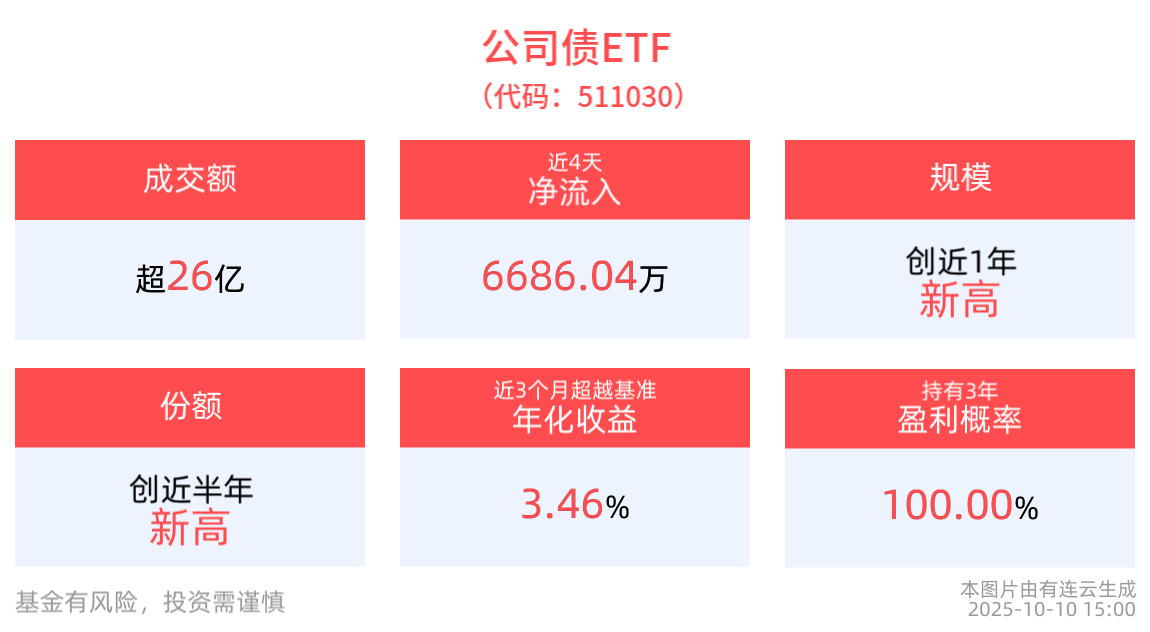
Core Insights - The total scale of credit bond ETFs is 485.4 billion yuan, with a daily decrease of 410 million yuan, while the benchmark market-making ETF increased by 60 million yuan and the sci-tech bond ETF decreased by 470 million yuan [1] - The weighted median duration is 3.2 years, indicating the sensitivity of the ETFs to interest rate changes [1] Liquidity - The overall trading volume reached 193.9 billion yuan, with an average single transaction amount of 6.05 million yuan (benchmark market-making at 5.04 million yuan, sci-tech bonds at 6.72 million yuan) [1] - The median turnover rate is 39.8%, reflecting active trading in the market [1] Valuation - The median yield is 1.95%, with a median discount rate of -19.1 basis points (benchmark market-making at -40.9 basis points, sci-tech bonds at -17.9 basis points) [1] - The company bond ETF is positioned as a short-term bond ETF+, with a current duration of 1.96 years and a static yield of 2.00%, ranking 84th out of 557 in the market year-to-date return of 0.87% [1] Company Bond ETF Performance - As of October 10, 2025, the company bond ETF (511030) is trading at 106.12 yuan, with a 1-year cumulative increase of 1.93% [3] - The latest scale of the company bond ETF reached 22.911 billion yuan, marking a new high in nearly a year [3] - The latest share count is 216 million shares, also a new high in the past six months [3] Fund Flows - The company bond ETF recorded a net inflow of 3.1836 million yuan, with a total of 66.8604 million yuan in the last four trading days [3] Historical Performance - Over the past five years, the net value of the company bond ETF has increased by 13.22% [3] - The highest monthly return since inception is 1.22%, with the longest consecutive monthly increase lasting 9 months and a maximum increase of 3.80% [3] - The annual profit percentage is 83.33%, with a monthly profit probability of 78.73% and a 100% probability of profit over a 3-year holding period [3] Drawdown and Fees - The maximum drawdown in the last six months is 0.28%, with a relative benchmark drawdown of 0.06% [4] - The management fee rate for the company bond ETF is 0.15%, and the custody fee rate is 0.05% [4] Tracking Accuracy - The tracking error for the company bond ETF year-to-date is 0.013% [5] - The ETF closely tracks the China Bond - Medium to High Grade Corporate Bond Spread Factor Index, which serves as a performance benchmark for investments in medium to high-grade corporate bonds [5]
信用债市场周观察:短端中高等级信用债依然是首选
Orient Securities· 2025-09-15 09:41
Report Summary 1. Report Industry Investment Rating No industry investment rating is provided in the report. 2. Core Viewpoint of the Report - Short - term, medium - to high - grade credit bonds remain the top choice, and the idea of excavating based on the issuer's yield curve should be continued. In the current environment, the market pursues certainty and low volatility, so short - term, medium - to high - grade credit bonds are preferred for the pure - bond part. It is recommended to look for riding opportunities in the steep part of the curve or "convex points" of individual bonds when gradually moving towards the medium - and long - term [5][8]. - There are issuers with relatively large term spreads among those with an implied rating of AA+ or above. After the trading concentration in the 1 - 2Y segment further increases, the 2 - 3Y term spread may be repaired, which is suitable for institutions with strong liability - side stability to layout in advance. For issuers with an implied AA rating, there is also room for excavation, and investors can sink according to their needs [5][10][12]. 3. Summary by Directory 3.1 Credit Bond Weekly Viewpoint - The short - term, medium - to high - grade credit bonds are still the best option. Last week, the bond market sentiment was fragile, affected by the stock market sentiment and negative news such as fund fee adjustment and tax exemption cancellation. The short - term of credit bonds also adjusted last week, but the adjustment was limited due to the short duration, and the 2 - 3Y medium - term adjusted more, causing the 3Y - 1Y term spread to widen [5][8]. - For specific excavation, among issuers with an implied AA+ rating or above, the 2Y - 1Y term spread is mostly around 10 - 15bp, and the 3Y - 2Y is concentrated in the range of 15 - 20bp. For issuers with an implied AA rating, the 2Y - 1Y term spread of 20 - 30bp is relatively high, and 15 - 20bp has relatively large excavation space [5][10][12]. 3.2 Credit Bond Weekly Review 3.2.1 Negative Information Monitoring - There were no bond defaults, issuer rating or outlook downgrades, or bond rating downgrades this week. However, some overseas ratings were adjusted. For example, Fitch downgraded the long - term foreign - currency issuer default rating and senior unsecured rating of China State Construction Engineering Corporation Limited from "A" to "A - ", and Moody's downgraded the long - term credit rating of Sinochem Hong Kong (Group) Limited from A3 to Baa1 [15][16]. - There were several major negative events, including some real - estate companies facing litigation, being restricted from high - end consumption, and failing to repay debts on time [17]. 3.2.2 Primary Market Issuance - The primary issuance volume of credit bonds doubled week - on - week, the maturity volume was roughly the same, and the market returned to net financing. The primary issuance cost of medium - to high - grade new bonds was basically flat week - on - week. Six credit bonds were cancelled or postponed for issuance, with a total scale of 290 million yuan [17][18][20]. 3.2.3 Secondary Market Trading - The valuations of credit bonds across all grades and terms were adjusted again, with the central adjustment range around 5bp. Credit spreads were mostly flat, and some medium - and long - term spreads were passively narrowed. The 3Y - 1Y term spread of medium - to high - grade bonds widened, while most other spreads narrowed. The AA - AAA grade spread fluctuated slightly, with the 5Y spread widening by up to 3bp [22][24]. - In terms of credit spreads, most provincial credit spreads of urban investment bonds fluctuated within ±1bp, with medium - to high - valuation regions tending to narrow. Most industry spreads of industrial bonds were flat, and the steel industry spread narrowed by up to 3bp week - on - week [26][28]. - The liquidity of credit bonds further declined, and the turnover rate increased by 0.04 percentage points to 1.53%. The issuers of bonds with the top - widening spreads were mostly real - estate companies, and the valuation of private construction company Xinjie Investment also increased significantly [5][32].
信用策略系列:扩容在即,再看科创债ETF
Tianfeng Securities· 2025-08-28 14:43
Group 1 - The core viewpoint of the report highlights the significant growth of the first batch of 10 Sci-Tech Bond ETFs, which reached a total scale of over 120 billion yuan, increasing by more than 90 billion yuan since their launch [1][9][12] - The report notes that the trading volume of some Sci-Tech Bond ETFs has decreased to below 10% since the end of July, but has recently rebounded as the market stabilizes [1][16] - The weighted duration of the bonds held by the 10 Sci-Tech Bond ETFs ranges from 3.20 to 4.74 years, indicating a relatively long duration compared to the initial listing [23][24] Group 2 - The report identifies the most heavily held component bonds, with issuers such as State Power Investment Group and China Railway Corporation having holdings exceeding 3 billion yuan [2][32] - Other notable issuers with holdings between 2 to 3 billion yuan include China Ordnance Industry Group and China National Building Material [2][32] - The report provides a detailed breakdown of the holdings of the top 50 component bonds, indicating a concentration in the 1-3 year and 3-5 year maturity ranges [33][35] Group 3 - Since July, the credit bond yields and credit spreads have shown a "W-shaped" trend, with component bonds experiencing significant valuation changes compared to non-component bonds [3][36] - In the early July period, the demand for building positions in the newly launched Sci-Tech Bond ETFs led to a rapid decline in the valuations of component bonds, which outperformed non-component bonds by approximately 10 basis points [3][38] - The report notes that during the adjustment phase, the short-term component bonds reacted most significantly to market changes, while the 1-3 year and 3-5 year component bonds showed higher volatility during recovery periods [3][43] Group 4 - The upcoming issuance of the second batch of Sci-Tech Bond ETFs is expected to further benefit the valuation of component bonds and compress spreads, as current valuations present a better cost-performance ratio compared to mid-July lows [4][30] - The report suggests that there may be limited room for further compression in valuations for high-rated individual bonds, with an estimated potential of 14-15 basis points [4][30] - From an investment perspective, the report advises early positioning in component bonds to avoid the trap of trying to capture the last few basis points during market fluctuations [4][30]
多只债基上半年净值增长率跑赢基准
Zheng Quan Ri Bao· 2025-08-24 16:06
Core Viewpoint - The bond market has shown resilience in the first half of 2025, with several bond funds outperforming their benchmarks due to effective management strategies in a volatile environment [1][2][5]. Group 1: Fund Performance - As of August 24, 2025, South China Fund Management Company reported that 12 out of 20 products released their mid-term reports, with all 12 bond funds showing positive net value growth rates [2]. - Notable performers include South China Rui Ze Bond A, which achieved a net value growth rate of 6.15%, surpassing its benchmark by 6.21 percentage points, and South China Rui Li Bond A, which rose by 2.04%, exceeding its benchmark by 2.18 percentage points [1][2]. Group 2: Market Dynamics - The bond market experienced fluctuations due to a tightening of the funding environment and rising interest rates, followed by a stabilization supported by the central bank [2][3]. - Funds have adjusted their investment portfolios flexibly to navigate the complex market conditions, with six bond funds outperforming their benchmarks in the first half of the year [2][3]. Group 3: Investment Strategies - Some bond funds increased their allocation to short-duration bonds to mitigate risks associated with interest rate volatility, with South China Rui Heng Short-Duration Bond holding 100 million yuan in short-term financing bonds, up from 50.43 million yuan at the end of the previous year [3]. - Fund managers focused on credit analysis have selectively invested in high-quality credit bonds to enhance returns, with South China Rui Yang Pure Bond A and South China Rui Xiang Pure Bond A achieving net value growth rates that exceeded their benchmarks by 0.59 and 0.48 percentage points, respectively [3][4]. Group 4: Outlook for the Second Half - Institutions express a cautiously optimistic view for the bond market in the second half of the year, anticipating a continuation of the current volatile environment but with potential structural opportunities [5][6]. - The overall bond market is expected to remain in a fluctuating state, supported by a moderately loose monetary policy and a stable liquidity environment, while concerns about rising funding costs may temper expectations for bond yield declines [5][6].
信用债ETF总规模下降,平安公司债ETF回撤控制稳定备受关注
Sou Hu Cai Jing· 2025-08-19 01:52
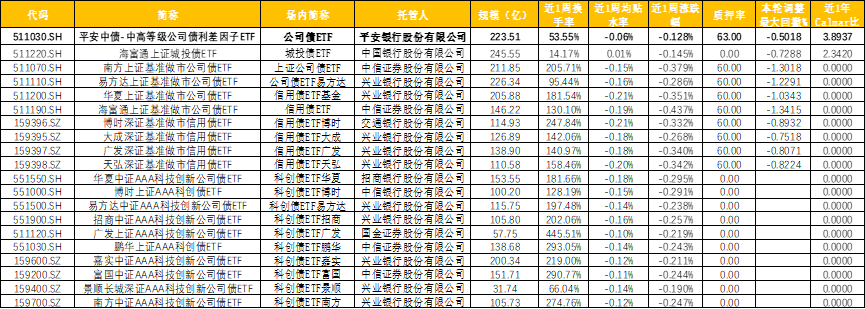
Group 1 - The total scale of credit bond ETFs is 347.6 billion yuan, with a daily decrease of 800 million yuan [1] - The median weighted duration is 3.9 years, indicating the average time until cash flows are received [1] - The overall trading volume is 68.4 billion yuan, with an average single transaction amount of 760,000 yuan [1] Group 2 - The median yield is 1.90%, and the median discount rate is -33.8 basis points [1] - The Ping An Company Bond ETF (511030) has the best performance in controlling drawdown this year, with a net value that remains stable [1] - The data shows various ETFs with their respective scales, weekly performance, and drawdown metrics, highlighting the performance of different funds [1]
信用策略周报20250817:3年二永,跌出来的机会?-20250818
Tianfeng Securities· 2025-08-18 02:12
Group 1 - The overall credit bond yields have followed the adjustment of interest rate bonds, with credit spreads showing mixed changes. Specifically, the decline in the 3-5 year high-grade perpetual bonds was the most significant, reaching 6-11 basis points, while the longer-term bonds also experienced notable declines [1][11] - City investment bonds saw a greater decline compared to medium-short bonds, with the 7-year ultra-long city investment bonds experiencing the largest drop of around 8 basis points [1][11] - The credit spread for medium-short bonds, especially those with maturities of 4 years and above, was generally weaker than that of the same maturity national development bonds, leading to a passive narrowing of credit spreads during the week [1][11] Group 2 - Since July, the trading volume of public credit bonds has been continuously shrinking, and the duration has also decreased from its high levels. The long-term credit bonds (over 5 years) have shown relative resilience due to buying from insurance and wealth management products, while the buying power from funds has decreased significantly [2][16] - The valuation of ETF constituent bonds has generally followed the market adjustment, but the decline in valuation for constituent bonds was structurally lower than that of non-constituent bonds of similar maturity [3][24] - The long-end constituent bonds, especially ultra-long bonds, were more resilient during the week, with most individual bonds experiencing smaller valuation declines compared to non-constituent bonds [3][44] Group 3 - Since May, the trading duration of perpetual bonds has been continuously extended, with both the trading volume and proportion of bonds with maturities over 5 years reaching year-to-date highs. This indicates a shift from trading to allocation among major participating institutions [4][46] - The supply of perpetual bonds, including TLAC bonds, has significantly increased during this period, and the buying power from public funds has been higher than selling power, particularly for long-end perpetual bonds [4][47] Group 4 - As of August 15, 2025, some AA and AA(2) credit bonds with maturities within 2 years have seen yields drop to over 1.9%, indicating the value of short-term bonds. These bonds also possess defensive attributes amid market volatility, as the bond market will continue to be influenced by equity market fluctuations [5][60] - The 3-4 year perpetual bonds have emerged as a cost-effective option, with their yield curve steepening and current valuations being higher than those of similarly rated medium-short bonds and city investment bonds, offering better trading value and liquidity [5][60]
信用债8月投资策略展望:震荡偏强趋势下,继续选择高等级拉久期
BOHAI SECURITIES· 2025-08-05 12:20
Core Insights - The report emphasizes a continued preference for high-grade long-duration credit bonds amidst a fluctuating but generally strong market trend [1][62] - It highlights a slight decrease in the issuance scale of credit bonds in July, with a net financing increase, indicating a mixed but generally positive market sentiment [2][12][19] Group 1: Primary Market Conditions - In July, a total of 1,435 credit bonds were issued, amounting to 12,900.31 billion, reflecting a month-on-month decrease of 1.27% [12] - The net financing amount for credit bonds increased to 3,662.83 billion, a month-on-month increase of 954.08 billion [12] - The issuance rates for various maturities decreased, with overall changes ranging from -20 BP to -1 BP [14][18] Group 2: Secondary Market Conditions - The total transaction volume of credit bonds in July reached 41,783.17 billion, representing a month-on-month growth of 4.05% [19] - Credit spreads for most varieties of credit bonds narrowed, with the trend mirroring that of yields [22][29] - The report notes that the overall yield of credit bonds exhibited a volatile trend, with a monthly average decline compared to June [62] Group 3: Investment Perspectives - The report suggests that the current market conditions favor high-grade bonds due to their potential for price recovery and the limited space for compression in short-term credit spreads [62][67] - It recommends focusing on bonds from state-owned enterprises and high-quality private enterprises with strong guarantees, as these are expected to provide better risk-adjusted returns [67] - The report also indicates that the ongoing adjustments in the market necessitate a strategic approach to bond selection, emphasizing the importance of monitoring interest rate trends and individual bond coupon values [62][67]