利率波动

Search documents
中国人寿20250910
2025-09-10 14:35
Summary of the Conference Call for China Life Insurance Company Overview - The conference call pertains to **China Life Insurance** and discusses its financial performance and strategic outlook for 2025. Key Points and Arguments Financial Performance - The VFA model has shown some accounting losses due to short-term interest rate fluctuations, which do not reflect long-term performance. It is essential to focus on the full-cycle investment performance and operational capabilities when evaluating results [2][3] - In the first half of 2025, underwriting financial losses increased by **7% year-on-year**, primarily due to the growth in reserve size [2][3] - The discount rate curve used by the company ranges from **1 year to 40 years**, with a terminal level of **4.5%** applied from **20 years onward**. This results in better CSM indicators for longer-duration businesses under the new standards [2][3][4] - The company's income tax expenses significantly decreased in the first half of 2025, mainly due to increased investment income from tax-exempt investment types (government bonds) and the potential release of deferred tax assets in the future [2][8] Business Strategy and Market Position - The company maintains a strategy of simultaneous growth in scale and value for its bancassurance channel, achieving significant improvements in total premiums, new premiums, and first-year premiums in the first half of 2025 [3][8] - The average guaranteed interest rate for existing liabilities is approximately **2.9%**, while the new business average is about **2.2%**, showing a downward trend compared to the end of 2024 [3][10] New Business Margins - The new business contract service margin (CSM) was significantly impacted by market interest rate changes, with a notable decrease in the new business liability duration [6][11] - The CSM for new contracts declined by approximately **90 basis points**, which is a more significant drop than the decrease in guaranteed interest rates, leading to a reduction in CSM [11] Investment Strategy - The company is optimistic about the equity market, expecting stable growth in the Chinese economy. The strategy includes long-term investment, value investment principles, and flexible allocation in fixed income [12][13] - The overall bond allocation ratio remained stable compared to the end of the previous year, indicating a divergence in market participants' strategies based on their circumstances [14] Regulatory Compliance - The company is committed to the regulatory requirement of investing **30% of new premiums** into the A-share market. In the first half of 2025, the public market equity scale increased by **150 billion** yuan [17] Risk Management and Future Outlook - The company plans to maintain a certain level of long-term bond allocation to match liabilities, with an effective duration of approximately **10 years** for liabilities and **8.5 years** for assets [15] - The difference between the adjusted net asset value and the net asset value in financial statements is attributed to the use of a longer-term discount rate for the adjusted value and the exclusion of non-tradable intangible assets [16] Additional Important Insights - The company is enhancing its agent channel's value rate through product transformation and improved expense management, which has led to significant improvements in profitability [9] - The company is prepared to adapt its strategies in response to market conditions, particularly if the stock market continues to rise [17]

债市机构行为周报(9月第1周):利率波动“基金化”-20250907
Huaan Securities· 2025-09-07 13:18
1. Report Industry Investment Rating No information provided in the content. 2. Core View of the Report - The pricing power of funds in the bond market has further increased, and there are still short - term long - trading opportunities. The high correlation between funds and interest rate trends has been further strengthened this year, and low interest rate fluctuations imply the enhancement of funds' pricing power in the bond market. Some "unexplained" interest rate increases may be due to the lack of bond - receiving institutions. The impact of fund institutional behavior on interest rate fluctuations may further expand, and short - term redemption pressure is controllable [2][11][15] 3. Summary According to the Directory 3.1 This Week's Institutional Behavior Review - **Correlation between funds and interest rates**: The high correlation between funds and interest rate trends is not new. Since 2024, the behavior of funds and interest rate trends have shown high correlation, and this year, the low - level fluctuation of interest rates has implied the further improvement of funds' pricing power in the bond market, which may be related to bank wealth management outsourcing [2][11][12] - **"Unexplained" interest rate increases**: This phenomenon may be related to the lack of bond - receiving institutions. Insurance institutions have reduced their allocation of national bonds since 2024, and rural commercial banks' intention to buy more as the interest rate adjusts is gradually decreasing [15] 3.2 Yield Curve - **Treasury bonds**: Short - term yields increased, while medium - and long - term yields decreased. The 1Y yield increased by 3bp, the 3Y yield increased by 1bp, the 5Y yield decreased by 2bp, the 7Y yield decreased by 1bp, the 10Y yield decreased by 1bp, the 15Y yield increased by 3bp, and the 30Y yield decreased by 3bp [17] - **China Development Bank bonds**: Yields decreased overall. The 1Y yield increased by 1bp, the 3Y yield decreased by 1bp, the 5Y yield decreased by about 2bp, the 7Y yield decreased by 2bp, the 10Y yield decreased by about 1bp, the 15Y yield decreased by 2bp, and the 30Y yield decreased by 1bp [17] 3.3 Term Spread - **Treasury bonds**: The interest spread increased, and the short - term spread narrowed while the long - term spread was differentiated. The 1Y - DR001 interest spread remained flat overall, and the 1Y - DR007 interest spread increased by 10bp [20] - **China Development Bank bonds**: The interest spread increased, and the short - term spread narrowed while the long - term spread was differentiated. The 1Y - DR001 interest spread increased by 2bp, and the 1Y - DR007 interest spread increased by about 8bp [22] 3.4 Bond Market Leverage and Funding Situation - **Leverage ratio**: It decreased to 107.14%. From September 1st to September 5th, 2025, the leverage ratio fluctuated and increased within the week. As of September 5th, it was about 107.14%, up 0.30pct from last Friday and 0.07pct from Monday [25] - **Average daily trading volume of pledged repurchase**: From September 1st to September 5th, the average daily trading volume of pledged repurchase was about 7.3 trillion yuan, a decrease of 0.24 trillion yuan compared with last week. The average daily trading volume of overnight pledged repurchase was 7.6 trillion yuan, a decrease of 0.43 trillion yuan month - on - month. The average overnight trading volume accounted for 88.35%, an increase of 2.89pct month - on - month [28][33] - **Funding situation**: Bank - based fund outflows first increased and then decreased. The main fund inflow party was funds, and the outflows of money market funds first decreased and then increased. DR007 and R007 fluctuated and decreased [34] 3.5 Duration of Medium - and Long - Term Bond Funds - **Median duration**: The median duration of medium - and long - term bond funds decreased. As of September 5th, the median duration (de - leveraged) was 2.77 years, a decrease of 0.04 years from last Friday; the median duration (including leverage) was 2.95 years, a decrease of 0.16 years from last Friday [45] - **Duration of different types of bond funds**: The median duration (including leverage) of interest - rate bond funds decreased to 3.75 years, a decrease of 0.16 years from last Friday; the median duration (including leverage) of credit bond funds decreased to 2.72 years, a decrease of 0.12 years from last Friday [51] 3.6 Category Strategy Comparison - **Sino - US interest rate spread**: It widened overall. The 1Y spread widened by 23bp, the 2Y spread widened by about 12bp, the 3Y spread widened by 13bp, the 5Y spread widened by 8bp, the 7Y spread widened by 11bp, the 10Y spread widened by 11bp, and the 30Y spread widened by 7bp [55] - **Implied tax rate**: The short - term spread narrowed, and the long - term spread was differentiated. As of September 5th, the 1Y spread between China Development Bank bonds and treasury bonds narrowed by about 1bp, the 3Y spread narrowed by 2bp, the 5Y spread changed by less than 1bp, the 7Y spread narrowed by 1bp, the 10Y spread widened by 1bp, the 15Y spread narrowed by 5bp, and the 30Y spread widened by 2bp [56] 3.7 Bond Lending Balance Changes - On September 5th, the lending concentration of active 10Y treasury bonds, active 10Y China Development Bank bonds, and active 30Y treasury bonds increased; the lending concentration of the second - active 10Y China Development Bank bonds decreased, and the lending concentration of the second - active 10Y treasury bonds remained unchanged. In terms of institutions, the lending of large - scale banks and other institutions decreased, while that of small - and medium - sized banks and securities firms increased [57]
每日钉一下(美元降息,对A股港股有利吗?)
银行螺丝钉· 2025-08-25 13:50
Group 1 - The article emphasizes that different stock markets do not move in unison, and understanding multiple markets can provide investors with more opportunities [2] - Global investment can significantly reduce volatility risk, and the article suggests a free course on investing in global stock markets through index funds [2][3] - The course includes notes and mind maps to help participants quickly grasp the concepts of global index investing [3] Group 2 - The article discusses the impact of interest rate changes on asset prices, likening interest rates to gravity for assets [5] - A decrease in interest rates is beneficial for asset prices, particularly for bonds, and indirectly supports the stock market by increasing liquidity and lowering capital costs [6] - Non-dollar assets benefit more during a dollar interest rate cut cycle, as the dollar tends to depreciate against other currencies, which was evident during the last bull market in Hong Kong stocks from 2020 to 2021 [7] - Following the first interest rate cut by the Federal Reserve in September 2024, A-shares and Hong Kong stocks experienced significant gains, marking the fastest rise in a decade [7][8] - While interest rate fluctuations can create short-term trading opportunities, their long-term impact on investment returns is less significant compared to the longer cycles of bull and bear markets [8]


「固收+」品种,为啥是当下稳健投资的好选择?
银行螺丝钉· 2025-08-11 04:01
Core Viewpoint - The article discusses the current state of long-term pure bond funds, highlighting their underperformance in 2025 due to low interest rates and the shift towards "fixed income plus" products that combine bonds with equities for better returns [10][12][35]. Summary by Sections Types of Bond Funds - Common types of bond funds include short-term pure bond funds, long-term pure bond funds, and "fixed income plus" funds [1][4][6]. - Short-term pure bond funds have minimal volatility, typically with a drawdown of less than 1% [1]. - Long-term pure bond funds, such as 7-10 year government bonds, exhibit greater volatility, potentially comparable to low-volatility stock funds [2][3]. - "Fixed income plus" funds combine bonds with a small portion of equities or convertible bonds, aiming for higher returns [4][5]. Performance Trends - In 2021, long-term pure bond funds had interest yields of over 3%-4%, but entered a declining interest rate cycle thereafter [7][8]. - A bull market for long-term pure bond funds lasted from 2021 to 2024, but by 2025, these funds faced significant declines due to low yields [9][10][12]. - As of late 2024, the yield on 10-year government bonds was around 1.6%-1.7%, making long-term pure bonds less attractive [12]. Factors Influencing Bond Fund Performance - Interest rate fluctuations are a primary factor affecting bond fund performance, with declining rates typically leading to rising bond prices [15][16]. - The long-term trajectory of interest rates is influenced by economic growth rates and inflation [20][21]. - In 2025, the performance of long-term pure bond funds was negatively impacted by rising interest rates and a strong stock market [13][20]. Shift to "Fixed Income Plus" Products - Due to low yields on traditional bond funds, investors are increasingly turning to "fixed income plus" products, which offer a mix of stable bond returns and higher-risk equities [35][36]. - "Fixed income plus" funds typically consist of a defensive bond component and a more aggressive equity component, aiming to enhance overall returns [36][37]. - The performance of "fixed income plus" products has been strong, with indices for these funds reaching new highs in 2025, contrasting with the decline in pure bond fund indices [38][39]. Characteristics of "Fixed Income Plus" Products - These products leverage the negative correlation between stocks and bonds, allowing for reduced volatility and improved long-term returns [39][40]. - The risk profile of "fixed income plus" products is significantly influenced by the proportion of equities they hold [43][44]. - They benefit from declining deposit rates, as traditional savings accounts offer lower returns, prompting investors to seek better alternatives [46][48]. Investment Considerations - Investors should assess the equity proportion in "fixed income plus" products based on their risk tolerance [51]. - The bond component should focus on mid to short-term bonds, which currently offer more stability [51]. - Selecting funds with automatic rebalancing strategies can help mitigate risks associated with market volatility [51][60]. Examples of "Fixed Income Plus" Products - The 365-day and monthly salary investment combinations are highlighted as effective "fixed income plus" options, with varying equity and bond ratios [52][55]. - These products have shown resilience and recovery in performance, with the 365-day combination achieving historical highs since its inception [55][58].

债市收盘| 隔夜资金利率不足1.3%,主要利率债收益率全线下行
Xin Lang Cai Jing· 2025-08-07 09:32
Group 1 - The core viewpoint of the articles indicates a downward trend in the yields of major term government bonds, with the 10-year government bond yield returning to 1.69% and a generally loose funding environment as the overnight rate is below 1.3% [1][5] - The closing prices of government bond futures mostly increased, with the 30-year main contract rising by 0.03% to 119.380 yuan, the 10-year main contract up by 0.05% to 108.615 yuan, and the 5-year main contract also up by 0.05% to 105.830 yuan [1][3] - The interbank major interest rate bond yields decreased across the board, with the 10-year government bond active coupon yield down by 0.7 basis points to 1.69% and the 30-year government bond yield down by 0.45 basis points to 1.914% [1][2] Group 2 - The auction results for government bonds showed a weighted interest rate of 1.585% for a 3-year bond and 1.715% for a 7-year bond, with full bid-to-cover ratios of 3.27 and 5.36 respectively [3] - The trading market for non-financial credit bonds saw significant movements, with the top five gainers including bonds from companies like 德达 and 文蓝, while the top five losers included bonds from 万科 and 梁山 [4] - The central bank conducted a reverse repurchase operation of 160.7 billion yuan at a rate of 1.40%, with a net withdrawal of 122.5 billion yuan for the day [5][6]
利率周记(7月第3周):历史上债市横盘如何破局?
Huaan Securities· 2025-07-22 10:12
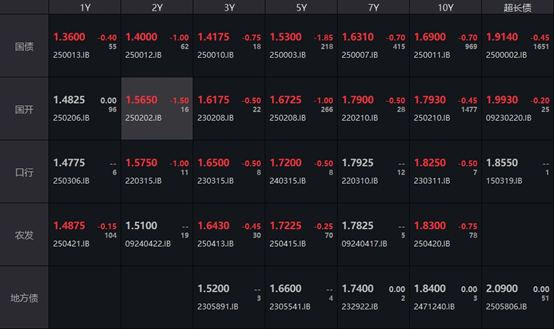
Group 1: Report Information - Report Title: "Fixed Income Weekly: How Has the Bond Market Broken Through Sideways Trading Historically? - Interest Rate Weekly (Week 3 of July)" [1] - Report Date: July 22, 2025 [2] - Analysts: Yan Ziqi, Hong Ziyan [2] Group 2: Industry Investment Rating - No information provided Group 3: Core Viewpoints - The current bond market has been in a long - lasting sideways trading with low interest rates and extremely low volatility. From April to July this year, the 10 - year Treasury bond yield oscillated between 1.60% - 1.70%, with a range of only 10bp, and the volatility on July 8 reached the lowest in the past 5 years [2]. - Historically, out of 12 rounds of bond market sideways trading from 2019 to now, 7 times the subsequent interest rates broke through downward and 5 times upward, with the sideways trading usually lasting about 1 month. A transition to a bull market typically requires a combination of increased economic downward pressure, monetary policy easing, and asset shortage, while a transition to a bear market needs factors like better - than - expected economic recovery, tightened monetary policy, rising inflation expectations, and regulatory impacts [3]. - The current trading theme in the bond market is unclear. On one hand, the strong GDP performance in the first half of the year makes investors expect no significant incremental policies in the short term, and recent consumption policies have made the bond market underperform. On the other hand, the current capital situation is in a balanced state, and the government bond supply pressure from July to August is not large and can be hedged by the central bank [4][7]. - A method to judge the end of a sideways market turning bearish is to observe the significant cooling of investors' aggressiveness in non - interest - rate bond strategies. When investors' expectation of further interest rate decline weakens, their buying of non - interest - rate bonds decreases, especially in the case of Tier 2 and perpetual bonds [7]. - Historically, the bond market breaking through sideways trading usually requires unexpected macro and policy factors. Currently, considering the long - term sideways trading, low interest rates, and small fluctuations in the bond market, and the enhanced learning effect in the market this year, investors can focus on the aggressiveness of non - interest - rate bond strategies to measure the bond market's risk - preference expectations [10]. Group 4: Summary by Related Catalog Historical Bond Market Sideways Trading and Breakthrough - The report sorted out 12 rounds of bond market sideways trading from 2019 to now, analyzing the sideways trading periods, 10 - year Treasury bond fluctuation ranges, reasons for sideways trading, post - breakthrough performances, and triggering factors [3][4]. Current Bond Market Situation - The trading theme is unclear, with factors from economic performance, policies, capital situation, and supply side affecting the market [4][7]. Micro - perspective Analysis - By observing the trading behavior of non - interest - rate bonds, especially the buying intensity of Tier 2 and perpetual bonds by brokers and funds, a method to judge the end of a sideways market turning bearish is provided [7].
二永债机构行为全解析
Huaan Securities· 2025-07-17 05:46
1. Report Industry Investment Rating No relevant content provided. 2. Core Viewpoints of the Report - The investment in secondary and perpetual bonds (referred to as "two - eternal bonds") in the current bond market has reached the fourth stage. Since 2024, two - eternal bonds have become amplifiers of interest rate fluctuations. The report focuses on analyzing the institutional behavior patterns of two - eternal bonds and attempts to discover effective signals [2][15]. - Different types of institutions have different allocation patterns for two - eternal bonds. For example, banks act as stabilizers in the bond market, while securities firms have high - frequency trading, funds are the main buyers, and other institutions have their own preferences [5][6]. - It is difficult to use the institutional behavior of two - eternal bonds to predict interest rate trends, but it can help investors understand the market's expectation of whether interest rates can continue to decline. The report constructs investment sentiment measurement indicators for the trading desks of two - eternal bonds to assist investors in observation [7][8]. 3. Summary According to the Table of Contents 3.1 Why Focus on the Institutional Behavior of Two - eternal Bonds? - The investment in two - eternal bonds has gone through four stages. Since 2024, they have become amplifiers of interest rate fluctuations. The report aims to analyze their institutional behavior patterns and find effective signals [2][15]. - The report discusses three types of bonds (secondary capital bonds, perpetual bonds, and ordinary financial bonds) and six types of investors (banks, securities firms, funds, wealth management, insurance, and others). Different investors' term preferences are mainly concentrated in 1Y, 3Y, and 5Y, and the trading volume of two - eternal bonds over 5Y declines significantly [3][15]. 3.2 Institutional Behavior Patterns of Two - eternal Bonds 3.2.1 Banks Still Act as Stabilizers in the Bond Market - Since the second half of 2024, commercial banks have increased the trading volume of 1Y/3Y secondary capital bonds and continuously net - sold 5Y secondary capital bonds. For perpetual bonds, the trading volume of 1Y/3Y is small, and 5Y is significantly net - sold. For ordinary financial bonds, the trading volume in the 3Y term is the largest, and they are mostly net - sold, except for increasing allocation during bond market corrections [5][16]. 3.2.2 Securities Firms Have High - Frequency Band - trading of Two - eternal Bonds - Securities firms show obvious trading - desk characteristics in the trading of two - eternal bonds, frequently switching between buying and selling with a relatively large scale. They have a high preference for 1Y/3Y/5Y two - eternal bonds and ordinary financial bonds [5][21]. 3.2.3 Funds Are the Main Buyers of Two - eternal Bonds - Funds tend to make trend - based allocations to two - eternal bonds. They continuously buy during bull markets and sell significantly during bear markets, driving market trends. In recent years, with the overall decline in the interest rates of two - eternal bonds, funds have shown a trend of increasing allocation [5][30]. 3.2.4 The Institutional Behavior Characteristics of Wealth Management in Two - eternal Bonds Are Diverse - In most periods, the trading characteristics of wealth management in two - eternal bonds are not obvious, showing an overall allocation trend. At some points, they take profits during bull markets, buy during bear markets, and continue to buy during volatile markets [5][37]. 3.2.5 Insurance Also Acts as a Stabilizer in the Bond Market - Insurance institutions generally net - sell two - eternal bonds but increase allocation during market corrections, acting as stabilizers [5][46]. 3.2.6 Other Types of Institutions Prefer to Continuously Allocate 5Y Two - eternal Bonds - Other types of institutions have a greater preference for continuously allocating 5Y two - eternal bonds [6][52]. 3.3 How to Use the Institutional Behavior Patterns of Two - eternal Bonds? - It is relatively difficult to use the institutional behavior of two - eternal bonds to predict interest rate trends due to factors such as the synchronicity of institutional behavior indicators, less trading data, and data delays [7][61]. - However, the institutional behavior of two - eternal bonds can help investors understand the market's expectation of whether interest rates can continue to decline. When investors expect interest rates to continue to decline, the trading desks of two - eternal bonds will continue to buy, compressing the spread. When the expectation weakens, the buying power will decrease [7][61]. - The report constructs investment sentiment measurement indicators for the trading desks of two - eternal bonds, which are the smoothed overall purchases of funds and securities firms in 5Y secondary capital bonds and 5Y perpetual bonds. When these indicators decline significantly and approach zero, it indicates that the trading desks are less optimistic about buying two - eternal bonds for capital gains. This year, there were two such time points in January 15th and late April, corresponding to subsequent bond market corrections or fluctuations [8][62].
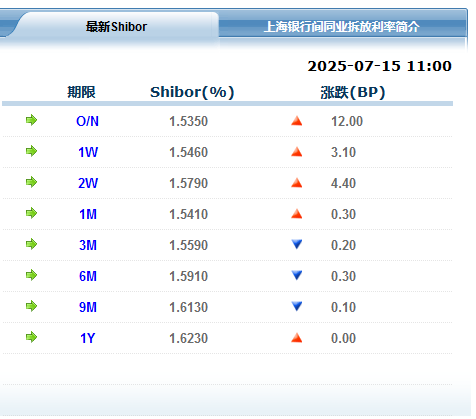
隔夜SHIBOR报1.5350%,上涨12.00个基点。7天SHIBOR报1.5460%,上涨3.10个基点。3个月SHIBOR报1.5590%,下降0.20个基点。
news flash· 2025-07-15 03:03
Group 1 - The overnight SHIBOR rate is reported at 1.5350%, increasing by 12.00 basis points [1] - The 7-day SHIBOR rate is reported at 1.5460%, increasing by 3.10 basis points [1] - The 3-month SHIBOR rate is reported at 1.5590%, decreasing by 0.20 basis points [2] Group 2 - The latest SHIBOR rates for various tenors are as follows: - O/N: 1.5350% (up 12.00 BP) - 1W: 1.5460% (up 3.10 BP) - 2W: 1.5790% (up 4.40 BP) - 1M: 1.5410% (up 0.30 BP) - 3M: 1.5590% (down 0.20 BP) - 6M: 1.5910% (up 0.30 BP) - 9M: 1.6130% (up 0.10 BP) - 1Y: 1.6230% (no change) [3]
债市下半年展望:预计维持震荡格局,三季度有配置窗口期
Di Yi Cai Jing· 2025-07-08 12:56
Core Viewpoint - The bond market in the first half of 2025 is characterized by significant issuance expansion and interest rate volatility, with expectations of a fluctuating market in the second half [1][2][4]. Group 1: Market Issuance and Structure - The total issuance in the bond market exceeded 27 trillion yuan in the first half of 2025, with a year-on-year increase of nearly 24% [2]. - Interest rate bonds accounted for nearly 40% of the total issuance, with government bonds at 7.89 trillion yuan and local government bonds at 5.49 trillion yuan [2]. - The issuance of special bonds accelerated, reaching 2.16 trillion yuan, with a progress rate of 49.11%, which is 10.82 percentage points faster than the same period last year [2]. - The net financing scale of interest rate bonds surged, with government bonds net financing reaching 3.4 trillion yuan, approximately double that of the previous year [2]. Group 2: Interest Rate Trends - The 10-year government bond yield rose by 30 basis points in the first quarter, reaching a high of 1.89% before falling to around 1.65% by the end of the second quarter, forming a "V" shape [3]. - The interbank 7-day pledged repo rate (DR007) decreased from approximately 2.3% at the beginning of the year to below 1.7%, indicating a shift from a "tight balance" to a "relatively loose" liquidity environment [3]. Group 3: Market Outlook for the Second Half - The bond market is expected to maintain a fluctuating pattern in the second half, with the 10-year government bond yield projected to fluctuate between 1.5% and 1.8% [4]. - Analysts suggest that the balance between supply pressure from interest rate bonds and expectations of monetary policy easing will influence market dynamics [4]. - The net financing scale of interest rate bonds in the second half is estimated to be around 6.88 trillion yuan, with a monthly average of 1.15 trillion yuan, close to the levels of the same period in 2023 [4]. Group 4: Investment Strategies - Institutions recommend a balanced investment approach, focusing on both short-term liquidity and long-term value in interest rate bonds, while capturing opportunities in a flattening yield curve [5]. - In the credit bond market, there is a positive trend with a focus on high-quality local government bonds, financially stable state-owned real estate companies, and stable city commercial bank secondary capital bonds [5]. - Investors are advised to maintain flexibility in their portfolios, managing duration risk while seizing structural opportunities across different varieties and maturities [5].
拥有500万元存款,可以靠利息过上怎样生活?听听银行人怎么说的
Sou Hu Cai Jing· 2025-06-22 04:53
Core Viewpoint - The article discusses the reality of having 5 million in savings and the various factors that influence whether this amount can lead to a comfortable lifestyle, emphasizing that it is not a guarantee of financial security [1][8]. Summary by Relevant Sections Savings and Wealth Accumulation - For most ordinary families, accumulating 5 million in savings is a distant dream, requiring 50 years of saving 100,000 annually [1]. - The individuals who typically possess such wealth are often those who have successfully sold properties at peak prices or received substantial compensation from property demolitions, indicating that this wealth accumulation is highly contingent and risky [1]. Impact of Interest Rates - The fluctuation of interest rates significantly affects savings returns; for instance, the interest rate for a three-year deposit of 5 million was previously 3.5%, yielding an annual return of 175,000, but has now dropped to 2.3%, resulting in only 113,000 annually [5]. Investment Risks - Many suggest investing savings in stocks, funds, or bank financial products for higher returns; however, in 2023, the average loss for stock investors was 64,500, with many funds experiencing losses of up to 20% [5]. - Given the current volatile market conditions, keeping funds in a bank for principal safety may be a more prudent choice [5]. Inflation Concerns - The risk of inflation is significant, with the M2 money supply exceeding 300 trillion; while current excess money mainly circulates within the financial system, future inflation risks remain [5]. - Although 5 million may provide financial freedom today, its purchasing power could diminish significantly over the next 20 years depending on future price trends [5]. Living Conditions and Quality of Life - The location of residence greatly influences living standards; in major cities like Beijing, Shanghai, Guangzhou, and Shenzhen, monthly interest income of less than 10,000 may only support a middle-class lifestyle, especially when rent is considered [6]. - Conversely, in lower-tier cities, the same interest income can afford a more comfortable living experience [6]. Conclusion - Ultimately, having 5 million in savings does not guarantee a worry-free life, as factors such as interest rate fluctuations, investment risks, inflation, and living location significantly impact quality of life [8].