
期货价格

Search documents
《能源化工》日报-20260115
Guang Fa Qi Huo· 2026-01-15 01:58
1. Report Industry Investment Rating No relevant information provided in the reports. 2. Core Views of the Reports Polyolefin Industry - LLDPE: Supply is expected to increase marginally, and demand enters the seasonal off - season with weakening downstream开工率. There is a positive feedback in the spot market, and the sustainability of demand should be monitored [1]. - PP: Both supply and demand are weak. There are many maintenance plans, and there is an expectation of inventory reduction in January. The balance has improved significantly, and attention should be paid to the implementation of maintenance plans [1]. Methanol Industry - The methanol futures are oscillating strongly. The inland price is expected to oscillate, and the port price is restricted by factors such as low MTO profits and potential maintenance of MTO devices [3]. Pure Benzene - Styrene Industry - Pure benzene: The short - term supply - demand pattern is weak, but it is driven by the strong performance of styrene and oil prices. The short - term trend is strong. It is recommended to wait and see for BZ2603 unilaterally and narrow the EB - BZ spread when it is high [5]. - Styrene: The short - term supply - demand is tight, but there is an expectation of inventory accumulation around the Spring Festival, and the upward space is limited. It is recommended to look for shorting opportunities for EB03 and narrow the EB processing fee when it is high [5]. Natural Rubber Industry - The rubber price is expected to oscillate in the range of 15,500 - 16,500. The raw material price provides support at the lower end, and the weak demand suppresses the upper end. Attention should be paid to the raw material output in Thailand [6]. Glass - Soda Ash Industry - Soda ash: The futures price is expected to oscillate weakly in the short term. Attention should be paid to the production load adjustment and inventory situation of soda ash plants [9]. - Glass: The price is expected to continue to weaken in the short term and can be treated bearishly [9]. Crude Oil Industry - The oil price is generally strong due to the instability in Iran, but the increase is limited by the weak supply - demand expectation. Attention should be paid to geopolitical conflicts such as the Russia - Ukraine peace talks and the Middle East situation [11]. LPG Industry No specific views provided in the report other than price and inventory data. Polyester Industry - PX: The short - term price is expected to oscillate at a high level before the Spring Festival, and the mid - term can be treated bullishly at low levels. It is recommended to do a long - short spread for PX5 - 9 at a low level [16]. - PTA: The short - term price is expected to oscillate between 5,000 - 5,300, and the mid - term can be treated bullishly at low levels. It is recommended to do a long - short spread for TA5 - 9 at a low level [16]. - MEG: The price is under pressure. It is recommended to pay attention to the pressure at around 4,000 for EG2605, do a short - long spread for EG5 - 9 at a high level, and sell out - of - the - money call options EG2605 - C - 4100 at a high level [16]. - Short fiber: The price is driven by raw materials in the short term. It is recommended to have the same strategy as PTA unilaterally and narrow the PF processing fee when it is high [16]. - Bottle chips: The price and processing fee are expected to follow the cost side. It is recommended to have the same strategy as PTA unilaterally [16]. PVC - Caustic Soda Industry - Caustic soda: The price is expected to be stable and weak. Attention should be paid to the procurement volume of the main downstream and the price fluctuation of liquid chlorine [18]. - PVC: The fundamentals are still under pressure, but the short - term price fluctuates emotionally. It is recommended to wait and see for short positions [18]. Urea Industry - The urea price is expected to be strong in the short term. Attention should be paid to the follow - up of downstream agricultural demand and the resumption rhythm of devices [19]. 3. Summaries According to Relevant Catalogs Polyolefin Industry - **Prices and Spreads**: Futures and spot prices of LLDPE and PP increased, and there were changes in various spreads such as L59, PP59, and LP05 [1]. - **Inventory**: PE enterprise inventory decreased by 11.41%, and PP trader inventory decreased by 5.28% [1]. - **开工率**: PE装置开工率 increased by 0.52%, and PP装置开工率 decreased by 1.65% [1]. Methanol Industry - **Prices and Spreads**: Methanol futures and spot prices increased, and there were changes in various spreads such as MA59 and regional spreads [3]. - **Inventory**: Methanol enterprise inventory increased by 0.73%, and port inventory decreased by 6.63% [3]. - **开工率**: The upstream domestic enterprise开工率 increased by 0.54%, and some downstream device开工率 decreased [3]. Pure Benzene - Styrene Industry - **Prices and Spreads**: The prices of pure benzene, styrene, and related products increased, and there were changes in various spreads such as EB - BZ [5]. - **Inventory**: The pure benzene port inventory reached a record high, and the styrene port inventory decreased significantly [5]. - **开工率**: The开工率 of some pure benzene and styrene downstream industries changed, with some increasing and some decreasing [5]. Natural Rubber Industry - **Prices and Spreads**: The spot price of natural rubber increased, and there were changes in various spreads such as the 9 - 1 spread [6]. - **Inventory**: The bonded area inventory increased by 3.62%, and the factory - warehouse futures inventory decreased by 1.74% [6]. - **Production and开工率**: The production in Thailand, Indonesia, and other countries decreased in November, and the开工率 of automobile tires changed [6]. Glass - Soda Ash Industry - **Prices and Spreads**: The spot prices of glass and soda ash were generally stable, and there were changes in futures prices and spreads [9]. - **Inventory**: The glass factory - warehouse inventory decreased by 5.69%, and the soda ash factory - warehouse inventory increased by 4.25% [9]. - **Supply and开工率**: The开工率 and supply of soda ash remained at a high level, and the glass melting volume and产能利用率 decreased slightly [9]. Crude Oil Industry - **Prices and Spreads**: The prices of Brent, WTI, and SC crude oil increased, and there were changes in various spreads such as Brent - WTI [11]. - **Refined Oil**: The prices of refined oil products such as NYM RBOB and NYM ULSD increased, and there were changes in cracking spreads [11]. LPG Industry - **Prices and Spreads**: The LPG futures prices changed slightly, and the spot price increased. There were changes in various spreads such as PG02 - 03 [14]. - **Inventory**: The LPG refinery storage capacity ratio decreased by 1.94%, and the port inventory decreased by 0.41% [14]. - **开工率**: The upstream main refinery开工率 increased by 2.49%, and the downstream PDH开工率 increased by 0.68% [14]. Polyester Industry - **Prices and Spreads**: The prices of PX, PTA, MEG, and polyester products changed, and there were changes in various spreads such as PX - naphtha [16]. - **Inventory**: The MEG port inventory increased [16]. - **开工率**: The开工率 of PX, PTA, and polyester products changed, with some increasing and some decreasing [16]. PVC - Caustic Soda Industry - **Prices and Spreads**: The prices of PVC and caustic soda decreased slightly, and there were changes in various spreads such as V2605 - V2601 [18]. - **Inventory**: The inventory of liquid caustic soda and PVC increased [18]. - **开工率**: The开工率 of the caustic soda and PVC industries changed, with some increasing and some decreasing [18]. Urea Industry - **Prices and Spreads**: The urea futures price increased, and the spot price was stable with a slight upward trend. There were changes in various spreads and basis [19]. - **Inventory**: The domestic urea factory - warehouse inventory decreased by 3.53%, and the port inventory remained unchanged [19]. - **Supply and Demand**: The daily and weekly production of urea increased, and the agricultural demand in some regions increased [19].
今日黄金期货价格实时行情(2026年1月14日)
Jin Tou Wang· 2026-01-14 03:56
今日黄金期货价格实时行情(2026年1月14日) 今日黄金期货价格(2026年1月14日) | 名称 | 最新价 | 开盘价 | 昨收价 | 最高价 | 最低价 | 报价单位 | | --- | --- | --- | --- | --- | --- | --- | | 沪金主力 | 1036.94 | 1028.82 | 1027.18 | 1038.70 | 1028.24 | 元/克 | 打开APP,查看更多高清行情>> 备注:以上 黄金期货价格仅供参考,更多 黄金期货行情实时价格、 黄金期货一手要多少钱请以官方价 格为准,如有对黄期货价格有何疑问可咨询本站客服。 ...
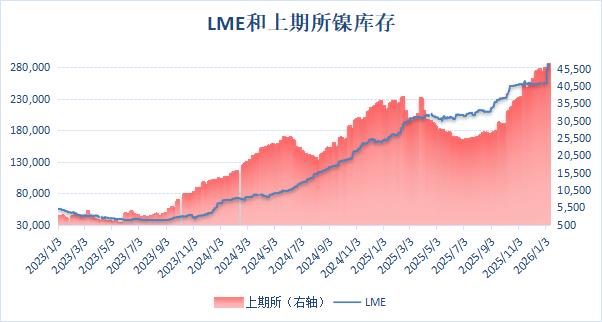
沪镍库存继续累积 增至逾八年新高
Wen Hua Cai Jing· 2026-01-14 02:35
伦敦金属交易所(LME)公布数据显示,上周伦镍库存明显累积,1月9日库存增至284,790吨,刷新逾 七年新高,本周库存有所回落,最新库存水平为284,562吨。 2023年以来LME和上期所镍库存对比 以下为2025年12月以来LME和上期所镍库存数据:(单位:吨) | 日期 | LME | 上期所 | | --- | --- | --- | | 2026/1/12 | 284, 562 | | | 2026/1/9 | 284, 790 | 46, 650 | | 2026/1/8 | 276, 300 | | | 2026/1/7 | 275, 634 | | | 2026/1/6 | 255, 546 | | | 2026/1/5 | 255, 354 | | | 2026/1/2 | 255, 282 | | | 2025/12/31 | 255, 162 | 45, 544 | | 2025/12/30 | 255, 186 | | | 2025/12/29 | 255, 186 | | | 2025/12/26 | | 44, 454 | | 2025/12/24 | 255, 696 | | ...

合成橡胶:上方压力逐步增加
Guo Tai Jun An Qi Huo· 2026-01-13 02:00
Report Industry Investment Rating - Not provided Core Viewpoints of the Report - Short - term, with the marginal weakening of macro sentiment, the upward pressure on the futures price of butadiene rubber is expected to gradually increase. The butadiene raw material market's short - term buying sentiment is marginally weakening, presenting a pattern of neutral reality and strong expectations. The short - term fundamentals of butadiene are neutral, and the butadiene rubber mainly fluctuates following the cost side [3]. Summary by Relevant Catalogs 1. Fundamentals Tracking 1.1 Futures Market - For the butadiene rubber main contract (03 contract), the daily closing price increased by 55 yuan/ton to 12,070 yuan/ton, the trading volume increased by 12,475 lots to 113,696 lots, the open interest increased by 65,592 lots to 91,931 lots, and the trading volume increased by 71,055 ten - thousand yuan to 6,810,210,000 yuan [1]. 1.2 Spread Data - The basis of Shandong butadiene - futures main contract decreased by 105 to - 120, and the monthly spread of BR02 - BR05 increased by 10 to - 60 [1]. 1.3 Spot Market - The butadiene rubber prices in North China, East China, South China, and Shandong all decreased by 50 yuan/ton. The price of Qilu styrene - butadiene rubber (model 1502) decreased by 100 yuan/ton, and the price of Qilu styrene - butadiene rubber (model 1712) remained unchanged. The mainstream price of butadiene in Jiangsu remained unchanged at 9,250 yuan/ton, and the mainstream price in Shandong increased by 25 yuan/ton to 9,475 yuan/ton [1]. 1.4 Fundamental Indicators - The butadiene rubber operating rate remained unchanged at 79.6897%. The theoretical full cost of butadiene rubber increased by 103 yuan/ton to 11,976 yuan/ton, and the profit of butadiene rubber increased by 97 yuan/ton to 124 yuan/ton [1]. 2. Industry News - As of January 7, the latest inventory of butadiene in East China ports was about 41,300 tons, a decrease of 3,400 tons from the previous period due to reduced import arrivals and normal raw material inventory consumption [2]. - As of January 7, 2026, the domestic butadiene rubber inventory was 33,100 tons, a decrease of 400 tons from the previous period, with a month - on - month decrease of 1.08%. Although the production was high and sales improved, there was some unsold inventory, and the overall inventory change was limited [2][3].
原木期货日报-20260112
Guang Fa Qi Huo· 2026-01-12 06:44
1. Report Industry Investment Rating - No relevant content provided 2. Core View of the Report - From January 5 - 11, 2026, 13 New Zealand log ships are expected to arrive at 13 Chinese ports, 1 more than last week, a week - on - week increase of 8%; the total arrival volume is about 47.9 million cubic meters, 7.05 million cubic meters more than last week, a week - on - week increase of 17% [2] - The 01 contract continues to be deeply discounted for delivery, and the buyer's willingness to take delivery remains poor. The 03 contract has less inventory pressure due to low inventory and expected reduction in later shipments. However, the demand remains weak, and the upside is limited. Overall, the contradictions are insufficient, and the upward and downward drivers are limited. The market is expected to fluctuate within a range [2] 3. Summary by Related Catalogs 3.1 Futures and Spot Prices - Futures prices: On January 9, the price of log 2601 was 742.0, unchanged from January 8; log 2603 was 774.5, down 4.0 from January 8 with a decline of - 0.51%; log 2605 was 787.0, down 2.0 with a decline of - 0.25%; log 2607 was 798.0, down 2.5 with a decline of - 0.31%. The basis of the main contract was - 34.5, up 4.0 from January 8 [1] - Spot prices: The prices of various types of logs at ports such as Rizhao and Taicang remained unchanged from January 8 to January 9. The CFR price of 4 - meter medium - A radiata pine was 110 US dollars per JAS cubic meter, down 2 US dollars with a decline of - 1.79%; the CFR price of 11.8 - meter spruce was 124 euros per JAS cubic meter, unchanged [1] 3.2 Cost: Import Cost Calculation - On January 12, the RMB - US dollar exchange rate was 6.976, unchanged from January 11. The import theoretical cost was 755.70 yuan, down 13.87 yuan from January 11 with a decline of - 2% [1] 3.3 Supply: Monthly - Port inventory: On November 30, it was 191.4 million cubic meters, up 2.2 million cubic meters from October 31 with an increase of 1.16% [1] - Departing ships from New Zealand to China, Japan and South Korea: The number of departing ships was 52.0, up 3.0 from the previous period with an increase of 6.12% [1] 3.4 Inventory: Main Port Inventory (Weekly) - As of January 2, the total inventory of coniferous logs in China was 267 million cubic meters, up 13 million cubic meters from December 26 with an increase of 5.12%. In Shandong, it was 195.00 million cubic meters, up 9.8 million cubic meters from December 26 with an increase of 5.29% [1] 3.5 Demand (Weekly) - As of January 2, the daily average outbound volume of logs in China was 5.65 million cubic meters, down 0.18 million cubic meters from the previous week with a decline of - 3%. In Shandong, it was 2.89 million cubic meters, up 0.10 million cubic meters with an increase of 4%. In Jiangsu, it was 2.17 million cubic meters, down 0.27 million cubic meters with a decline of - 11% [2]
(2026年1月12日)白银期货价格今日行情查询
Jin Tou Wang· 2026-01-12 02:23
| 名称 | 最新价 | 最高价 | 最低价 | 昨收价 | | --- | --- | --- | --- | --- | | 沪银主力 | 20535.00 | 20641.00 | 18743.00 | 18731.00 | 打开APP,查看更多高清行情》 金投白银网(http://ag.cngold.org)为您提供最新白银期货价格、白银期货合约、白银期货交易以及白银期 货走势,更多白银期货行情敬请关注:白银期货专栏 备注:以上白银的价格仅供参考,请以官方报价为准。如对白银投资有疑问可咨询本站客服。 金投白银网提供今日白银期货价格走势_今天白银期货价格走势(2026年1月12日) 今日白银期货价格查询(2026年1月12日) ...
《金融》日报-20260106
Guang Fa Qi Huo· 2026-01-06 02:34
Report Industry Investment Rating - Not provided in the given documents Core Views of the Reports 1. **Stock Index Futures Spread Daily Report** - Presents detailed data on the latest values, changes from the previous day, historical 1 - year and all - time quantiles of various stock index futures spreads and cross - variety ratios, including IF, IH, IC, and IM [1] 2. **Interest Rate Futures Basis and Spread Daily Report** - Provides data on the basis, cross - period spreads, and cross - variety spreads of TS, TF, T, and TL interest rate futures, along with their changes and percentiles since listing [2] 3. **Precious Metals Spot - Futures Daily Report** - Future market may focus on the impact of US economic data on Fed policy and geopolitical situation in South America. Precious metals are expected to maintain high volatility in January. Suggestions include long - position gold allocation on dips, light long - position silver trading with option hedging, and long - position platinum trading due to its strong external market performance [3] 4. **Container Shipping Industry Spot - Futures Daily Report** - Shows the increase in settlement price indices and Shanghai export container freight rates. Futures prices of container shipping indices have also risen, and there are changes in fundamental data such as supply, port indicators, and overseas economic indicators [7][8] Summary of Relevant Catalogs 1. **Stock Index Futures Spread Daily Report** - **Spread Data**: Includes IF, IH, IC, and IM futures' spot - futures spreads, cross - period spreads, and cross - variety ratios, with specific values, changes, and quantiles [1] 2. **Interest Rate Futures Basis and Spread Daily Report** - **Basis Data**: TS, TF, T, and TL futures' basis values, changes, and percentiles since listing [2] - **Cross - Period Spread Data**: Cross - period spreads of different contracts and their changes and percentiles [2] - **Cross - Variety Spread Data**: Cross - variety spreads among different interest rate futures and their changes and percentiles [2] 3. **Precious Metals Spot - Futures Daily Report** - **Futures Closing Price**: Domestic and foreign precious metals futures closing prices, price changes, and percentage changes [3] - **Spot Price**: Spot prices of various precious metals, price changes, and percentage changes [3] - **Basis**: Basis values of different precious metals, price changes, and 1 - year quantiles [3] - **Ratio**: Ratios of different precious metals, price changes, and percentage changes [3] - **Interest Rate and Exchange Rate**: 10 - year and 2 - year US Treasury yields, 10 - year TIPS Treasury yields, US dollar index, and offshore RMB exchange rate, along with their changes and percentage changes [3] - **Inventory and Position**: Inventory and position data of precious metals, changes, and percentage changes [3] 4. **Container Shipping Industry Spot - Futures Daily Report** - **Settlement Price Index**: SCFIS for European and US West routes, with price changes and percentage changes [7] - **Shanghai Export Container Freight Rate**: SCFI comprehensive index, European, US West, and US East routes, with price changes and percentage changes [7] - **Futures Price and Basis**: Futures prices of different container shipping index contracts, price changes, percentage changes, and basis value changes of the main contract [7] - **Fundamental Data**: Global container shipping capacity supply, Shanghai port indicators (quasi - arrival rate, berthing situation), monthly export amount, overseas economic indicators (euro - zone PMI, EU consumer confidence index, US manufacturing PMI, OECD leading indicators), with their changes and percentage changes [7] - **Spot Quotation**: Spot freight rates of Shanghai - Europe routes for different shipping companies, price changes, and percentage changes [8]
广发期货日报-20260106
Guang Fa Qi Huo· 2026-01-06 01:05
Report Investment Ratings - No investment ratings provided in the reports Core Views - In the precious metals market, the gold market has completed its correction. Future market attention may shift to the impact of US economic data on Fed policies and geopolitical situations in South America. Platinum and palladium prices may gradually stabilize, with the platinum price rising due to strong overseas markets. Palladium, with a relatively weaker fundamental situation, may follow the trend. The platinum-palladium ratio is expected to rise, presenting a hedging arbitrage opportunity. Silver may face a pullback risk due to global commodity index rebalancing, and investors are advised to maintain a light long position and use options to lock in profits [3] - In the container shipping industry, the freight rates for European and US routes have increased, with significant growth on the US - West route. The fundamental data shows that the global container shipping capacity supply remains stable, while port - related indicators and overseas economic data present a mixed picture [5] Summary by Category Stock Index Futures Spread - **Price Difference Data**: F, H, IC, and IM have different current - spot price differences and inter - period price differences, with varying changes compared to the previous day and percentile rankings in different time frames. There are also cross - variety ratios such as IC/IF, IC/IH, etc., with corresponding changes and percentile rankings [1] Bond Futures - **Basis and Spread Data**: TS, TF, T, and TL have different basis values, inter - period spreads, and cross - variety spreads, with corresponding changes compared to the previous day and percentile rankings since listing [2] Precious Metals - **Domestic Futures**: AU2602, AG2602, PT2606, and PD2606 contracts all declined in price, with varying decline rates [3] - **Foreign Futures**: Contracts for COMEX gold, COMEX silver, NYMEX platinum, and NYMEX palladium all rose in price, with varying increase rates [3] - **Spot Prices**: The spot prices of London gold and London silver rose, while the spot prices of platinum and palladium declined. The prices of gold T + D and silver T + D on the Shanghai Gold Exchange also declined [3] - **Basis and Ratio**: There are different basis values and cross - variety ratios among various precious metals, with corresponding changes [3] - **Interest Rates and Exchange Rates**: The 10 - year US Treasury yield, 2 - year US Treasury yield, 10 - year TIPS Treasury yield, and the US dollar index all changed slightly, while the on - shore RMB exchange rate declined slightly [3] - **Inventory and Holdings**: The inventories of Shanghai Futures Exchange gold and silver, COMEX gold and silver, and the holdings of SPRD gold ETF and SLV silver ETF all changed to different extents [3] Container Shipping Industry - **Freight Index**: The SCFIS for European and US - West routes increased, with a significant increase on the US - West route. The SCFI comprehensive index and the SCFI for US - West and US - East routes also increased, while the SCFI for the European route declined slightly [5] - **Futures Prices and Basis**: The prices of EC2602 (main contract), EC2604, etc. changed slightly, and the basis of the main contract increased [5] - **Fundamental Data**: The global container shipping capacity supply remained unchanged. Port - related indicators such as the port punctuality rate and port calls in Shanghai, and overseas economic data such as the euro - zone composite PMI, EU consumer confidence index, and US manufacturing PMI all changed to different extents [5]
2026年1月PX、PTA、MEG策略报告-20260105
Guang Da Qi Huo· 2026-01-05 05:48
1. Report Industry Investment Rating No relevant content provided. 2. Core Viewpoints of the Report - The cost side of PX, PTA, and MEG has more disturbances, and polyester prices fluctuate following the cost. The game between the downward feedback from downstream and the expected improvement remains the focus of market contradictions. For PX, beware of the real - world situation dragging it down; for PTA, it is expected to decline; for MEG, it is expected to fluctuate after a rebound [2][155]. 3. Summary According to the Table of Contents 3.1 PX&PTA&MEG Price: Follow Crude Oil Price Fluctuations, Geopolitical Factors Affect Crude Oil Price - **Futures Price**: From November 28, 2025, to December 30, 2025, the PTA closing price increased from 4700 yuan/ton to 5144 yuan/ton, a rise of 9.4%; the MEG closing price decreased from 3885 yuan/ton to 3847 yuan/ton, a decline of 1.0%; the PX closing price increased from 6830 yuan/ton to 7316 yuan/ton, a rise of 7.1% [6]. - **Basis and Spread**: The PTA, MEG, and PX basis and spreads have changed to varying degrees. For example, the PTA basis decreased from - 37 yuan/ton to - 46 yuan/ton, a decline of 24.3% [15]. - **Price Differences**: The TA - EG spread widened significantly, with a change value of 482 yuan/ton and a rise of 59.1%. The TA - PX * 0.656 spread also increased, with a change value of 97 yuan/ton and a rise of 44.2%. There were also changes in the price differences between raw materials such as PX - crude oil, PX - MX, etc. [18][22]. 3.2 PX&PTA&MEG Supply Situation: Focus on Device Maintenance - **PX**: As of December 26, 2025, the Asian PX operating rate was 79.5%, a month - on - month increase of 0.8 percentage points; the Chinese PX operating rate was 88.2%, a month - on - month decrease of 0.1 percentage points. A 70 - ton PX device in the Northeast is restarting, and its capacity will expand to 1 million tons/year after restart [36]. - **PTA**: As of December 26, 2025, the PTA operating rate was 72.5%, a month - on - month decrease of 1.2 percentage points. Multiple PTA devices have restarted, such as the 55 - ton PTA device of FCFC in Taiwan and the 1.2 - million - ton PTA device of Zhongtai Petrochemical [38]. - **MEG**: As of December 26, 2025, the overall operating rate of ethylene glycol in mainland China was 73.32% (a month - on - month decrease of 1.14%), and the operating rate of ethylene glycol produced by the oxalic acid catalytic hydrogenation method (syngas) was 77.28% (a month - on - month increase of 4.52%). Multiple MEG devices in Taiwan, Iran, and Saudi Arabia have planned maintenance [52]. 3.3 PX&PTA&MEG Import and Export Situation: India's BIS Certification Cancelled - **PX**: In November 2025, the total import volume of PX in mainland China was about 817,000 tons, a month - on - month decrease of 1% and a year - on - year decrease of 16.3% [60]. - **PTA**: In November 2025, the PTA import volume was 300 tons, a year - on - year decrease of 89.94%; the export volume was 358,900 tons, a year - on - year decrease of 16.93%. The cumulative export volume from January to November 2025 was 3.4553 million tons, close to the full - year level in 2023 [65]. - **MEG**: In November 2025, the import volume of ethylene glycol was 580,000 tons, a year - on - year increase of 6.1%. The cumulative import volume from January to November was 6.88 million tons, a year - on - year increase of 15.2% [68]. - **Polyester**: In November 2025, the total export volume of polyester products was 1.2948 million tons, a month - on - month increase of 96,300 tons and a year - on - year increase of 121,000 tons [73]. 3.4 PX&PTA&MEG Inventory Situation: Downstream Finished - Product Inventory Reduction - **PTA**: The total PTA inventory is at the bottom. - **MEG**: On December 29, 2025, the inventory of MEG in some main ports in East China was about 730,000 tons [85]. 3.5 Polyester Demand Situation: Terminal Demand Faces Challenges - **Domestic Polyester Device Changes**: As of December 31, 2025, the total planned reduction of three major polyester filament factories was about 2.819 million tons. Multiple devices are planned to be shut down for maintenance, and some devices have restarted [87]. - **Domestic Polyester - Related Data**: The operating rates of polyester, texturing machines, looms, etc. have decreased to varying degrees, and the inventory days and cash flows of some products have also changed [88]. - **Terminal Demand**: Terminal demand has declined, such as the decline in textile and clothing exports. From January to November 2025, China's textile and clothing exports decreased by 1.9%, and in November, it decreased by 5.1% [105]. 3.6 PX&PTA&MEG Positioning Situation - **PTA**: As of December 30, 2025, the total PTA position was 1,890,052 lots, showing a month - on - month and year - on - year increase [120]. - **MEG**: As of December 30, 2025, the total MEG position was 341,247 lots, showing a month - on - month decrease and a year - on - year slight decrease [120]. - **PX**: As of December 30, 2025, the total PX position was 458,083 lots, showing a month - on - month and year - on - year increase [120].
国泰君安期货能源化工天然橡胶周度报告-20260104
Guo Tai Jun An Qi Huo· 2026-01-04 08:26
1. Report Industry Investment Rating No relevant content provided. 2. Report's Core View - This week, the domestic natural rubber futures market declined while the overseas market rose. Due to the improvement in weather in overseas main - producing areas after the holiday, the increase in supply will put pressure on raw material prices, and the cost support may weaken. Although the spot inventory of natural rubber continues to accumulate and some downstream enterprises plan to have short - term maintenance during the "New Year's Day" holiday, after the holiday, funds will return to the market. Affected by the external market during the holiday, with limited self - contradiction driving, it is expected that the natural rubber price will follow the overall trend of the energy and chemical sector and fluctuate slightly stronger [9][102]. - Valuation: The spread between the main contracts of RU and NR remained stable at 2980 yuan/ton, and the spread between mixed standard rubber and the main contract of RU decreased by 65 yuan/ton. Investment strategies include waiting and seeing for RU in the unilateral aspect, waiting for opportunities to short at high prices; observing in the inter - period and cross - variety aspects [103]. 3. Summary by Directory Industry News - In the first 11 months of 2025, Vietnam's total exports of natural rubber and mixed rubber decreased by 5.6% year - on - year, and the total exports to China decreased by 0.6% year - on - year [5]. - On December 31, the Ministry of Commerce and other departments issued the implementation rules for the 2026 automobile trade - in subsidy, expanding the scope of support compared with 2025 [6]. - In the first 11 months of 2025, Thailand's total exports of natural rubber and mixed rubber increased by 4.6% year - on - year, and the total exports to China increased by 24% year - on - year [7]. Market Trends - This week, the domestic rubber futures market declined, while the overseas market rose. For example, the closing price of RU2605 decreased by 1.11% compared with the previous period, and the closing price of Singapore TSR20:2605 increased by 0.17% [9][11]. Price Basis and Calendar Spread - The basis of whole milk - RU05 increased by 26.04% compared with the previous period, and the 05 - 09 calendar spread increased by 100.00% compared with the previous period [12]. Other Spreads - Spreads such as RU - NR, RU - BR, NR - SICOM TSR20, and RU - JPX RSS3 decreased [16]. - This week, most rubber spot prices declined, and futures prices declined more, resulting in a stronger basis [20]. - The spread between whole milk and Thai mixed rubber and the spread between 3L and Thai mixed rubber widened [23]. Substitute Prices - The price of butadiene at the raw material end of butadiene rubber continued to rise, providing obvious bottom support for the short - term market price, and most spot offers maintained a firm price and tried to sell [29]. Capital Trends - The virtual - to - physical ratio and the settled funds of RU and NR both decreased. For example, the virtual - to - physical ratio of RU decreased by 16.46% compared with the previous period, and the settled funds decreased by 11.80% [32][34]. Fundamental Data Supply - Weather in Thai producing areas: The rainy season in southern Thailand is gradually coming to an end with decreasing rainfall, and the rainy season in northeastern Thailand has passed, but the rainfall is higher than the same period [37]. - Weather in domestic producing areas: The rainy seasons in Hainan and Yunnan producing areas have basically ended [39]. - Raw material prices: Due to the easing of overseas geopolitical tensions, raw material prices declined. For example, the price of cup lump in the Hat Yai market in Songkhla Province, Thailand, decreased by 2.54% compared with the previous period [41][43]. - Raw material spreads: The spread between water and cup in Thailand widened, the spread between Hainan glue going into the concentrated latex factory and going into the whole milk factory was stable, and Yunnan has basically stopped tapping [45]. - Upstream processing profit: As raw material prices declined, the rubber processing profit in Thailand generally improved. For example, the production profit of Thai standard rubber increased by 18.53% compared with the previous period [48][50]. - Delivery profit: The delivery profit in Hainan decreased, and Yunnan has basically stopped tapping, so the data update was suspended [53]. - Thai exports: In November, Thailand's natural rubber exports decreased month - on - month, with a slight increase in latex exports and a decrease in the exports of smoked sheets, standard rubber, and mixed rubber [60]. - Thai exports to China: In November, the quantity of Thailand's natural rubber exports to China decreased month - on - month, with an increase in the exports of latex, smoked sheets, and standard rubber and a decrease in mixed rubber [63]. - Indonesian exports: In October, Indonesia's total natural rubber exports decreased significantly year - on - year and month - on - month due to a large decrease in standard rubber exports, while the exports of mixed rubber continued to increase month - on - month. The total exports to China also decreased month - on - month [66]. - Vietnamese exports: In October, Vietnam's natural rubber exports increased month - on - month, with a large increase in latex exports. The exports to China increased seasonally, with large increases in standard rubber and latex exports [72]. - Ivorian exports: In November, Cote d'Ivoire's rubber exports decreased month - on - month, and the quantity of exports to China decreased significantly month - on - month [74]. - Rubber imports: In November, China's imports of natural rubber (including mixed rubber and composite rubber) were 643,600 tons, a month - on - month increase of 25.98% and a year - on - year increase of 14.76%. The imports of Thai mixed rubber, Thai standard rubber, and Ivorian standard rubber increased significantly month - on - month, while the imports of Vietnamese standard rubber and mixed rubber decreased year - on - year [78]. Demand - Tire capacity utilization and inventory: Some enterprises have short - term maintenance plans during the "New Year's Day" holiday, mostly for 3 - 5 days, and most enterprises maintain normal production. Tire inventory continued to accumulate last week (the current data has not been updated) [81]. - Tire exports and heavy - truck sales: In November, heavy - truck sales increased month - on - month with a higher growth rate, passenger car sales continued to grow but the year - on - year and month - on - month growth rates continued to decline, and tire exports recovered slightly month - on - month [84]. - Road transport turnover: In November, the road freight turnover increased month - on - month, while the passenger turnover decreased month - on - month [88]. Inventory - Spot inventory: The current natural rubber inventory in China continued to accumulate seasonally. Qingdao's inventory increased, and the increase rate of the increase in light - colored rubber inventory compared with the previous period weakened [94][96]. - Futures inventory: The natural rubber futures inventory in the Shanghai Futures Exchange and the 20 - rubber futures inventory in the Shanghai International Energy Exchange both increased to some extent. For example, the natural rubber futures inventory in the Shanghai Futures Exchange increased by 7.09% compared with the previous week [99].