贸易摩擦

Search documents
股指周报:贸易风云再起,预计避险情绪升温,但影响弱于4月-20251013
Xin Da Qi Huo· 2025-10-13 09:22
1. Report Industry Investment Rating - Short - term: Oscillation - Medium - short - term: Bullish [1] 2. Core Viewpoints of the Report - Last week, the stock index market rose first and then fell. After the holiday, the capital enthusiasm recovered, but the high - level divergence continued. The growth styles such as the ChiNext and the Science and Technology Innovation Board declined, and the four major broad - based indexes closed slightly down. - The US announced a 100% new tariff on Chinese imported goods last Friday, which will transmit bearish sentiment to the domestic A - share market this week. High - position stocks and the ChiNext and Science and Technology Innovation Board with front - running characteristics are expected to continue the downward trend, and small - cap styles such as the CSI 1000 need key defense. However, the direct impact of overseas sentiment transmission on the market is limited, and the indirect impact is more short - term and phased. In the long - term, market adjustments can be regarded as a new layout opportunity. [1][2] 3. Summary According to the Directory 3.1 Last Week's Stock Index Operation Situation 3.1.1 Trade Tensions Resurfaced, and Most Global Stock Indexes Fell - The four major broad - based indexes in the domestic stock index market closed slightly down last week. The weekly gains and losses of the four major stock indexes were: CSI 500 (- 0.19%) > SSE 50 (- 0.47%) > CSI 300 (- 0.51%) > CSI 1000 (- 0.54%). - Overseas, affected by the US government shutdown and the new 100% tariff on Chinese imports, the international risk - aversion sentiment generally increased last week. The VIX fear index rose 25% on Friday, and the three major US stock indexes generally fell. The Nasdaq Index dropped 3.56% on Friday and 2.53% for the week. [1][8] 3.1.2 Non - ferrous Metals and Coal Led the Gains, and the Trading Volume Rebounded Compared with Before the National Day - From the performance of the Shenwan primary industry classification, sectors were significantly differentiated last week. Non - ferrous metals (+ 4.44%) and coal (+ 4.41%) led the gains, while media (- 3.83%) and electronics (- 2.63%) lagged behind. The growth style adjusted, and the cycle and stable styles were relatively strong. - In terms of capital, the A - share trading volume rebounded last week, fluctuating between 2.5 - 2.6 trillion yuan during the week, and the capital entry willingness remained at a relatively strong historical level. [2][9] 3.1.3 The Basis of Stock Index Futures Changed Little, and the Option Volatility Fell Rapidly - In the futures market, the basis (spot - futures) of each stock index futures changed little last week. The far - month discounts of IC and IM slightly expanded compared with before the holiday, while IF and IH basically remained unchanged. The sentiment in the derivatives market was more cautious than that in the spot market. - In the options market, the implied volatility of stock index options fell last week. After the long - holiday effect ended, the average IV of the CSI 300 current - month contract reached the 15 - 16% level, which was at a relatively low historical level. [10] 3.2 Fundamental Elements and Outlook for the Future 3.2.1 The Central Bank Conducted a Net Withdrawal of 152.63 Billion Yuan in the Open Market Last Week - In terms of inter - bank liquidity, the central bank achieved a net withdrawal of 152.63 billion yuan in the open market last week, with open - market reverse repurchase operations of 113.7 billion yuan and a cumulative reverse repurchase maturity amount of 266.33 billion yuan. - In terms of inter - bank interest rates, interest rates at various tenors generally declined last week. The overnight Shibor decreased by 6.50bp, the one - week Shibor decreased by 0.20bp, the two - week Shibor decreased by 22.00bp, R001 decreased by 21.57bp, R007 decreased by 19.98bp, and R014 decreased by 18.49bp. [70] 3.2.2 The Tariff Shock Resurfaced, but the Impact is Expected to be Weaker than in April - The US announced a 100% new tariff on Chinese imported goods last Friday, which led to a spread of panic in the international market. For the A - share market, bearish sentiment is expected to spread this week. High - position stocks and the ChiNext and Science and Technology Innovation Board are expected to continue to decline, and small - cap styles need key defense. However, the direct impact of overseas sentiment on the A - share market is limited. - Futures operation: If there are unclosed long - term trend orders, short positions can be opened on Monday for hedging or temporarily exit the market for observation. For speculators, if the market falls this week, there may be rebound opportunities near the 20 - day moving average and the position on September 4th, and intraday long positions can be used for short - term trading based on these two points. - Options operation: It is very likely that the volatility will increase this week, but the increase is expected to be smaller than that in early April. Short - term participation in buying far - month CSI 1000 put options is recommended, and exit the market in time if there is a profit during the week. For SSE 50 and CSI 300 options, it is recommended to wait for the volatility to rise before entering the double - selling strategy. [2][71] 3.3 Economic Data and Financial Event Forecast 3.3.1 Macroeconomic Data Release No specific data release information was provided in the report. 3.3.2 Key Financial Events - October 13 (to be determined): China's import and export volume in September. - October 13 (20:30): The number of new non - farm payrolls and the unemployment rate in the US in September. - October 15 (to be determined): Financial data such as new social financing and M2 in China in September. - October 15 (20:30): CPI and core CPI in the US in September. - October 16 (20:30): PPI and core PPI in the US in September. - October 18 (10:00): Real estate data (new construction, completion, and construction area of houses) in China in September. [102]
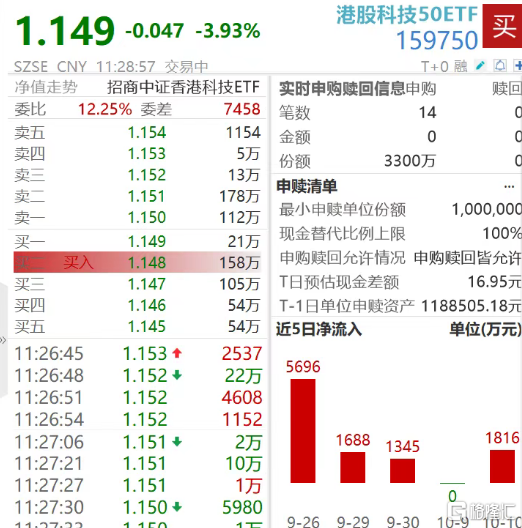
港股跌幅扩大,小米集团跌超6%,近3800万资金逆势净流入港股科技50ETF(159750)
Ge Long Hui· 2025-10-13 07:58
Market Overview - The Hong Kong stock market is experiencing a downturn, with the Hang Seng Technology Index dropping over 3% and the Hang Seng Index down 2.5% [1] - Notable declines include Sunny Optical Technology and WuXi AppTec, both falling over 7%, while BYD Electronics, Xiaomi Group, and Bilibili saw declines exceeding 6% [1] ETF Performance - The Hong Kong Technology 50 ETF (159750) decreased by 3.93%, with a trading volume of 115 million CNY, and saw a net inflow of nearly 38 million CNY during the session [1][2] Market Sentiment and Analysis - Huatai Securities highlights that the rising global market volatility, driven by discussions around the AI "bubble" and escalating trade tensions, is impacting market conditions [2] - Despite the volatility, the long-term outlook for the technology sector remains relatively unaffected, with structural opportunities expected to emerge post-market correction [2][3] Investment Strategy - The investment approach is shifting from a broad-based speculative strategy to a more discerning selection process, focusing on high-quality technology companies primarily listed in Hong Kong [3] - The capital expenditure (Capex) of non-financial companies has significantly increased, with a year-on-year rise of 12%, indicating a positive cycle for leading firms [3]


贸易摩擦再升级,不过这次做好了准备!
雪球· 2025-10-13 07:55
Core Viewpoint - The article discusses the ongoing tensions between China and the U.S., particularly focusing on China's proactive measures in response to U.S. actions, especially regarding rare earth elements and high-end manufacturing capabilities [3][4][6]. Group 1: U.S.-China Relations - The conflict has escalated since April, marking a shift from a honeymoon phase to increased hostilities, with both sides taking actions [3]. - China's upgraded countermeasures, particularly in the rare earth sector, have provoked a strong reaction from the U.S., indicating the effectiveness of these measures [4]. Group 2: Market Implications - The market is closely watching whether the current situation will lead to a "taco transaction," suggesting that the U.S. may continue its previous strategies [5]. - The emotional market downturn is seen as a reaction to earlier disruptions in supply chains, but there is potential for recovery, differing from previous events [5]. Group 3: Industry Developments - China appears to have made significant advancements in high-end manufacturing, including developments in lithography machines, indicating a shift towards domestic alternatives [5]. - U.S. strategies, such as imposing 100% tariffs and EDA software controls, are viewed as outdated tactics, while China is building a more self-sufficient industrial system [6]. Group 4: Long-term Outlook - The article suggests that the balance of power may be shifting, with China's global competitiveness improving and the U.S. having fewer options to exert pressure [6].

直线涨停!午后,这一板块集体拉升!
券商中国· 2025-10-13 06:57
Core Viewpoint - The article discusses the recent surge in port and shipping stocks in response to the Chinese Ministry of Transport's announcement of special port fees for U.S. vessels, effective from October 14, 2025, which is expected to lead to increased shipping rates due to heightened cost transfer motivations among shipping companies [1][5][8]. Group 1: Market Reactions - Nanjing Port's stock price surged to the daily limit, while Lianyungang and several shipping stocks also saw significant increases, with Lianyungang rising nearly 8% and other stocks like China National Offshore Oil Corporation and Ningbo Maritime rising over 6% [1][3]. - The announcement from the Ministry of Transport has led to a collective rally in the shipping sector, indicating strong market sentiment towards shipping stocks amid the ongoing trade tensions [2][3]. Group 2: Policy Details - The Ministry of Transport's announcement includes a phased implementation of special port fees for U.S. vessels, starting at 400 RMB per net ton in 2025 and increasing to 1120 RMB by 2028 [6]. - The policy targets various categories of U.S.-owned or operated vessels, which could significantly impact shipping operations and costs for U.S. companies [5][6]. Group 3: Investment Opportunities - Research institutions suggest that the new port fees will create investment opportunities in the shipping sector, particularly for companies with strong fundamentals and limited available capacity [8]. - Analysts from multiple firms, including Huachuang Securities and Shenwan Hongyuan, recommend focusing on shipping stocks as they are likely to benefit from increased freight rates due to the cost pressures from the new fees [8][9].



美国豆农困境:要补贴 但更想要中国市场
Jin Tou Wang· 2025-10-13 06:31
美国正通过潜在的财政援助和多元化出口市场的努力来缓解中国"不买"美国大豆带来的冲击。尽管美国 农民对这些援助表示欢迎,但他们依旧更希望看到了来自中国的订单。 特朗普上周四表示,他可能于本月晚些时候在韩国亚太经合组织峰会期间与中国讨论大豆问题。与此同 时,美国还敦促印度加大对美国大豆的采购力度,此前美国农民已经积极在越南和尼日利亚等国寻找买 家。据报道,美国政府还在考虑一项价值100亿至140亿美元的援助计划,资金将来自关税收入。 随着美国大豆库存持续积压,中西部农业州的压力正不断显现。由于供应过剩,大豆的仓储成本不断上 升,许多农场的运营也陷入困境。美国农业协会多次向特朗普政府发出警告,若不能与中国达成协议, 将会有更大的损失。 美国北达科他州大豆种植者协会主席表示,若中国订单持续停滞,农民将被迫大幅减产,甚至可能放弃 种植大豆。 美国当地农民对以上政策表示欢迎,毕竟"有总比没有强",这可以暂时缓解他们的痛苦。然而更多的农 民却还是希望回到正常的、有稳定订单的日子。 伊利诺伊州大豆协会表示:"中国市场对大豆等大宗商品的进口规模巨大,通常占我们出口总额的一半 以上,这导致任何规模较小的市场组合都无法完全取代它。 ...
有色金属周报:美联储降息预期提升,有色板块冲高回落-20251013
Guo Mao Qi Huo· 2025-10-13 06:10
1. Report Industry Investment Rating - Not provided in the content 2. Core Viewpoints of the Report - The Fed's interest rate cut expectations have increased, and the non - ferrous metals sector has initially risen but then fallen. The prices of different non - ferrous metals are affected by various factors such as macro - economy, raw material supply, smelting, demand, and inventory, showing different trends and investment outlooks [2] - For copper, short - term prices may fall after a sharp rise, and it is expected to fluctuate. For zinc, short - term macro - disturbances increase, and the investment view is bearish. For nickel and stainless steel, they are expected to be weak in the short term due to factors like Sino - US trade frictions and uncertain policies [9][95][195] 3. Summary by Directory 01. Non - ferrous Metal Price Monitoring - The report monitors the closing prices of various non - ferrous metals, including the US dollar index, exchange rate CNH, and prices of industrial silicon, lithium carbonate, copper, aluminum, zinc, etc. Each metal shows different daily, weekly, and annual price changes [7] 02. Copper (CU) - **Macro Factors**: Neutral to bearish. The US government shutdown, poor ADP employment data, and Sino - US trade frictions have increased market uncertainty and the expectation of the Fed's interest rate cut [9] - **Raw Material End**: Bullish. The spot processing fee of copper ore has slightly decreased, the port inventory has increased, and the suspension of a major copper mine in Indonesia has tightened the supply [9] - **Smelting End**: Neutral to bullish. The losses of smelters using spot and long - term copper ore have both narrowed, and the copper output in September decreased and is expected to continue to decline in October [9] - **Demand End**: Bearish. The sharp rise in copper prices and the holiday have led to a significant decline in the operating rates of refined copper rods and recycled copper rods [9] - **Inventory**: Bearish. Both domestic and foreign copper inventories have increased [9] - **Investment View**: The price is expected to fluctuate, and there is a risk of a short - term decline [9] - **Trading Strategy**: Short - term bullish for single - side trading, and consider domestic positive arbitrage [9] 03. Zinc (ZN) - **Macro Factors**: Bearish. Sino - US trade frictions have intensified, and there is a risk of a decline in global asset prices [95] - **Raw Material End**: Neutral. Domestic and imported processing fees show different trends, and the purchasing enthusiasm of smelters for imported ores is not high [95] - **Smelting End**: Neutral. The refined zinc output in September decreased, and it is expected to increase in October [95] - **Demand End**: Neutral. The "Silver October" peak season has limited expectations, and the downstream raw material procurement sentiment is weak [95] - **Inventory**: Bearish. Social inventories have increased after the holiday, while LME zinc inventories have continued to decline [95] - **Investment View**: Bearish. Although the export window is almost open, there is still a risk of inventory accumulation [95] - **Trading Strategy**: Wait and see for single - side trading, and pay attention to the opportunity of internal - external reverse arbitrage [95] 04. Nickel & Stainless Steel (NI & SS) - **Macro Factors**: Bearish. The Sino - US trade friction has resurfaced, and market risk - aversion sentiment has increased [195][196] - **Raw Material End**: Neutral to bullish. The RKAB approval system in Indonesia has changed, the nickel ore premium is firm, and the domestic port inventory has increased [195][196] - **Smelting End**: Neutral. The output of pure nickel remains high, the price of nickel iron is stable, and the production of Indonesian nickel iron has slightly recovered [195][196] - **Demand End**: Neutral. The price of stainless steel fluctuates, the production of steel mills recovers limitedly, and the demand in the peak season is weak. The new energy demand remains high [195][196] - **Inventory**: Neutral to bearish. Global nickel inventories continue to accumulate [195][196] - **Investment View**: Weak in the short term. Pay attention to macro - factors and policy changes in resource - rich countries [195][196] - **Trading Strategy**: Trade in a range for single - side trading and wait and see for arbitrage in the nickel market; Sell on rallies for single - side trading and no arbitrage in the stainless - steel market [195][196]
国债周报:中美贸易再起波澜,债期迎来修复期-20251013
Guo Mao Qi Huo· 2025-10-13 06:09
1. Report Industry Investment Rating - There is no information provided regarding the report industry investment rating in the given content. 2. Core Viewpoints of the Report - In the short - term, Trump's statement on imposing a 100% tariff on Chinese products and implementing export controls on "all key software" is positive for the bond market. Bond futures will enter a short - term repair window, with US Nasdaq down 3.56%, China Golden Dragon Index down 6.1%, crude oil down 5%, copper down about 4%, and US Treasury yields down 1 - 2bp across all tenors, and gold performing well. On Saturday, spot bond yields across all tenors declined, with the 30 - year active bond yield down more than 5bp [8]. - In the long - term, insufficient effective demand is the main challenge for China's economic development. In the new normal stage where the marginal benefits of land finance and debt - driven economic growth are declining, the balance sheets of residents and enterprises are under pressure, and new economic growth drivers are still being cultivated. Coupled with the potential impact of trade frictions in the Trump 2.0 era, total demand is unlikely to fundamentally recover in the short term, and deflation is likely to continue. Therefore, the fundamentals are still favorable for bond futures. The coordinated strengthening of monetary and fiscal policies, with monetary policy taking the lead, and the low - interest - rate environment is a key part of policy implementation. The logic of a bond bull market is expected to continue [8]. 3. Summary by Relevant Catalogs 3.1 Part One: Main Viewpoints - **Weekly Market Review**: This week had only two trading days, with the market rising first and then falling, and the volatility increasing. On Thursday, bond futures recovered significantly. On one hand, the National Day consumption data was mediocre, with the growth rate of cross - regional personnel flow during the National Day holiday slower than that of the May Day holiday, and the box office during the National Day holiday down 19.2% year - on - year. On the other hand, the Hong Kong stock market declined slightly during the National Day, and the unexpected shutdown of the US government may have led to a decrease in risk appetite, helping bond futures continue the pre - National Day recovery trend. On Friday, the market weakened again, with both stocks and bonds falling. The issuance of ultra - long - term Treasury bonds falling slightly short of expectations may be a negative factor, and the main factor driving the decline of bonds on Friday may be the stock market slump and the redemption of "fixed income +" products, leading to a reduction in bond positions [4]. - **Weekly Performance of Bond Futures**: The report provides the closing prices, weekly price changes, weekly trading volumes, changes in weekly trading volumes, weekly open interests, and changes in weekly open interests of multiple bond futures contracts such as TL2512.CFE, TL2603.CFE, etc. For example, TL2512.CFE closed at 113.970, down 0.19% for the week, with a weekly trading volume of 20,551,300, a decrease of 47,287,900 from the previous week, and an open interest of 147,131, a decrease of 282 [5]. 3.2 Part Two: Liquidity Tracking - The report presents various aspects of liquidity tracking, including open - market operations (both in terms of quantity and price), medium - term lending facilities (both in terms of quantity and price), capital prices (such as deposit - based pledged repurchase rates, SHIBOR, Shanghai Stock Exchange pledged repurchase rates, and bond - based pledged repurchase rates), and the spreads between different interest rates. It also shows the data of MLF maturity volume, policy rates, and market rates, as well as the deposit reserve ratio and LPR [10][12][18]. 3.3 Part Three: Treasury Bond Futures Arbitrage Indicator Tracking - The report tracks multiple arbitrage indicators of Treasury bond futures, including basis, net basis, implied repo rate (IRR), and implied interest rate for 2 - year, 5 - year, 10 - year, and 30 - year Treasury bond futures contracts [44][52][59][65].
集运日报:中美贸易摩擦再起,外盘普遍大幅下跌,不建议继续加仓,设置好止损。-20251013
Xin Shi Ji Qi Huo· 2025-10-13 05:51
1. Report Industry Investment Rating - No specific industry investment rating is provided in the report. 2. Core Viewpoints of the Report - Due to the resurgence of Sino - US trade friction and the general sharp decline in the external market, it is not recommended to continue adding positions, and stop - loss should be set [2]. - The tariff issue has shown a marginal effect, and the current core is the trend of spot freight rates. The main contract may be in the bottom - building process, and it is recommended to participate with a light position or wait and see [5]. - The short - term strategy suggests that the main contract remains weak while the far - month contracts are stronger, which is in line with the bottom - building judgment. Risk - preferring investors are advised to take profits. Pay attention to the subsequent market trend, do not hold losing positions, and set stop - losses. The arbitrage strategy recommends waiting and seeing or trying with a light position due to large fluctuations. The long - term strategy is to take profits when the contracts rise and wait for the callback to stabilize before judging the subsequent direction [6]. 3. Summary by Related Content 3.1 SCFIS, NCFI and Other Freight Rate Indexes - On October 6, the Shanghai Export Container Settlement Freight Rate Index (SCFIS) for the European route was 1046.50 points, down 6.6% from the previous period; the SCFIS for the US - West route was 876.82 points, down 4.8% from the previous period [3]. - On October 10, the Ningbo Export Container Freight Rate Index (NCFI) (composite index) was 818.97 points, up 11.50% from the previous period; the NCFI (European route) was 698.67 points, up 11.39% from the previous period; the NCFI (US - West route) was 844.43 points, down 0.34% from the previous period [3]. - On October 10, the Shanghai Export Container Freight Rate Index (SCFI) announced a price of 1160.42 points, up 45.90 points from the previous period; the SCFI European route price was 1068 USD/TEU, up 9.9% from the previous period; the SCFI US - West route was 1468 USD/FEU, up 10.76% from the previous period [3]. - On October 10, the China Export Container Freight Rate Index (CCFI) (composite index) was 1014.78 points, down 6.7% from the previous period; the CCFI (European route) was 1287.15 points, down 8.2% from the previous period; the CCFI (US - West route) was 777.77 points, down 5.7% from the previous period [3]. 3.2 PMI Data - The eurozone's September manufacturing PMI preliminary value was 49.5, back below the boom - bust line, lower than analysts' expectations and the previous value of 50.7. The service industry PMI preliminary value rose from 50.5 to 51.4, exceeding the expected 50.5. The eurozone's September composite PMI preliminary value was 51.2, exceeding analysts' expectations. The eurozone's September Sentix investor confidence index was - 9.2, with an expected - 2 and a previous value of - 3.7 [3]. - In August, China's manufacturing PMI was 49.4%, up 0.1 percentage points from the previous month, and the manufacturing prosperity level improved. The composite PMI output index was 50.5%, up 0.3 percentage points from the previous month, remaining above the critical point, indicating that the overall expansion of Chinese enterprises' production and business activities accelerated [4]. - The preliminary value of the US September S&P Global manufacturing PMI was 52 (the final value in August was 53); the preliminary value of the service industry PMI was 53.9 (the final value in August was 54.5); the preliminary value of the composite PMI was 53.6 (the final value in August was 54.6) [4]. 3.3 Main Contract Information - On October 10, the main contract 2512 closed at 1570.0, down 3.04%, with a trading volume of 31,500 lots and an open interest of 28,100 lots, an increase of 3834 lots from the previous day [5]. 3.4 Geopolitical Situation - On October 10, Israeli radio reported that the Israeli Defense Forces would soon withdraw to the "preliminary withdrawal line" area as planned by President Trump. The cease - fire agreement between Israel and Hamas has taken effect, but some reports claim that the Israeli military's attacks on multiple areas in Gaza continue [7]. - On the evening of October 9, local time, Hamas senior official and chief negotiator Khalil al - Hayya announced the achievement of a cease - fire agreement, stating that "the Gaza war is over" [7]. 3.5 Contract Policy Adjustments - The up - limit and down - limit for contracts 2508 - 2606 are adjusted to 18%. - The company's margin for contracts 2508 - 2606 is adjusted to 28%. - The daily opening limit for all contracts 2508 - 2606 is 100 lots [6].
格林大华期货早盘提示:三油-20251013
Ge Lin Qi Huo· 2025-10-13 05:40
1. Report on the Investment Rating of the Industry No information provided regarding the industry investment rating. 2. Core Viewpoints of the Report - In the vegetable oil sector, due to external macro - impacts such as the unexpected bearish supply - demand report of Malaysia in September, the weakening of international crude oil, and the end of pre - holiday stocking, the sector has shown a downward trend. Palm oil led the decline, followed by soybean oil, while rapeseed oil was relatively resistant to the decline. - In the two - meal (soybean meal and rapeseed meal) sector, affected by Sino - US economic and trade frictions, international crude oil price drops, and supply - demand imbalances, both are expected to have limited rebound space, and it is not advisable to chase high prices, but rather wait for mid - to - long - term short - selling opportunities [1][2][3]. 3. Summary by Relevant Catalogs 3.1 Vegetable Oil Market 3.1.1 Market Review - On October 10, affected by the unexpected bearish Malaysian September supply - demand report, the vegetable oil sector weakened. The main contracts of soybean oil, palm oil, and rapeseed oil all declined, with varying degrees of position reduction or increase. For example, the main soybean oil contract Y2601 closed at 8302 yuan/ton, down 0.36% day - on - day, and decreased positions by 1961 hands [1]. 3.1.2 Important Information - NYMEX crude oil futures closed lower on Thursday after the Israel - Hamas cease - fire agreement in Gaza. - After Argentina suspended the export tax on grains, about 40 ships of Argentine soybeans were registered for export in November and December, mostly to China, affecting US soybean export sales. Argentina resumed the export tax on Thursday. - The Malaysian Palm Oil Board (MPOB) was to release an official monthly report on October 10. An industry survey showed that Malaysia's palm oil inventory in September would decline for the first time since February due to increased exports and decreased production. - Indonesia is approaching the implementation of the B50 biodiesel policy, which will require 20.1 million kiloliters of palm - based biofuel annually, compared to 15.6 million kiloliters under the current B40 policy. - From October 1 - 10, Malaysia's palm oil exports increased by 9.9% compared to the same period in September, with a significant increase in exports to China. - From October 1 - 5, Malaysia's palm oil production increased by 12.55% month - on - month. - As of the 39th week of 2025, the total inventory of the three major domestic edible oils decreased by 2.19% week - on - week but increased by 17.18% year - on - year [1]. 3.1.3 Spot Market - As of October 10, the average spot price of soybean oil in Zhangjiagang was 8580 yuan/ton, with a basis of 278 yuan/ton, up 30 yuan/ton week - on - week; the average spot price of palm oil in Guangdong was 9460 yuan/ton, with a basis of 22 yuan/ton, up 132 yuan/ton week - on - week, and the palm oil import profit was - 569.67 yuan/ton; the spot price of grade - four rapeseed oil in Jiangsu was 10370 yuan/ton, down 110 yuan/ton week - on - week, with a basis of 309 yuan/ton, up 77 yuan/ton week - on - week [2]. 3.1.4 Market Logic - Externally, Sino - US trade disputes and the decline of international crude oil led to the weakening of US soybean oil, and the bearish Malaysian supply - demand report pressured Malaysian palm oil. Domestically, after the pre - holiday stocking ended, demand weakened. In terms of supply, soybean oil production was high, and the inventory might increase. Palm oil was in the process of inventory accumulation, while rapeseed oil had a relatively strong fundamental support due to the expected supply gap [2]. 3.1.5 Trading Strategy - For single - side trading, a small number of new short positions in palm oil can be added. Wait for the adjustment to end before buying new long positions in rapeseed oil, and hold short positions in soybean oil. Provide support and pressure levels for each contract [2]. 3.2 Two - Meal Market 3.2.1 Market Review - On October 10, the spot market of the two - meal was slow, and the futures market was under pressure. The main contracts of soybean meal and rapeseed meal all declined, with varying degrees of position increase. For example, the main soybean meal contract M2601 closed at 2922 yuan/ton, down 0.58% day - on - day, and increased positions by 57932 hands [2]. 3.2.2 Important Information - As of October 2, the sowing progress of Brazil's 2025/26 soybean reached 9% of the total sown area, higher than the previous week and the same period last year. - Analysts expected that the net sales volume of US 2025/26 soybean exports from October 2 would be between 600,000 and 1.6 million tons, but the US Department of Agriculture postponed the release of the export sales report indefinitely due to the government shutdown. - The Trump administration was expected to announce a plan to rescue US farmers affected by the trade war and price drops, with preliminary expenditures possibly reaching up to $15 billion. - As of the end of October, Brazil's soybean exports were expected to reach 102.2 million tons, exceeding the total volume of 2024 and 2023. - As of the 39th week of 2025, the domestic inventory of imported soybeans increased, while the inventory of imported rapeseed decreased. The inventory of domestic soybean meal increased, and the contract volume decreased; the inventory of imported rapeseed meal remained flat, and the contract volume increased [2][3]. 3.2.3 Spot Market - As of October 10, the spot price of soybean meal was 2980 yuan/ton, up 1 yuan/ton week - on - week, with a basis of - 2 yuan/ton, down 3 yuan/ton week - on - week; the spot price of rapeseed meal was 2413 yuan/ton, down 2 yuan/ton week - on - week, with a basis of 179 yuan/ton, up 14 yuan/ton week - on - week [3]. 3.2.4 Market Logic - Externally, Sino - US economic and trade frictions and the decline of international crude oil pressured US soybeans. Trump planned to pressure China to resume US soybean purchases. Domestically, the supply of soybean meal was under pressure, and the demand was weak. For rapeseed meal, the approval of a company in Fujian to import Australian rapeseed had limited impact on the spot market, and the demand was limited as the aquaculture season was ending [3]. 3.2.5 Trading Strategy - For single - side trading, it is not advisable to chase high prices during the rebound. Wait for mid - to - long - term short - selling opportunities. Provide support and pressure levels for each contract [3].
A股再受冲击!业内乐观:情况好于4月7日
第一财经· 2025-10-13 02:45
本文字数:1041,阅读时长大约2分钟 业内人士认为,短期市场依然承受压力,因为市场"学习效应",资金趁低买入等原因,预计冲击比4 月要小,经历调整之后部分个股会出现吸纳机会;不过,也要警惕部分涨幅较大个股融资盘较高的风 险,部分涨幅不大的优质个股会有更多机会,预计三季报超预期个股会有更突出表现。 深圳市德远投资有限公司基金经理伍周向第一财经记者表示,预计11月1日再决定是否加征关税,大 概率是双方谈判前施压、增加谈判筹码,对市场影响来看,预计关税2.0版本市场跌幅小于4月7日的 关税1.0版本;市场下跌也不失是低吸涨幅不大的优质股票的时间窗口,A股港股很多将延续自身的 调整周期,调整后又将迎来新上涨周期。 2025.10. 13 作者 | 第一财经 李隽 贸易摩擦可能升级、美国政府"停摆"危机,在美国总统特朗普威胁要大幅加征关税后,刚刷新历史新 高的美股遭遇重挫,中概股在10月10日也经历了较大跌幅,整个周末市场都在担心10月13日A股开盘 表现。 不过形势可能峰回路转。根据媒体报道,10月12日晚间,美国副总统万斯在接受采访时候,针对特 朗普在10日发布的最新关税威胁,释放了一些缓和的信号,他在节目中表示 ...