
高端化

Search documents
研判2025!中国热塑性聚酰胺行业产业链图谱、发展现状、细分市场、企业布局及未来发展趋势分析:多领域需求共振发力,行业规模有望突破266亿元[图]
Chan Ye Xin Xi Wang· 2025-12-16 01:04
Core Insights - The thermoplastic polyamide (PA) industry in China is experiencing simultaneous scale expansion and structural upgrades, with a focus on high-performance applications and recycling technology [1][11] - PA6 is entering a rational growth cycle, with capacity expansion and downstream demand creating a positive interaction, while PA66 is facing challenges in supply-demand balance after overcoming key raw material issues [1][11] - The industry is expected to focus on high-temperature, bio-based, and other high-end products, while consolidating raw material independence and promoting integrated supply chains [1][11] Industry Overview - Thermoplastic polyamide, commonly known as nylon, is a versatile engineering plastic with excellent mechanical properties and adaptability for various industrial applications [2][3] - The industry is characterized by a shift from large-scale manufacturing to breakthroughs in core technologies and high-value downstream applications [5][11] Market Dynamics - The overall market for thermoplastic composites in China is projected to reach approximately 64 billion yuan by 2024, with PA materials holding about 38% market share [11] - The PA6 segment has seen capacity grow from approximately 5.4 million tons to 7.858 million tons from 2020 to 2024, with a compound annual growth rate (CAGR) of 10% [11][12] - PA66 production capacity is expected to increase from 560,000 tons to 1.27 million tons during the same period, with a CAGR of 23.2% [12] Key Players - Major companies in the thermoplastic polyamide sector include Wanhua Chemical, Shenyang Chemical, and Jinhai Technology, among others [2] - Foreign companies like BASF maintain a strong presence in high-end markets, while domestic firms are accelerating their competitive positioning through technological advancements [14] Future Trends - The industry is expected to advance in three main directions: technological upgrades, supply chain collaboration, and application expansion [15] - There is a growing emphasis on high-performance and sustainable products, with a focus on bio-based polyamides and recycling technologies [15][16] - New application areas are emerging, particularly in the automotive sector, electronics, and low-altitude economy, which will drive demand for customized and functional products [17][18]






提香30%重塑风味标准 正庭香定义高香麻酱新品类
Jing Ji Wang· 2025-12-15 09:16
Core Insights - The article highlights the rise of Zhengtingxiang High Fragrance Sesame Sauce as a leading product in the high fragrance sesame sauce market, achieving the highest sales nationwide [1] - The growth of the condiment industry is driven by a shift from basic seasoning to flavor experiences, with the overall market expected to reach 1 trillion yuan by 2027 [1] Industry Trends - The Chinese condiment market is projected to reach 687.1 billion yuan in 2024, with expectations to exceed 1 trillion yuan by 2027, indicating significant growth potential [1] - Key trends in the industry include health consciousness, premiumization, and flavor diversification, reshaping market competition and creating opportunities for product innovation [1] Company Strategy - Zhengtingxiang High Fragrance Sesame Sauce has differentiated itself through deep insights and precise market positioning, achieving a 30% increase in fragrance compared to regular sesame sauce [2] - The company has established four core principles to create a unique quality barrier: sourcing from specific regions, using only fresh ingredients, employing a three-step fragrance enhancement process, and strict food safety controls [3] Partnerships and Market Presence - Zhengtingxiang High Fragrance Sesame Sauce has formed partnerships with over 2,000 restaurant chains across China, enhancing product structure and consumer dining experiences [4] - The company aims to continue innovating and expanding application scenarios to support the high-quality development of the restaurant industry [4]
鞍钢股份(000898) - 2025年12月12日投资者关系活动记录表
2025-12-15 08:40
Group 1: Company Development Strategy - The company will focus on high-end, intelligent, and green development, aligning with national strategies and market demands [2] - Emphasis on integrating new information technology with production processes to create a smart manufacturing model [2] - Commitment to ecological priorities and green development through carbon reduction and resource recycling [2] Group 2: Product Competitiveness - The company offers a comprehensive product range including hot-rolled sheets, cold-rolled sheets, galvanized sheets, and seamless steel pipes [2][3] - Products are widely used across various industries such as machinery, metallurgy, petrochemicals, and construction [2] - Leading position in shipbuilding steel certification and stable supply of high-tech shipbuilding steel [2][3] Group 3: Advanced Product Capabilities - Automotive steel products can achieve strength levels up to 2000MPa and include advanced features like aluminum-silicon coating [3] - Full production capability for non-oriented silicon steel with applications in mainstream automotive and electrical industries [3] - Increasing proportion of high-grade oriented silicon steel supplied to major transformer manufacturers [3]

茅台失去的十年
投中网· 2025-12-15 07:06
Core Viewpoint - The article discusses the long-term decline in Chinese liquor consumption, particularly in the context of the aging population and changing consumer demographics, emphasizing the need for high-end liquor producers to adapt their strategies to capture profits in a shrinking market [6][20][41]. Group 1: Market Trends - The slowdown in Chinese liquor consumption has been ongoing for over a decade, with national liquor sales dropping by at least 50% [10][11]. - The global whiskey market, as a reference, has seen sales stagnate around 2.8 billion liters for the past ten years, struggling to recover post-pandemic [8]. - The aging population in developed societies is leading to a decline in liquor consumption among older demographics, while the younger consumer base is shrinking due to low birth rates [16][19]. Group 2: High-End Liquor Performance - Despite the overall decline in liquor sales, high-end brands like Moutai, Wuliangye, and Luzhou Laojiao have seen their sales increase by over 200% in the past decade, reaching 100,000 tons [26]. - The profits of the top six Chinese liquor companies surged from 31 billion in 2015 to 160.7 billion in 2024, with their revenue share rising from 15.7% to 48.1% [27]. - High-end whiskey brands have similarly experienced growth, with revenue contributions from high-end segments increasing from 33% to around 50% [27]. Group 3: Consumer Demographics - Young consumers are increasingly important for the liquor market, with Diageo reporting that young consumers contribute 48% of high-end liquor revenue, compared to 35% across the entire liquor market [31]. - The share of young women in the whiskey market has grown from 15% in 2019 to 35% in 2024, indicating a shift in consumer demographics [31]. - In contrast, the share of young consumers in Chinese liquor has declined from 25% in 2015 to just 13% today, highlighting a significant demographic challenge for brands like Moutai [36]. Group 4: Strategic Responses - International liquor giants have proactively targeted younger consumers to mitigate the risks associated with an aging customer base, while Chinese liquor brands have been slower to adapt [30][34]. - The article suggests that Chinese liquor companies need to embrace high-end positioning and innovate to attract younger consumers, as evidenced by the financial strategies of companies like Wuliangye, which recently announced a 10 billion dividend [43]. - The long-term solution for Chinese high-end liquor brands may involve financial engineering, such as accelerated dividends and share buybacks, to enhance shareholder value amidst declining consumer engagement [42].



2025年快消品市场企稳 线下新兴渠道逆势增长
Zhong Guo Jing Ying Bao· 2025-12-14 12:57
Core Insights - The report indicates that the Chinese fast-moving consumer goods (FMCG) market is stabilizing in 2025 after a flat performance in 2024, with a 1.3% year-on-year sales growth in the first three quarters, driven by a 3.8% increase in sales volume [1] - The average selling price in the FMCG market has decreased by 2.4%, a reduction compared to the 3.4% decline in 2024, reflecting a trend towards price stabilization [1] Market Trends - The decrease in promotional activities has contributed to price stabilization, with the contribution of promotions to FMCG sales dropping from 24.1% to 23% [2] - Nearly 80% of the growth in the FMCG market in 2025 is attributed to third to fifth-tier cities, with sales volume increasing by 4%-6%, offsetting a 2%-3% decline in average selling prices [2] - The main drivers of growth include ongoing urbanization and robust local consumption, with more retailers and FMCG brands expanding into lower-tier cities [2] Category Performance - Packaged food categories have shown the fastest growth, with core staple foods and snacks driving a 3.4% increase in sales [2] - Household care products grew by 3.3%, supported by stable demand for cleaning supplies, while personal care categories showed signs of recovery with a 1.1% year-on-year growth [2] - In contrast, beverage sales declined by 1.1%, despite a 3.6% increase in volume, due to a 4.6% drop in average selling prices driven by intensified brand competition and market pressures [3] Consumer Behavior - The report highlights a shift in consumer behavior, with a trend towards quality and price balance rather than solely seeking the lowest price [2] - The "consumption substitution" phenomenon remains prevalent, although some categories like juice and chocolate continue to experience premiumization [3] Channel Dynamics - Traditional retail channels are contracting, with traditional hypermarkets and convenience stores seeing a further decline in their share of FMCG sales [4] - Emerging channels such as warehouse membership stores, snack collection stores, and discount stores are experiencing rapid growth, with year-on-year increases of 40%, 51%, and 92% respectively [4] - The rise of snack collection stores is particularly significant for foreign brands, which view these channels as crucial for business growth and market penetration [5][6] Retailer Strategies - Retailers are increasingly focusing on convenience, value, and brand differentiation, with a trend towards developing private labels that offer innovative products rather than just low prices [6] - Collaboration between retailers and brands is becoming more common, blurring the lines between retail and brand ownership [6]
化学原料行业上市公司万华化学、宝丰能源跻身2025年三季报归母净利润百强
Sou Hu Cai Jing· 2025-12-13 11:01
Core Insights - The article highlights the performance of Wanhua Chemical and Baofeng Energy in the third quarter, showcasing two distinct yet successful models within the chemical industry [1] - It emphasizes the ongoing transformation in the chemical sector towards "high-end and low-carbon" development [1] Group 1: Company Performance - Wanhua Chemical (stock code 600309) reported a net profit attributable to shareholders of 9.157 billion yuan, a year-on-year decrease of 17.45%, ranking 72nd [3] - Baofeng Energy (stock code 600989) achieved a net profit attributable to shareholders of 8.950 billion yuan, a year-on-year increase of 97.27%, ranking 75th [5] Group 2: Industry Trends - Both companies represent different successful models in the chemical industry, focusing on quality improvement and efficiency amidst ongoing changes [6] - The restructuring of global energy costs, particularly in Europe, presents structural opportunities for Chinese chemical leaders with complete industrial chains [6] - Wanhua Chemical's growth potential lies in the optimization of the MDI market and continuous breakthroughs in new materials [6] - Baofeng Energy's growth potential is driven by clear capacity expansion and the synergy between green hydrogen and modern coal chemical processes, enhancing its low-carbon competitiveness [6] - The global competitiveness of both companies is expected to improve through technological innovation and globalization [6]

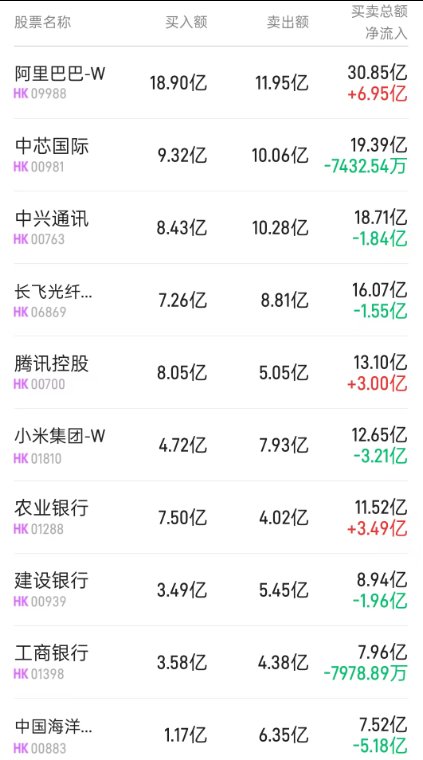
北水动向|北水成交净买入7.91亿 内银股分化芯片股遭抛售 北水抢筹美团超12亿港元
Zhi Tong Cai Jing· 2025-12-11 09:59
Group 1 - The Hong Kong stock market saw a net inflow of 791 million HKD from Northbound trading, with a net sell of 320 million HKD from the Shanghai Stock Connect and a net buy of 1.111 billion HKD from the Shenzhen Stock Connect [1] - The most bought stocks included Meituan-W (03690), Xiaomi Group-W (01810), and Beike-W (02423), while the most sold stocks were CNOOC (00883), Alibaba-W (09988), and SMIC (00981) [1] Group 2 - Alibaba-W (09988) had a net inflow of 6.95 billion HKD, with a total trading volume of 30.85 billion HKD, while it faced a net sell of 11.12 billion HKD [2] - Xiaomi Group-W (01810) experienced a net buy of 13.31 billion HKD, with a total trading volume of 22.60 billion HKD [3] - Meituan-W (03690) received a net buy of 12.79 billion HKD, with a total trading volume of 18.92 billion HKD [4] Group 3 - Beike-W (02423) saw a net buy of 6.47 billion HKD, amid discussions on mortgage interest subsidy policies that could stimulate housing demand [5] - Agricultural Bank (01288) had a net buy of 3.49 billion HKD, while Industrial and Commercial Bank (01398) and China Construction Bank (00939) faced net sells of 797.89 million HKD and 1.96 billion HKD respectively [5] - Semiconductor stocks faced selling pressure, with Huahong Semiconductor (01347) and SMIC (00981) experiencing net sells of 2.57 billion HKD and 4.03 billion HKD respectively [5] Group 4 - ZTE Corporation (00763) faced a net sell of 3.58 billion HKD, related to compliance investigations regarding the U.S. Foreign Corrupt Practices Act [6] - Tencent (00700) and CNOOC (00883) also experienced net sells of 1.15 billion HKD and 5.17 billion HKD respectively [7]



中酒协秘书长何勇:啤酒风味竞争 从满足口感到创造“心感”
Mei Ri Jing Ji Xin Wen· 2025-12-11 06:24
Core Insights - The 2025 CIBC China International Beer Technology Summit highlighted the importance of technological innovation in the beer industry, focusing on green brewing, smart equipment, and health-oriented beverages [1] - The Chinese beer industry is undergoing structural adjustments and upgrades, with a reported production of 19.04 million kiloliters in the first half of 2025, slightly down from 19.088 million kiloliters in the same period last year [1] - The beer market faces challenges such as personalized consumer demands, diverse flavor choices, fragmented distribution channels, and the global push for sustainability, necessitating innovation and high-end product development [1] Industry Trends - The beer industry is shifting from a focus on scale and speed to quality and efficiency, with a relatively stable competitive landscape compared to other alcoholic beverages [1] - Future technological advancements in the beer industry will focus on enhancing product quality, expanding flavor diversity, and integrating technology with culture to elevate industry value [2] - The intelligent transformation of the beer industry involves a comprehensive upgrade of the entire supply chain, merging traditional brewing methods with smart technologies [2] Market Dynamics - The competition in the beer market is fundamentally about expanding the breadth of flavors within the broader beverage alcohol market, requiring continuous technological innovation [2] - The value of beer must be presented through traceable technology systems and verifiable quality standards, with technology creating new cultural experiences for consumers [2]
小米集团-W(01810.HK):汽车业务实现扭亏 Q3业绩再创新高
Ge Long Hui· 2025-12-11 04:01
Core Viewpoint - Xiaomi Group reported significant growth in revenue and adjusted net profit for the first three quarters of 2025, indicating strong performance across various business segments [1] Financial Performance - In the first three quarters of 2025, Xiaomi achieved revenue of 340.37 billion yuan, a year-on-year increase of 32.5%, and adjusted net profit of 32.82 billion yuan, up 73.5% [1] - For Q3 2025, revenue reached 113.12 billion yuan, growing 22.28% year-on-year, with adjusted net profit hitting a record high of 11.31 billion yuan, an increase of 80.92% [1] Smartphone Segment - In Q3 2025, Xiaomi shipped 43.4 million smartphones, a year-on-year increase of 1.3%, maintaining a global market share of 13.6% [1] - The average selling price (ASP) of smartphones decreased by 3.6% to 1,062.8 yuan, leading to a 3.1% decline in smartphone revenue to 46 billion yuan [1] - The launch of the Xiaomi 17 series, featuring innovative designs, resulted in a 30% increase in sales compared to the previous generation [1] IoT and Consumer Products - In Q3 2025, revenue from IoT and consumer products reached 27.6 billion yuan, a year-on-year increase of 5.6%, despite a 15.7% decline in smart home appliance revenue [2] - The gross margin for IoT and consumer products improved by 3.2 percentage points, with expectations of further growth driven by high-end strategies [2] Automotive and AI Innovations - Revenue from automotive and AI innovation reached 29 billion yuan in Q3 2025, a remarkable year-on-year increase of 199.2%, with automotive revenue at 28.3 billion yuan, up 197.9% [3] - The total number of vehicles delivered in Q3 was 108,800, reflecting year-on-year growth of 173.4% [3] - The average ASP for vehicles reached 260,000 yuan, a 9.0% increase year-on-year, with a gross margin of 25.5%, up 8.4 percentage points [3] - The automotive segment achieved operational profitability for the first time, with an operating profit of approximately 700 million yuan [3] Profit Forecast - The company anticipates continued growth in adjusted net profit, projecting 44.6 billion yuan for 2025, 51.5 billion yuan for 2026, and 62.2 billion yuan for 2027, maintaining a "buy" rating [3]
质创未来 行稳致远 从宇通看中国商用车十四五答卷
Zhong Guo Qi Che Bao Wang· 2025-12-11 03:12
Core Insights - The article highlights the transformation of China's commercial vehicle industry over the past five years, emphasizing the shift from manufacturing to intelligent manufacturing, and from traditional power to new energy leadership. Yutong serves as a model for this transformation through its strategic focus on electrification, intelligent networking, high-end development, and internationalization [2]. Innovation and Competitive Edge - Innovation is identified as the primary driver of development, with Yutong leading in the new energy commercial vehicle sector since 1997, launching its first pure electric bus in 1999. The company has consistently increased R&D investment, averaging over 5% of revenue annually, and has built a research team of over 3,000 people [2]. - Yutong has achieved significant breakthroughs in core technologies related to batteries, motors, and control systems, leading to industry-leading standards and reliability. The company has been awarded the National Science and Technology Progress Award for the fourth time [2]. - The introduction of a proprietary electric platform, "Rui Control E Platform," has resulted in a 10% increase in driving range and a 20% reduction in operating costs, showcasing Yutong's systematic strategic layout and platform construction [3]. Product Competitiveness - Yutong's heavy-duty truck, "Yuanjie T800," features an 800 kWh battery, extending its driving range to over 550 kilometers, while its light-duty trucks have achieved breakthroughs in energy density and electric chassis technology [4]. High-End Manufacturing - Yutong is committed to high-end manufacturing, exemplified by its T7 model, which has served significant national events for over a decade, breaking the monopoly of joint venture brands. The company has also achieved 100% localization of electric airport shuttle buses, exporting to over 30 countries [5]. - The Yutong Tianyu S12, designed for high-end tourism and business reception, incorporates 102 patents and sets new benchmarks in the high-end bus market, reflecting the company's transition from a follower to a standard-setter in the industry [5]. Internationalization - Yutong has exported over 120,000 buses to more than 100 countries, establishing a strong presence in high-end markets like Europe. The company employs a localized operational strategy, with a vast service network and rapid response capabilities [7]. - The company has transitioned from product output to technology output and solutions in over ten countries, integrating Chinese standards and technology into global supply chains [7]. Sustainable Development - Yutong aligns its development with national "dual carbon" goals, having sold over 240,000 new energy commercial vehicles globally, significantly reducing carbon emissions by 28.7 million tons [8]. - The company is leading in the logistics sector with its new energy heavy and light trucks, and its autonomous mining trucks are promoting safety and efficiency in the mining industry [8]. Future Outlook - Looking ahead, Yutong aims to deepen its domestic market presence and expand internationally while ensuring the autonomy of key industry chain segments. The company is poised to contribute further to the commercial vehicle industry's transformation towards green and intelligent solutions [9].

