人民币升值

Search documents
【十大券商一周策略】A股跨年行情已经启动,新的主线浮出水面
Xin Lang Cai Jing· 2025-12-28 15:19
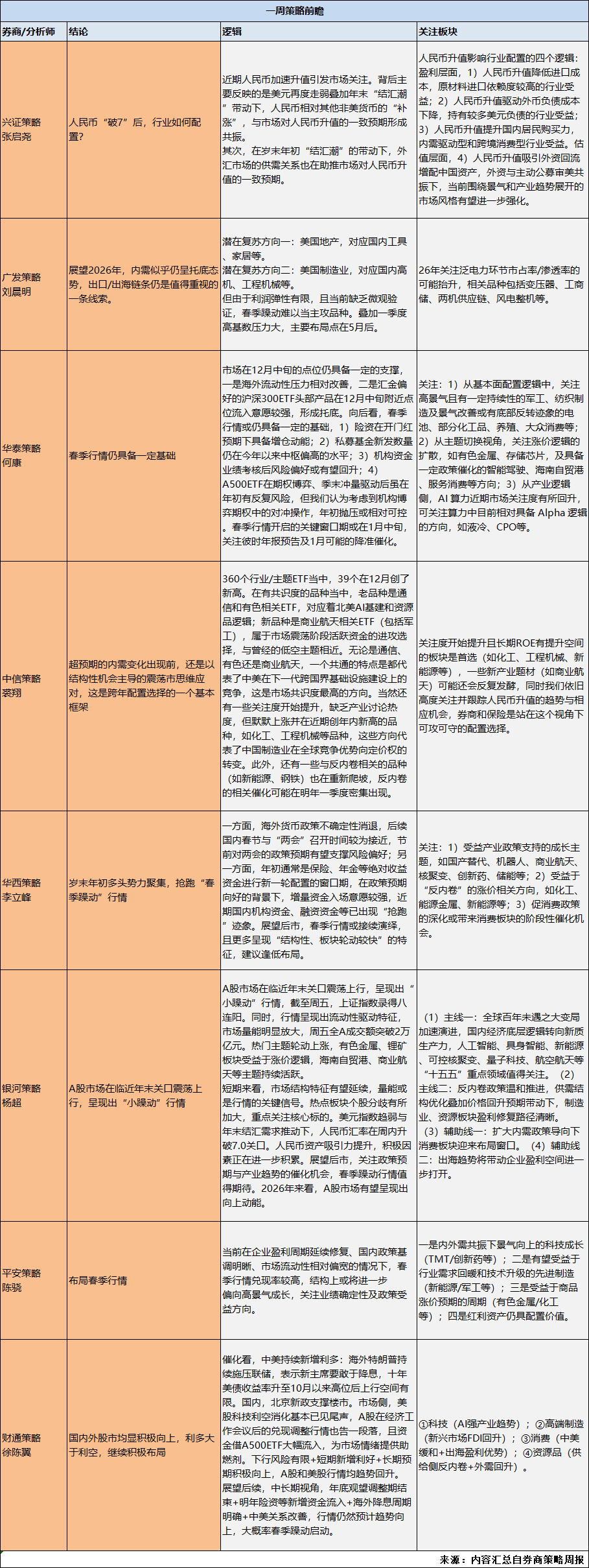
Core Viewpoint - The A-share market is expected to experience a spring rally driven by liquidity, policy expectations, and structural opportunities, with a focus on sectors like AI, commercial aerospace, and non-bank financials [5][10][12]. Group 1: Market Trends and Predictions - 39 out of 360 industry/theme ETFs reached new highs in December, with communication and non-ferrous metals being traditional favorites, while new themes like commercial aerospace are gaining traction [3]. - The A-share market is showing signs of a spring rally, supported by liquidity and positive policy expectations, with a focus on sectors such as technology and advanced manufacturing [5][10]. - The market is expected to maintain a high risk appetite due to favorable conditions, including a weak dollar and the upcoming Chinese New Year and Two Sessions [11][16]. Group 2: Sector Focus and Investment Opportunities - Key sectors to watch include AI, commercial aerospace, and non-ferrous metals, which are expected to benefit from structural changes and increased demand [10][12]. - The manufacturing sector, particularly in chemicals and engineering machinery, is showing signs of recovery and is expected to benefit from the shift in global competition [3][4]. - Non-bank financials, including insurance and brokerage firms, are positioned to benefit from the anticipated capital inflows and improved asset returns [9][12]. Group 3: Currency and Economic Factors - The appreciation of the RMB is expected to lower import costs and enhance domestic purchasing power, benefiting sectors reliant on imports and domestic consumption [7][9]. - The potential for significant capital inflows due to RMB appreciation could lead to a revaluation of Chinese assets, creating a favorable environment for investment [7][9]. - The overall economic environment is improving, with expectations of continued liquidity support and a stable policy backdrop, which is conducive to market growth [5][10].




【十大券商一周策略】A股跨年行情已经启动,新的主线浮出水面
券商中国· 2025-12-28 14:59
Group 1 - The article highlights that among 360 industry/theme ETFs, 39 reached new highs in December, with established sectors like telecommunications and non-ferrous metals reflecting North American AI infrastructure and resource logic, while new sectors like commercial aerospace are gaining attention during market fluctuations [2] - The focus is on structural opportunities in a volatile market, with sectors like chemicals, engineering machinery, and new energy being prioritized due to their long-term ROE potential, alongside emerging themes like commercial aerospace [3] - The article emphasizes the importance of the RMB appreciation trend and its implications for investment strategies, particularly in brokerage and insurance sectors [3] Group 2 - The article discusses favorable conditions for the spring market rally, driven by liquidity and investor expectations, with a focus on the A500 ETF and potential market fluctuations at year-end and early next year [4] - It notes that the RMB's recent strength, driven by corporate settlement demand and a favorable external environment, could lead to a capital market rally, benefiting sectors reliant on imported materials and those with significant foreign currency liabilities [6] - The article identifies new investment themes emerging in the commodity market and manufacturing sectors, particularly in AI and global manufacturing recovery, recommending investments in industrial resources and equipment exports [8] Group 3 - The article indicates that the A-share market has entered a cross-year rally phase, supported by optimistic institutional investor sentiment and favorable policy expectations [9] - It suggests that the spring market is likely to exhibit structural characteristics with rapid sector rotation, encouraging investors to adopt a low-buying strategy [13][14] - The article highlights the potential for a continued upward trend in the market leading up to the Spring Festival, with a focus on technology themes and non-bank financial sectors [15]

周末,全是利好!史诗级行情,刚刚宣布,暂停申购!
中国基金报· 2025-12-28 14:43
Key Points - The article discusses recent positive developments in the Chinese financial market, including government policies aimed at boosting fiscal spending and consumer support [3][4]. - The People's Bank of China emphasizes the need for a favorable policy environment to enhance long-term investments in the A-share market [5]. - The Shanghai Stock Exchange has introduced guidelines to support commercial rocket enterprises, indicating a focus on innovation in the aerospace sector [8][10]. - The market is experiencing a "small rally" with significant trading volume, particularly in sectors like metals and commercial aerospace [27]. Group 1: Government Policies - The Ministry of Finance plans to continue implementing a proactive fiscal policy in 2026, focusing on expanding fiscal spending and optimizing government bond tools [3]. - The government will support consumer goods through a subsidy program for replacing old products, aiming to stimulate consumption [4]. Group 2: Market Developments - The People's Bank of China reports on improving the investment environment for long-term funds in the A-share market, aiming for a healthy cycle between capital markets and the real economy [5]. - The Shanghai Stock Exchange has released guidelines for commercial rocket companies to facilitate their listing on the Sci-Tech Innovation Board, supporting the growth of the aerospace industry [8][10]. Group 3: Market Analysis by Securities Firms - CITIC Securities highlights the performance of ETFs, noting that sectors like telecommunications and aerospace are gaining traction due to their alignment with international infrastructure competition [15]. - Shenwan Hongyuan emphasizes the liquidity-driven nature of the current market rally, suggesting that the spring market conditions remain favorable [17]. - Guotai Junan identifies new investment themes emerging in commodity markets and the manufacturing sector, reflecting China's growing manufacturing advantages [19].

跨年行情如何布局?六大机构最新策略出炉
Xin Lang Cai Jing· 2025-12-28 14:15
Market Outlook - The A-share market is expected to continue a structural opportunity-driven volatile market approach as the year-end trading concludes, with key signals from trading volume [1][5] - The focus is on sectors with low holding concentration and potential for long-term ROE improvement, such as commercial aerospace and other trending themes [1][5] Fiscal Policy - The National Fiscal Work Conference has decided to continue implementing a more proactive fiscal policy in 2026, which includes expanding fiscal spending, optimizing government bond tools, and enhancing the effectiveness of transfer payments [2] Industrial Profit - From January to November, the total profit of large-scale industrial enterprises reached 66,268.6 billion yuan, showing a year-on-year growth of 0.1%, with cumulative growth maintained for four consecutive months since August [3] ETF Market - The total scale of domestic ETFs has reached a historical high of 6.03 trillion yuan, with stock ETFs exceeding 3.8 trillion yuan and cross-border ETFs over 930 billion yuan [4] Investment Strategies - Citic Securities suggests a focus on sectors with low holding concentration and rising market attention, such as chemicals, engineering machinery, and new energy, while also monitoring the trend of RMB appreciation [5] - Industrial sectors benefiting from RMB appreciation include AI hardware, advantageous manufacturing, and non-ferrous metals, as well as upstream resource products like steel and chemicals [6] - China Galaxy emphasizes that trading volume will be a key signal for market trends, recommending defensive sectors and focusing on new production capabilities in AI, renewable energy, and aerospace [7] Economic Expectations - The low-altitude economy is highlighted as a key investment theme, with expectations for a spring market rally in 2026 driven by stable macroeconomic conditions and abundant global liquidity [8] - Investment in infrastructure and real estate is anticipated to drive cyclical price increases, while service consumption is also recommended as a focus area [8]
A股分析师前瞻:多头势力聚集,“春季躁动”有望抢跑
Xuan Gu Bao· 2025-12-28 13:08
Core Viewpoint - Overall optimism remains among brokerage strategy analysts, with expectations for a "spring rally" as domestic policies and market conditions align favorably [1] Group 1: Market Trends - The A-share market is experiencing a "small rally" as it approaches year-end, with the Shanghai Composite Index recording eight consecutive days of gains [1] - Market liquidity is increasing, with total trading volume in the A-share market exceeding 2 trillion yuan on Friday [1][3] - Analysts suggest that the current market structure may continue, with trading volume being a key indicator of market trends [3] Group 2: Currency Impact - The recent appreciation of the RMB is drawing market attention, with four key implications for industry allocation: 1. Lower import costs benefiting industries reliant on imported raw materials [2] 2. Decreased foreign currency debt costs benefiting industries with significant USD liabilities [2] 3. Enhanced domestic purchasing power benefiting demand-driven and cross-border consumption industries [2] 4. Attraction of foreign capital back to Chinese assets due to RMB appreciation, potentially reinforcing market styles focused on economic trends [2][3] Group 3: Sector Focus - Analysts highlight several sectors for potential investment, including: - High-demand sectors such as military, textiles, and chemicals, which may show signs of recovery [3] - Industries benefiting from policy support, such as domestic substitution, robotics, and commercial aerospace [4] - Growth sectors like advanced manufacturing and technology, which are expected to benefit from economic recovery and policy clarity [5]
继续逢低布局春季行情
Haitong Securities International· 2025-12-28 13:03
Group 1 - The report emphasizes that the market is currently in a consolidation phase, with opportunities to buy on dips ahead of a potential spring rally. The A-share market has shown strength, with the Shanghai Composite Index rising by 1.9% and the ChiNext Index gaining 3.9% [1][8] - The A-share market's average daily turnover has rebounded to nearly RMB 2 trillion, driven by significant trading in the commercial aerospace sector and A500 ETFs, while the Hong Kong market turnover has declined to around HKD 160 billion due to the Christmas holiday [3][11] - The report notes that the commercial aerospace sector has absorbed market liquidity, accounting for 20% of total A-share trading, indicating a shift in market dynamics [3][11] Group 2 - The report highlights that the U.S. dollar index has declined by 0.7% to 98, with expectations for further Federal Reserve rate cuts, leading to a general appreciation of non-U.S. currencies, including the RMB, which has appreciated by 2.6% to 97.88 since July [2][9] - The report indicates that the one-year forward rate for the RMB has risen to 6.87, reflecting strengthened appreciation expectations, although the daily fixing remains around 7.036, suggesting a cautious approach from the PBOC regarding rapid appreciation [2][9] - The report discusses the significant rise in commodity prices, particularly in precious metals like silver and platinum, driven by a weaker U.S. dollar and geopolitical tensions, indicating a shift in capital towards metals [2][10] Group 3 - The report suggests that A-shares may attempt another upward push, with Hong Kong equities potentially following suit. However, further upside in A-shares will face resistance near annual highs, and a clean breakout is likely to be challenging without a meaningful expansion in turnover [4][14] - The report recommends focusing on domestically oriented consumption and non-bank financials that are trading at low levels and offer defensive characteristics in the near term. It also suggests that a market pullback could provide an opportunity to increase exposure to technology sectors [4][14]
A股正在挑战前高!一股坚韧的力量正在助推
雪球· 2025-12-28 13:00
Group 1 - The market continues to recover, with the Shanghai Composite Index reaching 3963 points [3] - Recent afternoon surges indicate that buying funds are waiting for short sellers to drive prices down before accumulating shares [4] - The recent appreciation of the RMB beyond 7 signifies a stronger willingness to exchange currency compared to previous years, which may support the economy [7] Group 2 - The RMB's future direction is anticipated to stabilize around 6.9, as rapid appreciation could negatively impact exports and technological innovation [8][10] - The strong willingness to exchange currency this year is mitigated by many companies having hedged their positions, limiting potential losses [10][12] - The monthly customer option buying volume in the banking sector has reached 30 billion USD, doubling from last year [11] Group 3 - Signals to boost domestic demand are becoming more pronounced, with both spot and forward exchange rates showing significant appreciation [15][16] - The current low volatility environment during the RMB's appreciation suggests that large reversals are unlikely, similar to slow bull markets in equities [25][28] - The revaluation period for Chinese assets is expected to open officially [30] Group 4 - The relaxation of purchase restrictions in Beijing is seen as beneficial for the real estate sector, but not necessarily for housing prices [31] - The true intention behind the government's focus on "investing in people" can be understood by observing rental prices, which are leading indicators for housing stability [35][36] - The continuous decline in the REITs index indicates significant rental pressure [37] Group 5 - The A500 ETF has seen increased trading volume, with the leading A500 ETF's transaction volume reaching 53.3 billion [40] - The current market volatility has decreased, suggesting that many short positions in derivatives may convert to long positions in the future [40] - The investment landscape is shifting towards sectors like military and robotics, with insurance stocks reaching new highs and showing a 33% increase this year [40]

黄鼠狼给鸡拜年!美方“劝”人民币升值,背后藏着2.0算计?
Sou Hu Cai Jing· 2025-12-28 12:12
Group 1 - The core argument suggests that the International Monetary Fund (IMF) is advocating for a gradual appreciation of the Renminbi (RMB) by about 5% annually, which may undermine China's export advantages and manufacturing core [1][6][10] - The recent appreciation of the RMB against the US dollar, with a cumulative increase of 3.44% by December 15, has led to speculation among investors about currency arbitrage opportunities [4][14] - The IMF's suggestion is seen as a strategy to weaken China's economic position, reminiscent of the Plaza Accord that targeted Japan in the 1980s, which ultimately led to economic challenges for Japan [6][8][19] Group 2 - China's trade surplus reached an unprecedented $1.08 trillion in the first 11 months of 2025, indicating strong global confidence in its manufacturing capabilities [10][12] - The proportion of US Treasury bonds in China's foreign reserves has decreased to $688.7 billion, the lowest in 17 years, reflecting a strategic shift towards reducing dependency on the US dollar [12][14] - The RMB's recent appreciation is attributed to external factors such as a declining US dollar index and internal factors like trade surplus and year-end settlement demands from export companies [14][15] Group 3 - In the current RMB appreciation environment, Chinese assets are becoming more attractive, leading to a trend of capital inflow into domestic markets [17] - The Chinese government maintains control over economic policies, focusing on consumption-driven domestic demand, which suggests a stable yet slightly stronger RMB to attract capital [17][19] - Long-term strategic investments in sectors like advanced manufacturing and new energy are emphasized as the most viable opportunities under the RMB appreciation scenario [19]
国金证券:A股新的主线浮出水面 把握当下切换窗口期
智通财经网· 2025-12-28 11:49
Group 1 - The core viewpoint is that a new investment theme for 2026 is emerging in commodity markets, real industry chains, and foreign exchange markets, driven by a scenario where investment exceeds consumption [1] - The report recommends focusing on industrial resource products that resonate with AI investment and global manufacturing recovery, including copper, aluminum, tin, lithium, crude oil, and oil transportation [1] - It also highlights the Chinese equipment export chain with global comparative advantages, confirming a cyclical bottom, including sectors like power grid equipment, energy storage, lithium batteries, photovoltaics, engineering machinery, and commercial vehicles [1] Group 2 - The A-share market is experiencing a gradual upward trend, with the cross-year market rally starting, moving beyond a single narrative focused on AI to a broader range of themes including domestic demand and new industry topics [2] - The price increase chain has become a market focus, driven by rising raw material prices and the effects of anti-involution policies, leading some companies to reduce production and jointly raise prices [3] - The ongoing global manufacturing recovery is expected to continue with investment outpacing consumption, while the relationship between AI investment and metal prices is compared to past trends in coal and new energy [4] Group 3 - The new external circulation pattern is leading to a new cycle of RMB appreciation, primarily driven by the weakening dollar and seasonal capital inflows, with expectations of a recovery in China’s export resilience [5] - The RMB's appreciation is alleviating cost pressures from rising prices of commodities and integrated circuits, benefiting sectors such as communication equipment, environmental governance, aviation, electronics, and lithium batteries [6] - Historical trends indicate that during periods of RMB appreciation, the sales gross margin of companies exposed to high external demand typically experiences a slight increase followed by a decrease, suggesting a nuanced impact on export competitiveness [6]

惊世阳谋!人民币持续走强,突围战悄然打响,全球资本重新站队
Sou Hu Cai Jing· 2025-12-28 11:37
Core Viewpoint - The recent appreciation of the Chinese yuan, breaking the 7.0 mark against the US dollar, signifies a shift in trade dynamics and reflects the underlying geopolitical strategies among major economies [1][3][4]. Group 1: Economic Context - The yuan's rise is attributed to a record trade surplus and strong export performance, leading to increased foreign exchange earnings [6]. - The appreciation is not merely a result of market supply and demand but is part of a calculated strategy in the context of global power dynamics [4][6]. Group 2: Geopolitical Dynamics - The ongoing competition among the US, Europe, and China has intensified, with the US recognizing China's advancements in high-end technology and manufacturing capabilities [10]. - The US has initiated a process of de-globalization, attempting to bring manufacturing back home through tariffs and technology restrictions, which has led to a coordinated depreciation of the yuan by Western economies [12][10]. Group 3: Strategic Responses - In response to external pressures, China has opted for a proactive strategy of allowing the yuan to appreciate, countering the intended effects of Western economic policies [14][20]. - This strategy aims to mitigate the impact of currency appreciation on export profits by encouraging price increases, thus protecting domestic businesses from a price war [16][20]. Group 4: Industry Implications - The strategy of price increases is seen as a means to strengthen leading industry players and promote technological advancements, as weaker firms are likely to be eliminated in the process [22][24]. - By allowing for moderate price increases, China aims to provide breathing room for Western manufacturers, thereby avoiding a complete collapse of their industries and fostering a more stable competitive environment [26][30]. Group 5: Market Reactions - Despite the yuan's appreciation, Chinese exports remain robust, with trade surpluses continuing to rise, indicating a persistent reliance on Chinese goods by Western economies [30][33]. - The current market dynamics have led to increased demand for commodities, with prices for metals like copper and aluminum reaching new highs, driven by Western countries' stockpiling in response to supply chain vulnerabilities [36][40]. Group 6: Future Outlook - The ongoing developments in the yuan's valuation and China's strategic positioning in global trade are expected to continue shaping the landscape of international finance and economic relations [42][44]. - The narrative of China's manufacturing resilience and strategic foresight is likely to play a significant role in its future economic trajectory and global standing [44].