消费复苏

Search documents
国庆中秋假期消费亮点纷呈,食品饮料ETF天弘(159736)连续11日“吸金”累计超2.1亿元,盘中获净申购200万份
2 1 Shi Ji Jing Ji Bao Dao· 2025-10-09 02:30
Group 1 - The consumer sector experienced fluctuations, with the Tianhong Food and Beverage ETF (159736) declining over 1.5%, while stocks like Yangyuan Beverage rose over 9% [1] - The Tianhong Food and Beverage ETF has seen a net inflow of over 210 million yuan over 11 consecutive trading days, with a net subscription of 2 million units during the trading session [1] - The ETF closely tracks the CSI Food and Beverage Index, which selects stocks from the beverage, packaged food, and meat industries [1] Group 2 - During the National Day and Mid-Autumn Festival holiday, key retail and catering enterprises reported a 2.7% year-on-year increase in sales [2] - Foot traffic and sales in monitored pedestrian streets increased by 8.8% and 6.0% respectively during the holiday period [2] - Sales of green organic food surged by 27.9%, while smart home products and domestic fashion clothing saw increases of 14.3% and 14.1% respectively [2] Group 3 - As the impact of second-quarter liquor consumption policies diminishes, the demand for liquor and catering supply chains is entering a recovery phase [3] - Positive signals are expected from the supply side, including a consensus among liquor-producing regions to slow production [3] - The fourth quarter is anticipated to show improvement in key indicators such as the price of Feitian Moutai, driven by macro policy changes and low expectations in the capital market [3]
国信证券:看好食饮行业四季度投资机会 建议关注白酒、餐饮供应链(预制菜)等方向
智通财经网· 2025-10-09 02:21
Core Viewpoint - Guosen Securities suggests that the fourth quarter will see concentrated macro policies, with low baseline fundamentals and low market expectations, indicating potential stock price increases due to any changes in supply and demand, particularly in sectors sensitive to policies like liquor and the catering supply chain (pre-made dishes) [1] Market Review - The food and beverage sector has underperformed this year due to insufficient domestic demand and consumer confidence, with A-shares and H-shares rising by 1% cumulatively, while A-share food and beverage (Shenwan) fell by 4.7%, significantly lagging behind the CSI 300 (+17.9%); H-share food and beverage (Shenwan) increased by 29.5%, underperforming the Hang Seng Index (+34%) [2] Category Differentiation - Since the second quarter, liquor stocks have been under pressure due to policy impacts, with Kweichow Moutai and liquor (excluding Kweichow Moutai) down by 5.5% and 5.8% respectively since the beginning of the year; however, mass-market products show signs of improvement, with leading brands rising by 13.4% in the first three quarters, and beverages (e.g., Nongfu Spring, Dongpeng Beverage) and snacks (e.g., Wei Long, Yanjinpuzi) performing the best [3] Reform Empowerment - Many companies have actively engaged in channel, product, and organizational reforms this year, leveraging digitalization to reshape the industry ecosystem, with emerging trends such as maternity subsidies, coconut water, sugar-free tea, konjac snacks, sparkling yellow wine, and new models like Zhenjiu Lidu and Jiu Gui Jiu's Free Love, indicating enhanced bottom signals for the sector [4] Outlook for Q4 - As the impact of liquor consumption policies from the second quarter gradually weakens, demand in liquor and catering supply chains is expected to enter a recovery phase, with positive signals emerging from the supply side, such as a consensus among liquor-producing regions on slowing production; Guosen Securities believes that key indicators like the price of Feitian Moutai will show improvement in the fourth quarter [5]

华泰证券:白酒行业双节表现平淡,压力边际去化
Xin Lang Cai Jing· 2025-10-09 00:04
Core Viewpoint - The liquor industry is experiencing a continued adjustment trend during the National Day and Mid-Autumn Festival, with overall pressure persisting and a divergence in performance among companies [1] Industry Summary - The industry is showing a year-on-year decline in sales, although some regions have seen slight improvements on a month-on-month basis [1] - The consumption scenarios are varied, with a recovery in mass banquet consumption, while government and business consumption remains under pressure, and gift consumption has decreased [1] - In terms of price segments, high-end liquor is experiencing a weak recovery in demand during the peak season, while mass-priced products are leading in sales performance; the next-highest price segment continues to face significant pressure and divergence [1] - Current industry inventory levels are stabilizing, with some liquor companies marginally reducing inventory to alleviate operational pressure [1] Outlook - Major liquor companies are focusing on long-term healthy development during this adjustment phase, with fundamentals stabilizing; combined with promotional policies supporting consumption, the industry may gradually enter a phase of positive recovery [1] - It is recommended to consider bottom-fishing in strong fundamental leading companies [1]

一线私募把脉A股后市 多元配置实现攻守兼备
Zhong Guo Zheng Quan Bao· 2025-10-08 22:34
Core Viewpoint - The A-share market is expected to perform positively in the fourth quarter, supported by favorable external conditions from overseas markets and resilient domestic consumption data during the recent holiday [1][2]. Group 1: Overseas Market Influence - The overall performance of overseas markets during the holiday has boosted investor sentiment in the A-share market, with private equity firms noting a positive emotional momentum [2]. - Factors such as the U.S. government shutdown, geopolitical developments, and record-high gold prices are seen as having a generally positive impact on the A-share market [2][3]. Group 2: Domestic Economic Indicators - The recent Golden Week holiday showcased strong consumer resilience, with impressive travel and consumption data, which adds warmth to the economic fundamentals [1][2]. - The stable release of domestic policies and economic data around the holiday is expected to lack major variables that could significantly impact the market [2]. Group 3: Investment Strategies - Private equity firms are adopting a balanced approach to stock selection, emphasizing the importance of both aggressive and defensive strategies [4]. - Some firms are increasing their positions and optimizing their portfolios, anticipating a recovery in market sentiment post-holiday [4][5]. Group 4: Focus on Technology and Growth Sectors - The technology growth sector remains a focal point for many private equity firms, with expectations for significant opportunities in areas such as artificial intelligence and high-end manufacturing [5][6]. - The upcoming third-quarter earnings reports are anticipated to present opportunities for stocks that performed well [5][6]. Group 5: Market Trends and Opportunities - The market is expected to maintain its focus on key themes such as the internet, domestic semiconductor industry, and innovative pharmaceuticals [6]. - There is a belief that both technology growth and value stocks will perform well, with potential for revaluation in consumer and cyclical sectors [6][7].
北京时间9:30,中国股市逼空准时开始?
凤凰网财经· 2025-10-08 12:57
Group 1 - The article highlights significant global market movements during the National Day holiday, including a government shutdown in the US, a surge in Japan's stock market, and gold prices reaching historical highs [1] - Japan's Nikkei 225 index broke the 48,000-point mark for the first time on October 6, becoming the best-performing major index globally, influenced by the election of a new president in the ruling Liberal Democratic Party [2] - The US stock market saw slight gains, with the Nasdaq up 0.57%, Dow Jones up 0.44%, and S&P 500 up 0.39%, driven by strong performance in the semiconductor sector due to a significant agreement between AMD and OpenAI [6] Group 2 - Gold prices surged, with spot gold breaking the $4,000 mark for the first time, reflecting a nearly $1,400/ounce increase this year, a rise of over 52% [8] - The People's Bank of China announced a 1.1 trillion yuan reverse repurchase operation to enhance liquidity, marking a significant policy move to support the market [10] - A new government procurement policy will provide a 20% price evaluation advantage for domestically produced products starting January 1, 2026, aimed at fostering a competitive procurement market [11] Group 3 - The electric vehicle and energy storage sectors saw increased activity, with record charging volumes and strong demand for energy storage cells, although BYD's September sales declined to 396,300 units [12] - Meta's AI glasses have sold out in retail stores, indicating strong market demand, with plans for increased sales points to meet supply [14] - Longfeng Pharmaceutical's stock surged over 230% on its debut, attracting investor attention despite a general market downturn [15] Group 4 - Private equity firms maintain an optimistic outlook for the A-share market post-holiday, focusing on technology growth as a core investment theme [16] - October's "golden stocks" list from brokers features nearly 200 stocks, with Zhaoyi Innovation receiving multiple recommendations, indicating a focus on technology and consumer recovery sectors [17]


2025年四季度食品饮料行业投资策略:底部蓄能,强者恒强
Guoxin Securities· 2025-10-08 06:52
Core Conclusions - The report emphasizes that the food and beverage industry is currently at a bottoming phase, with strong players continuing to thrive [4] - The market has underperformed due to weak domestic demand and consumer confidence, with A-share food and beverage sector down 4.7% year-to-date, while H-share food and beverage sector increased by 29.5% [4] - There is a notable divergence among product categories, with alcoholic beverages facing pressure while mass-market products show signs of improvement, particularly in leading brands [4] Market Indicators - The trading volume, open interest, and valuation of the food and beverage sector are at historically low levels, with the sector's trading volume in A-shares dropping below 2% [9][10] - The price-to-earnings (PE) ratio for food and beverage has been declining since 2021, with categories like liquor and beer at historically low percentiles [12][16] Fundamental Analysis - The report discusses the need for a top-down approach to assess the investment value of leading companies like Kweichow Moutai, which holds a 31% weight in the food and beverage sector [27] - A bottom-up approach is also suggested to identify rapidly growing segments or companies in recovery [27] Company Recommendations - The report recommends focusing on policy-sensitive sectors such as liquor and the restaurant supply chain, highlighting companies like Kweichow Moutai, Luzhou Laojiao, and Haidilao [4] - Strong brands in the mass-market segment are also recommended, including Nongfu Spring, Dongpeng Beverage, and Yili Group [4] Industry Outlook - The report anticipates a recovery in liquor consumption as the impact of recent policies diminishes, with positive signals expected from the supply side [4] - The fourth quarter is projected to see improvements in key indicators for the liquor sector, including the price of Moutai [4] Performance Forecast - For Q3 2025, Kweichow Moutai is expected to generate revenue of 1,863.3 billion yuan, reflecting a 7% year-on-year increase, while Luzhou Laojiao is projected to see a 10% decline in revenue [49][50] - The report provides detailed forecasts for various companies, indicating expected revenue and profit changes for the upcoming quarters [49][50]






晨会纪要:对近期重要经济金融新闻、行业事件、公司公告等进行点评-20250930
Xiangcai Securities· 2025-09-30 01:48
Industry Overview - In August, the total retail sales of consumer goods reached 39,668 billion yuan, growing by 3.4% year-on-year. Excluding automobiles, retail sales amounted to 35,575 billion yuan, with a growth of 3.7% [2] - From January to August, the total retail sales of consumer goods were 323,906 billion yuan, increasing by 4.6%. Excluding automobiles, retail sales were 292,643 billion yuan, with a growth of 5.1% [2] - By consumption type, in August, the retail sales of goods were 35,172 billion yuan, growing by 3.6%, while catering revenue was 4,496 billion yuan, increasing by 2.1% [2] E-commerce and Online Retail - From January to August, the online retail sales reached 99,828 billion yuan, growing by 9.6%. Among this, the physical goods online retail sales were 80,964 billion yuan, with a growth of 6.4%, accounting for 25.0% of total retail sales [3] - Categories such as food, clothing, and daily necessities saw growth rates of 15.0%, 2.4%, and 5.7% respectively [3] Consumer Trends - The consumer market in China is showing a moderate recovery, with a clear structural characteristic in consumption growth. Online channels are significantly driving this growth, and service consumption remains active [3] - The beauty and personal care sector is experiencing a shift towards functional skincare, domestic brands, and premium products, with leading brands achieving high growth despite market challenges [4] Investment Opportunities - Recent additions to the Hong Kong Stock Connect list include several retail and light manufacturing stocks, which may see increased liquidity and trading opportunities [5] - The beauty care industry is witnessing a shift towards rational consumption, with consumers focusing more on product quality and cost-effectiveness, benefiting domestic brands [5] - The upcoming National Day and Mid-Autumn Festival holidays are expected to boost the tourism retail sector, with a focus on online travel platforms, theme parks, and chain hotels [6] Recommendations - Maintain an "overweight" rating on the retail industry, with a focus on newly added Hong Kong stocks in the retail sector and domestic beauty brands during the Double Eleven pre-sale period [6]
天风证券:消费板块复苏周期抬头 重视恒生互联网
Zhi Tong Cai Jing· 2025-09-29 01:53
Market Performance Analysis - The market is experiencing a short-term overheating phase driven by increased trading activity after reaching new highs, with a recommendation for cautious investment strategies [1][4] - Historical data shows that the market typically performs poorly in the days leading up to the National Day holiday, with a median return of -0.81% in the five trading days before the holiday, while the first phase after the holiday shows a strong median return of 2.27% [1][2] Index and Style Performance - Major indices showed weak performance before the holiday, with only the ChiNext Index recording a positive return of 0.34%, while small-cap indices faced the largest declines [2] - Post-holiday, all major indices experienced positive returns, with the ChiNext Index leading in the first phase, followed by a general pullback in the second phase, and a resurgence of small-cap stocks in the third phase [2] - In terms of style indices, only the consumer sector recorded a positive return before the holiday, while all styles saw gains afterward, particularly growth and financial sectors [2] Industrial Profit Trends - Industrial enterprise profits saw a significant year-on-year increase in August, with cumulative profits turning positive, indicating a recovery in the industrial sector [3] - The profit margins in mining, manufacturing, and public utilities showed slight increases compared to the previous month, reflecting a positive trend in industrial profitability [3] Investment Strategy Recommendations - The investment focus should be on three main areas: breakthroughs in AI technology, valuation recovery in consumer stocks, and the rise of undervalued dividend stocks [4] - The core factor for investing in the consumer sector is valuation, with current low valuations, declining interest rates, and policy support indicating a potential recovery phase, albeit weak [4]

8月份社会消费品零售总额增长3.4%:商贸零售行业周报-20250928
Xiangcai Securities· 2025-09-28 10:57
Investment Rating - The industry investment rating is maintained at "Overweight" [2] Core Insights - The retail sector experienced a 4.32% decline last week, underperforming the CSI 300 index by 5.39 percentage points [4][9] - The current Price-to-Earnings (PE) ratio for the retail sector is 40.68X, down 1.85 percentage points from the previous week, with a one-year range of 27.98X to 43.58X [5][17] - The retail sales of consumer goods in August reached 39,668 billion yuan, growing by 3.4% year-on-year, with significant contributions from online channels and service consumption [6][20] Summary by Sections Industry Performance - The retail sector's index closed at 2,384.72 points, ranking 29th among Shenwan's primary industries [4][9] - The sector's absolute return over the past 12 months is 38.0%, while the relative return is 9.7% [3] Industry Valuation - The current Price-to-Book (PB) ratio is 1.96X, with a one-year range of 1.36X to 2.1X [5][18] Industry Dynamics - In August, retail sales of consumer goods grew by 3.4%, with a total of 39,668 billion yuan, and online retail sales increased by 9.6% [6][20] - The beauty and personal care segment showed a mild recovery, with retail sales reaching 34.9 billion yuan in August, up 5.1% year-on-year [21] Investment Recommendations - The report suggests focusing on high-end domestic beauty brands and tourism-related retail sectors as potential investment opportunities [7][24] - The upcoming Double Eleven shopping festival is expected to boost sales for domestic beauty brands, particularly high-end products [24][25]
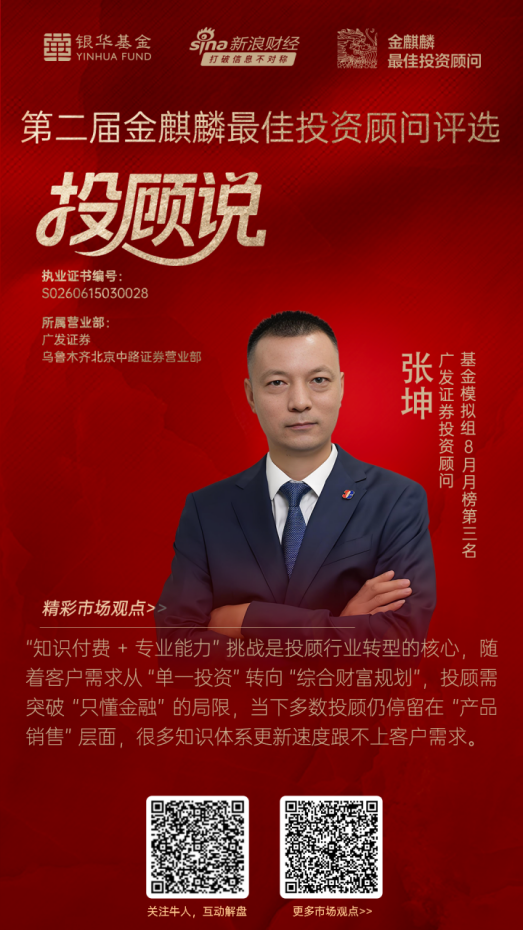
【金麒麟优秀投顾访谈】广发证券投顾张坤:模拟组合采取“优选行业+龙头标的+分散配置”策略
Xin Lang Zheng Quan· 2025-09-25 02:40
Group 1 - The core viewpoint of the article highlights the ongoing "Second Golden Unicorn Best Investment Advisor Selection" event, emphasizing the growth of China's wealth management industry and the critical role of investment advisors in asset allocation [1] - The event aims to provide a platform for investment advisors to showcase their capabilities, expand services, and enhance skills, thereby promoting the healthy development of the wealth management sector in China [1] - The article mentions that investment advisors face both opportunities and challenges in the current market environment, necessitating a focus on improving their internal competencies [1] Group 2 - Zhang Kun, an investment advisor from Guangfa Securities, achieved third place in the public fund simulation portfolio ranking for August, demonstrating effective investment strategies [2] - The investment strategy employed by Zhang Kun is based on "selecting industries + leading stocks + diversified allocation," which is crucial for achieving high returns [2] - Zhang Kun notes that the current market is characterized by a "weak economic recovery and strong policy support," with the dual drivers of "valuation repair + profit improvement" remaining intact [2] - The focus for future market opportunities is on "technology upgrades" and "consumption recovery," particularly in sectors with "policy barriers + technological barriers" such as semiconductors and AI computing [2]