流动性

Search documents
经济前瞻指标小幅回升,因子选择略偏向均衡——量化资产配置月报202510
申万宏源金工· 2025-10-13 08:01
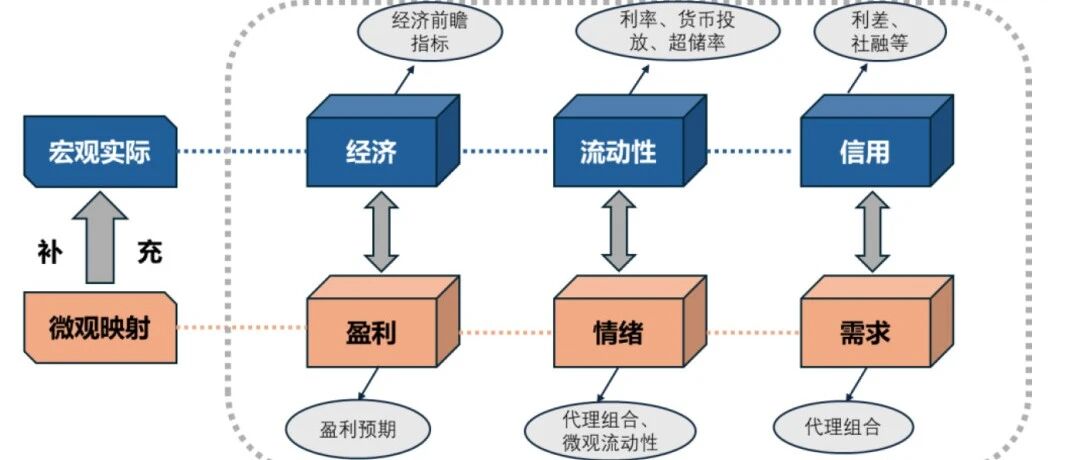
Group 1 - The article emphasizes a balanced approach to factor selection, integrating macroeconomic quantitative insights with factor momentum to identify resonant factors while adjusting for discrepancies between macro and micro indicators [1] - Current macroeconomic indicators show signs of economic recovery, slightly loose liquidity, and improved credit metrics, leading to a revised outlook of economic improvement, weak liquidity, and loose credit [1] - The article presents a table summarizing the performance of various factors across different indices, indicating that growth factors remain strong in the CSI 300, while the CSI 500 shows a more balanced factor selection [2][3] Group 2 - Economic leading indicators are beginning to rise, with the PMI and new orders showing increases, suggesting a slight upward trend in economic activity expected to continue into early 2026 [5][9] - The liquidity environment is assessed as slightly loose despite rising interest rates, with a comprehensive liquidity signal indicating a mixed outlook [11][15] - Credit indicators are showing weakness, with a slight positive shift in overall credit metrics, indicating a complex credit environment [15][16] Group 3 - The article suggests a preference for asset allocation towards gold due to strong momentum, while equity allocations are slightly reduced, reflecting a cautious stance on A-shares [16] - The focus of market attention is shifting from liquidity to economic indicators, with recent trends indicating a growing concern for economic performance over liquidity conditions [17] - Industry selection is advised to favor sectors sensitive to economic changes but less affected by liquidity, with public utilities and coal being highlighted as top sectors based on their sensitivity scores [19]

流动性周报:避险情绪,是追是止?-20251013
China Post Securities· 2025-10-13 03:20
Group 1: Report Overview - Report Type: Fixed Income Report - Release Date: October 13, 2025 - Analyst: Liang Weichao - SAC Registration Number: S1340523070001 - Email: liangweichao@cnpsec.com [1][2] Group 2: Investment Rating - No specific industry investment rating is provided in the report. Group 3: Core Viewpoints - The bond market is expected to move in a volatile manner in the fourth quarter. The 30 - 10 and 10 - 1 year Treasury yield spreads have reflected the risk preference repair, and the current bond market has allocation value. Supply pressure is expected to ease, there may be opportunities for monetary easing, and redemption pressure will persist. The bond market may alternate between repair and adjustment, with repair driven by allocation value and adjustment due to redemption pressure. If there is an opportunity for monetary easing, the emotional repair will accelerate, followed by faster unwinding and selling [3][10]. - After the holiday, liquidity enters the seasonal easing window at the beginning of the quarter. The marginal easing of the capital market has intensified, and the current capital price has fallen to the lowest level in the same period of history, with the central level dropping back to the policy rate. The continued decline in capital prices has promoted the warming of easing expectations and the repair of bond market sentiment [3][10]. - The short - end is in a high - allocation value range, and the long - short term spread has fully priced in the risk preference repair. The current pricing level is close to the historical average, so the long - short term spread is reasonably priced, which can control the risk of further upward movement of the long - end. The downward drive of the long - end depends on the decline of risk preference or the opportunity of monetary easing [3][12]. - Recently, the risk - aversion sentiment has increased, and bond market trading is "better to stop than to chase". The risk - aversion sentiment comes from international geopolitics with high uncertainty, the disturbance of redemption problems still exists during the market repair, and the yield is about to fall to the chip - intensive area. Therefore, although the bond market has recovered under the drive of risk - aversion sentiment, the yield is unlikely to return to the state of rapid decline, and chasing the rise requires caution [4][14]. Group 4: Summary by Directory 1. Is it time to chase or stop the risk - aversion sentiment? - **Market Outlook**: The bond market in the fourth quarter may move in a volatile manner. The yield spreads have reflected risk preference repair, and the market has allocation value. Supply pressure may ease, there may be monetary easing opportunities, and redemption pressure will continue. The market may alternate between repair and adjustment [10]. - **Liquidity Analysis**: After the holiday, liquidity enters the seasonal easing window at the beginning of the quarter. The capital price has fallen to the lowest level in the same period of history, and the continued decline has promoted the warming of easing expectations and bond market sentiment. This is related to the calendar effect of funds and the central bank's liquidity management [10]. - **Short - end and Term Spread Analysis**: The short - end is in a high - allocation value range as the risk of capital tightening is low. The long - short term spread has fully priced in the risk preference repair, and the current pricing is close to the historical average, which can control the long - end upward risk. The long - end downward drive depends on risk preference decline or monetary easing [12]. - **Risk - aversion and Trading Advice**: The risk - aversion sentiment comes from international geopolitics with high uncertainty. The redemption problem still disturbs the market, and the yield is about to fall to the chip - intensive area. Bond market trading is "better to stop than to chase" [14][15].
铝:风险点聚焦流动性及衰退主题,氧化铝:重心下移铸造,铝合金:跟随电解铝
Guo Tai Jun An Qi Huo· 2025-10-13 02:38
2025 年 10 月 13 日 铝:风险点聚焦流动性及衰退主题 氧化铝:重心下移 铸造铝合金:跟随电解铝 王蓉 投资咨询从业资格号:Z0002529 wangrong2@gtht.com 王宗源(联系人) 期货从业资格号:F03142619 wangzongyuan@gtht.com 所 铝、氧化铝、铸造铝合金基本面数据更新 期 货 研 究 期货研究 【综合快讯】 1. 美国 9 月 CPI 报告发布时间定于 10 月 24 日,比原定晚 9 天。根据美国劳工统计局,重磅的美国 9 月 CPI 报告将于 10 月 24 日美国东部时间上午 8 点 30 分发布,比原定时间推迟了 9 天。最新的 9 月 CPI 发 布时间,也赶在了美联储 10 月 28 日至 29 日的 FOMC 政策会议前发布。(华尔街见闻) 2. 官方报告未公布,高盛预计美国首申失业金人数升至 23.5 万。高盛经济学家 Jan Hatzius 等人在最新 的研报中表示,截至 10 月 4 日当周,美国首次申请失业金人数增加到了 23.5 万,高盛估算的前周首申失业 金人数约为 22.4 万。(华尔街见闻) | | | T | T-1 ...
节后买断式逆回购操作释放积极信号,资金利率或低位运行
Xin Hua Cai Jing· 2025-10-13 02:03
Group 1 - The People's Bank of China (PBOC) conducted a 1.378 trillion yuan 7-day reverse repurchase operation at an interest rate of 1.40%, maintaining the previous rate, resulting in a net injection of 1.378 trillion yuan due to no reverse repos maturing on that day [1] - From September 28 to October 11, the central bank's reverse repo net withdrawal reached 1.3304 trillion yuan, with a significant operation of 1.1 trillion yuan 3-month reverse repos announced on October 9, contrasting with a net injection of 300 billion yuan for the month [1] - Despite the large-scale reverse repos maturing after the holiday, funding prices gradually returned to pre-quarter-end levels, with overnight funding rates dropping to 1.33%, down 21 basis points from before the holiday [1] Group 2 - The upcoming week (October 13-17) will see a decrease in reverse repo maturities to 1.021 trillion yuan, with significant amounts maturing on Thursday and Friday, and a total of 8 billion yuan 3-month reverse repos maturing on Tuesday [2] - Analysts expect the funding environment to remain loose, as the central bank's proactive measures and limited government bond net payments will help mitigate external disturbances [2] - The liquidity test in October is anticipated to be concentrated at the end of the month, with tax payment deadlines delayed to October 27, coinciding with the month-end liquidity pressure [3] Group 3 - The PBOC's liquidity injection tools have shifted towards longer-term MLF and reverse repos since the third quarter, reducing the necessity for frequent short-term operations [4] - Despite the increase in reverse repo maturities post-holiday, the central bank's consistent stance on liquidity provision suggests limited impact on the funding environment [4] - Analysts from Citic Securities believe that the liquidity gap in October may be weaker than seasonal trends, with the central bank's monetary policy remaining accommodative [3][4]
中信证券:流动性收紧的风险有限,资金面大概率维持平稳
Sou Hu Cai Jing· 2025-10-13 00:21
Core Viewpoint - The liquidity gap in October is expected to be weaker than seasonal trends, with limited risks of liquidity tightening due to the central bank's accommodative monetary policy stance [1] Group 1: Liquidity Analysis - The overall net financing of government bonds in October is projected to be approximately 600 billion yuan, considering the easing supply pressure from local government bond issuance plans [1] - The estimated liquidity gap for October is around 500 billion yuan, excluding factors such as the maturity of Medium-term Lending Facility (MLF) and reverse repos [1] - Fiscal spending is expected to be delayed, which may cause disturbances around mid-month [1]

中信证券:流动性收紧的风险有限 资金面大概率维持平稳
Xin Lang Cai Jing· 2025-10-13 00:00
Group 1 - The core viewpoint indicates that the liquidity gap in October may be weaker than seasonal trends, with the central bank's monetary policy remaining accommodative, suggesting limited risks of liquidity tightening and a likely stable funding environment [1] - Government debt supply pressure is easing, with an estimated overall net financing of approximately 600 billion yuan in October based on local government bond issuance plans and national bond issuance patterns [1] - Excluding factors such as the maturity of Medium-term Lending Facility (MLF) and reverse repos, the liquidity gap for October is projected to be around 500 billion yuan, although fiscal spending timing may cause some disturbances mid-month [1]
股指周报:中美关系再度复杂化股指受冲击回落-20251012
Zhe Shang Qi Huo· 2025-10-12 12:10
Report Industry Investment Rating - Not provided in the report Core Viewpoints - In the short term, the intensifying Sino-US friction impacts risk appetite and affects the stock index trend, especially high - valuation technology stocks. The stock index is expected to adjust, but the decline may be weaker than in April, and there's no need to be overly pessimistic. In the long - term, the domestic market is driven by liquidity, with continuous inflow of incremental funds, maintaining upward momentum [3] - The US is entering a new interest - rate cut cycle, which is favorable for RMB appreciation and foreign capital inflow, bringing new incremental funds. Current policies for stabilizing the capital market are positive, with a clear bottom line for the stock index. New technologies and new consumption are driving the economic outlook to stabilize and recover. After the risk - free rate drops to a low level, the entry of medium - and long - term funds and individual investors into the market will enter a new cycle [9] - Future index trends depend on trading volume. If the trading volume of the two markets can remain above two trillion, the market can maintain relative strength. It is recommended to focus on technology growth sectors with earnings certainty such as semiconductors and AI computing power, and also pay attention to the rotation and allocation value of low - valuation defensive sectors such as finance, securities, and consumption [9] Summary by Directory Market Performance - This week, domestic stock indices rose first and then fell, and technology stocks adjusted. The Nasdaq index dropped 2.53%, the S&P 500 index fell 2.43%, and the Hang Seng Technology index declined 5.48%. The Shanghai Composite Index rose 0.37%, while the ChiNext Index dropped 3.86%, and the STAR 50 Index fell 2.85% [12][16] - Among industries, the 32 Shenwan primary industry indices showed divergent trends. Sectors such as non - ferrous metals, coal, and steel rose significantly, while sectors like media, electronics, and power equipment led the decline [16] Liquidity - In August, the growth rate of social financing declined, and the "gap" between M1 and M2 narrowed. The 8 - month difference was 2.8 percentage points, indicating increased capital activity. The new social financing in August was 2.57 trillion yuan, a year - on - year decrease of 483 billion yuan. The year - on - year growth rate of social financing stock dropped to 8.8%, 0.2 percentage points lower than at the end of last month, the first year - on - year decrease in 8 months [14][17] - The narrow - sense money M1 was 111.23 trillion yuan in August, with a year - on - year growth of 6.0%, the highest since May 2022. The growth rate of M1 has accelerated, and the "gap" between M1 and M2 has been continuously narrowing since April [17] Trading Data and Sentiment - This week, the trading volume of the two markets increased, and high - priced stocks adjusted. The monthly new account openings showed fluctuations, with 157000 in January, 283000 in February, 306000 in March, 192000 in April, 155500 in May, 164640 in June, 196360 in July, and 265030 in August. The average daily trading volume (MA5) of the two markets exceeded 2.5 trillion yuan, indicating sufficient liquidity to support the index [27] Index Valuation - As of October 10, 2025, the absolute valuation of the index was at a low level. The latest PB of the Shanghai Composite Index was 16.68, with a percentile of 83.21, and the PB of the entire A - share market was 22.46, with a percentile of 87.81. Among major stock indices, the valuation percentiles ranked as CSI 1000 > CSI 500 > SSE 50 > SSE 300 [34][35] Index Industry Weight - As of June 30, 2025, the weights of banks, non - bank finance, and food and beverage in the SSE 50 were relatively high, at 21.34%, 15.48%, and 13.88% respectively, and the electronics sector became the fourth - largest weighted industry. The weights of the CSI 300 were more dispersed, with the top three weighted industries being banks, non - bank finance, and electronics [44][45] - The top three weighted industries of the CSI 500 were electronics, pharmaceutical biology, and non - bank finance, and those of the CSI 1000 were electronics, pharmaceutical biology, and computers [45] Other Overseas and Domestic Policy Tracking - Domestic important policies: In 2025, the government work report and the Two Sessions in March set the economic growth target at 7 - 8%, the CPI increase at around 2 - 8%, proposed a moderately accommodative monetary policy with timely reserve requirement ratio and interest - rate cuts, and a more proactive fiscal policy with a deficit ratio of about 4% and the issuance of 1.3 trillion yuan in ultra - long - term special treasury bonds. In May, the State Council Information Office meeting announced a 0.5 - percentage - point cut in the reserve requirement ratio, a 0.1 - percentage - point cut in the policy rate, a 0.25 - percentage - point cut in the provident fund rate, and the establishment of a 300 - billion - yuan service consumption and pension refinancing loan [50] - In September, the State Council Information Office meeting summarized the achievements of the financial industry during the 14th Five - Year Plan and set the tone for the 15th Five - Year Plan. It continued to deepen the reform of the STAR Market, ChiNext, and the Beijing Stock Exchange, and promoted the entry of medium - and long - term funds into the market [51] - The US is about to enter a new interest - rate cut cycle, with a 25 - basis - point cut in September. As of October 12, the probability of another rate cut in October by the Fed exceeded 80%, and there are still two expected rate cuts this year [52]
华金证券:十月慢牛趋势不变,风格难改
Sou Hu Cai Jing· 2025-10-12 03:45
Core Viewpoint - The main factors influencing the A-share market in October are policies and external events, liquidity, and fundamentals, with historical data indicating a tendency for the market to be volatile during this month [1][2]. Group 1: Historical Performance - Since 2010, the Shanghai Composite Index has shown an upward trend in October during years when the "Five-Year Plan" was implemented, such as in 2010, 2015, and 2020 [2][3]. - Out of the last 15 years, the index has risen in 8 instances during October [2]. Group 2: Influencing Factors - Policies and external events are the core influencing factors; positive developments may lead to market gains, while tightening policies or negative external shocks could weaken the market [2][3]. - Liquidity conditions are also crucial; a loose liquidity environment can boost the market, as seen in 2010 with the anticipation of QE2, in 2015 with interest rate cuts, and in 2019 with Fed rate cuts [2][3]. - The performance of the third-quarter reports is expected to significantly impact the market in October, with potential structural recovery in earnings [2][3]. Group 3: October Outlook - The A-share market is likely to continue a slow bullish trend in October, supported by positive policy expectations and a potentially loose liquidity environment [3]. - The upcoming Fourth Plenary Session may enhance positive policy expectations, while geopolitical tensions could remain a concern, particularly regarding U.S.-China trade relations [3]. - Economic conditions are expected to show weak recovery, with third-quarter earnings reports indicating a structural rebound in sectors like technology and cyclical industries [3]. Group 4: Sector Allocation - The technology and growth sectors are expected to outperform in October, particularly those related to the "14th Five-Year Plan," which emphasizes technological innovation and domestic demand [4]. - Historical data suggests that industries with strong earnings reports during the third-quarter disclosure period tend to perform well, with high growth expected in technology and cyclical sectors [4]. - The current Fed rate cut cycle may favor technology and certain cyclical industries, with a higher likelihood of leading performance from sectors like computing, automotive, and electronics [4]. - Recommendations include accumulating positions in sectors benefiting from policy support and improving fundamentals, such as communication, machinery, electronics, and renewable energy [4].
流动性跟踪:资金利率或低位运行
HUAXI Securities· 2025-10-11 14:09
Group 1: Liquidity Overview - After the National Day holiday, the liquidity returned to a loose state, with a significant reverse repo maturity of CNY 2.66 trillion on October 9-10[1] - The overnight rate (R001) decreased by 21 basis points to 1.33%, while the 7-day rate (R007) fell by 13 basis points to 1.49% as of October 10[1][11] Group 2: Future Outlook - The liquidity is expected to remain stable before the tax period, with the tax declaration deadline delayed to October 27, leading to increased liquidity pressure at the end of the month[2] - The net repayment of government bonds from October 13-17 is projected to be CNY 748 billion, which is not expected to significantly disturb liquidity[2] Group 3: Market Operations - From October 13-17, a total of CNY 19.71 trillion in reverse repos will mature, including CNY 10.21 trillion in 7-day reverse repos and CNY 8 trillion in 3-month buyout reverse repos[3][28] - The People's Bank of China (PBOC) conducted a net withdrawal of CNY 426.3 billion from October 9-11, with a total reverse repo issuance of CNY 11.37 trillion during the same period[3][27] Group 4: Bill Market Dynamics - The 1-month bill rate fell by 115 basis points to 0.90%, and the 3-month rate decreased by 135 basis points to 0.30% as of October 10[4][31] - Major banks turned to net buying of CNY 478 billion in bills on October 9, reversing a trend of net selling in the previous month[4][32] Group 5: Government Debt - The net repayment of government bonds from October 13-17 is CNY 852 billion, up from CNY 468 billion in the previous week[5][34] - The increase in net repayment is primarily driven by a rise in national bonds, which saw a net repayment increase of CNY 861 billion to CNY 1.26 trillion[5][36] Group 6: Interbank Certificates of Deposit - The weighted issuance rate of interbank certificates of deposit fell to 1.61%, down 5.7 basis points from the previous week[6][38] - The upcoming maturity pressure for certificates of deposit is expected to rise slightly, with CNY 4.94 trillion maturing from October 13-17[6][53]
当美联储遇上量化交易:一场不对称战争
Sou Hu Cai Jing· 2025-10-11 10:08
Core Insights - The recent list of candidates for the Federal Reserve Chair reveals complex implications for global monetary policy, with potential shifts in liquidity management and market dynamics [2][7]. Group 1: Federal Reserve Candidates - Current Vice Chair Bowman represents policy continuity, while Waller is a traditional monetary policy expert, and Reed from BlackRock carries Wall Street influence [2]. - The nomination of economic advisor Hassett indicates unprecedented political influence over the Federal Reserve [2][7]. - Historical transitions in Federal Reserve leadership have consistently led to significant changes in monetary policy, highlighting the importance of candidate perspectives on quantitative easing [7]. Group 2: Market Dynamics - The current market rally is primarily liquidity-driven, with a significant disparity between index performance and individual stock movements, leading to a phenomenon termed "double slap" market [2][3]. - Over 40% of stocks have underperformed the index despite the Shanghai Composite Index rising by over 700 points since April 2025, indicating a disconnect between broader market trends and individual stock performance [2][3]. - Institutional investment patterns reveal that while some stocks show strong rebounds, the absence of institutional support can lead to a lack of sustained momentum [5]. Group 3: Investment Strategies - Investors are advised to focus on data-driven analysis rather than traditional technical indicators, as the market operates on complex liquidity dynamics [7][8]. - Establishing a robust data radar to track capital flows is essential for navigating market noise and identifying genuine trends [7]. - Acknowledging the critical role of liquidity in both U.S. and domestic markets is vital for investment decision-making, as liquidity ultimately dictates market movements [7][8].