债务货币化

Search documents
贵金属牛市进阶,金融属性+工业需求双引擎驱动:2026年贵金属行情展望
Guo Lian Qi Huo· 2025-12-23 01:54
Group 1: Report Industry Investment Rating - No information about the industry investment rating is provided in the report. Group 2: Core Views of the Report - In 2026, the bull market in precious metals will continue to advance, driven by the dual engines of "financial attributes + industrial demand", with significant differentiation among varieties. Gold will maintain a volatile upward trend, while silver will show a strong pattern driven by both "industry + finance" [2][115][116]. - Gold is expected to have a high of around $5000 per ounce in 2026. It is recommended to use gold as the core strategic defensive variety in the 2026 asset portfolio to achieve risk hedging and value preservation [2][115]. - Silver's price increase space will be more prominent in 2026, with greater room for imagination. Its high - volatility characteristics are expected to continue [2][116]. Group 3: Summary According to the Directory Gold: Multifaceted Hedge and Long - Term Allocation Value Remains - **Global "Broad Fiscal" Cycle Resonance**: In 2026, major global economies are expected to continue the broad fiscal cycle, with the US, Europe, and Japan showing different fiscal expansion patterns. The US's "Big and Beautiful Act" will increase the deficit, and the deficit rate is expected to rise to about 7.0% in 2026. Germany will drive the mild expansion of the euro - zone's fiscal policy, and Japan will see a moderate increase in the deficit rate. The broad fiscal cycle has intensified concerns about fiscal sustainability, pushing up long - term bond yields and eroding the credit of major currencies, highlighting the value of gold as a "ballast stone" [7][9][10][11]. - **Fed's Interest Rate Cut Cycle**: The Fed will continue the interest rate cut cycle in 2026, with a "stable at first, then rapid" rhythm. Economic and debt pressures will drive the need for a low - interest - rate environment. The change of the Fed chairman will be a key variable, with a dovish new chairman expected to accelerate the interest rate cut process. The Fed's technical balance - sheet expansion and its combination with the US Treasury's debt issuance strategy will inject liquidity and reduce the financing and holding costs of precious metals. However, concerns about the Fed's policy independence remain [24][33][43][44]. - **US Mid - term Elections**: The "pendulum effect" of the 2026 US mid - term elections will reduce trade and geopolitical fluctuations. Although the overall tariff risk is lower, short - term attention should be paid to potential tariff increases in key industries, and the risk of sudden outbreaks in Sino - US trade conflicts still exists [48][52][54]. - **Central Bank Gold Purchases**: Global central banks are continuing to increase their gold reserves, which is a long - term strategic adjustment of the currency reserve structure. Emerging market central banks, as the main buyers, still have room to increase their gold reserves. In 2026, central bank net purchases are expected to remain above 800 tons, providing strong support for the gold market [56][61][62]. - **Gold Investment Scale**: In 2025, gold investment demand was strong, but the current proportion of gold in global asset management is still low, and there is still a large space for growth in gold investment scale [63][64][67]. Silver: Dual - Engine Drive of "Industry + Finance" and Strategic Resource Value Highlights - **Supply Constraints**: Global silver supply growth is sluggish. Structural factors such as the decline in mine grade, the lack of new large - scale silver mines, and the fact that silver is mostly a by - product of other metals limit production growth. In 2026, the production of associated silver may be affected by the smelting restrictions of copper, lead, and zinc [70][72][75]. - **Diversified Demand**: - **Industrial Demand**: The demand for silver in the photovoltaic, automotive, and data center and artificial intelligence industries is expected to continue to grow. The photovoltaic industry will drive silver consumption due to the increase in installed capacity, the automotive industry will see increased demand due to electrification, and the development of data centers and artificial intelligence will also boost silver demand [82][86][87]. - **Investment Demand**: In 2025, the investment demand for silver increased significantly, and the position of the world's largest silver ETF, SLV, continued to rise. There is still room for the position to return to the historical high, which will provide upward momentum for the silver price [96]. - **Supply - Demand Gap**: Since 2021, the global silver market has been in a supply shortage pattern, and this situation is expected to continue in 2026, providing upward momentum for the silver price [69][101][102]. - **Low Inventory**: In 2025, the inventories of major silver markets were at multi - year lows. Low inventory will amplify price fluctuations and may trigger a squeeze - out market [103][105][108]. - **Strategic Resource Attribute**: Major countries around the world have introduced policies to manage silver as a strategic resource, which will have a complex impact on the silver price and supply - demand structure in the short and long term [109][110][111]. 2026 Precious Metals Market Outlook - Gold will maintain a volatile upward trend, and it is recommended to use it as a core strategic defensive variety in the asset portfolio. Silver will show a strong pattern driven by both "industry + finance", with greater price increase potential and high - volatility characteristics [115][116].
无无无无无无无无无无无无无无无无无无无无无无无无无无无无无无无无无无无无无无无无无无无无无无无无无无无无无无无无无无无无无无无无无
Zi Jin Tian Feng Qi Huo· 2025-12-22 09:51
1. Report Industry Investment Rating No information provided. 2. Core Viewpoints of the Report - International events have accelerated the trend towards multi - polarization and increased the demand for reserve asset diversification and safe assets, with gold being the key recipient [3] - The long - term support for gold lies in two macro drivers: hedging against sovereign debt and currency credit risks, and serving as an ultimate currency and value storage tool [3] - The core factors driving up gold prices, such as hedging against debt monetization, responding to de - dollarization, and central banks' increased allocation, show no signs of reversal in the short term. Short - term liquidity shortages may cause a 15% - 25% technical correction in gold prices, but the long - term upward trend remains [3] 3. Summary by Relevant Catalogs Recent Market Review - In 2025, the cumulative increase in gold prices exceeded 60%, outperforming most global risk and fixed - income assets [5] Federal Fiscal Situation - In the 2025 fiscal year, the federal fiscal deficit was $1.8 trillion, a slight reduction of $800 million from 2024. The ratio of federal public debt to GDP is about to exceed 100%, mainly due to the imbalance between fiscal revenue and expenditure [18] - The US debt - reduction experience after World War II is difficult to replicate today as the key conditions, such as significant cuts in fiscal spending, strong post - war economic growth, and a long - term low - interest - rate environment, are absent [18] - The US fiscal expenditure structure is rigid, with mandatory expenditures accounting for over 85% of the total. Reducing social welfare or net interest expenditures is politically difficult and may damage the credit of the US dollar. In the 2025 fiscal year, the net interest expenditure on public debt exceeded $1 trillion for the first time [19][23] - US fiscal deficit expansion is a cross - party and cross - cycle norm. The actual deficit rate is likely to be higher than the CBO's forecast, as different presidents have promoted tax cuts and expenditure expansion policies over the past two decades [27] - In 2026, the average effective tariff rate in the US is expected to be lower than in 2025, which will lead to a decrease in tariff revenue and a greater impact on the fiscal balance [33] - If the Trump administration distributes tariff revenue as dividends, it will increase the deficit by $6 trillion in the next decade. The "Great Beauty Act" will increase the basic deficit by about $3.4 trillion in the next decade, and the additional deficit cannot be covered by tariff revenue [38] - If the IEEPA tariffs are completely abolished, the ratio of US federal public debt to GDP is expected to rise to 127% in the next decade, and may further increase to 138% - 143% if tariff dividends are distributed. This may lead to a sell - off of US Treasuries and an increase in the demand for gold [44] Central Bank Gold Purchases - Despite the nearly 60% increase in gold prices in 2025, official demand remained strong in the first three quarters, with a cumulative purchase of 634 tons. The gold purchase scale in the third quarter ranked among the top three in history [50] - In 2025, the proportion of gold in global central bank reserve assets (foreign exchange + gold) rose to 26%, while the US dollar share decreased from 43% to 39%, indicating a continuous trend of reserve asset diversification [54] - In 2025, global gold ETFs had a net inflow of over 700 tons, reversing the four - year net outflow trend and compensating for the decline in central bank gold purchases [61] Other Gold Demand Factors - The EU plans to use frozen Russian foreign exchange reserves to support Ukraine, which increases the risk of using sovereign currencies as reserve assets and further strengthens the safe - haven property of gold [67] - As of September 30, 2025, Tether's USDT held 104.2 tons of gold reserves, accounting for 7.1% of its total reserve assets. Tether's gold purchase is to enhance the stability of USDT's collateral and diversify its assets [71] Fed's Interest Rate Policy and Gold Prices - The slowdown in the US employment market, such as a decline in non - farm payrolls and an increase in the unemployment rate, provides a basis for the Fed to cut interest rates earlier and more significantly in 2026. Meanwhile, the potential inflation trend remains stable [77] - The expectation of interest rate cuts has led to an inflow of funds into the gold market, driving up the price of gold. Once the labor market shows signs of weakness, the Fed may cut interest rates, opening a new window for capital inflows into the gold market [83] Short - Term Disturbances to Gold Prices - "Liquidity risk" and "liquidity crisis" may be the key variables causing short - term declines in gold prices. However, the Fed's improved crisis - response ability means that the significant decline in the second stage of gold price fluctuations will be reduced [89]
中方再次减持118亿美债,特朗普逼4国接盘,特斯拉CEO马斯克更直言“美国基本没救了”
Sou Hu Cai Jing· 2025-12-20 11:58
全球金融市场被一条消息震动:中国再次减持118亿美元美国国债,而特朗普政府正施压日本等盟友接盘。 特斯拉CEO马斯克更直言"美国基本没救了"。 这 不仅仅是数字游戏,而是美元霸权遭遇的一次公开质疑。 当世界最大的债主开始收手,美国靠借债度日的模式正在露出破绽。 特朗普公开要求美联储大幅降息,理由是刺激就业和稳定经济。 但华尔街的交易员们私下议论,这其实是为了减轻政府的利息负担。 美国国债已经超过34 万亿美元,高利率下,每天支付的利息就像一台烧钱的机器。 美联储主席的职位还没换人,市场已经提前行动。 债券价格开始波动,美元汇率上下起伏,股市也跟着摇摆。 投资者担心,政治压力会让美联储失去独立 性,未来通胀可能再次飙升。 美国财政部数据显示,中国持仓降到多年来的低点。 这种减持不是突然清仓,而像慢慢拧紧水龙头,减少对美元资产的依赖。 加拿大、卢森堡这些金融中心也在减持美债,加拿大减仓的比例相当高,几乎是在重新安排自己的家底。 海外资金对美债的态度变了,以前觉得最安全, 现在开始担心风险。 马斯克在社交媒体上发言,批评美国财政路线。 他说,光靠人工智能和科技梦想,填不平债务的大坑。 这话从一位科技巨头嘴里说出来, ...

Clocktower首席策略师王凯文:黄金牛市基础未变,白银潜在空间更为可观
Ge Long Hui· 2025-12-20 01:52
Core Viewpoint - The chief strategist of Clocktower, Wang Kaiwen, indicates that the fiscal expansion of major Western economies and the eventual path of debt monetization will continue to erode the credibility of fiat currencies. The market's pricing of the likelihood of a return to the gold standard remains low, but the long-term bullish foundation for gold still exists. [1] Group 1 - The potential for a significant increase in silver prices is greater than that of gold, based on technical breakthroughs and market capitalization capacity. [1] - In the event of turmoil in the global bond market, a substantial amount of funds seeking safe-haven assets may ultimately push central banks towards the silver market. [1]
【黄金年报】无估值、无上限
Xin Lang Cai Jing· 2025-12-20 00:33
Group 1 - The core viewpoint of the article emphasizes the increasing demand for gold as a hedge against sovereign debt and currency credit risks, driven by the expansion of U.S. fiscal deficits and the shift towards diversified reserve assets amid geopolitical tensions [3][20][29] - The U.S. federal fiscal deficit for the fiscal year 2025 is projected at $1.8 trillion, with public debt nearing 100% of GDP, marking a significant increase in fiscal pressure [7][19] - The average effective tariff rate in the U.S. is expected to decrease in 2026, which could lead to a reduction in tariff revenue and further exacerbate the fiscal deficit [27][28] Group 2 - Central banks globally have increased their gold reserves from 13% in 2021 to 26% in 2025, while the dollar's share has decreased from 50% to 39%, indicating a trend towards asset diversification [3][41] - Despite a significant rise in gold prices, central banks continue to exhibit a rigid buying behavior, with a net inflow of over 700 tons into gold ETFs in 2025, reversing a four-year trend of net outflows [31][37] - The demand for gold remains strong, with central banks purchasing 634 tons in the first three quarters of 2025, reflecting a robust underlying demand despite price increases [40][41] Group 3 - The U.S. labor market shows signs of weakness, with recent employment data indicating a downward trend, which may influence future Federal Reserve interest rate decisions [4][50] - The Federal Reserve's recent dovish signals and anticipated interest rate cuts are expected to drive further demand for gold as a safe-haven asset [52][55] - The structural changes in the U.S. fiscal landscape, including rising mandatory spending and interest payments, are likely to sustain upward pressure on gold prices as investors seek refuge from inflation and fiscal instability [19][29][26]

美联储第三次扩表开启:美元的黄昏与黄金的新纪元
雪球· 2025-12-13 03:44
Group 1 - The Federal Reserve's recent decision to lower interest rates by 0.25% and initiate a $40 billion bond purchase within 30 days marks the beginning of a significant expansion of its balance sheet, indicating that the U.S. economy is entering a "crisis moment" again [4] - The expansion of the balance sheet is driven by an imbalance in the U.S. Treasury market and unsustainable debt interest payments, with new Treasury issuance expected to reach $2.5 trillion to $3 trillion annually and interest payments around $1.5 trillion [5] - The Federal Reserve's actions are seen as a form of debt monetization, which may appear to solve fiscal crises but ultimately risks undermining the dollar's status as the global reserve currency [6] Group 2 - The current monetary policy is expected to lead to a resurgence of inflation, with the increase in money supply likely to erode the purchasing power of the dollar over time [6] - The pricing structure of gold is undergoing a fundamental change, with $4,000 per ounce potentially becoming a new support level, driven by the Fed's bond purchases and rising inflation expectations [7] - Investment strategies are shifting towards gold stocks and industrial metals, as rising gold prices are expected to significantly boost profits for mining companies, while metals like silver, copper, and tin are anticipated to benefit from both inflation and their intrinsic value [8]

债务GDP235%还砸8200亿日本半导体复兴还是债务深渊
Sou Hu Cai Jing· 2025-12-02 23:40
Group 1 - The Japanese government announced a significant economic stimulus plan amounting to 18.3 trillion yen (approximately 820 billion RMB), representing 3.2% of Japan's GDP, focusing on sectors like semiconductors, artificial intelligence, and green energy [1][3] - 64% of the stimulus funds will be raised through new government bonds, leading to an increase in government debt by 11.7 trillion yen, pushing the total government debt to 1,333.6 trillion yen, which is 235% of GDP [3][5] - The Bank of Japan holds 45% of the national debt, creating a cycle of "monetization of fiscal deficits," raising concerns about the sustainability of this debt strategy [3][5] Group 2 - The government plans to invest 330 billion yen (approximately 15 billion RMB) into the Rapidus project, aiming for 2nm process mass production by 2027, reminiscent of the successful VLSI project from 1976 [5][7] - Japan's semiconductor industry faces significant challenges, with TSMC holding 56% of the advanced process foundry market and ASML monopolizing the EUV lithography market, leaving Japan with a technological gap in processes below 14nm [5][7] - Historical lessons from the 1980s semiconductor decline and the 2013 Abenomics indicate potential pitfalls for the current stimulus plan, as past policies led to increased debt without corresponding GDP growth [7][9] Group 3 - The Ministry of Economy, Trade and Industry predicts a potential GDP growth of 0.9% in 2026 if the stimulus plan is successfully implemented, but the IMF warns of structural issues like an aging population and low corporate investment [9][10] - Political decisions, such as rejecting suggestions to ease tensions with China, complicate Japan's economic recovery, indicating a paradox between economic revival and diplomatic relations [9][10] - The stimulus plan reflects Japan's difficult choice in the context of US-China strategic competition, highlighting that fiscal stimulus alone cannot achieve industrial upgrades or true prosperity [10]

美债遭大规模抛售,美联储将做出最后一个决定,中美是否能回到过去?
Sou Hu Cai Jing· 2025-11-28 04:35
Group 1: U.S. National Debt Situation - The total U.S. federal debt has surpassed $38 trillion as of November 2025, with annual interest payments nearing $1.5 trillion, exceeding the GDP of many medium-sized countries [1] - The U.S. debt-to-GDP ratio is projected to rise to 143% by 2030, significantly higher than 122% in 2024 [5] - The U.S. government is expected to allocate 26.5% of its fiscal revenue to interest payments in the fiscal year 2025, meaning over $1 out of every $4 in tax revenue will go towards interest [5] Group 2: Foreign Holdings of U.S. Debt - China has reduced its holdings of U.S. Treasury bonds to $700.5 billion, the lowest level since 2008, having sold off nearly $300 billion since 2022 [2] - The structure of U.S. debt ownership is changing, with foreign investors' share dropping from around 50% in 2015 to approximately 30% currently, while domestic investors' share is increasing [17] - As of November 2025, Japan remains the largest foreign holder of U.S. debt at approximately $1.19 trillion, followed by the UK at about $865 billion, and China at $700.5 billion [21] Group 3: U.S. Treasury Yield Trends - Despite the Federal Reserve's interest rate cuts, long-term U.S. Treasury yields have risen, with the 10-year yield surpassing 5%, marking a nearly 20-year high [3] - A significant sell-off in the U.S. Treasury market occurred in early April 2025, with the 10-year yield increasing by 50 to 60 basis points in a short period [7] Group 4: Economic and Trade Relations - The U.S. and China maintain a high level of trade interdependence, with bilateral trade reaching $688.28 billion in 2024, making the U.S. China's largest goods export destination [13] - The Chinese yuan's exchange rate has become a focal point in U.S.-China economic competition, with a 15% depreciation in 2023 followed by a 5% appreciation in late 2024 [13] Group 5: Federal Reserve Challenges - The Federal Reserve faces a dilemma with core inflation remaining above 2.5%, while the volatility in the Treasury market necessitates intervention [11] - There are concerns regarding the independence of the Federal Reserve, as political pressures from the Trump administration may lead to changes in leadership that could affect monetary policy [15] Group 6: Global Financial System Changes - The dollar's share in global foreign exchange reserves fell to 55% in Q1 2025, the lowest since 1999, indicating a shift towards a "de-dollarization" trend [9] - The development of alternative payment systems, such as China's CIPS, and the increasing use of local currencies for trade settlements are contributing to the erosion of dollar dominance [23]
CA Markets:达利欧警告,美联储泡沫中放水或酿更大风险
Sou Hu Cai Jing· 2025-11-07 09:06
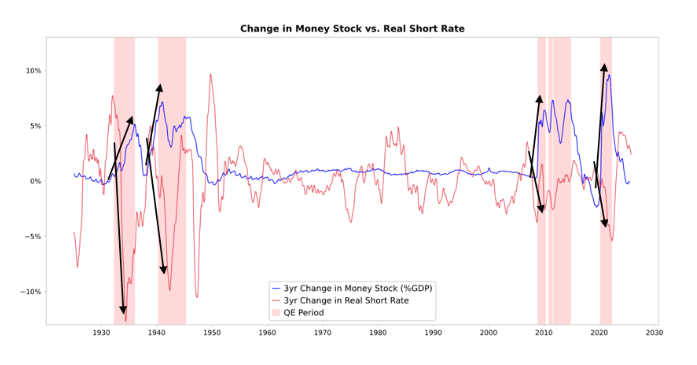
Core Viewpoint - Ray Dalio, founder of Bridgewater Associates, warns that the Federal Reserve's end to quantitative tightening (QT) is not a technical adjustment but a dangerous experiment that adds liquidity to an already inflated bubble [2][3] Group 1: Current Economic Environment - The current policy mix of expanding fiscal deficits, restarting monetary easing, and the AI narrative is pushing the U.S. towards a perilous end of a large debt cycle characterized by a liquidity-driven super bubble [2] - Historically, quantitative easing (QE) has been introduced during recession periods when asset valuations were low, inflation was subdued, and credit was frozen, providing significant policy space [3] - In contrast, the current environment features a S&P 500 earnings yield of only 4.4%, nearly inverted with the nominal yield of 10-year U.S. Treasuries at 4%, and a compressed equity risk premium of just 0.3% [3] Group 2: Risks of Current Policies - The economy is maintaining a 2% real growth rate, with an unemployment rate of 4.3% and inflation still above 3%, indicating overheating rather than recession [3] - The government continues to accumulate debt aggressively, and if the Fed resumes bond purchases, it effectively monetizes the fiscal deficit, creating a closed loop of debt monetization [3] - A significant expansion of the balance sheet alongside a simultaneous reduction in interest rates could lead the market to perceive this as fiscal dominance, where the central bank is forced to cover government overspending, potentially unanchoring inflation expectations [3] Group 3: Asset Impact and Market Dynamics - Liquidity will not be evenly distributed; QE tends to lower real interest rates and compress risk premiums, directly boosting assets that are most sensitive to discount rates, such as technology, AI, cryptocurrencies, and gold [3] - Dalio anticipates a short-term liquidity frenzy reminiscent of the 1999 internet bubble, with price-to-earnings multiples continuing to expand, benefiting both long-duration growth stocks and inflation-hedging assets [3] - Experts from CAMarkets note that behind this frenzy, issues such as wealth disparity, financial fragility, and inflationary pressures are likely to intensify, and when policies eventually shift, the cost of the bubble's collapse will exceed that of any historical cycle [3]
金银在交易什么?——贵金属逻辑框架再审视
对冲研投· 2025-10-17 06:51
Group 1 - The article discusses the recent strong upward trend in gold and silver prices, with London gold breaking through $4,300 and reaching a historical high of $4,380.79 per ounce, while London silver hit a record high of $54.429 [3][4] - The main trading narrative for the precious metals market has shifted from trade policy uncertainties to expectations of monetary and fiscal easing by the Federal Reserve, especially following the U.S. government shutdown and ongoing geopolitical tensions [4][5] - The inflow of funds into gold ETFs reached a record high in September, indicating a growing interest among investors to hedge against risks, despite overall positive market sentiment [4][5] Group 2 - The article highlights that the recent rally in precious metals began in late August, driven by multiple favorable events, including concerns over the independence of the Federal Reserve and rising expectations for interest rate cuts [8][9] - The article notes that the silver market is experiencing structural tightness, with rental rates for silver surging above 30%, driven by increased investment demand and seasonal demand from India [4][10] - The analysis indicates that the current bull market for precious metals is likely to continue, supported by ongoing central bank gold purchases and the macroeconomic backdrop of persistent supply-demand imbalances [6][56] Group 3 - The article emphasizes the changing dynamics in the gold market, with new trading centers emerging in the Middle East and China, which are reshaping the traditional gold trading landscape [21][22] - It discusses the significant debt issues facing major economies, particularly the U.S., where federal debt has surpassed $37 trillion, raising concerns about fiscal sustainability and potential inflationary pressures [24][30] - The article also addresses the implications of the Federal Reserve's monetary policy, particularly the potential impact of political pressures on its independence and the resulting effects on inflation and gold prices [35][37]