
债市修复

Search documents
机构行为月报:债市修复期,各类机构在买卖什么?-20251104
Tianfeng Securities· 2025-11-04 08:42
1. Report Industry Investment Rating No relevant content provided. 2. Core Viewpoints of the Report - In October, the trading sentiment in the bond market recovered, with the interest rate oscillation range significantly lower than in September. Overall, the trading willingness of funds significantly recovered, while allocation players seized the opportunity to exit the market. The potential for a year - end "rush to allocate" seasonal bond market rally is uncertain, and the restoration of allocation players' strength remains doubtful. The high duration of bond funds also poses risks [1][10][45]. 3. Summary by Directory 3.1 10月:债市修复期,各类机构在买卖什么? - **Market Situation**: In October, the trading sentiment in the bond market recovered, and the interest rate oscillation range was significantly lower than in September. The main bond market trend remained unclear, and various factors successively affected the market trend, with the interest rate generally maintaining a range - bound oscillation [10]. - **Overall Institutional Behavior**: The trading willingness of funds significantly recovered, with the average daily net purchase of spot bonds turning positive for the first time since July, reaching 176 million yuan. The average daily net selling of rural commercial banks increased from 148 million yuan in September to 253 million yuan. Although insurance and large - scale banks maintained net purchases, their average daily net purchase amounts decreased from 182 million yuan to 143 million yuan and from 193 million yuan to 50 million yuan respectively [10]. 3.1.1 大行:全面加大3Y以内短债净买入力度,平衡持仓久期 - **Reason for Behavior**: After large - scale banks bought long - term treasury bonds and policy - financial bonds in September, they shifted to comprehensively increasing the net purchase of short - term bonds within 3 years in October, possibly to balance the duration of their holdings [16]. - **Specific Buying Behavior**: In October, large - scale banks further strengthened the net purchase of 1 - 3Y old treasury bonds (the average daily net purchase increased to 6.7 billion yuan). They also significantly increased the net purchase of new and old treasury bonds within 1 year and new 1 - 3Y treasury bonds (the average daily net purchase increased to 1.6 billion yuan, 5 billion yuan, and 2.4 billion yuan respectively). The average daily net purchase of 7 - 10Y old treasury bonds and old policy - financial bonds decreased to 400 million yuan and 500 million yuan respectively [17]. - **Purchase Rhythm and Annual Data**: The peak of large - scale banks' net purchase of treasury bonds within 3 years occurred between the 20th and 28th. After the central bank announced it would resume bond - buying, the scale of large - scale banks' net purchase of short - term bonds declined. From January to October this year, large - scale banks' cumulative net purchase of 1 - 3Y treasury bonds was 88.61 billion yuan, exceeding 78.16 billion yuan in the same period last year; the cumulative net purchase of treasury bonds within 1 year also reached 43.55 billion yuan. The central bank's resumption of bond - buying may not necessarily mean that large - scale banks need to replenish their positions on a large scale in the secondary market, and the positive impact on short - term varieties may converge [20]. 3.1.2 农商行和保险:趁修复之际快速持续卖出 - **Rural Commercial Banks**: In October, the net selling of rural commercial banks spread from long - term and ultra - long - term to short - term bonds. The selling pressure on 7 - 10Y policy - financial bonds was the greatest throughout the month. They closely followed the interest rate for "buying high and selling low" operations, with the selling intensity significantly greater than the buying intensity. The average daily net selling of long - term and ultra - long - term interest - rate bonds increased from 90 million yuan in September to 700 million yuan, but the net selling intensity was weaker than in June, another repair period [28]. - **Insurance Companies**: In October, the average daily net selling of 20 - 30Y treasury bonds by insurance companies reached a new high since 2023, with the average daily net selling scale reaching 210 million yuan. The net purchase of 20 - 30Y local government bonds decreased significantly, which is in line with the rule that their purchase volume closely follows the supply volume [33]. 3.1.3 基金:积极参与信用二永票息与国开 - 国债利差策略 - **Seeking Spread Trading Opportunities**: During the previous bond market adjustment, ultra - long - term bonds, Tier 2 capital bonds, and policy - financial bonds favored by funds generally faced significant selling pressure, opening up spread spaces. In October, funds began to seek spread trading opportunities for these bonds. The buying intensity for 7 - 10Y policy - financial bonds and 7 - 10Y other bonds (mainly Tier 2 capital bonds with a remaining maturity of 2 - 5Y) was the strongest, with the total net purchase scale in the month reaching 6.84 billion yuan and 4.54 billion yuan respectively. They remained cautious about ultra - long - term bonds, with the net purchase of treasury bonds over 10 years only at 1.94 billion yuan throughout the month [38]. - **Exploring Short - Term Spread Trading Space**: On October 31, the spot bond data showed that the net purchase of 3 - 5Y policy - financial bonds by funds jumped to 970 million yuan. As the positive impact of the central bank's resumption of bond - buying on short - term treasury bonds weakened, funds may start to explore the spread trading space between short - term policy - financial bonds and treasury bonds [38]. - **Selecting Coupon Assets**: Since there was still no major trend in the bond market, some funds actively selected coupon assets to seek the certainty of coupon income. In October, the total net purchase of credit bonds by funds increased from 1.42 billion yuan in September to 13.26 billion yuan, the highest since July, but still lower than in the second quarter [38]. 3.2 11月:会有年末抢配行情出现吗? - **Uncertainty of Allocation Players' Restoration**: The restoration of the bond - allocation strength of rural commercial banks and insurance companies is likely to be limited, and the timing for allocation players to enter the market is more focused on quarterly timing. The year - end "rush to allocate" seasonal bond market rally may not reappear this year [46]. - **Uncertainties for Large - Scale Banks**: The potential for large - scale banks to undertake bond purchases faces uncertainties such as liability - side instability, profit - taking demands, and pressure on interest - rate risk indicators. Although the supply of ultra - long - term bonds in the fourth quarter is expected to be lower than in the second and third quarters, and the pressure on interest - rate risk indicators is expected to ease, there are still potential uncertainties, including the large - scale maturity of high - interest time deposits in the fourth quarter, the possible acceleration of credit issuance, and the banks' profit - taking demands in the fourth quarter [47]. - **High Duration Risk of Bond Funds**: The duration of bond funds remains at a historically high level, and their risk - resistance ability is relatively weak. If the official draft of the new regulations on fund sales fees is implemented at the end of the year, or if funds are redeemed by banks and wealth management products for other reasons, there is a possibility of a negative feedback loop due to the concentrated release of duration risk. However, the market currently has limited pricing for this risk, and there may not be many foreseeable negative factors in November. More attention can be paid to whether there will be regulatory and stimulus policy expectations in December [49].
固定收益市场周观察:央行恢复国债买卖,不只是一次性利好
Orient Securities· 2025-11-04 01:45
Report Industry Investment Rating - Not provided in the report Core Viewpoints - The central bank's resumption of treasury bond trading is not just a one - off benefit. It can continuously improve the bond market trading structure and enhance banks' willingness to allocate bonds, helping the bond market to continue its repair and the interest rate to decline in an oscillatory manner [6][10][11] - Although many investors interpret the central bank's resumption of treasury bond trading as a one - off benefit, as the market's expectation of monetary policy has returned to neutral in 2025, it is difficult for the bond market to replicate last year's fourth - quarter rally. However, it will still have a positive impact on the bond market [6] Summary by Directory 1. Bond Market Weekly Viewpoint - The central bank's resumption of treasury bond trading served as a catalyst for the decline in interest rates, which is in line with the previous judgment of bond market repair and interest rate peaking in the fourth quarter [6][9] - The trading structure of the bond market this year is characterized by funds "fighting alone", with banks showing low enthusiasm for participating in the bond market. The central bank's resumption of treasury bond purchases will promote banks to expand their balance sheets again and increase their willingness to allocate bonds [10] 2. This Week's Focus in the Fixed - Income Market 2.1 Concern about Domestic Inflation and Export Data - This week, China will release October's Caixin Manufacturing PMI, CPI, PPI, etc., and the US will release October's ISM Manufacturing PMI, ADP employment figures, etc. The Bank of England will announce its interest - rate decision [15][16] 2.2 This Week's Expected Interest - Rate Bond Issuance Volume - This week, the issuance scale of interest - rate bonds is expected to be 562.1 billion yuan, including 330.5 billion yuan of treasury bonds, 91.6 billion yuan of local bonds, and about 140 billion yuan of policy - bank bonds [16][17] 3. Review and Outlook of Interest - Rate Bonds 3.1 Net Open - Market Operation Injection of 1.4 Trillion Yuan - Last week, the central bank's reverse - repurchase net injection was 1.2 trillion yuan, and the MLF net injection was 200 billion yuan, with a total net injection of 1.4 trillion yuan in open - market operations. The funds were stable across the month [20][21] - The issuance scale of certificates of deposit (CDs) remained relatively high, mainly medium - term issuance. The prices in the primary and secondary markets decreased significantly with the improvement of market sentiment [27] 3.2 Rapid Decline in Bond Market Interest Rates - Last week, the bond market sentiment was optimistic, and yields declined rapidly. The central bank's resumption of treasury bond trading, successful Sino - US consultations, loose funds, and lower - than - expected October PMI all contributed to the decline [41] - The yields of 10 - year treasury bonds and active state - development bonds decreased by 5.3bp and 5.4bp respectively to 1.79% and 1.86%. The yields of 1 - year, 3 - year, 5 - year, 7 - year, and 10 - year ChinaBond treasury bonds decreased by 8.9bp, 11.5bp, 5.1bp, 9.6bp, and 5.3bp respectively [41] 4. High - Frequency Data - On the production side, the operating rates were divided. The blast - furnace and semi - steel tire operating rates decreased, while the PTA and asphalt operating rates increased. The year - on - year growth rate of the average daily crude - steel output in mid - October widened negatively [49] - On the demand side, the year - on - year growth rates of passenger - car manufacturers' wholesale and retail sales changed differently. The year - on - year growth rate of the commercial - housing transaction area weakened again. The SCFI and CCFI composite indexes increased by 10.5% and 2.9% respectively [49] - In terms of prices, crude - oil prices continued to decline, copper and aluminum prices increased, coal prices were divided, and prices of many mid - stream commodities increased. The prices of downstream consumer products such as vegetables, fruits, and pork also changed [50]

固定收益定期:存单偏弱的原因与修复前景
GOLDEN SUN SECURITIES· 2025-11-02 12:55
Report Industry Investment Rating No information about the report industry investment rating is provided in the content. Core Viewpoints of the Report - The bond market entered a repair period this week, with yields across all tenors generally declining. The subsequent repair market may continue as the risk factors that led to the bond market adjustment in the third quarter receded and the central bank stabilized market expectations [1][8]. - During the bond market repair, certificates of deposit (CDs) lagged. The CD yields remained relatively high, constraining the overall short - term interest rates. This was mainly due to the reduction of CD holdings by banks and foreign investors [2][9]. - In the short term, the constraints on CD yields may ease, and CD yields are expected to decline. A dumbbell - shaped allocation strategy is recommended, and the 10 - year Treasury yield is expected to recover to 1.6% - 1.65% by the end of the year [5][21]. Summary by Related Catalogs Bond Market Repair - This week, the bond market repaired rapidly, with the 10 - year and 30 - year Treasury yields dropping 5.3bps and 7.0bps to 1.8% and 2.14% respectively, and the 3 - year and 5 - year secondary capital bond yields falling 9.1bps and 7.7bps. The 1 - year AAA CD yield dropped 4.8bps to 1.63% [1][8]. - In the third quarter, the bond market performance deviated from the fundamentals and capital situation, which was due to increased risk appetite and the digestion of previous over - increases. Currently, with fundamental pressure and a growing asset shortage, interest rates may decline, and the central bank's decision to resume Treasury bond trading stabilized market expectations, so the bond market repair may continue [1][8]. Reasons for High CD Yields - **Reduction in Allocation by Banks and Foreign Investors**: From March to September this year, the total CD custody decreased by 1.2 trillion yuan. Banks reduced their CD holdings by 1.25 trillion yuan, with large - scale banks and rural commercial banks reducing the most, and foreign investors reduced their holdings by 421.7 billion yuan. In contrast, broad - based funds increased their holdings by 34.6 billion yuan [2][12]. - **Banks' Regulatory Pressure**: This year, banks' liability - side duration has shortened, while the asset - side duration has lengthened, leading to a deeper mismatch between assets and liabilities. Some joint - stock banks are close to the regulatory red line of the Net Stable Funding Ratio (NSFR). In October, the joint - stock banks with the greatest pressure on this indicator had a net CD financing of 624.4 billion yuan, which weakened banks' CD allocation [3][13]. - **Exchange Rate Impact on Foreign Investors**: As the RMB exchange rate shifted from depreciation pressure to appreciation pressure, the forward premium decreased, causing foreign investors engaged in bond market arbitrage to withdraw. From April to September, foreign investors' CD holdings decreased from 1.3 trillion yuan to 856.1 billion yuan, with an average monthly decrease of 8.43 billion yuan [4][18]. Outlook for CD Yields - **Easing of Constraints**: In October, the large - scale net CD financing of 797.3 billion yuan effectively alleviated banks' liability pressure and future financing needs. Foreign investors' CD holdings are expected to drop to around 60 billion yuan by the end of the year, with limited room for further decline, so the short - term constraints on CD yields may ease [4][20]. Investment Strategy - A dumbbell - shaped strategy is recommended. It can control risks through duration and potentially benefit from the overall interest rate decline and narrowing spreads. It is expected that interest rates will decline more smoothly in the second half of the fourth quarter, and the 10 - year Treasury yield is expected to recover to 1.6% - 1.65% by the end of the year [5][21].
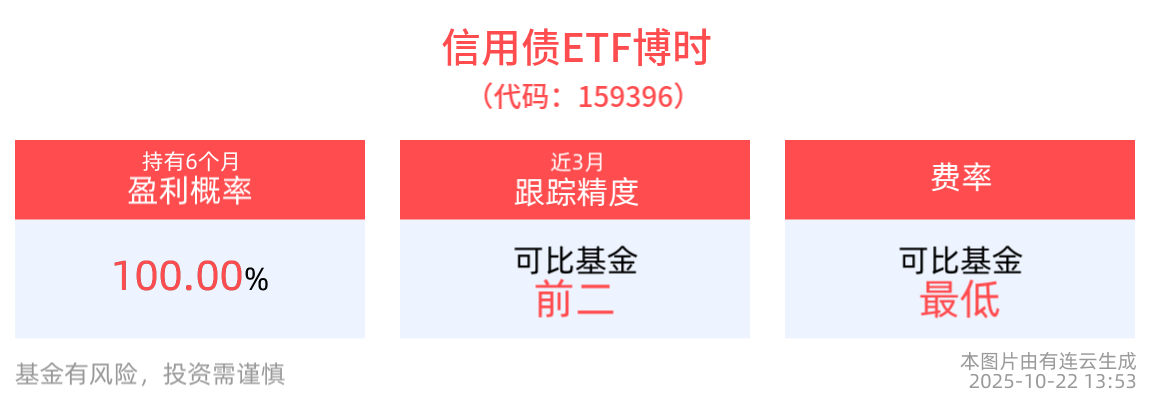
9月地产信用债融资大增9成,信用债ETF博时(159396)今日小幅上涨
Sou Hu Cai Jing· 2025-10-22 06:12
Group 1 - The core viewpoint of the news highlights the performance and trends in the credit bond ETF market, particularly focusing on the BoShi Credit Bond ETF, which has shown a slight increase in value and significant trading volume over the past year [2] - As of October 21, the credit bond ETF BoShi has a recent trading volume of 2.611 billion yuan on average per day over the past year, indicating strong market activity [2] - In September, the total bond financing in the real estate sector reached 56.1 billion yuan, marking a year-on-year increase of 31%, with credit bond financing contributing significantly to this growth [2] Group 2 - The report from CITIC Securities suggests that inflation predictions for 2026 may show a steady increase in PPI, influenced by various economic indicators, while CPI may experience fluctuations [3] - Huaxi Securities notes that the demand for credit bonds may decline in the fourth quarter due to seasonal trends and institutional profit-taking pressures, which could hinder the performance of the credit bond market [3] - The latest scale of the credit bond ETF BoShi is reported to be 10.034 billion yuan, closely tracking the Shenzhen benchmark credit bond index [3]

中信建投:短期债市胜率较高,但建议见好就收
Xin Lang Cai Jing· 2025-10-14 00:03
Core Viewpoint - The short-term bond market is primarily focused on two key aspects: the sustainability of the recovery sentiment since late September and the impact of escalating China-U.S. trade tensions [1] Group 1: Market Recovery - Since September 25, the bond market has experienced a recovery, with the 10-year government bond yield declining by 9 basis points from its peak over the past 8 trading days [1] - The recovery has been substantial, indicating a significant adjustment in market sentiment [1] Group 2: Trade Tensions - The intensification of China-U.S. trade tensions is viewed as a tactical move rather than a long-term trend, with the ongoing decoupling between the two economies being a broader concern [1] - The bond market's reaction to these tensions has been limited, as it has adapted to the ongoing trade conflict since its escalation in April [1] Group 3: Investment Strategy - While the bond market shows a higher probability of favorable outcomes in the short term, caution is advised against excessive chasing of gains [1]

债市日报:10月13日
Xin Hua Cai Jing· 2025-10-13 08:07
Core Viewpoint - The bond market is expected to experience a phase of stabilization and gradual recovery in the fourth quarter, with a focus on narrowing interest rate spreads and leveraging strategies remaining favorable [1][6][7]. Market Performance - On October 13, government bond futures closed higher across the board, with the 30-year main contract rising by 0.37% to 114.440, the 10-year main contract up by 0.10% to 108.065, and the 5-year main contract increasing by 0.03% to 105.685 [2]. - In the interbank market, major interest rate bond yields rebounded after a significant decline, with the 10-year government bond yield rising by 1.2 basis points to 1.755% [2]. Monetary Policy and Liquidity - The People's Bank of China conducted a net injection of 137.8 billion yuan through a 7-day reverse repo operation, maintaining a stable and slightly loose liquidity environment [5]. - The Shibor rates showed a mixed trend, with the overnight rate unchanged at 1.314% and the 7-day rate rising by 4.4 basis points to 1.447% [5]. Institutional Insights - Guosheng Securities noted that the recent escalation in trade tensions has led to significant fluctuations in global capital markets, with expectations of a downward trend in bond yields [6]. - Huatai Securities predicts that the bond market in the fourth quarter will perform slightly better than in the third quarter due to improved odds and favorable supply conditions [7].
四季度债市“否极泰来”,但不会“一蹴而就”
Orient Securities· 2025-10-13 06:13
Research Conclusion - The adjustment of the bond market in the third quarter was mainly due to two reasons: the repair of deflation expectations and regulatory policy changes. The negative impact of these two factors on the bond market will weaken in the fourth quarter [3][8]. - The bond market will "turn the corner" in the fourth quarter, but it won't happen overnight. The repair speed and rhythm in the fourth quarter are difficult to replicate those in April. The repair amplitude won't be large, and it's a relatively slow interest - rate peak - building process. The catalysts for the accelerated decline of interest rates are the relaxation of regulatory policies and the intensification of monetary policies [5][8][13]. - In terms of investment strategy, it is recommended to try to slightly go long on bonds in the short term but in a cautious way. Currently, bond market investment opportunities are still in the form of bands, not trend - based long opportunities. The short - end is more stable than the long - end, and credit is more stable than interest rates. The short - duration and high - liquidity strategy of credit bonds has higher certainty [5][17]. This Week's Focus in the Fixed - Income Market Attention to September Data - China will release September's social financing, export, and inflation data, and the US will release September's PPI [18]. Seasonal Increase in Interest - Rate Bond Issuance - This week, the issuance scale of interest - rate bonds will increase seasonally but remains at a relatively low level compared to the same period in previous years, with an expected total issuance of 443.3 billion yuan. Among them, the planned issuance of national bonds is around 261 billion yuan, local bonds is 32.3 billion yuan, and policy - bank bonds is about 150 billion yuan [19][22][23]. Review and Outlook of Interest - Rate Bonds Net Withdrawal in Open - Market Operations at the Beginning of the Quarter - At the beginning of the quarter, a large number of reverse repurchases matured, resulting in a significant net withdrawal in open - market operations. After the cross - quarter period, the central bank maintained a high - level reverse - repurchase injection, with a net injection of 114 billion yuan. However, due to a large number of maturities, the final net withdrawal was 153 billion yuan. The inter - bank funds rate seasonally declined at the beginning of the quarter. The trading volume of repurchase rose to over 750 billion yuan, and the overnight proportion fluctuated around 73% on average. In terms of price, the inter - bank funds rate significantly declined compared to the end of the previous quarter. The issuance volume of certificates of deposit increased, and most prices declined [24][26][31]. Recovery of Bond - Market Sentiment at the Beginning of the Quarter - At the end of the previous quarter, the market's expectation of the central bank's injection was unstable, and the liability - side stability of asset - management products was weak, leading to a strong willingness to realize profits, and ultimately a large increase in interest rates. After the holiday, the market sentiment marginally recovered, the funds rate declined, and the expectation of the central bank's loose monetary policy resurfaced, causing bond - market interest rates to return to a downward trend. On the 11th, Trump's tariff policy caused fluctuations again, driving interest rates down rapidly. Finally, the yields of the 10 - year treasury bond and the active state - development bond decreased by 4bp and 3.65bp respectively compared to last week, reaching 1.74% and 1.93%. The yields of interest - rate bonds with various maturities mainly declined [45]. High - Frequency Data Production - Side - The operating rates were divided. The blast - furnace operating rate remained flat at 84.3%, the semi - steel tire operating rate seasonally declined from 73.6% to 55.3%, and the PTA operating rate changed from 77.5% to 77.8%. The year - on - year growth rate of the average daily crude - steel output in early September turned negative, reaching - 8.6% [54]. Demand - Side - The year - on - year growth rates of the wholesale and retail sales of passenger - car manufacturers significantly improved. In the week of September 30th, the year - on - year growth rates of the wholesale and retail sales of passenger - car manufacturers were 57% and 43% respectively. The year - on - year growth rate of the commercial - housing transaction area turned positive. In the week of October 5th, the land premium rate of 100 large - and medium - sized cities increased, the land transaction area decreased, and the year - on - year growth rate turned positive. The sales area of commercial housing in 30 large - and medium - sized cities seasonally declined, but the year - on - year growth rate rapidly rose to a high of 58%. The SCFI and CCFI composite indexes changed by 4.1% and - 6.7% respectively [54]. Price - Side - Considering the price changes on October 11th compared to the end of the quarter (September 30th), the crude - oil price declined, the copper and aluminum prices increased, and the settlement price of the active coking - coal futures contract increased. In the mid - stream, the comprehensive building - materials price index slightly declined, and both the cement and glass indexes decreased. The output of rebar decreased, and inventory started to accumulate again. The futures price increased by 0.6% after the holiday. In the downstream consumer sector, the prices of vegetables, fruits, and pork changed by - 1.2%, 2.3%, and - 2.8% respectively [55].
策略周报:波动再度放大,如何应对?-20251012
HWABAO SECURITIES· 2025-10-12 06:06
Group 1 - The report highlights that the bond market is experiencing a mild recovery due to the central bank's continued support for liquidity, with expectations of a gradual decline in supply in the fourth quarter [2][10][12] - In the stock market, increased volatility is noted, particularly in the financial and low-volatility sectors, as profit-taking in growth sectors leads to significant market fluctuations [3][10][12] - The report suggests a balanced investment approach, focusing on mid to large-cap indices, and indicates that stable funds may enter the market to maintain stability during periods of heightened volatility [3][12][13] Group 2 - Key events include a significant increase in domestic travel during the National Day holiday, with 888 million trips taken, generating a total expenditure of 809 billion yuan, reflecting a year-on-year increase [9] - The report mentions new export control measures on certain materials, which will take effect on November 8, indicating potential impacts on related industries [9] - The report tracks important market indicators, noting that the average daily trading volume in the A-share market has rebounded to 2.603 trillion yuan, indicating increased market activity post-holiday [21][22]
纯债基金上周收益率环比提升 市场仍在酝酿修复
Mei Ri Jing Ji Xin Wen· 2025-09-22 14:09
Group 1 - The market anticipates the People's Bank of China (PBOC) to restart government bond trading operations, leading to a rise in the 10-year government bond yield [1][3] - The yield on the 10-year government bond increased from 1.7895% to 1.795%, reflecting market volatility [3] - The PBOC has conducted a net purchase of 1 trillion yuan in government bonds from August to December 2024, providing crucial support for market liquidity [3] Group 2 - Economic data from August showed weaker-than-expected performance, particularly in infrastructure investment, indicating ongoing issues with domestic demand [4][5] - The bond market is expected to remain under pressure due to weak institutional sentiment, despite the potential for a recovery in the future [6] - Short-term market conditions may continue to exhibit volatility, with a cautious approach recommended for bond market participation [7]
近10日“吸金”超13亿,30年国债ETF(511090)单日成交突破70亿,机构:债市或在震荡中渐进式修复
Sou Hu Cai Jing· 2025-09-19 07:01
Group 1 - The 30-year Treasury ETF (511090) has been adjusted with a latest quote of 118.83 yuan as of September 19, 2025, indicating active market trading with a turnover of 22.28% and a transaction volume of 7.011 billion yuan [1] - The latest scale of the 30-year Treasury ETF has reached 31.484 billion yuan, with a net outflow of 304 million yuan recently; however, in the last 10 trading days, there were net inflows on 7 days totaling 1.354 billion yuan [1] - The Ministry of Finance announced plans to reissue 1,570 billion yuan of 3-year fixed-rate Treasury bonds with a coupon rate of 1.42%, which is consistent with previously issued bonds of the same term [1] Group 2 - The 30-year Treasury ETF closely tracks the China Bond 30-Year Treasury Index, which includes publicly issued 30-year Treasury bonds with a remaining maturity of 25-30 years, serving as a benchmark for investment in this category of bonds [2]