
流动性宽松

Search documents
现货黄金突破4700美元,关注黄金基金ETF(518800)
Sou Hu Cai Jing· 2026-01-21 01:07
无论是股票ETF/LOF基金,都是属于较高预期风险和预期收益的证券投资基金品种,其预期收益及预期 风险水平高于混合型基金、债券型基金和货币市场基金。 基金资产投资于科创板和创业板股票,会面临因投资标的、市场制度以及交易规则等差异带来的特有风 险,提请投资者注意。 1月20日,黄金股票ETF(517400)、黄金基金ETF(518800)分别收涨2.45%、0.72%。金价继续走 高,伦敦现货价格突破4700美元/盎司;从中长期来看,流动性宽松和去美元化仍然构成金价的关键支 撑因素。 从中长期来看,尽管地缘政治的危机呈现脉冲性,故而金价可能随着地缘危机的缓和而回调,但全球流 动性宽松和去美元化趋势对金价构成比较稳定的支撑。在过去一年,G10国家中有9个下调了利率,而 这一趋势在今年有望延续,从而降低黄金的持有成本。基于对美国庞大债务及当前政府干涉主义的担 忧,全球央行继续购入黄金,最新的数据显示,自1996年以来,全球央行持有的黄金储备首次超过了美 国国债,这一趋势有望延续。 基于上述理由,金价的中枢或仍将震荡上行,投资者或可逢回调布局以摊低成本。投资者或可关注直接 投资实物黄金,免征增值税的黄金基金ETF(5 ...
春季躁动中场休息
AVIC Securities· 2026-01-18 14:56
Core Insights - The report highlights that the A-share market is currently experiencing a phase of regulatory adjustments aimed at controlling excessive market enthusiasm while ensuring sustainable growth [8][9][10] - It emphasizes the importance of the AI technology revolution and the trend of de-globalization, which are expected to persist for the next 5-10 years, creating investment opportunities in related sectors [9][10][22] - The report suggests that the Chinese economy is in a transition phase, benefiting from a unified market policy and a low-interest-rate environment, which may lead to increased foreign capital inflows into RMB assets [10][12] Market Overview - The A-share market saw a significant trading volume of 3.99 trillion yuan on January 14, marking a historical high, but subsequently retreated to around 3 trillion yuan, indicating a cooling of market exuberance [8][9] - The report notes that the recent increase in the financing margin ratio from 80% to 100% by the regulatory authority reflects a counter-cyclical adjustment strategy [8][9] Investment Opportunities - The report recommends focusing on investment opportunities in commodities such as copper, rare earths, and gold, which are expected to gain value amid geopolitical tensions and the ongoing trend of de-globalization [10][18][20] - It also points out that the rapid development of AI is likely to drive demand for computing power and related infrastructure, benefiting sectors like new energy vehicles and resource materials [22][24] Economic Trends - The report anticipates that the global economy will continue to experience a loose monetary policy environment, with fiscal expansions expected in major economies, which may further enhance liquidity and support resource sectors [20][22] - Historical data indicates that periods of RMB appreciation are often accompanied by significant foreign capital inflows into Chinese assets, suggesting a favorable outlook for the A-share market [10][12]
贵金属市场周报-20260116
Rui Da Qi Huo· 2026-01-16 09:29
Group 1: Report Overview - Report Title: "Precious Metals Market Weekly Report" [2] - Date: January 16, 2026 [2] - Authors: Researcher Liao Hongbin, Assistant Researcher Xu Dingfeng [3] Group 2: Weekly Key Points Summary - Tariff situation heats up as the US will impose a 25% ad - valorem import tariff on some imported semiconductors, semiconductor manufacturing equipment, and derivatives from January 15, 2026, which may marginally increase the risk - aversion premium [5] - US PPI and core PPI in November 2025 both rose 3% year - on - year, higher than the market expectation of 2.7%, with rising energy costs being the main driver [5] - The US Department of Justice plans to conduct a criminal investigation into Fed Chairman Powell, but Trump has no plan to fire him, easing market concerns [5] - The December non - farm payrolls were less than expected, indicating a cooling US labor market, leading traders to expect three interest rate cuts this year, possibly starting before May [5] - The Middle East situation has a temporary easing, but geopolitical risks remain high due to Iran's threat to US military bases and sporadic escalation in the Russia - Ukraine front [5] - In the medium term, the bullish logic for precious metals remains unchanged, and it's advisable to buy on dips in the long - term, while being cautious of short - term corrections [5] - The resistance level for London Gold is 4650 US dollars per ounce, and the support level is 4300 US dollars per ounce; for London Silver, the resistance level is 95 US dollars per ounce, and the support level is 70 US dollars per ounce [5] Group 3: Futures and Spot Market - The precious metals market continued to be strong this week, with a continuous short - squeeze in the silver market [6] - As of January 16, 2026, the Shanghai Silver main contract 2604 closed at 22,483 yuan per kilogram, up 20.03% for the week; the Shanghai Gold main contract 2604 closed at 1,032.32 yuan per gram, up 2.57% for the week [10] - This week, the net position of foreign gold ETFs increased, while that of silver decreased. As of January 15, 2026, the SPDR Gold ETF holdings were 1,074.80 tons, up 0.72% month - on - month; the SLV Silver ETF holdings were 16,062 tons, down 0.90% month - on - month [11][15] - As of January 6, 2025 (the latest), both COMEX gold and silver net long positions decreased. The COMEX gold net position was 227,632 contracts, down 1.50% month - on - month; the COMEX silver net position was 29,271 contracts, down 2.63% month - on - month [16][20] - This week, the basis of gold and silver weakened. As of January 15, 2026, the basis of the Shanghai Gold main contract was - 6.74 yuan per gram, with a basis rate of - 0.65%; the basis of the Shanghai Silver main contract was - 210 yuan per kilogram, with a basis rate of - 0.93% [21][23] - This week, the gold and silver inventories in domestic and foreign exchanges decreased. As of January 15, 2026, the COMEX gold inventory was 36,132,901.14 ounces, down 0.70% month - on - month; the SHFE gold inventory was 97,653 kilograms, down 0.05% month - on - month; the COMEX silver inventory was 435,671,453 ounces, down 3.0% month - on - month; the SHFE silver inventory was 620,262 kilograms, down 10.30% month - on - month [24][28] Group 4: Silver Industry Situation - As of November 2025, the import volume of silver and silver ore sand increased. The import volume of Chinese silver was 263,505.88 kilograms, up 9.90% month - on - month; the import volume of silver ore sand and its concentrates was 180,915,984 kilograms, up 21.23% month - on - month [30][34] - Due to the increasing demand for silver in the semiconductor industry, the production of integrated circuits has been rising, and the year - on - year growth rate has stabilized. As of November 2025, the monthly production of integrated circuits was 4,390,000 pieces, with a year - on - year growth rate of 15.6% [36][40] Group 5: Silver Supply and Demand - The silver supply and demand are in a tight - balance situation. As of the end of 2024, the industrial demand for silver was 680.5 million ounces, up 4% year - on - year; the demand for coins and net bars was 190.9 million ounces, down 22% year - on - year; the net investment demand for silver ETFs was 61.6 million ounces, compared with - 37.6 million ounces in the same period of the previous year; the total demand for silver was 1,164.1 million ounces, down 3% year - on - year [42][44] - In 2025, the improvement in silver supply and demand was due to the recovery of mine production and a slight increase in recycled silver, while the investment and industrial demand declined slightly, significantly narrowing the market shortage. As of the end of 2024, the silver supply - demand gap was - 148.9 million ounces, down 26% month - on - month. The World Silver Institute predicted that the global total silver supply in 2025 would increase by 3% to about 1,050 million ounces; the global total silver demand would decrease by 4% year - on - year to about 1,120 million ounces; the supply - demand gap in 2025 was expected to narrow to about - 70 million ounces, a decrease of about 53% month - on - month [48][50] Group 6: Gold Supply and Demand - The investment demand for gold ETFs has increased significantly, and central banks of emerging countries continue to buy gold [52] Group 7: Macroeconomic Data - This week, the US dollar index continued to rebound from the low level within the oscillation range [56] - This week, the 10Y - 2Y US Treasury yield spread widened slightly, and the CBOE gold volatility decreased [61] - This week, the US inflation - balanced interest rate rebounded slightly [65] - In January 2026, the central banks of China and Turkey continued to buy about 0.93 tons and 3.0 tons of gold respectively [69]
和讯投顾高璐明:突发利好!降息!今天反弹?
Sou Hu Cai Jing· 2026-01-16 01:19
Group 1 - The People's Bank of China announced a targeted interest rate cut, effective January 19, reducing the re-lending and rediscount rates by 0.25 percentage points, with new rates set at 0.95%, 1.15%, and 1.25% for 3-month, 6-month, and 1-year loans respectively, and a rediscount rate of 1.5% [1] - The National Grid's investment plan for the 14th Five-Year Plan period includes a fixed asset investment of 4 trillion yuan, a 40% increase from the previous plan, focusing on new power system construction, which will benefit sectors like smart grids, grid equipment, transformers, and energy storage [1] Group 2 - The Shanghai Composite Index's trading volume decreased significantly to 11,759.15 billion yuan from 16,070.41 billion yuan, indicating reduced selling pressure, which is a typical signal for market rebound [2] - The performance of financial heavyweight sectors such as insurance and brokerage is crucial for market momentum; their ability to rebound strongly will determine the overall market's strength and sustainability [3]
沪铝价格站上2.5万元/吨,沪金沪银双创历史新高,有色金属ETF(512400)拉涨超2%,流动性宽松与新兴需求双支撑有色金属板块价值
Xin Lang Cai Jing· 2026-01-14 02:36
Core Viewpoint - The article highlights the significant price increases in non-ferrous metals, particularly aluminum and precious metals, driven by global liquidity conditions, technological advancements, and geopolitical factors. Group 1: Non-Ferrous Metals - The non-ferrous metals ETF (512400) experienced a rise of over 2% at one point, currently up 1.87%, marking a four-day consecutive increase with a turnover of 1.7% and a transaction volume of 5.04 billion yuan [1] - The domestic aluminum price reached a historic breakthrough, with the main contract price on the Shanghai Futures Exchange surpassing 25,000 yuan per ton, setting a new record [1] - The prices of copper have also been on the rise, with copper futures exceeding 100,000 yuan per ton, indicating strong performance in the non-ferrous metals sector [1] Group 2: Precious Metals - As of January 13, the main silver contract on the Shanghai Futures Exchange rose by 5.9% to 21,004 yuan per kilogram, while the main gold contract increased by 1.01% to 1,027.18 yuan per gram, both reaching historical highs [1] - The environment of global liquidity easing is supporting the prices of precious metals, with factors such as inflation and high debt levels contributing to a bullish outlook for gold prices [2] Group 3: Market Dynamics - West Securities indicates that the rapid development of artificial intelligence and high-end manufacturing is expected to accelerate the demand for non-ferrous metals [1][2] - Geopolitical tensions are leading major countries to elevate the strategic importance of key minerals, which may result in a revaluation of commodity prices [2] - The non-ferrous metals index, which the ETF closely tracks, includes 50 listed companies from the non-ferrous metals and non-metallic materials sectors, reflecting the overall performance of the industry [2]
瑞银仍“看多”A股:流动性宽松推动上行 全年看盈利提升和估值复苏
Di Yi Cai Jing· 2026-01-13 13:30
Core Viewpoint - The A-share market is experiencing a correction after a period of increase, but there is optimism for the first quarter of the year due to overall liquidity easing, which is expected to drive up market valuations [1] Group 1: Market Outlook - UBS Securities analyst Meng Lei expresses a positive outlook for A-shares in the first quarter, attributing this to overall liquidity easing that will promote valuation increases [1] - For the entire year of 2026, an increase in overall earnings combined with a valuation recovery is expected to further drive A-shares upward [1] Group 2: Supporting Factors - UBS Global Financial Markets Department head Fang Dongming highlights strong innovation capabilities, supportive policies, ample liquidity, and potential inflows from domestic and foreign institutional investors as key factors that will support another prosperous year for the Chinese stock market [1]

美联储独?性担忧升温,贵?属续创新
Zhong Xin Qi Huo· 2026-01-13 08:00
Report Summary 1. Report Industry Investment Rating No relevant information provided. 2. Core View of the Report - The prices of gold and silver have risen again with significant trading volume. The resonance of macro and geopolitical risks, along with expectations of liquidity and resource security, has become the main driving force. The trading logic of the impaired independence of the Federal Reserve has been repriced, leading to a continued upward trend in gold prices. Silver prices have accelerated their rise due to tight spot supply and high price elasticity, with significantly amplified short - term fluctuations [1]. - Gold and silver are expected to maintain an overall oscillatory and bullish pattern under the resonance of long - term expectations of loose liquidity, pro - cyclical trading, and concerns about resource security. The central price of gold is expected to continue to rise, with London gold focusing on the range of $4900 - 5000 per ounce. Silver may continue to experience high volatility, with London silver focusing on the range of $90 - 100 per ounce [3]. 3. Summary by Relevant Catalogs 3.1 Key Information - The Trump administration in the United States has threatened to sue Federal Reserve Chairman Powell for his testimony in Congress last summer. Powell believes this is an excuse to expand the government's influence on the Federal Reserve and monetary policy [2]. - In December, U.S. employment growth slowed more than expected, with job losses in the construction, retail, and manufacturing sectors. However, the unemployment rate dropped to 4.4%, indicating that the labor market has not deteriorated rapidly [2]. - U.S. Treasury Secretary Bessent will host a meeting of more than a dozen senior financial officials on Monday, urging the Group of Seven (G7) and other countries to increase efforts to reduce their dependence on China in the critical minerals sector [2]. 3.2 Price Logic - **Gold**: As the change of the Federal Reserve Chairman approaches, the threat of a subpoena from the Department of Justice to the current chairman has significantly increased the expectation of impaired independence. The market has further strengthened the pricing of long - term policy easing and constraints on the U.S. dollar's credit. Despite the FedWatch indicating a delay in the timing of interest rate cuts this year, the long - term "independence - credit - liquidity" logic dominates the price direction. Coupled with rising geopolitical risks and central bank allocation demand, gold is insensitive to marginal changes in interest rates, and continuous trend - following buying has pushed the price of London gold above $4600 per ounce [3]. - **Silver**: The Section 232 investigation on critical minerals has not been finalized, and expectations of tariffs and resource security have repeatedly disrupted the market. Hoarding demand has continuously squeezed the deliverable and liquid inventories in the United States. Although the London silver lease rate has recently fallen slightly to the 3% - 5% range, the structurally tight pattern remains unchanged. The tight spot supply and financial attributes have jointly amplified the price elasticity. Coupled with the rapid compression of the gold - silver ratio, silver has become the focus of risk - preference and resource - security trading, with its price breaking through $84 per ounce during the day and showing significant trading volume [3]. 3.3 Index Performance - **Characteristic Index**: The commodity index was 2432.53, up 1.57%; the commodity 20 index was 2786.88, up 1.85%; the industrial products index was 2360.48, up 1.27%; the PPI commodity index was 1468.38, up 1.31% [47]. - **Precious Metals Index**: On January 12, 2026, the precious metals index was 4216.32, with a daily increase of 4.96%, a 5 - day increase of 3.89%, a 1 - month increase of 17.76%, and a year - to - date increase of 10.25% [48].
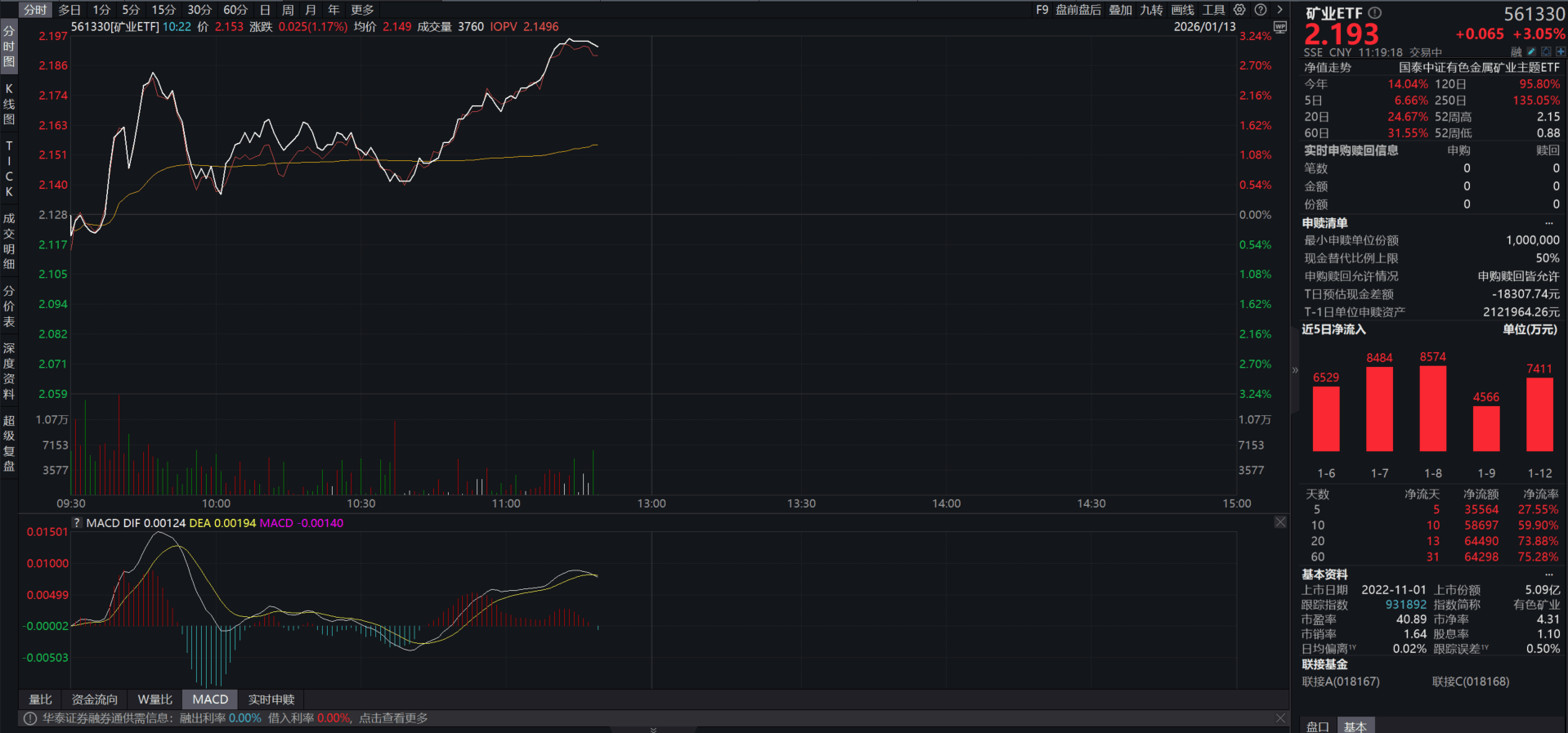
COMEX黄金突破4600美元创新高,矿业ETF(561330)涨超3%
Sou Hu Cai Jing· 2026-01-13 04:10
Core Viewpoint - Recent trends indicate a strong performance in gold prices, with COMEX gold surpassing $4600 per ounce, driven by liquidity easing and increased demand for safe-haven assets, suggesting a potential continuation of the bull market in the metals sector [3][4]. Group 1: Gold Price Dynamics - As of January 12, COMEX gold reached a historic high of over $4600 per ounce, supported by macroeconomic factors such as the deepening Federal Reserve rate cut cycle and rising geopolitical uncertainties [3]. - The ongoing demand for gold from global central banks remains robust, contributing to the upward pressure on prices [3]. Group 2: Supply Constraints in Base Metals - Key base metals like copper, aluminum, and nickel are facing supply challenges, which are expected to support price increases. Recent strikes and production halts in major mining operations have exacerbated supply issues [3][4]. - Specific incidents include a strike at the Mantoverde copper mine in Chile and indefinite shutdowns at the Mozal aluminum plant in Mozambique, indicating significant supply disruptions [3]. Group 3: Investment Opportunities in Mining ETFs - The mining ETF (561330) has shown a remarkable performance, with a net inflow of nearly 600 million yuan over ten consecutive days, reflecting strong investor interest [1][4]. - The mining ETF is positioned to outperform due to a higher concentration of leading stocks, with the top ten holdings accounting for 55.82% of the index, compared to 47.93% in the broader base metals index [4][7]. Group 4: Future Market Outlook - The copper market is expected to benefit from supply-demand imbalances and the favorable conditions of a rate cut cycle, which historically leads to price increases [12]. - The aluminum sector is constrained by production limits and strong demand from new energy sectors, suggesting sustained high prices [12]. - Lithium demand is projected to rise due to energy storage needs, with a potential supply-demand balance expected by 2026 [13]. - The rare earth sector may see profit elasticity and valuation improvements as China eases export restrictions, highlighting its strategic importance in global markets [14].

COMEX黄金突破4600美元,关注黄金基金ETF(518800)、黄金股票ETF(517400)
Sou Hu Cai Jing· 2026-01-13 01:29
Core Viewpoint - Recent gold prices have surged, with COMEX gold breaking through $4600 per ounce, reaching a historical high as of January 12. This increase is driven by both "liquidity easing" and "safe-haven demand" [1] Group 1: Macroeconomic Factors - The current rise in gold prices is primarily supported by the deepening interest rate cut cycle by the Federal Reserve, which lowers the opportunity cost of holding gold [1] - Increased geopolitical uncertainties across regions such as Eastern Europe, the Middle East, and South America have contributed to the demand for gold as a safe-haven asset [1] - Global central bank demand for gold remains strong, indicating a sustained interest in gold as a reserve asset [1] Group 2: Investment Opportunities - The combination of the Federal Reserve's interest rate cuts, escalating overseas uncertainties, and the trend of de-dollarization globally continues to support gold prices in the medium to long term [1] - Gold stocks exhibit a "Davis Double Play" effect, where mining companies benefit not only from inventory appreciation but also from nonlinear profit margin expansion during bull markets, making them more elastic than gold prices themselves [1] - Gold stock ETFs, such as the one with code 517400, include leading companies in the gold sector, providing a convenient way for investors to gain exposure to high-quality assets in the gold industry [1] - Investors are encouraged to consider gradual investment strategies or dollar-cost averaging to participate in the gold market [1]
国新国证期货早报-20260113
Guo Xin Guo Zheng Qi Huo· 2026-01-13 01:26
Report Summary 1. Investment Rating No investment rating for the industry is provided in the report. 2. Core View On January 12, 2026, the A - share market showed strong performance, with significant increases in major indices and record - high trading volume. Different futures varieties had diverse price movements influenced by various factors such as market liquidity expectations, supply - demand fundamentals, and policy news [1]. 3. Summary by Variety **Stock Index Futures** - On January 12, A - share major indices continued to perform strongly. The Shanghai Composite Index had a 17 - day consecutive increase, reaching a new high in over a decade. The Shanghai Composite Index rose 1.09% to 4165.29 points, the Shenzhen Component Index rose 1.75% to 14366.91 points, and the ChiNext Index rose 1.82% to 3388.34 points. The trading volume of the Shanghai, Shenzhen, and Beijing stock markets reached 36450 billion yuan, a significant increase of nearly 5000 billion yuan from the previous trading day, setting a new record [1]. - The CSI 300 Index was strong on January 12, closing at 4789.92, a rise of 30.99 compared to the previous day [2]. **Coke and Coking Coal** - Coke: The weighted index of coke oscillated and sorted on January 12, closing at 1771.6, a rise of 23.8. The market's expectation of loose liquidity increased. After the end of environmental protection, coking operations resumed, and the average profit per ton of coke declined as coal prices stopped falling. The daily average output of hot metal was 229.5 tons, an increase of 2.07 tons from last week, indicating a bottom - up trend in hot metal demand [2][4]. - Coking Coal: The weighted index of coking coal oscillated and strengthened on January 12, closing at 1240.5 yuan, a rise of 50.7. The market's expectation of loose liquidity increased during the week, and the risk appetite significantly improved. The general rise of commodities drove the low - valued black varieties to make up for losses. There was news of eliminating backward production capacity and reducing the output of thermal coal in 2026, which triggered market speculation on policy - based production restrictions. In January, the supply and demand of coking coal both increased. There was an expectation of restocking in mid - to late January that had not been fulfilled [3][4]. **Zhengzhou Sugar** - Affected by the slight decline of US sugar on Friday and the stable spot price, the Zhengzhou Sugar 2605 contract oscillated narrowly and closed slightly higher on Monday. At night, due to short - selling pressure, the contract oscillated and declined. As of January 7, Thailand's cumulative sugar production was 153.09 million tons, a decrease of 56.73 million tons or 27.03% compared to the same period last year. The global sugar market supply - demand pattern is expected to change from a supply shortage of about 200 million tons in the 2024/25 period to a supply surplus of about 700 million tons in the 2025/26 period [4]. **Rubber** - Affected by capital, Shanghai rubber oscillated widely, first falling and then rising, closing slightly higher on Monday. At night, due to the increase in the combined inventory of natural rubber in bonded and general trade in Qingdao, Shanghai rubber oscillated and adjusted. As of January 11, 2026, the combined inventory of natural rubber in bonded and general trade in Qingdao was 56.82 million tons, an increase of 1.98 million tons or 3.62% from the previous period [4][5]. **Palm Oil** - On January 12, after the Malaysian Palm Oil Board (MPOB) announced December data with bright export figures, palm oil futures rose rapidly in the afternoon. The main contract P2605 closed at 8724, a rise of 0.48% from the previous day. In December, Malaysia's crude palm oil production was 1.83 million tons, a decrease of 5.46% month - on - month; exports were 1.3165 million tons, an increase of 8.52% month - on - month; apparent demand was 331,000 tons, a slight decrease from 374,000 tons in the previous month; and inventory was 3.05 million tons, with an estimated inventory range of 3 - 3.1 million tons [5]. **Soybean Meal** - Internationally, on January 12, CBOT soybeans fell sharply due to a bearish USDA supply - demand report. The US Department of Agriculture's January supply - demand report showed that the estimated soybean production in the US in the 2025/26 period was 4.262 billion bushels, an increase of 90 million bushels from December, while export estimates were reduced by 600 million bushels to 1.575 billion bushels. Domestically, on January 12, the main soybean meal contract M2505 closed at 2790 yuan/ton, a rise of 0.14%. The oil refinery's operating rate continued to recover rapidly this week, and the output of soybean meal was expected to increase. The current inventory of soybean meal in oil refineries was at a relatively high level compared to the same period of the year, and the supply pressure was large. The restart of the auction of imported reserve soybeans further suppressed the upward space of soybean meal prices [5]. **Live Hogs** - On January 12, the main live hog contract LH2603 closed at 11735 yuan/ton, a decline of 0.3%. In the first half of this month, the supply of medium - and large - sized hogs of appropriate weight decreased slightly, and some farmers showed a mentality of reducing supply to support prices, which tightened the market supply in the short term. However, pig enterprises may still advance the slaughter before the Spring Festival, and the subsequent supply pressure remains. The current seasonal consumption such as pickling and sausage - making in China continues, but the terminal consumption's acceptance of price increases is limited, and there is a short - term "gap period" [5]. **Shanghai Copper** - Shanghai copper rose strongly. The main 2602 contract closed at 103800 yuan/ton. The macro - environment saw an increase in the expectation of Fed easing, a weakening US dollar, and geopolitical disturbances, which led to capital flowing into the metal sector. Globally, the supply of copper mines was tight and lacked elasticity, and the demand from new energy and AI provided support. Domestically, downstream consumption was dull before the Spring Festival, and inventory accumulated moderately [5]. **Cotton** - On Monday night, the main Zhengzhou cotton contract closed at 14685 yuan/ton. Cotton inventory increased by 380 lots compared to the previous trading day. Downstream yarn mills and textile enterprises purchased as needed [6]. **Iron Ore** - On January 12, the main iron ore 2605 contract oscillated and closed higher, with a rise of 0.92% to 822.5 yuan. The shipments of Australian and Brazilian iron ore decreased month - on - month, the arrival volume increased slightly, and the port inventory continued to accumulate. Currently, steel mills had restocking needs, and the hot metal output continued to rise, so the supply - demand structure improved. In the short term, iron ore prices were in an oscillating trend [6]. **Asphalt** - On January 12, the main asphalt 2603 contract oscillated and closed lower, with a decline of 0.25% to 3157 yuan. The current asphalt supply remained at a low level, inventory accumulated, and the middle - and downstream procurement was cautious, with a significant decrease in demand. Supported by the crude oil cost, asphalt prices oscillated in the short term [6]. **Logs** - The main log 2603 contract opened at 772 on Monday, with a minimum of 772, a maximum of 776.5, and closed at 773, with an increase of 47 lots in positions. Attention should be paid to the support from the spot market. The spot price of 3.9 - meter medium - grade A radiata pine logs in Shandong was 740 yuan/cubic meter, unchanged from the previous day, and the price in Jiangsu was 740 yuan/cubic meter, an increase of 10 yuan/cubic meter from the previous day [6][7]. **Steel** - On January 12, rb2605 closed at 3165 yuan/ton, and hc2605 closed at 3311 yuan/ton. The rising prices of raw fuels strengthened the cost support for steel prices, and mainstream steel mills' price - supporting measures promoted the rise of steel prices. On the other hand, the demand for steel in the off - season continued to decline, and the supply - demand pressure increased, so steel prices may not continue to rise. In the short term, steel prices may first rise and then fall, oscillating within a range [7]. **Alumina** - On January 12, ao2605 closed at 2866 yuan/ton. The domestic operating capacity of alumina remained at a high level, and there was no sign of long - term production reduction, so the supply surplus pattern continued, and prices were under pressure. Based on the 5 - dollar reduction in the long - term contract price of Guinea's ore in the first quarter, the average cash cost in Shanxi and Henan regions would drop to about 2650 yuan/ton. On the consumption side, although the electrolytic aluminum enterprises in Inner Mongolia had been put into operation, they were in the early stage, and the demand increase was limited [7]. **Shanghai Aluminum** - On January 12, al2603 closed at 24650 yuan/ton. Domestically, the cancellation of the VAT export tax rebate for photovoltaic products starting from April 1 may trigger the rush - work demand in the domestic photovoltaic industry, which may improve the demand for photovoltaic frames and brackets and support aluminum prices. Fundamentally, the supply side was operating normally, and social inventory continued to accumulate. The demand side showed a cooling trend, with downstream buyers being cautious and traders reducing purchases [7].