
AI需求

Search documents
国泰海通|有色:工业金属的三连击
国泰海通证券研究· 2025-12-22 13:58
Group 1: Core Insights - The article emphasizes the importance of macroeconomic factors, such as monetary policy, geopolitical tensions, and supply disruptions, in influencing metal prices, particularly in a tight supply-demand balance [1] - Industrial metals are expected to benefit from liquidity, traditional recovery, and AI demand, which are seen as three driving forces [1] Group 2: Precious Metals - Silver prices continue to rise, with last week's London spot silver price surpassing $66 per ounce, supported by ongoing inventory disruptions [1] - The outlook for gold remains positive, with expectations of increased central bank purchases and rising gold ETF holdings, alongside a weakening dollar index due to anticipated interest rate cuts by the Federal Reserve [1] - Geopolitical risks from the Russia-Ukraine negotiations are noted as a short-term concern, while silver inventory shortages may lead to stronger price performance [1] Group 3: Copper - The copper market is experiencing increased supply vulnerability, with the 2026 copper long-term contract processing fees set at $0 per ton and $0 per pound, reflecting a year-on-year decrease of $21.25 per ton and 2.125 cents per pound [2] - Strong demand from AIDC and the power grid is expected to exacerbate copper supply vulnerabilities, leading to a potentially strong copper price [2] Group 4: Aluminum - Aluminum prices are supported by macroeconomic improvements, despite supply disruptions from South32's Mozal Aluminum due to unresolved power agreements, which may lead to production cuts [2] - The processing operating rate for aluminum continues to decline, currently at 61.5%, while alumina prices are under pressure due to high bauxite inventories [2] Group 5: Energy Metals - Lithium demand is showing signs of weakening, with rising production levels leading to decreased inventory depletion rates, while market uncertainties regarding the resumption of key mines in Jiangxi persist [3] - Cobalt prices remain high due to tight upstream raw material supplies, while downstream demand is cautious [3] - Rare earth prices have decreased, particularly for medium and heavy rare earths, while tin supply remains uncertain due to disruptions in Nigeria, the Democratic Republic of Congo, and Indonesia [3]


存储迎史上最强涨价周期,两大牛股年内涨近400%
2 1 Shi Ji Jing Ji Bao Dao· 2025-12-18 11:22
Core Viewpoint - The storage industry is experiencing a significant price increase driven by AI demand, marking the beginning of a "super cycle" in the sector [2][5][10]. Group 1: Price Increases and Market Dynamics - Major companies like Samsung, SK Hynix, and Micron have raised product prices, with DDR contract prices expected to increase by 35% and NAND prices by 20% in Q4 2023 [2][5]. - UBS forecasts that DDR contract prices will rise by an additional 30% and NAND prices by 20% in Q1 2026 [2]. - The stock prices of several A-share companies in the storage sector have surged significantly, with Shannon Chip achieving a year-to-date increase of over 394% [2][8]. Group 2: Industry Trends and Future Outlook - The storage industry has entered a new cycle, with AI server demand increasing the shipment of storage chips, particularly DDR5 and HBM [5][6]. - The transition from DDR4 to DDR5 has been accelerated due to AI investments, leading to a supply-demand imbalance in the industry [6][11]. - Morgan Stanley predicts that the global storage market could reach $300 billion by 2027, driven by sustained demand [6][10]. Group 3: Company Performance and Financial Results - Micron reported a strong performance for Q1 FY2026, with adjusted revenue of $13.64 billion, a 57% year-over-year increase [7]. - Samsung's Q3 2025 operating profit reached 12.16 trillion KRW (approximately $85.6 billion), a 32.2% increase year-over-year [7]. - SK Hynix's Q3 2025 sales were 24.45 trillion KRW, with a year-over-year growth of 39% [7]. Group 4: Supply Chain and Production Strategies - Major players are cautious about expanding production capacity, focusing instead on optimizing capital expenditures to balance customer demand and market prices [10][11]. - SK Hynix plans to shift a significant portion of its DRAM capacity to the latest 10nm products, indicating a strategic pivot rather than aggressive expansion [10]. - The cautious approach stems from the fear of overproduction if AI demand does not sustain, as seen in previous downturns [11].


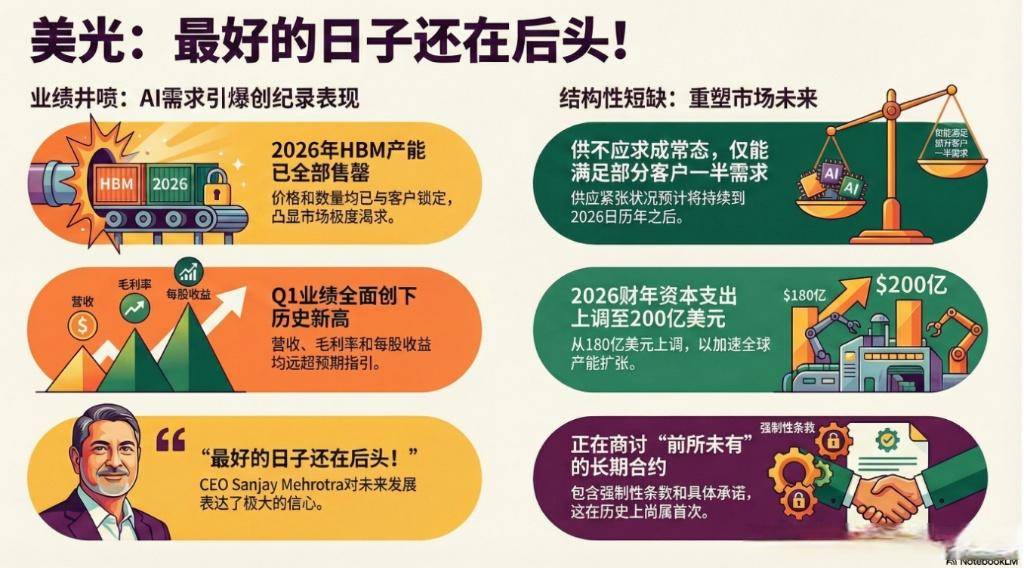
【美光电话会:“好日子还在后头!”CEO直言2026年HBM已售罄,正签署“前所未有”长期合同】与市场担心的“AI需求放缓”截然相反,美光CEO称:2026年的HBM产能不仅没剩,而且已经被锁死。更重要的是,美光警告全行业正面临“结构性短缺”,其目前仅能满足核心客户约一半至三分之二的订单需...
Sou Hu Cai Jing· 2025-12-18 03:13
【美光电话会:"好日子还在后头!"CEO直言2026年HBM已售罄,正签署"前所未有"长期合同】与市场担心的"AI需求放缓"截然相反,美光CEO 称:2026年的HBM产能不仅没剩,而且已经被锁死。更重要的是,美光警告全行业正面临"结构性短缺",其目前仅能满足核心客户约一半至三分 之二的订单需求。同时,公司正在与客户谈判一种"史无前例"的、更有约束力和有具体承诺的多年期供货合同。 ...
锂矿携手电解液齐涨,化工50ETF(516120)午后强势拉升涨超3.5%,成分股超92%上涨
Mei Ri Jing Ji Xin Wen· 2025-12-17 06:52
Group 1 - The three major indices rose significantly, with the Shanghai Composite Index increasing by over 1% and the ChiNext Index rising by more than 2.5%, leading to nearly 2,500 stocks in the market experiencing gains [1] - Sectors such as lithium mining, lithium battery electrolytes, and rare metals saw the highest increases, indicating strong market interest in these areas [1] - The Chemical 50 ETF (516120) rose by 3.53% in the afternoon session, with a cumulative increase of over 46% since April 8, 2023, and over 92% of its constituent stocks reported gains [1] Group 2 - Key stocks in the Chemical 50 ETF include Wanhu Chemical, Salt Lake Shares, and Tianqi Lithium, which have shown significant price increases, with Salt Lake Shares rising over 8% and Tianqi Materials over 7% [1] - The chemical industry is expected to enter a recovery phase, driven by global supply dynamics and AI demand, with specific growth anticipated in electronic chemicals and new energy materials due to technological advancements and policy support [1] - The Chemical 50 ETF closely tracks a comprehensive chemical index that includes leading stocks across various sub-sectors, providing investors with a means to access the overall opportunities in the chemical sector [2]
招商期货-期货研究报告:商品期货早班车-20251215
Zhao Shang Qi Huo· 2025-12-15 01:20
2025年12月15日 星期一 商品期货早班车 招商期货-期货研究报告 黄金市场 招商评论 单暂时止盈。 风险提示:中美贸易摩擦反复,美联储货币政策意外转向 基本金属 | 招商评论 | | | | | --- | --- | --- | --- | | 铜 | 市场表现:周五夜盘铜价震荡偏弱运行。 | | | | | 基本面:周五美股大幅走弱,市场讨论甲骨文和博通财报不及预期,风险偏好整体下行。供应端,铜矿紧张 | | | | | 格局延续,周度 TC 继续小幅下滑。精铜依然担忧伦敦挤仓,伦敦注销占比维持在 40%。国内精废价差 | 4400 | | | | 元附近,废铜票点上行 1.5%。 | | | | | 交易策略:观望等待买点。 | | | | | 风险提示:全球需求不及预期。仅供参考。 市场表现:周五电解铝主力合约收盘价较前一交易日+0.91%,收于 22170 元/吨,国内 0-3 月差-155 | 元/吨, | | | | LME 价格 2875 美元/吨。 | | | | | 基本面:供应方面,电解铝厂维持高负荷生产,运行产能小幅增加。需求方面,周度铝材开工率小幅下降。 | | | | 铝 | ...
手机电脑被迫涨价,小米多次预警、联想囤货
2 1 Shi Ji Jing Ji Bao Dao· 2025-12-10 01:36
Group 1 - The storage market in Shenzhen Huaqiangbei has seen a "daily price change" become the norm, with the PC industry being the first to feel the impact of rising costs [1] - Due to the surge in DRAM and SSD prices, several overseas distributors indicate that prices for certain laptops and commercial PCs will undergo a new adjustment cycle by the end of this year to early next year, with expected increases ranging from 10% to 20% [1] - The most affected products are mainstream lightweight laptops and high-spec office computers with standard configurations of 16GB or more RAM [1] Group 2 - In the highly competitive smartphone market, price increases are occurring in a more subtle manner [1] - Xiaomi executives have acknowledged the significant rise in BOM costs and have repeatedly warned about industry price pressures [1] - Lenovo's management has expressed confidence, stating that they have taken proactive inventory measures and will not pass the pressure onto consumers in the short term due to sufficient stock [1] Group 3 - There is currently no clear indication of when the price increase trend will peak, with industry experts predicting that the structural imbalance caused by AI demand will be difficult to alleviate in the next 6 to 12 months [2] - High storage prices are expected to persist until 2026 [2]
股市面面观|金银铜走势共振 有色金属板块开启跨年行情?
Xin Hua Cai Jing· 2025-12-02 06:17
Group 1: Precious Metals Market Overview - The precious metals sector, represented by gold and silver, has shown strong performance in the A-share and Hong Kong markets, with silver prices reaching historical highs and a year-to-date increase exceeding 100% [2][6] - The expectation of a Federal Reserve interest rate cut in December has contributed to the bullish sentiment in the precious metals market, with silver leading the gains [6][7] - Structural supply shortages in the silver market are anticipated to continue, with a projected supply gap of approximately 95 million ounces in 2025, marking the fifth consecutive year of supply-demand imbalance [6][7] Group 2: Industrial Metals Market Dynamics - The industrial metals sector, particularly copper, has experienced significant price resilience, with LME copper prices reaching historical highs due to supply constraints and macroeconomic optimism [3][4] - Analysts predict a potential super cycle for copper driven by supply disruptions from major mines and increasing demand from sectors such as AI and renewable energy [3][4][5] - The global refined copper supply is expected to face shortages starting in 2024, with projected shortfalls of 270,000 tons, 460,000 tons, and 580,000 tons from 2025 to 2027, respectively [4] Group 3: Aluminum Market Outlook - The aluminum market is also expected to enter a bullish phase, with supply constraints becoming more pronounced as domestic production reaches capacity limits [5] - The global average annual supply growth for electrolytic aluminum is projected at 1.4%, while demand growth is expected to be 1.8%, leading to an expanding supply-demand gap [5] Group 4: Long-term Trends in Gold Prices - The long-term bullish trend for gold prices remains intact, supported by ongoing monetary easing and central bank gold purchases, which are expected to provide a strong safety net for gold prices [7][8] - The urgency for physical gold demand is anticipated to increase due to significant liquidity in the market, potentially leading to unpredictable price movements [8]

英伟达暂时让全世界松了一口气
36氪· 2025-11-28 13:35
Core Viewpoint - The article discusses the ongoing debate about the existence of an AI bubble, particularly in light of Nvidia's recent earnings report, which exceeded market expectations and provided a positive outlook for future growth [4][6][20]. Group 1: Nvidia's Financial Performance - Nvidia reported third-quarter revenue of $57 billion, a 62% increase year-over-year, with diluted earnings per share of $1.3, surpassing market expectations [5][20]. - The data center business contributed $51.2 billion in revenue, accounting for nearly 90% of total revenue, and grew by 66% year-over-year [20][21]. - Nvidia provided a bold fourth-quarter revenue guidance of approximately $65 billion, reflecting a year-over-year growth of about 65% [20][21]. Group 2: Market Reactions and Implications - Following the earnings report, Nvidia's stock price surged over 6% in after-hours trading, positively impacting other tech giants like Amazon, Microsoft, and Google [6][20]. - Despite the positive earnings, concerns about the sustainability of AI spending and potential market corrections remain prevalent among analysts [6][12]. Group 3: Strategic Positioning and Collaborations - Nvidia is evolving from a chip supplier to a central player in defining and orchestrating future AI computing power, as evidenced by its significant partnerships with OpenAI and Anthropic [26][27]. - The collaboration with OpenAI involves a $100 billion partnership to deploy Nvidia systems for AI infrastructure, indicating a strong commitment to future AI developments [26][27]. - Nvidia's partnerships with major tech companies are expected to drive substantial capital expenditures, further solidifying its market position [27][29]. Group 4: Industry Context and Challenges - The article highlights the critical role of Nvidia's earnings in assessing the broader AI narrative and its implications for the tech sector, especially amid macroeconomic uncertainties [10][11][12]. - Concerns about high valuations and the potential for a market correction are underscored by significant sell-offs from major investors, including Peter Thiel and Bridgewater Associates [15][16]. - The ongoing debate about whether AI represents a bubble is intensified by macroeconomic factors, including interest rate fluctuations and their impact on corporate financing [10][11][12].
化工行业估值与盈利双底,绿色转型+新材料驱动增长,石化ETF(159731)份额创新高
Sou Hu Cai Jing· 2025-11-27 02:10
Group 1 - The Petrochemical ETF (159731) has seen a 0.37% increase as of November 27, with notable gains from holdings such as Xingfa Group, Cangge Mining, and Yara International. The ETF has experienced net inflows in 8 out of the last 10 trading days, totaling 22.42 million yuan, reaching a record high of 228 million shares [1] - The National Development and Reform Commission has revised and issued the "Regulations on the Planning, Construction, and Operation Management of Oil and Gas Infrastructure," which will take effect on January 1, 2026. This regulation marks a significant milestone for systematic and comprehensive management in China's oil and gas industry, aiming to enhance management and ensure national energy security while promoting green and sustainable development [1] - Western Securities indicates that the chemical industry is currently at a dual bottom in valuation and profitability, with a 7.45% year-on-year increase in net profit for the basic chemical sector from Q1 to Q3 of 2025. The industry is experiencing internal competition, and attention should be paid to the implementation of anti-competition policies. With resource supply tightening and steady demand recovery, the industry is expected to continue its upward cycle [1] Group 2 - The Petrochemical ETF closely tracks the CSI Petrochemical Industry Index, with the basic chemical industry accounting for 60.85% and the oil and petrochemical industry for 32.16%. The elimination of outdated production capacity and the strengthening of green technology innovation in the petrochemical industry are expected to enhance the value of the industry chain [2]
威刚董事长:现在有钱也买不到存储
国芯网· 2025-11-25 10:54
Core Viewpoint - The current shortage of DRAM and NAND is unprecedented, with market demand exceeding expectations and original manufacturers' safety stock at historical lows, leading to a "make what you can sell" situation [2][4]. Group 1: Market Conditions - The chairman of ADATA, Chen Libai, noted that the simultaneous shortage of DRAM and NAND is a phenomenon not seen in over 20 years [2]. - The extreme tightening of supply has resulted in high visibility of orders for ADATA, but actual shipments are constrained by limited allocations from original manufacturers [4]. - Customers are facing a situation where they have money but cannot purchase goods, with even top executives needing to negotiate directly with suppliers for inventory [4]. Group 2: Pricing and Contracts - Due to the supply-side having absolute bargaining power, most non-CSP customers are unable to secure long-term contracts and must accept short-term agreements with monthly pricing negotiations [4]. - The current demand for AI is a genuine necessity, with its sustainability and scale surpassing any previous storage shortages, indicating a prolonged bullish market trend [4]. Group 3: Future Outlook - It is anticipated that the supply-demand imbalance for DRAM and NAND will persist until 2026, with ADATA's strategy for the upcoming year focusing on "selling conservatively" and prioritizing strategic key customers [5].
