
K型经济

Search documents
美国劳动者报酬占GDP比重跌至1947年来的最低水平
财富FORTUNE· 2026-01-28 13:07
Core Viewpoint - Despite soaring corporate profits and continuous GDP growth in the U.S., the labor force has not shared in the prosperity, with labor compensation's share of GDP declining to its lowest level since 1947 [1][2]. Group 1: Labor Market Trends - Labor compensation's share of GDP is projected to drop to 53.8% by Q3 2025, down from 54.6% in the previous quarter and below the decade average of 55.6% [1]. - The U.S. unemployment rate slightly decreased to 4.4% in December 2025, but remains higher than the 4.1% rate from a year prior, with only 584,000 new jobs added in 2025 compared to 2 million in 2024 [2]. Group 2: Economic Disparities - The contrasting performance of corporate profits and labor market data raises concerns about a "no job growth" phenomenon, exacerbating the K-shaped economic recovery where the rich get richer and the poor get poorer [4]. - The decline in labor income share is attributed to wealth distribution favoring capital, with automation replacing human jobs while productivity continues to rise [4][5]. Group 3: Automation and Job Replacement - Automation is expected to replace 25% of total work hours, with AI-driven productivity improvements potentially leading to a 6% to 7% job loss, equating to up to 1 million unemployed individuals [5]. - Despite the potential job losses from automation, new job creation from technological advancements may mitigate the impact [5]. Group 4: Immigration Policy Impact - Tightened immigration policies have led to a reduction of 881,000 foreign workers since January 2025, which has negatively affected job opportunities for domestic workers [9]. - The decrease in foreign labor contradicts claims that such policies would increase the domestic labor force, as evidenced by rising unemployment rates [9][10]. Group 5: Skills Training and Workforce Development - Addressing the automation trend and expanding the labor force requires a focus on skills training and retraining programs, which have not received adequate resources from both political parties [11][12]. - A significant increase in enrollment in vocational schools among Generation Z indicates a shift towards careers less susceptible to automation, with a 16% rise in community college enrollment for vocational programs in 2024 [11].


美联储换帅在即,特朗普版‘房改’能否奏效
Di Yi Cai Jing· 2026-01-28 05:21
作者 | 第一财经 冯迪凡 近来,特朗普政府推出了一系列旨在降低住房成本的"组合拳",包括下令房利美和房地美购买2000亿美 元的抵押贷款债券,特朗普还签署行政令限制大型机构投资者购买独栋住宅。同时特朗普持续向美联储 施压,要求降低利率。 当地时间27日,美国联邦住房金融局 (FHFA)发布的数据显示,经季节性调整后,2025年11月全美房价 环比上涨0.6%,同比上涨1.9%。 全美各地区房价涨幅差异显著,从美国大西洋中部地区的持平到东南部中部地区的1.1%不等。FHFA表 示,过去一年,太平洋沿岸地区的房价下跌了0.4%,而东北中部地区的年涨幅最高,达到5.1%。 美国房地产经纪人协会高级经济学家克里梅尔(Jake Krimmel)认为,特朗普政府的那些举措不太可能 为美国住房市场带来持久的缓解,因为这些举措只是"短期"措施,而非解决困扰该市场的深层结构性问 题的长期方案。 "我希望看到更多着眼于长期的供给侧解决方案,而不仅仅是刺激需求的措施。"克里梅尔解释道,如果 美国建筑业没有大幅增长,住房可负担性问题仍将持续存在。 美国金鹰房产投资公司执行合伙人陈跃武对第一财经记者解释道:"目前美国的房产库存量是4 ...
美联储换帅在即,特朗普版“房改”能否奏效
第一财经· 2026-01-28 04:31
Core Viewpoint - The article discusses the recent measures taken by the Trump administration to lower housing costs in the U.S., including the purchase of $200 billion in mortgage bonds by Fannie Mae and Freddie Mac, and the restriction on large institutional investors from buying single-family homes. However, experts believe these measures are short-term solutions and do not address the underlying structural issues in the housing market [3][4]. Group 1: Housing Market Trends - As of November 2025, U.S. home prices increased by 0.6% month-over-month and 1.9% year-over-year, with significant regional variations in price changes [3]. - The Pacific Coast region saw a 0.4% decline in home prices over the past year, while the Northeast Central region experienced the highest annual increase at 5.1% [3]. - The current housing inventory in the U.S. is at a 4-month sales level, which is below the 6-month balance point, indicating a persistent shortage of approximately 4 million homes [4]. Group 2: Interest Rates and Mortgage Trends - The average rate for a 30-year fixed mortgage is currently at 6.09%, down from a peak of 8.0% two years ago, following Trump's announcement to purchase $200 billion in mortgages [5]. - Economists suggest that if mortgage rates drop to 5.5%, it could significantly impact the market by encouraging first-time homebuyers and alleviating the "lock-in effect" for current homeowners [7]. - Predictions indicate that mortgage rates could fall to between 5% and 5.5% in 2026, potentially accelerating home price increases by 2% to 5% [8]. Group 3: Regional Market Dynamics - The U.S. housing market is fragmented, with varying affordability and supply-demand dynamics across different regions. The Northeast and Midwest face inventory constraints, while the South and West are experiencing affordability pressures despite more active construction [10][11]. - Cities like Chicago, New York, and Cleveland saw the highest year-over-year price increases, while cities such as Phoenix, Dallas, and Tampa experienced declines [11]. - Dallas is highlighted as a potential hotspot for real estate investment in 2026, driven by its status as a major financial center and significant population growth [12].
锐评|甩不完的“锅”,破不了的“斩杀线”
Xin Lang Cai Jing· 2026-01-26 23:12
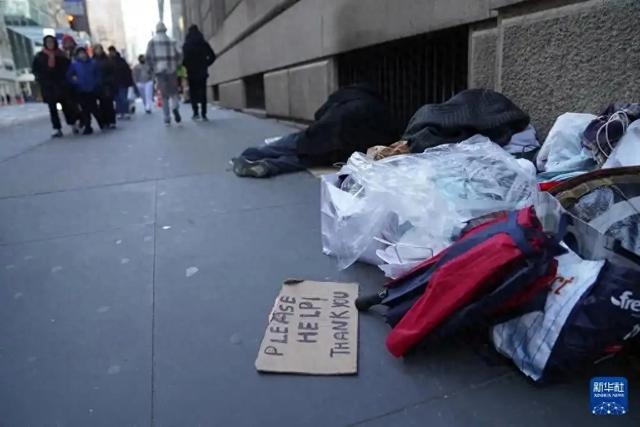
Core Viewpoint - The term "killing line" has gained popularity, highlighting the long-standing survival anxiety in American society, exacerbated by systemic issues in healthcare, income, and housing, leading to a "low-tolerance society" [4][5] Group 1: Social Issues - Approximately 63% of American adults have only enough cash to cover an emergency expense of $400, indicating financial fragility [4] - The U.S. has a significant wealth disparity, with the top tier of society being extremely wealthy while the lower and middle classes face constant risks of financial collapse [4] - The U.S. lacks universal healthcare, with around 20 million adults burdened by medical debt totaling $220 billion, and 66% of personal bankruptcies linked to medical expenses [4] Group 2: Homelessness - As of January 2024, the number of homeless individuals in the U.S. reached 771,480, the highest recorded, equating to 23 homeless individuals per 10,000 people [4] Group 3: Political Dynamics - The "blame-shifting" culture in U.S. politics is characterized by mutual accusations between federal and state governments, and between political parties, especially during crises [7][9] - This blame culture is rooted in the "American exceptionalism" mindset and the decentralized political system, which allows for the easy transfer of responsibility [9][10] Group 4: Economic Context - The "killing line" reflects the failures of capitalism, where individuals unable to contribute to capital growth are seen as expendable, leading to a systemic neglect of vulnerable populations [13][14] - The ongoing discussion around the "killing line" suggests that the American system may not be the optimal model for governance and development, as it fails to protect ordinary citizens from systemic failures [14]
特朗普的“新三支箭”(国金宏观钟天)
Xin Lang Cai Jing· 2026-01-26 15:09
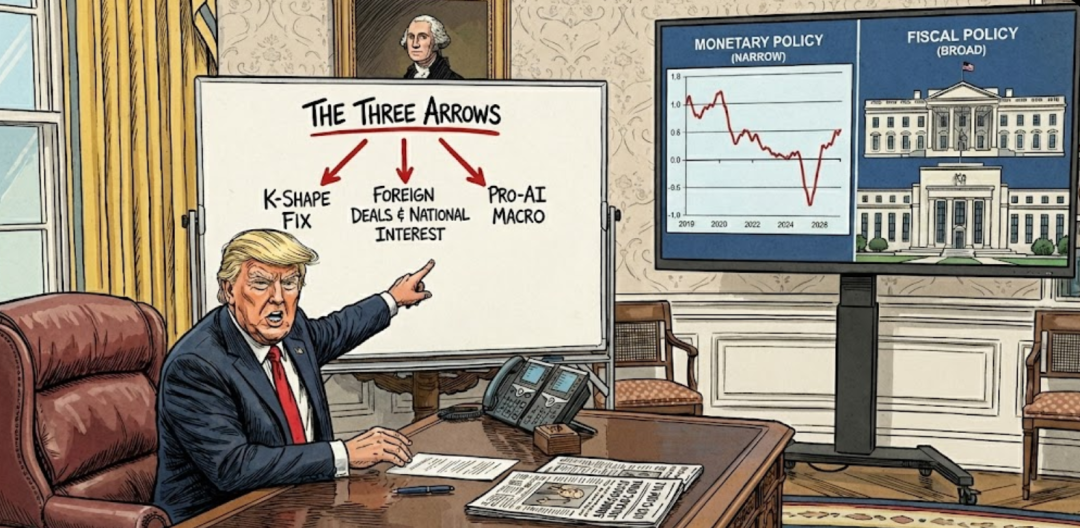
Core Viewpoint - The article discusses Trump's expansion of executive power in 2026, focusing on domestic policies aimed at improving affordability and external policies that seek to align personal political interests with national interests, particularly in the context of a K-shaped economy and the role of AI [3][38]. Group 1: Domestic Policies - Trump aims to control living costs through administrative measures rather than relying on the Federal Reserve's monetary policy, recognizing the limitations of traditional monetary policy [3][39]. - The K-shaped economy shows a disparity where one part is "overheated" and another is "cooled," with Trump's policies targeting the "cold" end, which includes low-income groups and suppressed employment [4][40]. - The labor income share for the American working class fell to 53.8% in Q3 2025, marking a historical low and continuing a downward trend since 2000, which may increase government transfer payments and fiscal deficit pressure [6][42]. - Key policies include capping credit card interest rates at 10% and introducing 50-year mortgages, along with requiring Fannie Mae and Freddie Mac to purchase $200 billion in mortgage-backed securities to lower mortgage costs [7][44]. - The controversial 10% credit card interest rate cap is projected to save households $100 billion in interest payments, but the calculation may overestimate the actual savings [10][44]. - Potential negative effects of the interest rate cap include reduced credit supply, as banks may stop lending to high-risk individuals due to insufficient profit margins [10][47]. Group 2: External Policies - Trump's foreign policy actions, such as the arrest of Maduro and interest in Greenland, aim to capture the "greatest common divisor" of U.S. national interests, voter concerns, and personal political ambitions [16][53]. - The actions are part of a broader strategy to establish a U.S.-led "energy fortress" in the Western Hemisphere, reflecting a return to Monroe Doctrine principles [16][53]. - The pursuit of Greenland is driven by political aspirations and strategic goals, including access to rare earth minerals and new trade routes [17][54]. - Trump's approach emphasizes "peace through strength," suggesting that the U.S. will continue to break global rules, with tariffs and military interventions as options [18][55]. Group 3: AI and Economic Strategy - Trump emphasizes the need to maintain AI leadership, advocating for a new spirit of patriotism and national loyalty among tech companies [19][56]. - The internal policies aimed at supporting the K-shaped economy and external strategies for resource acquisition are designed to create a favorable environment for AI sustainability [19][56]. - The rapid growth of private credit investments in AI companies raises concerns about credit risk, as these firms' ability to meet high profit growth expectations is crucial for economic stability [22][59]. - The article warns that the costs of Trump's policies will ultimately be borne by U.S. dollar credit, highlighting the complexities of maintaining economic stability amid rising fiscal pressures [24][61].
特朗普的“新三支箭”(国金宏观钟天)
雪涛宏观笔记· 2026-01-26 13:21
Core Viewpoint - The article discusses Trump's expansion of executive power in 2026, focusing on domestic policies aimed at improving affordability and external policies that seek to align personal political interests with national benefits [4]. Group 1: Domestic Policies - Trump aims to control living costs through administrative measures rather than relying on the Federal Reserve's monetary policy, recognizing the limitations of traditional monetary policy [5][9]. - The labor income share for the American working class fell to 53.8% in Q3 2025, marking a historical low and continuing a downward trend since 2000, which may increase fiscal deficit pressures due to higher government transfer payments [6]. - Key policies to improve affordability include capping credit card interest rates at 10% and introducing 50-year mortgages, alongside interventions in the oil market and immigration policies to support low-income wages [9][10]. - The proposed 10% credit card interest rate cap could save households $100 billion in interest payments, but may also lead to reduced credit supply and increased risks of moral hazard [10][12]. Group 2: External Policies - Trump's foreign policy actions, such as the arrest of Maduro and interest in Greenland, aim to maximize U.S. national interests and align with voter concerns, reflecting a strategy of "energy as governance" [16][17]. - The approach to Greenland is driven by political ambitions and strategic goals, including securing strategic minerals and enhancing trade routes [16][17]. - Trump's negotiation tactics, exemplified by the Greenland situation, demonstrate a pattern of extreme pressure to achieve favorable outcomes without significant costs [19]. Group 3: AI and Economic Strategy - Trump emphasizes the importance of maintaining AI leadership, advocating for a patriotic spirit among tech companies to prioritize U.S. interests [20][21]. - The domestic and foreign policies are designed to create a favorable macro environment for AI sustainability, with significant investments in AI-related sectors [21][22]. - The rapid growth of private credit investments in AI firms raises concerns about potential credit risks, as the disparity between stock prices and bond valuations may lead to market corrections [26]. Group 4: Overall Economic Implications - The costs of Trump's policies will ultimately be borne by U.S. dollar credit, with increasing fiscal, inflationary, and deficit pressures complicating the economic landscape [27][28]. - The article suggests that Trump's administrative measures, while potentially effective in the short term, may not address underlying economic realities, leading to future inflation and volatility risks [28].
特朗普中选年的三支箭
SINOLINK SECURITIES· 2026-01-26 09:03
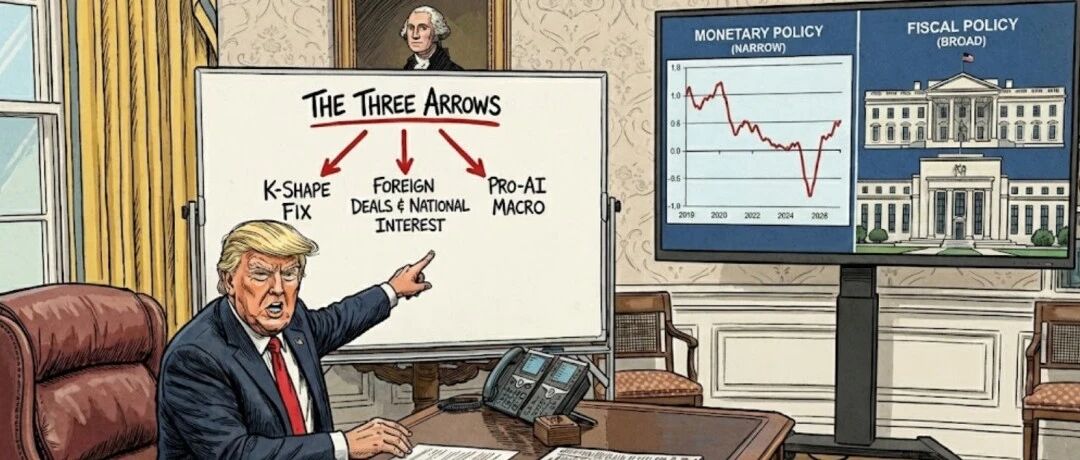
Report Industry Investment Rating - Not provided in the content Core View of the Report - Trump's policies in the new year aim to address domestic and international issues, providing a more favorable macro - environment for the AI narrative. The role of monetary policy is narrowing, and fiscal policy is expanding. The traditional economic policy framework is being replaced by the White House's executive power. In 2026, Trump will maximize his executive power, and the success of domestic policies will be judged by voters, while the international affairs will affect the US dollar credit [2][4]. Summary by Relevant Catalogs First Arrow: Improving Affordability Domestically - Trump uses administrative means to control living costs instead of relying on the Fed's monetary policy, aiming to stimulate the "cold" end of the K - shaped economy (low - income groups and suppressed employment) [5]. - The labor income share of the US "working class" dropped to 53.8% in Q3 2025, continuing the downward trend since 2000. Tax cuts or direct cash - handouts will increase the government transfer payment ratio and cause greater fiscal deficit pressure [6]. - Trump's direct policies include setting a 10% credit - card interest - rate cap and intervening in the housing market (launching 50 - year mortgages and having "Fannie & Freddie" buy $200 billion of MBS). The 10% credit - card interest - rate cap is controversial and likely to backfire, causing a decline in credit supply and potential moral hazards, as well as increased inflation pressure. The purchase of MBS by "Fannie & Freddie" can increase mortgage demand and compress mortgage spreads to some extent [10][14]. - Trump's administrative means rely on the Fed's support, but his attempt to force Powell to resign may backfire. His control over the new Fed chair candidate is increasing, which is more "friendly" to the capital market [16]. Second Arrow: Seeking the "Greatest Common Divisor" of US Interests Abroad - Trump's actions in Venezuela and his interest in Greenland are to seek the greatest common divisor of "US national interests, voter concerns, and his political demands". The "Absolute Determination Operation" in Venezuela aims to build a US - led "Western Hemisphere energy fortress", and his interest in Greenland is for personal political gain and to achieve national strategic goals [19]. - Trump advocates an economic nationalism model to replace the Davos globalist model. His negotiation art often involves extreme pressure, and he may use various means such as tariffs and military intervention. Assets like gold and Bitcoin will face more frequent event - driven shocks [20]. - As the marginal utility of Trump's threats decreases, he may issue secondary threats, which may lead to the selling of US assets, rising long - term US Treasury yields, and increased liquidity pressure on the US stock market [21]. Third Arrow: Maintaining AI Leadership - Trump requires AI companies to prioritize US national interests, and his domestic and international policies are to create a better macro - environment for AI development. The investment proportion of computer and related equipment and data centers is increasing [22][23]. - In 2026, the importance of external financing for AI companies has increased, and the risk of private - credit funds investing in AI is also gathering. The current stock - price increase of AI companies far exceeds the debt - market pricing, and there is a potential risk of a significant stock - price correction [27][30]. Finally: The High Cost Borne by the US Dollar Credit - Trump's policies aim to maintain the stability of the US economic system, but their dynamic impacts are complex and uncertain, including fiscal, inflation, and deficit pressures. These policies are similar to the "Modern Monetary Theory" (MMT) previously advocated by the far - left [31]. - Administrative logic can temporarily overcome economic logic, but economic laws cannot be cancelled. The costs suppressed by administrative orders may turn into future inflation, default risks, and higher systemic volatility. The cost of Trump's policies will be borne by the US economy and the US dollar credit [32].
Economy shows shifting pockets of strength and weakness, says Charles Schwab strategist
Youtube· 2026-01-26 05:00
Economic Outlook - The current economic environment is characterized by instability, with volatility, rotating leadership, and uneven growth becoming the new normal [1][2] - The concept of a K-shaped economy is highlighted, indicating bifurcations in the equity market and rapid sector rotations [2] Federal Reserve Insights - The Federal Reserve is expected to maintain its current stance without significant changes, similar to its previous timeout period [4] - There is a wider range of expectations among FOMC members regarding the future of the Fed funds rate, reflecting ongoing uncertainty and instability [6] Recession and Economic Performance - Manufacturing has been in a recession for several years, struggling to recover, as indicated by the ISM manufacturing index remaining below 50 [8] - In contrast, the services sector continues to show strength, offsetting weaknesses in manufacturing and housing, which is also attempting to recover from its own recession [9][10] Bond Yields and Stock Market Dynamics - There has been a shift in the correlation between bond yields and stock prices, with historical trends showing both positive and negative correlations depending on the economic backdrop [12][14] - The market is currently navigating between two regimes: one where bond yields are influenced by inflation and another where they are driven by growth [13][14] Investment Strategy - A GARP (growth at a reasonable price) approach is favored in the current environment, focusing on positive earnings revisions and balance sheet strength [15][16]


国泰海通|宏观:美元资产的“双击时刻”
国泰海通证券研究· 2026-01-25 14:03
Core Viewpoint - The article discusses the "double whammy" moment for dollar assets, triggered by Trump's comments on Greenland and tariff threats, alongside the early dissolution of the Japanese House of Representatives leading to a sell-off in Japanese bonds, resulting in credit breakdown and liquidity withdrawal for dollar assets [2][8]. Group 1: Dollar Assets and Market Reactions - Trump's remarks on Greenland elevated the issue to a matter of "national security and sovereignty," coupled with tariff threats against European allies, causing a significant market reaction where U.S. stocks, bonds, and currencies faced a triple hit, leading to a "death cross" between the dollar and U.S. Treasuries [2][8]. - The sell-off in Japanese bonds, particularly the long-term bonds, was described as a "High City Moment," with the 30-year bond yield rising by 26 basis points to 3.875% and the 40-year bond yield increasing by 27 basis points to 4.215% [10]. Group 2: Economic Data and Consumer Confidence - The U.S. job market remains stable, with initial jobless claims at 260,000, indicating seasonal alignment, but the high number of continuing claims suggests difficulties for unemployed individuals in finding new jobs [4][17]. - The Michigan Consumer Sentiment Index for January showed a slight rebound to 56.4 from a previous 54, although it remains at historically low levels, raising questions about the sustainability of this trend [5][19]. - Mortgage applications in the U.S. showed a slight decline, with the purchase index at 78.2 (previously 79.9) and the refinancing index at 319.4 (previously 340.9), indicating a mixed recovery in housing market activity [4][18].

海外经济政策跟踪:美元资产的双击时刻
GUOTAI HAITONG SECURITIES· 2026-01-25 11:06
Group 1: Market Dynamics - The "double-click moment" for USD assets is triggered by Trump's comments on Greenland and tariff threats, alongside the early dissolution of Japan's House of Representatives, leading to a sell-off in Japanese bonds[1] - Trump's elevation of the Greenland issue to a matter of "national security and sovereignty" has reignited concerns over USD credit, causing a "death cross" between the USD and US Treasury bonds, while safe-haven assets like gold and silver have strengthened[7] - The sell-off in Japanese bonds saw the 30-year yield rise by 26 basis points to 3.875% and the 40-year yield increase by 27 basis points to 4.215%, raising fears of a reversal in carry trade[9] Group 2: Economic Indicators - Initial jobless claims in the US for the week ending January 17 were 260,000, indicating a stable labor market but high continuing claims suggest difficulty for unemployed individuals in finding new jobs[13] - The Michigan Consumer Sentiment Index for January rose to 56.4 from 54, showing signs of stabilization but remaining at historically low levels[13] - The MBA mortgage application index showed a slight decline, with the purchase index at 78.2 (previously 79.9) and the refinancing index at 319.4 (previously 340.9), indicating a mixed recovery in housing loans[13]