
反内卷政策

Search documents
首创期货孙伏鲲:把握宏观逻辑、洞察产业矛盾、警惕突发冲击是交易的关键
Qi Huo Ri Bao· 2025-12-13 23:43
Core Insights - The discussion focuses on the analysis of the 2025 futures market, highlighting ten classic cases that illustrate market trends, reversals, and volatility, providing traders with a clear understanding of market dynamics [2] Group 1: Trend Analysis - The "Trend King" for 2025 is identified as commodities that exhibit sustained single-direction trends due to macroeconomic forces and deep-seated industrial contradictions [3] - Gold prices unexpectedly surged in 2025, driven by increased demand for safe-haven assets due to geopolitical conflicts, changes in interest rates from the Federal Reserve, and ongoing central bank purchases reflecting a shift away from the US dollar [3] - Silver prices showed greater elasticity alongside gold, supported by tight circulating inventories and rising demand from emerging industries like photovoltaics, as well as favorable conditions from the Federal Reserve's monetary policy [3] Group 2: Reversal Analysis - The "Reversal King" is characterized by how policy expectations and market microstructures can significantly alter price trends, with coking coal exemplifying this dynamic through a "V" shaped price recovery influenced by "anti-involution" policies [5] - The price of polysilicon reversed from bearish to bullish primarily due to policy-driven changes, despite a backdrop of oversupply and high inventories [5] - Industrial silicon and lithium carbonate are also affected by "anti-involution" policy expectations, with industrial silicon facing severe overcapacity and lithium carbonate requiring attention to supply elasticity and demand forecasts [5] Group 3: Volatility Analysis - The "Volatility King" is crude oil, which experienced wide price fluctuations in 2025 due to the interplay of Federal Reserve monetary policy, US energy and trade policies, and geopolitical conflicts [6] - The supply surplus in the oil market is unlikely to change fundamentally, with geopolitical tensions remaining a primary driver of price volatility [6] Group 4: Market Dynamics - The analysis reveals that different market characteristics are driven by distinct underlying logic: trend markets are influenced by long-term narratives and solid industrial contradictions, reversal markets are catalyzed by strong policy expectations and unique market structures, while high-volatility markets are closely tied to unpredictable external shocks [7] - Understanding and differentiating these market types and their core drivers is essential for traders to identify opportunities and manage risks effectively [7]


2026年建材行业年度策略:玻纤粗纱和电子布景气有望共振
Soochow Securities· 2025-12-12 13:05
Core Views - The building materials sector slightly underperformed the overall A-share market in 2025, with a return of 19.62% compared to a -4.85% excess return relative to the Wind All A Index [2][10] - The macro outlook suggests that total policies are expected to strengthen, with physical demand support likely to increase, as emphasized in the December Politburo meeting [2][15][20] - The glass fiber industry is anticipated to see a resonance between traditional and emerging fields, with demand growth expected to remain stable despite a potential slowdown [2][23][45] 2025 Market Review - The building materials sector's performance can be segmented into several phases, with notable periods of underperformance and outperformance against the A-share market [10][12] - The glass fiber sub-sector showed significant excess returns driven by high demand in wind power and thermoplastics [10][12] - The cement sub-sector experienced a boost due to improved domestic demand expectations and effective supply-side discipline [10][12] Macro Outlook - Fixed asset investment in China saw a year-on-year decline of 1.7% from January to October 2025, with infrastructure and real estate investments dropping by 0.1% and 14.7%, respectively [15][19] - The Politburo's focus on expanding domestic demand and optimizing supply is expected to lead to a moderate increase in total policies [15][20] - The anticipated fiscal spending for 2026 is projected to reach 41.62 trillion yuan, a 2.1% increase year-on-year, with a focus on effective investment [20][21] Glass Fiber Industry - The supply shock in the glass fiber industry is gradually being digested, with new capacity expected to be limited in the medium term [23][39] - The effective production capacity for glass fiber is projected to reach 759.2 million tons for roving and 107.7 million tons for electronic fabrics in 2026, representing year-on-year increases of 6.9% and 7.3%, respectively [23][40] - Demand for glass fiber is expected to remain stable, supported by wind power and thermoplastics, despite potential declines in growth rates [45][46] Cement Industry - The cement industry is expected to maintain self-discipline in supply, with a focus on eliminating outdated capacity, which will support profitability [3][20] - The exit of 10,952 million tons of outdated capacity is projected, which will enhance the utilization rate of clinker capacity [3][20] - The profitability of the cement sector is expected to improve in 2026, particularly in regions with significant infrastructure projects [3][20] Glass Industry - The glass industry is experiencing accelerated supply clearance, which is expected to provide price elasticity in 2026 [2][3] - The current state of losses in the industry is likely to drive the closure of high-cost production lines, leading to a potential rebound in prices in the first half of 2026 [2][3] - Long-term policies aimed at curbing disorderly competition are expected to stabilize industry profitability and enhance the competitive advantage of leading companies [2][3]



12月资产配置月度报告:股债调整金价冲高,经济筑底静待企稳
Sou Hu Cai Jing· 2025-12-12 08:04
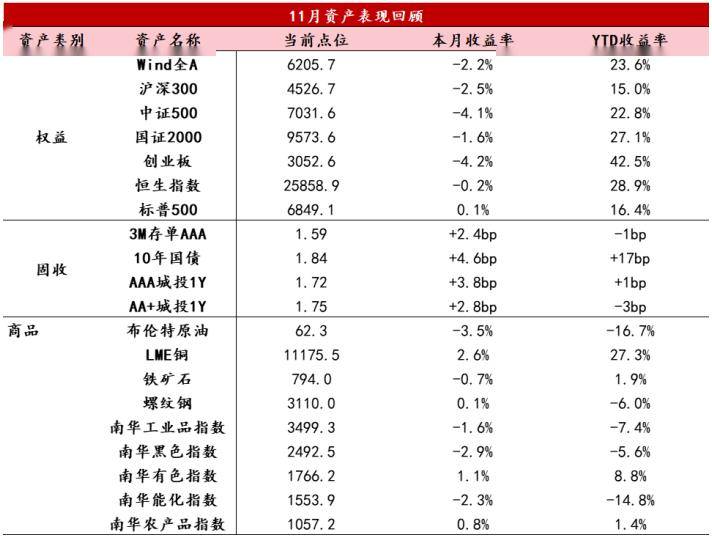
Market Overview - In November, global risk assets primarily declined due to changing expectations around Federal Reserve interest rate cuts and concerns about potential AI asset bubbles and the sustainability of tech narratives [1] - The Wind All A index recorded a decline of 2.22% for the month, with small-cap stocks outperforming, as the Wind Micro-cap index rose by 4.97% while the STAR Market and ChiNext indices fell by 6.24% and 4.23% respectively [1] - In the Hong Kong market, the Hang Seng Technology index fell by 5.23%, while the Hang Seng Index showed relative strength with a decline of only 0.18% [1] Bond Market - The bond market saw a brief recovery in sentiment at the beginning of November due to the central bank's announcement to restart government bond purchases, but yields quickly turned upward due to lower-than-expected bond buying and reduced expectations for monetary easing [2] - The yield on 10-year government bonds rose by nearly 5 basis points to 1.84% over the month [2] Commodity Market - The commodity market showed significant divergence in November, with precious metals rising; London gold spot prices increased by 5.41% to $4,218.55 per ounce, while domestic gold rose by 2.89% to ¥948.15 per gram [3] - Oil prices, however, experienced a downward trend, with Brent crude falling by 3.50% to $62.32 per barrel [3] Economic Performance - In October, macroeconomic growth slowed due to holiday effects and rising baselines, with production, investment, foreign trade, social financing, and credit growth all falling below market expectations [5] - Industrial production showed a year-on-year increase of 4.9% in October, down 1.6 percentage points from the previous value, indicating a weakening production momentum [6] Investment and Consumption - Fixed asset investment continued to drag on economic growth, with a cumulative year-on-year decline of 1.7% in October [7] - Retail sales growth remained weak, with consumer spending under pressure, particularly in the automotive sector, while service consumption showed improvement due to extended holiday effects [7] Monetary Policy - The monetary policy maintained a moderately loose stance in November, focusing on supporting credit demand and ensuring adequate liquidity [9] - The central bank is expected to continue using flexible open market operations to maintain liquidity and prevent significant fluctuations in funding rates [9] Asset Allocation Outlook - The current economic cycle is characterized as an early recovery phase, with external demand expected to provide support, but internal demand indicators have not shown a clear turning point [25] - The asset performance ranking is currently: bonds, stocks > commodities, with potential for a shift towards stocks and commodities if fiscal and monetary policies exceed expectations [26]
港股通消费ETF华安(159285)短线走强,机构:看好新消费与传统消费白马龙头企业发展空间
2 1 Shi Ji Jing Ji Bao Dao· 2025-12-12 02:31
Group 1: Market Performance - The consumer sector showed strong performance in early trading, with the Hong Kong Stock Connect Consumer ETF (Huashan, 159285) rising by 0.97% and the Food and Beverage ETF (516900) increasing by 0.69% [1] - The technology sector remains active, with the Sci-Tech Chip ETF (588290) up 55.66% year-to-date and the ChiNext 50 ETF (159949) up 57.23% year-to-date as of December 11 [1] Group 2: Economic Policy and Outlook - The Central Economic Work Conference held on December 10-11 emphasized the importance of domestic demand, aiming to build a strong domestic market and implement actions to boost consumption [1] - The conference plans to expand the supply of quality goods and services, optimize the implementation of "two new" policies, and remove unreasonable restrictions in the consumption sector to unleash service consumption potential [1] - The conference also aims to stabilize investment, increase the scale of central budget investments, and effectively stimulate private investment through new policy financial tools [1] Group 3: Sector Analysis - According to China International Capital Corporation (CICC), the Chinese consumer market is complex and diverse, presenting new opportunities, with significant growth potential for both new consumption enterprises and leading traditional consumer companies [1] - Guotai Junan Securities noted a clear divergence in micro-enterprise profitability, primarily concentrated in high-growth sectors such as TMT and industries benefiting from "anti-involution" policies, indicating a structural recovery driven by new economy sectors [2]

债市回归“上有顶、下有底”震荡格局,关注十年国债ETF(511260)
Sou Hu Cai Jing· 2025-12-12 01:45
此前我们发出了对债市的做多信号,刚好遇上央行宣布重启国债买卖的利好消息。一个月下来之后,我们发现债市重新走回了"上有顶、下有底"的窄幅震荡 状态,这也是我们到年末的主要观点。 为什么要重提"上有顶、下有底"?首先,目前宏观"水温"比较冷,我们仍处于新旧动能转换时期,社会名义增长率相对不足,这对债市形成了支撑。但今年 货币政策非常温和,央行在避免引导债市形成单边预期,因此向更低利率突破的难度较大。有投资人会问,在这种震荡市该如何操作?我们的建议是:首 先,仓位不宜过重,因为震荡市确实难以择时;其次,建议大家参考我们第二部分将要介绍的量化择时模型,进行更精细化的操作。我们的模型也将陪伴各 位投资者,在市场中持续跟踪、不断迭代。 在介绍具体量化模型之前,我们先分析债市的潜在空间。量化模型跟踪的是趋势,仅能告知我们趋势延续的方向,但对远期空间的判断才是决定仓位的关 键。首先需要说明的是,历史上债市的大级别回撤,往往是基本面与政策面共同作用的结果。因此,目前大家暂时无需担心债券出现进一步大幅涨跌。当 然,近期有观点认为债市与基本面"脱钩",或认为基本面分析、宏观分析已失效。但我们认为这种说法并不准确,基本面仍是核心分析 ...

财信证券袁闯:政策护航提质增效 关注科技成长核心主线
Zhong Zheng Wang· 2025-12-11 14:23
Core Viewpoint - The Central Economic Work Conference emphasizes a continuation of proactive macroeconomic policies, including more active fiscal policies and moderately loose monetary policies, to support economic recovery and stabilize the capital market [1] Market Environment - The overseas economy remains resilient with marginally easing liquidity, alongside rising expectations for interest rate cuts by the Federal Reserve, indicating an improving external environment [1] - Domestically, the "dual easing" policy is expected to continue, leading to a likely weak recovery in the economy, while "anti-involution" policies are set to optimize industry supply and demand dynamics, positively impacting listed company performance [1] Investment Themes - The technology growth sector remains the core focus for the medium to long term, with the AI industry chain expected to shift from hardware to application, particularly in media, computing, and internet sectors [2] - Four specific investment lines are highlighted: 1. High dividend assets are seeing increased accumulation by institutional investors, with sectors like white goods, banking, and telecommunications showing promising dividend strategies [2] 2. The "anti-involution" trend is entering a phase driven by fundamentals, with significant performance improvement expected in coal, steel, and photovoltaic industries [2] 3. Domestic demand expansion focuses on "matching effects," with new consumption areas like health consumption and pet economy, alongside travel and aviation sectors, presenting opportunities [2] 4. In the resource sector, strategic minor metals and industrial metals are anticipated to follow gold in price recovery, benefiting from the upward trend in commodity prices [2] Outlook for 2026 - With policy support, improving internal and external environments, and structural optimization, the A-share market is likely to continue its upward trend, with a focus on technology growth and advantageous niche sectors as the core logic for capturing market opportunities [2]
头部私募年末操作大调整:防御中优化结构,2026看好三条线
2 1 Shi Ji Jing Ji Bao Dao· 2025-12-11 13:28
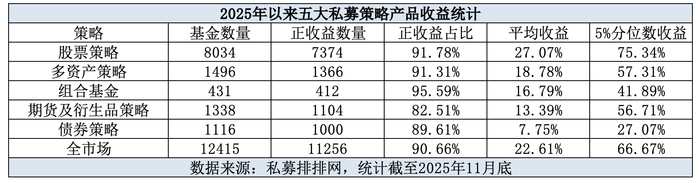
Market Overview - In November 2025, the market entered a phase of adjustment after a previous upward trend, with major indices showing declines, including a drop of over 4% in the STAR Market Index and a 1.67% decrease in the Shanghai Composite Index [1] - Despite the market's downturn, the private equity industry reported strong performance, with 90.66% of 12,415 private equity products showing positive returns and an average return of 22.61% [1] Performance by Strategy - Among five major strategies, the stock strategy emerged as the biggest winner, with an average return of 27.07% and a positive return ratio of 91.78% [2][3] - Quantitative long strategies outperformed subjective long strategies, achieving an average return of over 36% and a positive return ratio of 96.11% [2][4] Strategy Differentiation - The performance of stock strategies showed significant internal differentiation, with quantitative strategies capturing opportunities effectively despite a market environment that favored subjective strategies [2][4] - Subjective long strategies demonstrated strong performance among top performers, with a 5% percentile return of 82.57%, the highest among sub-strategies [4] Market Sentiment and Positioning - As the market adjusted, private equity managers shifted towards defensive and structural optimization strategies, with a slight decrease in aggressive positions [8][9] - By the end of November, 92.9% of subjective long strategy products maintained positions above 50%, although the proportion of fully invested and leveraged positions decreased [8][9] Future Investment Themes - Looking ahead to 2026, there is a consensus among institutions on investment themes centered around energy infrastructure, "anti-involution" policies, and globalization opportunities [11][12] - The development of AI is expected to drive global electricity demand, leading to a reevaluation of energy and power infrastructure investments [11] - The "anti-involution" policy is anticipated to improve supply-demand dynamics in various industries, presenting substantial investment opportunities [12] Divergence in Market Outlook - There are differing views on the recovery of the consumer sector and volatility in the Hong Kong market, with some private equity firms maintaining high positions in Hong Kong stocks while others have reduced exposure [13] - Overall, private equity managers are adopting a cautiously optimistic outlook for 2026, recognizing the challenges of valuation pressures and macroeconomic uncertainties while remaining confident in China's economic transformation [13]

扩内需政策措施继续显效
Jing Ji Wang· 2025-12-11 06:56
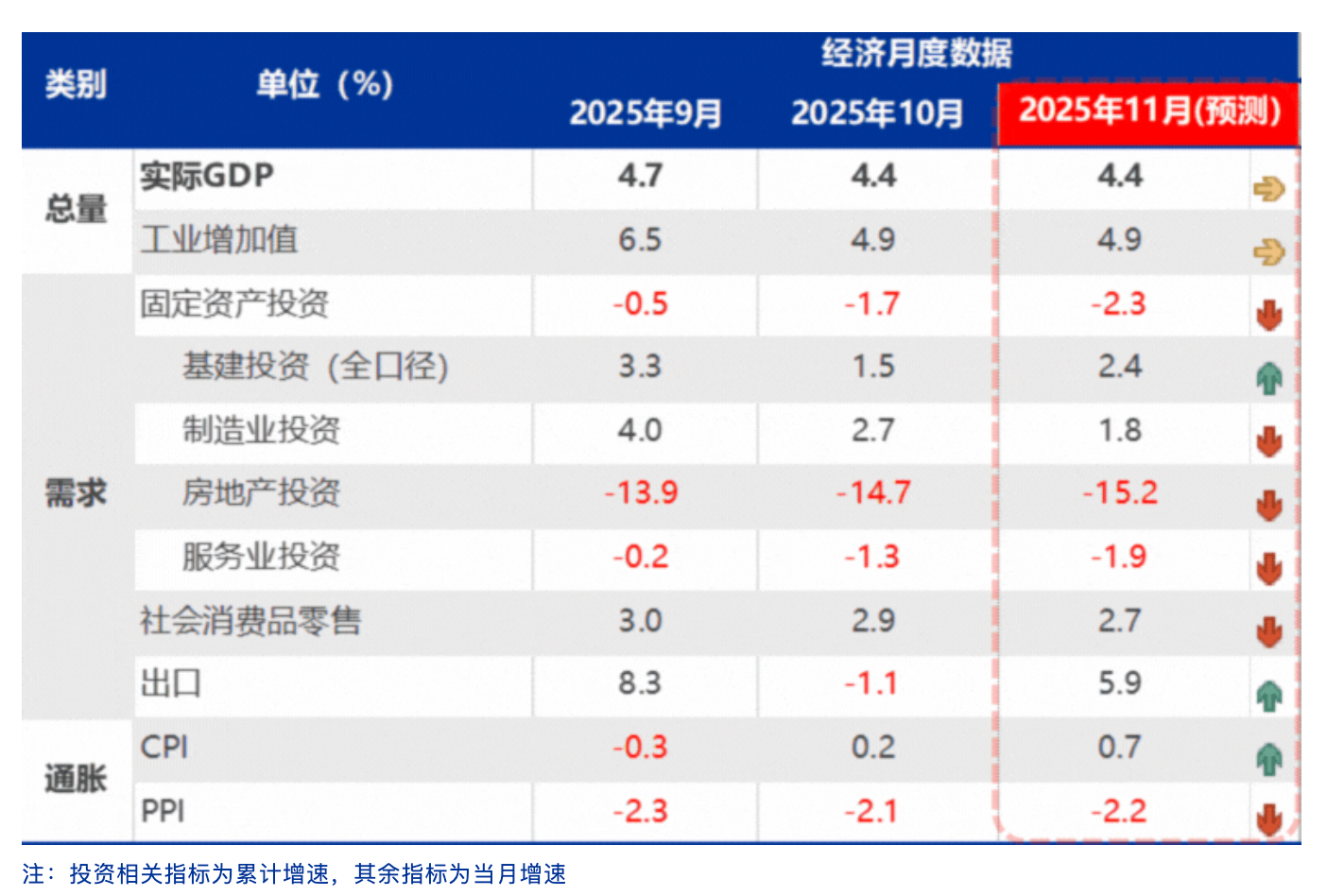
Group 1: Consumer Price Index (CPI) Insights - In November, the CPI increased by 0.7% year-on-year, marking the highest growth since March 2024, with a month-on-month decrease of 0.1% [2][3] - The rise in CPI was primarily driven by a shift in food prices from decline to increase, with fresh vegetable prices rising by 14.5% after nine consecutive months of decline [2][3] - Core CPI, excluding food and energy, rose by 1.2% year-on-year, maintaining above 1% for three consecutive months, indicating stable inflationary pressures [2][3] Group 2: Producer Price Index (PPI) Insights - The PPI increased by 0.1% month-on-month in November, marking the second consecutive month of growth, influenced by seasonal demand increases in certain industries [4] - Year-on-year, the PPI decreased by 2.2%, with the decline slightly widening compared to the previous month, primarily due to high comparison bases from the previous year [4] - The increase in PPI was supported by rising prices in coal and gas sectors, while international oil price fluctuations led to a decrease in domestic oil and gas extraction prices [4] Group 3: Market Trends and Future Outlook - The ongoing "anti-involution" measures are showing results, with price declines in key industries narrowing, indicating improved market competition [5] - Emerging industries are rapidly developing, contributing to price increases in related sectors, such as a 13.9% rise in external storage devices and components [6] - Future inflation is expected to remain low, with a gradual recovery in prices anticipated due to stable domestic demand and effective competition governance [7][8]
赵伟:11月经济或量价回升,保持增长韧性
Di Yi Cai Jing· 2025-12-11 06:16
供给扰动消退带动出口回升,政策加码或支撑服务消费、投资上行。 一问:11月经济活动有何亮点? 清账或持续约束制造业投资,地产对经济的拖累或尚未改善。 11月经济增长压力或仍聚焦于制造业领域,主要表现为企业加快清缴欠款,对投资产生额外拖累。本轮化债也要求企业加快清缴欠款,但由于当前企业盈利 偏弱,企业或将投资的资金用于清缴欠款,导致固定投资回落;10月应收账款增速降至5.1%。此外,去年来制造业投资强劲并非缘于政策驱动,更多是设 备处于自然更新上行周期;但下半年来,自然周期退坡,或也拖累制造业投资。 "反内卷"政策思路从严格限产转向构建中性成本机制,因而目前制造业中下游的反内卷进度偏慢,或令成本率仍处历史高位。与供给侧改革严格限产的政策 不同,本轮"反内卷"政策强调构建行业中性成本机制,引导企业避免低价竞争,而非直接限产,因而也导致反内卷进度偏慢的领域聚焦在中下游。规模以上 工业企业数据显示,目前其成本率仍维持高位,中下游消费链尤为明显。 地产对经济的拖累或未出现改善下,11月地产投资、商品房销售可能进一步回落。2021年房企融资承压导致施工周期拉长,今年四季度地产投资的在建项 目,对应的仍是2022年四季度开 ...
11月国内CPI同比上涨0.7%
Qi Huo Ri Bao Wang· 2025-12-11 05:56
Group 1 - The consumer price index (CPI) increased by 0.7% year-on-year in November, the highest since March 2024, driven mainly by a turnaround in food prices, which shifted from a 2.9% decline to a 0.2% increase [1] - The core CPI, excluding food and energy, rose by 1.2% year-on-year, maintaining above 1% for three consecutive months, indicating stable inflationary pressures in the service and industrial sectors [1] - The producer price index (PPI) decreased by 2.2% year-on-year, with the decline slightly widening compared to the previous month, primarily due to a high base effect from the previous year [1] Group 2 - The PPI data across various industries shows positive trends due to effective macro policies, with price declines in sectors like coal mining, photovoltaic equipment manufacturing, and lithium-ion battery manufacturing narrowing significantly [2] - The "old-for-new" policy has positively impacted prices in the automotive and home appliance sectors, contributing to the recent increase in core CPI [2] - Analysts suggest that while the price level has stabilized, further policies are needed to boost demand and support industrial prices, indicating a cautious outlook for future price movements [2][3]