
地缘政治风险

Search documents
以星航运面临港口罢工与行业挑战,机构展望谨慎
Jing Ji Guan Cha Wang· 2026-02-13 16:40
Core Viewpoint - A large-scale strike at multiple ports in Italy has disrupted operations for Evergreen Marine Corporation, increasing uncertainty in the Mediterranean supply chain [1] Group 1: Company Developments - Evergreen Marine Corporation and Maersk will upgrade their joint operating routes by adding new ports of call and increasing capacity to optimize their network [1] - The potential reopening of the Red Sea shipping route may exacerbate the risk of declining industry profitability, with ongoing pressures from overcapacity and shrinking demand [1] Group 2: Stock Performance - Over the past week, Evergreen Marine Corporation's stock price has shown volatility, with a range of 1.69% and an amplitude of 6.29% [2] - The latest closing price on February 13 was $21.03, down 0.71% for the day, with trading volume decreasing from 2.0093 million shares on February 12 to 266,600 shares on February 13, indicating a moderate decline in market activity [2] Group 3: Institutional Perspectives - Six institutions currently have no buy ratings for Evergreen Marine Corporation, with hold and sell opinions each accounting for 50%, and a target average price of $16.68, which is below the current stock price [3] - Jefferies and other institutions highlight that overcapacity and geopolitical risks remain significant pressures, although a high dividend yield may provide defensive support [3]
Vista黄金股价大跌13.77%,核心项目决策与市场环境成主因
Jing Ji Guan Cha Wang· 2026-02-13 13:55
Company Overview - Vista Gold's stock price dropped by 13.77% on February 12, 2026, closing at $2.63, primarily due to strategic decision-making regarding the Mt Todd project and market conditions [1] - The company plans to make a final decision by mid-2026 on whether to sell or finance the Mt Todd gold mine project, which will significantly impact its long-term development direction [1] - The company's Q3 2025 financial report indicated zero revenue, continued net losses, a debt-to-asset ratio of 7.55%, and negative free cash flow [3] Industry Context - On February 12, 2026, international gold prices reached $5,070 per ounce, but the gold mining sector faced pressure due to volatile gold prices and fluctuating market expectations regarding Federal Reserve policies and geopolitical risks [2] - The Nasdaq index fell by 2.03%, indicating a decline in risk appetite among investors [2] Institutional Insights - Despite buy ratings from institutions like HC Wainwright, major shareholder Sun Valley Gold LLC has recently reduced its holdings, suggesting some investors are choosing to take profits ahead of the upcoming decision [4]
山金期货贵金属策略报告-20260213
Shan Jin Qi Huo· 2026-02-13 11:56
Report Industry Investment Rating No relevant content provided. Core View of the Report - It is expected that precious metals will experience wide - range fluctuations and be generally weak in the short term, oscillate to build a bottom in the medium term, and maintain a long - term bullish trend [1]. Summary by Relevant Catalogs 1. Gold - **Strategy**: Conservative investors should wait and see, while aggressive investors can buy low and sell high. It is recommended to manage positions well and set strict stop - loss and take - profit levels [2]. - **Price Data**: Comex gold active contract closed at $4941.40 per ounce, down $166.40 (-3.26%); London gold at $5043.15 per ounce, down $34.70 (-0.68%); Shanghai gold futures main contract at 1110.10 yuan per gram, down 16.02 yuan (-1.42%); Gold T + D at 1108.50 yuan per gram, down 14.42 yuan (-1.28%) [2]. - **Position and Inventory**: Comex gold positions decreased by 16.13% to 409,694 contracts; Shanghai gold futures main contract positions decreased by 6.53% to 153,140 contracts; LBMA gold inventory increased by 0.57% to 9158 tons [2]. 2. Silver - **Strategy**: Similar to gold, conservative investors should wait and see, and aggressive investors can use a high - selling and low - buying strategy. Good position management and strict stop - loss and take - profit are recommended [5]. - **Price Data**: Comex silver active contract closed at $75.01 per ounce, down $9.07 (-10.79%); London silver at $83.52 per ounce, down $2.58 (-3.00%); Shanghai silver futures main contract at 19,782 yuan per kilogram, down 844 yuan (-4.09%) [5]. - **Position and Inventory**: Comex silver positions remained unchanged at 143,180 contracts; Shanghai silver futures main contract positions decreased by 20.22% to 2,718,300 contracts; Total visible inventory decreased by 1.78% to 40,324 tons [5]. 3. Platinum - **Strategy**: Conservative investors should wait and see, and aggressive investors can buy low and sell high. Position management and stop - loss/take - profit are necessary [7]. - **Price Data**: NYMEX platinum active contract closed at $2097.40 per ounce, up $126.40 (6.41%); London platinum at $2054 per ounce, up $30 (1.48%); Platinum futures main contract on Guangzhou Futures Exchange at 545.05 yuan per gram, up 39.05 yuan (7.72%) [8]. - **Position and Inventory**: NYMEX platinum active contract positions decreased by 5.47% to 55,657 contracts; NYMEX platinum total inventory decreased by 1.33% to 21 tons [8]. 4. Palladium - **Strategy**: Conservative investors should wait and see, and aggressive investors can adopt a high - selling and low - buying strategy. Position management and stop - loss/take - profit are recommended [10]. - **Price Data**: NYMEX palladium active contract closed at $1712 per ounce, up $71 (4.33%); London palladium at $1693 per ounce, down $127 (-7.56%); Palladium futures main contract on Guangzhou Futures Exchange at 438.15 yuan per gram, up 27.65 yuan (6.74%) [10]. - **Position and Inventory**: NYMEX palladium active contract positions decreased by 14.87% to 13,515 contracts; NYMEX palladium total inventory decreased by 14.80% to 6 tons [10]. 5. Key Fundamental Data of Precious Metals - **Monetary Policy**: The upper limit of the federal funds target rate is 3.75%, the discount rate is 3.75%, and the reserve balance interest rate is 3.65%, all down 0.25 percentage points [11]. - **Economic Indicators**: The 10 - year US Treasury real yield is 2.39%, down 0.11 (-4.40%); the US dollar index is 96.91, down 1.06 (-1.08%); the US trade deficit is -$56.8 billion, down $27.6 billion (-94.57%) [11][13]. - **Inflation Data**: CPI year - on - year is 2.70%, with no change; core CPI year - on - year is 2.60%, with no change; PCE price index year - on - year is 2.77%, up 0.09 [11]. - **Other Data**: The geopolitical risk index is 142.57, down 24.88 (-14.86%); the VIX index is 20.82, up 3.17 (17.96%); the CRB commodity index is 306.23, down 4.36 (-1.40%) [13].
【黄金期货收评】多空交织下黄金维持震荡 沪金日内下跌1.61%
Jin Tou Wang· 2026-02-13 08:29
Group 1 - The core viewpoint is that gold prices are experiencing wide fluctuations due to mixed market signals, including strong U.S. employment data and geopolitical risks [2][3]. - On February 13, the Shanghai gold spot price was quoted at 1104.00 yuan per gram, showing a discount of 6.1 yuan per gram compared to the futures price of 1110.10 yuan per gram [1]. - The probability of a 25 basis point rate cut by the Federal Reserve in March is 5.9%, while the probability of maintaining the current rate is 94.1% [1]. Group 2 - The U.S. non-farm payroll data for January showed a significant increase in employment, which exceeded expectations and led to a decrease in the unemployment rate, indicating resilience in the labor market [2]. - The labor department significantly revised down the projected non-farm employment numbers for 2025, removing most of the expected job additions for that year [2]. - The market is grappling with the credibility of the January data against the backdrop of the downward revision for 2025, resulting in high volatility in gold and silver prices [2]. Group 3 - New Century Futures indicates that gold prices are maintaining a volatile trend due to strong U.S. employment data, which undermines expectations for a rate cut in March [3]. - Concerns over AI disruption continue to pressure the dollar index, providing support for gold prices [3]. - A decrease in gold ETF holdings has weakened investment demand, while ongoing geopolitical risks and a trend of central banks increasing gold reserves remain long-term supportive factors for gold [3].
中俄电力供应终止,双方合作价值链升级才是破局之道
Zhong Guo Neng Yuan Wang· 2026-02-13 07:12
2026年1月1日,我国正式全面停止从俄罗斯进口电力。1月21日俄能源部长表示2026年将追加1.16亿美 元的专项拨款用于电网建设,重点集中在远东、西伯利亚等地区。该事件核心信号是中俄远东地区开发 合作亟需提质升级。 结语 中俄电力合作始于2012年,双方签署了有效期至2037年的长期供电合同,约定整个合同期内俄罗斯向我 国供应电力约1000亿千瓦时,年均供电量约40亿千瓦时。合作初期,俄对华电力出口有效弥补了我国部 分边境地区的电力缺口,尤其是2021年中国东北地区出现能源短缺时,俄罗斯应中方请求将出口量提升 30%至39.7亿千瓦时,2022年峰值达到47亿千瓦时,为我国区域能源安全提供了重要支撑。 中俄电力合作的战略价值,远超越电力贸易本身,更是双边战略互信的重要载体和我国深度参与俄罗斯 远东开发的核心抓手。从能源供应全局来看,俄罗斯对华电力出口占我国全社会用电量不足万分之一, 处于完全可替代范围,此次停购俄电虽规避了短期经济损失,但俄方远东能源基建的短板暴露,也为中 俄合作提质升级创造了关键机遇。俄方已明确2026年追加1.16亿美元专项拨款用于远东、西伯利亚电网 建设,其改善远东能源基建的意愿明确 ...
油轮跟踪-美伊局势僵持-行业供给脆弱
2026-02-13 02:17
2026-02-12 摘要 VLOC 即期运价维持高位,一年期租金大幅上涨,反映船东对 2026 年 市场乐观预期。地缘政治风险,如美伊关系紧张,可能导致运价短期内 突破 15-20 万美元,长期僵持或制裁将稳步推升运价。 俄乌冲突加剧欧盟对俄海运禁令,增加俄油影子船队运营难度,收缩合 规船队运力,利好阿芙拉型和苏伊士型油轮市场,运价有望进一步上行。 印度在美国压力下减少俄罗斯原油进口,转向美国和委内瑞拉,提升合 规远洋运输需求。12 月印度从俄罗斯进口原油量减少,未来或逐步转向 合规市场。 影子船队面临生存空间缩小、运营难度加大的挑战,受制裁邮轮承担全 球原油出口的重要比例,但高昂的维修费用和扣船风险使其运营风险增 加。 人民币国际化进程加速,沙特阿美对华原油出口人民币结算比例已达 45%,中俄本币结算比例超 90%,推动大宗商品人民币结算,或将挑 战美元主导地位。 Q&A 目前游轮行业的市场状况如何? 油轮跟踪:美伊局势僵持,行业供给脆弱 20260212 游轮行业当前处于一个非常高景气的状态,未来发展有可能大概率超过此前预 期。近期发生了两个重要变化:地缘局势的升级和行业集中度的大幅提升,这 些因素将显 ...
油轮运价强势-地缘波动和行业格局是何预期
2026-02-13 02:17
油轮运价强势,地缘波动和行业格局是何预期? 20260212 2026-02-12 摘要 印度炼油企业如信实、IOC 等自 8 月起减少俄油采购,转向中东等地, 导致印度每周消耗约 20 个 VLCC 船位,显著影响全球 VLCC 市场。 印度港口拥堵严重,Jamnagar 和 Mundra 港口卸货需 14-21 天,远高 于中国舟山的 2-3 天,加剧运力紧张,推高运价。 委内瑞拉原油产量占比极低(1%-1.3%),主要用于偿还中国债务,设 施老化和政治不稳定限制其产能快速恢复。 伊朗局势紧张,美国军事施压与谈判并存,地缘政治风险增加,可能导 致邮轮运费波动,任何冲突或制裁升级都将推高运价。 长锦商船控制全球约 20%的 VLCC 运力,主要船东合计控制超过一半运 力,提高了行业议价能力,长锦商船报价强硬,溢价能力显著。 新造 VLCC 交付有限,老旧船舶难以满足合规要求,从事非法油运输的 老旧船舶几乎无法转为合规运营,美国对受制裁船舶的制裁难以解除。 场景商船大规模收购 VLCC,但运营效率低,现金流情况不明,资金来 源传闻有 MAC 支持,短期目标是控制 130-150 条 VLCC,但模式可持 续性 ...
宏观金融类:文字早评2026/02/13星期五-20260213
Wu Kuang Qi Huo· 2026-02-13 01:49
Report Industry Investment Rating No information provided in the report. Core Views - In the medium to long term, the policy's supportive attitude towards the capital market remains unchanged. The strategy is to buy on dips. For the bond market, it is expected to be in a strong and volatile trend. For precious metals, they are in a high - level volatile pattern, and the market focus has shifted to the upcoming US CPI data. For various commodities, their price trends are affected by factors such as supply - demand relationships, seasonal factors, and policy impacts, and corresponding trading strategies are proposed for each commodity [4][7][9]. Summary by Directory Macro - Financial Category Index - **Market Information**: On February 13, the central bank conducted 100 billion yuan of outright reverse repurchase operations; the European Central Bank Executive Committee will expand the scope of application of the euro back - up financing mechanism; many car companies disclosed their solid - state battery technology paths and industrial plans; some companies made progress in 3D printing technology and PCB production [2]. - **Basis Annualized Ratio**: Presented the basis annualized ratios of IF, IC, IM, and IH for different contract periods [3]. - **Strategy View**: Due to the intensifying divergence in US monetary policy expectations, the risk appetite of the capital market is suppressed, and the US stocks and precious metals are highly volatile. Domestically, the liquidity is tightened seasonally approaching the Spring Festival. The strategy is to buy on dips [4]. Treasury Bonds - **Market Information**: On February 13, the central bank conducted 100 billion yuan of 6 - month outright reverse repurchase operations, with an incremental scale of 50 billion yuan compared to the maturity amount. In 2025, commercial banks' net profit was 2.4 trillion yuan, and the average capital profit rate and average asset profit rate were 7.78% and 0.60% respectively. The central bank's net injection on Thursday was 44.8 billion yuan [5][6]. - **Strategy View**: The central bank emphasizes the coordination of monetary and fiscal policies, and the capital market is expected to remain loose. The economic recovery foundation is not solid, and the bond market is expected to be in a strong and volatile trend [7]. Precious Metals - **Market Information**: On Thursday, precious metals tumbled. The decline was due to the decline of US technology stocks, investors' forced liquidation, and profit - taking. The US initial jobless claims and continuing jobless claims data were released, and the US existing home sales in January decreased by 8.4% month - on - month [8]. - **Strategy View**: Although short - term monetary policy expectations suppress precious metals, they are still in a high - level volatile pattern. The market is waiting for the US CPI data. The strategy is to wait and see, with the reference ranges of 950 - 1100 yuan/gram for Shanghai gold and 18500 - 21000 yuan/kilogram for Shanghai silver [9][10]. Non - Ferrous Metals Category Copper - **Market Information**: Before the domestic long holiday, funds were cautious. Overnight silver and US stocks declined, and copper prices fell after rising. LME copper inventory increased, and the domestic electrolytic copper social inventory also increased [12][13]. - **Strategy View**: Although the market sentiment is affected by the decline of precious metals, the strong manufacturing in Europe and the US provides support. The copper price is expected to be in a high - level volatile pattern during the long holiday, with reference ranges of 99000 - 103000 yuan/ton for Shanghai copper and 12500 - 13200 US dollars/ton for LME copper [14]. Aluminum - **Market Information**: The Mozambique aluminum smelter is expected to shut down for maintenance in March. Aluminum prices rose and then fell. The domestic aluminum ingot and aluminum rod inventories increased, and the LME aluminum inventory decreased [15]. - **Strategy View**: The domestic demand is weak, but the low LME inventory and high US aluminum spot premium support the price. The aluminum price is expected to be in a volatile and upward trend during the long holiday, with reference ranges of 23200 - 23600 yuan/ton for Shanghai aluminum and 3050 - 3140 US dollars/ton for LME aluminum [16]. Zinc - **Market Information**: The zinc index rose slightly. The domestic zinc ingot social inventory started to accumulate, and the downstream enterprise operation was average [17]. - **Strategy View**: The zinc mine inventory accumulation slowed down, and the zinc concentrate TC stabilized. Although the domestic zinc industry is weak, the strong US PMI may drive the zinc price to rise, and there is still a risk of price fluctuations during the Spring Festival [17][18]. Lead - **Market Information**: The lead index fell slightly. The lead ingot social inventory increased, and the waste battery inventory was higher than that in 2025 [19]. - **Strategy View**: The lead ore inventory is still higher than the same period in previous years, and the lead concentrate processing fee is low. The lead price is near the lower edge of the long - term shock range, and whether it can stabilize depends on the post - holiday restocking willingness of downstream enterprises [19]. Nickel - **Market Information**: The nickel price fluctuated. The spot premium of nickel was stable, and the nickel ore price was stable. The price of nickel iron rose slightly [20]. - **Strategy View**: After the second decline of precious metals and risk assets, there is a short - term rebound demand, but the nickel price is expected to be in a wide - range volatile pattern due to fundamental pressure. The approved nickel ore production quota has little impact on the price, with reference ranges of 120,000 - 150,000 yuan/ton for Shanghai nickel and 16,000 - 18,000 US dollars/ton for LME nickel [20]. Tin - **Market Information**: The tin price fluctuated. The smelter's production in Yunnan was stable, and that in Jiangxi was low due to the shortage of waste tin raw materials. The downstream demand was weak [21]. - **Strategy View**: The tin price may rebound with the stabilization of precious metals, but it is expected to be in a wide - range volatile pattern in the short term due to the marginal relaxation of supply - demand and the increase in inventory. It is recommended to wait and see, with reference ranges of 350,000 - 410,000 yuan/ton for the domestic main contract and 46,000 - 50,000 US dollars/ton for LME tin [23]. Lithium Carbonate - **Market Information**: The lithium carbonate spot index rose, and the futures price fell slightly. The inventory decreased [24]. - **Strategy View**: The supply has decreased, and the demand is expected to be strong. The short - term supply - demand pattern is tight. The upstream has more bargaining power after the holiday. The reference range for the Guangzhou Futures Exchange's lithium carbonate 2605 contract is 143,000 - 157,000 yuan/ton [25]. Alumina - **Market Information**: The alumina index fell slightly, and the trading volume decreased. The spot price in Shandong was at a discount to the main contract [26]. - **Strategy View**: There is a strike in the Guinea bauxite mine area, and the alumina smelting capacity is in excess. It is recommended to wait and see, with the reference range of 2750 - 3000 yuan/ton for the main contract AO2605 [27]. Stainless Steel - **Market Information**: The stainless steel main contract fell. The spot price was stable, and the inventory increased [29]. - **Strategy View**: The supply pressure is controllable, and the demand is weak before the Spring Festival. It is recommended to buy on dips, with the reference range of 13,500 - 14,500 yuan/ton for the main contract [29]. Cast Aluminum Alloy - **Market Information**: The cast aluminum alloy price rebounded slightly, and the trading volume increased. The inventory increased [30]. - **Strategy View**: Although the demand is average, the price is supported by supply - side disturbances and seasonal raw material shortages [31]. Black Building Materials Category Steel - **Market Information**: The prices of rebar and hot - rolled coil decreased slightly. The rebar inventory started to accumulate, and the hot - rolled coil inventory increased slightly [33]. - **Strategy View**: The carbon emission trading policy may increase the cost of the steel industry. The steel market is in a bottom - game stage, and it is expected to be in a weak and volatile pattern in the short term. Attention should be paid to inventory inflection points and policy changes [35]. Iron Ore - **Market Information**: The iron ore main contract fell slightly. The overseas iron ore shipment decreased, and the port inventory decreased [36]. - **Strategy View**: The overseas iron ore shipment is in the off - season, and the iron water production is in a recovery trend. The ore price is expected to be in a weak and volatile pattern before the festival. Attention should be paid to overseas shipments and domestic terminal demand after the festival [37]. Coking Coal and Coke - **Market Information**: The prices of coking coal and coke fell slightly. The spot prices of coking coal and coke were at a premium to the futures prices [38]. - **Strategy View**: Overseas coal - related disturbances have a positive impact on sentiment, but the short - term upward drive of coking coal is not strong. The downstream replenishment is coming to an end, and there is a risk of price correction after the festival. Coking coal may have a better performance from June to October [40][42]. Glass and Soda Ash - **Glass** - **Market Information**: The glass main contract fell. The inventory increased, and the downstream demand was weak [44]. - **Strategy View**: The glass market is expected to be in a volatile and sorted pattern, with the reference range of 1030 - 1120 yuan/ton for the main contract [45]. - **Soda Ash** - **Market Information**: The soda ash main contract fell. The inventory increased, and the demand for heavy soda ash was weak [46]. - **Strategy View**: The soda ash market is in a weak and stable volatile pattern, with the reference range of 1140 - 1230 yuan/ton for the main contract [46]. Manganese Silicon and Ferrosilicon - **Market Information**: The prices of manganese silicon and ferrosilicon fell. The spot prices were at a premium to the futures prices [47]. - **Strategy View**: The long - term commodity market is expected to be bullish, but the short - term market sentiment is affected by precious metals. The supply - demand pattern of manganese silicon is loose, and that of ferrosilicon is balanced. Attention should be paid to the cost push of manganese ore and the supply contraction of ferrosilicon [48][49]. Industrial Silicon and Polysilicon - **Industrial Silicon** - **Market Information**: The industrial silicon futures price fell. The supply is expected to decrease, and the demand is weak [50]. - **Strategy View**: The industrial silicon market is in a situation of weak supply and demand in February. The price is expected to be in a weak and volatile pattern, and attention should be paid to market sentiment [51]. - **Polysilicon** - **Market Information**: The polysilicon futures price fell. The supply decreased, and the inventory is expected to decrease slightly [52]. - **Strategy View**: The polysilicon market is expected to be in a volatile pattern. It is recommended to wait and see, and attention should be paid to post - holiday demand and spot prices [53]. Energy and Chemical Category Rubber - **Market Information**: The rubber price fluctuated with the commodity market. The tire enterprise operating rate decreased, and the inventory increased [56][57]. - **Strategy View**: It is recommended to reduce risks before the Spring Festival, trade short - term on the disk, and hold a hedging position during the festival [58]. Crude Oil - **Market Information**: The crude oil futures price rose slightly. The US crude oil commercial inventory increased, and the diesel and fuel oil inventories decreased [59]. - **Strategy View**: The current oil price has priced in a high geopolitical premium. It is recommended to take profits on rallies and focus on medium - term layout [61]. Methanol - **Market Information**: The methanol spot price changed slightly, and the futures price decreased [62]. - **Strategy View**: Methanol has priced in many negative factors. It is recommended to stop losses on short positions and wait and see in the short term [63]. Urea - **Market Information**: The urea spot price was stable, and the futures price rose [64]. - **Strategy View**: The import window has opened, and the fundamental outlook is negative. It is recommended to short - sell [65]. PVC - **Market Information**: The PVC futures price fell. The supply was high, and the demand was weak. The inventory increased [66]. - **Strategy View**: The PVC market has a situation of strong supply and weak demand. The short - term price is supported by electricity price expectations and export rush, and attention should be paid to capacity and operating rate changes [67]. Ethylene Glycol - **Market Information**: The ethylene glycol futures price fell. The supply was high, and the demand was weak. The inventory increased [68]. - **Strategy View**: The ethylene glycol market needs to reduce production to improve the supply - demand pattern. There is a risk of price rebound due to geopolitical factors and coal price rebound [69]. PTA - **Market Information**: The PTA futures price fell. The supply was high, and the demand was weak. The inventory increased [70]. - **Strategy View**: The PTA market is in the Spring Festival inventory - accumulation stage. The processing fee is expected to be stable at a high level, and there is an opportunity to buy on dips after the Spring Festival [71]. p - Xylene - **Market Information**: The p - xylene futures price fell. The supply was high, and the demand from downstream PTA was weak. The inventory increased [72]. - **Strategy View**: The p - xylene market is expected to accumulate inventory before the maintenance season. The valuation is expected to rise after the Spring Festival, and there is an opportunity to buy on dips following the crude oil price [73][74]. Agricultural Products Category Live Pigs - **Market Information**: The domestic pig price fluctuated. The trading volume decreased approaching the Spring Festival [76]. - **Strategy View**: The short - term pig price is under pressure due to large supply and high inventory. It is recommended to short - sell on rallies. The long - term price may be supported by seasonal factors and demand recovery [77]. Eggs - **Market Information**: The egg price was stable in most markets approaching the Spring Festival [78]. - **Strategy View**: The egg market is in the inventory - accumulation period. The short - term price is under pressure, and it is recommended to short - sell. The long - term price trend depends on capacity reduction [79]. Soybean and Rapeseed Meal - **Market Information**: The domestic soybean meal price was stable, and the rapeseed meal price rose. The global soybean supply and demand were slightly adjusted in the USDA report [80]. - **Strategy View**: The short - term protein meal price is expected to be in a volatile pattern due to the increase in US soybean procurement expectations and the rise in import costs [81]. Oils and Fats - **Market Information**: The domestic soybean oil price rose, the palm oil price fell, and the rapeseed oil price was stable. The global palm oil supply and demand data were released [82][83]. - **Strategy View**: The consumption growth of oils and fats is greater than the production growth this year. It is recommended to wait for a pull - back to go long [84]. Sugar - **Market Information**: The domestic sugar price fell. The domestic and foreign sugar production and sales data were released [85][86]. - **Strategy View**: The international sugar price may rebound after the northern hemisphere's harvest is completed. The domestic sugar price has limited downward space. It is recommended to wait and see [87]. Cotton - **Market Information**: The domestic cotton price rose. The domestic and foreign cotton supply and demand data were released in the USDA report [88][89]. - **Strategy View**: The USDA report is neutral. It is recommended to try to go long at the lower edge of the shock range after the Spring Festival, and attention should be paid to the downstream operating rate and the new cotton target price policy [90].
黄金巨震、原油冲高、大豆破关,节后市场逻辑将如何演绎?
Sou Hu Cai Jing· 2026-02-13 01:35
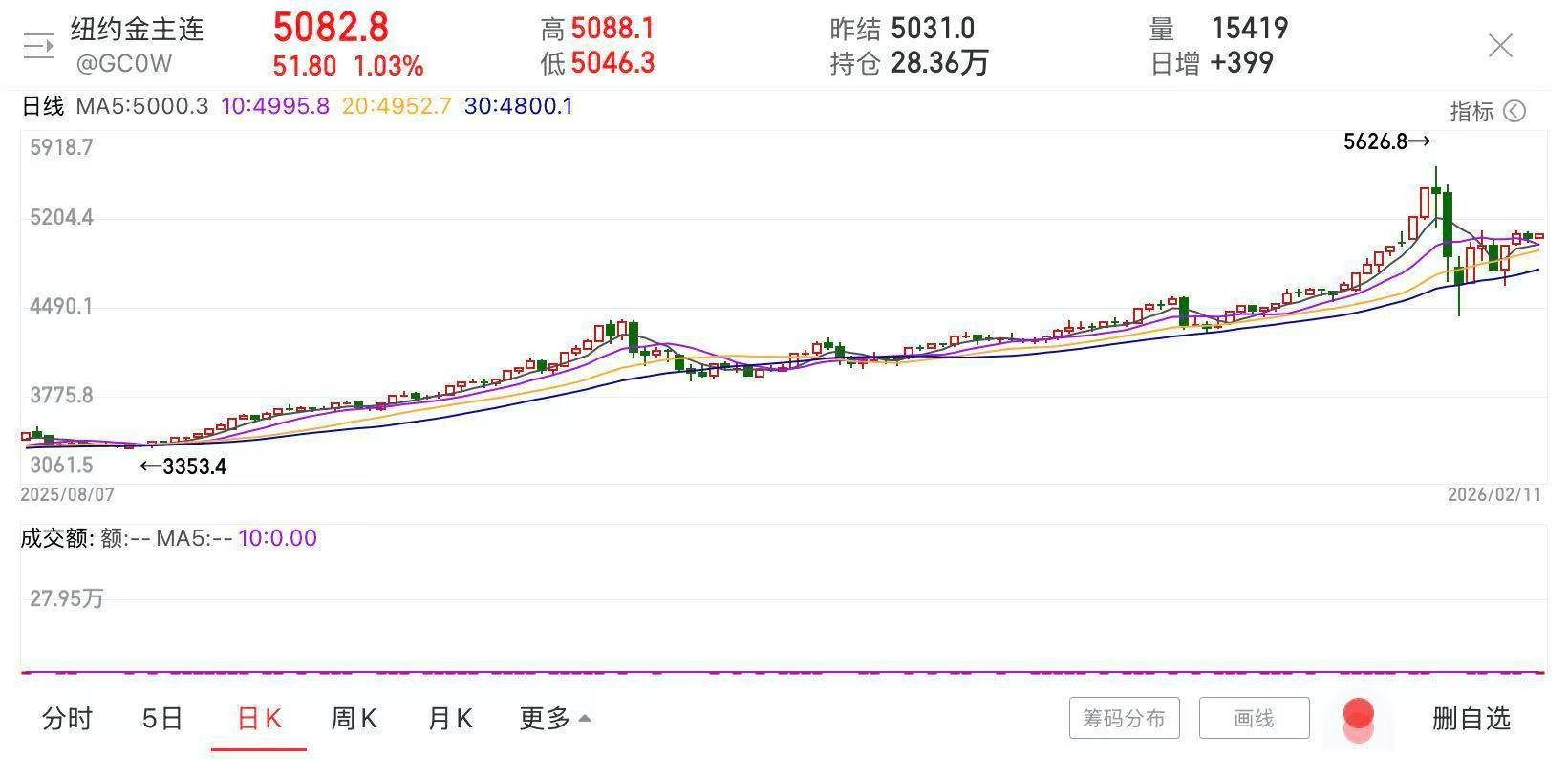
Group 1: Precious Metals - The recent volatility in precious metals, particularly gold and silver, has raised questions about whether the current price adjustments signify a market correction or the end of a bull market [1][2] - Gold prices surged to over $5600 per ounce at the end of January but have since dropped back to around $5000, while silver experienced a significant one-day drop exceeding 25% [1][2] - Factors contributing to the recent decline include increased geopolitical uncertainty, potential shifts in Federal Reserve monetary policy, and profit-taking from previous highs [2] Group 2: Oil Market - Oil prices have recently increased, with West Texas Intermediate crude rising from a low of $55 per barrel to a high of $66 per barrel, reflecting a more than $10 increase [3][6] - Tensions between the U.S. and Iran are a primary driver of oil price fluctuations, as Iran controls a significant portion of global oil reserves and key shipping routes [6] - The outlook for oil prices post-Chinese New Year will depend on geopolitical developments and the resumption of global economic activities, with predictions of a potential supply surplus in 2026 varying among major energy agencies [6][7] Group 3: Agricultural Products - The market reacted positively to President Trump's announcement regarding China's potential purchase of 20 million tons of soybeans, leading to a rise in soybean futures prices above $11 per bushel [8][12] - The increase in soybean prices is supported by improved trade expectations, supply changes in major producing regions, and favorable policy adjustments regarding biodiesel [12] - The soybean market's dynamics will shift post-holiday, focusing on seasonal supply and demand factors, with the consumption pace and recovery in end-user markets being critical for price movements [13]

大规模空袭 乌30万人停水断电!特朗普威胁!美原油库存远超预期 油价下跌 银价暴跌
Qi Huo Ri Bao· 2026-02-13 00:23
Group 1: Market Performance - COMEX gold futures fell by 3.08% to $4941.4 per ounce, while COMEX silver futures dropped by 10.62% to $75.01 per ounce [1] - The three major U.S. stock indices closed lower, with the Dow down 1.33%, Nasdaq down 2.02%, and S&P down 1.57% [2] - International oil prices declined, with light crude oil futures for March delivery falling by $1.79 to $62.84 per barrel, a decrease of 2.77%, and Brent crude oil futures for April delivery down by $1.88 to $67.52 per barrel, a drop of 2.71% [2] Group 2: U.S. Tariff Impact - A report from the New York Federal Reserve indicated that U.S. consumers and businesses bore approximately 90% of the costs from tariffs imposed by the Trump administration, contradicting the government's claim that foreign entities would absorb these costs [2] - The average tariff rate in the U.S. rose from 2.6% to 13% over the past year, with U.S. entities absorbing 94% of tariff impacts from January to August, 92% from September to October, and 86% in November [2] Group 3: U.S. Oil Inventory and Market Dynamics - The U.S. crude oil inventory surged by 8.53 million barrels, marking the largest weekly increase since January of the previous year, which exceeded market expectations [4] - Despite the significant inventory increase, oil prices rebounded quickly due to geopolitical factors overshadowing traditional supply-demand indicators [4] - Analysts noted that the increase in inventory was primarily driven by fluctuations in import and export volumes, with U.S. crude oil production rising to 13.71 million barrels per day, an increase of approximately 500,000 barrels from the previous week [5] Group 4: Geopolitical Risks and Oil Pricing - Geopolitical tensions, particularly regarding U.S.-Iran relations, are currently influencing oil pricing more than fundamental supply-demand factors [5][8] - The potential for military action against Iran could significantly disrupt oil supplies, with analysts estimating that geopolitical risk premiums could add $3 to $5 per barrel to oil prices [5] - If a military strike occurs, it could lead to severe retaliatory actions from Iran, impacting the stability of oil supply routes, particularly in the Strait of Hormuz [5] Group 5: Seasonal Trends and Future Outlook - As the cold weather subsides, U.S. oil production is returning to normal levels, and refineries are beginning seasonal maintenance, leading to a typical seasonal inventory build-up [6] - Current U.S. commercial crude oil inventory levels are close to historical averages, and refinery processing rates are at their highest in five years, indicating no significant signs of weakened demand [7] - Analysts caution that if refined product inventories remain high, it could lead to reduced refinery processing rates and increased crude oil inventory levels in the future [7]