
债券市场

Search documents
中短债受“双降”利好影响,利率出现明显下行!谁在买入短债资产?
Mei Ri Jing Ji Xin Wen· 2025-05-12 07:51
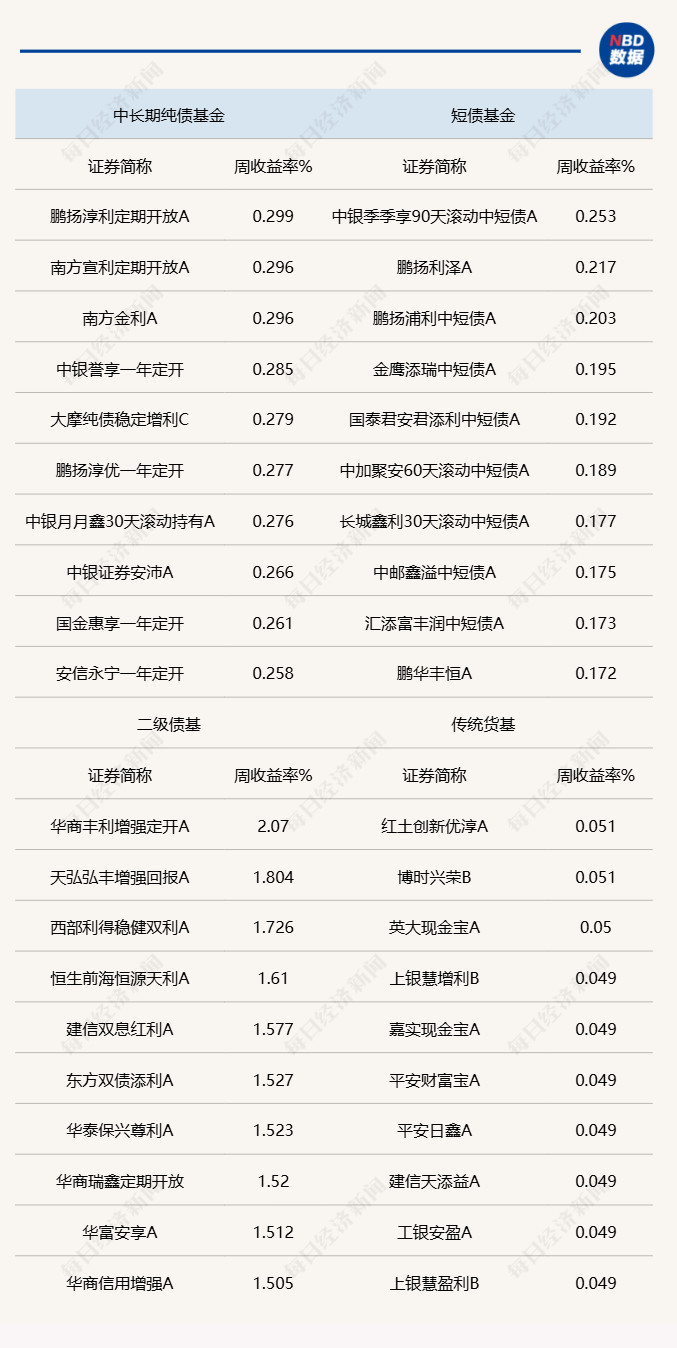
Core Viewpoint - The recent interest rate cuts have positively impacted short and medium-term bonds, leading to a notable decline in rates, while long-term bonds are experiencing a "buying expectation, selling reality" scenario [1][2]. Group 1: Market Reactions - Following the "double cut" (interest rate and reserve requirement ratio), the 1-year government bond yield fell to 1.40%, while long-term bonds showed mixed performance due to market dynamics [2]. - The average yield of long-term bond funds slightly outperformed that of short-term bond funds, with yields at 0.13% and 0.10% respectively, indicating a growing interest in short-term assets [4]. Group 2: Key Players in the Market - Major buyers of short-term bonds include rural commercial banks and foreign investors, with net purchases exceeding 10 billion yuan for bonds with maturities of one year or less [2]. - Non-bank institutions have also been active in the secondary market, significantly increasing their purchases of certificates of deposit, with eight out of twelve types of institutions net buying [2][3]. Group 3: Fund Performance - The performance of various bond funds showed minimal yield differences, with top-performing long-term funds yielding around 0.299% and short-term funds yielding around 0.253% [6][7]. - The overall leverage ratio in the bond market has remained low, with a slight increase to 106.70%, while fund leverage has seen a rebound, indicating a shift in investment strategies [3]. Group 4: Future Outlook - The bond market is expected to remain in a volatile state, with the potential for further rate declines, although the pace may not be smooth [5]. - The market is currently in a phase where the effects of previous policy stimuli are diminishing, and economic fundamentals are showing signs of weakening, suggesting a cautious approach moving forward [4][5].

4月物价保持低位-宏观经济专题报告
格林大华期货· 2025-05-11 00:40
Group 1: CPI Analysis - In April, the national Consumer Price Index (CPI) decreased by 0.1% year-on-year, slightly better than the market expectation of a 0.15% decline[1] - The average CPI from January to April showed a year-on-year decrease of 0.1%[1] - April's food prices fell by 0.2% year-on-year, while non-food prices remained stable[5] Group 2: PPI Analysis - The Producer Price Index (PPI) in April dropped by 2.7% year-on-year, slightly better than the expected 2.8% decline[10] - Production material prices decreased by 3.1%, contributing approximately 2.28 percentage points to the overall PPI decline[10] - The mining industry saw a significant year-on-year price drop of 9.4% in April[10] Group 3: Monthly Trends - In April, the CPI increased by 0.1% month-on-month, reversing a previous decline of 0.4%[6] - Core CPI rose by 0.2% month-on-month, indicating slight inflation outside of volatile food and energy prices[6] - The prices of domestic gold jewelry surged by 10.1% month-on-month, impacting the CPI by approximately 0.06 percentage points[6] Group 4: Monetary Policy Implications - The central bank announced a reserve requirement ratio cut and interest rate reduction on May 7, aiming to lower the Loan Prime Rate (LPR) by about 0.1 percentage points[4] - The central bank's first-quarter report emphasized the importance of promoting reasonable price recovery as a key monetary policy consideration[4] - Current economic conditions suggest increased difficulty in achieving expected price targets, necessitating more fiscal policy support[4]
每日债市速递 | 央行公开市场操作单日净投放1586亿
Wind万得· 2025-05-08 22:43
Monetary Policy - The central bank conducted a 7-day reverse repurchase operation on May 8, with a fixed rate and a total amount of 158.6 billion yuan, at an interest rate of 1.40%, resulting in a net injection of 158.6 billion yuan for the day [1]. Market Liquidity - Overnight and 7-day pledged repo rates for deposit-taking institutions have decreased, with the former dropping over 13 basis points and the latter nearly 7 basis points [3]. - The latest overnight financing rate in the U.S. stands at 4.32% [3]. Interbank Certificates of Deposit - The latest transaction rate for one-year interbank certificates of deposit in the secondary market is around 1.67%, showing a significant decline compared to the previous day [7]. Bond Market - The yields on major interbank bonds have shown a downward trend, with the 1-year government bond yield at 1.4150%, down by 3 basis points, and the 10-year yield at 1.6280%, down by 0.80% [9]. - The closing prices for government bond futures indicate an increase, with the 30-year main contract rising by 0.26% [12]. Corporate Bonds - Guotai Haitong plans to issue no more than 2 billion yuan in sci-tech bonds [15]. - Greentown Real Estate Group has spent a total of 2.06 billion yuan purchasing its own bonds over the past six months [15]. - Zhaojin Group successfully issued 1 billion yuan in technology innovation convertible bonds [15].

热点点评:《民营经济促进法》落地,法治升级对债市影响几何?
Zhong Cheng Xin Guo Ji· 2025-05-07 09:58
Group 1: Legal Framework and Impact - The "Private Economy Promotion Law" was passed on April 30, 2025, and will take effect on May 20, 2025, marking a significant legal recognition of the private economy's status in China[2] - The law aims to enhance the legal framework supporting private enterprises, promoting high-quality development and a multi-level capital market system[2] - It emphasizes the importance of the bond market as a crucial channel for direct financing, particularly for private enterprises[2] Group 2: Financing Mechanisms and Challenges - In the first four months of 2025, private enterprises issued bonds totaling approximately 102.2 billion yuan, accounting for only 2.1% of the total credit bond issuance, a significant drop of 11.4 percentage points from 2016[6] - The law introduces measures to optimize financing mechanisms for private enterprises, addressing issues of high financing costs and difficulties in accessing funds[4] - The law also mandates timely legal action against overdue payments to small and medium-sized private enterprises, which currently have accounts receivable constituting 11% of their total assets, higher than the average for all listed companies[7] Group 3: Innovation and International Cooperation - The law supports technological innovation and international cooperation, aiming to enhance the vitality of the private economy through various measures, including participation in national technology projects[8] - The bond market has seen the introduction of innovative financing tools for technology enterprises, with the current stock of technology bonds reaching approximately 1.85 trillion yuan[9] Group 4: Risk Management and Credit Rating - The law proposes a market-based mechanism for sharing financing risks, encouraging collaboration between banks and financing guarantee institutions to support private enterprises[9] - It highlights the need for improved credit rating services, with a focus on enhancing the methodologies used by credit rating agencies to better assess the creditworthiness of private enterprises[10]
固收点评20250507:双降之后,债券市场怎么走?
Soochow Securities· 2025-05-07 08:35
[Table_Tag] [Table_Summary] 事件 ◼ 2025 年 5 月 7 日,在国新办举行的"一揽子金融政策支持稳市场稳预 期"新闻发布会上,央行行长潘功胜宣布三大类共十项货币政策措施, 其中总量型政策包括降低存款准备金率 0.5 个百分点,以及下调政策利 率 0.1 个百分点。 观点 证券分析师 李勇 执业证书:S0600519040001 010-66573671 liyong@dwzq.com.cn 证券研究报告·固定收益·固收点评 固收点评 20250507 双降之后,债券市场怎么走? 2025 年 05 月 07 日 证券分析师 徐沐阳 执业证书:S0600523060003 xumy@dwzq.com.cn 相关研究 《绿色债券周度数据跟踪(20250428- 20250502)》 2025-05-05 《二级资本债周度数据跟踪 (20250438-20250502)》 2025-05-05 东吴证券研究所 1 / 4 请务必阅读正文之后的免责声明部分 ◼ 降准是货币与财政配合的重要手段:降准为银行提供了无期限的零成本 的资金,降准 50bp 可以为金融市场提供约 1 万亿元的流 ...
从一季度政策环境看债市走向:关税风波强化避险属性,重点领域支持再加码
Zhong Cheng Xin Guo Ji· 2025-05-06 11:22
Report Industry Investment Rating No relevant content provided. Core Views of the Report - In 2025, facing a complex internal and external environment, China's central government adheres to the general tone of making progress while maintaining stability, strengthens counter - cyclical macro - policy regulation, and the bond market plays an important role in counter - cyclical adjustment. The bond market focuses on "improving quality and efficiency, serving the real economy", and strengthens direct financing functions through various measures to support key areas and weak links [4]. - The tariff game between China and the US has intensified, increasing the uncertainty of the global economic situation. The risk - aversion attribute of China's bond market has been enhanced, and it is expected to attract more long - term allocation funds. Meanwhile, the bond market has increased support for key areas such as science and technology innovation and green development, and tried to improve the financing environment of private enterprises, but the effect still needs time to show [3][4]. Summary by Directory External Environment - The continuous escalation of the China - US tariff dispute has a great impact on market sentiment. After the tariffs are implemented, global risk assets are under pressure, and funds flow into safe - haven assets. China's bond market has strengthened significantly. The relative attractiveness of US dollar assets has decreased, which may boost foreign capital's demand for RMB bonds [3]. - In the recent tariff conflict, the US has continuously increased tariffs on Chinese goods, which has affected China's import and export and economic fundamentals. The yields of Chinese treasury bonds and credit bonds have generally declined, and the 10 - year treasury bond yield is still at a low level [6][7][8]. - Affected by tariff policies and market risk - aversion sentiment, US stocks, US bonds, and the US dollar have all declined. The Fed's subsequent interest - rate policy is uncertain. The narrowing of the yield spread between Chinese and US 10 - year treasury bonds may attract more long - term foreign capital to allocate RMB bonds [9]. Key Areas - In the first quarter, the bond market increased its support for science and technology innovation and green development, releasing policy dividends. The support policies for science and technology finance have been upgraded in terms of specification and frequency, with new measures such as the "science and technology board" of the bond market [3][10][11]. - For green finance, policies have been deepened from multiple aspects. The Ministry of Finance issued a green sovereign bond framework and successfully issued 6 billion RMB of green sovereign bonds overseas, which is conducive to diversifying financing channels and promoting international green finance cooperation [15][16]. - In the first quarter, the issuance of innovative bond varieties was hot. The issuance volume of innovative products exceeded 300 billion yuan, of which science and technology innovation bonds accounted for about 80% and green bonds were nearly 60 billion yuan. There is still room for expansion in the science and technology innovation and green bond markets [17]. Weak Links - In the first quarter, the issue of private enterprise development has attracted more attention. The central government has released clear support signals, and bond market regulators have also taken measures to boost market confidence and optimize financing support [19]. - Multiple departments have held symposiums on private enterprises, emphasizing the need to solve the problems of difficult and expensive financing for private enterprises. The bond market has optimized basic mechanisms to increase financing services for private enterprises [20][21]. - Although a series of support measures are conducive to improving the financing environment of private enterprises, due to the time - lag of policy transmission and low market risk preference, the credit bond financing scale of private enterprises in the first quarter was limited, and it still takes time to improve [23]. Basic Systems - In the first quarter, the bond market continued to optimize basic systems. The inter - bank and exchange markets optimized trading and settlement mechanisms, reduced transaction costs, and attracted more medium - and long - term funds [24][25]. - The exchange market standardized debt - restructuring bond replacement business and revised the review guidelines for corporate bond issuance and listing, which is conducive to strengthening credit risk management and improving the transparency of bond issuance review [26].
机构行为的十大伪规律
Huaan Securities· 2025-05-06 10:59
1. Report Industry Investment Rating No relevant content provided. 2. Core Views of the Report In the current low - interest - rate and trading - oriented bond market environment in 2025, the research on institutional behavior has greater significance for interest rate guidance. The report focuses on ten pseudo - laws of institutional behavior, including data caliber, trading nature misjudgments, and model limitations [2]. 3. Summary According to the Directory 3.1 Why We Focus on Pseudo - Laws of Institutional Behavior In the low - interest - rate and trading - oriented bond market environment this year, the research on institutional behavior has increased significance for interest rate guidance, and there are many pseudo - laws in institutional behavior that need to be explored [14]. 3.2 Ten Pseudo - Laws of Institutional Behavior 3.2.1 Are Spot Bond Trading Data T + 0 or T + 1? —— It Should Be T + 1 Spot bond trading data should be analyzed with a one - day lag from interest rate trends because the transactions are usually negotiated the day before [16]. 3.2.2 Do Banks and Brokerages Only Sell Bonds for Distribution? —— There Is Also a Lot of Proprietary Trading Banks and brokerages often show net selling, which may be due to "primary subscription and secondary distribution." Observing old - bond transactions of banks and bond lending of brokerages can help understand their real trading intentions [20][21]. 3.2.3 Is Selling "Smashing" and Buying "Snatching"? —— Focus on the Active Party's Behavior In the secondary spot bond market, it is a zero - sum game. Market trends are driven by the active party. For example, the relationship between rural commercial banks and funds should be analyzed in combination with the active party's behavior [33][34]. 3.2.4 Is Fund Selling a "Redemption Wave"? —— Not Necessarily Historically The current market's panic about fund redemptions may be more of a preventive redemption by wealth management. Measuring the liability - side pressure of funds through the comprehensive holding - cost indicator shows that the current redemption pressure on bond funds is controllable [39][43]. 3.2.5 Are Insurance Companies All Allocation - Oriented? —— The Proportion of Trading - Oriented Has Significantly Increased The trading - oriented proportion of insurance companies has increased, as shown by the fact that they may buy 30Y Treasury bonds for trading purposes and the increase in their 30Y bond selling volume [47]. 3.2.6 Can't We Observe Foreign Investment in Bonds at a High Frequency? —— Most of the "Other" Institutions May Be Foreign Investors Foreign investors' trading behavior can be observed through the "other" type of institutions in high - frequency secondary spot bond trading data. For example, in April, the net buying of "other" institutions was roughly equivalent to the net buying of foreign investors mentioned by the SAFE [53]. 3.2.7 Does Institutional Allocation Increase in the Custody Caliber Mean Buying? —— It May Just Be Due to High Bond Supply An increase in institutional custody may be due to more primary - market bond underwriting or bond maturity, rather than active buying [6]. 3.2.8 High - Winning - Rate Institutional Behavior Indicators May Have Errors —— Interference from the Bull - Market Model Some high - winning - rate institutional behavior indicators may have asymmetric winning rates for buying and selling signals, which may be affected by the previous bull market. When constructing models, the weight of volatile or bear markets should be increased [6]. 3.2.9 Are Non - Linearly Extrapolatable Institutional Behavior Indicators Useless? —— "Direction Sense" Can Also Improve Investment Winning Rates Although some institutional behavior indicators have poor "prediction" effects, they can help investors find the core driving factors of market changes and provide a "direction sense" in investment [7]. 3.2.10 Boundaries of Institutional Behavior Quantitative Models —— Some Errors Such as Short - Term Emotions and Event Impacts Are Still Difficult to Eliminate The existing institutional behavior models have common errors, such as overfitting, being affected by short - term events, and errors in weight assignment. These errors can be reduced but cannot be completely eliminated, so dynamic adjustment and other subjective and objective research are needed [7].
平安固收:2025年3月机构行为思考:财政货币政策或将支持债市供需两旺
Ping An Securities· 2025-05-06 07:27
Report Industry Investment Rating No relevant content provided. Core Viewpoints - In March 2025, the bond market maintained rapid growth, with the bond custodial balance reaching 180.5 trillion yuan, a year - on - year increase of 14.81%. Fiscal and monetary policies are expected to support a strong supply - demand situation in the bond market [3]. - The supply of bonds is expected to continue increasing, and different institutional investors have different trends in bond allocation [3]. Summary by Directory Bond Supply by Type - In March 2025, the new bond custodial volume increased by nearly 1.8 trillion yuan year - on - year. The government bonds and NCDs each increased by about 1 trillion yuan year - on - year, while corporate credit bonds decreased by about 430 billion yuan [5][9]. - The significant increase in government bonds was due to the front - loaded fiscal policy. The NCD increase was because of bond and credit expansion and insufficient bank liabilities. The decrease in corporate credit bonds might be affected by stricter regulations and high base numbers [12][17]. Bond Allocation by Institution - In March 2025, asset management accounts increased their bond allocation, while banks significantly reduced their bond addition. Asset management accounts, securities firms, and insurance companies increased their bond holdings by 1.7204 trillion, 22.07 billion, and 10.42 billion yuan respectively year - on - year, while commercial banks decreased their holdings by 42.93 billion yuan [19]. - Banks had weak bond - allocation due to liability pressure. After adjustment, they increased their government bond holdings by 28.28 billion yuan and reduced their NCD holdings by 47.32 billion yuan [26]. - Insurance companies increased their bond holdings year - on - year but with a weaker intensity than the historical average. They mainly increased their local government bond holdings because of valuation advantages [27]. - Asset management accounts reduced duration and increased NCD allocation, showing a conservative management approach. Securities firms increased their bond holdings by 22.07 billion yuan, mainly following the supply of government bonds, local government bonds, and NCDs. Foreign investors increased their bond holdings by 9.74 billion yuan, mainly in government bonds [31][35]. Outlook - From April 1 - 28, the net bond financing was 1.663 trillion yuan, a year - on - year increase of 693.9 billion yuan, with government bonds increasing by 894.6 billion yuan. The net financing of corporate credit bonds increased, possibly due to falling interest rates or regulatory policies [37]. - Banks are expected to increase their bond allocation, especially government bonds, as their liability pressure eases. Insurance companies are expected to continue increasing their government bond allocation, with a preference for local government bonds. The capital increment of asset management accounts may continue to be lower than in previous years [41][44][47].
债券聚焦|数据验证期兼政策窗口期?
中信证券研究· 2025-05-05 07:59
Core Viewpoint - The article discusses the impact of tariff measures on the bond market, highlighting a rapid decline in interest rates and the subsequent stabilization, while emphasizing the need to monitor external demand shocks and government debt issuance in May [1][2][3]. Group 1: Bond Market Overview - In April, following the implementation of tariff measures by the Trump administration, the stock market experienced a significant drop, leading to a rapid decline in long-term bond yields [2]. - The 10-year government bond yield remained stable around 1.65% during the latter part of April, reflecting market adjustments to external demand shocks and monetary policy expectations [2][3]. - The issuance of special government bonds has been confirmed, with net financing for government bonds in May expected to be around 623.4 billion, indicating a moderate level of financing activity [4]. Group 2: Liquidity and Monetary Policy - The liquidity gap in May is projected to be around 1500 billion, which is considered manageable, suggesting a continuation of a loose monetary environment [5]. - Despite the tariff-induced uncertainties, the central bank has not implemented significant monetary easing measures, maintaining a stance of "appropriate looseness" in monetary policy [6][7]. - The article anticipates that the central bank may prioritize a reserve requirement ratio cut in the second quarter, depending on external economic conditions [7]. Group 3: Credit Market Dynamics - In April, credit bond yields decreased, particularly in short-term bonds, with credit spreads for one-year bonds narrowing by up to 14 basis points [9]. - The article notes a shift in the yield curve, with the potential for long-term credit bonds to experience upward adjustments in yields [9][10]. - The analysis suggests that selecting 3-5 year credit bonds could yield higher returns, with estimated riding yields of 0.4% to 2% depending on the holding period [10]. Group 4: Interest Rate Trends - Recent trends indicate a decline in overnight funding rates, with the 7-day moving average of DR001 dropping to 1.65%, reflecting a 30 basis point decrease from previous highs [11]. - The article emphasizes the need for a supportive monetary environment to stimulate domestic demand, with expectations for short- to medium-term government bond yields to benefit from this liquidity [11][12]. - The current yield curve is described as relatively flat, with a higher probability of a steepening trend in the near future [12].

策略师:GDP数据信号好坏参杂 引发债市波动
news flash· 2025-04-30 13:35
金十数据4月30日讯,芝加哥DRW公司的市场策略师说,"当你看到最终销售下降2.5%时,这是不包括 库存数据的GDP,你要知道这是一个非常疲弱的数字。这是自新冠时期以来最疲软的,在新冠之前,你 必须回到2009年,才能找到一个实际最终销售额较弱的季度。所以我认为这可能是债券最初上涨的原 因,但重新考虑一下,他们可能会关注通胀指标,GDP平减指数和个人消费支出核心指数,两者都明显 高于预期。因此,这份报告对债券市场产生了一点推动作用。" 策略师:GDP数据信号好坏参杂 引发债市波动 ...