
反内卷政策

Search documents
宏观|《2026年财政收支展望》
2025-12-08 00:41
Summary of Key Points from Conference Call Records Industry Overview - The records primarily discuss the macroeconomic outlook for China and Japan, focusing on fiscal revenue and monetary policy implications for 2026 [1][2][3][4][5][8][10]. Key Insights and Arguments 1. **China's Fiscal Revenue Outlook for 2026**: - China's broad fiscal revenue is expected to stabilize and increase, driven by stable macro tax burdens, anti-involution policies, performance of special taxes, and enhanced tax collection measures [1][2][3][4]. - The overall fiscal revenue is projected to show uncertainty but trend towards stability [4]. 2. **Factors Influencing China's Fiscal Revenue**: - **Stable Macro Tax Burden**: Emphasis on maintaining a reasonable macro tax burden and regulating tax incentives to address the ongoing decline in macro tax levels [3]. - **Anti-Involution Policies**: These policies are anticipated to help improve prices in 2026, particularly benefiting domestic value-added tax revenues from manufacturing and wholesale sectors [3]. - **Performance of Special Taxes**: The shift towards domestic demand may reduce the drag from export tax refunds, while higher trading volumes in the securities market could enhance stamp duty contributions [3]. - **Strengthened Tax Collection Measures**: Increased coverage and regulation of personal income tax and compliance requirements for local government investment incentives are expected to improve fiscal stability [3]. 3. **Japan's Economic Stimulus and Fiscal Challenges**: - Japan's government has introduced a ¥21.3 trillion economic stimulus plan, primarily targeting inflation and social subsidies, which is expected to raise the fiscal deficit to 3.0% in 2026 [1][8]. - The effectiveness of Japan's fiscal expansion is anticipated to be weaker compared to the U.S. and Germany, with a projected GDP impact of only 0.5 percentage points [8][9]. 4. **Market Risks and Volatility**: - The combination of fiscal expansion and monetary tightening in Japan has raised risks of a reversal in yen carry trades, particularly as the Bank of Japan shifts towards a hawkish stance [8][10]. - Current market conditions show a balanced position in yen trading, with net long positions emerging, indicating a more stable environment compared to previous extremes [11][12]. 5. **U.S. Economic Data and Implications**: - Recent U.S. economic data, including a decline in ADP employment figures and stagnant PCE consumption growth, suggest a weakening labor market and potential for a rate cut by the Federal Reserve in December [7]. Other Important but Overlooked Content - The records highlight the importance of monitoring the interplay between U.S. and Japanese monetary policies, particularly during periods of contrasting stances, which could create volatility in the markets [10]. - The potential for Japan's fiscal measures to lead to increased inflationary pressures, despite initial subsidies aimed at reducing costs, is a critical consideration for future economic stability [9][12].
全球格局重构与“十五五”战略新机遇 - 2026年资本市场年度策略展望
2025-12-08 00:41
Summary of Key Points from Conference Call Records Industry and Company Overview - The conference call discusses the global economic landscape, focusing on the implications of U.S. monetary policy, U.S.-China relations, and the technology sector's development in 2026 [1][2][4]. Core Insights and Arguments U.S. Monetary Policy - The Federal Reserve is expected to maintain a passive easing policy, with potential impacts on liquidity influenced by Trump's announcement of the next Fed chair, which could benefit tech stocks but with limited sustainability [1][2]. - A key focus is on the timing of the Fed's shift to active easing, which historically has been favorable for U.S. equities [3]. U.S.-China Relations - 2026 is highlighted as a pivotal year for U.S.-China relations, with significant events such as Trump's potential visit to China and the need for a trade agreement by September to gain support from key voter demographics [5][6]. - The Chinese government is likely to implement policies to guide long-term capital into the market and support technological development in response to U.S. competition [4]. Domestic Policy Directions - China's domestic policies will become more proactive in addressing international competition, focusing on developing new productive forces and reducing reliance on high technology [7][11]. - The emphasis will be on enhancing the value of domestic industries and addressing the challenges posed by U.S. policies [11][12]. Investment Opportunities - Key investment opportunities in 2026 include sectors related to AI applications, AR technology, humanoid robotics, consumer electronics, and innovative pharmaceuticals [13]. - The focus on new energy supply chains, including critical materials like lithium and silicon, is emphasized as a strategic area for investment [12][37]. Risks and Market Dynamics - The Nasdaq's current valuation is noted to be significantly lower than during the Obama administration, despite higher ROE, indicating potential for recovery as the Fed shifts to active easing [3]. - The technology sector is experiencing volatility not primarily due to AI issues but rather due to market share shifts among companies, which could lead to increased investment and technological advancement in the long term [3]. Other Important but Potentially Overlooked Content Economic Indicators - The Shanghai Composite Index and the RMB/USD exchange rate are identified as critical indicators for monitoring China's economic health and policy effectiveness [8]. - The anticipated annual increase in the Shanghai Composite Index is projected to be between 10% and 20%, with a focus on maintaining a low volatility environment [8]. Housing Market Outlook - The housing market is expected to remain in a correction phase, with rental yields significantly lower than mortgage rates, making renting more attractive than buying [16]. Consumer and Fiscal Policies - China's consumer and fiscal policies are designed to ensure social stability amid geopolitical tensions, with limited scope for aggressive consumer spending initiatives [14][15]. Structural Changes in the Economy - The ongoing structural changes in China's economy, particularly in the real estate sector, are leading to a decline in disposable income growth and consumer sentiment, impacting overall economic stability [23]. Strategic Focus Areas - The conference highlights the importance of focusing on industries that can enhance China's competitive edge in global markets, particularly in technology and energy sectors [27][34]. This summary encapsulates the key points discussed in the conference call, providing insights into the strategic directions and investment opportunities within the context of the evolving global economic landscape.
交通运输行业周报:快递行业增速红利消退,龙头企业有望迎来双击-20251207
GOLDEN SUN SECURITIES· 2025-12-07 12:14
交通运输 快递行业增速红利消退,龙头企业有望迎来双击 证券研究报告 | 行业周报 gszqdatemark 2025 12 07 年 月 日 周观点:看好快递两条投资主线。反内卷线:快递行业份额逐步向头部快 递集中,反内卷政策下恶性价格战得到有效遏制,头部快递份额、利润同 步提升,有望迎来双击。出海线:快递出海,天地广阔,海外电商 GMV 爆 发式增长,带动快递业务量迅猛增长,相关标的为极兔速递。 行情回顾:本周交通运输板块行业指数上涨 1.22%,跑赢上证指数 0.86 个百分点(上证指数上涨 0.37%)。从申万交通运输行业三级分类看,涨 幅前三名分别为公路货运、公交、航空运输板块,涨幅分别为 6.90%、 3.04%、2.31%;跌幅前三名分别为仓储物流、跨境物流、快递板块,对 应跌幅分别为-0.86%、-0.42%、-0.10%。 出行:继续看好航空板块中长期景气度。运力供给维持低增速、需求持续 恢复,供需缺口缩小叠加油价中枢下移及"反内卷"政策推进,静待票价 持续修复、航司盈利不断改善。持续跟踪需求修复情况,关注公商务出行 需求及国际航班恢复情况。 航运港口:油运,四季度运价维持高位,市场担心旺季结 ...

多资产周报:反内卷政策演进与实践-20251207
Guoxin Securities· 2025-12-07 12:11
Group 1: Policy Evolution - The anti-involution policy has undergone multiple iterations, with the central economic work conference in late 2023 first identifying "overcapacity in certain industries" at the national policy level[1] - In 2024, the focus was on industry self-discipline, but most sectors failed to balance supply and demand[1] - From July 2025, governance shifted to a three-dimensional collaboration of "administrative guidance + legal delineation + industry self-discipline," marking a new policy phase[1] Group 2: Capacity Reduction and Price Control - The current anti-involution strategy centers on capacity reduction, with price control as a supplementary measure[1] - The polysilicon sector is expected to clear 1.5 to 2.23 million tons of outdated capacity through energy consumption constraints and market acquisitions[1] - The cement industry has revised its capacity from 1.8 billion tons to 1.6 billion tons and is piloting online production monitoring[1] Group 3: Industry-Specific Measures - Energy-intensive industries like polysilicon and electrolytic aluminum are using energy consumption as a key metric, with 800,000 tons of electrolytic aluminum capacity set to exit by the end of 2026 if not upgraded[1] - Heavy pollution industries such as cement and coking are facing strict environmental constraints, leading to the clearance of tens of millions of tons of capacity[1] - Resource-based industries like lithium and rare earths are tightening compliance with property rights, resulting in a 10% reduction in lithium mica capacity[1] Group 4: Market Performance - From November 29 to December 6, the CSI 300 index rose by 1.28%, the Hang Seng Index by 0.88%, and the S&P 500 by 0.32%[2] - The 10-year China bond yield increased by 0.69 basis points, while the 10-year U.S. Treasury yield rose by 12 basis points[2] - The U.S. dollar index fell by 0.46%, and the offshore RMB appreciated by 0.04%[2] Group 5: Inventory and Fund Behavior - The latest crude oil inventory stands at 44.355 million tons, up by 2.78 million tons from the previous week[3] - Copper inventory increased by 14,656 tons to 109,690 tons, while aluminum inventory rose by 2,000 tons to 620,000 tons[3] - The latest week saw a decrease of 530 contracts in long positions for the U.S. dollar, while short positions increased by 229 contracts[3]
185亿资金追捧有色金属,有指数年内狂飙80%
21世纪经济报道· 2025-12-06 15:56
Core Viewpoint - The remarkable 80% increase in the Shenwan primary industry non-ferrous metals index in the A-share market this year is driven by global liquidity expectations, supportive "anti-involution" policies, and new demands from AI and renewable energy [1][3]. Group 1: Market Performance - The non-ferrous metals index has surged by 80.45% year-to-date, with the copper index skyrocketing over 103% [5]. - Eight non-ferrous metal ETFs have attracted a total of 18.5 billion yuan in inflows this year, indicating strong investor interest [5]. - In the first week of December alone, nearly 1.2 billion yuan flowed into these ETFs, suggesting sustained buying momentum [5]. Group 2: Fund Flows and Sentiment - Recent data shows a net inflow of 394 million yuan into the non-ferrous metals sector, including rare earths and tungsten [5]. - There are signs of short-term speculative funds exiting the market, indicating a potential overheat in market sentiment [5]. - The enthusiasm for non-ferrous metal ETFs has created a "sentiment peak" as ETF subscription rates rise alongside stock price increases [5]. Group 3: Sector Differentiation - Copper is identified as the "king of metals," driven by its essential role in new energy and AI data center construction, making it a primary focus for investors [6]. - Precious metals like gold and silver are benefiting from increased global central bank purchases and expectations of interest rate cuts, showing strong independent performance [6]. - Aluminum is supported by supply-side constraints and demand trends towards lightweight materials, leading to a widely recognized valuation recovery [6]. Group 4: Future Drivers - The expectation of loose global liquidity is a core driver for the strong performance of non-ferrous metals, with a weak dollar expected to support a commodity bull market [8]. - Supply constraints are evident, particularly in copper, where major mining companies face challenges such as declining ore grades and rising extraction costs [8]. - Emerging demands from sectors like renewable energy and AI are anticipated to lead to explosive growth in the demand for metals such as copper, aluminum, lithium, and tin [8]. Group 5: Investment Outlook - Institutional investors remain bullish on non-ferrous metals, with predictions for copper prices to range between $10,000 and $12,000 per ton by 2026 [9]. - The overall market sentiment supports the likelihood of a cross-year rally in non-ferrous metals, with a focus on strong-performing varieties [9]. - The driving forces behind the rise in non-ferrous metals remain unchanged, suggesting continued upward potential in the coming year [9].


12月光伏产业减产,午后光伏涨幅扩大,光伏ETF华夏(515370)上涨1.69%
Mei Ri Jing Ji Xin Wen· 2025-12-05 06:15
Core Viewpoint - The A-share market saw a collective rise in major indices, with the photovoltaic ETF Huaxia (515370) increasing by 1.69% in the afternoon, following a significant inflow of over 100 million yuan on December 4 [1] Industry Summary - In December, domestic production of polysilicon decreased by 0.96% month-on-month, while silicon wafer production fell by 15.95%, battery cell production by 12.61%, and module production by 13.58%. This decline is attributed to industry self-discipline and other factors affecting multiple segments of the photovoltaic supply chain [1] - CITIC Construction Investment anticipates that the "price control" measures have led to price increases in the main supply chain since July, with the polysilicon segment turning profitable in Q3. The "volume control" measures are also progressing smoothly with the arrival of the dry season [1] - Current inventory levels for polysilicon across the industry are approximately 460,000 tons, indicating significant pressure. If demand remains flat or slightly declines next year, a further reduction of about 30% in polysilicon production will be necessary to normalize inventory levels by 2026 [1] - Overall, it is expected that the "anti-involution" policy will drive profitability across various segments back to reasonable levels [1] Company Summary - The photovoltaic ETF Huaxia (515370) tracks the CSI Photovoltaic Industry Index, which includes companies across the upstream, midstream, and downstream segments of the photovoltaic industry, such as silicon wafers, polysilicon, battery cells, cables, photovoltaic glass, battery modules, inverters, photovoltaic brackets, and solar power stations, providing a comprehensive reflection of the overall performance of the photovoltaic industry [1]
成交额1.47亿元,同类领先!港股央企红利ETF(513910)成交火爆原因几何?
Mei Ri Jing Ji Xin Wen· 2025-12-05 04:55
Group 1 - The China Securities Hong Kong Stock Connect Central State-Owned Enterprises Dividend Index (931233) decreased by 0.67% as of December 5, 2025 [1] - Among the constituent stocks, China Nonferrous Mining (01258) led with a gain of 2.37%, while Agricultural Bank of China (01288) experienced the largest decline at 3.59% [1] - The largest Hong Kong Stock Connect Central SOE Dividend ETF (513910) saw a turnover of 2.88% and a transaction volume of 147 million yuan, with an average daily transaction volume of 420 million yuan over the past week [1] Group 2 - The dividend yield for the Hong Kong Stock Connect Central SOE Dividend ETF (513910) is 6.51% over the past year, significantly higher than the 4.03% yield of the China Securities Central SOE Dividend Index during the same period [2] - There is a consistent trend where central enterprises have higher dividend yields compared to state-owned and private enterprises in both markets [2]
产量与库存增加,多晶硅基本面仍较差
Hua Tai Qi Huo· 2025-12-05 02:54
1. Report Industry Investment Rating - Not provided in the content 2. Core View of the Report - For industrial silicon, the spot price is basically stable. After the production cut in the southwest region, the supply - demand pattern may improve. The industrial silicon futures are mainly affected by overall commodity sentiment and policy - related news. If there are relevant capacity - exit policies, the futures price may rise. For polysilicon, the supply - demand situation is poor, with increasing production, declining consumption, and rising inventory. The futures price is affected by anti - involution policies and weak market reality, and is expected to fluctuate in the short term [3][6] 3. Summary by Related Catalogs Industrial Silicon Market Analysis - On December 4, 2025, the industrial silicon futures price fluctuated. The main contract 2601 opened and closed at 8910 yuan/ton, down 45 yuan/ton ( - 0.50%) from the previous day's settlement. The position of the 2601 main contract was 193,019 lots, and the number of warehouse receipts was 7,228 lots, an increase of 336 lots from the previous day. The spot price of industrial silicon was basically stable. The social inventory of industrial silicon in major regions on December 4 was 558,000 tons, an increase of 8,000 tons from the previous week [1] Consumption End - The quoted price of organic silicon DMC was 13,500 - 13,800 yuan/ton. The domestic organic silicon DMC market price continued to rise this week, with the mainstream price range at 13,500 - 13,800 yuan/ton, about 450 yuan/ton higher than the average price of the previous week [2] Strategy - Short - term range operation is recommended, and it is advisable to go long on contracts during the dry season at low prices [3] Polysilicon Market Analysis - On December 4, 2025, the main contract of polysilicon futures fluctuated widely, opening at 57,270 yuan/ton and closing at 56,915 yuan/ton, with a closing price change of 0.05% from the previous trading day. The position of the main contract was 116,653 lots, and the trading volume was 175,576 lots. The spot price of polysilicon weakened slightly. The inventory of polysilicon manufacturers and silicon wafers increased, with the polysilicon inventory at 291,000 tons (a month - on - month change of 3.38%) and the silicon wafer inventory at 21.30 GW (a month - on - month change of 9.23%). The weekly production of polysilicon was 25,800 tons (a month - on - month change of 7.50%), and the silicon wafer production was 11.95 GW (a month - on - month change of - 0.58%) [4] - In October, the polysilicon production was expected to be about 133,500 tons, an increase from September. In November, the production in the southwest region was expected to decline significantly [5] Strategy - Short - term range operation is recommended, and the main contract is expected to fluctuate between 50,000 and 57,000 yuan/ton [6]
近2000亿主力资金狂涌!化工板块震荡盘整,机构看好三大主线布局机会
Xin Lang Cai Jing· 2025-12-05 02:50
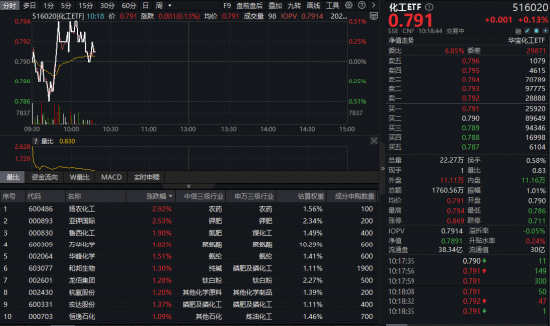
Group 1 - The chemical sector experienced fluctuations on December 5, with the chemical ETF (516020) showing a price increase of 0.13% [1][9] - Key stocks in the sector, including agricultural chemicals, potassium fertilizers, and polyurethane, saw significant gains, with Yangnong Chemical and Yaqi International both rising over 2% [1][9] - The basic chemical sector has attracted substantial capital recently, with a net inflow of over 2.2 billion yuan on the day, ranking fifth among 30 sectors [12][13] Group 2 - The chemical ETF (516020) has a price-to-book ratio of 2.32, which is at a relatively low level compared to the past decade, indicating potential value for long-term investment [4][11] - Future demand in the chemical industry is expected to recover gradually, driven by improvements in macroeconomic conditions and consumption stimulus policies [5][6] - Investment opportunities may arise in sectors such as organic silicon, polyester filament, and phosphate chemicals, which are expected to benefit from favorable supply-demand dynamics and government policies [12][13] Group 3 - Salt Lake Co. reported stable operations in its lithium salt project, achieving a daily output of 60-70 tons with a purity of over 99.7%, indicating strong production performance [10][11] - The basic chemical sector has seen a cumulative net inflow of 196.8 billion yuan over the past 60 days, ranking third among 30 sectors [12][13] - The chemical ETF (516020) provides exposure to a diversified range of chemical sub-sectors, with nearly 50% of its holdings in large-cap leading stocks [13]





落实“反内卷”,光伏产业12月减产!光伏ETF华夏(515370)资金流入加速
Mei Ri Jing Ji Xin Wen· 2025-12-05 02:14
Core Viewpoint - The A-share market experienced fluctuations with the photovoltaic ETF Huaxia (515370) declining by 0.56% after a significant inflow of over 100 million yuan on December 4. The production of various components in the photovoltaic industry has decreased in December, indicating potential challenges ahead for the sector [1]. Industry Summary - In December, domestic production of polysilicon decreased by 0.96% month-on-month, while silicon wafer production fell by 15.95%, battery cell production by 12.61%, and module production by 13.58%. This decline is attributed to factors such as industry self-discipline [1]. - CITIC Construction Investment anticipates that the "price control" measures have led to price increases in the main industry chain since July, with polysilicon turning profitable in Q3. The "volume control" measures are also progressing smoothly due to the dry season [1]. - Current inventory levels for polysilicon across the industry are approximately 460,000 tons, indicating significant pressure. If demand remains flat or slightly decreases next year, a further reduction of about 30% in polysilicon production will be necessary to normalize inventory levels by 2026 [1]. - Overall, the "anti-involution" policy is expected to help restore profitability across various segments of the photovoltaic industry [1]. Company Summary - The photovoltaic ETF Huaxia (515370) tracks the CSI Photovoltaic Industry Index, which includes companies across the upstream, midstream, and downstream segments of the photovoltaic industry, such as silicon wafers, polysilicon, battery cells, cables, photovoltaic glass, battery modules, inverters, photovoltaic brackets, and power stations. This ETF provides a comprehensive reflection of the overall performance of the photovoltaic industry [1].