
扩内需

Search documents
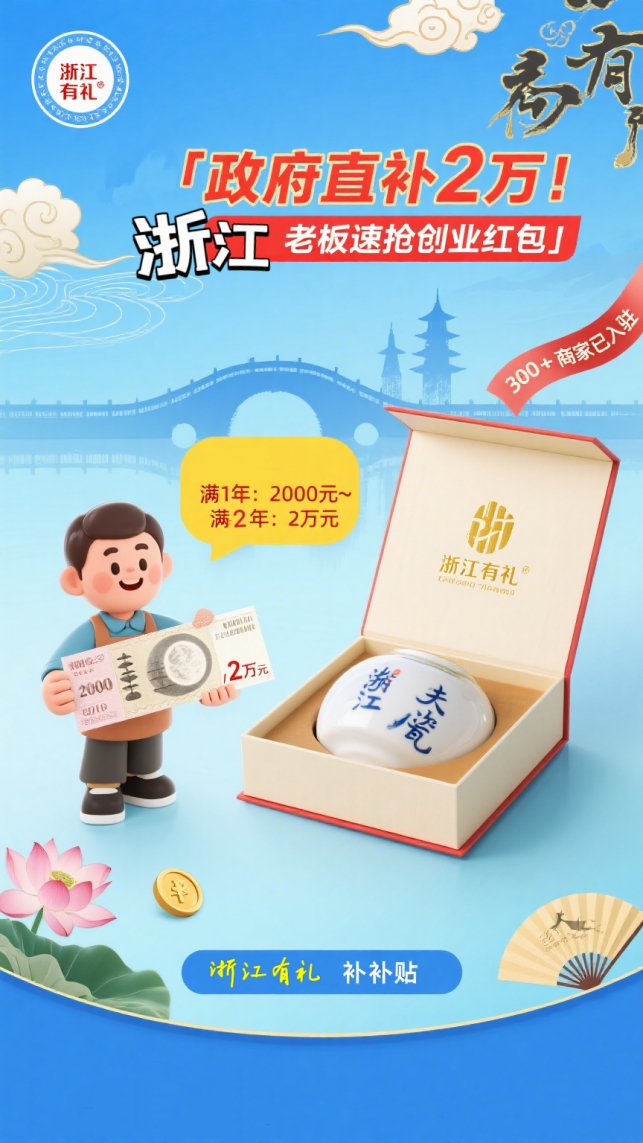
“浙江有礼”三重好礼 真金白银促进消费
Cai Fu Zai Xian· 2025-07-11 03:08
Core Viewpoint - The Zhejiang Youli Selection Center mini-program is set to launch by the end of July 2025, aiming to stimulate consumption and stabilize growth through a multi-faceted approach involving government subsidies, platform empowerment, and public participation [1] Merchant Side: Tiered Subsidies to Strengthen Market Foundation - A "Development Safeguard Plan" is introduced for small and medium-sized merchants, offering tiered subsidies based on the duration of their participation in the mini-program, with 2,000 yuan available after one year and a cumulative total of 20,000 yuan after two years [3] - The subsidy funds are directed towards supply chain upgrades and service quality improvements, particularly in key sectors such as catering, retail, and cultural tourism, aiming to create a cluster of "reassuring consumption demonstration merchants" [3] Consumer Side: Targeted Subsidy Coupons to Activate Consumption - The program will launch "benefit subsidy consumption coupons" covering various consumer categories, allowing users to receive a direct 30% subsidy based on their spending through the mini-program, which can be combined with other platform discounts [5] - This cash-based incentive model is designed to directly enhance residents' purchasing power and boost consumer confidence [5] Agent Side: Nationwide Recruitment for Promotion Agents - A "Consumption Promotion Agent" recruitment plan is initiated, allowing individuals from all sectors to apply as promotion agents, earning 100 yuan for each merchant they successfully refer to the platform [6] - The agent mechanism includes professional training and data monitoring support, aiming to create a vibrant atmosphere of public participation in consumption promotion, with expectations to onboard over 5,000 merchants within the year [6] Policy Closure: Transition from Short-term Stimulus to Long-term Ecological Consumption Upgrade - The policy represents an innovative practice by the Zhejiang Youli Selection Center to implement consumption stimulation strategies, forming a complete loop from supply to demand through the three-dimensional linkage of merchant stability, consumer confidence, and channel expansion [6] - The application process for merchant entry, coupon collection, and agent registration is currently in preparation and will soon be available on the official mini-program platform [6]

财政政策“非常积极” 稳增长扩内需资金充足
Zheng Quan Shi Bao· 2025-07-10 18:32
Group 1 - The national general public budget expenditure progress in the first five months of this year reached the highest level in nearly five years, with a significant increase in fiscal spending to support economic growth and improve people's livelihoods [1] - The issuance of local government special bonds and replacement bonds exceeded 2.1 trillion yuan and 1.7 trillion yuan respectively in the first half of the year, indicating a proactive fiscal policy [1] - The broad fiscal expenditure scale expanded significantly to 14.5 trillion yuan in the first five months, reflecting a year-on-year growth of 6.6%, which is much higher than the revenue growth rate [1] Group 2 - Special bond funds are increasingly diversified, supporting not only infrastructure projects but also revitalizing idle land and stabilizing the real estate market [2] - Fiscal funds have been directed towards social security, education, and healthcare, with significant growth in public finance expenditure in these areas compared to infrastructure spending [2] - The issuance of replacement bonds has nearly reached 90% of the annual target, providing space for economic development through debt restructuring [2] Group 3 - The Ministry of Finance has accelerated the issuance of ultra-long-term special government bonds to support key policies, with a noticeable increase in the issuance pace of special bonds and ultra-long-term bonds since June [3] - There remains over 2 trillion yuan in special bond quotas and 745 billion yuan in ultra-long-term bond quotas available for issuance, indicating ample fiscal resources for stabilizing growth and expanding domestic demand [3] - The likelihood of introducing incremental fiscal policies in the second half of the year is low, but there may be a greater probability of policy financial tools being introduced to support the real estate sector [3] Group 4 - The foundation for the recovery of the Chinese economy needs to be further solidified through effective use of fiscal policies and optimization of expenditure structure [4] - Fiscal spending should focus on "investing in people," emphasizing key areas such as education, healthcare, employment, and elderly care to support human capital [4] - In regions with population inflows, there should be an appropriate expansion of public services, while in outflow regions, resource integration and structural optimization should be prioritized to enhance service efficiency [4]
国泰海通|“反内卷”· 合集
国泰海通证券研究· 2025-07-10 09:50
Core Viewpoint - The central government is intensifying its "anti-involution" policy, focusing on comprehensive governance of low-price disorderly competition and overcapacity issues in enterprises [1][4]. Group 1: Macro and Policy Analysis - The "anti-involution" policy has led to a rebound in prices of industrial products such as coking coal, rebar, and glass, reflecting policy expectations rather than substantial improvements in the fundamental supply-demand structure [4]. - To effectively address the issue of involution, the coordination of demand expansion policies is essential, as one root cause of involution is insufficient effective demand [4]. - Current economic operations face both internal and external pressures, including uncertainties in tariff situations and external demand recovery, which may affect future consumption demand [4]. Group 2: Industry-Specific Insights Construction Materials - The supply-side expectations in the construction materials sector are rising, with core policy thoughts focusing on limiting overproduction [11]. - The demand for construction materials is shifting, with a self-driven improvement in the industry environment reflected in price increases [11]. Coal Industry - The coal industry is expected to see improved supply dynamics under the "anti-involution" framework, with a clear turning point anticipated [14]. - In the first four months of 2025, the national coal production was 400 million tons, with a notable decrease in imports, indicating a tightening supply situation [16]. Light Industry - The paper industry is experiencing overcapacity, with prices and profitability at low levels, leading to aggressive competition strategies among paper companies [21][22]. - The industry has seen accelerated capacity growth since 2020, exacerbating the overcapacity situation [22]. Renewable Energy - The photovoltaic industry is responding to policy signals aimed at reducing disorderly competition, with leading companies announcing production cuts to alleviate structural pressures [27]. - The focus is on improving industry supply-demand structures and enhancing product quality [27]. Steel Industry - The steel industry is viewed as entering a turning point year, with expectations of supply contraction strengthening due to policies aimed at reducing low-price competition [30]. - Demand for steel is stabilizing, with a decrease in the rate of decline expected, particularly as manufacturing demand rises [33]. Non-Ferrous Metals - The lithium market is experiencing a rebound driven by expectations, although the reality remains weak, leading to a volatile price environment [37].

国泰海通|宏观:“破局”通胀:反内卷与扩内需
国泰海通证券研究· 2025-07-09 14:38
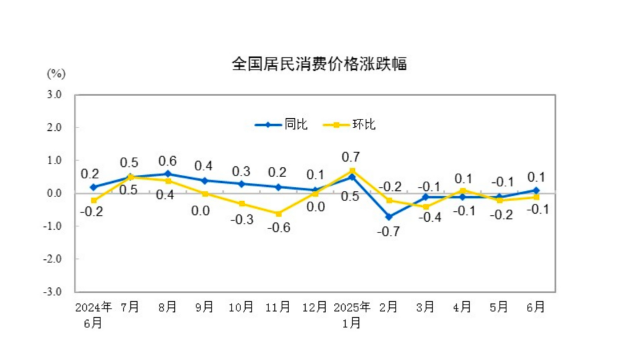
而且我们认为,要真正破解内卷困局,扩内需政策的协同发力不可或缺。 事实上,内卷现象的根源之一在 于有效需求不足。当前经济运行还面临内外部共同压力:关税局势和外需回暖的不确定性持续存在、以旧 换新政策可能透支部分后续消费需求、地产销售投资端的调整还在持续。如果同时进行单纯的去产能,反 而可能带来工业生产放缓、就业压力加剧等影响。由此,稳经济、化解内卷还需要内需政策的接续支持。 在具体操作上,仍需继续关注经济基本面走势,即若出口、制造业 PMI 、地产等数据明显走弱,货币财 政政策加码概率可能大大增加。 风险提示: 房地产走势不确定性仍存;政策力度不及预期。 报告导读: 今年以来,"以旧换新"补贴政策持续支撑耐用消费品价格,带动核心 CPI 同 比小幅修复,而其中服务价格方面仍有待提振,指向了居民部门资产负债表的修复进展有 限,需要后续稳增长政策接续。 6 月 CPI 同比转正。 食品价格拖累减弱;国际油价上涨输入带动能源价格;核心 CPI 环比持平,核心消 费品 CPI 环比表现显著好于 2023 、 2024 年," 618 "提前促销影响过去后,"以旧换新"政策支持的相 关品类价格仍相对偏强,而服务相关价格 ...

提振消费政策持续显效,6月CPI转涨
2 1 Shi Ji Jing Ji Bao Dao· 2025-07-09 11:35
Group 1: CPI Analysis - In June, the national CPI increased by 0.1% year-on-year, marking a shift from four consecutive months of decline, primarily driven by a rebound in industrial consumer goods prices [1][3] - The core CPI rose by 0.7%, reaching a 14-month high, indicating the effectiveness of policies aimed at stabilizing growth and boosting consumption [1][4] - The CPI's month-on-month decline was 0.1%, with urban areas also experiencing a 0.1% decrease, while rural areas remained stable [4] Group 2: PPI Analysis - The national PPI decreased by 3.6% year-on-year and 0.4% month-on-month, with the year-on-year decline widening by 0.3 percentage points compared to the previous month [1][5] - Industrial producer purchase prices fell by 4.3% year-on-year and 0.7% month-on-month, with a 2.8% decline in the first half of the year compared to the same period last year [4][5] - The PPI's decline is expected to persist due to insufficient industrial demand, but improvements in supply-demand relationships and macroeconomic policies may stabilize prices [5][7] Group 3: Policy Implications - The government aims for a GDP growth of around 5% and a CPI increase of about 2% this year, indicating potential for further fiscal and monetary policy support to stimulate demand and improve price performance [4][7] - Policies targeting the reduction of "involutionary competition" are anticipated to enhance supply-demand structures, supporting price increases in various sectors [7] - Supply-side structural reforms are expected to alleviate overcapacity issues, potentially boosting industrial prices and improving corporate profitability [7]
2025年6月物价数据点评:“破局”通胀,反内卷与扩内需
GUOTAI HAITONG SECURITIES· 2025-07-09 09:37
券研究报 请务必阅读正文之后的免责条款部分 宏观研究 / 2025.07.09 "破局"通胀:反内卷与扩内需 应锈钢(分析师) 021-38676666 2025年6月物价数据点评 本报告导读: 贺媛(分析师) 今年以来,"以旧换新"补贴政策持续支撑耐用消费品价格,带动核心 CPI 同比小幅 021-38676666 修复,而其中服务价格方面仍有待提振,指向了居民部门资产负债表的修复进展有 登记编号 S0880525040129 限,需要后续稳增长政策接续。 梁中华(分析师) 投资要点: 02 -38676666 Q 6月 CPI 同比转正。食品价格拖累减弱;国际油价上涨输入带动能 登记编号 S0880525040019 源价格;核心 CPI 环比持平,核心消费品 CPI 环比表现显著好于 2023、2024年,"618"提前促销影响过去后,"以旧换新"政策支持 的相关品类价格仍相对偏强,而服务相关价格继续稳中偏弱。 6月 PPI 同比跌幅继续扩张,一是受高温降雨天气影响,房地产、 o 基建项目施工进度有所放缓。二是"反内卷"具体政策和效果仍待 观察,尤其是对光伏、水泥、钢铁等行业实际供需格局的影响。三 观去 ...
瑞达期货铝类产业日报-20250709
Rui Da Qi Huo· 2025-07-09 08:51
Report Summary 1. Report Industry Investment Rating No information provided. 2. Report's Core View - The alumina fundamentals may be in a stage of relatively sufficient supply and stable demand, with the cost side supporting the spot price. It is recommended to conduct light - position short - term long trades at low prices, paying attention to rhythm and risks [2]. - The fundamentals of Shanghai aluminum may be in a situation of relatively stable supply, seasonal decline in demand, and increased inventory. Due to the support of the macro - environment, the industry outlook remains positive. It is recommended to conduct light - position range - bound trading, paying attention to rhythm and risks [2]. - The fundamentals of cast aluminum alloy may be in a situation of weak supply and demand, with seasonal inventory accumulation. The long - term industry outlook and the firm cost side may provide some support for the cast aluminum price. It is recommended to conduct light - position range - bound trading, paying attention to rhythm and risks [2]. 3. Summary by Related Catalogs Futures Market - **Aluminum Futures**: The closing price of the Shanghai aluminum main contract is 20,515 yuan/ton, down 10 yuan; the main contract position is 250,099 lots, down 19,098 lots; the net position of the top 20 in Shanghai aluminum is 16,703 lots, up 2,441 lots; the Shanghai - London ratio is 7.96, down 0.05 [2]. - **Alumina Futures**: The closing price of the alumina futures main contract is 3,130 yuan/ton, up 20 yuan; the main contract position is 248,656 lots; the LME aluminum cancelled warehouse receipts are 8,225 tons, unchanged [2]. - **Cast Aluminum Alloy Futures**: The closing price of the cast aluminum alloy main contract is 19,830 yuan/ton, down 20 yuan; the main contract position is 8,571 lots, down 114 lots [2]. Spot Market - **Aluminum Spot**: The average price of Shanghai Non - ferrous Network A00 aluminum is 20,660 yuan/ton, up 60 yuan; the average price of Yangtze River Non - ferrous Market AOO aluminum is 20,590 yuan/ton, up 120 yuan; the Shanghai Wumaotrade aluminum premium/discount is - 50 yuan/ton, up 10 yuan [2]. - **Alumina Spot**: The alumina spot price of Shanghai Non - ferrous is 3,100 yuan/ton, up 10 yuan; the alumina basis is - 30 yuan/ton, down 10 yuan [2]. Upstream Situation - **Alumina**: The alumina production is 748.80 million tons, up 16.50 million tons; the alumina import volume is 6.75 million tons, up 5.68 million tons; the alumina export volume is 21.00 million tons, down 5.00 million tons [2]. - **Aluminum Scrap**: The average price of crushed raw aluminum in Foshan metal scrap is 16,200 yuan/ton, unchanged; the average price in Shandong metal scrap is 15,750 yuan/ton, down 50 yuan; China's import volume of aluminum scrap and fragments is 159,700.92 tons, down 30,651.64 tons; the export volume is 72.44 tons, up 35.90 tons [2]. Industry Situation - **Aluminum Production and Trade**: The primary aluminum import volume is 223,095.59 tons, down 27,381.21 tons; the export volume is 32,094.07 tons, up 18,421.29 tons; the aluminum product production is 576.20 million tons, down 0.20 million tons; the export volume of unwrought aluminum and aluminum products is 55.00 million tons, up 3.00 million tons [2]. - **Capacity and Utilization**: The total production capacity of electrolytic aluminum is 4,520.70 million tons, up 0.50 million tons; the electrolytic aluminum production capacity utilization rate is 97.68%, up 0.03% [2]. Downstream and Application - **Automobile and Real Estate**: The automobile production is 264.20 million vehicles, up 3.80 million vehicles; the National Housing Prosperity Index is 93.72, down 0.13 [2]. Option Situation - The 20 - day historical volatility of Shanghai aluminum is 8.08%, down 1.16%; the 40 - day historical volatility is 9.10%, down 0.05%; the implied volatility of the Shanghai aluminum main contract at - the - money is 8.28%, down 0.0041; the call - put ratio is 1.15, up 0.0349 [2]. Industry News - In June, the production and retail of passenger cars reached 2.419 million and 2.084 million respectively, with year - on - year increases of 13.3% and 18.1%. Among them, the production and retail of new energy vehicles reached 1.2 million and 1.111 million respectively, with year - on - year increases of 28.3% and 29.7% [2]. - From January to June, the production and retail of passenger cars reached 13.246 million and 10.901 million respectively, with year - on - year increases of 13.5% and 10.8%. Among them, the production and retail of new energy vehicles reached 6.457 million and 5.468 million respectively, with year - on - year increases of 38.7% and 33.3% [2].
瑞达期货沪铜产业日报-20250709
Rui Da Qi Huo· 2025-07-09 08:39
Report Industry Investment Rating - Not provided Core View of the Report - The fundamentals of Shanghai copper are currently in a state where supply is boosted, but demand is still weak. However, due to the support of the macro - environment, the industry is expected to operate favorably. The option market sentiment is bullish, and the implied volatility has slightly decreased. It is recommended to conduct light - position short - term long trades at low prices, while paying attention to controlling the rhythm and trading risks [2]. Summary by Relevant Catalogs Futures Market - The closing price of the Shanghai copper futures main contract is 78,400 yuan/ton, down 1,220 yuan; the LME 3 - month copper price is 9,611.50 dollars/ton, down 179 dollars. The main contract's inter - month spread is 200 yuan/ton, up 30 yuan; the main contract's open interest of Shanghai copper is 193,999 lots, down 13,383 lots. The top 20 futures positions of Shanghai copper are 9,545 lots, down 5,230 lots. The LME copper inventory is 102,500 tons, up 5,100 tons; the SHFE inventory of cathode copper is 84,589 tons, up 3,039 tons; the LME copper cancelled warrants are 37,100 tons, up 225 tons; the SHFE warrants of cathode copper are 21,336 tons, down 2,856 tons [2]. Spot Market - The SMM 1 copper spot price is 79,190 yuan/ton, down 605 yuan; the Yangtze River Non - ferrous Market 1 copper spot price is 79,255 yuan/ton, down 550 yuan. The Shanghai electrolytic copper CIF (bill of lading) price is 62 dollars/ton, unchanged; the Yangshan copper average premium is 28.50 dollars/ton, up 12 dollars. The CU main contract basis is 790 yuan/ton, up 615 yuan; the LME copper cash - 3 months spread is 51.31 dollars/ton, down 28.49 dollars [2]. Upstream Situation - The import volume of copper ore and concentrates is 239.52 million tons, down 50.98 million tons. The copper smelter's TC is - 44.25 dollars/thousand tons, up 0.56 dollars. The copper concentrate price in Jiangxi is 70,110 yuan/metal ton, down 70 yuan; in Yunnan, it is 70,810 yuan/metal ton, down 70 yuan. The southern processing fee for blister copper is 800 yuan/ton, unchanged; the northern processing fee is 750 yuan/ton, unchanged [2]. Industry Situation - The refined copper output is 125.40 million tons, unchanged. The import volume of unwrought copper and copper products is 430,000 tons, down 10,000 tons. The social inventory of copper is 41.82 million tons, up 0.43 million tons. The price of 1 bright copper wire in Shanghai is 55,990 yuan/ton, down 100 yuan; the price of 2 copper (94 - 96%) in Shanghai is 68,100 yuan/ton, unchanged. The ex - factory price of 98% sulfuric acid of Jiangxi Copper is 600 yuan/ton, unchanged [2]. Downstream and Application - The copper product output is 209.60 million tons, up 1.50 million tons. The cumulative completed investment in power grid infrastructure is 2,039.86 billion yuan, up 631.69 billion yuan. The cumulative completed investment in real estate development is 36,233.84 billion yuan, up 8,504.27 billion yuan. The monthly output of integrated circuits is 4,235,000 thousand pieces, up 68,000 thousand pieces [2]. Option Situation - The 20 - day historical volatility of Shanghai copper is 11.25%, up 1.31 percentage points; the 40 - day historical volatility is 10.33%, up 0.78 percentage points. The implied volatility of the current - month at - the - money IV is 10.86%, down 0.0038 percentage points; the call - put ratio of at - the - money options is 1.49, up 0.0312 [2]. Industry News - From January to June, policies to expand domestic demand and promote consumption continued to show effects. The year - on - year CPI changed from a decline to a 0.1% increase; the month - on - month decrease was 0.1%, with the decline narrowing by 0.1 percentage points. The core CPI excluding food and energy prices continued to rise, up 0.7%. The month - on - month PPI decreased by 0.4%, the same as last month; the year - on - year decrease was 3.6%, with the decline expanding by 0.3 percentage points. Trump announced that tariffs would start on August 1st, with a 50% tariff on imported copper and up to 200% on drugs. He also mentioned possible tariffs on semiconductors. Chinese Premier Li Qiang met with the Director - General of the WTO and stated that China has the resources and means to hedge against external adverse effects. In June, the production and retail of passenger cars increased year - on - year, with new energy vehicles showing more significant growth. By 2035, about 32% of global semiconductor production may be affected by climate - change - related copper supply disruptions [2].
核心CPI同比创近14个月以来新高,怎么看?
Di Yi Cai Jing· 2025-07-09 03:13
Group 1: CPI Trends - In June, the Consumer Price Index (CPI) turned from a decline to an increase of 0.1% year-on-year after four months of negative growth, influenced by the recovery of industrial product prices [1][3] - The core CPI, excluding food and energy, rose by 0.7% year-on-year, marking a 14-month high, indicating effective policies to expand domestic demand and promote consumption [1][3] Group 2: PPI Trends - The Producer Price Index (PPI) decreased by 0.4% month-on-month, with a year-on-year decline of 3.6%, which is an increase in the rate of decline by 0.3 percentage points compared to the previous month [1][5] - The decline in PPI is attributed to seasonal price decreases in domestic raw material manufacturing, increased green electricity leading to lower energy prices, and price pressures in export-oriented industries [5][6] Group 3: Industry-Specific Insights - In the automotive sector, prices for both gasoline and new energy vehicle manufacturing increased by 0.5% and 0.3% month-on-month, respectively, with year-on-year declines narrowing by 1.9 and 0.4 percentage points [1] - The photovoltaic equipment and electronic components manufacturing prices fell by 10.9% year-on-year, with the decline narrowing by 1.2 percentage points [1] - High-tech industries such as integrated circuit packaging and testing saw price increases of 3.1% year-on-year, indicating a growth in new production capacities and innovation [6] Group 4: Policy Implications - The government aims to balance the expansion of domestic demand with supply-side structural reforms to improve market price order and promote reasonable price recovery [7][8] - The effectiveness of macroeconomic policies, particularly those supporting the real estate sector, will significantly influence future industrial product price trends [6]
破内卷困局,离不开扩内需支撑
China Post Securities· 2025-07-08 02:57
Group 1: Economic Policy and Trends - The central government is reinforcing "anti-involution" policies to address low nominal economic growth and persistent negative PPI, focusing on eliminating low-price competition and overcapacity[1] - The manufacturing sector's capacity utilization rate was 74.10% at the end of Q1 2025, significantly below the historical average of 7.1% since 2018[16] - The PPI growth rate for coal mining and washing, general equipment, specialized equipment, automotive, and pharmaceuticals is at historically low levels, indicating potential "involution" issues in these sectors[17] Group 2: Industry Impact and Investment Opportunities - Key industries identified for "anti-involution" measures include coal mining, chemical raw materials, non-metallic minerals, and automotive manufacturing, which are expected to undergo significant policy scrutiny[17] - Recent price recovery in coal, rebar, and polysilicon suggests that the market has priced in expectations of "anti-involution" policies, presenting potential investment opportunities if policies align with market expectations[28] - If "anti-involution" policies fall short, there is a risk of price corrections in these industries, necessitating caution for investors[28] Group 3: Risks and Economic Challenges - The report highlights external uncertainties, including global trade tensions and geopolitical conflicts, which could exacerbate economic challenges[4] - The need for coordinated demand expansion policies alongside supply-side reforms is emphasized to mitigate potential structural pain in industrial production and employment[27] - The real estate sector is undergoing significant adjustments, impacting overall investment momentum and economic growth prospects[27]