
通胀预期

Search documents
贵金属早报-20251028
Da Yue Qi Huo· 2025-10-28 02:47
1. Report Industry Investment Rating No relevant content provided. 2. Core Viewpoints of the Report - Global trade tensions have eased, leading to a continued decline in gold and silver prices. The optimism about trade has returned, increasing the downward pressure on gold prices, and silver prices have followed the decline of gold prices. The premiums of Shanghai gold and silver have expanded slightly, and the domestic sentiment remains relatively strong [4][5]. - After Trump took office, the world entered a period of extreme turmoil and change. The inflation expectation has shifted to an economic recession expectation. Gold prices are difficult to fall, and silver prices still mainly follow gold prices. However, tariff concerns have a stronger impact on silver prices, and there is a risk of an enlarged increase in silver prices [9][12]. 3. Summary by Related Catalogs 3.1 Previous Day's Review - **Gold**: The three major US stock indexes rose across the board, and the three major European stock indexes closed slightly higher. US bond yields fell collectively, with the 10 - year US bond yield dropping 3.46 basis points to 3.976%. The US dollar index fell 0.12% to 98.82. The offshore RMB depreciated against the US dollar to 7.1091. COMEX gold futures fell 3.40% to $3997.00 per ounce. The basis was - 1.56, with the spot at a discount to the futures. Gold futures warehouse receipts remained unchanged at 87,015 kilograms. The 20 - day moving average was upward, and the K - line was above the 20 - day moving average. The main net long position decreased [4]. - **Silver**: Similar to gold, COMEX silver futures fell 3.61% to $46.83 per ounce. The basis was - 18, with the spot at a discount to the futures. The Shanghai silver futures warehouse receipts decreased by 17,328 kilograms day - on - day to 647,643 kilograms. The 20 - day moving average was upward, and the K - line was above the 20 - day moving average. The main net long position increased [5]. 3.2 Daily Tips - **Gold**: Positive factors include the long - term upward trend on the disk and the main net long position. Negative factors include unchanged gold futures warehouse receipts. The expected impact of the day's events: Trump extended the US - Mexico trade negotiation period, and the US reached trade agreements with multiple Southeast Asian countries, causing gold prices to fall again. The trade optimism has returned, increasing the downward pressure on gold prices [4]. - **Silver**: Positive factors include the decrease in Shanghai silver futures warehouse receipts, the long - term upward trend on the disk, and the increase in the main net long position. Negative factors are not obvious. The silver price followed the gold price decline due to trade factors, and the domestic sentiment remained relatively strong [5]. 3.3 Today's Focus - 07:00: South Korea's preliminary GDP for the third quarter - Time TBD: The 2025 World Digital City Conference in Shenzhen (lasting until October 31), the 2025 Shenzhen International All - Touch and Display Exhibition, the Guangdong International Robot and Intelligent Equipment Development Conference, and the 2025 Financial Street Forum Annual Conference - 16:30: German Economic and Energy Minister Robert Habeck's speech and participation in the public discussion of the Foreign Trade Day event - 17:00: The European Central Bank releases CPI expectations and the loan survey report - 17:30: ECB Governing Council member Fabio Panetta's speech - 21:00: US FHFA Housing Price Index for August, S&P/CS 20 - City Composite Home Price Index for August - 22:00: US Richmond Fed Manufacturing Index for October, Conference Board Consumer Confidence Index for October [14] 3.4 Fundamental Data - **Gold**: The inflation expectation has shifted to an economic recession expectation, and the new US government's policy expectations and actual verification will continue, making gold prices still prone to rise and difficult to fall [9]. - **Silver**: Silver prices still mainly follow gold prices. Tariff concerns have a stronger impact on silver prices, and there is a risk of an enlarged increase [12]. 3.5 Position Data - **Gold**: The main net long position decreased. The long position of the top 20 in Shanghai gold decreased by 45 contracts (- 0.03%), the short position increased by 864 contracts (1.31%), and the net long position decreased by 909 contracts (- 0.88%) [4][29]. - **Silver**: The main net long position increased. The long position of the top 20 in Shanghai silver decreased by 5,409 contracts (- 1.53%), the short position decreased by 13,453 contracts (- 5.06%), and the net long position increased by 8,044 contracts (9.16%) [5][32]. - **ETF Position**: The SPDR gold ETF position continued to decrease, and the silver ETF position also decreased but was higher than the same period in the past two years [34][37]. - **Warehouse Receipts**: Shanghai gold warehouse receipts increased again, COMEX gold warehouse receipts decreased slightly but remained at a high level. Shanghai silver warehouse receipts continued to decrease significantly and were at the lowest level in nearly six years, and COMEX silver warehouse receipts continued to decrease, with New York silver transferred to London [38][39][41].
黄金今日行情走势要点分析(2025.10.28)
Sou Hu Cai Jing· 2025-10-28 00:28
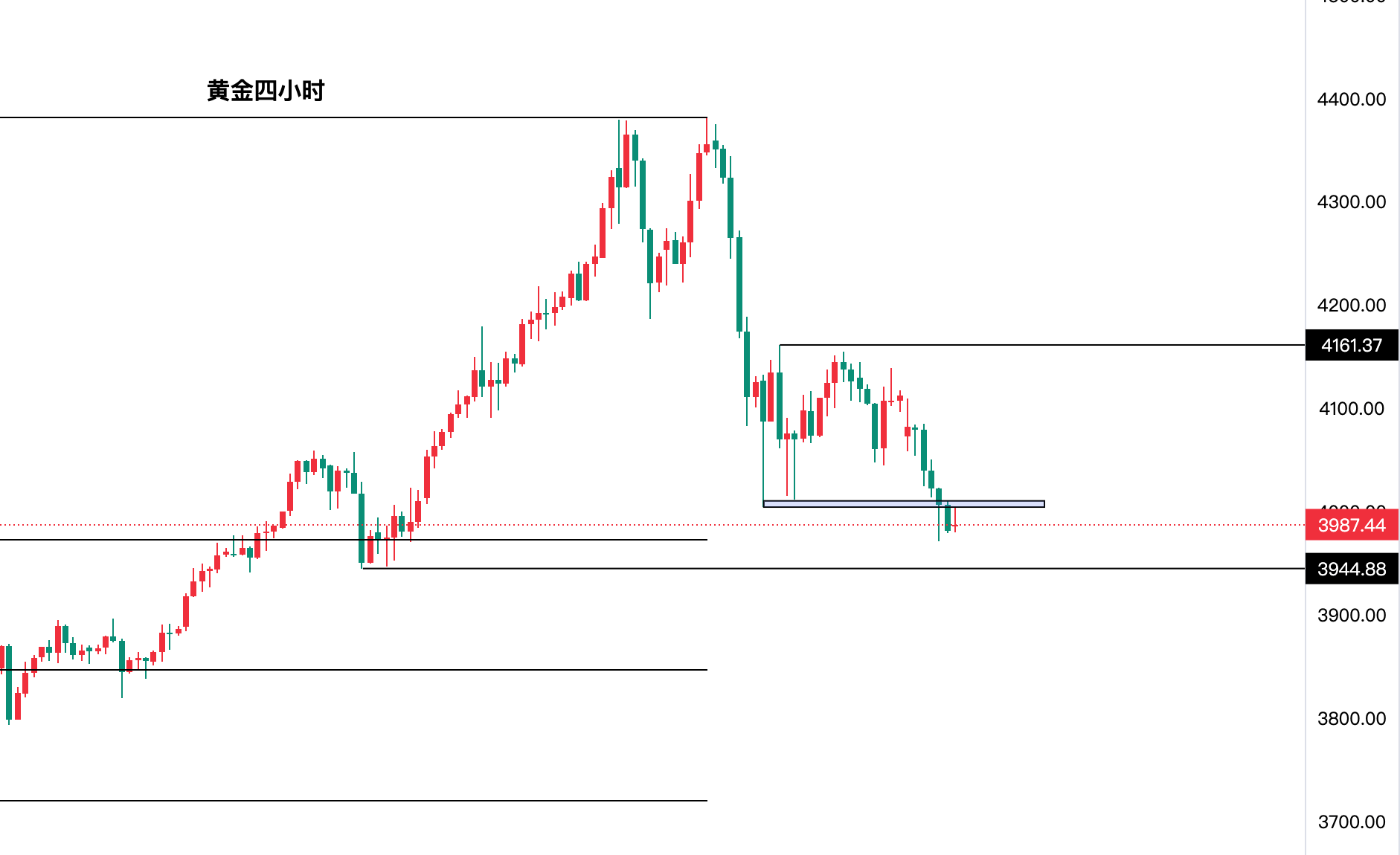
Group 1: Fundamental Analysis - The core reason for the significant drop in gold prices is the progress in China-U.S. trade negotiations, which has led to a reduction in market risk aversion and a shift of investors towards riskier assets [2] - The rapid increase in gold prices prior has resulted in substantial profit-taking by investors, exacerbated by technical selling pressure due to optimistic trade sentiment [3] - Current market conditions show strong expectations for a Federal Reserve interest rate cut, with a 98% probability of a 25 basis point cut, but this expectation has already been priced in, providing limited support for gold prices [4] Group 2: Market and Macro Environment Changes - The U.S. 10-year Treasury yield has slightly increased, reflecting enhanced market risk appetite, while the U.S. dollar index has decreased slightly but failed to support gold prices [5] - Market focus is on the Federal Reserve's interest rate path and U.S. consumer confidence data, which will influence future gold price movements [6] Group 3: Future Price Trends and Investment Suggestions - Short-term factors such as progress in China-U.S. trade talks, strong global stock markets, and rising U.S. Treasury yields are likely to continue suppressing gold prices, leading institutions to lower long-term expectations [7] - Long-term factors such as geopolitical risks, inflation expectations, global central bank gold purchases, and the potential for a long-term decline in the U.S. dollar may still provide support for gold prices [8] Group 4: Technical Analysis - On the daily chart, gold has shifted from a consolidation phase to a bearish trend after breaking below the previous week's low, indicating a short-term market shift towards weakness [9] - Key resistance is identified at around 4070, where the 5-day and 20-day moving averages intersect, while support levels to watch are at 3971 and 3960 [9] - On the four-hour chart, the previous support zone of 4010-4000 has been broken, and the market should monitor whether this area will act as resistance moving forward [11]

美国通胀或阶段性见顶——美国9月CPI数据点评
一瑜中的· 2025-10-26 13:15
Core Viewpoint - The article suggests that US inflation may have reached a temporary peak, with expectations of a decline in the coming months due to manageable tariff impacts and a stabilizing job market [1][3][13]. Inflation Trends - Over the past six months, US inflation has experienced a slight recovery, with the CPI rising from 3% in January to 3% in September, after a low of 2.3% in April [1][5]. - Core CPI also showed a similar trend, increasing from 2.8% in May to 3% in September [1][5]. Tariff Impact - The price impact of tariffs is relatively controllable, with the effective tariff rate rising from 2.3% to 9.5% between February and July, which is lower than initial market expectations [1][6]. - As of September, the tariff price effect on core goods prices is estimated to be close to 90%, with a potential remaining impact of about 0.5 percentage points on core goods and 0.1 percentage points on overall CPI if tariffs rise to 17% [2][7]. Labor Market Dynamics - The marginal weakening of the job market has prevented a wage-price spiral, with wage growth slowing and rental prices stabilizing around 0.2-0.3% [2][6]. - The rental growth rate has decreased, with primary residence rent rising only 0.2%, the smallest monthly increase since January 2021 [19][22]. Inflation Expectations - Consumer inflation expectations remain high in the short and medium term but have decreased compared to earlier in the year, with market pricing for long-term inflation expectations remaining stable or even declining [11][13]. Future Inflation Projections - If US tariff policies do not experience significant fluctuations, inflation is expected to stabilize around 3% in Q4 of this year and decline to approximately 2.5% and 2.8% for CPI and core CPI, respectively, in Q2 of next year [3][13]. Monetary Policy Implications - The controllable impact of tariffs and the peak in inflation may support the Federal Reserve's decision to continue "preemptive" rate cuts, with potential cuts of 25 basis points in October and December [15][25]. - Future rate cuts may slow down if inflation declines at a moderate pace and employment stabilizes [15][25].

美国9月CPI点评:美联储继续降息或无悬念
KAIYUAN SECURITIES· 2025-10-25 09:56
Group 1: Inflation Data Overview - In September 2025, the US CPI increased by 3.0% year-on-year and 0.3% month-on-month, while core CPI also rose by 3.0% year-on-year and 0.2% month-on-month, all below market expectations[2] - Overall inflation shows a marginal rebound, but core inflation is declining, indicating a potential easing impact from tariffs on US inflation[3] - Energy inflation rose significantly, with a year-on-year increase of 2.8%, while food inflation increased by 3.1%, showing a slight decline from August[4] Group 2: Future Inflation Trends and Federal Reserve Actions - The report suggests that inflation may trend downward in the future, with core inflation expected to remain stable or decrease slightly[5] - The Federal Reserve is likely to continue lowering interest rates by 25 basis points, with a total expected reduction of 75 basis points for 2025, due to ongoing risks in the labor market and low consumer confidence[6] - Consumer confidence index recorded a low of 55 in October, indicating pessimism about future economic conditions[42] Group 3: Key Economic Indicators - The Michigan University inflation expectation remained stable at 4.6%, with a 5-year expectation at 3.7%, suggesting consumers do not anticipate rapid cost transfers to them despite income pressures[46] - The core services inflation, excluding housing, showed a year-on-year decline, reflecting significant differences across various consumption sectors[23] - Risks include potential inflation surprises due to international tensions and unexpected economic downturns in the US[47]
每日投行/机构观点梳理(2025-10-24)
Jin Shi Shu Ju· 2025-10-24 15:53
Group 1: Gold Market Outlook - Morgan Stanley predicts that the average gold price will exceed $5,000 per ounce by Q4 2026, with a long-term target of $6,000 per ounce by 2028, based on expected investor demand and central bank purchases [1] - The analysis highlights that the current market consolidation is a healthy phenomenon, reflecting a supply-demand imbalance with high buyer interest and limited sellers [1] - The report emphasizes that gold remains a strong investment amid concerns over inflation, currency devaluation, and the Federal Reserve's interest rate cuts [1] Group 2: U.S. Economic Indicators - Barclays anticipates that the upcoming U.S. CPI data will need to be significantly higher than expected to alter the market's view on the Federal Reserve's interest rate cuts [2] - Morgan Stanley and Bank of America expect the Federal Reserve to end its balance sheet reduction earlier than previously forecasted due to rising borrowing costs in the dollar financing market [3] - The market is divided on when the Fed will conclude its quantitative tightening, with some institutions predicting an end in October while others expect a later conclusion [3] Group 3: Risk Assets and Inflation - State Street Global Advisors warns that investor optimism towards high-risk assets may be excessive, with expectations of rising inflation impacting the Federal Reserve's decisions [4] - Dutch International Group notes that the credit spread for U.S. corporate bonds is tightening, making them less attractive compared to euro-denominated bonds, amid rising risks [5] - Citigroup highlights that the recent rise in oil prices due to U.S. sanctions on Russia provides a hedging opportunity for producers, although geopolitical premiums may not last [6] Group 4: Japanese Economic Policy - Morgan Stanley suggests that the market's cooling expectations for a Bank of Japan rate hike this month may be overstated, indicating a potential rebound for the yen [7] - Dutch International Group points out that rising inflation in Japan could pave the way for a rate hike by the Bank of Japan in December, with consumer price inflation accelerating to 2.9% in September [8] Group 5: Cryptocurrency and AI Transition - Guojin Securities reports that overseas cryptocurrency mining companies are transitioning to AI data centers, leveraging low electricity costs and approved power quotas [8] - The report suggests focusing on companies with clear AI expansion plans and undervalued market positions during this transition [8] Group 6: U.S. Tariff and Inflation Outlook - CITIC Securities predicts that the U.S. Supreme Court will expedite the ruling on Trump's tariff legality, with potential implications for U.S.-China negotiations [9] - Minsheng Securities warns that rising core inflation in the U.S. could lead to a more cautious approach from the Federal Reserve regarding interest rate cuts, with inflation pressures expected to increase in Q4 [10]



美国消费者信心深陷极端悲观区域 已跌至经济衰退期间水平
Zhi Tong Cai Jing· 2025-10-24 15:21
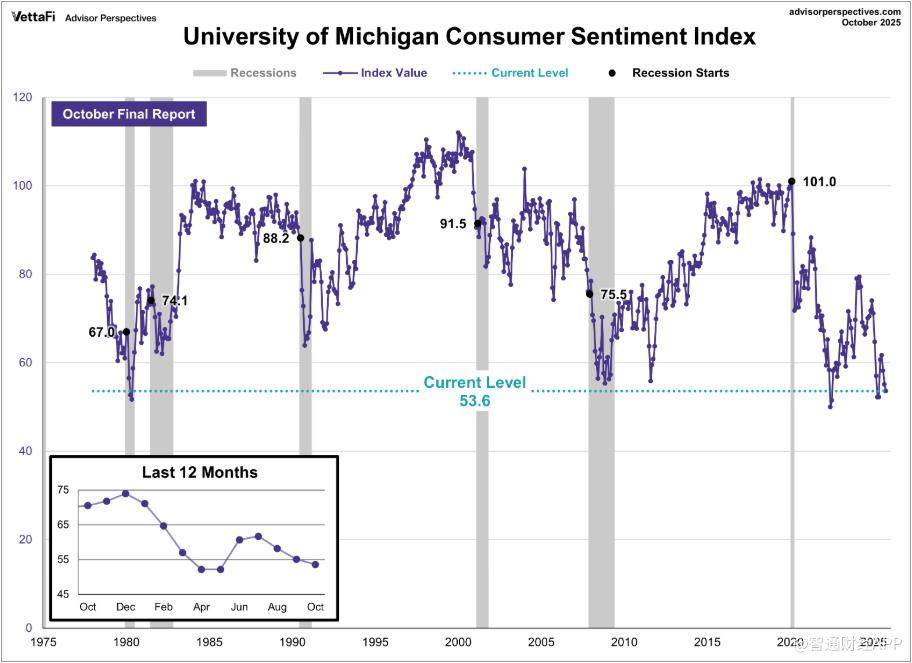
Core Insights - US consumer confidence continued to decline in October, remaining at a five-month low with the University of Michigan's final consumer confidence index at 53.6, down 1.5 points from September and significantly lower than the market expectation of 55, representing a 24% decrease year-over-year [1][3] Group 1: Consumer Confidence Index - The consumer sentiment index is currently 36.4% below the average level since 1978, indicating extremely low consumer sentiment [1] - The consumer current conditions index (CECI) fell for the fourth consecutive month to 58.6, marking a three-year low with a month-over-month decline of 3.0% and a year-over-year drop of 9.7%, which was weaker than the market forecast of 61 [3] - The consumer expectations index (CEI) also declined for four months in a row, reporting 50.3, the lowest since May, with a month-over-month decrease of 2.7% and a significant year-over-year contraction of 32.1%, falling short of the market expectation of 51.2 [3] Group 2: Economic Conditions and Inflation Expectations - Despite a slight improvement in personal financial situations, expectations for future finances have weakened, with consumers perceiving no significant change in overall economic conditions compared to the previous month [3] - Inflation and high prices remain overwhelming sources of pressure for consumers, with one-year inflation expectations slightly decreasing from 4.7% to 4.6%, while long-term inflation expectations rose from 3.7% to 3.9%, still below the highs of April [3] - The current consumer sentiment index is lower than the levels observed at the onset of the last six US economic recessions, indicating that consumer sentiment is in a typical pre-recession pessimistic range [3][4]
俄央行年内第四次降息
Xin Hua She· 2025-10-24 14:48
Core Viewpoint - The Central Bank of Russia has lowered the benchmark interest rate by 50 basis points to 16.5%, marking the fourth rate cut this year [1] Economic Outlook - The Russian economy is returning to a balanced growth trajectory, although inflation expectations remain high in recent months [1] - The annual inflation rate in Russia is projected to be between 6.5% and 7.0% by the end of 2025 [1] - The Central Bank will maintain a tight monetary policy as needed to bring inflation back to target levels [1] Growth Projections - The economic growth forecast for Russia in 2025 has been revised down from 1%-2% to 0.5%-1% [1]
PMI "Contractionary Territory" & "Little Changed" Consumer Sentiment Follow Cool CPI
Youtube· 2025-10-24 14:30
Economic Data Summary - S&P Global PMIs indicate manufacturing PMI at 52.2%, exceeding expectations of 51.9%, signaling expansion [1][2] - Services PMI also surpassed expectations at 55.2%, compared to the anticipated 53.5%, showing month-over-month improvement [2] Manufacturing Sector Insights - Production volumes in manufacturing increased for the fifth consecutive month, marking the largest expansion since August [2] - Domestic orders are driving growth, while export orders have significantly declined, the steepest drop since February, attributed to tariff policies and weaker demand from China and Europe [3] Services Sector Insights - The services sector is experiencing a deceleration in input and output prices, but faces challenges in employment due to a lack of qualified candidates [4] Consumer Sentiment Analysis - University of Michigan consumer sentiment survey shows little change, with consumer expectations at 50.3%, sentiment at 53.6%, and current conditions at 58.6% [6][7] - One-year inflation expectations remain stable at 4.6%, indicating no significant shifts in consumer outlook [8] Inflation and Market Reaction - CPI year-over-year is reported at 3%, aligning with expectations, while core CPI also matches at 3% [14][15] - Month-over-month CPI figures came in slightly lower than anticipated, contributing to a positive market reaction [13][16] Market Performance and Technical Analysis - S&P 500 reached a key resistance level at 6,800, with potential for further gains if it breaks through this level [18][19] - Leading sectors include communication services, technology, and financials, which are performing well in the current market environment [20]
“全球资产定价之锚”来到临界点! 若9月CPI超预期 “股债双牛”叙事将遭遇重击
Zhi Tong Cai Jing· 2025-10-24 03:27
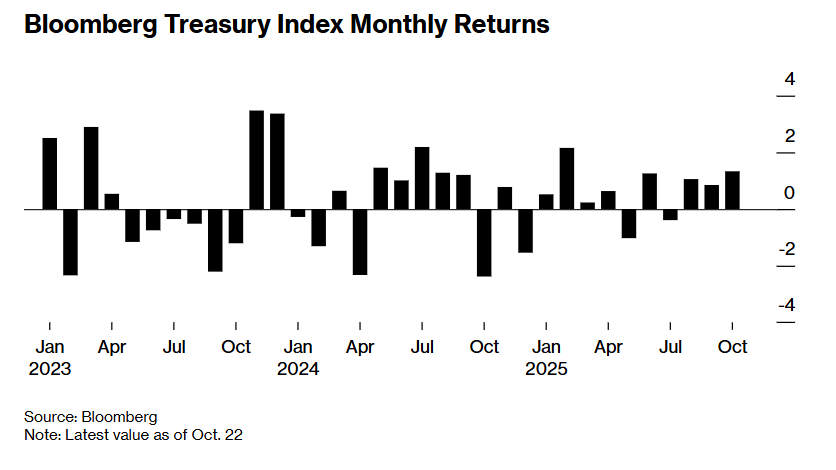
Core Viewpoint - The upcoming U.S. CPI inflation data is critical, as a higher-than-expected reading could disrupt the prevailing market consensus on interest rate cuts and negatively impact the recent strong rebound in U.S. stock and bond markets since October [1][2][10]. Group 1: U.S. Treasury Market Dynamics - The 10-year U.S. Treasury yield fell below 4% for the first time in six months, reaching a low of 3.9%, indicating a significant rebound in Treasury prices despite the government shutdown delaying key economic data [1]. - The overall return of U.S. Treasuries in October is approximately 1.3%, potentially marking the best monthly performance since February, driven by safe-haven buying and expectations of Federal Reserve rate cuts [5]. - If the September CPI data exceeds expectations, it could lead to a sharp rise in Treasury yields, negatively affecting global stock and bond markets [3][10]. Group 2: Inflation Expectations and Market Reactions - Economists predict that the overall CPI for September will show a month-over-month increase of 0.4%, with core CPI expected to rise by 0.3%, both indicating a year-over-year growth of 3.1%, the highest since May 2024 [8]. - There is a prevailing concern that strong inflation data could undermine the market's confidence in further rate cuts, as indicated by various market strategists [10][11]. - The market is currently pricing in a high probability of a 25 basis point rate cut in December, but a significant rise in inflation could jeopardize these expectations [9]. Group 3: Impact on Equity Markets - The strong performance of major tech companies and the AI sector has driven a historic investment surge in U.S. equities, with indices like the S&P 500 and MSCI Global Index reaching new highs [4]. - The 10-year Treasury yield serves as a critical component in equity valuation models, and a sustained decline below 4% could support a continued bull market in stocks, particularly in technology [3][4]. - If inflation remains stubbornly high, it could lead to a reassessment of risk asset valuations, including tech stocks and cryptocurrencies, which are currently at historical highs [4][10].
研究所晨会观点精萃-20251024
Dong Hai Qi Huo· 2025-10-24 02:38
Report Summary 1. Report Industry Investment Rating No relevant information provided. 2. Core Viewpoints of the Report - The upcoming China-US trade negotiations from October 24 - 27 have boosted market optimism. However, the new US sanctions on a Russian oil company have led to a sharp rise in oil prices, increasing inflation expectations, and causing the US dollar index and US Treasury yields to rebound. The domestic economy is growing faster, and the impending trade negotiations have lifted domestic market sentiment. The Fourth Plenary Session of the CPC Central Committee emphasized supply security, with manufacturing and technological self - reliance taking the lead, which is expected to enhance domestic risk appetite. The short - term macro - upward drive has strengthened, and attention should be paid to the progress of China - US trade negotiations and the implementation of domestic incremental policies [2]. - For assets, the stock index is expected to fluctuate in the short term, with a cautious long - position approach. Treasury bonds are also expected to fluctuate, and it is advisable to observe cautiously. In the commodity sector, black metals are expected to rebound with short - term fluctuations, and a cautious long - position is recommended; non - ferrous metals are expected to fluctuate, and a cautious long - position is also suggested; energy and chemicals are expected to rebound with short - term fluctuations, and a cautious long - position is appropriate; precious metals are experiencing a short - term correction at high levels, and it is advisable to observe cautiously [2]. 3. Summary by Relevant Catalogs 3.1 Macro - finance - **Macro - situation**: Overseas, the upcoming China - US trade negotiations have boosted global risk appetite, but US sanctions on a Russian oil company have increased inflation expectations. Domestically, the economy is growing faster, and the trade negotiations are expected to lift the domestic market. Policy - wise, the Fourth Plenary Session of the CPC Central Committee's stance is favorable for domestic risk appetite. The short - term macro - upward drive has strengthened, and attention should be paid to trade negotiation progress and domestic policy implementation [2]. - **Asset suggestions**: Stock index: short - term fluctuation, cautious long - position; Treasury bonds: short - term fluctuation, cautious observation; commodities - black metals: short - term rebound with fluctuation, cautious long - position; non - ferrous metals: short - term fluctuation, cautious long - position; energy and chemicals: short - term rebound with fluctuation, cautious long - position; precious metals: short - term high - level correction, cautious observation [2]. 3.2 Stock Index - The domestic stock market rose slightly driven by sectors such as coal, energy metals, and film and television theaters. The improving domestic economy and upcoming trade negotiations have boosted market sentiment. Policy support from the Fourth Plenary Session of the CPC Central Committee has enhanced risk appetite. The short - term macro - upward drive has strengthened, and it is advisable to take a cautious long - position in the short term [3]. 3.3 Precious Metals - The precious metals market rose on Thursday night. Geopolitical risks and anticipation of US inflation data drove the increase. Spot gold rose 0.76% to $4125 per ounce. In the short term, precious metals are expected to rebound with fluctuations, and the long - term upward trend remains unchanged. Short - term investors should reduce long - positions and observe, while long - term investors should buy on dips [3]. 3.4 Black Metals - **Steel**: On Thursday, the steel futures and spot markets rebounded to varying degrees, with low trading volumes. The upcoming China - US trade negotiations have maintained strong macro expectations. The real - world demand for steel has improved marginally, with a 27.41 - million - ton decrease in inventory and a 17.32 - million - ton increase in apparent consumption this week. Supply has increased slightly but is expected to decline due to compressed steel mill profits. The steel market has no clear trend, with limited upward and downward space in the short term [4]. - **Iron Ore**: On Thursday, iron ore futures and spot prices continued to rebound. Steel mill profits are compressed, leading to a three - week decline in pig iron production, and further decline is expected. Steel mills are mainly making just - in - time purchases. Global iron ore shipments increased by 126 million tons this week, while arrivals decreased by 526.4 million tons. The price difference between Carajas fines (Carajás) and PB fines has narrowed. Iron ore prices are expected to fluctuate within a range [6]. - **Silicon Manganese/Silicon Ferro - alloy**: On Thursday, the spot prices of silicon ferro - alloy and silicon manganese were stable, while the futures prices rebounded slightly. The production of five major steel products increased slightly, and the demand for ferro - alloys is currently stable. The开工 rate of silicon manganese enterprises increased, and the daily output rose. The prices of silicon ferro - alloy and silicon manganese are expected to continue to fluctuate within a range [7]. 3.5 Chemicals - **Soda Ash**: On Thursday, the main soda ash contract fluctuated within a range. Supply is in a capacity - expansion phase, with plans for new capacity in the fourth quarter, resulting in high supply and inventory. Although there are anti - involution policies, the industry lacks clear policy implementation. In the long term, supply - side contradictions will suppress prices, and a bearish outlook is maintained [8]. - **Glass**: On Thursday, the main glass contract fluctuated within a range. Glass production increased slightly, and the number of operating production lines remained stable. As the "Golden September and Silver October" season ends, downstream procurement has slowed down. With anti - involution policies providing some support, but limited demand growth, short - term range - bound trading is recommended [8]. 3.6 Non - ferrous Metals and New Energy - **Copper**: Overnight, LME copper reached its highest level since October 9. High US copper inventories may limit future imports. The suspension of Indonesia's second - largest copper mine has tightened the global copper supply, but it is a temporary situation, and next year is expected to be a year of increased copper supply. China's refined copper inventory reduction has been less than expected. Copper prices are expected to remain high and fluctuate [9]. - **Aluminum**: On Thursday, SHFE aluminum rose significantly due to a positive macro environment and a general increase in commodity prices. An overseas aluminum smelter's accident has a limited impact on production. China's aluminum fundamentals are weak, with slow inventory reduction. However, market expectations are positive, and short - selling should be cautious [10]. - **Tin**: On the supply side, Indonesia's actions have tightened the global tin supply in the short term, and the mining approval cycle adjustment has added uncertainty. The smelting start - up rate has recovered. On the demand side, the start - up rate of tin solder is low, and demand in traditional and emerging industries is weak. High tin prices have suppressed consumption, but inventory has decreased due to some downstream replenishment. Tin prices are expected to remain high and fluctuate [11]. - **Lithium Carbonate**: On Thursday, the main lithium carbonate contract rose 4.17%. The market is experiencing both increased supply and demand, with strong seasonal demand and continuous inventory reduction. The market is strengthening with fluctuations, and attention should be paid to the upper pressure zone [12]. - **Industrial Silicon**: On Thursday, the main industrial silicon contract rose 2.72%. Production reached a new high, but there has been no inventory accumulation during the wet season. The market is expected to fluctuate within a range, and attention should be paid to the cash - flow cost support of large enterprises [12]. - **Polysilicon**: On Thursday, the main polysilicon contract rose 1.07%. The market is facing high supply and low demand. Expectations of policies such as state purchases are awaited, and attention should be paid to spot price support [13][14]. 3.7 Agricultural Products - **US Soybeans**: The CBOT soybeans rose overnight. Brazil's soybean sowing is progressing smoothly, and Argentina's weather conditions are favorable. The market is expected to remain stable with narrow fluctuations, and attention should be paid to China - US soybean trade developments [15]. - **Soybean and Rapeseed Meal**: The oil mill operating rate is high, and there is a widespread phenomenon of hastening the delivery of soybean meal. Oil mills are facing losses, increasing their willingness to support prices. There is a potential supply gap in the domestic market before the arrival of South American new soybeans next year. After a sharp decline, soybean meal is expected to stabilize with fluctuations. Rapeseed meal is in a state of balanced supply and demand, and its price is mainly influenced by soybean meal [15]. - **Soybean and Rapeseed Oil**: The short - term prices of soybean and rapeseed oil may be dragged down by palm oil. Soybean oil is in the peak season, but trading volume has not changed significantly. Palm oil is weak due to increased production in Malaysia. The price difference between soybean oil and palm oil is expected to continue to adjust. Rapeseed oil is supported by inventory reduction before new supplies arrive [16]. - **Palm Oil**: Malaysia's palm oil production has increased in October, and China's palm oil inventory has increased due to concentrated arrivals. MPOC expects palm oil prices to remain stable above 4400 ringgit per ton for the rest of 2025 [16]. - **Corn**: The price of corn in the Northeast region is stable. The China - US trade negotiations have an impact on the market, and traders' willingness to build inventories is relatively low. The price is approaching the cost of production, and farmers may be more reluctant to sell as the weather cools. The buying sentiment in the futures market has increased [17]. - **Hogs**: The price of hogs in the north has risen, increasing the cost of secondary fattening and reducing the enthusiasm of secondary fatteners. The breeding industry is facing losses, and the supply peak has not yet arrived. The price is expected to remain weak before the winter solstice consumption peak. The LH2601 futures contract is expected to fluctuate weakly [17].