
政府债券

Search documents
7月社融数据超预期增长9%,"一石多鸟"政策效应加快显现
Shang Hai Zheng Quan Bao· 2025-08-13 20:26
Core Viewpoint - The central bank's data indicates that as of the end of July, social financing scale, broad money (M2), and RMB loans grew by 9%, 8.8%, and 6.9% year-on-year, respectively, continuing to outpace economic growth [1][4]. Group 1: Credit Growth Analysis - In July, credit growth slowed due to multiple factors including seasonal effects, local government debt swaps, and financial institutions reducing excessive competition, leading to a decrease in the loan growth rate to 6.9%, down from 8.7% the previous year [2][3]. - July is traditionally a low month for credit, as June often sees higher lending due to banks' performance assessments and businesses' cash flow needs [2][3]. - The impact of local government debt swaps on loan data remains significant, with estimates suggesting that these swaps have influenced loan growth by approximately 2.6 trillion yuan [3]. Group 2: Monetary Policy and Financing Environment - The high growth rates of social financing scale and M2 reflect a moderately loose monetary policy, providing a suitable financial environment for the real economy [4][5]. - As of the end of July, the social financing scale stood at 431.26 trillion yuan, with a year-on-year growth of 9%, indicating a robust increase in financing activities [4]. - Government bond issuance has been a major driver of social financing growth, with a more proactive fiscal policy supporting economic demand [4][5]. Group 3: Loan Structure and Interest Rates - The structure of loans is optimizing to meet the demands of economic transformation, with inclusive small and micro loans and medium to long-term loans for manufacturing showing growth rates of 11.8% and 8.5%, respectively [7]. - Loan interest rates remain low, with new corporate loans averaging around 3.2% and personal housing loans at approximately 3.1%, reflecting a favorable credit supply environment [7]. - The reduction in financing costs has positively impacted effective demand, with some businesses reporting interest rates halved compared to previous levels [7]. Group 4: Future Outlook - Experts anticipate that macroeconomic policies will maintain continuity and stability in the second half of the year, supporting employment, businesses, and market expectations, which will facilitate smoother domestic economic circulation [8].
7月M2增长8.8%!“反内卷”见效影响信贷
Sou Hu Cai Jing· 2025-08-13 10:29
Group 1 - The core viewpoint of the articles highlights the significant increase in social financing scale and the ongoing supportive monetary policy, with a cumulative increase of 23.99 trillion yuan in social financing by the end of July, which is 5.12 trillion yuan more than the same period last year [1] - The growth rate of broad money supply (M2) reached 8.8% year-on-year, reflecting a 0.5 percentage point increase from the previous month, indicating a relatively loose monetary policy stance [1] - The government bond issuance has been robust, with a cumulative net financing of government bonds increasing by 4.32 trillion yuan year-on-year, supporting the overall social financing scale [6] Group 2 - The loan balance of RMB increased by 6.9% year-on-year, with external factors such as local government debt management and the reform of small and medium-sized banks affecting the loan growth rate [2] - The structure of credit is continuously optimizing, with loans in technology, green, inclusive, elderly care, and digital economy sectors growing significantly faster than the overall loan growth rate [4] - The interest rates for new corporate loans and personal housing loans have decreased, with corporate loan rates around 3.2% and personal housing loan rates around 3.1%, reflecting a relatively abundant credit supply [5] Group 3 - The shift towards direct financing is becoming more pronounced, with the proportion of direct financing increasing to better meet the diverse financing needs of enterprises [7] - The ongoing policies aimed at stimulating consumption and enhancing technology are showing positive effects, as evidenced by the increased willingness of the manufacturing sector to engage in long-term investments [4] - The financial institutions are adapting to changes in the economic structure, focusing on identifying effective credit demand in niche markets [3]
7月末社融规模存量为431.26万亿元,同比增长9%
Di Yi Cai Jing· 2025-08-13 09:18
Core Insights - As of the end of July 2025, the balance of RMB loans issued to the real economy accounted for 61.4% of the total social financing scale, a decrease of 1.2 percentage points year-on-year [1][2] - The total social financing scale stood at 431.26 trillion yuan, reflecting a year-on-year growth of 9% [1] - The balance of RMB loans to the real economy reached 264.79 trillion yuan, with a year-on-year increase of 6.8% [1] - The balance of foreign currency loans to the real economy, converted to RMB, was 1.21 trillion yuan, showing a significant year-on-year decline of 23.2% [1] - The balance of entrusted loans was 11.16 trillion yuan, with a slight year-on-year decrease of 0.4% [1] - Trust loans amounted to 4.46 trillion yuan, marking a year-on-year growth of 5.9% [1] - The balance of undiscounted bank acceptance bills was 1.92 trillion yuan, down 10.4% year-on-year [1] - Corporate bonds reached a balance of 33.39 trillion yuan, reflecting a year-on-year increase of 3.8% [1] - Government bonds totaled 89.99 trillion yuan, with a notable year-on-year growth of 21.9% [1] - The balance of domestic stocks of non-financial enterprises was 11.94 trillion yuan, showing a year-on-year increase of 3.2% [1] Structural Analysis - The proportion of RMB loans to the real economy decreased by 1.2 percentage points year-on-year, while foreign currency loans accounted for 0.3%, down 0.1 percentage points [2] - Entrusted loans represented 2.6% of the total, a decrease of 0.2 percentage points year-on-year [2] - Trust loans made up 1% of the total, down 0.1 percentage points year-on-year [2] - Undiscounted bank acceptance bills accounted for 0.4%, a decrease of 0.1 percentage points [2] - Corporate bonds represented 7.7% of the total, down 0.4 percentage points year-on-year [2] - Government bonds increased to 20.9% of the total, up 2.2 percentage points year-on-year [2] - Domestic stocks of non-financial enterprises accounted for 2.8%, down 0.1 percentage points year-on-year [2]
保民生促投资防风险 财政政策积极有为
Zhong Guo Zheng Quan Bao· 2025-08-06 21:09
Group 1 - The current economic growth faces challenges, and fiscal policy will focus on more proactive measures to support key areas, including optimizing expenditure structure and enhancing social welfare [1] - In the first half of the year, social security and employment, education, and health expenditures grew by 9.2%, 5.9%, and 4.3% respectively, all exceeding the general public budget expenditure growth of 3.4% [2] - The issuance of local government bonds reached 2.6 trillion yuan in the first half of the year, supporting major project construction [3] Group 2 - The Ministry of Finance plans to accelerate the issuance and utilization of government bonds, with a focus on special bonds and ultra-long-term special treasury bonds to stabilize investment and promote growth [3] - By the end of July, 2.78 trillion yuan of new special bonds had been issued, accounting for 63% of the annual quota, indicating a faster-than-usual issuance pace [3] - The Ministry of Finance aims to complete the issuance of 1.3 trillion yuan in ultra-long-term special treasury bonds to ensure the implementation of key projects [3] Group 3 - The government is actively working on replacing local government hidden debts, with 1.8 trillion yuan of the 2 trillion yuan replacement bonds for 2025 already issued by June [4] - There is a strong regulatory stance against new hidden debts, with a focus on the orderly exit of local financing platforms to mitigate systemic risks [4][5] - The government emphasizes a market-oriented transformation of financing platforms, gradually pushing for their exit from local government financing roles [5]
2025年6月财政数据点评:6月财政两本账表现分化,下半年财政政策仍将积极发力
Dong Fang Jin Cheng· 2025-08-04 02:55
Revenue Performance - In June 2025, the national general public budget revenue decreased by 0.3% year-on-year, a decline from May's 0.1%[1] - Tax revenue increased by 1.0% year-on-year, up from 0.6% in May, while non-tax revenue fell by 3.7%, a larger decline than the previous month's 2.2%[5] - For the first half of 2025, general public budget revenue cumulatively decreased by 0.3%, matching the performance from January to May[7] Expenditure Trends - In June 2025, general public budget expenditure grew by 0.4% year-on-year, down from 2.6% in May[1] - Cumulatively, general public budget expenditure increased by 3.4% in the first half of 2025, a slowdown from 4.2% in the previous period[9] - By June, general public budget expenditure completed 47.6% of the annual budget, slightly below the five-year average of 48.1%[9] Government Fund Insights - In June, government fund revenue surged by 20.8% year-on-year, a significant recovery from the previous month's decline of 8.1%[10] - Cumulatively, government fund revenue decreased by 2.4% in the first half of 2025, with land transfer revenue down by 6.5%[10] - Government fund expenditure in June increased by 79.2% year-on-year, driven by accelerated issuance of special bonds[10] Future Fiscal Policy Outlook - The Central Political Bureau meeting indicated that macro policies will continue to be proactive in the second half of 2025, emphasizing the need for increased government bond issuance and improved fund utilization[12] - Potential measures may include raising the fiscal deficit ratio and increasing the issuance of special bonds to stimulate domestic demand and counteract external economic slowdowns[12]
上半年广义财政收支差5.3万亿,中央定调下半年财政政策|财税益侃
Di Yi Cai Jing· 2025-07-31 12:27
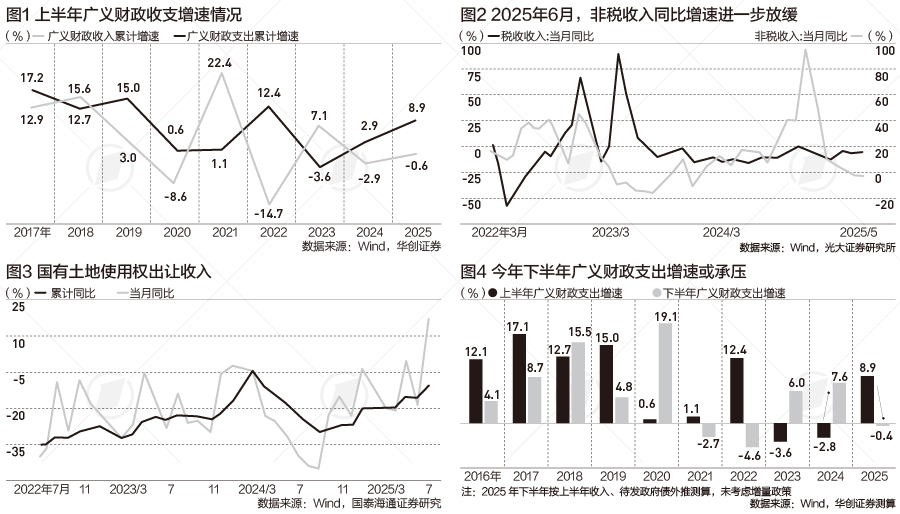
Core Viewpoint - Despite a slight decline in general fiscal revenue in the first half of the year, general fiscal expenditure reached a historical high, indicating a proactive fiscal policy aimed at stabilizing economic growth [1][3][4]. Fiscal Revenue and Expenditure - In the first half of the year, general fiscal revenue was approximately 135,008 billion yuan, showing a year-on-year decrease of about 0.6% [3]. - General fiscal expenditure amounted to nearly 188,800 billion yuan, with a year-on-year growth of approximately 8.9%, significantly higher than the economic growth rate of 5.3% [2][3]. - The fiscal expenditure exceeded revenue by 52,536 billion yuan, reflecting a year-on-year increase of about 45% [3]. Policy Measures and Economic Impact - The central government has emphasized the need for sustained and timely fiscal policy adjustments to support economic stability, particularly in the second half of the year [2][4]. - The Ministry of Finance reported that the fiscal policy has been more aggressive, contributing to a stable economic environment despite pressures [2][4]. - The government plans to accelerate the issuance of bonds and enhance the efficiency of fund utilization to address the fiscal gap [7][11]. Tax Revenue Trends - Tax revenue in the first half of the year was 92,915 billion yuan, down 1.2% year-on-year, indicating a mismatch with nominal GDP growth [4][6]. - Non-tax revenue grew by 3.7% to 22,700 billion yuan, but the growth rate has slowed compared to previous quarters [7]. - The decline in tax revenue is attributed to factors such as tax cuts and changes in the tax base, particularly in traditional industries [6]. Future Outlook - The fiscal space for the second half of the year is estimated to be 60,700 billion yuan, with significant remaining quotas for deficits and special bonds [9]. - The issuance of special bonds has accelerated, with a record monthly issuance of approximately 6,169 billion yuan in July [10]. - The government aims to enhance the management and efficiency of special bonds to ensure effective fund allocation for key projects [11].

一文读懂各类政府债券:国债、特别国债、地方政府债、专项债、一般债、再融资债券的区别和联系
Sou Hu Cai Jing· 2025-07-31 01:33
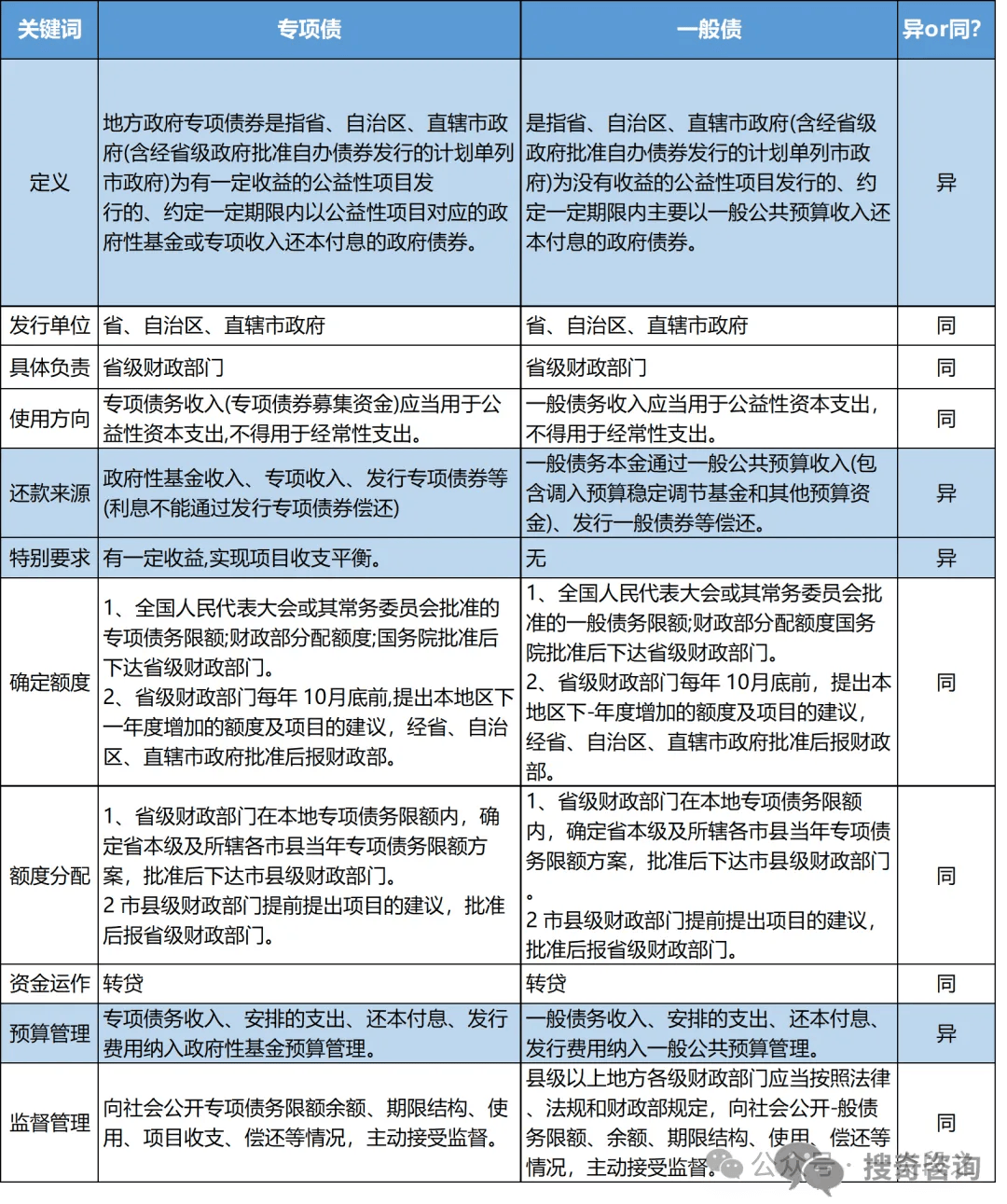
Group 1 - Bonds are debt securities issued by governments, financial institutions, and corporations to raise funds, promising to pay interest at a certain rate and repay the principal under agreed conditions [1] - The most common types of bonds include fixed-rate bonds, floating-rate bonds, and zero-coupon bonds, which can be traded in the market, forming a bond market [1] - Government bonds are issued to cover government expenditures, invest in public works, and manage fiscal deficits, with investors receiving interest during the holding period and principal at maturity [1] Group 2 - Different types of government bonds include national bonds, special national bonds, ultra-long special national bonds, special bonds, general bonds, and refinancing bonds, each with unique characteristics regarding issuance, purpose, and management [2] - National bonds are issued by the central government to raise fiscal funds, typically to cover deficits or invest in public infrastructure and key projects [3] - Special national bonds are issued for specific policies and purposes, not suitable for ordinary investors, and do not require budget arrangements for repayment [4] Group 3 - Ultra-long special national bonds have a maturity of over 10 years and are used for long-term strategic projects, with a planned issuance scale of 1.3 trillion yuan in 2025 for major strategic implementations and key area security capability construction [5] - Local government bonds are issued by local governments to raise funds for local construction, categorized into general and special bonds, with the latter being used for specific projects with expected returns [6][9] - General bonds are issued to cover public fiscal deficits, while special bonds are for projects with certain returns, repaid through corresponding government fund revenues [9] Group 4 - Refinancing bonds are issued to raise funds for repaying existing debts and adjusting debt structures, with a focus on repaying old debts rather than funding new projects [9][10] - Special refinancing bonds have evolved to allow funds to be used for repaying existing local debts, including hidden debts, thus becoming an important tool for local debt management [10]
宏观政策将持续发力适时加力 稳增长取向明晰
Zheng Quan Ri Bao· 2025-07-30 17:21
Group 1: Economic Policy Overview - The Central Political Bureau of the Communist Party of China emphasized the need for macro policies to continue to exert force and to be adjusted as necessary, indicating a stable growth orientation for the second half of the year [1] - The meeting highlighted the importance of implementing a more proactive fiscal policy and a moderately loose monetary policy to fully unleash policy effects [1] Group 2: Fiscal Policy Measures - The Ministry of Finance announced a more proactive fiscal policy, ensuring that fiscal policies remain effective and robust, with a focus on the issuance and utilization of government bonds [2] - As of June 30, the central government had transferred 9.29 trillion yuan to local governments, and over 90% of the central budget investment had been allocated [2] - The issuance of special government bonds is expected to accelerate, with a total of 27.776 billion yuan in new special bonds issued this year, representing a 56.5% increase compared to the same period last year [3] Group 3: Monetary Policy Outlook - The monetary policy will maintain a "moderately loose" stance, with an emphasis on ensuring ample liquidity and reducing the overall financing costs for society [4] - The central bank is expected to utilize various structural monetary policy tools to support key areas such as technological innovation, consumption, small and micro enterprises, and stabilizing foreign trade [5] - There is a possibility of further interest rate cuts, although the extent may be limited due to the narrowing net interest margins of commercial banks [5]
固定收益点评:下半年社融增速或承压
GOLDEN SUN SECURITIES· 2025-07-15 06:57
Report Industry Investment Rating There is no information provided regarding the report industry investment rating. Core Viewpoints - The growth rate of social financing may face pressure in the second half of the year. If there is no additional budget, government bonds will shift from year - on - year increase in the first half to year - on - year decrease in the second half, and non - government bond social financing has been weak due to high real interest rates [2][3][20]. - The low - base effect supports the continued significant rebound of M1 growth rate, and the rebound of social financing growth rate drives the rebound of M2 growth rate. Attention should be paid to the subsequent changes in fiscal deposits [3][4]. - The current stock market rise requires a low - interest - rate environment, and the impact on the bond market from capital flow is limited. The bond market has limited adjustment space, and it is a better allocation opportunity after adjustment. It is expected that bond yields will decline again, and a long - duration position and a dumbbell - shaped allocation are recommended [5][21]. Summary by Related Content Credit Situation - In June, new credit was 2.24 trillion yuan, a year - on - year increase of 110 billion yuan. Corporate short - term credit demand increased, while the improvement of household credit demand was still limited. Corporate medium - and long - term loans and short - term loans increased year - on - year, and bill financing decreased year - on - year. Household medium - and long - term and short - term loans also increased year - on - year, but high - frequency data showed weak real - estate sales [1][8]. Social Financing Situation - In June, new social financing was 4.1993 trillion yuan, a year - on - year increase of 0.9008 trillion yuan, and the year - on - year growth rate of social financing stock was 8.9%, 0.2 percentage points higher than the previous month. Government bonds were still the main support item. However, if there is no additional budget, subsequent bond supply will decrease year - on - year, and social financing growth rate may decline [2][13]. - In the first half of this year, the increase in social financing mainly came from government bonds. The annual budget increment of government bonds is 13.86 trillion yuan. After deducting the issued part in the first half, the net financing scale in the second half is expected to be about 6.1 trillion yuan, compared with about 8 trillion yuan in the same period last year [3][20]. M1 and M2 Situation - In June, the new - caliber M1 increased by 4.6% year - on - year, a rebound of 2.3 percentage points from May, mainly due to the low - base effect last year [3][15]. - In June, M2 increased by 8.3% year - on - year, a rebound of 0.4 percentage points from the previous month. The increase in social financing growth rate promoted the rebound of M2 growth rate. With the slowdown of government bond issuance in the second half, fiscal deposits may decrease year - on - year, increasing the capital supply in the market [4][18]. Stock and Bond Market Situation - The recent rise in the stock market is mainly driven by valuation recovery and requires a low - interest - rate environment. The impact of the stock market on the bond market's capital is limited. The bond market has limited adjustment space, and it is expected that bond yields will decline again. A long - duration position and a dumbbell - shaped allocation are recommended, with the 10 - year Treasury bond yield expected to fall to 1.4% - 1.5% [5][21].
固收点评:6月社融的“成色”几何?
Tianfeng Securities· 2025-07-15 01:43
Report Industry Investment Rating The provided content does not mention the industry investment rating. Core Viewpoints of the Report - In June, the overall social financing and credit exceeded expectations. The year-on-year growth rate of social financing stock rebounded by 0.2 pct to 8.9%, and credit data improved significantly, becoming one of the main supporting items for social financing [1][6]. - The improvement in short-term loans for enterprises and residents reflects the marginal boost in corporate business activities and residents' spending willingness. However, the impact of seasonal factors needs attention. The positive trend of medium- and long-term loans for residents and enterprises requires attention to its sustainability [1][6]. - The improvement in June's credit data indicates that incremental policies are gradually taking effect, and the economic fundamentals show "resilience." However, structural pressures still exist and may require further policy support [1][6]. - In the bond market, the overall favorable environment for the bond market in the third quarter has not fundamentally changed. The current prominent stock-bond "seesaw" effect is more of a disturbing factor. Long-term interest rates are expected to fluctuate narrowly around 1.65%, and there is no need to overly worry about adjustment risks [1][6]. Summary by Related Catalogs 1.1. In terms of total volume, government bonds and credit form support - In June, the new social financing was 419.93 billion yuan, a year-on-year increase of 90.08 billion yuan. The year-on-year growth rate of social financing was 8.9%, up 0.2 pct from the previous month. The social financing growth rate (excluding government bonds) was 6.1%, up 0.078 pct from the previous month [7]. - Government bonds remained the core driving force for social financing and are expected to support the economic performance in the second quarter. Fiscal front-loading has been in place since the beginning of the year, and government bond issuance has increased significantly year-on-year. In the second quarter, the net financing of government bonds significantly exceeded the seasonal level [7]. - In June, the new RMB loans (social financing caliber) increased by 16.73 billion yuan year-on-year, exceeding expectations. The improvement in credit supply is due to the seasonal increase in banks' credit supply demand in the end-of-quarter month and the positive factors in economic operation with the continuous implementation of a package of stable growth policies [2][7]. 1.2. In terms of structure, short-term corporate loans performed brightly - In June, the new RMB loans were 224 billion yuan, a year-on-year increase of 11 billion yuan. Among them, short-term loans for residents increased by 1.5 billion yuan year-on-year, medium- and long-term loans for residents increased by 1.51 billion yuan year-on-year, short-term loans for enterprises increased by 49 billion yuan year-on-year, and medium- and long-term loans for enterprises increased by 4 billion yuan year-on-year [13]. - Residents' willingness to increase leverage improved moderately. The "618" promotion and summer travel plans in June may have led to the concentrated release of household consumption demand, and policies such as trade-in of consumer goods also provided support [13]. - Medium- and long-term loans for residents are a comprehensive reflection of the relief of early mortgage repayment pressure and the year-on-year decline in real estate transactions. The reduction of existing mortgage rates may reduce early mortgage repayment, but the reduction of deposit rates in May may increase the pressure [13]. - Short-term corporate loans continued to improve year-on-year, becoming the main supporting item for new credit. This may be due to the end-of-quarter impulse and the implementation of structural monetary policy tools in early May [14]. - The impact of replacement bond issuance on medium- and long-term corporate loans was marginally relieved. The low base in the same period last year and the improvement in corporate operations, as reflected in the PMI data, also contributed to the increase [14]. 1.3. Under the low-base effect, the year-on-year growth of M1 was high - In June, the year-on-year growth rate of M2 was 8.3%, up 0.4% from the previous month and 2.1% from the same period last year. The year-on-year growth rate of M1 was 4.6%, up 2.3% from the previous month and 6.3% from the same period last year [22]. - The increase in residents' deposits was 247 billion yuan, a year-on-year increase of 33 billion yuan. Non-financial corporate deposits increased by 177.73 billion yuan, a year-on-year increase of 77.73 billion yuan. Fiscal deposits decreased by 82 billion yuan, a year-on-year decrease of 700 million yuan. Non-bank deposits decreased by 52 billion yuan, a year-on-year decrease of 34 billion yuan [22]. - The year-on-year and month-on-month growth rates of M1 and M2 both improved, and the year-on-year growth of M1 was significant. This is mainly due to the low-base effect caused by the "manual interest compensation" rectification in April last year and the bond bull market, which led to a decline in M1 and M2 growth last year [22]. - The continuous fiscal efforts at the end of the quarter also supported the growth of M1 and M2. The net financing scale of government bonds in the second quarter this year was significantly higher than that in the same period last year, and fiscal expenditure was strong [23]. - The phased easing of external tariff games and the continuous strengthening of domestic stable growth policies boosted corporate business expectations and residents' consumption confidence, which may have promoted the activation of general deposits [23].