
通胀预期

Search documents
重磅利好
Ge Long Hui· 2026-02-22 03:30
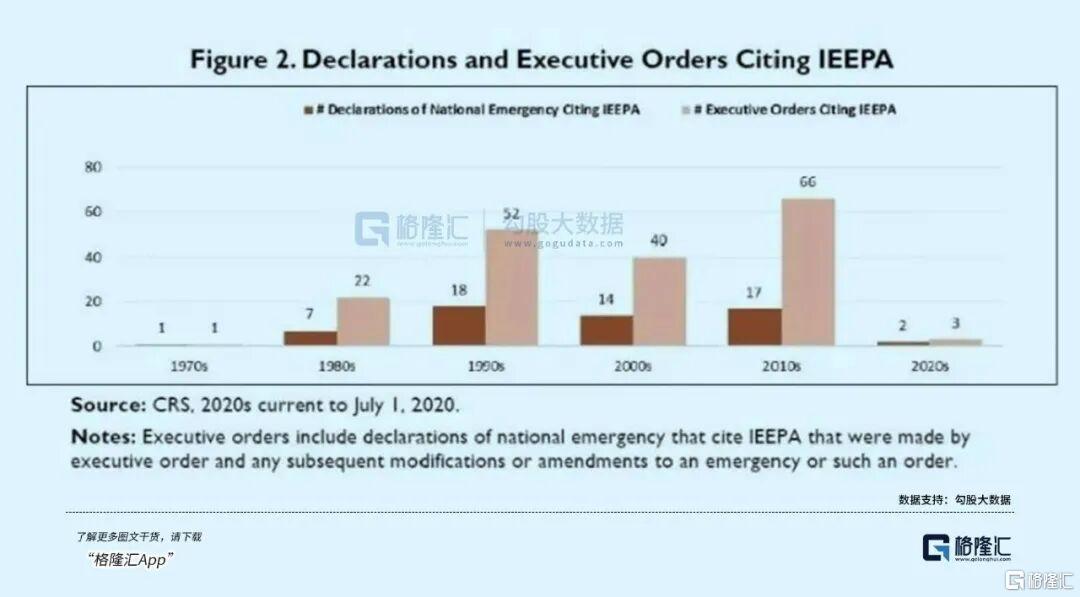
昨夜,美国联邦最高法院,以6:3的投票结果裁定: 行政部门试图援引1977年《国际紧急经济权力法》(IEEPA),将贸易逆差或普通的经济竞争视为"国家紧急状态",从而对全球进口商品实施地毯式关税的 行为,属于"行政越权"。 多数派意见书写得非常辛辣:"如果国会想要授予总统重塑全球贸易格局的权力,它必须说得'清楚明白'。我们不能从模糊的法律文本中,推导出如此巨 大的行政扩张。" 随后白宫证实,在最高法院作出裁决后,美国政府依据先前行政令、援引IEEPA推动的相关关税将不再有效。 根据瑞银集团的测算,这部分被推翻的关税,占到特朗普2025年全年征收关税总额的75%,涵盖了从日用消费品、电子零部件到工业原材料的数千亿美元 商品。 受此影响,美股三大指数盘中全线拉升。 难道悬在美股头顶的这把大剑,真就这么没了? 01 预测2026年,关税仍将占相关企业价格上涨因素的四分之一左右,盈利空间被持续挤压。 所以在裁决公布后,高盛、摩根士丹利等机构,才第一时间就上调了进口依赖型企业的盈利预测。 其中,高盛将沃尔玛2026财年的每股收益上调至3.05美元,较此前预测上调了7.3%,理由是"关税取消后,沃尔玛的采购成本将下降2. ...

【环球财经】市场人气改善 纽约股市三大股指20日上涨
Xin Hua Cai Jing· 2026-02-21 00:28
板块方面,标普500指数十一大板块九涨两跌。通信服务板块和非必需消费品板块分别以2.65%和1.27% 涨幅领涨,能源板块和医疗板块则分别逆势下跌0.71%和0.32%。 美国2025年12月个人消费支出价格指数环比上涨0.4%,前月数值则从0.5%修订为0.4%;该月美国个人 消费支出价格指数同比上涨2.9%,前月向上修订后的数据为2.8%。扣除食品和能源,美国2025年12月 核心消费者支出价格指数环比上涨0.4%,高于市场预期的0.3%和前月的0.2%;该月美国核心消费者支 出价格指数同比上涨3%,高于市场预期的2.9%和前月的2.8%。 标普全球20日发布的初步数据显示,美国2月综合PMI产出指数为52.3,低于1月的53。 截至当天收盘,道琼斯工业平均指数比前一交易日上涨230.81点,收于49625.97点,涨幅为0.47%;标 准普尔500种股票指数上涨47.62点,收于6909.51点,涨幅为0.69%;纳斯达克综合指数上涨203.34点, 收于22886.07点,涨幅为0.90%。 美国最高法院20日公布裁决,认定美国《国际紧急经济权力法》没有授权总统征收大规模关税。市场对 关税政策冲击的担 ...
通胀预期回落但群体分化加剧 美国2月消费者信心升幅不及预期
智通财经网· 2026-02-20 15:51
Core Viewpoint - US consumer confidence showed a slight recovery in February, but the increase was below market expectations, indicating a divide in sentiment among different income groups [1] Group 1: Consumer Confidence Index - The University of Michigan's consumer confidence index rose from 56.4 in January to 56.6 in February, which is below the median market expectation of 57.3 [1] - The survey covered responses from January 20 to February 16, reflecting a modest improvement in consumer sentiment [1] Group 2: Inflation Expectations - Consumers' inflation expectations for the next year decreased to 3.4%, down from 4% in January, marking the lowest level in a year [1] - Long-term inflation expectations for the next 5 to 10 years were reported at 3.3%, indicating some relief in short-term inflation concerns, though long-term pressures remain [1] Group 3: Income and Asset Impact - Higher-income consumers, benefiting from stock market gains, showed improved confidence, while those not sharing in asset price increases faced pressure from high prices and living costs [1] - 46% of consumers mentioned that high prices are eroding their personal financial situations, highlighting ongoing concerns about inflation [2] Group 4: Economic Indicators - Recent macroeconomic data indicates signs of stabilization, with stronger-than-expected job growth and a drop in the unemployment rate to 4.3% in January [2] - The Federal Reserve's January meeting minutes revealed that most officials believe signs of labor market weakness have eased, although inflation risks persist [2] Group 5: Consumer Sentiment Disparity - The index measuring current economic conditions rose from 55.4 to 56.6, while the index reflecting future expectations fell from 57 to 56.6, indicating a mixed sentiment among consumers [2] - Overall, there is an improvement in current financial perceptions, but a decline in future confidence, showcasing an uneven recovery in consumer sentiment [2]
M2同比增长加速至9%,剪刀差收窄反映流动性改善
Xin Lang Cai Jing· 2026-02-20 05:14
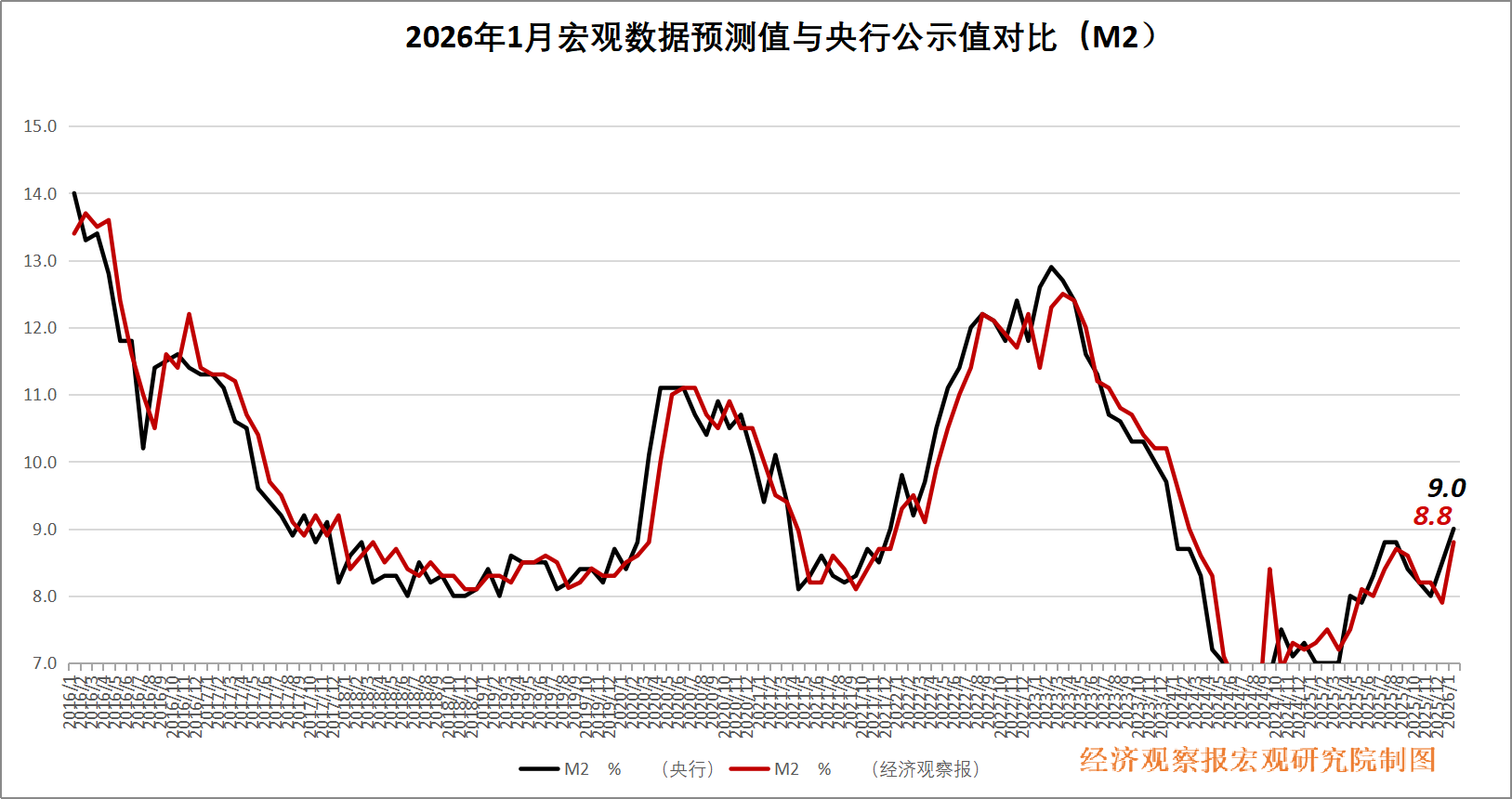
Core Insights - The economic data for January 2026 indicates a moderate recovery, but structural differentiation issues remain a concern, necessitating more policy efforts to maintain year-on-year price increases [1] Economic Indicators - January CPI growth rate decreased from 0.8% to 0.2%, while core CPI increased by 0.3% month-on-month [1] - PPI year-on-year narrowed from -1.9% to -1.4% [1] - Manufacturing PMI fell from 50.1% to 49.3% [1] - New RMB loans amounted to 4.71 trillion yuan, with a year-on-year decrease of 420 billion yuan [1] Monetary Supply - M2 year-on-year growth rate rose to 9.0%, with a balance of 347.19 trillion yuan at the end of January, an increase of 0.5 percentage points from the previous period [1] - The M1 - M2 spread narrowed by 0.6 percentage points, indicating a faster recovery in M1 growth, which reflects an acceleration in the activation of demand deposits [1] Financial Sector Dynamics - Increased deposits in non-bank financial institutions and accelerated "deposit migration" contributed to the generation of deposits, supported by government bond financing converting into corporate and household deposits [1] - The positive market conditions in the capital market also supported the expansion of broad money supply [1] Policy Implications - There is a need to remain vigilant regarding inflation expectations and asset bubbles, ensuring that M2 growth aligns with nominal GDP [1] - Policy coordination is required to boost domestic demand [1]
金丰来:金价短期陷入高位回调
Xin Lang Cai Jing· 2026-02-18 13:33
Core Viewpoint - The gold and silver markets experienced significant price retraction due to short-term speculative fund liquidation and multiple external market headwinds, reflecting high investor sensitivity to macroeconomic changes [1][3]. Market Dynamics - The rebound of the US dollar index and the weakening of commodities like crude oil challenged the logic that previously supported high prices for precious metals [1][3]. - Although long-term bullish expectations remain intact, short-term crowded long positions and liquidity tightening due to holiday factors have put pressure on gold prices around 4904.10 [1][3]. Geopolitical Factors - Ongoing regional nuclear talks have released some easing signals, leading to a withdrawal of high-premium safe-haven funds from the gold market [1][3]. - The expectation of reduced urgency for holding non-yielding assets has emerged as geopolitical tensions are anticipated to cool in the short term [1][3]. Technical Analysis - Gold is currently in a wide oscillation around key technical defense levels, facing upward resistance at psychological levels of 5000 and 5250, while downward support is tested around 4800 and 4670 [2][4]. - Silver is experiencing more volatile movements, currently oscillating around 73.66, with market attention on the support strength at the 70 level [2][4]. Future Outlook - The long-term trends for gold and silver are anchored in the evolution of global sovereign credit and monetary policy rather than solely on geopolitical events [2][4]. - Despite facing dual pressures from a rebounding dollar and diminishing safe-haven demand, the strategic value of precious metals is expected to resurface after the market completes a thorough turnover [2][4]. - Investors are advised to view the current rapid pullback as an opportunity to assess asset resilience, with close attention to the recovery efforts around the 5000 mark [2][4].

国际货币基金组织向日本发出三重警示
Yang Shi Xin Wen· 2026-02-18 07:33
Core Viewpoint - The International Monetary Fund (IMF) warns the Japanese government to maintain the independence of the Bank of Japan and control fiscal expansion, advising against reducing consumption tax to address living costs [2] Monetary Policy - The IMF emphasizes that the independence and credibility of the Bank of Japan are crucial for stabilizing inflation expectations [2] - The report suggests that the Bank of Japan should continue to exit monetary easing, aiming for the policy interest rate to reach neutral levels by 2027 [2] Fiscal Policy - The IMF advises against further fiscal loosening in the short term, which contradicts the campaign promise of "responsible active fiscal policy" proposed by the current administration [2] - While Japan has some fiscal space, the IMF stresses the need for fiscal restraint to solidify fiscal buffers and maintain the ability to respond to shocks [2] - The IMF predicts that Japan's government fiscal deficit will widen in the long term, with increasing spending pressures and a further rise in total public debt [2] - The IMF highlights that high debt levels, combined with deteriorating fiscal conditions, pose a series of shocks to the Japanese economy [2] Consumption Tax - Regarding the proposed two-year "zero food consumption tax" campaign promise, the IMF explicitly states that reducing consumption tax should be avoided, as it would compress fiscal space and increase fiscal risks [2]

Moneta Markets外汇:金商巨头高管套现 贵金属牛市格局
Xin Lang Cai Jing· 2026-02-16 16:35
Core Viewpoint - The recent internal trading activities of executives at Gold.com have drawn significant attention from investors, particularly in the context of the rising precious metals market. The stock's impressive 104% return over the past year is seen as a reasonable profit-taking move rather than a cause for concern [1][5]. Group 1: Executive Trading Activities - Brian Aquilino, COO of Gold.com, sold 10,000 shares on February 11, 2026, cashing out $595,472. This sale occurred near the stock's peak price, which may raise market concerns [1][5]. - Aquilino exercised options to buy 10,000 shares at $39.69 each, totaling $396,900, which mitigates the negative impact of the stock sale [2][5]. Group 2: Financial Health and Dividend Stability - Gold.com has a strong financial foundation, evidenced by a perfect Piotroski score of 9, indicating high asset quality. The company has maintained a 40-year uninterrupted dividend record, positioning it as a safe-haven asset in volatile markets [2][5]. Group 3: Capital Structure and Market Sentiment - Gold.com is enhancing its capital structure through a $150 million private placement agreement with Tether's TPM, issuing 3,370,787 shares at $44.50 each, which is an 11.9% discount to the weighted average price [3][6]. - Analysts, including DA Davidson, have raised their price target for Gold.com from $45.00 to $53.00, reflecting a bullish sentiment towards the precious metals sector [3][6]. Group 4: Industry Outlook - The overall precious metals industry remains robust, with companies like Barrick Gold exceeding market expectations and raising their price targets to $60.00. This positive trend is supported by strong gold and silver spot prices and widening retail and wholesale spreads [3][6]. - Despite potential short-term pressures from executive sell-offs or stock price corrections, the long-term investment value in precious metals and related companies remains significant due to inflation expectations and geopolitical premiums [3][6]. Group 5: Investor Considerations - Investors are advised to focus on the company's aggressive stock buyback plans and stable 1.39% dividend yield rather than overreacting to individual executive stock adjustments. Companies with strong financial resilience and expansion capabilities in the precious metals sector are crucial components of investment portfolios [4][7].

美国1月成屋销售大幅下滑——海外周报第127期
一瑜中的· 2026-02-15 13:45
Key Points - The article discusses the recent economic data from the US and Japan, highlighting significant trends in housing sales, employment, and inflation [2][10] - It emphasizes the mixed signals in the US economy, with some indicators showing improvement while others indicate a slowdown [2][4] Group 1: Important Data Review - US January existing home sales fell significantly, with an annualized rate of 3.91 million units, down 8.4% month-over-month, against an expectation of a 4.15 million unit decline [12] - The US non-farm payrolls for January added 130,000 jobs, exceeding expectations of 65,000, with average hourly earnings increasing by 3.7% year-over-year [12] - Japan's Prime Minister announced plans to implement tax cuts, including a proposal to suspend the consumption tax on food and beverages for two years, potentially reducing tax revenue by approximately 5 trillion yen annually [13] Group 2: Economic Activity Index - The US Weekly Economic Index (WEI) rose to 2.70% for the week ending February 7, up from 2.21% the previous week, indicating a rebound in economic activity [15] - Germany's Weekly Activity Index (WAI) also increased to 0.10% for the week ending February 8, compared to 0.02% the prior week [15] Group 3: Demand - The US Redbook retail sales growth rate decreased to 6.5% year-over-year for the week ending February 6, down from 6.7% the previous week [18] - Mortgage rates in the US fell slightly, with the 30-year fixed mortgage rate at 6.09%, down from 6.11% the previous week [23] Group 4: Employment - The ADP weekly employment change showed an increase, with 26,000 jobs added over the four weeks ending January 24, up from 20,000 the previous week [28] - Initial jobless claims decreased to 227,000 for the week ending February 7, down from 232,000 the previous week [31] - The number of job vacancies fell, with the Indeed job vacancy index averaging 103.5, down from 104.2 in December [36] Group 5: Prices - Commodity prices fell, with the RJ/CRB commodity price index at 306.54, down 1.0% week-over-week and 4.2% over the past two weeks [6] - US gasoline prices increased to $2.77 per gallon, up 0.8% from the previous week [42] Group 6: Financial Conditions - Financial conditions in the US and Eurozone tightened, with the Bloomberg Financial Conditions Index for the US at 0.537, down from 0.755 the previous week [46] - Offshore dollar liquidity worsened, with the three-month swap basis for the yen against the dollar at -20.1909 basis points, down from -17.9347 basis points the previous week [49] - The 10-year government bond yield spreads narrowed between the US and Eurozone, as well as between the US and Japan [52]

中金固收:结汇增加推升M2,贷款需求减弱,利好债券配置需求
Jin Rong Jie· 2026-02-14 02:57
Core Viewpoint - The report indicates a weakening support from government bond financing for social financing, leading to a slowdown in overall social financing growth, with the year-on-year growth rate dropping from 8.3% in December to 8.2% in January [1] Group 1: Social Financing and Monetary Supply - The demand for financing in the private sector remains weak, contributing to the overall sluggish growth in social financing [1] - The year-on-year growth rate of M2 increased from 8.0% in November to 9.0% in January, driven by a strong willingness of enterprises to settle in RMB and robust non-bank deposits [1] - The difference between the year-on-year growth rates of social financing and M2 is expected to influence interest rate trends, with potential further declines in bond rates anticipated [1] Group 2: Market Outlook and Investment Recommendations - Insufficient bank credit issuance since January has led to increased bond allocation, resulting in a gradual decline in medium to long-term interest rates [1] - The central bank's monetary policy easing may accelerate, suggesting further declines in bond rates are likely [1] - Despite previous concerns about potential inflation exceeding expectations in the first quarter, recent declines in industrial product prices indicate a continuation of low inflation in the domestic economy [1] - The domestic bond market is viewed positively, with recommendations for investors to actively monitor trading opportunities arising from potential discrepancies in inflation expectations after the Spring Festival [1]
俄罗斯央行宣布下调基准利率至15.5%
Sou Hu Cai Jing· 2026-02-13 15:15
Core Viewpoint - The Central Bank of Russia has decided to lower the benchmark interest rate by 50 basis points to 15.5%, marking the sixth consecutive rate cut, while indicating a gradual easing of monetary policy but maintaining a generally tight stance [1]. Group 1: Monetary Policy Adjustments - The Central Bank of Russia continues to gradually relax its monetary policy while still keeping it tight overall [1]. - The bank's announcement highlights that the Russian economy is returning to a balanced growth trajectory [1]. - The feasibility of further rate cuts will depend on the sustainability of inflation slowdown and changes in inflation expectations [1]. Group 2: Inflation and Economic Forecasts - In January, inflation accelerated significantly due to "one-off factors," but the Central Bank expects that sustainable indicators of price increases have not changed significantly [1]. - The Central Bank forecasts that under the current monetary policy, the annual inflation rate will decline to 4.5% to 5.5% by 2026, with a target of around 4% in the second half of 2026 [1]. - The annual inflation rate for 2025 is projected to be lower than the Central Bank's forecast at 5.6% [1]. Group 3: Inflation Risks - The Central Bank identifies that medium-term inflation risks outweigh deflation risks, with key inflation risks including long-term deviations from balanced growth, high inflation expectations, and the impact of VAT and regulated price increases [2]. - Trade tensions, global economic slowdown, and low oil prices could create inflationary effects through the ruble exchange rate [2]. - Geopolitical tensions remain a significant source of uncertainty [2]. Group 4: Upcoming Meetings - The Central Bank of Russia will hold a board meeting on March 20 to review subsequent adjustments to the benchmark interest rate [3].