
滞胀

Search documents
凯德北京投资基金管理有限公司:鲍威尔“打太极” 市场静待9月降息窗口
Sou Hu Cai Jing· 2025-06-20 10:27
美联储此次会议的另一大焦点是对经济数据的修正。最新《经济预测摘要》(SEP)显示,政策制定者将二零二五年底美国的核心PCE通胀预期从百分之二 点七上调至百分之三,同时将GDP增速预测从百分之一点七下调至一点四,失业率预期则小幅上升至百分之四点五。这一"通胀升温+增长放缓"的组合,进 一步加剧了市场对"滞胀"风险的担忧。 宏观经济学家指出,当前百分之三的通胀预期明显高于四月的实际水平(PCE增速百分之二点一),若这一预测成 真,美联储将面临更复杂的政策挑战——既要应对高物价压力,又要防范经济下行风险。鲍威尔在发布会上承认,部分商品价格已因关税政策上涨,但强调 仍需观察未来几个月的通胀数据,才能判断其持续性。 美联储在最新议息会议上再次选择按兵不动,将联邦基金利率维持在百分之四点二五到四点五的区间,符合市场普遍预期。然而,真正引发市场关注的并非 利率决议本身,而是最新发布的"点阵图"所揭示的深层分歧——美联储内部对今年降息路径的看法正日益分化。 尽管美联储点阵图的中值预测仍显示今年将累计降息五十个基点(即两次二十五个基点的降息),但细究内部结构,政策制定者的立场已发生明显变化。在 六月的最新预测中,有多达七位官员 ...

鲍威尔与特朗普矛盾再升级,哪些因素可能触发美联储降息?
Xin Hua Cai Jing· 2025-06-20 09:30
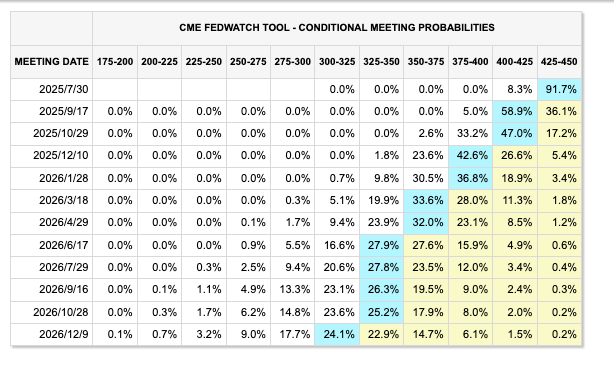
Group 1: Federal Reserve's Monetary Policy - The Federal Reserve maintained the federal funds rate target range at 4.25% to 4.50% for the fourth consecutive time, with minimal incremental information from the meeting [1] - Market expectations for a rate cut in September have risen to 58.9%, with a 42.6% chance of another cut in December [4] Group 2: Economic Indicators - The U.S. economy is projected to face "stagflation" by 2025, with a real growth rate of only 1.4% and inflation at 3.1% [2] - Employment data shows structural weaknesses despite strong wage growth, with leading indicators suggesting a potential decline in employment numbers [2] - Consumer spending is showing signs of weakness, with May retail sales declining by 0.9%, worse than the expected contraction of 0.7% [3] Group 3: Investment Outlook - Corporate investment is expected to continue declining, with weak manufacturing PMI and new orders indicating a downturn in non-residential investment growth [3] - The real estate sector is facing challenges such as weak housing demand and high financing rates, making improvements unlikely in the near term [3] Group 4: Factors Influencing Future Rate Cuts - Key triggers for potential rate cuts include rapid deterioration in consumer and employment data, risks in corporate bonds, and the upcoming concentrated issuance of U.S. Treasury bonds [6] - Barclays suggests that labor market weakness, diminishing tariff impacts on inflation, and declining consumer spending will be critical factors influencing future policy [7]
海通证券晨报-20250620
Haitong Securities· 2025-06-20 06:43
Group 1: Macro Insights - The Federal Reserve maintained the federal funds rate target range at 4.25%-4.5%, marking the fourth consecutive meeting without changes, aligning with market expectations. However, inflationary concerns have intensified, leading to downward revisions in economic growth forecasts for 2025 and 2026, alongside an increase in unemployment rate predictions and price index forecasts [2][10][11] - The impact of tariffs on inflation has not yet fully materialized, indicating significant uncertainty regarding future inflation trends. Tariff measures require time to affect consumer prices, and geopolitical issues in the Middle East may further exacerbate inflation [2][10][11] - The market is currently exhibiting signs of stagflation trading, with expectations of a potential recovery trading phase in the latter half of the year as tax reduction measures and debt ceiling increases are implemented [3][12] Group 2: Nuclear Fusion Industry - Shanghai Superconductor's IPO application has been accepted, signaling an acceleration in the industrialization of nuclear fusion. The company is a leading producer of high-temperature superconducting materials, holding over 80% of the domestic market share for second-generation high-temperature superconducting tapes [5][20][22] - The global market for high-temperature superconducting materials is projected to grow from 790 million yuan in 2024 to over 10.5 billion yuan by 2030, driven by applications in controllable nuclear fusion and other downstream industries [6][22][23] - Shanghai Superconductor's revenue is expected to grow significantly, with projections of 240 million yuan in 2024, representing a year-on-year increase of 187.4%. The company is anticipated to achieve profitability in 2024 after previous losses [6][22][23] Group 3: Automotive Industry - The heavy truck market in China is showing signs of recovery, with a projected 16% year-on-year increase in sales to 1.06 million units in 2025, driven by the implementation of the vehicle replacement policy [17][18] - In May 2025, domestic heavy truck sales reached 89,000 units, reflecting a year-on-year increase of 13.6%. The market is expected to benefit from the ongoing vehicle replacement initiatives [18][19] Group 4: Chemical Industry - The demand for photoinitiators is increasing due to their expanding application scenarios, leading to rising product prices. Key companies in this sector include Jiuri New Materials, Yangfan New Materials, and Qiangli New Materials [34][35] - The photoinitiator market is expected to grow rapidly, driven by environmental regulations and the emergence of new applications such as 3D printing [35]
银河证券每日晨报-20250620
Yin He Zheng Quan· 2025-06-20 05:22
Macro Overview - The Federal Reserve paused interest rate cuts in June, maintaining the federal funds rate at 4.25%-4.50% while continuing quantitative tightening, which aligns with market expectations [2][3] - Economic forecasts indicate a downward adjustment in growth expectations for 2025 and 2026, with unemployment rates slightly increased, reflecting concerns over "stagflation" [3][4] - The dollar index is expected to decline further in 2025 due to tariffs, economic slowdown, and strengthening of alternative assets, stabilizing below 100 for the year [7] Home Appliances Industry - The home appliance sector is expected to benefit from long-term stability, with white goods focusing on performance consistency and increasing dividend rates, while black goods present opportunities due to enhanced global competitiveness [9][12] - The industry has seen a significant increase in the SW home appliance index, with respective gains of 3.8%, 25.4%, and 1.93% for 2023, 2024, and 2025 YTD [9][10] - The outlook for the home appliance market is cautious due to potential demand exhaustion and intensified competition, particularly in the air conditioning segment [10][11] Chemical Industry - The chemical industry is currently facing significant supply and demand pressures, with low profitability in the petrochemical sector, and a need for structural opportunities as the market stabilizes [15][16] - Brent crude oil prices are projected to range between $60-$70 per barrel in the second half of 2025, which may alleviate some cost pressures for the industry [15] - Key investment themes include domestic demand stimulation, supply-side constraints, and the domestic substitution of new materials [15][16] New Energy Sector - The new energy sector is experiencing structural differentiation, with a focus on new technologies and non-US exports, particularly in the wind and solar energy segments [18][19] - The demand for energy storage is expected to shift from policy-driven to market-driven profitability, with significant growth potential in domestic and overseas markets [20][21] - The wind energy sector is anticipated to see a recovery in profitability, driven by increased installations and demand from emerging markets [19][20] Investment Strategies - The report emphasizes the importance of long-term investment strategies, particularly in state-owned enterprises, technology, and consumer sectors, which are expected to yield stable excess returns [24][25] - The development of public funds is expected to favor long-term and passive investment strategies, with a focus on ETFs and sector-specific funds [25][26] - The report highlights the potential for significant returns through quantitative stock selection strategies based on fundamental factors [24][26]
港股2025年下半年投资策略:港股业绩靓丽,进可攻,退可守
Guoxin Securities· 2025-06-20 03:32
Group 1 - The report highlights that Hong Kong stocks have shown strong performance, driven by impressive earnings and reasonable valuations, with a significant lead over global indices in the first half of the year [2][4]. - Key drivers for Hong Kong stocks include strong earnings from sectors such as technology, internet, pharmaceuticals, and new consumption, as well as increased share buybacks and a favorable IPO environment [2][4]. - The report suggests that the risks for Hong Kong stocks are primarily external, and despite these risks, it is expected that Hong Kong stocks will continue to generate excess returns [2][4]. Group 2 - The report identifies several sectors for investment: internet leaders, commodities, telecommunications and utilities, pharmaceuticals, and companies with upgraded earnings forecasts [2][4]. - Internet leaders are expected to perform well due to their stable competitive landscape and large user bases, while commodities are in an upward price cycle, providing a hedge against potential stagflation [2][4]. - The report emphasizes the importance of maintaining a balanced portfolio, particularly in the pharmaceutical and new consumption sectors, which may face valuation pressures due to rising U.S. Treasury yields [2][4].
国金证券:滞胀风险明显抬升 美联储或难以重启降息周期
智通财经网· 2025-06-19 23:04
Core Viewpoint - The Federal Reserve is expected to maintain the federal funds target rate range at 4.25%-4.50% during the June 2025 meeting, aligning with market expectations, while concerns over "stagflation" risks remain high, making the threshold for restarting the rate cut cycle quite elevated [1][3][4]. Group 1: Economic Predictions and Monetary Policy - The Federal Reserve's latest economic forecasts indicate a downward revision in growth predictions and an upward adjustment in inflation and unemployment rate forecasts, reflecting a more hawkish stance [3][4]. - The Fed has lowered the GDP growth forecast for 2025 and 2026 by 0.3 percentage points and 0.2 percentage points, respectively, while raising the core PCE inflation forecast for the same years by 0.3 percentage points and 0.2 percentage points [3]. - The unemployment rate forecast for 2025, 2026, and 2027 has been increased by 0.1 percentage points, indicating a more cautious outlook on the labor market [3]. Group 2: Investment Recommendations - Gold is expected to continue reaching historical highs due to factors such as potential U.S. "hard landing," dollar depreciation, and renewed Fed rate cuts, which are favorable for gold prices [2]. - The pharmaceutical sector, particularly innovative drugs, is anticipated to see upward opportunities in both A-shares and Hong Kong stocks during the Fed's rate cut cycle, driven by policy guidance and improving profit margins [2]. - The U.S. stock market faces significant adjustment risks due to "stagflation," which may pressure both earnings and valuations, necessitating a reassessment of valuation levels [2]. Group 3: Tariff Impacts and Inflation Concerns - The impact of tariffs is expected to become more pronounced in the summer, with the Fed acknowledging that high tariffs are likely to increase inflation and exert pressure on economic activity [4]. - The Fed's monetary policy guidance suggests that rate cuts may not come quickly unless there is a significant deterioration in the labor market or increased economic downward pressure [4]. - The potential for a "liquidity trap" scenario is highlighted, where rising tariffs could exacerbate "stagflation" risks, leading to a possible second round of rate hikes [5].

A股意外跳水!6月20日,分歧释放后的新周期即将来临?
Sou Hu Cai Jing· 2025-06-19 17:42
Group 1 - The Federal Reserve is unlikely to easily abandon its fight against inflation, facing a dilemma of either economic recession or stagflation [1] - ADP employment data indicates a poor job market, suggesting that the Fed may have to lower interest rates if inflation continues to cool [1] - The market predicts that the dollar may experience four interest rate cuts this year, with the probability of a cut in June approaching zero [1] Group 2 - A-shares experienced a significant drop, largely influenced by the decline in Hong Kong stocks, with both the Shanghai Composite and ChiNext indices showing a typical bearish trend [3] - The Hang Seng Index and Hang Seng Tech Index both fell over 2%, highlighting the strong correlation between A-shares and Hong Kong stocks [3] Group 3 - The market opened lower and continued to decline throughout the day, breaking below the 30-day moving average, indicating a downward trend after a period of consolidation [5] - The next key support levels to watch for potential buying opportunities are between 3316 and 3324 points [5] Group 4 - The ChiNext and Shenzhen Composite indices fell over 1%, with more than 4600 stocks declining across the two markets [7] - The total trading volume in the Shanghai and Shenzhen markets increased to 1.25 trillion, indicating heightened selling pressure and a preference for risk aversion among investors [7] - Despite the short-term bearish trend, the mid-term weekly and monthly structures remain stable, suggesting a potential new cycle may emerge after the current divergence [7]
国泰海通|宏观:滞胀担忧增加,美联储按兵不动——2025年6月美联储议息会议点评
国泰海通证券研究· 2025-06-19 14:01
Core Viewpoint - The Federal Reserve maintained its interest rate target range at 4.25%-4.5%, indicating a pause in monetary policy, while inflation expectations have intensified, leading to concerns about stagflation [2][3] Summary by Sections Federal Reserve's Decision - The Federal Reserve decided to keep the federal funds rate unchanged for the fourth consecutive time since January 2025, aligning with market expectations [2] - Economic forecasts were revised downward for 2025 and 2026, with an increase in unemployment rate predictions and a rise in price index forecasts, further exacerbating stagflation concerns [2] Inflation and Tariff Impact - The impact of tariffs on inflation has not yet fully materialized, suggesting significant uncertainty regarding future inflation [2] - Tariff measures require time to affect consumer prices, and ongoing geopolitical issues in the Middle East may lead to rising energy prices, contributing to inflationary pressures [2][3] Interest Rate Outlook - The Federal Reserve's stance remains hawkish, with expectations of two rate cuts in 2025 unchanged from March, but the forecast for 2026 was reduced from two cuts to one [2] - The number of Fed officials predicting no rate cuts in 2025 increased from four to seven, indicating a more hawkish outlook overall [2] Market Reactions and Future Expectations - Following the June FOMC meeting, the U.S. stock and bond markets exhibited characteristics of stagflation trading, with expectations of further development in this trend in the short term [4] - Anticipation of new economic policies, such as tax cuts and debt ceiling increases, could lead to a recovery trading phase in the latter half of the year [4] - The 10-year U.S. Treasury yield is expected to rise, potentially reaching a phase of 5% if inflation expectations increase due to tariffs [4]

(财经天下)美联储再次下调美国GDP增长预期,美经济或陷滞胀?
Sou Hu Cai Jing· 2025-06-19 12:36
中新社北京6月19日电 (记者 夏宾)北京时间6月19日,美联储最新一次议息会议结束,宣布将联邦基金 利率目标区间维持在4.25%至4.5%之间的水平不变。这是今年以来美联储连续第四次维持利率不变。 从议息会议和美联储主席鲍威尔对外释放的消息来看,下调对美国GDP(国内生产总值)增长预期、继续 紧盯关税政策对通胀影响、减少未来降息次数预期等均是市场关注重点。 经济或陷滞胀? 据美联储公布的经济预测概要显示,与今年3月时相比,其将今年的美国GDP增速预期中值下调0.3个百 分点至1.4%。这也是继3月后的又一次下调;将今年的通胀预期、核心PCE(个人消费支出)价格指数中 值上调0.3个百分点至3.1%。 一边是下调经济增长预期,一边是抬升通胀预期,这意味着什么? 威灵顿投资管理固定收益基金经理库拉那(Brij Khurana)对中新社记者表示,本次议息会议的关键要点在 于,美联储预计2025年美国经济环境将面临滞胀局面,实际增长率仅为1.4%(低于趋势水平),通胀却达 3.1%(高于目标水平),然而美联储委员的中位数预测仍预计2025年将降息两次。 工银国际首席经济学家程实表示,美联储下调2025年经济增速预测 ...
6月FOMC会议点评:滞胀风险明显抬升,掣肘美联储难以重启降息周期
SINOLINK SECURITIES· 2025-06-19 12:07
Core Insights - The Federal Reserve has maintained the federal funds target rate range at 4.25%-4.50%, marking the fourth consecutive "pause" since the beginning of the current rate cut cycle in September 2024 [2] - Economic forecasts indicate a heightened concern over "stagflation," with the Fed lowering growth projections while raising inflation and unemployment rate forecasts [2][3] - The Fed's dot plot suggests two rate cuts in 2025, but the number of committee members who believe no cuts are needed has increased from four to seven since March, indicating a hawkish stance [2][3] Economic Forecasts - The Fed has revised down the GDP growth forecast for 2025 and 2026 to 1.4% and 1.6%, respectively, while raising core PCE inflation forecasts to 3.1%, 2.4%, and 2.1% for 2025, 2026, and 2027 [2] - Unemployment rate forecasts have been adjusted upward to 4.5% for 2025 and 2026, and 4.4% for 2027 [2] Tariff Impact - The impact of tariffs is expected to become more pronounced in the summer, with Powell indicating that high tariffs are likely to push inflation up and exert pressure on economic activity [3] - The transmission of tariffs to final consumers is anticipated to take time, with many companies expected to pass on the costs to consumers [3] Monetary Policy Guidance - Powell stated that rate cuts could come quickly or may take time, depending on the labor market and economic pressures [3] - The current Fed stance is described as "passive and reactive," with potential for rate hikes if stagflation risks intensify [3] Investment Recommendations - Gold is expected to perform well amid a potential "hard landing" in the U.S. economy, driven by factors such as dollar depreciation and renewed Fed rate cuts [4] - The pharmaceutical sector, particularly innovative drugs, is seen as having upside potential during the Fed's rate cut cycle, with expectations of improved margins and revenue [4] - U.S. equities face significant adjustment risks due to stagflation concerns, with both earnings and valuation pressures anticipated [4] - U.S. Treasuries may present a trend-following opportunity only after inflation declines, with potential for rapid interest rate increases beforehand [4]