逆全球化

Search documents
西南期货早间评论-20250730
Xi Nan Qi Huo· 2025-07-30 02:09
2025 年 7 月 30 日星期三 重庆市江北区金沙门路 32 号 23 层; 023-67070250 上海市浦东新区世纪大道 210 号 10 楼 1001; 021-50591197 地址: 电话: 1 市场有风险 投资需谨慎 | | 日本 | | | --- | --- | --- | | 国债: | | 4 | | 股指: | | 5 | | 贵金属: | . | C | | 螺纹、热卷: | | C T | | 铁矿石: | . | 6 | | | 焦煤焦炭: | | | 铁合金: | | 1 | | 原油: | . | 8 | | 燃料油: | | C | | 合成橡胶: | | C | | 天然橡胶: | | C | | PVC: | .. | | | 尿素: | | 10 | | 对二甲苯 PX: | .. 11 | | | PTA: | .. | | | | 乙二醇: . | | | 短纤: | .. | | | 瓶片: | .. | | | 纯碱: | .. | | | 玻璃: | .. | | | 烧碱: | .. | | | 纸浆: | .. | | | 碳酸锂 | | 16 | ...
近5日“吸金”超2400万元,有色金属ETF基金(516650)回调,机构:供给收缩预期提振有色
2 1 Shi Ji Jing Ji Bao Dao· 2025-07-29 06:47
Group 1: Market Performance - On July 29, A-shares saw the three major indices turn positive, while the non-ferrous metal sector continued to adjust [1] - The non-ferrous metal ETF (516650) fell by 1.05%, with leading declines from stocks such as Shenghe Resources, China Rare Earth, and Northern Rare Earth [1] - The gold stock ETF (159562) decreased by 0.69%, with a premium rate of 0.17%, and stocks like Mingpai Jewelry and Hengbang Shares also saw significant declines [1] Group 2: Fund Flows and Trends - The non-ferrous metal ETF (516650) has recently experienced a net inflow of over 24 million yuan in the past five trading days [1] - The total scale of 53 gold-themed funds reached 246.9 billion yuan as of July 27, an increase of 12.85 billion yuan from the end of last year, marking a growth rate of 108.53% [2] - All 53 gold-themed funds have seen their net values rise this year, with 22 funds showing a growth rate exceeding 30% [2] Group 3: Industry Insights - The non-ferrous metal ETF tracks an index focusing on industrial metals like gold, copper, and aluminum, with respective weights of 30.6% for copper and 16.2% for gold [1] - The gold stock ETF tracks the CSI Hong Kong-Shenzhen Gold Industry Index, with the top ten holdings accounting for over 66.13% of the fund [2] - Analysts suggest that the current global trade and financial environment, characterized by "de-globalization" and "de-dollarization," is favorable for gold's investment value and safe-haven appeal [3]
西南期货早间评论-20250729
Xi Nan Qi Huo· 2025-07-29 05:33
1. Report Industry Investment Ratings No relevant content provided. 2. Core Views of the Report - For Treasury bonds, it's expected that there won't be a trending market, and caution is advised [6][7]. - Regarding stock indices, the long - term performance of Chinese equity assets is optimistic, and going long on stock index futures is considered [10][11]. - For precious metals, the long - term bull market trend is expected to continue, and going long on gold futures is considered [13][14]. - In the case of rebar and hot - rolled coils, investors can focus on low - position long opportunities after the correction [15]. - For iron ore, investors can look for low - position buying opportunities after the correction [17][18]. - For coking coal and coke, investors are advised to wait and see [20][21]. - Regarding ferroalloys, long - position exit opportunities can be considered when the market continues to rise, and long positions at low - support intervals can be considered if there is a decline [23]. - For crude oil, investors can focus on long opportunities in the main contract [26]. - For fuel oil, investors can focus on long opportunities in the main contract [28]. - For synthetic rubber, wait for the market to stabilize and then participate in the rebound [29][31]. - For natural rubber, it's expected to oscillate strongly [32][33]. - For PVC, it's expected to oscillate strongly in the short term [34][38]. - For urea, it will fluctuate in the short term and be bullish in the medium term [39][40]. - For PX, it may oscillate and adjust in the future, and investors should participate cautiously [42]. - For PTA, it may oscillate in the short term, and investors should participate in the range [43]. - For ethylene glycol, investors should be cautious about the upside space in the short term and participate in the range [44][45]. - For staple fiber, it may oscillate following the cost, and pay attention to cost changes and macro - policy adjustments [46]. - For bottle chips, it's expected to oscillate following the cost [47][48]. - For glass, continue to pay attention to spot trading and regional de - stocking; in the long - term, focus on the implementation of capacity clearance of old production lines [49][50]. - For caustic soda, the positive support is relatively limited, and it's affected by macro - sentiment recently [52]. - For pulp, the pulp price is expected to fluctuate and adjust, and pay attention to policy trends and actual spot transactions [54][55]. - For lithium carbonate, it's advisable to watch more and act less and control risks [56]. - For copper, there is still a basis for an upward trend [58]. - For tin, it's expected to oscillate [59]. - For nickel, it's expected to oscillate [60]. - For soybean oil and soybean meal, consider long opportunities in the support interval for soybean meal after adjustment; for soybean oil, consider call option opportunities in the support interval after the decline [62]. - For palm oil, consider long opportunities after the correction [64]. - For rapeseed meal and rapeseed oil, consider long opportunities [65]. - For cotton, it's recommended to short far - month contracts in batches at high prices [67][68]. - For sugar, it's recommended to wait and see [71]. - For apples, it's recommended to wait and see [75]. - For live pigs, consider holding previous short positions [77]. - For eggs, consider a 9 - 10 reverse spread [80]. - For corn and starch, consider virtual - value call option opportunities in the previous low - level interval for near - month corn contracts; corn starch follows the corn market [83]. - For logs, the market has returned to the actual spot situation [87]. 3. Summaries According to Relevant Catalogs Treasury Bonds - Last trading day, treasury bond futures closed up across the board. The central bank conducted 495.8 billion yuan of 7 - day reverse repurchase operations, with a net investment of 325.1 billion yuan. The national parenting subsidy system implementation plan was announced [5]. - The current macro - economic recovery momentum needs to be strengthened, and the treasury bond yield is at a relatively low level [6]. Stock Indices - Last trading day, stock index futures showed mixed results. The national industrial and information technology conference emphasized measures to expand domestic demand [8][9]. - The domestic economic recovery momentum is weak, but asset valuations are low, and China's economy has resilience. The long - term performance of Chinese equity assets is optimistic [10]. Precious Metals - Last trading day, gold and silver futures closed down. The US and the EU reached a 15% tariff agreement [12]. - The global trade and financial environment is complex, and the long - term bull market trend of precious metals is expected to continue [13]. Rebar and Hot - Rolled Coils - Last trading day, rebar and hot - rolled coil futures fell sharply. Policy expectations dominate the market, and the actual supply - demand pattern is secondary [15]. Iron Ore - Last trading day, iron ore futures fell sharply. Policy expectations are the core influencing factor. The supply - demand pattern is still strong, but it may adjust in the short term [17]. Coking Coal and Coke - Last trading day, coking coal and coke futures hit the daily limit down. The direct cause was the position - limit measure, and the deep - seated reason was the excessive previous rise. The supply - contraction policy has become a reality [20]. Ferroalloys - Last trading day, manganese silicon and ferrosilicon futures closed down. The supply of manganese ore has increased, and the supply of ferroalloys is still high while the demand is weak [22][23]. Crude Oil - Last trading day, INE crude oil opened high and closed low. Fund managers reduced their net long positions, and the number of US oil rigs decreased. OPEC+ is unlikely to change the production plan [24][25]. Fuel Oil - Last trading day, fuel oil oscillated downward. The fuel oil inventory in Japan and Singapore has changed. The supply in the Asian market is sufficient, but trade agreements are beneficial to the shipping market [27]. Synthetic Rubber - Last trading day, synthetic rubber futures closed down. The raw material price has rebounded, and the supply and demand situation has changed. Wait for the market to stabilize [29][30]. Natural Rubber - Last trading day, natural rubber futures closed down. The supply is affected by rainfall, and the demand has recovered slightly. It's expected to oscillate strongly [32]. PVC - Last trading day, PVC futures closed down. The supply is excessive, but the downward space may be limited. It's expected to oscillate strongly in the short term [34]. Urea - Last trading day, urea futures closed down. The supply - demand situation has weakened recently, and it will fluctuate in the short term and be bullish in the medium term [39]. PX - Last trading day, PX futures rose. The supply load has decreased, and the import volume has changed. The short - term supply - demand balance is tight, and it may oscillate and adjust [41][42]. PTA - Last trading day, PTA futures fell. The supply and demand have changed little, and the cost has some support. It may oscillate in the short term [43]. Ethylene Glycol - Last trading day, ethylene glycol futures fell. The supply pressure has increased, but the inventory has decreased. Be cautious about the upside space in the short term [44]. Staple Fiber - Last trading day, staple fiber futures fell. The supply is high, and the demand is weak. It may oscillate following the cost [46]. Bottle Chips - Last trading day, bottle chips futures fell. The device maintenance has increased, and the demand has recovered. It's expected to oscillate following the cost [47]. Glass - Last trading day, glass futures fell. The inventory has decreased, and the price in some regions has risen. The market sentiment fluctuates, and the follow - up needs to focus on spot trading and de - stocking [49][50]. Caustic Soda - Last trading day, caustic soda futures fell. The production has increased, and the inventory has changed. The positive support is limited [51][52]. Pulp - Last trading day, pulp futures fell. The supply has an expansion tendency, and the demand is weak. The pulp price is expected to fluctuate and adjust [53][54]. Lithium Carbonate - Last trading day, lithium carbonate futures fell. The supply is abundant, and the demand has improved slightly, but the trading is inactive. Be cautious and control risks [56]. Copper - Last trading day, Shanghai copper oscillated downward. The spot premium is expected to remain weak, but there is still a basis for an upward trend [58]. Tin - Last trading day, Shanghai tin oscillated. The supply of tin ore is tight, and the consumption is weak. It's expected to oscillate [59]. Nickel - Last trading day, Shanghai nickel fell. The supply is excessive, and the consumption is not optimistic. It's expected to oscillate [60]. Soybean Oil and Soybean Meal - Last trading day, soybean oil and soybean meal futures closed down. The US soybean yield is expected to be good, and the domestic supply is relatively loose. Consider different investment opportunities for soybean oil and soybean meal [61][62]. Palm Oil - Malaysian palm oil fell. The export volume has decreased, and the domestic inventory has increased. Consider long opportunities after the correction [63][64]. Rapeseed Meal and Rapeseed Oil - Canadian rapeseed weakened. The domestic import volume has changed, and the inventory situation is different. Consider long opportunities [65]. Cotton - Last trading day, domestic cotton oscillated at a high level. The global supply - demand is expected to be loose, and it's recommended to short far - month contracts in batches at high prices [66][67][68]. Sugar - Last trading day, domestic sugar oscillated strongly. The Brazilian sugar production is lower than expected, and the domestic inventory and import volume have changed. It's recommended to wait and see [69][71]. Apples - Last trading day, domestic apple futures rose sharply and then fell. The expected production reduction has been falsified. It's recommended to wait and see [73][74][75]. Live Pigs - The national average price of live pigs fell. The supply is abundant, and the demand is average. Consider holding previous short positions [76][77]. Eggs - The average price of eggs in the main production and sales areas fell. The supply is increasing, and it's recommended to consider a 9 - 10 reverse spread [78][80]. Corn and Starch - Last trading day, corn and starch futures rose. The US corn yield is expected to be good, and the domestic supply - demand is approaching balance. Consider option opportunities for corn and follow the corn market for starch [81][83]. Logs - Last trading day, log futures rose. The supply has increased, and the inventory has decreased. The market has returned to the actual spot situation [84][85][87].
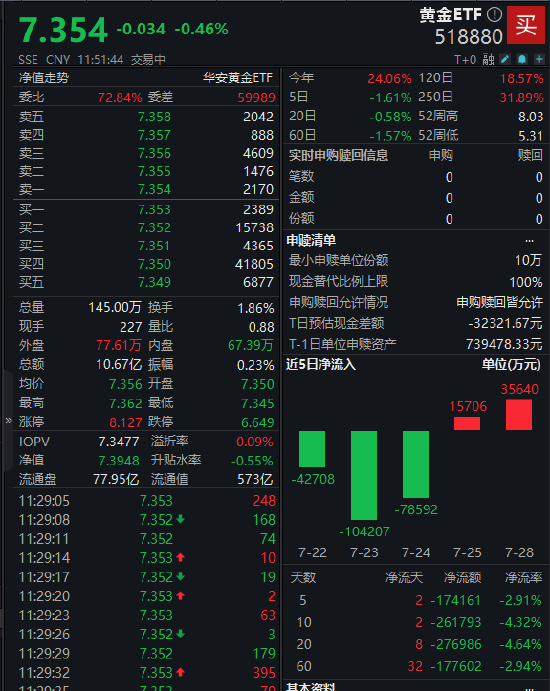
回调空间有限?黄金ETF(518880)近2个交易日净流入5.13亿元
Xin Lang Ji Jin· 2025-07-29 04:09
Core Viewpoint - The gold ETF (518880) experienced a slight decline of 0.46% to 7.354 CNY, with a trading volume of 10.67 billion CNY, indicating a mixed sentiment in the market [1][2]. Fund Performance - Over the past 10 trading days, the gold ETF saw a net outflow of 23.17 billion CNY, while the last 5 days recorded a net outflow of 17.42 billion CNY, followed by a net inflow of 5.13 billion CNY in the last 2 days [1]. - As of July 28, 2025, the circulating scale of the gold ETF reached 576.41 billion CNY [1]. Market Analysis - Long-term outlook remains bullish for precious metals due to ongoing global central bank gold purchases and persistent supply-demand gaps in silver, despite short-term bearish pressures from easing risk aversion as global trade negotiations progress [2]. - The recent passage of the "Big and Beautiful" bill by the U.S. Senate and the potential increase in fiscal deficit rates are expected to provide long-term support for gold prices [2]. Product Overview - The Huaan Gold ETF, established on July 18, 2013, is one of the earliest gold ETFs in China, benchmarked against domestic gold spot price returns, and has established a leading position in terms of scale and performance [3]. - Investors are advised to consider phased investment or dollar-cost averaging strategies when participating in the Huaan Gold ETF (518880) and its linked funds [3].

“反内卷”掩映下的商品超级周期
2025-07-29 02:10
Summary of Conference Call Records Industry or Company Involved - The discussion primarily revolves around the **commodity supercycle** and the impact of **anti-involution policies** on the **midstream materials and manufacturing industries**. Core Points and Arguments 1. **Impact of Anti-Involution Policies**: Anti-involution policies may lead to a revaluation of midstream materials and manufacturing industries, similar to the utility price increase trend observed in 2023-2024. Focus on industries with negative ROC minus VAC indicators, such as **coke, rebar, plastics, fiberglass, and photovoltaic equipment** [1][2][5]. 2. **Drivers of Commodity Supercycle**: The commodity supercycle is driven by **de-globalization** and **de-dollarization**. De-globalization restricts factor flow, raising inflation, while de-dollarization leads to increased commodity pricing. Historical parallels are drawn to the 1970s commodity bull market due to similar conditions [3][9]. 3. **Renminbi Exchange Rate**: The Renminbi's exchange rate is highly correlated with market trends. In the medium term, the price gap between China and the US supports Renminbi appreciation, although short-term risks from US debt issuance could pressure the A-share market [1][6]. 4. **Investment Strategy**: It is recommended to follow the **Barbell Strategy**, allocating 80% of investments to safe assets like **gold, banks, resources, and utilities**, and 20% to sectors with potential catalysts such as **domestic computing power, robotics, and Hainan Free Trade Zone** [1][7]. 5. **US Treasury Account and Interest Rates**: The US Treasury General Account (TGA) needs to be replenished quickly, which may lead to a rise in the 10-year US Treasury yield to near or above 5%. This could impact dollar liquidity and put pressure on the A-share market, particularly growth-style stocks [1][8]. 6. **Historical Context of Anti-Involution**: The current anti-involution policy is seen as part of a broader strategy to address economic deflation, with historical precedents in 1999 and 2015-2016. The focus should also be on demand-side policies [5][11]. 7. **Measuring Industry Involution**: The difference between ROIC and WACC serves as a measure of industry involution. Negative values indicate industries that are not creating value, with many midstream manufacturing and materials sectors currently in this state [12]. 8. **Recent Performance of Involved Industries**: Industries with high involution levels, such as **coke, rebar, plastics, fiberglass, and photovoltaic equipment**, have shown significant recent performance improvements, indicating potential investment opportunities [14]. Other Important but Possibly Overlooked Content 1. **Commodity Price Trends**: From July 2022 to the present, gold and silver prices have increased by 100%, while platinum has risen by over 40%. Scarce metals have also seen significant price increases, suggesting a likely upward trend in commodity pricing [10]. 2. **Sector-Specific Insights**: Certain commodities like **alumina and live pigs** have seen price increases not due to anti-involution but rather as part of the broader commodity supercycle, indicating the complexity of market dynamics [15][16]. 3. **Asset Allocation Recommendations**: In the absence of a fundamental reversal in globalization trends, a suggested asset allocation strategy includes 80% in safe assets and 20% in technology and AI sectors, providing a balanced approach to risk management [17].
彭博:如何为后美元时代做好准备?
彭博· 2025-07-28 01:42
Investment Rating - The report indicates a cautious outlook on the investment landscape, particularly highlighting the challenges posed by the shift from globalization to de-globalization and demographic changes affecting economic growth [1][3]. Core Insights - The transition from globalization to de-globalization presents significant challenges for investors accustomed to previous market conditions [1][3]. - Demographic shifts, particularly aging populations in regions like Europe and China, are expected to slow global economic growth rates, impacting long-term economic forecasts [1][9]. - Despite global trends, there remain substantial investment opportunities in U.S. technology companies, although the U.S. stock market is projected to underperform compared to global markets in 2025 [1][4]. - High debt levels in developed countries, comparable to those during World War II, pose potential risks if interest rates rise, increasing debt repayment costs [1][11]. - The role of the U.S. dollar as a safe-haven asset is diminishing, as evidenced by its increasing negative correlation with gold and the rising correlation with alternative assets like Bitcoin [1][13]. Summary by Sections Globalization and Economic Trends - The report discusses the reversal of globalization trends and the implications of demographic changes on economic growth, particularly the decline in the working-age population in the U.S., Europe, and China [1][9][10]. U.S. Market Opportunities - Investment opportunities in U.S. technology firms remain robust, despite a forecasted underperformance of the U.S. stock market relative to global markets in 2025 [1][4]. Debt and Economic Stability - The report highlights the concerning levels of debt in developed nations, with the U.S. debt repayment costs projected to exceed defense budgets in 2024, a historical indicator of potential negative outcomes [1][12]. Dollar Dynamics - The report emphasizes the changing perception of the U.S. dollar, noting its declining status as a safe-haven asset and the increasing relevance of alternative assets in investor portfolios [1][14][17]. Future Considerations - Investors are advised to monitor indicators such as the dollar's exchange rates, its share in global transactions, and its correlation with risk assets to gauge shifts in perceptions of its stability [1][12].
西部利得基金管浩阳:资源股迎来贝塔时代 供给约束重塑“战略资产”
Zheng Quan Shi Bao· 2025-07-27 17:09
Core Viewpoint - The strategic importance of resource commodities is gaining consensus in the market amid rising de-globalization trends, with a significant commodity market rally since 2020, covering various resources from coal to gold, copper, silver, and rare earths [1] Group 1: Investment Strategy - The new fund manager of Western Lide Fund, Guan Haoyang, emphasizes that supply is more critical than demand at this investment juncture, and beta is more important than individual stocks [1][6] - Guan believes that the ongoing commodity market rally, which has been active for five years, still presents opportunities as resource commodities transition from "cyclical goods" to "strategic assets" [1][6] Group 2: Research Background - Guan has focused on cyclical stock research since entering the industry in 2016, expanding his expertise from steel to various sectors including construction, materials, non-ferrous metals, chemicals, and coal over nine years [2] - He has developed a comprehensive research framework for cyclical commodities, recognizing the high barriers between different sub-industries [2] Group 3: Resource Classification - Guan categorizes resource stocks into four types: 1. **Cyclical Assets**: Assets with explosive performance during uptrends, such as gold and silver, where price tracking is crucial [4] 2. **Thematic Assets**: Assets like rare earths that are rising in price but have not yet shown performance, focusing on price trends and market sentiment [4] 3. **Value Assets**: Stable price assets with low valuations, such as copper, where company growth and valuation matching are key [5] 4. **Dividend Assets**: Stable price assets with high dividend yields, like oil and coal, where finding assets with potential dividend recovery is essential [5] Group 4: Market Outlook - Guan assesses that the current commodity cycle, which began in 2020, still holds potential due to rigid supply constraints [6] - He identifies three main supply constraints: insufficient capital expenditure, a decrease in quality mines, and the elevation of resource commodities to strategic assets through administrative measures by various countries [6][7] - The restructuring of supply chains driven by de-globalization is expected to create long-term benefits for industrial metals like copper [7]
重估“安全资产”系列报告(二十):“反内卷”掩映下的商品超级周期
Western Securities· 2025-07-27 07:44
Group 1 - The report highlights that the pulse market driven by exchange rates continues, with a focus on the upcoming issuance schedule of US Treasury bonds, indicating a potential liquidity disturbance due to the need to replenish over 500 billion USD in the TGA account by the end of September [1][18] - The "anti-involution" movement is seen as a superficial phenomenon, with the real driving force behind the rise in commodity prices being the beginning of a new super cycle in commodities, influenced by de-globalization and de-dollarization [2][29] - The report suggests that "anti-involution" is merely the first step in a debt-clearing cycle, emphasizing the need to pay attention to demand-side policies following the supply-side changes [3][34] Group 2 - ROIC-WACC is identified as a key indicator for measuring the degree of "involution," with current negative values concentrated in the midstream materials and manufacturing sectors, indicating deeper involution compared to previous years [4][42] - The report notes that the current super cycle in commodities is just beginning, driven by factors such as the restructuring of global interest distribution and the weakening of the dollar, which shifts pricing from demand to supply [2][29] - The analysis indicates that industries like coking coal, photovoltaic equipment, and wind power equipment are still in a state of "true involution," suggesting potential for further price increases [4][51] Group 3 - The report emphasizes the importance of "hard currency" and "hard technology" investments, recommending a focus on gold, banks, resources, and public utilities as safe assets, alongside domestic AI computing capabilities as a growth area [5][66] - It is noted that the current economic environment is characterized by significant deflationary pressures, with historical parallels drawn to previous debt-clearing cycles [3][34] - The report suggests that the upcoming political bureau meeting will be a critical observation point for future demand-side policies, which are essential for sustaining economic recovery [3][36]
西南期货早间评论-20250724
Xi Nan Qi Huo· 2025-07-24 01:35
1. Report Industry Investment Ratings No relevant content provided. 2. Core Viewpoints - The report provides a comprehensive analysis of various futures, including their market conditions, influencing factors, and investment suggestions. It suggests that the long - term trends of some commodities are positive, while others are expected to be range - bound or have short - term risks [5][10][14]. 3. Summaries by Categories Bonds - **Market Performance**: The previous trading day saw government bond futures close lower across the board, with the 30 - year, 10 - year, 5 - year, and 2 - year main contracts down 0.21%, 0.11%, 0.09%, and 0.03% respectively. The central bank conducted a 7 - day reverse repurchase operation of 150.5 billion yuan, resulting in a net withdrawal of 369.6 billion yuan [5]. - **Analysis**: The macro - economic recovery momentum needs to be strengthened, and the monetary policy is expected to remain loose. The bond yield is relatively low, and there is uncertainty in the Sino - US trade agreement. It is expected that there will be no obvious trend in the bond market, and caution is advised [6][7]. Stock Index Futures - **Market Performance**: The previous trading day, stock index futures showed mixed results. The main contracts of CSI 300 (IF), SSE 50 (IH), CSI 500 (IC), and CSI 1000 (IM) had changes of 0.31%, 0.48%, 0.13%, and 0.06% respectively [8]. - **Analysis**: The domestic economy is stable, but the recovery momentum is weak, and market confidence in corporate earnings is lacking. However, domestic asset valuations are low, and the Chinese economy has sufficient resilience. The long - term performance of Chinese equity assets is optimistic, and it is advisable to consider going long on stock index futures [10][11]. Precious Metals - **Market Performance**: The previous trading day, the main gold contract closed at 792.9 with a 1.03% increase, and the night - session closed at 785.26. The main silver contract closed at 9492 with a 1.05% increase, and the night - session closed at 9431 [12]. - **Analysis**: The global trade and financial environment is complex, and the "de - globalization" and "de - dollarization" trends are beneficial to the allocation and hedging value of gold. Central bank gold - buying and potential Fed rate cuts support the long - term bullish trend of precious metals. It is advisable to consider going long on gold futures [14][15]. Steel Products (Rebar and Hot - Rolled Coil) - **Market Performance**: The previous trading day, rebar and hot - rolled coil futures rose and then fell. The spot price of Tangshan billet was 3120 yuan/ton, Shanghai rebar was 3230 - 3390 yuan/ton, and Shanghai hot - rolled coil was 3450 - 3470 yuan/ton [16]. - **Analysis**: Policy expectations dominate the market, and the actual supply - demand pattern is secondary. The supply contraction expectation of steel products is strengthened, and the short - term strength may continue. Investors can pay attention to opportunities to go long on dips and manage positions carefully [16]. Iron Ore - **Market Performance**: The previous trading day, iron ore futures declined slightly. The spot price of PB powder was 790 yuan/ton, and super - special powder was 670 yuan/ton [18]. - **Analysis**: Policy expectations boost the black - series commodities, but the supply - demand pattern of iron ore has weakened marginally. The price valuation is relatively high. The short - term strength may continue, and investors can pay attention to low - level buying opportunities [18][19]. Coking Coal and Coke - **Market Performance**: The previous trading day, coking coal and coke futures rose significantly [21]. - **Analysis**: Policy expectations lead to supply contraction expectations, and the supply - contraction policy has become a reality, which is a major positive for the supply - demand logic of the coking industry. The short - term strength may continue, and investors can pay attention to opportunities to go long on dips [21]. Ferroalloys - **Market Performance**: The previous trading day, the main manganese - silicon contract closed down 0.37% at 5938 yuan/ton, and the main silicon - iron contract closed up 0.90% at 5832 yuan/ton [23]. - **Analysis**: After entering the off - season, the short - term demand for ferroalloys has peaked, and the supply is still high. The cost has limited downward space, and if the spot losses continue to expand, long - position opportunities in the low - level support range can be considered [24]. Crude Oil - **Market Performance**: The previous trading day, INE crude oil rose and then fell,受阻于 the 10 - day moving average [25]. - **Analysis**: The decrease in US oil rigs supports oil prices, but the reduction in net long positions by CFTC fund managers shows a bearish view on the oil market. Tariff frictions and EU sanctions on Russia also restrict oil prices. Short - selling opportunities in the main crude - oil contract can be considered [26][27]. Fuel Oil - **Market Performance**: The previous trading day, fuel oil oscillated downward,受阻于 the 5 - day moving average. China's fuel - oil imports increased in June, and the export of marine fuel oil also rose [28]. - **Analysis**: The influx of fuel oil from the Middle East and Russia into Asia has led to sufficient supply and wider spot discounts. The signing of the US - Japan trade agreement is beneficial to the shipping market. Overall, fuel oil is weak, and short - selling opportunities in the main contract can be considered [28][29]. Synthetic Rubber - **Market Performance**: The previous trading day, the main synthetic - rubber contract closed down 1.25%, and the mainstream price in Shandong was adjusted down to 12000 yuan/ton [30]. - **Analysis**: The supply and demand are short - term loose, and it is advisable to wait for the market to stabilize before participating in the rebound [30][32]. Natural Rubber - **Market Performance**: The previous trading day, the main natural - rubber contract closed down 0.17%, and the 20 - rubber contract closed down 0.54%. The Shanghai spot price was stable at around 14600 yuan/ton [33]. - **Analysis**: It is expected to maintain a relatively strong oscillation in the next week. The cost support has weakened, and medium - term long - position opportunities can be considered [33][34]. PVC - **Market Performance**: The previous trading day, the main PVC contract closed down 0.67%, and the spot price was stable. The basis widened [35]. - **Analysis**: The oversupply situation continues, but the downward space may be limited. It is expected to oscillate strongly in the short term [35][38]. Urea - **Market Performance**: The previous trading day, the main urea contract closed down 1.83%, and the price in Shandong Linyi was adjusted down to 1820 yuan/ton [38]. - **Analysis**: The domestic urea market will fluctuate narrowly in the short term. It is advisable to wait for policies and demand to materialize. It should be treated as bullish in the medium term [38][39]. PX - **Market Performance**: The previous trading day, the PX2509 main contract rose 0.12%. The PXN spread was adjusted to 270 dollars/ton, and the PX - MX spread was 100 dollars/ton [40]. - **Analysis**: The short - term supply - demand balance of PX remains tight, and the cost support from crude oil is insufficient. It will oscillate and adjust in the short term. It is advisable to participate cautiously and pay attention to crude - oil price changes [40]. PTA - **Market Performance**: The previous trading day, the PTA2509 main contract rose 0.25%, and the East - China spot price was 4772 yuan/ton with a basis rate of - 0.46% [41]. - **Analysis**: The supply has increased, the demand has weakened, and the cost support is slightly insufficient. It will oscillate in the short term. The processing fee is at a relatively low level, and more unplanned production cuts may occur. Interval participation is advisable, and attention should be paid to the low - level rebound of the processing fee [42]. Ethylene Glycol - **Market Performance**: The previous trading day, the main ethylene - glycol contract rose 0.14% [43]. - **Analysis**: The short - term supply pressure has eased, and the inventory has decreased. It will oscillate in the short term. It is advisable to participate in the range and pay attention to port inventory and import changes [43]. Short - Fiber - **Market Performance**: The previous trading day, the short - fiber 2509 main contract rose 0.03% [44]. - **Analysis**: The short - term fundamental driving force is insufficient, and some factories have cut production. It will oscillate with costs. Caution should be exercised regarding the repair space of the processing margin, and attention should be paid to cost changes and production - cut efforts [45]. Bottle Chips - **Market Performance**: The previous trading day, the bottle - chips 2509 main contract rose 0.1% [46]. - **Analysis**: The raw - material price is oscillating, the number of device overhauls has increased, and the inventory has decreased. The market is expected to oscillate with the cost, and risk control is necessary [46]. Soda Ash - **Market Performance**: The previous trading day, the main 2509 contract closed at 1338 yuan/ton with a 0.68% increase [47]. - **Analysis**: The domestic soda - ash market is stable and slightly strong, but the long - term oversupply situation is difficult to change. The downstream glass industry cannot provide strong support. It is advisable to be rational and not over - pursue long or short positions [48]. Glass - **Market Performance**: The previous trading day, the main 2509 contract closed at 1211 yuan/ton with a 0.67% increase [49]. - **Analysis**: Driven by macro - sentiment and some companies' price increases, the overall market has risen. It is necessary to continue to pay attention to the spot trading and regional inventory reduction of glass [49]. Caustic Soda - **Market Performance**: The previous trading day, the main 2509 contract closed at 2644 yuan/ton with a 1.03% increase [50]. - **Analysis**: The supply is relatively sufficient, and the demand support is limited. It is expected to oscillate narrowly, and it is easily affected by macro - sentiment. Risk control is necessary [51][52]. Pulp - **Market Performance**: The previous trading day, the main 2509 contract closed at 5414 yuan/ton with a 1.35% increase [53]. - **Analysis**: The supply has an expansion tendency, the downstream demand is weak, and the market is in the off - season. The pulp price is expected to fluctuate. It is easily affected by the overall commodity sentiment and foreign - market quotes, and the actual pressure in the off - season should be noted [55][56]. Lithium Carbonate - **Market Performance**: The previous trading day, the main lithium - carbonate contract closed down 4.07% at 69380 yuan/ton [57]. - **Analysis**: The supply - demand surplus situation has not changed significantly, and the supply - side disturbance sentiment has a greater impact than the actual situation. It is advisable to observe more and operate less and control risks [57][58]. Copper - **Market Performance**: The previous trading day, Shanghai copper oscillated downward. The average price of 1 electrolytic copper was 79750 yuan/ton, down 10 yuan/ton from the previous trading day [59]. - **Analysis**: The approaching US tariff on copper and the shortage of copper concentrates support the price. Long - buying opportunities in the main Shanghai - copper contract can be considered [59][60]. Tin - **Market Performance**: The previous trading day, Shanghai tin oscillated and rose 1.62% to 273260 yuan/ton [61]. - **Analysis**: The supply of tin ore is tight, but the expectation of production resumption in the fourth quarter has increased. The overall supply is still short. It is expected that the tin price will oscillate strongly [61][62]. Nickel - **Market Performance**: The previous trading day, Shanghai nickel rose 0.1% to 123660 yuan/ton [63]. - **Analysis**: The nickel market is in an oversupply situation, and the price is expected to oscillate [63]. Soybean Oil and Soybean Meal - **Market Performance**: The previous trading day, the main soybean - meal contract rose 0.62% to 3095 yuan/ton, and the main soybean - oil contract rose 0.02% to 8074 yuan/ton [64]. - **Analysis**: The supply of soybeans is relatively loose, and the import cost has increased. After the adjustment of soybean meal, long - position opportunities in the support range can be considered, and call - option opportunities in the support range of soybean oil after the decline can be considered [64][65]. Palm Oil - **Market Performance**: Malaysian palm oil rose, and the domestic import of palm oil increased in June [66]. - **Analysis**: Long - buying opportunities in palm oil after the correction can be considered [66][67]. Rapeseed Meal and Rapeseed Oil - **Market Performance**: Canadian rapeseed rose, and China's imports of rapeseed, rapeseed oil, and rapeseed meal changed in June [68]. - **Analysis**: Long - buying opportunities in rapeseed products can be considered [68][70]. Cotton - **Market Performance**: The previous trading day, domestic Zhengzhou cotton oscillated, and the US cotton data showed changes in production and inventory [71]. - **Analysis**: The global supply - demand of cotton is expected to be loose, and the short - term market follows the overall commodity rebound. It is advisable to wait and see [73][74]. Sugar - **Market Performance**: The previous trading day, domestic Zhengzhou sugar oscillated, and the international sugar market was affected by supply - demand factors [75]. - **Analysis**: The Brazilian sugar production increase expectation has been adjusted downward, and the domestic inventory is low with high imports. It is advisable to wait and see [75]. Apples - **Market Performance**: The previous trading day, domestic apple futures oscillated, and the 2025 - 2026 apple production is expected to increase slightly [77]. - **Analysis**: Short - selling opportunities at high prices can be considered [77][78]. Pigs - **Market Performance**: The previous trading day, the national average price of live pigs was 14.22 yuan/kg, and the main contract rose 1.67% to 14590 yuan/ton [79][81]. - **Analysis**: The group - farm slaughter volume will decrease at the end of the month, but the market is in the summer consumption off - season. It is advisable to hold previous short positions [79][81]. Eggs - **Market Performance**: The previous trading day, the average price of eggs in the main production areas was 3.34 yuan/jin, and the main contract rose 0.36% to 3637 yuan/half - ton [82][83]. - **Analysis**: The egg supply is expected to increase in July, and the consumption is in the off - season. A 9 - 10 reverse spread can be considered [82][83]. Corn and Corn Starch - **Market Performance**: The previous trading day, the main corn contract closed down 0.17% to 2321 yuan/ton, and the main corn - starch contract rose 0.11% to 2658 yuan/ton [84]. - **Analysis**: The domestic corn supply - demand is approaching balance, and the inventory pressure has decreased. It is advisable to wait and see. Corn starch follows the corn market [86]. Logs - **Market Performance**: The previous trading day, the main 2509 contract closed at 823.0 yuan/ton with a 2.08% decrease [87]. - **Analysis**: The supply of logs has increased, and the market has returned to the reality of the spot [87][88].
中美达成重要共识,欧洲按捺不住了?冯德莱恩将访华,有大事找中国商量!美国赔了夫人又折兵
Sou Hu Cai Jing· 2025-07-23 13:01
Core Viewpoint - The visit of EU leaders to China comes amid heightened tensions with the US over tariff policies, reflecting the EU's urgent need to reassess its trade relationships with both the US and China [1][3][7] Group 1: EU's Position and Concerns - The EU is caught in a complex situation, needing to navigate pressures from the US while also considering its significant trade relationship with China [1][3] - EU officials express concerns that if the market is fully opened to China, up to 50% of market share could be captured by Chinese companies, necessitating protective measures [3][4] - The EU's internal production chains, established for globalization, may face marginalization if de-globalization trends intensify [3][4] Group 2: Objectives of the Visit - The primary goals of the EU leaders' visit to China include securing more orders for EU companies and negotiating unequal tariff arrangements, where China would implement zero tariffs on EU products while maintaining some tariffs on Chinese goods [4][6] - The EU also aims to pressure China to reduce its cooperation with Russia, using sanctions as leverage [4][6] Group 3: Challenges in Negotiations - There is a fundamental conflict between the EU's requests and China's principles, particularly regarding tariff arrangements and cooperation with Russia [6][9] - The timeline for negotiations is tight, with the US imposing an August 1 deadline for new tariff agreements, leaving little room for complex discussions [6][9] - The EU's predicament highlights the broader international dynamics, where the US seeks to reshape trade rules to its advantage, often at the expense of its allies [6][9] Group 4: Implications for Global Trade - The shifting global trade landscape indicates that the EU's ability to balance relations between the US and China is diminishing, necessitating a reevaluation of its ties with China [7][9] - The outcome of the EU's negotiations with China will not only impact its economic future but also have significant repercussions for the global trade framework [9]