
地缘风险

Search documents
沥青(BU):原油受多重原因影响下挫,沥青跟跌
Guo Mao Qi Huo· 2025-10-13 06:20
1. Report Industry Investment Rating - The investment view for asphalt in October is "oscillating weakly" [3]. 2. Core View of the Report - Crude oil prices declined due to multiple factors, causing asphalt prices to follow suit. In October, asphalt supply increased, but demand decreased in the north due to the rainy season, resulting in a lackluster peak season. The overall trend of asphalt will continue to fluctuate with crude oil [3]. 3. Summary by Relevant Catalogs 3.1 Main Views and Strategy Overview - **Supply (Neutral)**: Two information companies estimated October's local refinery asphalt production at 1.604 million tons and 1.61 million tons, a month - on - month increase of 3% and 9% respectively. Although some refineries plan to maintain full - load production or resume production, others' maintenance or intermittent production limits the increase [3]. - **Demand (Negative)**: Affected by factors such as logistics restrictions during the National Day holiday and early - October rainfall, domestic asphalt demand is likely to decline. However, there are still construction rush expectations in some areas [3]. - **Inventory (Neutral)**: Domestic asphalt inventory shows a trend of "slightly increasing factory inventory and slightly decreasing social inventory". Low - inventory regions have stronger price support, while high - inventory regions are weaker [3]. - **Cost (Neutral)**: This week, crude oil prices fluctuated, first rebounding and then falling. The initial rebound was due to OPEC +'s production increase plan being lower than expected and geopolitical risks, while the subsequent decline was due to the easing of the Middle East situation, concerns about demand, and weak global economic recovery [3]. - **Investment View**: Oscillating weakly. The overall trend will continue to follow crude oil [3]. - **Trading Strategy**: Unilateral trading: oscillating weakly; Arbitrage: none [3]. 3.2 Price - The report presents the mainstream market prices of heavy - traffic asphalt in different regions (East China, South China, North China, Shandong) from 2021 to 2025 [5][6][9]. 3.3 Spread, Basis, and Delivery Profit - **Spread**: The report shows the historical data of asphalt cracking spread (BU - (SC * 6.35)) and asphalt - coking material spread from 2021 to 2025 [14][15][16]. - **Basis**: It presents the basis data of asphalt in major regions (South China, East China, Shandong) from 2024 to 2025 [17][18]. 3.4 Supply - **Production Forecast**: It shows the monthly production and production forecast of asphalt in China from 2022 to 2025 [22][26]. - **Capacity Utilization**: It shows the capacity utilization rate of heavy - traffic asphalt in different regions (China, Shandong, East China, North China, South China, Northeast) from 2019 to 2025 [31][34][36]. - **Maintenance Loss**: It shows the weekly and monthly maintenance loss of asphalt in China from 2018 to 2025 [38]. 3.5 Cost and Profit - **Production Gross Margin**: It shows the production gross margin of asphalt in Shandong from 2021 to 2025 [41][42]. - **Diluted Asphalt**: It presents the price, premium, and port inventory data of diluted asphalt from 2022 to 2025 [44][45][46]. 3.6 Inventory - **Factory Inventory**: It shows the factory inventory and inventory rate of asphalt in different regions (China, Shandong, East China, North China, South China, Northeast) from 2019 to 2025 [50][52][53]. - **Social Inventory**: It shows the social inventory of asphalt in different regions (China, Shandong, East China, North China, South China, Northeast) from 2022 to 2025 [55][56]. 3.7 Demand - **Shipment Volume**: It shows the shipment volume of asphalt in different regions (China, Shandong, East China, North China, South China, Northeast) from 2022 to 2025 [59]. - **Downstream Operating Rate**: It shows the operating rates of road - modified asphalt, modified asphalt, building asphalt, and waterproofing membranes from 2018 to 2025 [61][62][63]. - **Modified Asphalt Operating Rate**: It shows the operating rates of modified asphalt in different regions (China, Shandong, East China, North China, South China, Northeast) from 2022 to 2025 [67][68].
ETO Markets 每日汇评:美联储非农数据失踪!H1趋势线变红,多单机会就在眼前?
Sou Hu Cai Jing· 2025-10-13 05:44
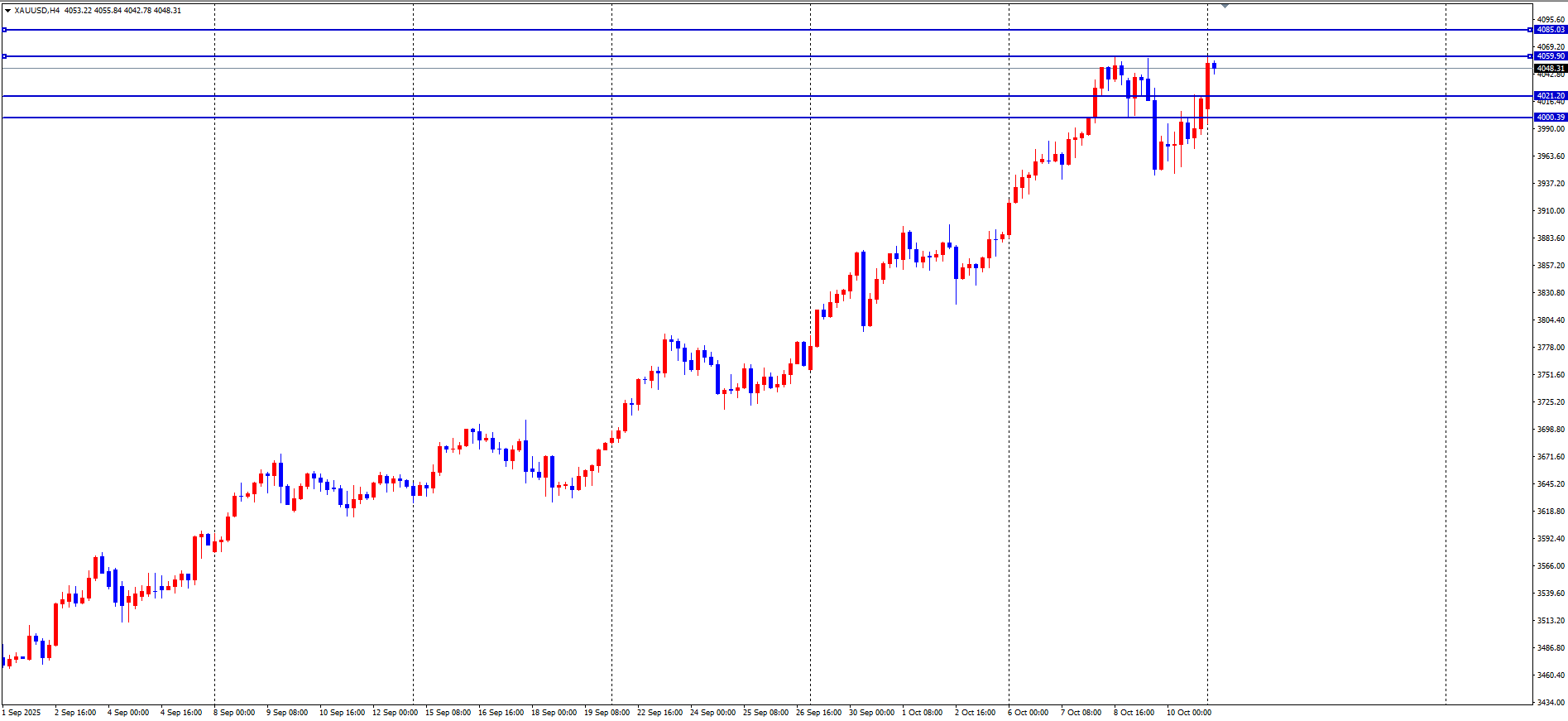
Group 1 - The core viewpoint indicates that gold prices are experiencing strong bullish momentum but face resistance levels around 4060/4085, with support at 4021/4000. A buy recommendation is suggested near 4020 with a target profit of 70-100 points and a stop loss at 4010 [2][3] - The driving factors for gold's movement include escalating geopolitical risks, expectations of Federal Reserve interest rate cuts, and political instability in multiple countries, which are increasing demand for safe-haven assets [3] Group 2 - For EUR/USD, the market is currently in a consolidation phase after reaching a high of 1.163, with a focus on the easing of political tensions in France and Germany, which counterbalance the delayed impact of U.S. employment data [5] - Key support levels are identified at 1.150/1.154 and resistance at 1.169/1.174, with a trading strategy suggesting a short position near 1.166 [7] Group 3 - GBP/USD is supported by hawkish comments from the Bank of England, but U.S. risk aversion is limiting its gains, resulting in a doji candlestick formation [9] - Key support levels are at 1.323/1.328 and resistance at 1.343/1.348, with a recommendation to enter a long position near 1.330 [11] Group 4 - GBP/JPY experienced a downward breakout after initial fluctuations, reaching a significant Fibonacci retracement level, with a bearish candlestick formation [13] - Resistance levels are noted at 203.7/204.4 and support at 201.3/202, with a recommendation to enter short positions between 203-203.5 [15]


银价炸了!50美元大关被暴力突破,飙至51美元,14年新高
Sou Hu Cai Jing· 2025-10-10 08:44
Group 1 - Silver prices have historically surpassed $50 per ounce, reaching $51 per ounce, marking a nearly 14-year high with a daily increase of over 4% [1] - Year-to-date, silver has shown a remarkable increase of over 70%, outperforming gold, which has risen by 50% [1] - The surge in silver prices is attributed to a dual driving force of "financial attributes + industrial demand" [1] Group 2 - The rising gold prices have positively influenced the entire precious metals sector, while the demand for silver in high-tech industries such as renewable energy, photovoltaics, and electric vehicles has seen explosive growth [1] - Silver serves as both a "safe-haven asset" and an "industrial metal," which contributes to its strong performance [1] - Factors such as expectations of Federal Reserve interest rate cuts, a weakening dollar, and geopolitical risks have collectively propelled silver prices [1] Group 3 - Citigroup has raised its silver price target to $55, indicating a bullish outlook [1] - Analysts suggest that while short-term fluctuations may occur, the long-term upward trend for silver remains solid, with potential to reach new highs by the end of the year [1] - Investment strategies recommend waiting for price corrections to enter positions at key support levels while managing risks effectively [1]
国际金价突破4000美元关口屡创新高,央行持续增持黄金,建信上海金ETF(518860)连续三日获资金净流入
Sou Hu Cai Jing· 2025-10-09 07:32
Group 1 - The international gold price reached a historic high during the domestic "Double Festival," with London spot gold hitting over $4000 per ounce on October 8 and New York futures also surpassing $4000 [1] - The China Construction Bank Shanghai Gold ETF (518860) saw a net inflow of 64.46 million yuan over three days, indicating strong investor interest [1] - Factors driving the gold price increase include expectations of continuous interest rate cuts by the Federal Reserve due to U.S. government shutdown and weak employment data, alongside rising stagflation risks [1][2] Group 2 - As of the end of September, China's gold reserves stood at 74.06 million ounces, marking an increase of 40,000 ounces and the 11th consecutive month of gold accumulation [1] - Goldman Sachs projects that central banks will average net purchases of 80 tons and 70 tons of gold in 2025 and 2026, respectively, contributing significantly to price increases [1] - The recent U.S. government shutdown has further fueled demand for gold, reinforcing the ongoing bullish trend in the market [2]
石化行业周报:OPEC+11月增产幅度较温和-20251009
China Post Securities· 2025-10-09 06:50
Investment Rating - The industry investment rating is "Strongly Outperform the Market" and is maintained [1] Core Views - OPEC+ will increase oil production by 137,000 barrels per day starting in November, which is a relatively moderate increase. The petrochemical sector continues to adjust, with ongoing attention to the progress of eliminating outdated facilities and upgrading [2][5] - The oil and petrochemical index underperformed this week, declining by 0.38% compared to last week. In contrast, the engineering services sector within the oil and petrochemical industry performed the best, with an increase of 0.88% [5] - Oil prices have decreased, with an increase in U.S. crude oil and gasoline inventories [6][10] - In the polyester segment, the price of polyester filament has dropped while the price spread has increased. The inventory days for polyester filament in Jiangsu and Zhejiang have decreased, and the operating rate of weaving machines has increased [14][19] - For olefins, the spot prices of sample polyolefins remain stable, and inventory levels are steady [21][22] Summary by Sections Oil Market - Oil prices have fallen, with Brent crude futures closing at $65.5 per barrel, a decrease of 7.2% compared to September 26 [7] - U.S. crude oil inventories increased by 6,440 thousand barrels, while gasoline inventories rose by 496 thousand barrels [13] Polyester - The prices for polyester filament (POY, DTY, FDY) are 6,550, 7,750, and 6,700 yuan per ton, respectively, with price spreads increasing by 61 yuan per ton compared to September 26 [16] - The inventory days for polyester filament in Jiangsu and Zhejiang are 25.7, 29.5, and 18.8 days for FDY, DTY, and POY, respectively, with an increase in the operating rate of weaving machines [19] Olefins - Sample prices for polyethylene (PE) and polypropylene (PP) are 7,800 and 8,050 yuan per ton, showing a slight decrease of 0.64% for PE and no change for PP compared to September 26 [24] - The total inventory of polyolefins is 590,000 tons, which is a decrease from the previous period [24]
永安期货集运早报-20251009
Yong An Qi Huo· 2025-10-09 02:43
Core Insights - The report highlights the expected impact of the Gaza ceasefire on market prices, predicting a significant downward trend, although the resumption of shipping through the Red Sea may take 2-3 months [3][26] - The report notes potential geopolitical risks between the US and Iran that could affect market dynamics [26] - There are multiple upward drivers anticipated from October to December, suggesting a complex market outlook [26] Market Data Summary - Recent futures prices show a decline, with EC2510 at 1110.6 (-0.39%), EC2512 at 1731.9 (-1.39%), and EC2602 at 1642.8 (-1.45%) [25] - The SCF index for the European line has decreased by 6.60% from the previous period, indicating a significant drop in shipping rates [25] - The CCFI and NCFI indices also reflect downward trends, with decreases of 4.69% and 8.85% respectively [25] Pricing Trends - The average price for the European line in weeks 40-41 was reported at 1450 USD, with specific rates for different shipping companies ranging from 1300 to 1600 USD [26] - A price increase announcement for week 42 suggests a target range of 1800-2000 USD, aimed more at stabilizing prices rather than actual increases [26] - The report indicates that the lowest price for YML was recorded at 1300 USD, marking a significant low for the year [26] Shipping Index Trends - The SCFI index shows a seasonal trend with fluctuations in shipping rates over the past years, indicating a complex pricing environment [38] - The TCI index for various routes also reflects seasonal variations, suggesting that shipping costs are influenced by both demand and geopolitical factors [39][40]

芦哲:国庆假期海外市场回顾
Sou Hu Cai Jing· 2025-10-08 06:43
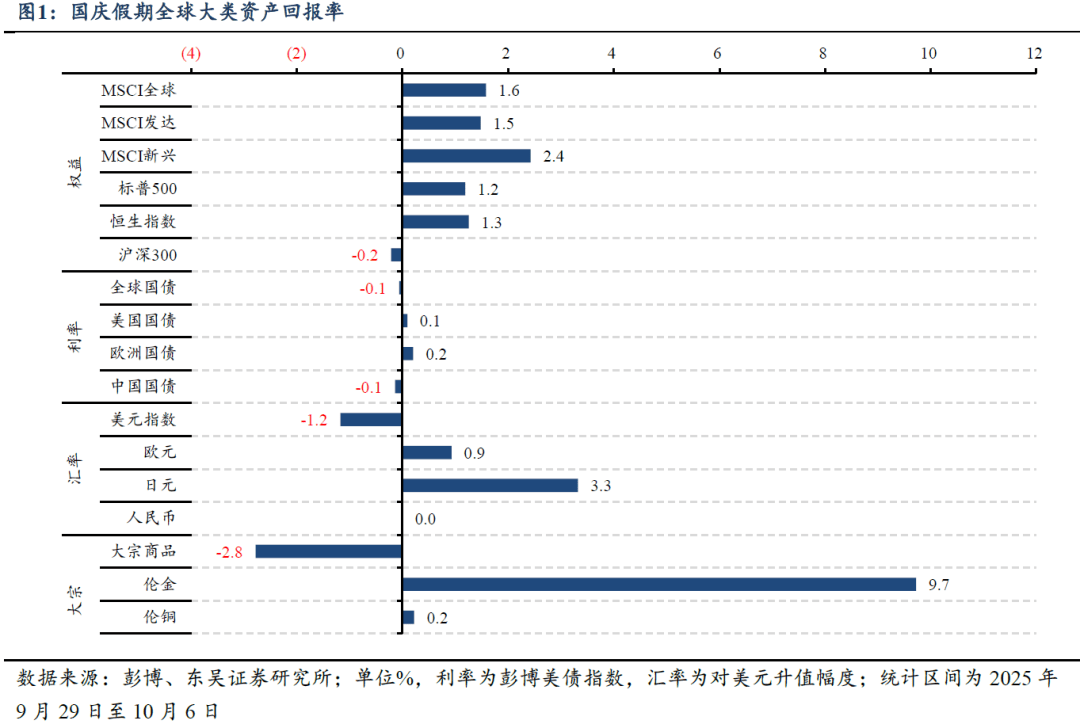
Core Viewpoint - The National Day holiday was dominated by two major events: the U.S. government shutdown and the election of Kishi Nobuo as the president of the Liberal Democratic Party in Japan. The government shutdown has heightened risk aversion, while expectations for the Federal Reserve to "blindly cut rates" have increased due to the suspension of key economic data releases. Concurrently, Kishi's victory has raised expectations for "loose fiscal and monetary" policies in Japan, driving gold and Bitcoin to new historical highs. Looking ahead, the global trend towards right-wing politics and loose fiscal and monetary policies suggests greater uncertainty from geopolitical friction and unsustainable global government debt, increasing the probability of a mild overheating of the economy. In terms of market strategy, short-term risk appetite for U.S. stocks is expected to weaken due to the ongoing government shutdown, while in the medium term, the combination of right-wing politics, fiscal and monetary easing, geopolitical risks, economic overheating, and weakening fiat currency credit is expected to lead to asset performance in the order of gold > copper > stocks [1]. Major Asset Performance - During the National Day holiday period (September 29 to October 6), global major assets reflected a typical "loose fiscal + loose monetary" trading pattern, with Bitcoin and gold leading the gains. The U.S. stock market saw a continuous rise, and global stock markets experienced broad gains. Specifically, on October 1, the U.S. federal government shut down due to the failure to pass a temporary spending bill, with the shutdown expected to last longer than market expectations, leading to increased risk aversion and a rise in gold and Bitcoin prices. Gold and Bitcoin reached new highs, surpassing $3960 per ounce and $150,000 respectively, while the Nikkei 225 index rose by 6.4% during the holiday, also reaching a historical high [2][3]. Overseas Economic Conditions - The U.S. government shutdown has led to the suspension of key economic data releases, including the September non-farm payrolls and initial jobless claims. The ADP employment data showed a decrease of 32,000 jobs, significantly below the expected increase of 51,000. The ISM manufacturing and services indices displayed mixed results, with the manufacturing PMI improving to 49.1, while the services PMI fell to 50. The consumer confidence index unexpectedly dropped to 94.2, below the expected 96. The lack of non-farm payroll data has left the market in a "no news" state, with the private sector data from Revelio Labs indicating a modest increase of 61,000 jobs in September [3][4]. U.S. Political Landscape - The U.S. federal government officially entered a shutdown on October 1 due to a failure to pass a temporary spending bill. The shutdown is primarily due to disagreements between the two parties over healthcare spending. The negative impact of the shutdown on the economy is expected to be limited, with previous shutdowns showing that GDP losses are often recovered once the government resumes operations. The shutdown is projected to last approximately 18 days, with significant delays expected for the release of key economic data such as the non-farm payrolls and CPI [4]. Japanese Political Landscape - Kishi Nobuo won the election for the president of the Liberal Democratic Party on October 4, expected to become Japan's first female prime minister. Kishi's economic policies advocate for loose fiscal and monetary policies, which are seen as a continuation of Abenomics. The market reacted positively, with the Nikkei 225 index rising over 4%. However, concerns about the sustainability of future fiscal expansions have led to increases in long-term Japanese government bond yields. Market expectations for the Bank of Japan's interest rate hikes have decreased, with the probability of a rate hike in October dropping to 20.8% [5].
恒信证券|现货黄金日内跌幅扩大至1%,避险资产承压背后逻辑
Sou Hu Cai Jing· 2025-09-30 12:01
Core Viewpoint - The recent decline in spot gold prices, which fell by 1%, reflects a market adjustment to Federal Reserve policy expectations and a temporary increase in investor risk appetite [1][2]. Market Review - On September 30, during European trading hours, spot gold prices experienced a significant decline, with a daily drop of 1%. The past week saw increased volatility in gold prices, indicating fluctuating market sentiment [2][10]. Driving Factors Analysis - **Strengthening Dollar and Interest Rate Expectations**: Recent robust U.S. economic data has led to a decrease in expectations for interest rate cuts by the Federal Reserve, resulting in a stronger dollar and higher 10-year U.S. Treasury yields, which have pressured gold prices [4]. - **Rising Risk Appetite**: The performance of risk assets, such as U.S. stocks and certain emerging market indices, has improved, leading to a recovery in investor sentiment and reduced demand for gold [5]. - **Technical Factors**: Gold faced resistance near key levels, with intensified trading activity leading to a 1% drop, potentially exacerbated by technical selling and stop-loss orders [6]. - **Temporary Easing of Geopolitical and Macroeconomic Variables**: A decrease in market focus on certain geopolitical risks has weakened the buying momentum for gold as a safe-haven asset [7]. Market Interpretation and Investor Sentiment - Market participants exhibit divided interpretations, with some institutions noting limited changes in gold ETF holdings, suggesting that long-term capital has not significantly exited the market, and that short-term fluctuations may be more emotional adjustments [8]. Future Outlook and Key Focus Areas - The future trajectory of gold prices will largely depend on: 1. The Federal Reserve's policy direction [9] 2. Potential declines in U.S. inflation and economic data over the coming months, which could lead to renewed expectations for interest rate cuts, benefiting gold prices [9]. Conclusion - The recent 1% decline in spot gold prices indicates significant short-term pressure from a strengthening dollar and rising interest rate expectations. However, gold retains its strategic value as a long-term safe-haven and store of value, warranting a broader examination of global macro trends and risk dynamics rather than solely focusing on short-term price movements [12].

综合晨报-20250930
Guo Tou Qi Huo· 2025-09-30 03:10
1. Report Industry Investment Ratings No relevant content provided. 2. Core Views of the Report - The overall market shows a complex situation with various commodities having different trends. Some commodities are facing supply - demand imbalances, while others are affected by geopolitical factors, seasonal changes, and policy expectations. Investors need to pay attention to different influencing factors for each commodity and adjust their investment strategies accordingly, especially during the National Day holiday to control risks [2][3][44] 3. Summary by Commodity Categories Energy - **Crude Oil**: Overnight international oil prices dropped significantly. The supply side is in a multi - empty intertwined state. The oil inventory accumulation process is clear, with a 2.4% increase in the third quarter. It's recommended to hold a protective strategy combining futures shorts and call options [2] - **Fuel Oil & Low - sulfur Fuel Oil**: Iraq's crude oil export recovery and OPEC +'s increasing production expectations put pressure on oil prices. High - sulfur fuel oil supply may tighten due to geopolitical factors, while low - sulfur fuel oil has a weaker fundamental situation [20] - **Asphalt**: Market pre - holiday stocking enthusiasm increased. The overall inventory level decreased. The 10 - month production plan was in line with expectations, and the BU trend is temporarily oscillating strongly [21] - **Liquefied Petroleum Gas**: Due to typhoon weather in South China, the import volume decreased. Supply - demand improved marginally, and the LPG price rebounded slightly from the bottom [22] Metals - **Precious Metals**: Overnight precious metals continued to be strong. The medium - term upward trend remains, but there is high volatility risk during the National Day holiday, so it's recommended to stay on the sidelines [3] - **Base Metals** - **Copper**: Overnight copper prices rose. The market is digesting the supply impact. Technically, LME copper shows potential for a trend breakthrough, and SHFE copper enters the high - price area. However, there are negative demand expectations [4] - **Aluminum**: Overnight non - ferrous metals were strong, but SHFE aluminum was relatively stable. The consumption in September was lower than expected, and it faces resistance at the March high. Pay attention to the peak - season feedback after the holiday [5] - **Zinc**: As the National Day holiday approaches, the zinc fundamentals weakened. Shorts increased positions significantly. Pay attention to the support at 21,500 yuan/ton, and be vigilant against potential short squeezes in the outer market [8] - **Lead**: The supply of lead exceeded demand in the short term, and the price dropped significantly. Pay attention to the cost support at around 16,500 yuan/ton [9] - **Nickel & Stainless Steel**: SHFE nickel is in a weak state. The inventory of pure nickel and nickel iron decreased, while the stainless - steel inventory increased. Wait for the external copper price to drive the market [10] - **Tin**: Overnight tin prices rose rapidly. Pay attention to the impact of Indonesia's policy and the changes in refined tin production rate and inventory after the holiday [11] - **Manganese Silicon & Silicon Iron**: With the "Three - Carbon" concept, there is an upward driving force for prices. The demand from molten iron production is rising, and it's recommended to go long at low prices [18][19] Chemicals - **Urea**: Agricultural and industrial demand is weak, and the supply exceeds demand. The inventory of production enterprises continues to accumulate. Pay attention to policy adjustments [23] - **Methanol**: The methanol market is expected to be weak. Pay attention to macro - sentiment and overseas device changes [24] - **Pure Benzene**: The real - world fundamental situation is okay, but the oil - price collapse and future demand decline expectations drag down the market [24] - **Styrene**: The cost - side support from oil prices is strengthening, but high inventory suppresses prices [25] - **Polypropylene, Plastic & Propylene**: The supply of polypropylene is under pressure, and the price is always under pressure. For polyethylene, the downstream has stocking demand before the holiday, but there is de - stocking pressure after the holiday [26] - **PVC & Caustic Soda**: PVC is in a weak and oscillating state due to high supply and inventory. Caustic soda may oscillate due to weak current situation and strong future expectations [27] - **PX & PTA**: The strong expectations of PX are weakened, and the supply - demand situation of PTA is still under pressure after the holiday [28] - **Ethylene Glycol**: The supply pressure is not large in the short term, but the supply - demand may be weak in the fourth quarter [29] - **Short Fibre & Bottle Chip**: Short - fiber demand is boosted during the peak season, and bottle - chip prices are affected by short - term factors [30] Building Materials - **Glass**: Pay attention to the downstream restocking sentiment. If capacity reduction does not occur, the market may return to a weak state [31] Agricultural Products - **Soybean - related Products**: U.S. soybeans face seasonal and export pressures. Palm oil is in a seasonal production - reduction cycle. Mid - term, soybean and palm oil are expected to trade in a range. Consider protective call strategies [34] - **Rapeseed Meal & Rapeseed Oil**: Due to the holiday, market sentiment is cautious. Rapeseed meal demand is suppressed, while rapeseed oil inventory is expected to continue to decline. It's recommended to stay on the sidelines before the holiday [35] - **Domestic Soybeans**: Domestic soybeans are performing better than imported ones in the short term. Pay attention to the performance after the listing of domestic soybeans [36] - **Eggs**: Egg futures have significantly reduced positions. After the National Day, demand will weaken. Consider long positions in far - month contracts next year [38] - **Cotton**: U.S. and Chinese cotton prices are falling. Xinjiang cotton may have a bumper harvest, and domestic demand is weak. Temporarily stay on the sidelines [39] - **Sugar**: Brazilian sugar production may remain high, and the market focuses on the next - crop - season yield estimate in China [40] - **Apples**: Although the spot market is good, the cold - storage inventory may be higher than expected, so maintain a short - selling mindset [41] - **Timber**: The supply - demand situation has improved, and the spot price is relatively low. Maintain a long - buying mindset [42] - **Pulp**: Pulp prices hit a new low. The inventory in Chinese ports is relatively high, and the demand is average. Stay on the sidelines [43] Financial Products - **Stock Index**: The stock index showed strength. The external liquidity environment for the Greater China stock index is positive. Mid - term, increase the allocation of technology - growth sectors, and moderately increase the allocation of cyclical sectors in the short term [44] - **Treasury Bonds**: Treasury futures closed down. The economic operation faces challenges, and the yield - curve steepening probability increases [45] Livestock - **Hogs**: Hog futures dropped. The supply is abundant, and the government has carried out small - scale purchases. The industry is in a loss state. Pay attention to the impact of re - entry in the fourth quarter [37] - **Eggs**: Egg futures reduced positions significantly. The demand will weaken after the National Day. Consider long positions in far - month contracts for next year [38]
大宗商品周度报告:流动性出现扰动商品短期或震荡运行-20250929
Guo Tou Qi Huo· 2025-09-29 13:06
1. Report Industry Investment Rating No relevant content provided. 2. Core Viewpoints of the Report - The commodity market rebounded after a correction last week, with an overall increase of 0.43%. Precious metals led the gains at 4.48%, followed by non - ferrous metals at 0.73%. Energy, chemicals, agricultural products, and black commodities declined by 0.06%, 1.23%, and 1.95% respectively. [2][7] - Due to uncertainties in the Fed's interest - rate cut path and the non - realization of expected domestic interest - rate cut policies, short - term liquidity is disrupted, and the commodity market may fluctuate. [2] - Different sectors have different short - term trends: precious metals may fluctuate; non - ferrous metals may remain stable; black commodities may fluctuate weakly; energy may fluctuate; chemical products face pressure; and agricultural products and oilseeds may fluctuate. [3][4] 3. Summary by Relevant Catalogs 3.1 Market Review - **Overall Performance**: The commodity market rose 0.43% last week. Precious metals led with a 4.48% increase, non - ferrous metals rose 0.73%, while energy, chemicals, agricultural products, and black commodities declined. [2][7] - **Top Gainers and Losers**: Silver, fuel oil, and copper had the highest increases at 6.63%, 4.36%, and 3.28% respectively. Rapeseed meal, coking coal, and coke had the largest declines at 4.64%, 2.88%, and 2.65% respectively. [2][7] - **Volatility**: The 20 - day average volatility of the commodity market continued to rise, especially for oilseeds. [2][7] - **Funds**: The overall market scale increased slightly, with net inflows in non - ferrous and precious metal sectors. [2][7] 3.2 Outlook - **Precious Metals**: PCE data met expectations, reducing pressure on the Fed's interest - rate cut rhythm. Uncertainties in interest - rate cut expectations may lead to short - term fluctuations. [3] - **Non - Ferrous Metals**: The stronger US dollar after the interest - rate meeting suppresses the sector, but domestic demand expectations and pre - holiday restocking support prices. The Grasberg copper mine accident affects supply and copper prices. The sector may remain stable in the short term. [3] - **Black Commodities**: Rebar demand improved, production stabilized, and inventory decreased. Steel mills have thin profits, and raw material supply is stable. The sector may fluctuate weakly in the short term. [3] - **Energy**: US inventory declines and geopolitical risks support oil prices. Geopolitical risks may rise around the National Day, but the rebound space is limited. The sector may fluctuate in the short term. [4] - **Chemical Products**: Polyester sales increased, reducing inventory pressure, but inventory accumulation and low profits continue to pressure the industry. [4] - **Agricultural Products**: Argentina's agricultural policy changes and China's increased soybean purchases reduce the supply gap risk next year. Palm oil is in a production - reduction cycle, and the oilseed sector may fluctuate in the short term. [4] 3.3 Commodity Fund Overview - **Gold ETFs**: Most gold ETFs had positive returns, with a combined scale increase of 1.83% and a combined trading volume increase of 4.52%. [39] - **Other ETFs**: The energy - chemical ETF had a 0.63% return, the soybean meal ETF had a - 1.81% return, the non - ferrous metal ETF had a 1.82% return, and the silver futures fund had a 5.72% return. [39]