贸易战

Search documents
IEXS盈十证券:黄金创历史新高,原油反弹受限,CPI数据成关键焦点
Sou Hu Cai Jing· 2025-10-13 12:26
Market Overview - Global financial markets experienced significant volatility, with spot gold breaking through $4060 per ounce, reaching a historical high before retreating to around $4050 [1] - WTI crude oil rebounded to the $60 mark, while Brent crude oil rose above $63, although trade concerns continue to suppress long-term outlooks [1] - U.S. stock index futures collectively rose, with the S&P 500 futures gaining nearly 1%, reflecting market expectations for policy signals [1] - The cryptocurrency market saw increased volatility, with Bitcoin briefly surpassing $115,000, but over 180,000 traders faced liquidation, highlighting high leverage trading risks [1] Core Asset Analysis Gold - The escalation of U.S.-China trade tensions has directly driven gold prices higher, with increased capital flowing into safe-haven assets [2] - The logic behind gold's rise has shifted from a single geopolitical risk to a combination of factors, including heightened expectations for Federal Reserve rate cuts and global central banks increasing gold holdings [2] - Technically, gold has stabilized above the $4000 level, with short-term support now at $3980; if trade tensions worsen, gold could challenge the $4100 mark [2] Oil - Despite a 5% rebound from last week's lows, WTI crude oil faces significant fundamental pressures [2] - OPEC's monthly report indicates a continued accumulation of global oil inventories, compounded by the impact of U.S. tariff policies on demand outlook [2] - The current oil price rebound is primarily driven by short-covering technical corrections; if OPEC+ fails to signal production cuts, oil prices may retest the critical support level of $55 [2] U.S. Stocks and Cryptocurrencies - U.S. stock index futures' rebound reflects market bets on a shift in Federal Reserve policy, with expectations for dovish signals from Fed Chair Powell [3] - The U.S. government shutdown is causing a lack of economic data, and with the earnings season approaching, market volatility is likely to remain high [3] - Bitcoin's surge past $115,000 was followed by profit-taking, resulting in liquidations totaling $630 million, indicating that market leverage remains high [3] Key Upcoming Events U.S. CPI Data - The U.S. Labor Department is set to release CPI data on October 24, which is crucial for Federal Reserve policy decisions; a year-on-year increase below 3.5% could strengthen expectations for a rate cut in December [4] Federal Reserve and IMF Policy Signals - Manufacturing PMI data from the New York and Philadelphia Fed will provide insights into U.S. economic resilience; Powell's speech at the IMF/World Bank annual meeting may offer key clues on monetary policy direction [5] Geopolitical and Trade Risks - Ongoing U.S.-China trade negotiations, developments in the Middle East, and the U.S. government shutdown represent three major risk sources for the market [6] - Investors are advised to adopt a "core + satellite" strategy, using gold and government bonds as core hedging tools while allocating to defensive sectors like energy and defense [6] Strategy Recommendations - For gold, consider entering long positions on pullbacks to the $3980-$4000 range, with a stop loss at $3950 and a target of $4080 [7] - For oil, light short positions above $62 with a stop loss at $64 and a target of $58 are recommended [8] - In the forex market, trade the euro against the dollar in the 1.0850-1.0950 range and monitor the pound against the dollar at the 1.2500 support level [8] - In cryptocurrencies, follow long positions in Bitcoin after it surpasses $118,000, while strictly controlling positions to within 5% of total capital [8]
商务部:中方坚决采取必要措施维护自身权益;央行连续第11个月增持黄金|每周金融评论(2025.10.06-2025.10.12)
清华金融评论· 2025-10-13 11:34
Group 1: Trade Relations and Economic Policies - The Ministry of Commerce of China announced that it will take necessary measures to safeguard its rights in response to the U.S. unilateralism, including imposing special port fees on U.S. vessels [5][6] - Following the U.S. announcement of a 100% tariff on China, global financial markets experienced significant turmoil, with the Dow Jones dropping 878 points (1.90% decline) and the Nasdaq falling 3.56%, resulting in a loss of approximately $700 billion in market value within three minutes of the announcement [6][8] - China's central bank has increased its gold reserves for the 11th consecutive month, with the gold reserves reaching 7.406 million ounces by the end of September, reflecting a month-on-month increase of 4,000 ounces [6][7] Group 2: Housing and Urban Development - The Minister of Housing and Urban-Rural Development, Ni Hong, stated that efforts are underway to transform old houses into "good houses" through renovation, focusing on five key aspects: good standards, good design, good materials, good construction, and good maintenance [7][8] - The shift in housing policy indicates a strategic transition towards improving existing urban infrastructure rather than merely expanding new developments, emphasizing quality of living over quantity [8] Group 3: Manufacturing and Economic Development - A joint implementation plan for promoting service-oriented manufacturing innovation from 2025 to 2028 has been released by seven government departments, aiming to enhance the integration of advanced manufacturing and modern services [9][10] - The plan outlines a roadmap for the next four years, with goals to strengthen the role of service-oriented manufacturing in high-quality development, including the establishment of 20 standards, 50 leading brands, and 100 innovation hubs by 2028 [10] Group 4: Tax Policies and Corporate Restructuring - The Ministry of Finance and the State Taxation Administration released guidelines on tax incentives for corporate mergers and acquisitions, aimed at reducing compliance costs and clarifying applicable policies for various types of restructuring [11] - The guidelines expand the scope of applicable entities to include "public institutions" and introduce clearer execution timelines, enhancing the accessibility of tax policies for businesses undergoing restructuring [11] Group 5: Foreign Exchange Reserves - China's foreign exchange reserves reached $33,387 billion by the end of September, marking an increase of $16.5 billion (0.5%) from the end of August, the highest level since December 2015 [12]


Tesla Stock Bounces Back. Why It's Rallying After Trump's China Trade Scare.
Barrons· 2025-10-13 11:27
President Donald Trump told Americans not to worry about a brewing trade war with China. ...


中国正告特朗普“不怕打”,虚张声势的美国,紧急给关税战灭火
Sou Hu Cai Jing· 2025-10-13 10:37
中方正告特朗普政府,中国"不愿打,但也不怕打"。表态一出,美国高层紧急灭火,特朗普政府仅仅虚张声势了2天不到,果然又缩回去了。 众所周知,美东时间10月10日星期五上午,特朗普怒发千字长文,以"中国稀土出口管制极具敌意"为由,威胁对中国商品"大规模加征关税"。 仅3分钟后,标普500指数蒸发7000亿美元;当日收盘,美股暴跌1.65万亿美元,创4月以来最惨烈跌幅。 按说股市跌成这样,正常人得收敛点,可特朗普偏不。美股一收盘他又加码威胁,说从11月1号起,要在现有关税基础上再额外加征100%,甚至放话"不再 计划跟中方在APEC会晤",那架势恨不得当场把谈判桌子掀了。 但这场"硬气表演"没撑过半天。当天晚上,美国贸易代表格里尔就上了福克斯新闻,态度来了个180度大转弯:"除非形势真的需要,美国没打算跟中国打贸 易战。"他还赶紧找补,说美方想跟中国建"平衡的贸易关系",甚至扯出"特朗普与中方关系良好"这种话,明摆着是给之前的狠话圆场。 到了12号上午副总统万斯干脆直接放软话,在同一个电视台说"特朗普愿意与中国进行理性谈判"。他还透底,说自己周六周日都跟特朗普通了电话,强调总 统"珍视与中方的友好关系",但又嘴硬补 ...
贵金属策略报告-20251013
Shan Jin Qi Huo· 2025-10-13 09:32
1. Report Industry Investment Rating No relevant content provided. 2. Core Viewpoints of the Report - Gold prices are expected to move up in the short - term with a step - up trend in the long - term. Silver prices are anchored to gold price trends. The short - term rise in gold is driven by increased short - term risk aversion, enhanced risk - hedging attributes, and the expectation of Fed rate cuts. The silver market shows slight increases in net long positions and ETF holdings, along with a slight decrease in visible inventories [2][6]. 3. Summary by Directory Gold - **Market Performance**: Today, precious metals fluctuated upwards. The main contract of Shanghai Gold closed up 1.99%, and the main contract of Shanghai Silver closed up 2.84% [2]. - **Core Logic**: In the short - term, risk aversion has increased due to the trade war and the US government shutdown. The risk of US economic stagflation has risen, with weak employment and moderate inflation, and the expectation of Fed rate cuts is being realized. Trump's trade war escalation, the US government shutdown, and the French Prime Minister's resignation have increased market uncertainty. Fed officials' warnings about the labor market and support for rate cuts, along with disappointing employment data and in - line inflation data, have strengthened the bet on further rate cuts. The market expects a 90% probability of a 25 - basis - point rate cut in October and about 2 rate cuts this year. The CRB commodity index's rebound is under pressure, and the RMB appreciation is negative for domestic prices [2]. - **Strategy**: Conservative investors should wait and see, while aggressive investors can sell high and buy low. It is recommended to manage positions well and set strict stop - loss and take - profit levels [3]. - **Data Summary**: There are detailed data on international and domestic gold prices, basis, spreads, ratios, open interest, inventories, CFTC managed fund net positions, and ETF holdings, as well as the net position rankings of the top 10 futures companies in the Shanghai Gold Exchange [3][4]. Silver - **Price Anchor**: Gold price trends are the anchor for silver prices [6]. - **Fundamentals**: CFTC silver net long positions and iShare silver ETF have slightly increased their positions, and the visible inventory of silver has slightly decreased recently [6]. - **Strategy**: Conservative investors should wait and see, while aggressive investors can buy on dips. It is recommended to manage positions well and set strict stop - loss and take - profit levels [7]. - **Data Summary**: There are detailed data on international and domestic silver prices, basis, spreads, open interest, inventories, CFTC managed fund net positions, and ETF holdings, as well as the net position rankings of the top 10 futures companies in the Shanghai Silver Exchange [7][8]. Key Fundamental Data - **Federal Reserve - Related Data**: The upper limit of the federal funds target rate is 4.25%, the discount rate is 4.25%, the reserve balance interest rate is 4.15%, and the Fed's total assets are $66416.68 billion. M2 year - on - year growth is 4.77%. The 10 - year US Treasury real yield, US dollar index, and US Treasury spreads have changed to varying degrees [9]. - **Other Key Indicators**: There are data on US inflation, economic growth, labor market, real estate market, consumption, industry, trade, economic surveys, central bank gold reserves, IMF foreign exchange reserve ratios, and risk - hedging and commodity - related indices [11][13].
瑞达期货集运指数(欧线)期货日报-20251013
Rui Da Qi Huo· 2025-10-13 09:14
明出处为瑞达期货股份有限公司研究院,且不得对本报告进行有悖原意的引用、删节和修改。 免责声明 本报告中的信息均来源于公开可获得资料,瑞达期货股份有限公司力求准确可靠,但对这些信息的准确性及完整性不 做任何保证,据此投资,责任自负。本报告不构成个人投资建议,客户应考虑本报告中的任何意见或建议是否符合其特定状 | | 集运指数(欧线)期货日报 | | | | 2025/10/13 | | | --- | --- | --- | --- | --- | --- | --- | | 项目类别 数据指标 | 最新 环比 最新 | | 数据指标 | | | 环比 | | EC主力收盘价 | 1562.500 1359.9 | | -42.6↓ EC次主力收盘价 | | | -5.50↓ | | 期货盘面 EC2512-EC2602价差 | 202.60 -30.40↓ EC2512-EC2604价差 | | | 464.00 | | -38.00↓ | | EC合约基差 | -6.20↓ | -530.70 | | | | | | 期货持仓头寸(手) EC主力持仓量 | 28771 715↑ | | | | | | | ...
贸易战2.5:市场太乐观了?
Hu Xiu· 2025-10-13 08:41
Group 1 - The article discusses the potential for prolonged trade friction between China and the U.S., with the APEC meeting not necessarily being a decisive moment for resolution [1][9][11] - There is a focus on the semiconductor and rare earth sectors as central to the ongoing tensions, highlighting their importance in both capital markets and geopolitical strategies [1][8] - The article emphasizes the need for understanding technology and its evolution as a critical factor in macroeconomic and geopolitical analysis [1] Group 2 - The U.S. government shutdown has led to a lack of employment data, while China's consumer spending has declined, indicating economic concerns on both sides [2] - China proposed a significant increase in direct investment in the U.S. during negotiations, aiming to ease restrictions on Chinese investments and trade [3][6] - The article notes that direct investment can deepen ties between nations, potentially fostering local support for Chinese interests in the U.S. [3] Group 3 - The importance of direct dialogue between ordinary citizens of both nations is highlighted as crucial for improving bilateral relations [4] - The U.S. appears to need China's manufacturing experience, reflecting a shift in the dynamics of international trade relationships [5] - The article points out that the U.S. has implemented further restrictions on semiconductors and shipping, increasing insecurity in trade relations [7][8] Group 4 - The article discusses the security dilemma and suspicion spiral in international relations, emphasizing the lack of trust between nations [21][22] - It notes that countries are increasingly creating non-military "weapons" in trade and technology to assert their influence [22][23] - The article suggests that the U.S. has opened a "Pandora's box" in trade relations, leading to a cycle of learning and adaptation among nations [23][30] Group 5 - The article raises questions about the negotiation power dynamics between buyers and sellers in a trade conflict, suggesting that sellers may hold more leverage due to control over key resources [24][25] - It discusses the significance of the U.S. dollar's status as a reserve currency and its implications for global trade [26][32] - The article concludes with observations on Trump's negotiation style and its impact on international relations, suggesting a decline in the credibility of threats made by the U.S. [35][36]
中方反制到软肋,美国已发不出薪水,美高官:3亿美民众已准备好
Sou Hu Cai Jing· 2025-10-13 07:06
特朗普没想到中国的反应如此强硬,甚至比他预期的还要更激烈。面对中国的反击,他表示非常震惊,并迅速宣布将对中国商品加征100%关税,计划于11 月1号生效。特朗普的政府成员也跟着表态,强调美国已经做好了全面应对的准备,并坚称美国的民众已经团结一致。但现实是,美国的财政状况已经岌岌 可危,连军饷可能都发不出来。 中方反击:中国不退让,特朗普愕然 中美关税战持续僵持,早在这场贸易争端初期,中国就明确表示愿意谈判,但必须有诚意。然而,美方始终没有展现出放下姿态,反而不断施加压力。近 期,中国做出了几项重要反制措施,令特朗普感到措手不及。 首先,中国扩大了对稀土的出口管制,将五种关键稀土及相关炼油技术纳入监管范围。此外,中国宣布自10月14日起,对涉及美国的船舶加征特别港务费, 直接回应美国此前对中国海运业的打压。这一系列反制措施让特朗普难以应对。 特朗普在10月10日通过社交平台发文表示,中国的行为"令人震惊且糟糕",并威胁要对所有中国商品征收100%的额外关税,甚至可能限制对飞机零部件的 出口。他一边大声宣称,"美国有两种替代品",指责中国在稀土方面垄断,但事实上,中国掌控着全球90%以上的稀土加工能力。美国在短期 ...
股指期货将震荡偏弱国债期货将震荡偏强黄金、白银期货将偏强震荡铜、锡、多晶硅、焦煤、玻璃、原油、燃料油、天然橡胶期货将震荡偏弱焦煤、纯碱期货将偏弱震荡
Guo Tai Jun An Qi Huo· 2025-10-13 05:11
1. Report Industry Investment Ratings No specific industry investment ratings are provided in the report. 2. Core Viewpoints of the Report Based on macro - fundamental and technical analyses, the report predicts the trends of various futures contracts on October 13, 2025. Stock index futures are expected to oscillate weakly; ten - year and thirty - year treasury bond futures are likely to oscillate strongly; gold and silver futures are predicted to oscillate strongly; while copper, tin, polysilicon, coking coal, glass, crude oil, fuel oil, and natural rubber futures are expected to oscillate weakly [1][2]. 3. Summary by Relevant Catalogs 3.1 Futures Market Forecast - **Stock Index Futures**: IF2512, IH2512, IC2512, and IM2512 are expected to oscillate weakly. Resistance and support levels are provided for each contract [2]. - **Treasury Bond Futures**: The ten - year T2512 and thirty - year TL2512 are likely to oscillate strongly, with specific resistance and support levels [2]. - **Precious Metal Futures**: Gold (AU2512) and silver (AG2512) futures are expected to oscillate strongly, with resistance and support levels given [2][3]. - **Base Metal Futures**: Copper (CU2511), aluminum (AL2511), alumina (AO2601), zinc (ZN2511), nickel (NI2511), and tin (SN2511) futures are expected to oscillate weakly, with corresponding resistance and support levels [3][4]. - **Other Commodity Futures**: Polysilicon (PS2511), lithium carbonate (LC2511), rebar (RB2601), hot - rolled coil (HC2601), iron ore (I2601), coking coal (JM2601), glass (FG601), soda ash (SA601), crude oil (SC2511), fuel oil (FU2601), PTA (TA601), PVC (V2601), soybean meal (M2601), soybean oil (Y2601), palm oil (P2601), and natural rubber (RU2601) futures are expected to oscillate weakly, with resistance and support levels provided. Methanol (MA601) is expected to have a wide - range oscillation [6][7][8]. 3.2 Macro - news and Trading Tips - China will impose a special port fee on US - related ships starting from October 14 in response to the US's 301 investigation restrictions on China's shipbuilding and other industries [9]. - Chinese Vice - Premier He Lifeng met with executives of well - known multinational companies, stating that China will continue to expand high - level opening - up [9]. - Vice - Premier Zhang Guoqing investigated the development of specialized and sophisticated enterprises with unique features in Zhejiang [9]. - The Ministry of Commerce responded to US tariff threats, stating that China is opposed to tariff wars and will take corresponding measures if the US persists [10][11]. - The market regulatory authority launched an investigation into Qualcomm for its illegal acquisition of Autotalks [11][12]. - The central bank announced the liquidity injection in September, with SLF, MLF, short - term reverse repurchase, and buy - out reverse repurchase having net injections, while PSL had a net withdrawal [11]. 3.3 Commodity Futures - related Information - The Shanghai Futures Exchange adjusted the daily price limit and margin ratios for nickel, tin, butadiene rubber, natural rubber, pulp, and offset printing paper futures contracts starting from the settlement on October 14 [15]. - The Shanghai International Energy Exchange adjusted the daily price limit and margin ratios for 20 - gauge rubber and container freight index (European line) futures contracts starting from the settlement on October 14 [16]. - On October 10, international precious metal futures generally rose, with COMEX gold rising 1.58% and COMEX silver rising 0.76%. International oil prices fell, with WTI crude oil falling 5.32% and Brent crude oil falling 4.8%. London base metals fell across the board [16][17]. 3.4 Futures Market Analysis and Forecast - **Stock Index Futures**: On October 10, IF2512, IH2512, IC2512, and IM2512 all opened slightly lower, rebounded but faced resistance and then declined. Short - term downward pressure increased. In the future, they are expected to have a weakly wide - range oscillation in October 2025 [18][19][20]. - **Treasury Bond Futures**: On October 10, ten - year and thirty - year treasury bond futures closed lower. The ten - year T2512 and thirty - year TL2512 are expected to oscillate strongly on October 13 [40][44]. - **Gold Futures**: On October 10, the gold futures AU2512 opened slightly higher, then declined. In the night session, it opened slightly higher and oscillated upwards. It is expected to oscillate strongly in October 2025 and reach new highs [48]. - **Silver Futures**: On October 10, the silver futures AG2512 opened with a gap up, then declined. It is expected to oscillate strongly in October 2025 and reach new highs [53]. - **Copper Futures**: On October 10, the copper futures CU2511 opened higher, then declined. It is expected to oscillate weakly on October 13 [60]. - **Aluminum Futures**: On October 10, the aluminum futures AL2511 opened slightly higher, then declined slightly. It is expected to have a wide - range oscillation in October 2025 and oscillate weakly on October 13 [65]. - **Alumina Futures**: On October 10, the alumina futures AO2601 opened slightly higher, then declined. It is expected to have a weakly wide - range oscillation in October 2025 and oscillate weakly on October 13 [71]. - **Zinc Futures**: On October 10, the zinc futures ZN2511 opened slightly higher, then declined slightly. It is expected to have a wide - range oscillation in October 2025 and oscillate weakly on October 13 [75]. - **Nickel Futures**: On October 10, the nickel futures NI2511 opened slightly lower, then declined. It is expected to have a wide - range oscillation in October 2025 and oscillate weakly on October 13 [80]. - **Tin Futures**: On October 10, the tin futures SN2511 opened slightly higher, then declined slightly. It is expected to have a strongly wide - range oscillation in October 2025 and oscillate weakly on October 13 [84]. - **Polysilicon Futures**: On October 10, the polysilicon futures PS2511 opened slightly lower, then declined. It is expected to oscillate weakly on October 13 [89]. - **Lithium Carbonate Futures**: On October 10, the lithium carbonate futures LC2511 opened slightly lower, then declined. It is expected to have a weakly wide - range oscillation in October 2025 and oscillate weakly on October 13 [89][90]. - **Rebar Futures**: On October 10, the rebar futures RB2601 opened slightly higher, then declined slightly. It is expected to have a wide - range oscillation in October 2025 and oscillate weakly on October 13 [94]. - **Hot - rolled Coil Futures**: On October 10, the hot - rolled coil futures HC2601 opened slightly higher, then declined slightly. It is expected to oscillate weakly on October 13 [99]. - **Iron Ore Futures**: On October 10, the iron ore futures I2601 opened slightly higher, then had a strong oscillation. It is expected to have a wide - range oscillation in October 2025 and oscillate weakly on October 13 [102]. - **Coking Coal Futures**: On October 10, the coking coal futures JM2601 opened slightly higher, then declined slightly. It is expected to have a wide - range oscillation in October 2025 and oscillate weakly on October 13 [106]. - **Glass Futures**: On October 10, the glass futures FG601 opened slightly higher, then declined. It is expected to have a weakly wide - range oscillation in October 2025 and oscillate weakly on October 13 [109]. - **Soda Ash Futures**: On October 10, the soda ash futures SA601 opened slightly higher, then declined. It is expected to have a weakly wide - range oscillation in October 2025 and oscillate weakly on October 13 [112]. - **Crude Oil Futures**: On October 10, the crude oil futures SC2511 opened flat, then declined. It is expected to oscillate weakly in October 2025 and on October 13 [115]. - **Fuel Oil Futures**: On October 10, the fuel oil futures FU2601 opened slightly lower, then declined. It is expected to oscillate weakly on October 13 [119]. - **PTA Futures**: On October 10, the PTA futures TA601 opened slightly lower, then declined. It is expected to oscillate weakly on October 13 [119][120]. - **PVC Futures**: On October 10, the PVC futures V2601 opened slightly higher, then declined. It is expected to oscillate weakly on October 13 [123]. - **Methanol Futures**: On October 10, the methanol futures MA601 opened flat, then oscillated upwards. It is expected to have a wide - range oscillation on October 13 [125]. - **Soybean Meal Futures**: On October 10, the soybean meal futures M2601 opened slightly higher, then declined slightly. It is expected to oscillate weakly on October 13 [127]. - **Soybean Oil Futures**: On October 10, the soybean oil futures Y2601 opened slightly lower, then declined slightly. It is expected to oscillate weakly on October 13 [129]. - **Palm Oil Futures**: On October 10, the palm oil futures P2601 opened flat, then declined. It is expected to oscillate weakly on October 13 [132]. - **Natural Rubber Futures**: On October 10, the natural rubber futures RU2601 opened slightly higher, then declined. It is expected to oscillate weakly on October 13 [135].
这周一,挖小黄金坑
Sou Hu Cai Jing· 2025-10-13 04:01
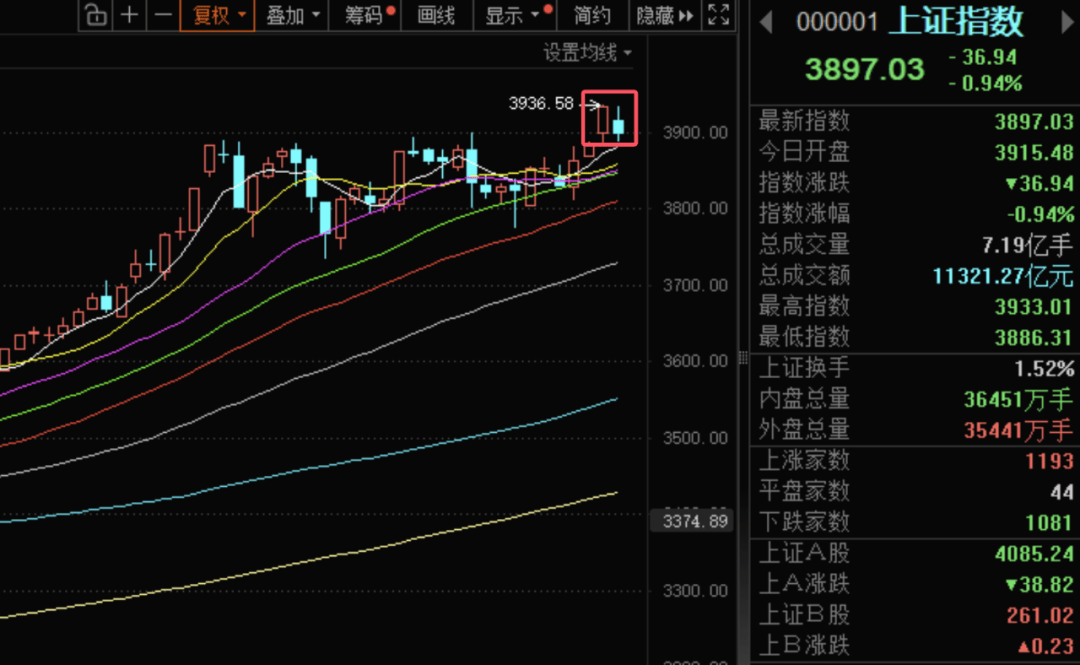
Core Viewpoint - The recent fluctuations in the stock market are primarily driven by regulatory changes affecting technology stocks and escalating trade tensions between China and the U.S. Market Performance - On October 9, the Shanghai Composite Index broke through the 3900-point mark, reaching a new high of 3936 points, but subsequently fell by 0.94% to close at 3897 points on October 10 [2][3]. - The trading volume on October 10 was 7.19 billion shares, with a total turnover of 1.132 trillion yuan [2]. Regulatory Impact - A significant factor for the market's decline on October 10 was the announcement that several brokerages would adjust the margin trading collateral for stocks like SMIC and BVI Storage to zero, reflecting a regulatory requirement for stocks with a static P/E ratio exceeding 300 [5][3]. - This regulatory action is seen as a response to high valuations in the tech sector, which has been experiencing a substantial increase, with the semiconductor sector up 57.19% year-to-date [5]. Trade Tensions - On the night of October 9, China announced a series of export controls on critical materials, including rare earths and lithium batteries, in response to U.S. trade policies [5][6]. - The U.S. has threatened to impose additional tariffs on Chinese goods, which is expected to negatively impact the market, although the severity of this impact is debated [22][26]. Market Sentiment - Despite the negative news, there is a belief that the market may not experience a severe downturn similar to previous instances, as many investors anticipate a recovery following the initial drop [26][28]. - The upcoming trading week is expected to see a decline, but it is viewed as a potential buying opportunity, with expectations that the market will stabilize and eventually break through the 4000-point level [28][29]. Sector Rotation - The current market dynamics suggest a rotation between technology stocks and blue-chip stocks, with the latter expected to support the index during the upcoming fluctuations [31].