
经济复苏

Search documents
日本央行行长植田和男:日本的核心通胀上升不仅受到疫情后经济复苏和紧缩的劳动力市场的推动,还受到供应冲击的影响,这些因素共同推升了国内价格和工资水平。
news flash· 2025-05-27 00:14
Core Insights - The Bank of Japan's Governor Kazuo Ueda stated that Japan's core inflation is rising due to a combination of post-pandemic economic recovery, a tightening labor market, and supply shocks [1] Group 1 - The increase in core inflation is influenced by the economic recovery following the pandemic [1] - A tightening labor market is contributing to the rise in domestic prices and wage levels [1] - Supply shocks are also impacting the inflationary pressures in Japan [1]
博时基金于善辉:AI赋能投研效率 多元配置把握低利率与复苏机遇
Xin Lang Ji Jin· 2025-05-26 01:36
文/博时基金投资决策委员会专职委员于善辉 最近两年,AI技术非常火热,AI赋能为公司的投研带来了显著的变化,主要体现在以下几个方面:信 息收集的效率更高,信息传播的速度更快,信息的覆盖面更广。 此外,AI通过智能化的加工手段,使我们获取信息变得更加容易。这些变化支持我们在投研上能够更 高效地做出决策。当然,AI并不是凭空产生的,它基于现有的信息进行高度浓缩、提炼和高效传播。 因此,有两点非常重要:一是基础信息的质量和噪音问题。我们需要面对并解决这些问题。二是信息本 身虽然重要,但并不能直接产生投资结果。关键在于独立判断和有效结合自己的能力。 在这个过程中,如何稳定获得超额收益,如何在复杂的信息中进行筛选,变得尤为重要。投资人或基金 经理需要有定力,适当做减法,不是所有信息都需要关注。同时,独立思考的时间也很重要,这有助于 形成更有价值和前瞻性的投资判断。信息的挖掘有助于提高胜率,但胜率的提升并不依赖于信息的狂轰 滥炸。 我们关注到,今年以来,FOF基金的业绩和发行规模有所回暖。FOF的规模膨胀达到4倍,这主要是因 为其体量相对较小,发展一波后倍数看起来较大。重要的是,FOF经过牛熊周期的检验,其风险收益特 征 ...
经济复苏成色
SINOLINK SECURITIES· 2025-05-23 05:27
Economic Growth Forecast - The GDP growth rate for Q2 is expected to be around 5.2%, with the first half of the year projected at approximately 5.3%[2] - Monthly GDP growth rates for April and May are estimated at 5.4% and 5.3%, respectively, aligning with demand-side predictions[2] Export and Trade Dynamics - Exports are anticipated to achieve a growth rate of 3%-5% in Q2, driven by "grabbing exports" and "grabbing trans-exports" despite high base effects[2][23] - The easing of trade frictions is expected to enhance export performance, making the real economic fundamentals more noteworthy in Q2[4] Consumer Spending Insights - Retail sales growth for the first four months of the year is at 4.7%, with "trade-in" consumption categories showing a 7.2% increase, contributing approximately 1.1 percentage points to overall retail growth[5] - The impact of "trade-in" policies is projected to support retail sales growth at around 4.5%-5% in Q2, with final consumption growth estimated at about 4.3%[20] Real Estate Market Trends - Real estate sales are facing downward pressure as the effects of the 924 policy diminish, with a 1-4 month cumulative decline in new housing sales area of -2.8% compared to -17.1% in the previous year[14] - The second-hand housing market showed a significant increase of 21.1% in transaction area from October 2024 to March 2025, but recent data indicates a cooling trend[14] Investment and Policy Implications - Fixed asset investment growth is expected to stabilize around 4%, supported by equipment updates and infrastructure projects, with manufacturing and infrastructure investment showing year-on-year increases of 8.8% and 10.9% respectively[23] - The overall economic stability in the first half of the year provides ample room for policy responses to external uncertainties, with sufficient flexibility for incremental policy adjustments in Q3[2][20]
【环球财经】欧元区服务业PMI走弱
Xin Hua Cai Jing· 2025-05-22 13:50
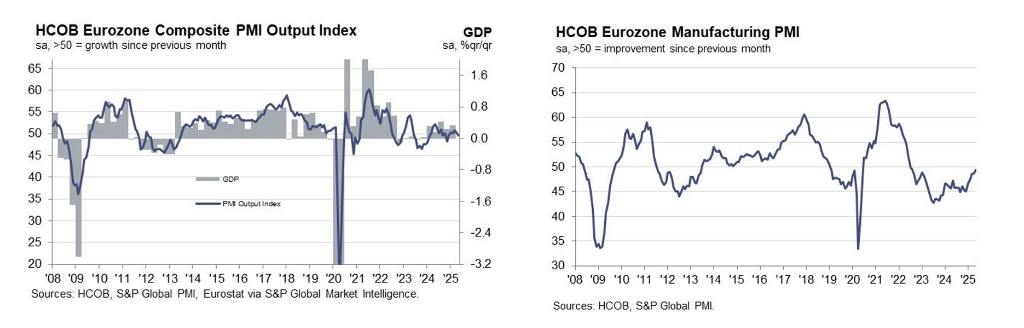
Group 1 - The core viewpoint of the articles indicates that the Eurozone's economic activity is experiencing a contraction, with the composite PMI falling from 50.4 in April to 49.5 in May, below market expectations [1] - The services sector PMI dropped to 48.9, the lowest since January 2024, significantly below the expected 50.3 and previous value of 50.1, indicating weakened demand and declining business confidence [1] - Manufacturing PMI showed signs of stabilization, rising to 49.4, above the previous value of 49.0 and the expected 49.3, with output index remaining in expansion territory at 51.5 for the second consecutive month [1] Group 2 - The analysis highlights that the Eurozone's economic momentum is insufficient, with the services sector's long-standing role as a growth engine being challenged, particularly under the pressures of global trade tensions and policy uncertainties [2] - There is an expectation that the European Central Bank will lower the deposit rate by 25 basis points to 2.00% in the upcoming meeting on June 5, which could further boost business confidence [1]
欧元区5月PMI意外萎缩,服务业创16个月来最差表现
Hua Er Jie Jian Wen· 2025-05-22 11:25
Core Viewpoint - The Eurozone economy unexpectedly contracted in May, with the services sector experiencing its worst performance in 16 months, overshadowing a slight improvement in manufacturing [1][5]. Group 1: Economic Activity - Eurozone private sector activity unexpectedly shrank in May, primarily due to weak performance in the services sector [5]. - France's economic activity has contracted for nine consecutive months, with a composite PMI rising slightly from 47.8 in April to 48 in May, still below the 50 threshold [4][7]. - Germany's PMI data also disappointed, with a decline in the services sector, although infrastructure reforms and military rebuilding plans by the new government may provide future support [10]. Group 2: PMI Data - The Eurozone composite PMI fell from 50.4 in April to 49.5 in May, below analysts' expectations of 50.6 [6]. - The services PMI preliminary value was 48.9, lower than the expected 50.5 and previous value of 50.1 [6]. - The manufacturing PMI preliminary value was 49.4, slightly above the expected 49.2 and previous value of 49 [6]. Group 3: Sector Performance - The weak performance of the services sector is the key factor leading to the overall PMI decline, indicating a more challenging road to recovery for the Eurozone economy [5]. - Despite the overall poor data, the Eurozone's manufacturing sector showed improvement, marking the first time since the pandemic began that manufacturing outperformed services [5]. - In Spain and other Southern European countries, performance was relatively better, with strong tourism demand reported by Ryanair Holdings Plc [13].

2025贸易冲击对全球经济的影响研究报告:复苏风险持续攀升
Sou Hu Cai Jing· 2025-05-22 09:57
Economic Outlook - Global economic growth is projected to decline from 3.2% to 2.7% in 2025 if new tariffs are implemented by the US [1][7] - The US economy is expected to slow down to 2.4% growth in 2025 from 2.8% in the previous year [1][7] - The Eurozone is forecasted to achieve only 1% growth in 2025, with Germany facing stagnation or a slight recession [1][7] Trade and Tariffs - New tariffs proposed by the US could significantly impact global trade, with potential tariffs of 60% on Chinese imports and 10-25% on imports from other countries [13][15] - The tariffs are expected to reduce global GDP by approximately 0.3% to 0.5% by 2026, with a notable decrease in global imports and exports by around 4% [18] - Germany, as an export-oriented economy, could see its GDP reduced by 0.4% in 2025 due to these trade restrictions [18] Monetary Policy - Central banks are facing challenges, with the Federal Reserve expected to maintain interest rates around 4% while the European Central Bank plans further cuts [2][7] - Diverging financial policies are affecting exchange rates, leading to a stronger US dollar against the euro and yen [2][7] Investment Environment - High interest rates are suppressing investment levels, particularly in construction and equipment, despite a recovery in consumer demand [2][3] - Emerging markets, especially in Asia, are showing stronger industrial production growth compared to regions like Africa and the Middle East [2][3] Consumer Behavior - In the US, consumer confidence remains low despite rising wages, with spending not increasing as expected due to inflationary pressures [3][4] - In Europe, countries like France and Italy are facing fiscal challenges that could hinder economic growth [3][4] Structural Challenges - The global economy is experiencing a complex recovery, with governments needing to balance economic stimulus and debt control [4] - Political uncertainties, particularly in the US and Europe, are complicating long-term economic planning for businesses [3][4]

风险月报 | 中美互降关税后市场基本面、预期回暖,市场情绪有所下降
中泰证券资管· 2025-05-22 09:52
截至2025年5月20日,中泰资管风险系统对各大资本市场的系统评分情况如下: 沪深300指数的中泰资管风险系统评分为42.04,较上月45.53有所下降,权益评分仍属中等偏低风险区间。 结合上期数据来看,本期在估值和预期回暖的同时,情绪得分却有所下滑。 沪深300估值较上月有所上升(本月43.53,上月38.93)。估值整体有所回升,其中国防军工回升最为明 显,但行业间估值分化现象依然延续。目前,28个申万一级行业中钢铁、房地产、商业、国防军工、计算 机、汽车的行业估值高于历史60%分位数;农林牧渔、非银金融等行业的估值低于历史10%分位数。市场 整体估值的调整,反映了市场对经济复苏节奏和企业盈利预期的重新评估。 市场预期分数较上月有所上升(本月55.00,上月48.00)。宏观分析师认为,4月金融数据显示政策靠前发 力和低基数支撑社融,实体经济融资需求仍弱。中美互降关税后,投资者对于全球经济形势的担忧情绪有 所缓解。 市场情绪较上月有所下降(本月34.07,上月50.89;分数越低表示市场情绪越低迷),需要指出的是,统 计期内市场预期体现的是专业投资者对于市场的判断,而情绪指标则反应的是整体市场的交易情况。 ...

德国企业信心现回暖迹象 结构性矛盾仍制约经济复苏
Zhi Tong Cai Jing· 2025-05-22 09:48
政策层面出现积极信号。德国总理弗里德里希·梅尔茨组建的独立经济顾问小组周二提交报告称,政府 正在推进的基础设施升级与国防重组计划有望为2026年经济注入活力。 该小组负责人莫妮卡·施尼策尔在接受采访时强调:"财政扩张已成为德国经济破局的关键突破口,当前 最紧迫的是确保资金快速精准投放。"她同时警示,行政审批流程改革与营商环境优化需与财政刺激形 成政策合力。 周四早间公布的5月PMI初值显示,德国私营部门综合产出指数意外萎缩,服务业活动创两年半以来最 差表现,仅有制造业呈现边际改善。 制约经济复苏的深层矛盾持续显现:全球需求疲软与贸易政策波动形成双重挤压,人口老龄化与行政审 批效率低下等结构性问题进一步加剧增长瓶颈。 (原标题:德国企业信心现回暖迹象 结构性矛盾仍制约经济复苏) 智通财经APP获悉,德国经济研究机构Ifo最新数据显示,5月企业预期指数较上月回升1.5个点至88.9, 超出彭博调查预测的88中值,但同期衡量经济现状的指标出现小幅回落。Ifo研究所主席克莱门斯·菲斯 特在周四发布的声明中指出:"近期困扰企业的贸易政策不确定性有所缓解,德国经济正逐步积累复苏 动能。" 作为欧元区最大经济体,德国当前仍 ...
新西兰财政部长:贸易关税将影响经济复苏的速度,预计新西兰2025/26财年的国内生产总值预计2.9%,2026/27财年增长3.0%。
news flash· 2025-05-22 02:03
新西兰财政部长:贸易关税将影响经济复苏的速度,预计新西兰2025/26财年的国内生产总值预计 2.9%,2026/27财年增长3.0%。 ...
市场分析:电池汽车行业领涨,A股小幅上扬
Zhongyuan Securities· 2025-05-21 13:09
Investment Rating - The industry is rated as "stronger than the market," indicating an expected increase of over 10% in the industry index relative to the CSI 300 index over the next six months [18]. Core Viewpoints - The A-share market experienced slight fluctuations with a small upward trend, supported by strong performances in the automotive, battery, shipping, and chemical pharmaceutical sectors [3][7]. - The average price-to-earnings ratios for the Shanghai Composite Index and the ChiNext Index are 13.84 times and 36.88 times, respectively, which are at the median levels over the past three years, suggesting a favorable environment for medium to long-term investments [3][17]. - The first quarter GDP growth was reported at 5.4%, indicating strong economic recovery momentum, with improvements in corporate profit growth and cash flow providing fundamental support for the market [3][17]. Summary by Sections A-share Market Overview - On May 21, the A-share market opened flat and experienced slight upward movement, with the Shanghai Composite Index facing resistance around 3394 points. The market showed a general upward trend throughout the day, with significant performances in the automotive and battery sectors [2][7]. - The total trading volume for both markets reached 12,146 billion, which is above the median of the past three years [3][17]. Future Market Outlook and Investment Recommendations - The market is expected to maintain a steady upward trend in the short term, with structural market conditions likely to continue. Policy support and a loose liquidity environment are anticipated to provide a bottom support for the market [3][17]. - Short-term investment opportunities are recommended in the automotive, battery, shipping, and chemical pharmaceutical sectors [3][17].