美联储货币政策

Search documents
华宝期货晨报铝锭-20251128
Hua Bao Qi Huo· 2025-11-28 03:43
Group 1: Report Industry Investment Rating - No relevant content provided Group 2: Core Views -成材预计震荡整理运行,因其在供需双弱格局下市场情绪悲观,价格重心下移,且今年冬储低迷对价格支撑不强[4] -铝土矿预计价格维持弱势震荡,虽北方地区国产矿供应偏紧,但铝土矿绝对库存仍处高位,氧化铝厂加价采购意愿偏低[4] -铝价预计短期高位震荡,宏观多空情绪交织,基本面对海外供应收紧有预期,国内淡季来临消费延后兑现,库存走势反复且上方有压力[5] Group 3: Summary by Related Catalogs 成材方面 -云贵区域短流程建筑钢材生产企业春节停产检修预计影响总产量74.1万吨,复产预计在正月初十一至正月十六左右[3] -安徽省6家短流程钢厂,1家1月5日已停产,大部分1月中旬左右停产,个别1月20日后停产,停产日度影响产量1.62万吨左右[4] -2024年12月30日 - 2025年1月5日,10个重点城市新建商品房成交面积环比降40.3%,同比增43.2%[4] -成材昨日震荡下行价格创新低,市场情绪悲观,价格重心下移,冬储低迷对价格支撑不强[4] 铝土矿方面 -北方地区国产矿供应偏紧格局延续,因接受环保督察开采未恢复,但铝土矿绝对库存高位,供应整体宽松,氧化铝厂加价采购意愿低[4] 铝价方面 -本周国内铝加工龙头企业周度开工率环比增0.3%至62.3%,铝型材等板块开工有好转[4] -周度铝水比例连续三周回落,铝锭供应压力略增,但铝价高位回落使近一周国内铝锭和铝棒出库量环比分别增20%和13%,带动铝锭库存降至60万吨以下[4] -11月27日国内主流消费地电解铝锭库存59.60万吨,较周一下跌1.7万吨,较上周四下跌2.5万吨[4]
宏观金融类:文字早评2025/11/28星期五-20251128
Wu Kuang Qi Huo· 2025-11-28 01:42
Report Industry Investment Rating No relevant content provided. Core Viewpoints - After recent continuous declines, the index is expected to stabilize in the short - term. Policy support for the capital market remains unchanged, and technology growth is still the market's main theme. The medium - to long - term approach for the index is to go long on dips [4]. - In the fourth quarter, the supply - demand pattern of the bond market may improve. The market is currently in a situation of weak domestic demand recovery and improved inflation expectations, maintaining an overall oscillatory trend. Attention should be paid to the linkage between stocks and bonds and the impact of liquidity [6]. - The expectation of the Fed's loose monetary policy has significantly rebounded, and the overseas interest - rate cut cycle will continue. It is recommended to go long on precious metals on dips [9]. - Most metal prices are expected to oscillate. Some metals have strong price support due to supply - demand relationships, while others may face downward pressure due to factors such as over - supply or weak demand [12][14][16]. - The demand for steel has officially entered the off - season, and the inventory pressure of hot - rolled coils remains. Steel prices are likely to continue weak oscillations in the short term, but there may be a marginal inflection point in demand later [33]. - The prices of most energy - chemical products are expected to oscillate. Some products may have short - term upward or downward trends due to factors such as supply - demand changes and cost fluctuations [54][55]. - The prices of most agricultural products are expected to oscillate. Some products may face downward pressure due to over - supply, while others may have short - term upward potential due to factors such as production reduction expectations [73][82]. Summary by Directory Macro - financial Stock Index - **Market Information**: There are over 150 humanoid robot enterprises in China, and the NDRC encourages the development of new energy storage and hydrogen energy technologies. OPEC+ may reach an agreement on a mechanism to evaluate member countries' maximum production capacity. JPMorgan Chase has upgraded the rating of A - shares to "overweight" [2]. - **Strategy Viewpoint**: After recent declines, the index is expected to stabilize in the short - term. The long - term approach is to go long on dips, with technology growth as the main theme [4]. Treasury Bonds - **Market Information**: On Thursday, the main contracts of TL, T, TF, and TS had positive changes. From January to October, the total profit of industrial enterprises above the designated size increased by 1.9% year - on - year. The NDRC has arranged special treasury bonds for "two major" construction projects. The central bank conducted a net injection of 564 billion yuan through reverse repurchase operations on Thursday [5]. - **Strategy Viewpoint**: In October, the economic data on both the supply and demand sides were weak. The growth rate of social financing may remain weak at the end of the year. The central bank is maintaining an attitude of protecting funds. The bond market is expected to oscillate in the fourth quarter [6]. Precious Metals - **Market Information**: Shanghai gold and silver futures rose, and COMEX gold and silver prices also had certain trends. The market is mainly concerned about the Fed's subsequent personnel changes and monetary policy expectations. The probability of a 25 - basis - point interest - rate cut by the Fed in December is 86.9% [7][8]. - **Strategy Viewpoint**: The expectation of the Fed's loose monetary policy has rebounded. It is recommended to go long on precious metals on dips [9]. Non - ferrous Metals Copper - **Market Information**: Geopolitical concerns have resurfaced, and the RMB has slightly depreciated. LME copper prices have declined, and domestic copper inventories have decreased. The import loss of domestic copper has widened [11]. - **Strategy Viewpoint**: The probability of an interest - rate cut by the Fed in December is high, but there are still uncertainties in the geopolitical situation. The supply of copper raw materials is tight, and the price support is strong. The reference range for the Shanghai copper main contract is 86,200 - 87,800 yuan/ton [12]. Aluminum - **Market Information**: Aluminum prices have corrected. Domestic aluminum ingot inventories have decreased, and LME aluminum inventories have also decreased [13]. - **Strategy Viewpoint**: The global visible inventory of aluminum ingots is relatively low, and the price support is strong. Although the downstream is entering the off - season, the inventory accumulation pressure is not large. The price may strengthen after adjustment. The reference range for the Shanghai aluminum main contract is 21,400 - 21,700 yuan/ton [14]. Zinc - **Market Information**: The Shanghai zinc index rose slightly. Domestic and LME zinc inventories have certain trends, and the import loss of zinc ingots is relatively large [15][16]. - **Strategy Viewpoint**: Zinc ore imports declined significantly in October, and the supply of zinc ore is tight during the winter stockpiling period of smelters. However, it is expected to loosen marginally after stockpiling. The zinc industry is still in an over - supply cycle, and zinc prices are expected to be weak in the short term [16]. Lead - **Market Information**: The Shanghai lead index declined. Domestic and LME lead inventories have certain trends, and the import profit of lead ingots is relatively small [17]. - **Strategy Viewpoint**: The supply of lead ingots is increasing, and the export of lead - acid batteries is declining. Lead prices are expected to decline at a slower pace in the short term [17]. Nickel - **Market Information**: Nickel prices oscillated narrowly. The prices of nickel ore and nickel pig iron have certain trends, and the supply of refined nickel raw materials is expected to increase [18]. - **Strategy Viewpoint**: The fundamentals of nickel are under pressure, and prices are expected to be under pressure in the short term. It is not recommended to chase short or bottom - fish. The reference range for Shanghai nickel prices is 113,000 - 118,000 yuan/ton [18]. Tin - **Market Information**: The Shanghai tin main contract rose. The production of tin smelters in Yunnan and Jiangxi is at a high level, and the demand in emerging fields provides support for tin prices. The inventory has increased slightly [20]. - **Strategy Viewpoint**: The short - term supply and demand of tin are in a tight balance. It is expected that tin prices will oscillate. It is recommended to wait and see. The reference range for the domestic main contract is 280,000 - 310,000 yuan/ton [21]. Carbonate Lithium - **Market Information**: The spot index of carbonate lithium declined. The price of the LC2605 contract also declined [22]. - **Strategy Viewpoint**: Domestic production has declined, and inventory has decreased. There are differences in the market's expectations for next year's demand. It is recommended to wait and see or use options. The reference range for the Guangzhou Futures Exchange's carbonate lithium 2605 contract is 91,200 - 99,600 yuan/ton [23]. Alumina - **Market Information**: The alumina index rose slightly. The price of overseas ore has declined, and the inventory of futures has decreased [24]. - **Strategy Viewpoint**: The supply of overseas ore is expected to increase, and the alumina smelting industry has an over - supply situation. It is recommended to wait and see in the short term. The reference range for the domestic main contract AO2601 is 2,600 - 2,900 yuan/ton [26]. Stainless Steel - **Market Information**: The stainless - steel main contract declined. The prices of spot and raw materials remained stable, and the inventory decreased [27]. - **Strategy Viewpoint**: The spot market price is stable, and the sales of 300 - series stainless steel are relatively good. However, the consumption in related fields is weak, and the inventory removal speed is slow. Stainless - steel prices are expected to oscillate [28]. Cast Aluminum Alloy - **Market Information**: The price of cast aluminum alloy fluctuated. The inventory of domestic aluminum alloy ingots decreased, and the inventory in factories increased [29]. - **Strategy Viewpoint**: The cost of cast aluminum alloy provides strong support, and the price is expected to follow the trend of aluminum prices in the short term [30]. Black Building Materials Steel - **Market Information**: The prices of rebar and hot - rolled coil futures declined. The prices of spot rebar and hot - rolled coil also decreased [32]. - **Strategy Viewpoint**: The supply and demand of rebar have both declined, and the inventory has been continuously removed. The production of hot - rolled coils has increased, and the inventory removal is slow. The export of steel to South Korea may be affected. Steel prices are expected to continue weak oscillations in the short term [33]. Iron Ore - **Market Information**: The iron - ore main contract rose slightly. The price of spot iron ore and the basis have certain trends [34]. - **Strategy Viewpoint**: The overseas shipment of iron ore has decreased, and the demand from steel mills has weakened. The inventory of iron ore is relatively high, and the price is expected to oscillate. If the molten iron output continues to decline, the ore price may decline in the short term [35]. Glass and Soda Ash - **Market Information**: The glass main contract rose slightly, and the inventory decreased. The soda - ash main contract rose slightly, and the inventory decreased [36][38]. - **Strategy Viewpoint**: The cold - repair expectation of glass production lines in December is increasing, and the supply is expected to shrink. The demand for glass is weak, and the price is expected to oscillate at the bottom. The supply of soda ash is in an over - supply situation, and the price is expected to remain weak [37][38]. Manganese Silicon and Ferrosilicon - **Market Information**: The prices of manganese - silicon and ferrosilicon futures declined. The prices of spot manganese - silicon and ferrosilicon also decreased [39]. - **Strategy Viewpoint**: The risk appetite of the market has weakened, and the prices of ferrous alloys have declined. However, the expectation of an interest - rate cut by the Fed in December has rebounded. It is recommended to pay attention to the inflection point of market sentiment. For the black sector, it may be more cost - effective to look for opportunities to rebound [40][42]. Industrial Silicon and Polysilicon - **Market Information**: The price of industrial - silicon futures rose slightly, and the inventory decreased. The price of polysilicon futures declined, and the inventory increased [43][45]. - **Strategy Viewpoint**: The production of industrial silicon is declining, and the demand is relatively stable. The price is expected to oscillate. The production of polysilicon is declining, and the supply - demand pattern may improve marginally. The price is expected to oscillate in a wide range [44][46]. Energy and Chemicals Rubber - **Market Information**: Rubber prices rebounded. The flood in Thailand's rubber - producing areas is a positive factor, but the subsequent rainfall has decreased. The inventory of exchange - traded RU is low [48]. - **Strategy Viewpoint**: It is recommended to take a neutral approach and conduct short - term trading. It is recommended to partially build a hedging position by buying RU2601 and selling RU2609 [52]. Crude Oil - **Market Information**: The prices of crude - oil and refined - oil futures rose. The US EIA data shows that the inventory of crude oil and some refined oils has increased [53]. - **Strategy Viewpoint**: Although the geopolitical premium has disappeared, the supply of OPEC has not increased significantly. It is recommended to take a wait - and - see approach in the short term and adopt a low - buy and high - sell strategy [54]. Methanol - **Market Information**: The price of methanol futures rose, and the basis decreased. The price of spot methanol also increased [55]. - **Strategy Viewpoint**: The potential positive factors of Iran's plant shutdown have been realized, and the market has stopped falling and stabilized. The supply is expected to remain high, and the market is expected to oscillate after the positive factors are realized [55]. Urea - **Market Information**: The price of urea futures rose, and the basis decreased. The price of spot urea also increased [56]. - **Strategy Viewpoint**: The price of urea is expected to gradually emerge from the bottom range. The supply is relatively high, and the demand has improved. It is recommended to go long on dips at low prices [56]. Pure Benzene and Styrene - **Market Information**: The price of pure - benzene futures remained unchanged, and the basis increased. The price of styrene futures declined, and the basis decreased [57]. - **Strategy Viewpoint**: The supply of styrene is under pressure, and the BZN spread has room for upward repair. The price of styrene may stop falling temporarily [58]. PVC - **Market Information**: The price of PVC futures rose, and the basis decreased. The cost of PVC remained stable, and the inventory increased [59]. - **Strategy Viewpoint**: The supply of PVC is in an over - supply situation, and the demand is weak. It is recommended to go short on rallies in the medium term [60]. Ethylene Glycol - **Market Information**: The price of ethylene - glycol futures declined, and the basis decreased. The inventory of ethylene glycol remained unchanged [61]. - **Strategy Viewpoint**: The supply of ethylene glycol is expected to decline in December, and the inventory accumulation may slow down. It is recommended to go short on rallies in the medium term [62]. PTA - **Market Information**: The price of PTA futures declined, and the basis decreased. The inventory of PTA decreased [63]. - **Strategy Viewpoint**: The supply of PTA is expected to increase, and the demand is expected to remain high in the short term. The processing fee of PTA has limited upward space, and there is a risk of PXN valuation correction [64]. Para - Xylene - **Market Information**: The price of PX futures declined, and the basis increased. The inventory of PX increased [65]. - **Strategy Viewpoint**: The load of PX remains high, and the inventory is difficult to continuously remove. The valuation of PX is at a neutral level, and there is a risk of valuation correction [66]. Polyethylene (PE) - **Market Information**: The price of PE futures declined, and the basis increased. The inventory of PE decreased [67]. - **Strategy Viewpoint**: The price of crude oil may have bottomed out. The valuation of PE has limited downward space, but the high number of warehouse receipts suppresses the price. It is recommended to short the LL - 1 - 5 spread on rallies [68]. Polypropylene (PP) - **Market Information**: The price of PP futures rose, and the basis decreased. The inventory of PP decreased [69]. - **Strategy Viewpoint**: The supply of PP is under pressure, and the demand is seasonally oscillating. The inventory pressure is high. The price may be supported after the supply - over - supply situation changes in the first quarter of next year [70]. Agricultural Products Hogs - **Market Information**: The domestic hog price mainly declined. The market demand is increasing slowly, and the supply of hogs is abundant [72]. - **Strategy Viewpoint**: The theoretical supply of hogs is still large, and the demand is weak. It is recommended to short near - term contracts or conduct reverse - spread trading [73]. Eggs - **Market Information**: The national egg price was stable with some increases. The supply is stable, and the downstream digestion speed is average [74]. - **Strategy Viewpoint**: The egg - price futures have rebounded in advance, but the spot price has not followed up as expected. The short - term trend is expected to oscillate. It is recommended to conduct reverse - spread trading in the near - term and far - term contracts, and short on rallies in the medium term [75]. Soybean and Rapeseed Meal - **Market Information**: The CBOT soybean market was closed due to a holiday. The domestic soybean - meal price was stable, and the inventory increased [76]. - **Strategy Viewpoint**: The global supply of soybeans has decreased, and the domestic soybean inventory is at a high level. The price of soybean meal is expected to oscillate [77]. Oils - **Market Information**: The export of Malaysian palm oil has decreased, and the production has increased. The domestic oil price rebounded [78]. - **Strategy Viewpoint**: The over - supply of palm oil may reverse in the fourth quarter and the first quarter of next year. It is recommended to try to go long on dips [79][80]. Sugar - **Market Information**: The Zhengzhou sugar futures price oscillated strongly. The global sugar supply is expected to be in surplus, and the domestic sugar price is at a relatively low level [81]. - **Strategy Viewpoint**: The global sugar supply - demand relationship has changed from shortage to surplus. It is recommended to short on rallies and close positions when the price falls [82]. Cotton - **Market Information**: The Zhengzhou cotton futures price oscillated narrowly. The downstream spinning - mill operating rate decreased, and the global cotton production increased [83]. - **Strategy Viewpoint**: The demand for cotton is not too bad after the peak season, and the market has digested the negative impact of high yields. The cotton price is expected to oscillate in the short term [84].
贵金属:贵金属日报-20251128
Wu Kuang Qi Huo· 2025-11-28 01:42
1. Report Industry Investment Rating - No information provided regarding the report industry investment rating 2. Core Viewpoints of the Report - The current focus of the precious metals market is the subsequent personnel changes at the Federal Reserve and the resulting monetary policy expectations, making gold and silver prices prone to rise and difficult to fall [1] - If Hassett is officially nominated as the new Federal Reserve Chairman next month, the market will further trade the impact of the weakened independence and influence of the Federal Reserve on the US dollar's credit [2] - The expectation of the Federal Reserve's loose monetary policy has significantly rebounded after the speeches of key voting members of the Fed, and the overseas interest - rate cut cycle will continue. The further driving force will be concentrated in December. It is recommended to buy on dips in the precious metals strategy [3] 3. Summary According to Related Contents Market Quotes - On November 28, 2025, Shanghai gold rose 0.02% to 946.90 yuan/g, Shanghai silver rose 1.29% to 12,490.00 yuan/kg; COMEX gold was reported at 4,194.00 US dollars/ounce, COMEX silver was reported at 53.82 US dollars/ounce; the US 10 - year Treasury yield was reported at 4%, and the US dollar index was reported at 99.53 [1] Federal Reserve Personnel and Policy Expectations - Foreign media reported that Hassett, the current director of the White House Economic Council, is the most popular candidate for the next Federal Reserve Chairman. His appointment would bring Trump's intentions into the Federal Reserve, greatly impacting its monetary policy independence. He said this month that he would cut interest rates if he were the Fed Chairman now [2] - Trump's policy team members, US Treasury Secretary Bessent and current Fed Governor Milan, expressed the need for the Fed to conduct "natural balance - sheet reduction" while buying US Treasuries, aiming to weaken the Fed's influence on the economy [2] - The CME interest - rate observer shows that the market expects an 86.9% probability of a 25 - basis - point interest - rate cut at the Fed's December meeting and a 13.1% probability of keeping the interest rate unchanged [2] Strategy Suggestions - The expectation of the Federal Reserve's loose monetary policy has significantly rebounded, and the overseas interest - rate cut cycle will continue. The further driving force will be concentrated in December. On December 10, the Fed will hold its last interest - rate meeting of the year and release an economic outlook report. Trump will probably complete the selection of the new Fed Chairman in late December [3] - It is recommended to buy on dips in the precious metals strategy. The reference operating range for the main contract of Shanghai gold is 917 - 967 yuan/g, and for the main contract of Shanghai silver is 12,036 - 13,000 yuan/kg [3] Data Summary - For gold on November 27, 2025, compared with the previous day, COMEX gold's closing price, trading volume, and open interest increased, while inventory decreased slightly; LBMA gold's closing price increased; SHFE gold's closing price, open interest, and precipitation funds increased, while trading volume decreased; AuT + D's closing price and open interest increased, while trading volume decreased [5] - For silver on November 27, 2025, compared with the previous day, COMEX silver's closing price, open interest, and trading volume increased, while inventory decreased; LBMA silver's closing price increased; SHFE silver's closing price, open interest, trading volume, and precipitation funds increased, while inventory increased; AgT + D's closing price and trading volume increased, while open interest decreased [5]
商品期货早班车-20251128
Zhao Shang Qi Huo· 2025-11-28 01:10
1. Report Industry Investment Ratings No relevant content provided. 2. Core Views The report provides a comprehensive analysis of various commodity futures markets, including precious metals, base metals, agricultural products, and energy chemicals. It assesses the market performance, fundamentals, and offers trading strategies for each sector. 3. Summary by Category Precious Metals - **Gold Market** - Market Performance: On Thursday, precious metal prices fluctuated, with London gold reaching $4150 per ounce [2]. - Fundamentals: Putin discussed a peace plan, China's industrial profits showed changes, and there were various inventory changes in gold and silver [2]. - Trading Strategy: Buy gold at the lower support level, and short - term long silver due to overseas market tensions [2]. - **Silver Market** - Market Performance: Reflects in inventory and price changes in different markets [2]. - Fundamentals: Inventory changes in multiple regions and import data from India [2]. - Trading Strategy: Short - term long due to overseas market tensions [2]. Base Metals - **Aluminum** - Market Performance: The electrolytic aluminum main contract closed +0.21% at 21,500 yuan/ton, with a domestic 0 - 3 month spread of - 150 yuan/ton [3]. - Fundamentals: High - load production in electrolytic aluminum plants, stable weekly aluminum product start - up rate [3]. - Trading Strategy: Prices are expected to fluctuate due to a warm macro - environment, inventory reduction, and expanding spot discounts [3]. - **Alumina** - Market Performance: The main contract closed +0.15% at 2724 yuan/ton, with a domestic 0 - 3 month spread of 18 yuan/ton [3]. - Fundamentals: No long - cycle maintenance and production reduction, high - load production in electrolytic aluminum plants [3]. - Trading Strategy: Prices are expected to be weakly fluctuating before large - scale production cuts due to supply - demand surplus and cost support [3]. - **Industrial Silicon** - Market Performance: The main 01 contract closed at 9115 yuan/ton, up 95 yuan/ton, with a decrease in positions and funds [3]. - Fundamentals: Decrease in furnace start - up, expected decline in south - west start - up rate, and different demand situations in downstream industries [3]. - Trading Strategy: The market is expected to trade between 8600 - 9400 yuan/ton, and it is recommended to wait and see [3]. - **Polysilicon** - Market Performance: The main 01 contract closed at 55235 yuan/ton, down 660 yuan/ton, with changes in positions and funds [4]. - Fundamentals: Slight decline in weekly production, inventory accumulation, and weakening demand in downstream industries [4]. - Trading Strategy: It is recommended to wait and see due to expected decline in downstream production and market uncertainties [4]. Agricultural Products - **Soybean and Soybean Meal** - Market Performance: CBOT soybeans are in short - term oscillation [5]. - Fundamentals: Near - term supply contraction, long - term large supply from South America, strong US soybean crushing, and uncertain exports [5]. - Trading Strategy: Wait for new drivers in the US soybean market, and the domestic market's mid - term trend depends on tariff policies and production [5]. - **Corn** - Market Performance: Corn futures prices fluctuate narrowly, with different trends in spot prices in North and Northeast China [5]. - Fundamentals: Supply delay due to weather, low inventory, strong demand from deep - processing industries, and expected increase in new - crop production [5]. - Trading Strategy: Pay attention to selling hedging opportunities as Northeast supply increases [5]. - **Fats and Oils** - Market Performance: The Malaysian palm oil market rose due to flood concerns [5]. - Fundamentals: High production in the producing areas, expected inventory accumulation in the near term, and seasonal production reduction in the long term [5]. - Trading Strategy: Trade the flood - related disturbances and pay attention to future production and biodiesel policies [5]. - **Sugar** - Market Performance: Zhengzhou sugar 01 contract closed at 5411 yuan/ton, up 0.24% [5]. - Fundamentals: International sugar prices are expected to decline in the long term, and the domestic market faces pressure in the fourth quarter [5]. - Trading Strategy: Short in the futures market and sell call options [5]. - **Cotton** - Market Performance: US cotton futures prices rebounded overnight, and international crude oil prices stopped falling [6]. - Fundamentals: Changes in international cotton export and import data, and stable domestic downstream demand [6]. - Trading Strategy: Buy at low prices, with a strategy in the 13600 - 13900 yuan/ton range [6]. - **Eggs** - Market Performance: Egg futures prices rebounded, and spot prices were stable [6]. - Fundamentals: Decrease in laying hen inventory, increased stocking by traders, and short - term strong egg prices with limited sustainability [6]. - Trading Strategy: Egg futures prices are expected to fluctuate [6]. - **Pigs** - Market Performance: Pig futures prices rebounded, and spot prices continued to fall [6]. - Fundamentals: Abundant pig supply, expected seasonal increase in demand, and possible concentrated slaughter near the winter solstice [6]. - Trading Strategy: Pig futures prices are expected to be weakly fluctuating [6]. Energy Chemicals - **LLDPE** - Market Performance: The main contract continued to decline slightly, with stable basis and general market transactions [7]. - Fundamentals: New device production, reduced supply pressure, and weakening downstream demand [7]. - Trading Strategy: Short - term weak oscillation, and in the long term, it is recommended to short at high prices or conduct month - spread reverse arbitrage [7]. - **PVC** - Market Performance: V01 closed at 4546, up 1% [7]. - Fundamentals: Low prices, increased inventory, increased supply, and weak demand [7]. - Trading Strategy: Short or conduct reverse arbitrage due to weak supply - demand [7]. - **PTA** - Market Performance: PX and PTA prices showed certain trends, with a specific spot basis [8]. - Fundamentals: High domestic PX supply, short - term PTA supply decline, and overall supply - demand situations in related industries [8]. - Trading Strategy: Take profit on PX long positions, and stop loss on PTA processing - fee short positions [8]. - **Rubber** - Market Performance: RU2601 oscillated upward, with continued night - session gains [8]. - Fundamentals: Stable raw material prices, different production situations in tire factories [8]. - Trading Strategy: Short - term strong oscillation due to rainfall affecting production [8]. - **Glass** - Market Performance: FG01 closed at 1060, up 1.9% [8]. - Fundamentals: Bottom - up rebound due to cold - repair and cost support, high inventory, and weak real - estate data [8]. - Trading Strategy: Exit reverse arbitrage due to upstream production cuts [8]. - **PP** - Market Performance: The main contract continued to decline slightly, with stable basis and general market transactions [8]. - Fundamentals: New device production, increased supply, and weakening demand [8]. - Trading Strategy: Short - term weak oscillation, and in the long term, short at high prices or conduct month - spread reverse arbitrage [8]. - **MEG** - Market Performance: East China spot price and basis are provided [9]. - Fundamentals: High - level supply, inventory accumulation, and situations in related industries [9]. - Trading Strategy: Short at high prices for the 01 contract and take partial profit on short positions [9]. - **Benzene and Styrene** - Market Performance: The main contract fluctuated slightly, with a certain market trading atmosphere [9]. - Fundamentals: Inventory situations in pure benzene and styrene, and weak downstream demand [9]. - Trading Strategy: Short - term oscillation, with limited upward space [9]. - **Soda Ash** - Market Performance: sa01 closed at 1190, up 1% [9]. - Fundamentals: Supply - demand balance, high inventory, and downstream demand situations [9]. - Trading Strategy: Wait and see due to supply - demand balance [9].
中美刚通话,人民币升值创1年新高,特朗普敲打日本,重视对我们经济
Sou Hu Cai Jing· 2025-11-27 16:32
Group 1 - The emergency call between President Trump and Japanese Prime Minister Suga lasted about 25 minutes, occurring shortly after a call with Chinese leaders, indicating a strategic diplomatic maneuver [3][8] - The offshore RMB to USD exchange rate surged past 7.09, reaching a new high in over a year, reflecting market optimism regarding US-China relations [3][8] - The Chinese yuan's strong performance is attributed to better-than-expected export figures and a recovering domestic economy, contrasting with the pressures faced during previous trade tensions [8][16] Group 2 - Trump's communication with Suga included a summary of the US-China call, which is unusual in diplomatic practice, suggesting an effort to stabilize US-Japan relations [10][11] - The recent political dynamics in the US, including Trump's declining approval ratings and upcoming midterm elections, are influencing the administration's foreign policy towards seeking stability [16] - The interaction between the US, China, and Japan reflects not only political ties but also economic connections, as seen in the performance of Chinese companies like Alibaba and their investment strategies [17]


美联储“褐皮书”显示关税致美制造业和零售业成本承压
Sou Hu Cai Jing· 2025-11-27 03:54
Core Insights - The Federal Reserve's Beige Book indicates a further decline in overall consumer spending in the U.S. from early October to mid-November, with tariffs putting pressure on manufacturing and retail costs [1] Economic Conditions - The report highlights a moderate increase in prices during the reporting period, with manufacturing and retail sectors facing widespread cost pressures primarily due to tariffs [1] - Businesses connected to the Federal Reserve expect ongoing cost pressures, with some retailers noting that the federal government shutdown negatively impacted consumer spending [1] Manufacturing and Retail Impact - Tariffs and related uncertainties continue to weigh on manufacturing activity, while non-financial service sector revenues are mostly flat or declining [1] - Community organizations report an increased demand for food assistance, partly due to the federal government shutdown disrupting the issuance of benefits related to the Supplemental Nutrition Assistance Program [1] Labor Market Trends - The Beige Book indicates a slight decline in employment levels during the reporting period, with about half of the Federal Reserve districts reporting weakened labor demand [1] Federal Reserve Context - The Beige Book is published eight times a year and serves as an important reference for the Federal Reserve's monetary policy meetings, with the next meeting scheduled for December 9-10 [1]
贺博生:11.27黄金原油最新行情涨跌趋势分析及今日独家多空操作建议
Sou Hu Cai Jing· 2025-11-27 03:25
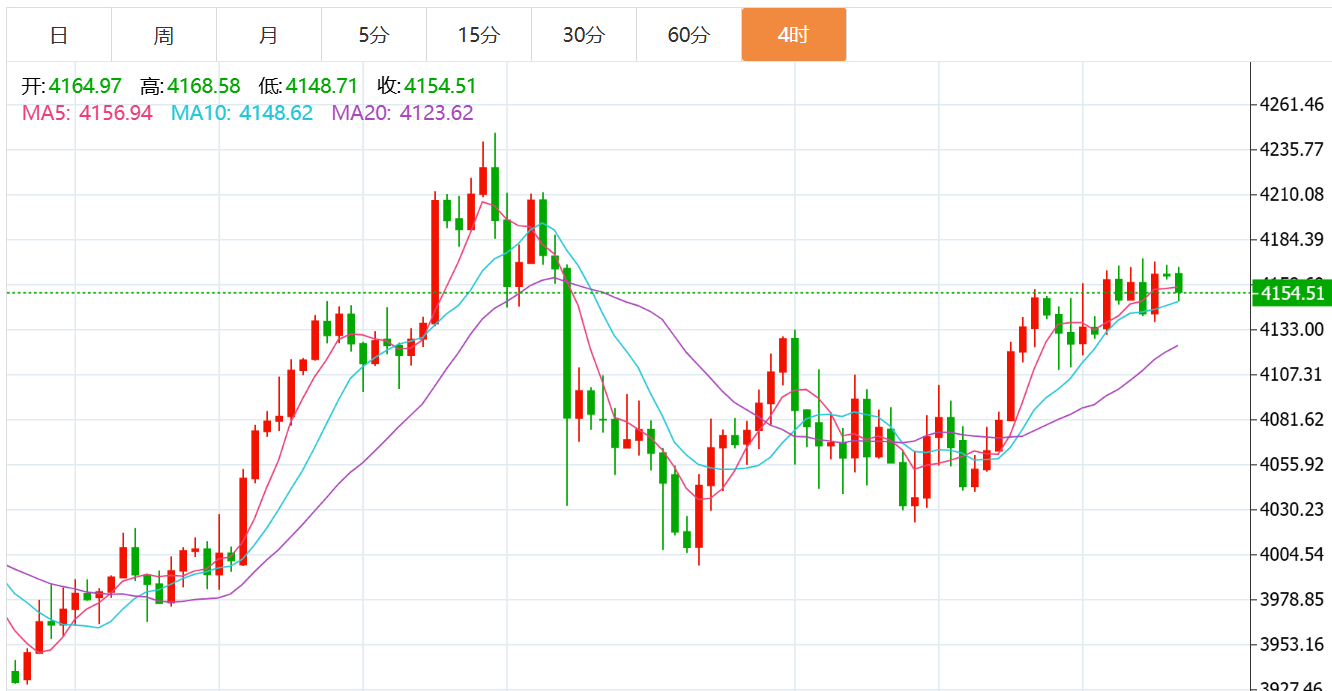
Group 1: Gold Market Analysis - The current price of spot gold is around $4151.86 per ounce, experiencing slight fluctuations due to the Thanksgiving holiday in the U.S. which limits market activity [2] - The expectation of a 25 basis point rate cut by the Federal Reserve in December has increased from 30% to 85%, driven by dovish statements from Fed officials and potential new leadership leaning towards looser policies [2] - Technical analysis indicates that gold has a resistance level at $4173, and until this level is broken, aggressive buying is not recommended. The price is currently under pressure, with short-term support levels at $4120-4100 [4] Group 2: Oil Market Analysis - West Texas Intermediate (WTI) crude oil is trading around $58 per barrel, remaining at a low level due to a lack of positive sentiment in the market. Recent EIA data showed an unexpected increase in U.S. crude oil inventories by 2.774 million barrels, reversing the previous week's decrease [5] - The current market conditions are characterized by weak demand, inventory rebuilding, and potential increases in Russian oil supply, which are exerting downward pressure on prices. The softening dollar and rate cut expectations provide only marginal support [5] - Technical indicators suggest that if the support level at $56 is broken, the oil market may enter a downward trend. The short-term trading range is between $59.00 and $57.00, with recommendations to focus on selling on rebounds and buying on dips [6]
宏观金融类:文字早评2025-11-27-20251127
Wu Kuang Qi Huo· 2025-11-27 01:19
Report Industry Investment Rating No relevant content provided. Core Viewpoints of the Report - After recent continuous declines, the index is expected to stabilize in the short - term. Policy support for the capital market remains unchanged, and technology growth is still the market's main line. The medium - to long - term strategy is to buy on dips [4]. - In the fourth quarter, the supply - demand pattern of the bond market may improve. The market is in a situation of weak domestic demand recovery and improved inflation expectations, maintaining an overall volatile trend. Pay attention to the impact of stock - bond linkage and liquidity [7]. - The expectation of the Fed's loose monetary policy has significantly increased. The overseas interest - rate cut cycle will continue, and the further driving force will be released in December. It is recommended to buy precious metals on dips [9]. - For most commodities, the market is affected by various factors such as supply - demand relationships, policies, and macro - economic conditions, showing different trends of volatility, strength, or weakness. Summary by Category Macro - Financial Stock Index - **Market News**: Six ministries including the Ministry of Industry and Information Technology jointly issued a document to enhance the adaptability of consumer goods supply and demand; the Cyberspace Administration of China strengthened the management of financial "self - media" and MCN accounts; the Guangzhou Futures Exchange announced the listing benchmark prices of platinum and palladium futures; US durable goods orders in September increased by 0.5% month - on - month [2]. - **Basis Ratio**: The basis ratios of IF, IC, IM, and IH for different contract periods are provided [3]. - **Strategy**: After recent declines, the index may stabilize in the short - term. The long - term strategy is to buy on dips [4]. Treasury Bonds - **Market News**: On Wednesday, the prices of TL, T, TF, and TS main contracts decreased. The Bank of Japan may raise interest rates in December; the winning yields of the Ministry of Finance's 2 - period treasury bonds were lower than the ChinaBond valuations. The central bank conducted 2133 billion yuan of 7 - day reverse repurchase operations, with a net withdrawal of 972 billion yuan [5]. - **Strategy**: The economic data in October was weak, and the year - end social financing growth rate may remain weak. The central bank maintains an attitude of protecting funds. The bond market is expected to be volatile in the fourth quarter, and pay attention to stock - bond linkage and liquidity [7]. Precious Metals - **Market News**: Shanghai gold rose 0.37%, and Shanghai silver rose 2.73%. COMEX gold and silver prices are also provided. A Fed governor made dovish remarks, and the market expects an 82.9% probability of a 25 - basis - point interest - rate cut in December [8]. - **Strategy**: The expectation of the Fed's loose monetary policy has increased. It is recommended to buy precious metals on dips [9]. Non - Ferrous Metals Copper - **Market News**: Overnight, US stocks rose, and the offshore RMB strengthened. LME copper prices increased, and domestic copper inventories and premiums showed certain changes [11]. - **Strategy**: Fed officials' dovish remarks increase the probability of a December interest - rate cut. The supply of copper raw materials is tight, and downstream demand is strong. Copper prices are expected to oscillate strongly [12]. Aluminum - **Market News**: Supported by overseas supply disruption news, aluminum prices rose. LME and domestic aluminum inventories and premiums changed [13]. - **Strategy**: Global aluminum inventories are low, and supply disruptions support prices. Although the downstream is entering the off - season, aluminum prices may strengthen after adjustment [14]. Zinc - **Market News**: On Wednesday, Shanghai zinc index prices decreased slightly. LME and domestic zinc inventories and basis are provided [15]. - **Strategy**: Zinc ore imports decreased in October, and the supply of zinc ore is tight during the winter stockpiling period. However, in the long - term, the zinc industry is still in an over - supply cycle. Zinc prices are expected to be weak in the short - term [16]. Lead - **Market News**: On Wednesday, Shanghai lead index prices rose slightly. LME and domestic lead inventories and basis are provided [17]. - **Strategy**: The supply of lead ingots is increasing, while the demand for lead - acid batteries is declining. Lead prices are expected to be weak in the short - term [17]. Nickel - **Market News**: On Wednesday, nickel prices rebounded. Spot prices and cost factors are provided [18]. - **Strategy**: The fundamentals of nickel are under pressure. Supply is increasing, and demand is weak. It is not recommended to chase short or bottom - fish. Wait for the nickel - iron price to stabilize [18]. Tin - **Market News**: On November 26, Shanghai tin prices rose. Supply, demand, and inventory information are provided [19]. - **Strategy**: The short - term supply - demand of tin is in a tight balance. Considering the high - price suppression of consumption and the marginal improvement of ore shortages, tin prices are expected to oscillate. It is recommended to wait and see [20]. Carbonate Lithium - **Market News**: The spot index of carbonate lithium rose, while the futures price of LC2605 decreased [21]. - **Strategy**: The improvement of fundamentals boosts bullish sentiment, but there are concerns about off - season demand. It is recommended to wait and see [21]. Alumina - **Market News**: On November 26, the alumina index decreased. Information on basis, overseas prices, and inventory is provided [22]. - **Strategy**: Overseas ore shipments are expected to increase, and the alumina smelting capacity is over - supplied. However, the current price is close to the cost line, and it is recommended to wait and see [23]. Stainless Steel - **Market News**: On Wednesday, the stainless - steel main contract price rose. Spot prices, raw material prices, and inventory information are provided [24]. - **Strategy**: The spot market price rose slightly, but the demand is affected by the real - estate market. Stainless - steel prices are expected to oscillate [25]. Cast Aluminum Alloy - **Market News**: Yesterday, the price of cast aluminum alloy oscillated. Information on contract prices, inventory, and demand is provided [26]. - **Strategy**: The cost of cast aluminum alloy provides support, and the price is expected to follow the trend of aluminum prices [27]. Black Building Materials Steel - **Market News**: The prices of rebar and hot - rolled coil main contracts decreased. Information on spot prices, registered warrants, and inventory is provided [29]. - **Strategy**: The steel market is in the off - season, and the export is affected by anti - dumping duties. Prices are expected to be weakly volatile in the short - term but may improve with policy implementation [30]. Iron Ore - **Market News**: Yesterday, the iron - ore main contract price rose. Information on spot prices, basis, and inventory is provided [31]. - **Strategy**: Overseas iron - ore shipments decreased, and the demand for iron ore is stable. The overall inventory is high, and the price is expected to oscillate [32]. Glass and Soda Ash - **Glass** - **Market News**: On Wednesday, the glass main contract price rose slightly. Information on spot prices, inventory, and positions is provided [33]. - **Strategy**: The supply of glass may decrease in December, and the demand is weak. The price is expected to oscillate at the bottom [34]. - **Soda Ash** - **Market News**: On Wednesday, the soda - ash main contract price decreased. Information on spot prices, inventory, and positions is provided [35]. - **Strategy**: The supply of soda ash is in excess, and the demand is divided. The price is expected to be weak [35]. Manganese Silicon and Ferrosilicon - **Market News**: On November 26, the prices of manganese - silicon and ferrosilicon main contracts decreased. Information on spot prices, basis, and price trends is provided [36]. - **Strategy**: The market risk appetite has weakened, and the prices of ferrous alloys have decreased. However, with the expectation of the Fed's interest - rate cut, there may be a turning point. It is recommended to pay attention to market sentiment [38]. Industrial Silicon and Polysilicon - **Industrial Silicon** - **Market News**: Yesterday, the industrial - silicon main contract price rose. Information on spot prices, basis, and production is provided [40]. - **Strategy**: The production of industrial silicon is decreasing, and the demand is affected by the polysilicon and organic - silicon industries. The price is expected to oscillate [41]. - **Polysilicon** - **Market News**: Yesterday, the polysilicon main contract price rose. Information on spot prices, basis, and production is provided [43]. - **Strategy**: The production of polysilicon is decreasing, and the supply - demand pattern may improve marginally. The price is expected to oscillate widely, and attention should be paid to platform company progress and price feedback [44]. Energy and Chemicals Rubber - **Market News**: Rubber prices rebounded. Thailand's rubber - producing areas were affected by floods, and the inventory of exchange - traded RU was low. The opinions of bulls and bears are different [46]. - **Strategy**: It is recommended to take a bullish short - term strategy and partially build positions for hedging [50]. Crude Oil - **Market News**: INE crude - oil futures prices decreased. The inventory of refined oil products in the Fujairah port increased [51]. - **Strategy**: Although the geopolitical premium has disappeared, OPEC's supply has not increased significantly. It is recommended to wait and see and test OPEC's export price - support willingness [52]. Methanol - **Market News**: The prices of methanol in different regions and the main contract increased. Information on basis and spread is provided [53]. - **Strategy**: The positive impact of Iranian device shutdowns is being realized, but the near - term high - inventory pattern remains. It is recommended to wait and see [53]. Urea - **Market News**: The prices of urea in different regions and the main contract changed. Information on basis and spread is provided [54]. - **Strategy**: The urea price is oscillating at the bottom. The supply is high, and the demand has improved. It is recommended to buy on dips [55]. Pure Benzene and Styrene - **Market News**: The spot price of pure benzene was unchanged, and the futures price of styrene rose. Information on basis, spread, and supply - demand is provided [56]. - **Strategy**: The supply of styrene is under pressure, but the demand is in the seasonal peak. The price may stop falling [57]. PVC - **Market News**: The PVC01 contract price decreased. Information on spot prices, basis, and supply - demand is provided [58]. - **Strategy**: The supply of PVC is in excess, and the demand is weak. It is recommended to short on rallies [60]. Ethylene Glycol - **Market News**: The EG01 contract price rose. Information on spot prices, basis, and supply - demand is provided [61]. - **Strategy**: The domestic supply of ethylene glycol is expected to decrease in December, but the medium - term supply - demand pattern is still weak. It is recommended to short on rallies [62]. PTA - **Market News**: The PTA01 contract price rose. Information on spot prices, basis, and supply - demand is provided [63]. - **Strategy**: The supply of PTA may increase, and the demand is affected by inventory and the off - season. The processing fee has limited upward space [64]. p - Xylene - **Market News**: The PX01 contract price rose. Information on spot prices, basis, and supply - demand is provided [65]. - **Strategy**: The load of PX is high, and the downstream PTA is in maintenance. PX may accumulate inventory in November, and the valuation may be adjusted downward [66]. Polyethylene (PE) - **Market News**: The futures and spot prices of PE decreased. Information on basis, inventory, and supply - demand is provided [67]. - **Strategy**: The price of PE is expected to be volatile at a low level. The supply is decreasing, and the demand is in the seasonal peak [68]. Polypropylene (PP) - **Market News**: The futures and spot prices of PP decreased. Information on basis, inventory, and supply - demand is provided [69]. - **Strategy**: The supply of PP is under pressure, and the demand is in the seasonal low. The price may be supported in the first quarter of next year [70]. Agricultural Products Hogs - **Market News**: Yesterday, domestic hog prices mostly decreased. The supply is high, and the demand is weak [72]. - **Strategy**: The supply of hogs is under pressure, and the demand is weak. It is recommended to short near - month contracts or conduct reverse arbitrage [73]. Eggs - **Market News**: Yesterday, the national egg prices were mostly stable. The supply and demand are in a stalemate [74]. - **Strategy**: The spot price of eggs has not followed the futures price increase. The price is expected to be oscillating in the short - term, and it is recommended to short on rallies in the medium - term [75]. Soybean and Rapeseed Meal - **Market News**: CBOT soybean prices rose. The domestic soybean inventory is high, and the meal inventory is large [76]. - **Strategy**: The global soybean supply has decreased, and the import cost has a bottom support. The meal price is expected to oscillate [77]. Oils - **Market News**: The export of Malaysian palm oil decreased, and the production increased. The domestic oil inventory may decrease in the future [78]. - **Strategy**: The high production of palm oil suppresses the price. It is recommended to take an oscillating view and turn bullish if production decreases [79]. Sugar - **Market News**: The Zhengzhou sugar futures price oscillated. The production of sugar in Brazil and India is expected to increase [81]. - **Strategy**: The global sugar supply is expected to be in excess, and the international sugar price may be weak. It is recommended to short on rallies [82]. Cotton - **Market News**: The Zhengzhou cotton futures price oscillated. The global cotton production is expected to increase [83]. - **Strategy**: The demand for cotton is not too bad after the peak season, and the price is expected to oscillate in the short - term [84].
“白宫系”代表或成美联储主席 “全球资产定价之锚”跌破4%
2 1 Shi Ji Jing Ji Bao Dao· 2025-11-26 13:08
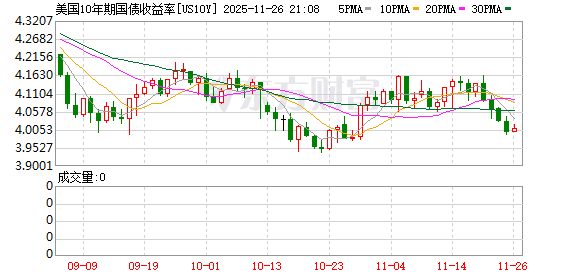
Core Viewpoint - The market is increasingly betting on significant cuts to the US dollar interest rates in the coming year, especially with Kevin Hassett emerging as a leading candidate for the next Federal Reserve Chair [2][4][5]. Group 1: Candidate Analysis - Kevin Hassett is viewed as a strong candidate for the Federal Reserve Chair due to his alignment with Trump's economic views, particularly the need for further interest rate cuts [4][5]. - Hassett's previous involvement in Trump's administration and economic policy design gives him an advantage over other candidates [4]. - The current Treasury Secretary, Scott Basset, is leading the selection process for the next Fed Chair, with Hassett being one of five candidates [2][4]. Group 2: Economic Indicators - Recent employment and retail sales data have fallen short of expectations, which has heightened the anticipation of interest rate cuts by the Federal Reserve [2][7]. - The ADP employment report indicated an average weekly job loss of 13,500 positions, raising concerns about consumer demand and employment growth [7]. - Retail sales in September rose only 0.2%, below the expected 0.4%, indicating a slowdown in consumer spending [7]. Group 3: Market Reactions - The yield on the 10-year US Treasury bond fell below 4%, reflecting market expectations for a more dovish monetary policy from the Federal Reserve [7][8]. - The decline in bond yields is attributed to both the anticipated dovish stance of the Fed and the recent weak economic data [8]. - Analysts predict that if Hassett is appointed and economic conditions worsen, the Fed may initiate aggressive rate cuts, potentially exceeding 100 basis points by 2026 [5][12]. Group 4: Future Monetary Policy Outlook - Regardless of who becomes the new Fed Chair, the monetary policy is likely to lean towards a dovish stance, driven by the need to support economic growth and manage inflation risks [12]. - The Trump administration is expected to favor a lower interest rate environment to stimulate the economy and mitigate the negative impacts of tariffs [12]. - Analysts forecast that the Fed may implement multiple rate cuts over the next year, potentially exceeding current market expectations [12].
LPR连续6个月保持不变,12月美联储降息预期降温 | 第一财经研究院中国金融条件指数周报
Sou Hu Cai Jing· 2025-11-26 08:47
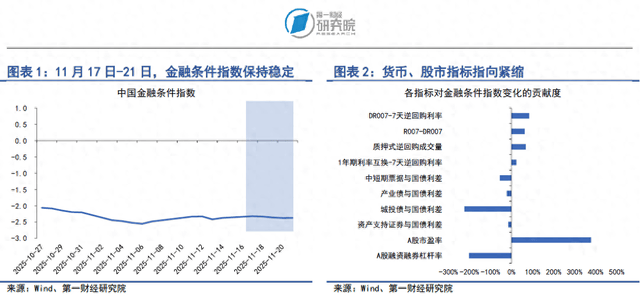
Group 1: Financial Conditions Index Overview - The average daily financial conditions index in China for the week of November 17 to November 21, 2025, was -2.35, remaining stable compared to the previous week, with a year-to-date decline of 0.95 [1][2] - The monetary and stock market indicators pointed towards tightening, with a decline in interbank market repo transaction volume and a steady rise in major money market rates [3][7] Group 2: Monetary Market - The average interbank repo transaction volume for the week was 7.3 trillion yuan, a decrease of 149.7 billion yuan from the previous week [7] - Major money market rates showed a steady increase, with overnight repo rates R001 and DR001 averaging 1.49% and 1.43%, respectively, up by 1.92 basis points and 0.86 basis points [7] - The central bank conducted a net fund injection of 554 billion yuan through 7-day reverse repos during the week [9] Group 3: Bond Market - The total issuance in the bond market for the week was 1.8 trillion yuan, an increase of 566.96 billion yuan from the previous week, with net financing amounting to 235.7 billion yuan [12] - Government bonds saw net financing of 354.8 billion yuan, while the financial sector experienced net repayments of 209.3 billion yuan [12] - The year-on-year growth rate of government bonds reached 18.8%, an increase of 4.1 percentage points compared to the same period in 2024 [13] Group 4: Stock Market - A-share financing totaled 8.14 billion yuan for the week, down by 15.99 billion yuan from the previous week, with a year-to-date total exceeding 1 trillion yuan [19] - Major A-share indices experienced significant declines, with the Shanghai Composite Index dropping 3.94% and the ChiNext Index falling 6.25% [21] - The average daily trading volume for A-shares was approximately 1.85 trillion yuan, a decrease of 8.7% from the previous week [21]