
外资流入

Search documents
A股翻绿,高位股集体大跌,泡泡玛特港股大涨超8%创新高
2 1 Shi Ji Jing Ji Bao Dao· 2025-08-20 04:02
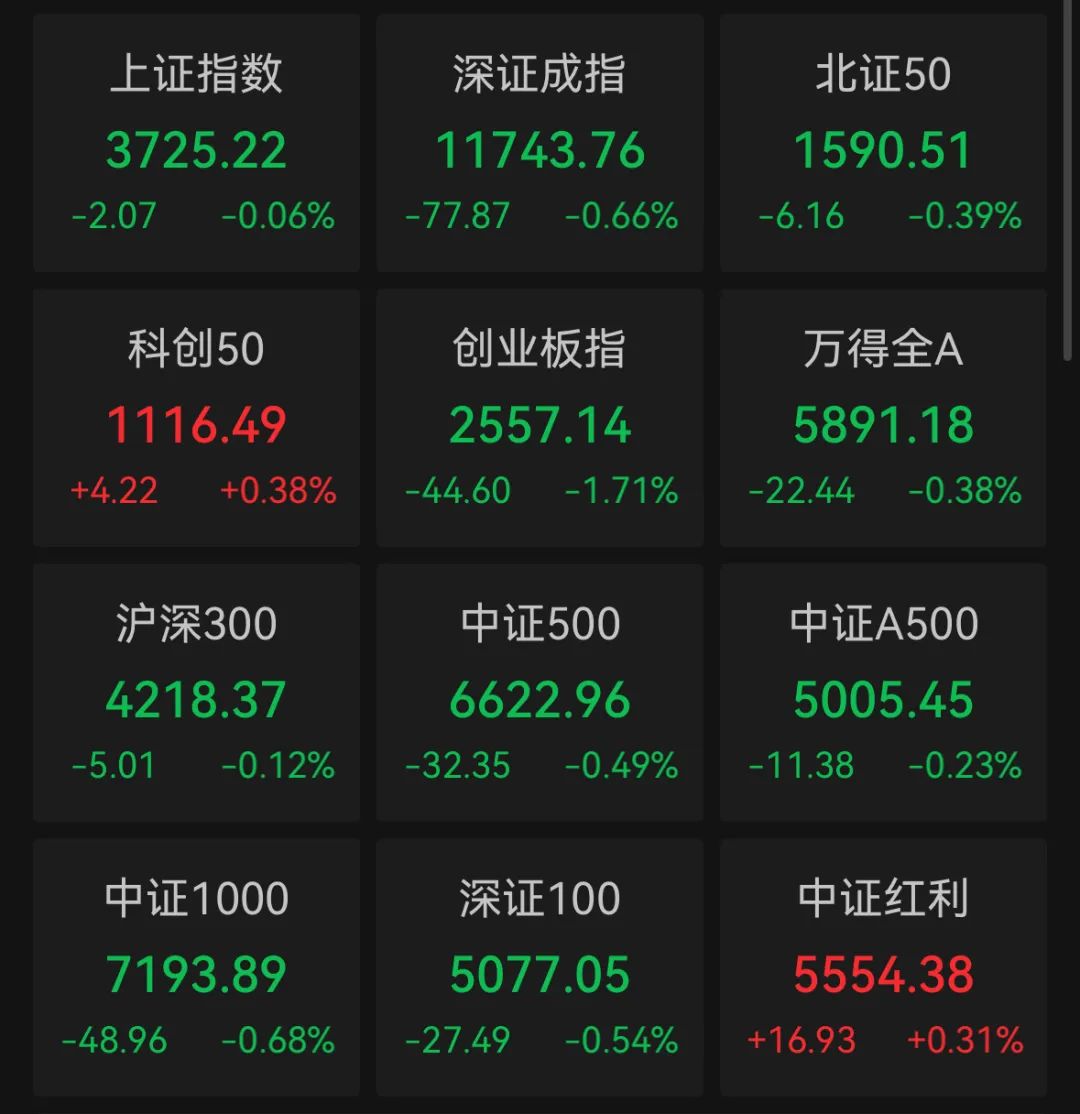
Market Overview - The A-share market experienced fluctuations on August 20, with the ChiNext index leading the decline, while the Shanghai Composite Index fell by 2.07 points, a decrease of 0.06%, closing at 3725.22 points [1] - The Shenzhen Component Index dropped by 77.87 points, down 0.66%, closing at 11743.76 points, and the ChiNext index fell by 44.6 points, down 1.71%, closing at 2557.14 points [1][2] - Overall, 3400 stocks in the market declined, with a trading volume exceeding 1.5 trillion yuan [2] Sector Performance - Consumer stocks, particularly in the liquor sector, rebounded, with JiuGuiJiu (000799) achieving two consecutive trading limits [4] - The sectors showing gains included liquor, non-ferrous metals, tourism, and AI glasses, while data center power, Huawei Ascend, software development, and CRO sectors faced declines [4] - Non-ferrous metal stocks showed strength, with Luoping Zinc & Electric (002114) hitting the daily limit [4] Foreign Investment Trends - Recent trends indicate increased foreign investment in A-shares, with the Shanghai Composite Index maintaining above 3700 points and reaching a ten-year high on August 18 [7] - The margin trading balance has rapidly increased, indicating that leveraged funds are entering the market, providing strong financial support for the market's rise [7] - JMC Capital's CIO noted that global funds are still under-allocated in the Chinese stock market, with the MSCI China Index's forward P/E ratio at 12.1 times, indicating a discount compared to other major global markets [7] Company Performance: Pop Mart - Pop Mart (09992.HK) saw its stock price surge over 8%, surpassing 300 HKD, marking a new high since its listing [10] - For the first half of 2025, Pop Mart reported revenue of 13.88 billion yuan, a year-on-year increase of 204.4%, and an adjusted net profit of 4.71 billion yuan, up 362.8% [12] - The company expects full-year revenue to be no less than 30 billion yuan, with a net increase of 12 offline stores, reaching a total of 443, and offline revenue growing by 117.1% [12]


光大期货金融期货日报-20250820
Guang Da Qi Huo· 2025-08-20 02:26
Report Summary 1. Investment Ratings - Stock Index Futures: Neutral (Oscillation) [1] - Treasury Bond Futures: Bearish in the short term, neutral (oscillation) in the long term [2] 2. Core Views - **Stock Index Futures**: The recent rise in the stock market is mainly due to three logics. Long - term: The market anticipates fiscal policy to shift more towards promoting consumption and an increase in the domestic inflation level after the easing of Sino - US relations. Medium - term: The anti - involution trend and infrastructure investment on the demand side benefit upstream cyclical sectors. Short - term: The capital market has relatively abundant liquidity, with funds flowing in due to RMB appreciation and improved enterprise deposit and loan data [1]. - **Treasury Bond Futures**: In the short term, the bond market is under pressure due to the recovery of risk appetite. However, there are no significant changes in the capital and fundamental aspects, and the bond market lacks directional drivers. It should be treated with an oscillation mindset in the long term [2] 3. Summary by Section **Research Views** - **Stock Index Futures**: On August 19, the A - share market fluctuated with increased trading volume. The Wind All - A index fell by 0.05% with a trading volume of 2.64 trillion yuan. The CSI 1000 index rose by 0.07%, while the CSI 500, SSE 50, and CSI 300 indices fell by 0.19%, 0.93%, and 0.38% respectively. Personal consumption loan subsidy policies and the implementation of the parenting subsidy system are expected to boost the economy. The central bank may purchase national debt to support more inclusive fiscal policies [1]. - **Treasury Bond Futures**: On August 19, the 30 - year, 10 - year, 5 - year, and 2 - year treasury bond futures contracts rose by 0.26%, 0.06%, 0.06%, and 0.03% respectively. The central bank conducted 580.3 billion yuan of 7 - day reverse repurchase operations, with a net injection of 465.7 billion yuan. The weighted average interest rates of DR001 and DR007 increased [2] **Daily Price Changes** - **Stock Index Futures**: On August 19, compared with August 18, IH fell by 1.16%, IF by 0.51%, IC by 0.12%, and IM by 0.10%. Among the stock indices, the SSE 50 fell by 0.93%, the CSI 300 by 0.38%, the CSI 500 by 0.19%, and the CSI 1000 rose by 0.07% [3] - **Treasury Bond Futures**: On August 19, compared with August 18, TS rose by 0.03%, TF by 0.08%, T by 0.04%, and TL by 0.39% [3] **Market News** - From January to July, the national general public budget revenue was 1.35839 trillion yuan, a year - on - year increase of 0.1%. Among them, tax revenue was 1.10933 trillion yuan, a year - on - year decrease of 0.3%, and non - tax revenue was 249.06 billion yuan, a year - on - year increase of 2% [4] - The Ministry of Finance plans to issue 30 billion yuan of 91 - day book - entry discount treasury bonds on August 20 [4] **Chart Analysis** - **Stock Index Futures**: The report presents the historical trends and basis trends of IH, IF, IM, and IC contracts [6][7][9] - **Treasury Bond Futures**: It shows the historical trends, basis trends, and cross - period spread trends of TS, TF, T, and TL contracts, as well as the yields of treasury bonds [12][15][16] - **Exchange Rates**: The report includes the historical trends of the US dollar - RMB, euro - RMB exchange rates, forward exchange rates, and other exchange rate - related data [20][21][22]
资本市场持续活跃背后 外资跑步加仓中国资产
2 1 Shi Ji Jing Ji Bao Dao· 2025-08-19 22:59
Group 1 - Foreign capital is rapidly increasing its investment in Chinese assets, with hedge funds buying Chinese stocks at the fastest pace since June [2][5] - Goldman Sachs reports that hedge funds are overweight in Chinese markets compared to the MSCI World Index by 4.9%, with Chinese stocks making up 5.8% of total positions and 7.3% of net positions [2] - The Shanghai Composite Index has shown significant growth, surpassing 3700 points and reaching a ten-year high, indicating strong market momentum [3] Group 2 - As of August 19, 663 A-share companies have disclosed their mid-year reports, with 139 companies receiving significant investments from 244 QFII institutions [4] - The influx of retail investors into the A-share market is becoming increasingly evident, signaling early signs of a bull market [4] - External factors such as anticipated interest rate cuts by the Federal Reserve and improved geopolitical conditions are driving international capital flow into China [2][5] Group 3 - In July, foreign capital injected $2.7 billion into the Chinese stock market, doubling the net inflow from June [5] - The total market value of A-shares held by foreign institutions is approximately 2.4 trillion yuan, reversing a trend of net selling over the past two years [5] - Analysts believe that the current valuation of Chinese stocks remains attractive compared to other major global markets, suggesting further foreign investment is likely [5][6]
国泰海通|策略:主动外资重燃信心,内资热钱延续流入
国泰海通证券研究· 2025-08-19 11:05
Core Viewpoint - The A-share market is experiencing increased trading activity, with rising margin balances and active retail investor participation, while foreign capital has turned to inflows, indicating a notable increase in incremental funds entering the market [3][4]. Group 1: Market Trading Activity - The trading heat in the market has marginally increased, with the average daily trading volume in the A-share market rising to 2.1 trillion yuan, and the turnover rate for the Shanghai Composite Index reaching the 93rd percentile [3]. - The number of daily limit-up stocks has increased to 74.4, with the maximum consecutive limit-up stocks being 5, while the sealing rate slightly decreased to 71.2% [3]. - The proportion of stocks that rose has decreased to 54.4%, and the median weekly return for all A-share stocks has dropped to 0.4% [3]. Group 2: Fund Flows - The net inflow of foreign capital was 2.7 billion USD as of August 13, with the northbound trading volume accounting for 11.0% of total trading [4]. - Public funds saw a decrease in new issuance to 5.947 billion yuan, while overall stock positions increased [4]. - The net buy amount for margin trading was 45.7 billion yuan, with the trading volume proportion rising to 10.6% [4]. Group 3: Industry Allocation - There is a clear divergence in fund allocation, with foreign capital significantly flowing out of the metals sector while financing mainly flows into electronics and machinery [5]. - The electronics sector saw a net inflow of 13.27 billion yuan, while the coal sector experienced a net outflow of 0.23 billion yuan [5]. - The ETF market showed a significant outflow of passive funds, with a net outflow of 27.93 billion yuan, while the food and beverage sector saw a net inflow of 0.59 billion yuan [5]. Group 4: Hong Kong and Global Fund Flows - Southbound capital inflows increased to 38.12 billion yuan, reaching the 92nd percentile since 2022, with foreign capital inflow into the Hong Kong market amounting to 370 million USD [6]. - Developed markets saw a net inflow of 6.85 billion USD, with the US and UK being the primary beneficiaries, while emerging markets experienced net outflows [6]. - Active foreign capital has returned to buy Chinese concept stocks for the first time since October 2024 [6].

广发策略:如果美联储降息,利好哪些资产和行业?
Sou Hu Cai Jing· 2025-08-17 09:38
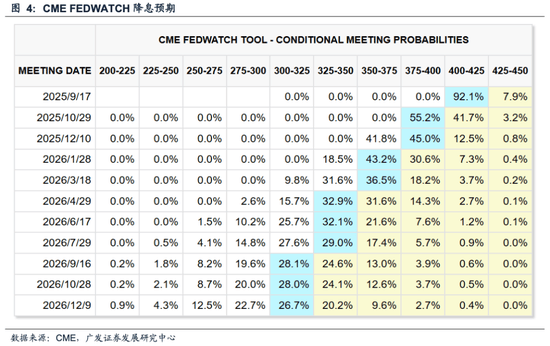
Group 1 - The Federal Reserve is expected to initiate a new round of "preventive" interest rate cuts in September 2024, influenced by concerns over inflation due to tariffs, although the rate cuts may face temporary pauses [1][19] - Recent data shows that July's non-farm employment figures were weaker than expected, and the core inflation rate for July has shown a decline in prices for core goods heavily reliant on imports, indicating manageable inflation pressure [1][19] - The market anticipates a 92.1% probability of a 25 basis point rate cut in September, reflecting expectations of a shift in monetary policy [21] Group 2 - Historical analysis indicates that during previous rounds of preventive rate cuts, U.S. equity markets performed well, with a general recovery in market fundamentals [2][19] - The current global capital rebalancing is driven by a weakening U.S. economy and dollar, leading to a shift of funds towards non-U.S. assets, particularly those with stronger short-term economic prospects [6][26] - Assets such as gold and cryptocurrencies are expected to attract capital due to their status as safe-haven alternatives to the dollar [28][29] Group 3 - A-shares are positioned to attract foreign investment due to their strong performance since July, despite the absence of significant changes in domestic fundamentals [8][36] - The narrowing interest rate differential between China and the U.S. following Fed rate cuts is likely to encourage capital inflows into China, providing additional monetary policy space [38][41] - The anticipated marginal changes in domestic fundamentals and policies in the second half of the year are expected to enhance foreign investor confidence in A-shares [41][42] Group 4 - Foreign investment preferences indicate a focus on local, competitive assets, with a tendency to favor industries that align with the current economic landscape [10][12] - Historical trends show that foreign investors favor core competitive industries and are willing to tolerate higher valuations, prioritizing stable and sustainable earnings [12][45] - The analysis of foreign investment in Taiwan's stock market reveals a preference for large-cap, high-ROE industry leaders, with a significant focus on the electronics sector [43][45]
A股“双2万亿”,近十年首现
3 6 Ke· 2025-08-15 06:05
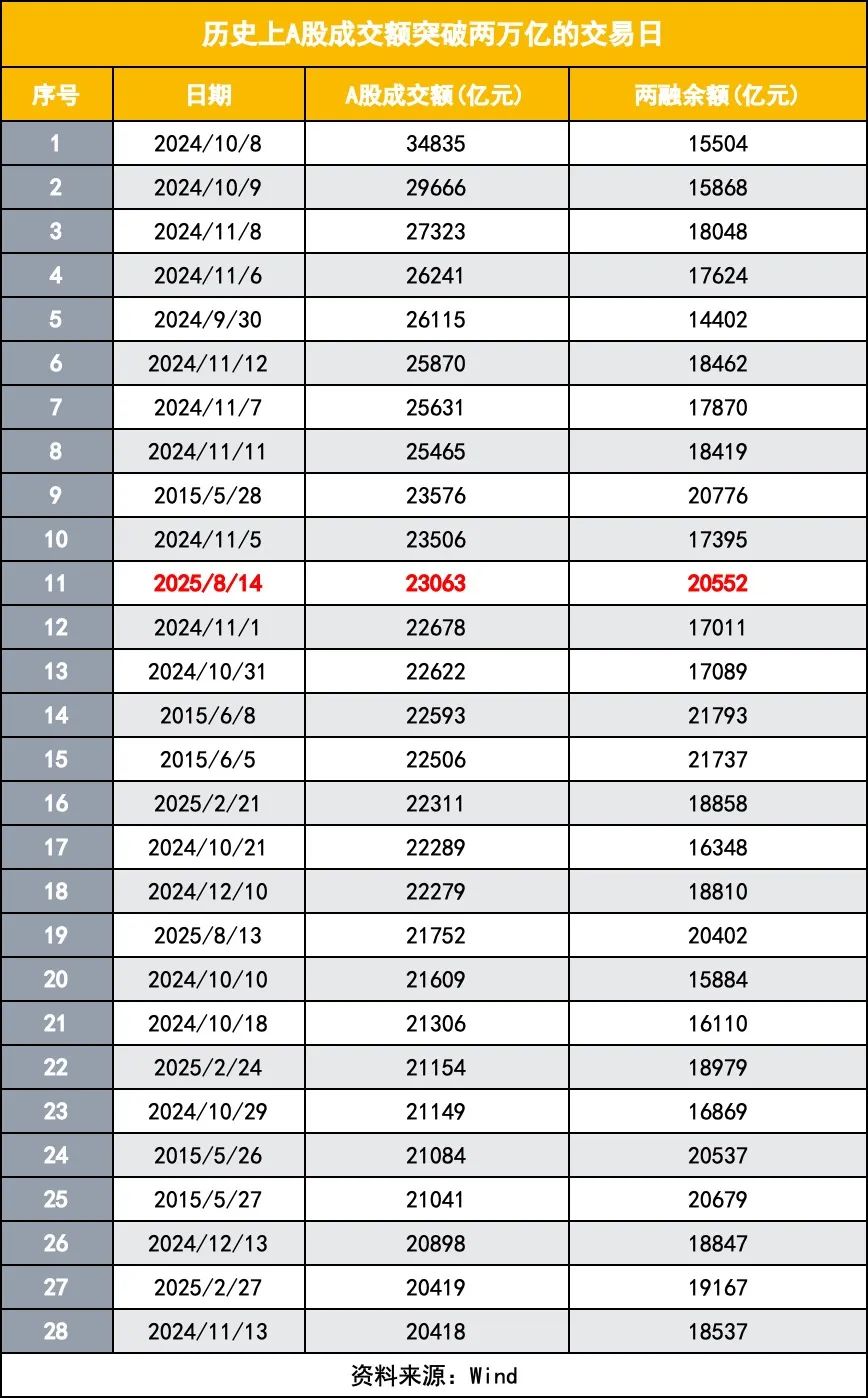
Core Insights - The A-share market has seen a significant increase in trading volume and margin financing balance, both surpassing 2 trillion yuan for two consecutive days, marking a notable shift in market dynamics [1][3][12] - Historical analysis shows that the occurrence of dual "2 trillion" trading days is rare, with only seven instances recorded, primarily during the 2015 leverage bull market and now in 2025, indicating a transformation in market structure [2][3][6] Trading Volume and Margin Financing - On August 14, the A-share trading volume reached 2.3 trillion yuan, while the margin financing balance exceeded 2 trillion yuan, recorded at 2.055 trillion yuan [1][3] - The dual "2 trillion" phenomenon has occurred only seven times in A-share history, with the latest instances on August 13 and 14, 2025, representing the first occurrences in nearly a decade [2][3][4] Market Dynamics and Funding Sources - The current market environment is characterized by a shift from high-leverage-driven dynamics to a more mature market driven by policy coordination and fundamental improvements [6][7] - Key supporting factors for the dual "2 trillion" phenomenon include a significant migration of household savings into the equity market, with a notable decrease in household deposits and an increase in non-bank deposits [8][10] Future Liquidity and Investment Trends - Analysts predict a turning point for incremental capital entering the market, with a peak in household deposits and financial products maturing from late 2025 to 2026, potentially releasing substantial funds into the equity market [3][11] - The influx of foreign capital is also a critical factor, with global funds showing increased confidence in the Chinese market, as evidenced by significant net inflows into Chinese stocks and bonds [10][11] Market Sentiment and Investor Behavior - The increase in new A-share accounts, reaching 1.96 million in July 2025, reflects a growing investor enthusiasm driven by the market's positive performance [9][10] - The current market phase is transitioning from policy-driven expectations to a focus on earnings validation, with improving corporate performance expected to sustain market momentum [12]
见证历史,中国资产大爆发
Zheng Quan Shi Bao· 2025-08-13 22:22
中国资产全线爆发。 13日晚间,美股开盘后,中国资产集体走强,纳斯达克中国金龙指数一度涨超2.3%,三倍做多富时中 国ETF大涨超8%,两倍做多中国互联网股票大涨超7%,热门中概股全线大涨。 目前外资正加速流入中国股票市场。摩根士丹利在最新发布的报告中表示,在全球多头基金连续两个月 净买入中国股票之后,预计重返中国股市的趋势将"更为强劲"。 另外,受美联储降息预期持续升温的刺激,投资者大举做多风险资产,全球股市大涨,MSCI全球国家 指数创出历史新高,纳指、标普500指数盘中也创出历史新高,欧洲股市亦全线拉升。 中概股全线走强,截至发稿,e家快服、比特起源暴涨超27%,小牛电动涨超10%,哔哩哔哩、小马智 行涨超6%,富途控股、老虎证券涨超5%,爱奇艺、携程、百济神州和黄医药涨超4%,阿里巴巴、网 易、百度、唯品会、金山云涨超3%,腾讯音乐、贝壳、理想汽车、蔚来、好未来等涨超2%。 腾讯控股ADR大涨近7%。最新业绩报告显示,该公司二季度实现营收1845亿元,同比增长15%;非国 际财务报告准则公司权益持有人应占盈利631亿元,同比增长10%。 今日亚洲交易时段,A股、港股市场亦集体走强,截至收盘,沪指涨0. ...
泰资产价格因关税减免而上涨,外资流入将延续
Shang Wu Bu Wang Zhan· 2025-08-12 15:06
Group 1 - The Thai Baht is expected to continue appreciating this quarter due to easing trade tensions and renewed interest from foreign investors in local stocks [1] - Malaysia Bank predicts the Baht will strengthen to 31.5 Baht per USD by year-end, while Bank of America forecasts it will reach 31.0 Baht per USD, a level not seen since March 2021 [1] - The Baht has become the best-performing currency in Asia this quarter, supported by a tariff agreement with Washington that improves Thailand's export outlook [1] Group 2 - Domestic political concerns have eased, and expectations of another interest rate cut by the Bank of Thailand may support capital inflows, bringing the Thai stock market closer to a bull market [1] - Local stocks have rebounded over 18% since their low in June, making the benchmark SET index one of the best-performing indices globally this quarter [1] - The reduction of tariffs on Thai goods from 36% to 19% by US President Donald Trump has improved Thailand's export prospects, prompting the Finance Ministry to raise its growth forecast by increasing estimates for foreign goods exports [1]
瑞达期货股指期货全景日报-20250812
Rui Da Qi Huo· 2025-08-12 08:50
Report Summary 1. Report Industry Investment Rating - Not provided in the content 2. Core View of the Report - A-share major indices closed generally higher, with the Shanghai Composite Index approaching the stage high on October 8, 2024. The trading volume of the Shanghai and Shenzhen stock markets rebounded significantly for two consecutive days. The pricing stability has a restorative effect on corporate profits and investment confidence. The market's focus has shifted to the semi-annual reports of listed companies, and the net profit growth rates of the four broad-based indices are all positive. Some listed companies' improved fundamentals support the stock market, but be vigilant against the drag on index performance from the profit decline of companies that have not yet released their financial reports. A-shares with reasonable valuations continue to attract foreign capital inflows, injecting incremental funds into the market. The S&P's attitude towards China's sovereign credit rating also boosts market confidence. Strategically, it is recommended to buy on dips with a light position [2] 3. Summary by Relevant Catalogs 3.1 Futures Disk - IF main contract (2509) latest price is 4131.2, up 21.0; IF sub-main contract (2508) latest price is 4144.4, up 21.4. IH main contract (2509) latest price is 2809.6, up 17.0; IH sub-main contract (2508) latest price is 2809.8, up 17.4. IC main contract (2509) latest price is 6342.6, up 33.0; IC sub-main contract (2508) latest price is 6409.2, up 33.0. IM main contract (2509) latest price is 6883.6, up 21.2; IM sub-main contract (2508) latest price is 6954.2, up 21.2 [2] - IF-IH current month contract spread is 1334.6, up 7.0; IC-IF current month contract spread is 2264.8, up 12.6. IM-IC current month contract spread is 545.0, down 12.4; IC-IH current month contract spread is 3599.4, up 19.6. IM-IF current month contract spread is 2809.8, up 0.2; IM-IH current month contract spread is 4144.4, up 7.2 [2] - IF current quarter - current month is -42.4, down 1.6; IF next quarter - current month is -74.8, down 3.4. IH current quarter - current month is 1.6, down 1.0; IH next quarter - current month is 1.2, down 0.8. IC current quarter - current month is -219.2, up 4.4; IC next quarter - current month is -357.6, up 4.6. IM current quarter - current month is -260.0, up 1.8; IM next quarter - current month is -442.2, up 4.6 [2] 3.2 Futures Position - IF top 20 net position is -26,597.00, up 1315.0; IH top 20 net position is -17,108.00, up 424.0. IC top 20 net position is -15,559.00, up 1313.0; IM top 20 net position is -52,263.00, down 494.0 [2] 3.3 Spot Price - CSI 300 is 4143.83, up 21.3; IF main contract basis is -12.6, up 5.1. SSE 50 is 2807.01, up 17.1; IH main contract basis is 2.6, up 3.1. CSI 500 is 6418.16, up 26.4; IC main contract basis is -75.6, up 17.4. CSI 1000 A-share trading volume (daily, billion yuan) is 6963.61, up 19.7; IM main contract basis is +552.93, up 166.82. Margin trading balance (previous trading day, billion yuan) is 20,261.98, up 12.7 [2] - Northbound trading total (previous trading day, billion yuan) is 2270.00, up 261.04; Reverse repurchase (maturity volume, operation volume, billion yuan) is -1607.0, up 1146.0 [2] 3.4 Market Sentiment - Main funds (yesterday, today, billion yuan) is +76.53 yesterday, -376.99 today. MLF data not provided. Rising stock ratio (daily, %) is 38.45, down 38.81. Shibor (daily, %) is 1.315, unchanged [2] - IO at-the-money call option closing price (2508) is 15.00, up 3.00; IO at-the-money call option implied volatility (%) is 10.14, down 1.31. IO at-the-money put option closing price (2508) is 22.80, down 19.60; IO at-the-money put option implied volatility (%) is 10.14, down 1.31 [2] - CSI 300 index 20-day volatility (%) is 9.80, up 0.08; Volume PCR (%) is 57.21, up 1.86. Position PCR (%) is 76.85, up 1.74 [2] 3.5 Wind Market Strength and Weakness Analysis - All A-shares score is 5.10, down 2.30; Technical aspect score is 3.80, down 3.90. Capital aspect score is 6.40, down 0.70 [2] 3.6 Industry News - In the first seven months of 2025, China's total goods trade imports and exports were 25.7 trillion yuan, a year-on-year increase of 3.5%. Exports were 15.31 trillion yuan, up 7.3%; imports were 10.39 trillion yuan, down 1.6%, with the decline narrowing by 1.1 percentage points compared to the first half of the year. In July, China's total goods trade imports and exports were 3.91 trillion yuan, up 6.7%. Exports were 2.31 trillion yuan, up 8%; imports were 1.6 trillion yuan, up 4.8%, rising for two consecutive months [2] - In July, CPI increased by 0.4% month-on-month from a 0.1% decline last month, and was flat year-on-year. Core CPI excluding food and energy prices increased by 0.8% year-on-year, with the increase expanding for three consecutive months. PPI decreased by 0.2% month-on-month, with the decline narrowing by 0.2 percentage points compared to last month, and decreased by 3.6% year-on-year, the same as last month [2] 3.7 Key Points of Attention - Pending: China's July financial data. On August 12 at 20:30, the US July CPI and core CPI. On August 14 at 20:30, the US July PPI and core PPI. On August 15 at 10:00, China's July industrial added value above designated size, fixed asset investment, total retail sales of consumer goods, and real estate data [3]
国债期货日报:股债跷跷板明显,国债期货全线收跌-20250812
Hua Tai Qi Huo· 2025-08-12 06:35
1. Report Industry Investment Rating No relevant content provided. 2. Core Viewpoints - The stock - bond seesaw is obvious, and treasury bond futures closed down across the board. Affected by the strong stock market, the rising risk appetite suppresses the bond market. Meanwhile, the strengthened expectation of the Fed's interest rate cut in September and the increasing global trade uncertainty add to the uncertainty of foreign capital inflows. Overall, the bond market fluctuates between the expectations of stable growth and monetary easing. Short - term attention should be paid to policy signals at the end of the month [1][3]. - For trading strategies, in the unilateral trading, the price of treasury bond futures fluctuates, and it is recommended to short at high levels for the 2509 contract. In the arbitrage trading, attention should be paid to the decline of the basis of TF2509. In the hedging trading, there is medium - term adjustment pressure, and short - position holders can use far - month contracts for appropriate hedging [4]. 3. Summary by Directory 3.1 Interest Rate Pricing Tracking Indicators - **Price Indicators**: China's CPI (monthly) has a 0.00% month - on - month change and a 0.10% year - on - year change; China's PPI (monthly) has a - 0.10% month - on - month change and a - 2.30% year - on - year change [8]. - **Monthly Economic Indicators**: The social financing scale is 408.34 trillion yuan, with a month - on - month increase of 2.74 trillion yuan (0.68%); M2 year - on - year growth is 7.30%, with a 0.20% (2.82%) month - on - month change; the manufacturing PMI is 50.10%, with a - 0.20% (- 0.40%) month - on - month change [8]. - **Daily Economic Indicators**: The US dollar index is 109.41, with a 0.47 (0.43%) day - on - day change; the offshore US dollar - RMB exchange rate is 7.324, with a - 0.019 (- 0.25%) day - on - day change; SHIBOR 7 - day is 2.01, with a - 0.03 (- 1.28%) day - on - day change; DR007 is 2.12, with a - 0.21 (- 9.18%) day - on - day change; R007 is 1.94, with a 0.12 (6.52%) day - on - day change; the yield of inter - bank certificates of deposit (AAA) for 3M is 1.89, with a 0.00 (0.09%) day - on - day change; the AA - AAA credit spread (1Y) is 0.15, with a - 0.01 (0.09%) day - on - day change [8]. 3.2 Treasury Bonds and Treasury Bond Futures Market Overview - Multiple charts are provided, including the closing price trend of the main continuous contracts of treasury bond futures, the price change rate of each variety of treasury bond futures, the precipitation fund trend of each variety of treasury bond futures, the position - holding ratio of each variety of treasury bond futures, the net position - holding ratio of the top 20 in each variety of treasury bond futures, the long - short position - holding ratio of the top 20 in each variety of treasury bond futures, the spread between policy - bank bonds and treasury bonds, and the issuance situation of treasury bonds [11][12][15]. 3.3 Money Market Fundamentals - Charts show the trend of Shibor interest rates, the maturity yield trend of inter - bank certificates of deposit (AAA), the transaction statistics of inter - bank pledged repurchase, and the issuance situation of local government bonds [24][25]. 3.4 Spread Overview - Multiple charts present the inter - term spread trend of each variety of treasury bond futures, the term spread of spot bonds and the cross - variety spread of futures (4*TS - T, 2*TS - TF, 2*TF - T, 3*T - TL), and the spread between spot bond spreads and futures spreads (2*TS - 3*TF + T) [28][35][36]. 3.5 Two - Year Treasury Bond Futures - Charts show the implied interest rate of the TS main contract and the maturity yield of treasury bonds, the IRR of the TS main contract and the fund interest rate, the basis trend of the TS main contract in the past three years, and the net basis trend of the TS main contract in the past three years [38][41][51]. 3.6 Five - Year Treasury Bond Futures - Charts show the implied interest rate of the TF main contract and the maturity yield of treasury bonds, the IRR of the TF main contract and the fund interest rate, the basis trend of the TF main contract in the past three years, and the net basis trend of the TF main contract in the past three years [47][48][53]. 3.7 Ten - Year Treasury Bond Futures - Charts show the implied interest rate of the T main contract and the maturity yield of treasury bonds, the IRR of the T main contract and the fund interest rate, the basis trend of the T main contract in the past three years, and the net basis trend of the T main contract in the past three years [56][59]. 3.8 Thirty - Year Treasury Bond Futures - Charts show the implied interest rate of the TL main contract and the maturity yield of treasury bonds, the IRR of the TL main contract and the fund interest rate, the basis trend of the TL main contract in the past three years, and the net basis trend of the TL main contract in the past three years [64][66][70].