
绿色产业

Search documents
大外交|韩国各大财团掌门人倾巢出动随总统访华 ,专家:从经济上重新认识中国
Xin Lang Cai Jing· 2026-01-04 08:11
Core Viewpoint - The visit of South Korean President Lee Jae-myung to China marks a significant opportunity for economic dialogue and cooperation between South Korea and China, with a focus on recalibrating perceptions of the Chinese market and enhancing bilateral trade relations [1][3][5]. Group 1: Economic Delegation and Activities - A large economic delegation consisting of over 200 South Korean business leaders, including heads of major corporations like Samsung, SK Group, and Hyundai, will accompany President Lee during his visit to China [1][2]. - The delegation will participate in the Korea-China Business Forum and sign cooperation memorandums, as well as engage in one-on-one business meetings organized by the Korea Trade-Investment Promotion Agency (KOTRA) [1][2]. Group 2: Shifts in Economic Relations - The economic relationship between South Korea and China has evolved from a complementary vertical division of labor to a coexistence of cooperation and competition, necessitating a reassessment of South Korea's approach to the Chinese market [1][3]. - The past six years of limited high-level exchanges due to various factors, including the pandemic and political changes in South Korea, have impacted economic interactions, making this visit particularly significant [2][3]. Group 3: Future Cooperation Areas - Discussions during the visit are expected to cover practical cooperation in supply chain investment, digital economy, environmental issues, cultural exchanges, tourism, and combating transnational crime [2][8]. - Both countries are looking to enhance cooperation in emerging fields such as artificial intelligence, biopharmaceuticals, green industries, and the silver economy, with a focus on mutual benefits and shared growth strategies [5][7]. Group 4: Trade Statistics and Economic Context - China has been South Korea's largest trading partner for many years, with bilateral trade reaching $328.08 billion in 2024, reflecting a 5.6% increase [5][6]. - South Korea remains a key investment destination for China, and the two countries have established a complementary relationship in critical industries such as semiconductors and batteries [6][7]. Group 5: Geopolitical Considerations - The ongoing U.S.-China competition poses challenges for South Korea, which is navigating pressures to decouple from China while maintaining strong economic ties [8][9]. - Despite U.S. pressures, the economic relationship between South Korea and China remains robust, with both countries recognizing the need for closer cooperation to mitigate external uncertainties [9].
中金公司首席经济学家彭文生:加强财政政策和货币政策协调
Zhong Guo Jin Rong Xin Xi Wang· 2025-12-31 03:25
Core Viewpoint - The speech emphasizes the need for coordination between fiscal and monetary policies to address medium-term economic fluctuations and ensure sustainable growth [3][4][7]. Group 1: Economic Theories and Adjustments - The traditional New Keynesian theory suggests that the economy can achieve macro balance in the medium to long term, but short-term frictions can lead to welfare losses, necessitating counter-cyclical monetary policy [3]. - There is a call for reflection and adjustment of this framework, particularly emphasizing the importance of medium-term fluctuations and the need for cross-cycle adjustments, which may require greater intensity than counter-cyclical adjustments [4]. Group 2: Medium-term Influencing Factors - Financial cycles are identified as a medium-term force, with the current phase being a downward trend, leading to a relative demand shortage compared to supply [5]. - Economies of scale are highlighted as another medium-term influencing factor, with the green industry and AI being significant contributors. The green industry benefits from economies of scale, while fossil energy typically does not [5][6]. - AI's impact on economic growth is debated, with estimates suggesting it could contribute an additional 0.8-1.3 percentage points to annual growth over the next decade, while other analyses predict a more modest increase of 0.07 percentage points [6]. Group 3: Geoeconomic Issues - The shift in China's trade partners towards the "Belt and Road" initiative and the increasing share of direct investment in these countries are noted as significant geoeconomic trends [7]. - Both economies of scale and geoeconomic factors contribute to the relative demand shortage, necessitating coordinated fiscal and monetary policies to boost domestic demand and ensure sustainable medium-term growth [7].


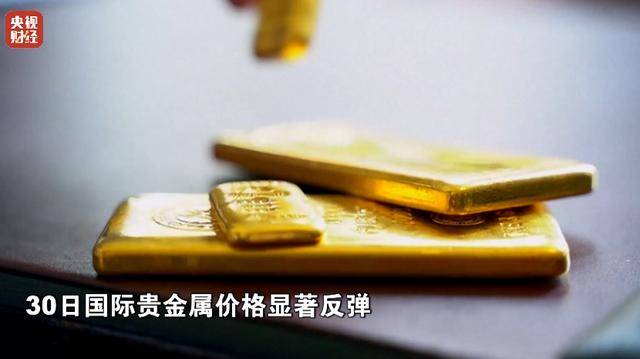
金价,涨了!银价,暴涨!美联储,大消息→
Sou Hu Cai Jing· 2025-12-31 03:22
Group 1: U.S. Stock Market - Retail investors are on vacation, leading to low trading volumes in the U.S. stock market as the year-end approaches [1] - The Federal Reserve's meeting minutes indicate increasing internal disagreements on future interest rate cuts, suggesting a cautious approach in early next year [1] - Major U.S. stock indices closed lower, with the Dow Jones down 0.20%, S&P 500 down 0.14%, and Nasdaq down 0.24% [1] Group 2: Company News - Meta, the parent company of Facebook, announced the acquisition of AI startup Manus, founded by a Chinese team, which is expected to accelerate the integration of advanced AI technology into Facebook and Instagram [1] - Following the announcement, Meta's stock rose by 1.1%, leading gains among seven major tech companies in the U.S. [1] Group 3: Precious Metals Market - After a significant sell-off, international precious metal prices rebounded due to technical buying by investors [4] - Analysts remain optimistic about the outlook for precious metals, anticipating increased investment demand driven by the Fed's potential interest rate cuts and the global push for green industries [4] - Gold prices rose to over $4,400 per ounce, silver prices surged over 10%, and platinum prices closed above $2,200 per ounce [4] Group 4: Commodity Prices - As of the close, gold futures for February delivery were at $4,386.3 per ounce, up 0.98%; silver futures for March delivery were at $77.919 per ounce, up 10.59%; and platinum futures for February delivery were at $2,240.8 per ounce, up 5.69% [6] - Analysts warn of potential volatility in precious metal prices due to upcoming adjustments in commodity index weights, which may lead to selling pressure from passive funds [6] Group 5: European Stock Market - European stock indices collectively rose, driven by a rebound in precious metal prices and buying interest in defense and military stocks [8] - The UK stock market increased by 0.75%, France by 0.69%, and Germany by 0.57%, with the German DAX index showing a 23.01% increase for the year, the largest annual gain since 2019 [8] Group 6: Oil Market - U.S. commercial crude oil inventories increased by 405,000 barrels, contrary to market expectations of a significant decrease, indicating weak oil consumption demand [10] - As of the close, light crude oil futures for February delivery were at $57.95 per barrel, down 0.22%, and Brent crude futures for February delivery were at $61.92 per barrel, down 0.03% [10]
让城市湿地成为生态文明建设“大课堂”
Xin Lang Cai Jing· 2025-12-30 20:11
Core Viewpoint - The article emphasizes the importance of wetland protection and management in China, highlighting significant achievements and ongoing efforts to enhance ecological functions and biodiversity while integrating natural beauty into urban development [1]. Group 1: Wetland Protection Achievements - During the "14th Five-Year Plan" period, China has implemented over 1,000 wetland protection projects, scientifically restored 289,600 hectares of wetlands, and maintained wetland areas above 80 million acres [1]. - China has 22 "International Wetland Cities," the highest number globally, and has established 903 national wetland parks, effectively protecting 2.4 million hectares of wetlands, with approximately 90% of these parks open to the public, attracting around 320 million visitors annually [1]. Group 2: Ecological Restoration and Education - The article discusses the implementation of ecological restoration projects based on the concept of a life community, focusing on natural recovery and artificial restoration, enhancing wetland ecosystem functions and biodiversity [2]. - It highlights the importance of ecological education, particularly for children, through activities like wetland park research, to instill conservation values and foster a collective effort in wetland protection [2]. Group 3: Environmental Governance and Public Awareness - The article outlines the strict management of ecological protection boundaries and the comprehensive governance of wetland resources, including pollution control and public awareness campaigns during special events [3]. - It emphasizes the need for public engagement in wetland conservation through various educational and promotional activities to enhance awareness of wetland values [3]. Group 4: Green Industry Development - The article suggests developing green industries such as wetland agriculture, eco-tourism, and cultural experiences to promote sustainable economic growth while protecting wetland resources [3]. - An example is provided of Hangzhou, which has leveraged its cultural heritage to create wetland cultural landscapes, boosting local tourism and related industries [3]. Group 5: Legal and Institutional Framework - The implementation of the Wetland Protection Law in June 2022 provides a robust legal framework for maintaining wetland ecological functions and biodiversity [4]. - The article mentions the establishment of the National Wetland Protection Plan (2022-2030), which sets clear goals for high-quality wetland development and ecological improvement by 2030 [4]. Group 6: Innovative Mechanisms for Participation - The article calls for innovative mechanisms to attract public participation in wetland protection, including exploring ecological compensation and carbon trading [5]. - It emphasizes the importance of creating a dual mechanism of interest connection and cultural immersion to encourage community involvement in wetland conservation [5].
140万亿之后,中国经济凭什么继续向前
Sou Hu Cai Jing· 2025-12-28 10:26
Core Insights - The article emphasizes that China's economy is not merely enduring but is undergoing a significant upgrade, characterized by a clear direction and stability [6] Group 1: Economic Structure and Growth - China's economy, valued at 140 trillion yuan, is likened to a giant ship successfully shifting gears rather than merely docking [5] - The economy has added approximately 40 trillion yuan over five years, equivalent to creating a new world-class economy, with a focus on digital economy, artificial intelligence, and green industries as primary growth drivers [5] Group 2: Policy Stability - The macroeconomic policy is described as "proactive" rather than unconventional, with precise fiscal measures and a monetary policy that prioritizes price stability and expectations [5] - The governance capability is highlighted as being able to maintain a firm grip on the economic direction, aiming for stable growth, stable prices, and stable confidence [5] Group 3: External Trade and Open Economy - In the face of trade tensions, China is taking a rational approach to countermeasures while expanding its openness, maintaining its position as the world's largest trading nation [5] - The strategy combines internal circulation as a foundation with high-level openness as an accelerator, using certainty to counteract uncertainty [5] Group 4: Future Outlook - Artificial intelligence is viewed not as a bubble but as a filter, with China's advantages lying in its vast scenarios, massive data, and stable power supply [5] - The commitment to open-source and inclusive technology aims to ensure that advancements are not only profitable but also beneficial to society [5]

白银暴涨145%的背后:散户狂热正在把行情推向极端
Hua Er Jie Jian Wen· 2025-12-26 16:30
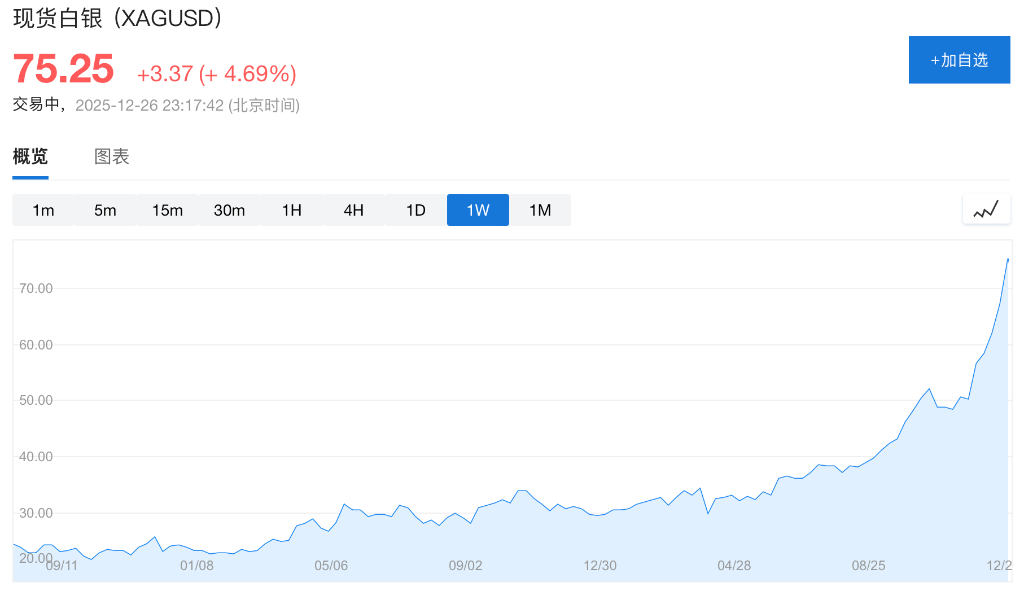
Group 1 - Silver prices have surged 145% this year, surpassing $75 per ounce, and have reached a 45-year historical high in October, significantly outperforming gold, which has risen about 70% in the same period [1][3] - The mining sector has benefited significantly, with major companies like Hochschild Mining and Coeur Mining seeing their stock prices double this year [1] - Retail investors are increasingly entering the silver market through various means, including physical silver collection, silver ETFs, and derivatives trading, with a mix of traditional precious metal investors and new short-term traders driven by market sentiment [1][3] Group 2 - The current rise in silver prices is attributed to tightening supply and increasing industrial demand, particularly from green industries like solar energy, leading to pressure on market inventories [3][6] - Retail investors' accumulation of physical silver has further widened the supply-demand gap, contributing to market tension [6] - Market excitement has raised concerns about overheating, with trading volumes in the largest silver ETF, iShares Silver Trust, nearing levels seen during the 2021 retail trading frenzy [3][7] Group 3 - Individual investors are increasingly turning to physical silver investments, as exemplified by a case of a truck driver who shifted from stocks and cryptocurrencies to purchasing physical silver [4] - The founder of Canada Gold reported a 150% year-over-year increase in silver sales at their stores, with a record single-day sales figure that was 50% higher than previous peaks [5] - The supply structure supports the price increase, with a scarcity of quality silver resources and strong industrial demand, while the macroeconomic environment encourages investors to allocate more to precious metals [6] Group 4 - Speculative activity in the silver market is rising, with some investors buying silver solely due to rapid price increases, leading to concerns about volatility [7] - Silver prices are more prone to significant fluctuations compared to gold, necessitating cautious risk management strategies for investors [7]
开展更多面向未来的合作(国际回响·大国外交·2025年度回眸)
Ren Min Ri Bao· 2025-12-23 22:31
Group 1 - The visit of Chinese President Xi Jinping to South Korea marks a significant step in reaffirming the strategic partnership between China and South Korea, with both leaders agreeing to enhance cooperation in emerging fields such as artificial intelligence, biopharmaceuticals, green industries, and the silver economy [2][3] - The leaders emphasized the importance of maintaining a multilateral trade system and stable supply chains, which is crucial for South Korea's export-oriented economy [3][4] - The two countries aim to strengthen collaboration in areas like trade digitalization and green development, which aligns with their mutual interests in promoting inclusive growth [3][4] Group 2 - The establishment of the Korea-China Parliamentary Alliance in 2022, consisting of approximately 130 South Korean lawmakers, highlights the increasing people-to-people exchanges and the importance of youth engagement for the sustainable development of bilateral relations [5] - The focus on youth exchanges, including entrepreneurship and diplomatic interactions, is seen as vital for fostering closer ties between the two nations [5] - The ongoing cooperation and healthy competition between China and South Korea are expected to serve as a successful model for global governance [5]

成都税务:向新而行,筑牢“十五五”高质量发展“税支撑”
Mei Ri Jing Ji Xin Wen· 2025-12-23 13:17
Core Viewpoint - Chengdu is committed to transforming national strategic potential into development momentum during the "14th Five-Year Plan" period, achieving significant high-quality urban development through tax modernization and support for local economic growth [1]. Tax Policy and Economic Support - Chengdu's tax authority has implemented over 210 billion yuan in tax reductions and exemptions during the "14th Five-Year Plan," effectively alleviating the burden on businesses [1]. - Tax support policies focusing on technological innovation and advanced manufacturing have contributed over 97 billion yuan in additional tax reductions, boosting corporate R&D confidence [1][4]. Innovation and Enterprise Support - Chengdu's tax service has established a comprehensive policy support system to convert macro policies into tangible benefits for market entities, enhancing stability and confidence in development [4]. - The city has developed a closed-loop management system for tax incentives, ensuring that policies are effectively communicated and implemented [5]. Green Industry Development - Chengdu is fostering a green low-carbon industry, with companies like Sichuan Zhongxin General Electric Co., which holds a 5.2%-6.6% market share in smart microgrid equipment, benefiting from tax incentives totaling over 994,000 yuan [7]. - The city has established collaborative mechanisms with various departments to promote a comprehensive tax support ecosystem for green industries [8]. Internationalization and Cross-Border Investment - Chengdu's tax environment has improved, enabling local high-tech products to gain international recognition, as seen with companies like Chengdu Rainbow Electric Group [9][10]. - The city has introduced tailored tax services for enterprises engaged in cross-border investments, resulting in direct investments of 6.807 billion yuan in "Belt and Road" countries, a 2.8% increase [11]. Future Development Strategy - Chengdu's tax authority aims to enhance tax compliance guidance and improve the efficiency of tax incentive policies to foster innovation and support high-quality urban development in the upcoming "15th Five-Year Plan" [11].

北京出台26项措施促进高质量充分就业
Jing Ji Guan Cha Bao· 2025-12-19 07:36
Overall Requirements - The implementation of the "Employment Priority Strategy" aims to promote high-quality and sufficient employment in Beijing, aligning with the city's development goals and the national strategy [2][3] - By 2030, the city aims to achieve a more balanced employment structure and a friendlier employment environment, with a further consolidation of high-quality employment by 2035 [2] Economic and Employment Coordination - High-quality and sufficient employment is prioritized in economic and social development, integrating various policies such as finance, industry, and investment [3] - An employment impact assessment mechanism will be established to evaluate job creation and unemployment risks when formulating major policies and projects [3] Employment-Friendly Development - Policies will be integrated to attract urgently needed talent, especially young professionals, to enhance the city's vitality [3] - Measures will be introduced to support the employment of older individuals and create job-seeking areas for seniors in public employment services [3] Industry Employment Synergy - The focus will be on developing new productive forces and expanding industry clusters to create quality jobs [4] - The government will invest in key projects and urban renewal to release job opportunities [4] Modern Human Resource Development - Education will be aligned with employment needs, optimizing academic programs and enhancing vocational education [5][6] - A lifelong vocational skills training system will be established to meet industry demands and improve employment skills [6][7] Support for Key Employment Groups - Employment support policies will be optimized to assist specific groups, including recent graduates and veterans [8][9] - Initiatives will be implemented to enhance rural labor force employment and income [9][10] Job Creation and Expansion - Support will be provided to various enterprises to stabilize and expand job positions, with a focus on financial and policy incentives [10][11] - New job fields will be developed, particularly in digital economy and green industries, to create additional employment opportunities [11] Employment Public Service System - A three-year action plan will be developed to enhance public employment services, ensuring coverage for all residents [12][13] - The efficiency of employment public services will be improved through data sharing and technology integration [12][13] Labor Rights Protection - Measures will be taken to ensure equal employment rights and prevent discrimination in hiring practices [14][15] - The growth of labor compensation will be promoted, with a focus on fair distribution based on contributions [14][15] Organizational Support - Strong leadership and coordination will be emphasized to prioritize employment as a key issue for the government [16][17] - Performance evaluations will include employment metrics to ensure accountability and effectiveness in achieving employment goals [17]
北京出新政促高质量充分就业
Zhong Guo Xin Wen Wang· 2025-12-19 06:23
Group 1 - The core viewpoint of the news is that Beijing is implementing new policies to promote high-quality and sufficient employment through various measures, including modernizing human resources and enhancing public employment services [1][2] Group 2 - The implementation opinions emphasize the need for collaboration between education and employment, suggesting that employment status should be a key factor in resource allocation, quality assessment, and enrollment planning in higher education [1] - There is a focus on developing new employment fields and positions, particularly in the digital economy, green industries, and service sectors such as childcare and elder care [1] - The policies aim to optimize the public employment service mechanism by establishing a unified human resources market and promoting the development of human resources service industry parks [2]