
降息交易

Search documents
环球市场动态:中美元首APEC会晤可期
citic securities· 2025-09-22 02:42
Market Overview - A-shares experienced a continuous decline, with the Shanghai Composite Index dropping by 0.3% and the Shenzhen Component down by 0.04%[15] - U.S. stocks reached new historical highs, with the Dow Jones increasing by 0.4% to close at 46,315.3 points, and the S&P 500 rising by 0.5% to 6,664.4 points[6][8] - European markets saw slight declines, with the Stoxx 600 down by 0.2% and the UK FTSE 100 decreasing by 0.1%[8] Economic Indicators - The market's concerns over potential U.S. tariffs on Chinese purchases of Russian oil eased, leading to a drop in international oil prices by over 1%[26] - The expectation of continued U.S. interest rate cuts has driven international gold prices higher, with gold rising by 0.7% to $3,676 per ounce[26] Sector Performance - In the U.S., the technology sector led gains, with the information technology index up by 1.19%, while the energy sector faced a decline of 1.28%[8] - In Hong Kong, the Hang Seng Index remained flat, with the Hang Seng Tech Index rising by 0.37%[10] Investment Insights - Nvidia plans to invest $5 billion in Intel, indicating a positive outlook for future business collaboration in the data center and PC markets[5] - The semiconductor sector is under scrutiny, with companies like Cambricon Technologies experiencing a significant drop of 5%[15] Fixed Income Market - U.S. Treasury yields rose slightly, with the 2-year yield increasing by 0.8 basis points to 3.57% and the 10-year yield up by 2.3 basis points to 4.13%[29] - Asian bond markets showed limited trading activity, with spreads narrowing by 0-3 basis points[29] Currency Movements - The U.S. Dollar Index increased by 0.3%, while the dollar's value against the Chinese Yuan remained stable at 7.118[25] - The Euro appreciated against the dollar, trading at 1.175, reflecting a 13.4% increase year-to-date[25]


海外宏观周报:降息兑现,“降息交易”降温-20250921
Ping An Securities· 2025-09-21 11:09
Group 1: U.S. Economic Policy - The Federal Reserve lowered the federal funds rate by 25 basis points to a range of 4.00%-4.25%, marking the first rate cut in nine months[1] - Initial jobless claims fell to 231,000, the largest drop in nearly four years, against an expectation of 240,000[1] - The New York Fed manufacturing index dropped 21 points to -8.7, significantly below the market expectation of 5[1] Group 2: European Economic Policy - The Bank of England maintained its interest rate at 4% and reduced its quantitative tightening scale from £100 billion to £70 billion over the next 12 months[1] - The European Central Bank's executive board member Schnabel indicated that inflation risks remain tilted to the upside, suggesting a hold on current interest rates[1] - The UK's August CPI remained steady at 3.8%, matching market expectations[1] Group 3: Japanese Economic Policy - The Bank of Japan kept its benchmark interest rate unchanged at 0.5% for the fifth consecutive time, with some members advocating for a 25 basis point increase[1] - Japan's exports fell by 0.1% year-on-year in August, marking the fourth consecutive month of decline, with exports to the U.S. down 13.8%[1] - The elderly population (aged 65 and above) in Japan reached 36.19 million, accounting for 29.4% of the total population, a record high[1] Group 4: Global Market Trends - Global stock market optimism has cooled, with the S&P 500, Dow Jones, and Nasdaq rising by 1.2%, 1.0%, and 2.2% respectively[1] - The 10-year U.S. Treasury yield rose by 8 basis points to 4.14%, reflecting investor concerns about future economic uncertainty[1] - Gold prices increased by 0.3% to $3,663.2 per ounce, while Brent crude oil prices fell by 0.5% to $66.7 per barrel[1]

“超级央行周”落幕 美联储领衔降息
Sou Hu Cai Jing· 2025-09-19 13:39
Group 1 - The Bank of Japan announced to maintain its current interest rate level and plans to sell financial assets to further reduce its easing measures and normalize monetary policy [1] - The Canadian central bank cut its benchmark interest rate by 25 basis points to 2.5%, aiming to stimulate economic growth and alleviate downward pressure on the economy [1] - The Federal Reserve lowered the federal funds rate target range by 25 basis points to between 4.00% and 4.25%, marking its first rate cut of the year and indicating potential further cuts in the future [2] Group 2 - The Federal Reserve's rate cut is expected to lower corporate financing costs, stimulate investment and consumption, and inject vitality into the U.S. economy [2][3] - The Fed's decision is likely to influence major asset classes, with expectations of a limited decline in U.S. Treasury yields, support for U.S. stocks, and a weaker dollar index [3] - Global funds may seek higher returns due to the U.S. rate decrease, potentially flowing into emerging market equities [3]
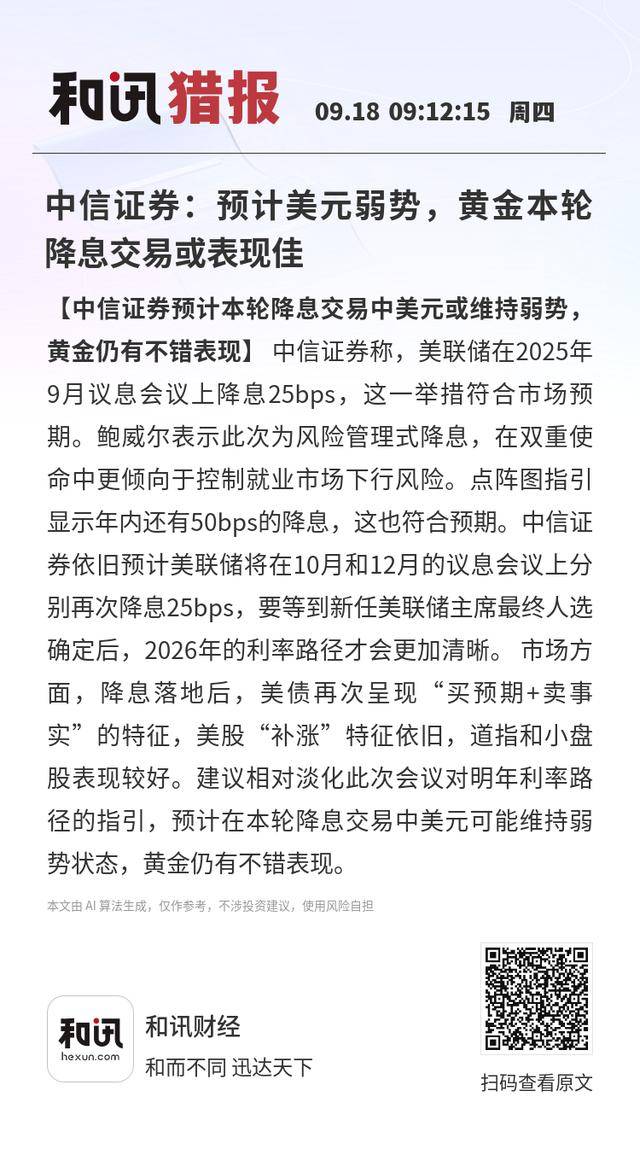
中信证券:预计美元弱势,黄金本轮降息交易或表现佳
Sou Hu Cai Jing· 2025-09-18 02:02
Group 1 - The core viewpoint is that Citic Securities expects the US dollar to remain weak during the current interest rate cut cycle, while gold is anticipated to perform well [1] - The Federal Reserve is projected to cut rates by 25 basis points at the September 2025 meeting, aligning with market expectations [1] - The dot plot indicates an additional 50 basis points of cuts within the year, which is also in line with expectations [1] Group 2 - Citic Securities anticipates further rate cuts of 25 basis points at the upcoming meetings in October and December [1] - The clarity on the interest rate path for 2026 will depend on the appointment of the new Federal Reserve Chair [1] - Following the rate cut, the market exhibited a "buy the rumor, sell the news" behavior, with the Dow Jones and small-cap stocks performing well [1]


策略点评报告:9月FOMC:鹰派的应对式降息
Huaxin Securities· 2025-09-18 01:30
Group 1 - The Federal Reserve lowered the benchmark interest rate by 25 basis points, setting the target range at 4% to 4.25%, while emphasizing that this rate cut is not a signal of easing but a gradual measure to maintain economic stability and avoid a hard landing [3][4]. - Powell's remarks indicate a return to a data-dependent approach for future rate cuts, with the Fed maintaining a neutral stance on economic and inflation outlooks, despite upward adjustments in economic forecasts [4][5]. - The report anticipates two more rate cuts in 2025, expected in late October and early December, with inflation pressures expected to be minimal due to weak demand and low base effects [5][6]. Group 2 - The current economic environment is characterized by a potential stagflation scenario, with employment data showing a continuous decline, including a notable increase in long-term unemployment [6]. - The report suggests that the market's liquidity has become more abundant, favoring small-cap stocks, and emphasizes the importance of a "barbell strategy" in equity investments, focusing on real estate and financial technology [7]. - The outlook for the U.S. dollar remains bearish, with expectations of fluctuations, while monitoring whether the 12-month rate cut expectations can exceed 150 basis points [7].
中信证券:预计在本轮降息交易中美元可能维持弱势状态 黄金仍有不错表现
Sou Hu Cai Jing· 2025-09-18 00:34
Core Viewpoint - The Federal Reserve is expected to lower interest rates by 25 basis points in September 2025, aligning with market expectations, as stated in a report by CITIC Securities [1] Group 1: Federal Reserve Actions - The rate cut is described as a risk management measure, with a focus on mitigating risks in the employment market [1] - The dot plot indicates a target interest rate midpoint of 3.6% for this year, down from the previously indicated 3.9% in June [1] - The Federal Reserve has raised its economic growth forecast for the U.S. while maintaining its predictions for inflation and unemployment rates [1] Group 2: Future Projections - CITIC Securities anticipates further rate cuts of 25 basis points in the upcoming meetings in October and December [1] - Clarity on the interest rate path for 2026 is expected only after the appointment of the new Federal Reserve Chair [1] Group 3: Market Reactions - Following the rate cut, the U.S. Treasury market exhibited a "buy the expectation, sell the fact" behavior, while U.S. stocks showed characteristics of "catching up," with the Dow Jones and small-cap stocks performing well [1] - The report suggests downplaying the guidance from this meeting regarding next year's interest rate path, predicting a continued weak status for the U.S. dollar and a favorable outlook for gold [1]
金银铜铝齐舞,基金经理热衷于“挖矿”
Sou Hu Cai Jing· 2025-09-17 22:32
Core Insights - Recent increase in posts related to resource cyclical commodities on investment social platforms indicates growing interest in this sector [1] - Multiple resource-themed funds have shown significant gains this year, reaching new net asset value highs recently [1] - The anticipated arrival of a Federal Reserve interest rate cut cycle is expected to benefit the non-ferrous metals sector due to increased liquidity [1] - With China's Producer Price Index (PPI) nearing a turning point, resource commodities are likely to become the core rising assets in the next market cycle, supporting a positive outlook for cyclical investments [1]
今夜无眠!美联储降息前夕,快速补习手里的资产到底该如何配置
雪球· 2025-09-17 12:51
Group 1 - The core viewpoint of the article is the anticipation of the Federal Reserve's interest rate decision, with a high probability of a 25 basis point cut, which is expected to influence global markets significantly [2][3][34] - The article emphasizes that the Federal Reserve's decisions impact not only the U.S. market but also global assets including U.S. stocks, bonds, A-shares, Hong Kong stocks, and commodities like gold [5][6] Group 2 - The article outlines three potential scenarios for the interest rate cut: no cut, a 25 basis point cut, and a 50 basis point cut, detailing the expected market reactions for each scenario [7][9][10] - In the case of a 25 basis point cut, it is viewed as beneficial for risk assets, while a 50 basis point cut could raise concerns about a potential recession, depending on market confidence in the U.S. economy [9][34] - Historical data shows that during previous significant rate cuts, equity markets generally experienced declines, while fixed income assets like U.S. Treasuries and gold tended to perform well [29][30][31] Group 3 - The article provides a summary of past Federal Reserve rate cut cycles, highlighting the economic conditions and market responses during those periods, indicating a consistent pattern of equity declines amid aggressive rate cuts [14][21][29] - It notes that during the 2001-2003 and 2007-2008 rate cut cycles, equity markets faced significant downturns, while fixed income and gold assets showed resilience [18][22][28] - The analysis suggests that the current market sentiment remains optimistic about the U.S. economy, with a 25 basis point cut being the most likely outcome, which could support risk assets like A-shares and Hong Kong stocks [34]

用好雪球三分法,把握降息后的投资机会
Sou Hu Cai Jing· 2025-09-17 11:22
Group 1 - The Federal Reserve is expected to announce a key interest rate decision in the second half of 2025, with a 95.9% probability of a 25 basis point rate cut [1] - A rate cut is anticipated to trigger a liquidity turning point in global financial markets, affecting the performance of U.S. stocks, emerging markets, and commodities [1][3] Group 2 - In the U.S. stock market, technology growth is expected to remain the main focus, while traditional cyclical sectors may perform relatively flat [3][5] - The Nasdaq 100 index, primarily composed of technology stocks, is likely to continue its upward trend post-rate cut, benefiting companies like Apple and Microsoft due to reduced financing costs [4] - Historical data indicates that U.S. stocks typically experience a "rate cut trade" lasting around three months, suggesting limited concern for immediate pullbacks [6] Group 3 - Emerging markets, particularly A-shares and Hong Kong stocks, may attract new capital as the U.S. dollar weakens post-rate cut [7] - A-shares in sectors like AI computing and semiconductors are expected to benefit from valuation expansion due to low interest rates, while Hong Kong tech stocks may recover from previous pressures [8] Group 4 - In the commodities market, gold and silver are seen as having greater opportunities compared to oil, with gold historically showing an 83% success rate in the ten trading days following rate cuts [9] - The appeal of gold is heightened by reduced opportunity costs and rising geopolitical risks, while silver benefits from both its safe-haven and industrial demand [9] Group 5 - The "雪球三分法" (Snowball Three-Part Method) is proposed as a strategy for investors to navigate the differentiated market conditions post-rate cut [11] - This method emphasizes asset, market, and timing diversification to capture opportunities across various sectors while mitigating risks associated with single markets [12] Group 6 - Asset diversification can lower volatility, as evidenced by a significant reduction in maximum drawdown when incorporating gold into traditional stock-bond portfolios during rate hikes [13] - Market diversification allows for capturing opportunities across global markets, reducing the impact of correlated movements between different asset classes [16] Group 7 - Timing diversification through regular investment can alleviate concerns about market timing, allowing investors to benefit from long-term trends without the stress of buying at peak prices [17]

策略深度报告:A股主升初期调整后的应对策略
Huaxin Securities· 2025-09-17 06:42
Group 1 - The report highlights that the initial adjustments during the main upward phases of A-shares in 2015, 2017, and 2020 typically saw an average adjustment period of 11 trading days, with an average decline of nearly 5% for the overall market and a 20% pullback in popular sectors [5][28][32] - The report indicates that the current adjustment has lasted for 6 trading days with a decline of 2.35%, and popular sectors have experienced a pullback of 28.5%, suggesting that the adjustment is nearing completion and a consolidation phase is beginning [5][8][66] - The report suggests that the main upward phase of A-shares is characterized by a significant influx of household deposits into the market, which has been a driving force behind the current upward trend [15][17] Group 2 - The report outlines that the adjustment in 2015 was primarily driven by regulatory warnings and weak earnings reports, leading to a decline in market sentiment [33][36] - In 2017, the adjustment was influenced by disappointing macroeconomic data and external shocks, such as credit rating downgrades, which affected investor confidence [51][52] - The 2020 adjustment was marked by a significant outflow of northbound capital and the IPO of a major company, which created short-term liquidity pressure on the market [64][66] Group 3 - The report identifies key sectors to focus on during the current market phase, including interest rate-sensitive sectors (TMT, non-bank financials, and metals), sectors benefiting from a potential PPI recovery (chemicals, machinery, and consumer goods), and growth sectors that may see rotation (AI hardware, innovative pharmaceuticals, and defense) [8][66] - The report emphasizes that the style rotation in the market is contingent on fundamental performance, with growth sectors expected to continue leading, while a shift towards consumer and cyclical sectors may occur if earnings improve [7][8][66]