K型分化

Search documents
权益市场远期保持乐观,关注现金流ETF(159399)、矿业ETF(561330)
Mei Ri Jing Ji Xin Wen· 2025-12-25 01:15
Group 1 - The core viewpoint of the article is an optimistic long-term outlook for the equity market, while emphasizing the need to focus on structural issues in the short term [1] - The optimism is driven by policies aimed at "expanding domestic demand," which include support for income-driven demand, reasonable investment returns, and financial demand constrained by principal and debt [1] - The current bottleneck in the A-share market is attributed to the K-shaped economic divergence, where high-performing sectors include AI, anti-involution, and export chains, while low-performing sectors are consumer real estate [1] Group 2 - The growth in high-performing sectors is facing uncertainties, particularly regarding the sustainability of capital expenditures by AI giants, which has amplified volatility in related sectors between US and A-shares [1] - There are concerns about the effectiveness of anti-involution measures, leading to downward adjustments in market expectations [1] - In the short term, the economic structure remains unchanged, but if risks emerge in sectors like AI, the market may shift back to a dividend-focused approach, such as cash flow ETFs [1] Group 3 - Given the crowded nature of single-track trading, the company suggests focusing on the diffusion effect of AI investments and allocating resources to more certain sectors [1] - Recommended sectors include those related to power infrastructure, such as mining ETFs, non-ferrous metal ETFs, and grid ETFs [1]
美国失业担忧渐升!家庭债务创纪录 美联储如何应对
Di Yi Cai Jing· 2025-12-25 00:38
Group 1: Employment Stability - The U.S. job market is experiencing a "no firing, no hiring" norm as of 2025, with employment stability becoming a major concern for workers [1] - A recent Mercer survey indicates that employment stability is now the second biggest concern for workers, following the ability to pay monthly living expenses [2] - The fear of unemployment has risen sharply, moving from the seventh position in 2023 to the second position in 2025, reflecting a disconnect between individual perceptions and macroeconomic data [2][3] Group 2: Economic Conditions - Despite a reported GDP growth of 4.3% in Q3, many Americans feel economic pressure, particularly due to high inflation and rising household debt [2][3] - Moody's analysis shows that 22 states are in recession, and 13 are experiencing stagnation, indicating broader economic challenges [2] - Consumer confidence has declined significantly, with a nearly 30% drop in the consumer confidence index compared to the same period in 2024 [4] Group 3: Household Debt - U.S. household debt reached a record high of $18.6 trillion in Q3 2025, complicating the Federal Reserve's monetary policy decisions [5] - The largest portion of household debt is mortgage debt, totaling $13.07 trillion, while credit card debt stands at $1.23 trillion and auto loans at $1.66 trillion [5] - The credit market is showing signs of a "K-shaped" economic recovery, where high-income households are thriving while low-income families face financial pressures [6]
美国失业担忧渐升!家庭债务创纪录,美联储如何应对
Di Yi Cai Jing· 2025-12-25 00:28
Group 1: Employment Stability Concerns - 63% of respondents in the University of Michigan consumer confidence survey expect the unemployment rate to continue rising next year [5] - Employment stability has become the second biggest concern for American workers, following the ability to pay monthly living expenses [3] - The unemployment rate in the U.S. rose to 4.6% in November, the highest in four years, with new job growth concentrated in the healthcare sector [4] Group 2: Economic Sentiment and Consumer Confidence - The consumer confidence index for December fell nearly 30% compared to the same period in 2024, driven by ongoing financial pressures [5] - Despite a reported GDP growth of 4.3% in Q3, public sentiment regarding the economy remains negative, indicating a disconnect between macroeconomic data and individual experiences [3][4] - A survey by the Conference Board revealed a more negative outlook on the labor market among consumers in December [4] Group 3: Household Debt and Financial Pressure - U.S. household debt reached a record high of $18.6 trillion in Q3 2025, complicating the Federal Reserve's monetary policy decisions [7] - The largest portion of household debt is mortgage debt, totaling $13.07 trillion, while credit card debt stands at $1.23 trillion [7] - The credit market is exhibiting "K-shaped" economic divergence, with high-income households benefiting from rising asset values, while low-income families face increasing financial pressure [8]


美国失业担忧上升,家庭债务创纪录
Di Yi Cai Jing Zi Xun· 2025-12-25 00:08
Group 1 - The core concern for American workers in 2025 is employment stability, which has risen to the second position in importance, following the ability to cover monthly living expenses [3] - The disconnect between macroeconomic data and individual experiences is highlighted, as GDP grew by 4.3% in Q3, yet many individuals feel economic pressure due to high inflation and rising costs [3][4] - The unemployment rate in November reached 4.6%, the highest in four years, with new job creation concentrated in the healthcare sector [5] Group 2 - U.S. household debt reached a record high of $18.6 trillion in Q3 2025, complicating the Federal Reserve's monetary policy decisions [6] - The largest portion of household debt is mortgage debt, totaling $13.07 trillion, while credit card debt stands at $1.23 trillion and auto loans at $1.66 trillion [6] - The credit market is exhibiting "K-shaped" economic divergence, where high-income groups benefit from a booming stock market, while low-income families face significant financial pressures [7]

国泰海通|宏观:美国经济的韧性与三重“K”型分化——2025年三季度美国经济数据点评
国泰海通证券研究· 2025-12-24 13:38
Core Viewpoint - The U.S. economy showed resilience in Q3 2025, driven by strong personal consumption, increased public spending, and enhanced export contributions, despite exhibiting a "K"-shaped divergence in income, business performance, and economic sectors [1][2]. Economic Performance - The annualized quarter-on-quarter GDP growth rate for Q3 2025 was 4.3%, surpassing expectations of 3.3% and the previous value of 3.8%, indicating overall economic resilience [2]. - Key drivers of this resilience included: - Strong personal consumption supported by the wealth effect from capital markets, with major stock indices reaching historical highs [2]. - Increased government consumption and investment, particularly in defense spending and investments in companies like Intel, alongside a significant rise in the borrowing plan by the U.S. Treasury [2]. - A rebound in global economic activity that boosted U.S. exports, aided by trade agreements that reduced or eliminated tariffs [2]. "K"-Shaped Divergence - The economy displayed a pronounced "K"-shaped divergence characterized by: - Income disparity leading to consumption differences, exacerbated by immigration policies affecting employment rates among minority groups [3]. - A split in business performance, where large enterprises maintained a positive outlook while small businesses showed relative weakness, as indicated by the S&P Global Composite PMI and NFIB optimism index [3]. - A divergence in investment and growth between new and old economies, with strong performance in private non-residential investments, particularly in equipment and intellectual property, while construction investment growth declined [3]. Future Outlook - The U.S. economy is expected to face short-term impacts from the government shutdown in Q4 2025, but overall resilience is anticipated to remain strong into 2026 [4]. - The shutdown is expected to have direct effects on government procurement and investment activities, as well as indirect impacts on income and industry approvals [4]. - A recovery is likely in Q1 2026 due to delayed demand release, sustained consumer spending, and new economic investments, alongside easing trade tensions and global economic recovery [4]. - The forecast remains for the Federal Reserve to implement 2-3 rate cuts in 2026, despite the strong economic performance, due to structural weaknesses in the labor market and potential changes in Fed leadership [4].

美国2025年经济回顾及2026年展望:多重约束下的韧性与分化
工银亚洲· 2025-12-24 12:16
Economic Growth Outlook - The US GDP growth rate for 2025 is estimated to be around 1.8%-2.0%[3] - For 2026, the GDP growth is projected to be approximately 2.3% under neutral conditions[5] Consumer Behavior - Private consumption is expected to exhibit a "K-shaped" trend, with high-income groups showing resilience while low-income groups face declining consumption[5] - The annual growth rate of private consumption in 2026 is anticipated to be around 2.3%[5] Employment Market - The labor market is experiencing structural imbalances, with the unemployment rate remaining low but showing signs of pressure due to a mismatch in supply and demand[3] - The labor force participation rate as of August 2025 is 62.7%, still below the pre-pandemic level of 63.4%[42] Inflation Dynamics - Inflation is expected to rise due to tariff costs being passed from production to consumption, with core commodity prices increasing[50] - The Consumer Price Index (CPI) is projected to experience upward pressure, particularly in the first half of 2026[55] Federal Reserve Policy - The Federal Reserve is likely to maintain a "data-dependent" and "path-open" approach, with a high probability of two rate cuts totaling 50 basis points in 2026[60] - The Fed faces a "four-dimensional dilemma" involving inflation, growth slowdown, liquidity risks, and policy independence[55] Investment Trends - Inventory, real estate, and corporate investments are expected to recover gradually, supported by lower interest rates and fiscal policies[21] - AI-related investment growth is projected to moderate in 2026 due to emerging constraints in hardware and deployment[30]
ETF日报:资金正源源不断地流入黄金ETF,今年除5月外,全球黄金ETF的总持仓量每个月都在上升
Xin Lang Cai Jing· 2025-12-24 11:49
Market Overview - A-shares experienced a rebound with the Shanghai Composite Index recording six consecutive days of gains, closing up 0.53% at 3940.95 points, while the Shenzhen Component Index rose 0.88% and the ChiNext Index increased by 0.77% [1][15] - The total trading volume in the Shanghai and Shenzhen markets was 1.88 trillion yuan, a decrease of 19.6 billion yuan from the previous trading day [1][15] - High-volatility sectors such as military, consumer electronics, photovoltaic, and communication performed well, while sectors like aquaculture, coal, and dividend stocks lagged behind [1][15] Investment Strategy - The current market environment suggests a neutral to strong risk appetite, with a recommendation for "balanced allocation" as a more prudent investment strategy due to the increasing difficulty in accurately betting on a single sector [1][15] - The China Securities A500 Index is highlighted as a new core broad-based index that aligns with market demands for balanced sector exposure [1][15] Future Outlook - The market is expected to continue its oscillating structure, with 2026 being a critical year for cross-year layout as it marks the beginning of the "14th Five-Year Plan" [2][16] - Structural opportunities are anticipated to arise from policy guidance and industry prosperity, with a focus on the China Securities A500 ETF (159338) as a popular choice among investors [2][16] Sector Analysis - The China Securities A500 Index offers comprehensive and balanced coverage across various industries, reflecting the performance of representative listed companies [2][16] - The index has reduced its weight in traditional sectors like non-bank financials and food and beverage by approximately 10%, reallocating to emerging industries, enhancing its growth characteristics [2][16] - The index includes 97% of the leading companies across various sectors, combining traditional giants with high-growth potential "hidden champions" [2][16] Precious Metals - Gold, silver, and platinum prices have surged to historical highs due to geopolitical risks, ongoing supply shortages, and strong investment demand [5][19] - The price of gold has surpassed $4500 per ounce for the first time, while platinum futures have exceeded $2300 per ounce [5][19] - The strong performance of gold is attributed to factors such as the recent interest rate cuts, higher-than-expected unemployment rates, and lower-than-expected CPI, which have raised expectations for further rate cuts [20] Cash Flow ETFs - The cash flow ETF (159399) has completed its quarterly adjustment, significantly increasing the weight of the communication sector while enhancing the allocation to electronics, retail, steel, and automotive industries [23][24] - The index adjustment has resulted in a more balanced industry distribution, with a slight increase in the free cash flow rate of constituent stocks [23][24] - Compared to other cash flow indices, the FTSE cash flow index is characterized by its focus on large and mid-cap stocks, providing a better risk-return profile [24][26]
国泰海通:美国经济的韧性与三重“K”型分化
Xin Lang Cai Jing· 2025-12-24 10:59
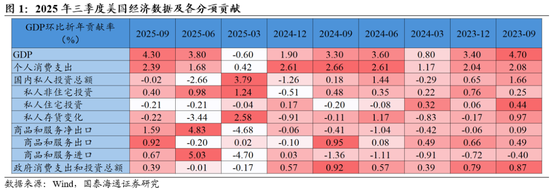
Core Viewpoint - The U.S. economy showed resilience in Q3 2025, driven by strong personal consumption, increased public spending, and enhanced export contributions, despite exhibiting a "K"-shaped divergence in income, business performance, and economic sectors [1][2][3][4]. Economic Performance - The U.S. GDP annualized growth rate for Q3 2025 was 4.3%, exceeding expectations of 3.3% and the previous value of 3.8%, indicating overall economic resilience [5][26]. - Key contributors to this economic resilience included personal consumption, public spending growth, and increased exports [2][23][27]. Personal Consumption - Capital market wealth effects significantly supported high growth in personal consumption, with a contribution rate of 2.39% to GDP in Q3 2025. Year-on-year, personal consumption grew by 2.8%, with goods consumption up 3.3% and services consumption up 2.5% [6][27]. - The performance of the capital markets, with major indices reaching historical highs, was closely linked to consumer spending [6][27]. Public Spending - Government consumption and investment saw a rebound, with a 0.55% increase in Q3 2025 compared to previous quarters' contractions. Notably, defense spending rose by 1.43% [6][27][28]. - The U.S. Treasury significantly raised its borrowing plan for Q3 2025 from an estimated $554 billion to $1.01 trillion, providing additional funding for government spending [6][27]. Export Growth - U.S. exports increased by 2.13% in Q3 2025, a significant rise compared to previous quarters, supported by a recovery in global economic activity and new trade agreements that reduced tariffs [7][28][29]. "K"-Shaped Divergence - The economy displayed a "K"-shaped divergence characterized by: - **Individual Level**: Income disparity led to consumption differences, with higher unemployment rates among minority groups and wealth concentration in the top 10% of households [3][11][32]. - **Business Level**: Large enterprises maintained a positive outlook, reflected in the S&P Global Composite PMI, while small businesses showed weaker performance as indicated by the NFIB optimism index [3][13][34]. - **Sector Level**: Investment and growth disparities were evident, with strong performance in private non-residential investments, particularly in equipment and intellectual property, while construction investment declined [3][15][35]. Future Outlook - The U.S. economy is expected to face short-term impacts from the government shutdown in Q4 2025, but overall resilience is anticipated to remain strong into 2026, with a likely recovery in Q1 2026 [4][18][25][37]. - The Federal Reserve is projected to implement 2-3 rate cuts in 2026, despite the economy's strength, due to structural weaknesses in the labor market and potential influences from leadership changes at the Fed [4][19][38].

博时宏观观点:降准降息预期保守,债市短期或维持震荡格局
Xin Lang Cai Jing· 2025-12-23 02:34
Group 1: Economic Overview - US inflation for October and November was significantly lower than expected, with a potential rebound in December. The focus of the Federal Reserve has shifted towards addressing weak employment under a K-shaped recovery, maintaining an overall accommodative policy stance, and market expectations for interest rate cuts next year have increased [1][11] - In China, November data on consumption and investment showed weakness, indicating that domestic demand still needs stabilization. However, the recovery in export growth has supported industrial production, while retail sales were affected by the decline in government subsidies and the "Double Eleven" shopping festival [1][11] Group 2: Market Strategy - In the bond market, the funding environment remained stable, with short-term yields declining and mid to long-term yields showing volatility. The central bank is expected to implement substantial easing to lower bank funding costs ahead of potential interest rate cuts [2][12] - For A-shares, the framework indicates a bottoming of profits, but liquidity and risk appetite remain negative. The rapid decline in US CPI has raised expectations for interest rate cuts, positively impacting the offshore market [2][13] - The Hong Kong stock market is currently in a phase benefiting from liquidity but facing weak fundamentals. The improvement of the price level in 2026 will be crucial for market performance [2][13] Group 3: Commodity Insights - In the oil market, global economic fundamentals indicate weak demand, continuous supply release, and inventory accumulation, leading to sustained price pressure [3][14] - For gold, the reduction of uncertainties due to easing US-China trade tensions and a shift in focus from trade to domestic policy may lead to a gradual decrease in risk premiums, potentially slowing the pace of gold price increases while maintaining a positive long-term outlook [3][14]
【招银研究】开局之年——2026年宏观经济与资本市场展望①
招商银行研究· 2025-12-22 09:47
Group 1: Macro and Strategy Overview - The article discusses the macroeconomic outlook for 2026, highlighting a "strong US and weak Europe" scenario, with the US economy expected to maintain steady growth supported by fiscal policies during the midterm election year [1][2] - The US Federal Reserve is anticipated to adopt a dovish stance, potentially lowering interest rates three times to around 3% [1][2] - The article warns of Japan potentially facing "stagflation," with rising inflation pressures possibly forcing the Bank of Japan to raise interest rates, contrasting with US and European central bank policies [1] Group 2: China's Economic Outlook - China's GDP growth is projected to reach 4.8% in 2026, characterized by stable external demand, improved internal demand, and price recovery [2][4] - The article outlines that fiscal policy will be more proactive, with a target deficit rate of 4.0%, corresponding to a deficit scale of 5.85 trillion yuan, and a total fiscal arrangement of 43 trillion yuan, an increase of 1.6 trillion yuan from the previous year [2][4] - Monetary policy is expected to be moderately accommodative, with a potential reduction in the OMO rate by 10 basis points to 1.3% and a reserve requirement ratio cut of 50 basis points [3][4] Group 3: Capital Market Insights - The domestic stock market is expected to grow, with A-shares projected to rise to a central level of 4,300 points, driven by improved liquidity and corporate performance [3][4] - The bond market may experience fluctuations, with the 10-year government bond yield expected to slightly rise to 1.8% [3][4] - Internationally, the article notes that the US stock market and Hong Kong stocks are likely to continue their upward trend, with the 10-year US Treasury yield expected to decrease to around 4.0% [3][4] Group 4: Asset Allocation Strategy - The article provides asset allocation recommendations for the next six months, suggesting a high allocation to Chinese government bonds and A-shares, while recommending a reduction in US dollar bonds [5] - It emphasizes an upward adjustment for growth-oriented stocks and technology sectors, particularly in the Hong Kong market [5]