
即时零售

Search documents
刚刚,直线拉升!中概股,重磅利好!
券商中国· 2025-11-25 13:00
Core Insights - The article highlights the positive performance of several Chinese concept stocks, particularly Alibaba, NIO, and Pony.ai, following the release of their financial results, which exceeded market expectations in various aspects [1][2][3]. Alibaba - Alibaba's latest financial report for the second fiscal quarter of 2026 shows revenue of 2477.95 billion RMB, a year-on-year increase of 4.8%, surpassing market expectations of 2452 billion RMB [2]. - The Cloud Intelligence Group emerged as a key growth driver, with revenue reaching 398.2 billion RMB, a significant 34% increase year-on-year, exceeding the forecast of 379.9 billion RMB [2][5]. - AI-related product revenue has seen triple-digit year-on-year growth for nine consecutive quarters, indicating strong adoption among enterprise clients [5]. - The Chinese e-commerce segment remains Alibaba's largest revenue source, contributing 1325.8 billion RMB, a 16% increase year-on-year, also exceeding market estimates [4][5]. - Alibaba's CFO noted that the company invested approximately 1200 billion RMB in AI and cloud infrastructure over the past four quarters [5]. NIO - NIO reported third-quarter revenue of 217.9 billion RMB, reflecting a year-on-year increase of 16.7% and a quarter-on-quarter increase of 14.7% [8]. - The company delivered 87,071 smart electric vehicles, marking a 40.8% year-on-year increase, with a gross profit of 30.2 billion RMB, up 50.7% year-on-year [8][12]. - NIO's cash and cash equivalents totaled 367 billion RMB at the end of the third quarter, showing a significant increase of nearly 10 billion RMB quarter-on-quarter [8]. Pony.ai - Pony.ai reported a substantial year-on-year revenue growth of 72% for the third quarter, reaching 1.81 billion RMB, with its Robotaxi business generating 477 million RMB, a remarkable 89.5% increase [12]. - The company anticipates achieving a fleet size of over 1,000 vehicles by the end of the year and plans to triple this number to over 3,000 by the end of 2026 [12][16]. - Pony.ai's CFO emphasized the importance of profitability in their Robotaxi business, noting that the unit economics have turned positive in Guangzhou, with an average of 23 orders per vehicle per day [17].


商务部研究院:即时零售冲刺万亿级规模 年轻客群撑起增长大旗
Bei Jing Shang Bao· 2025-11-25 12:39
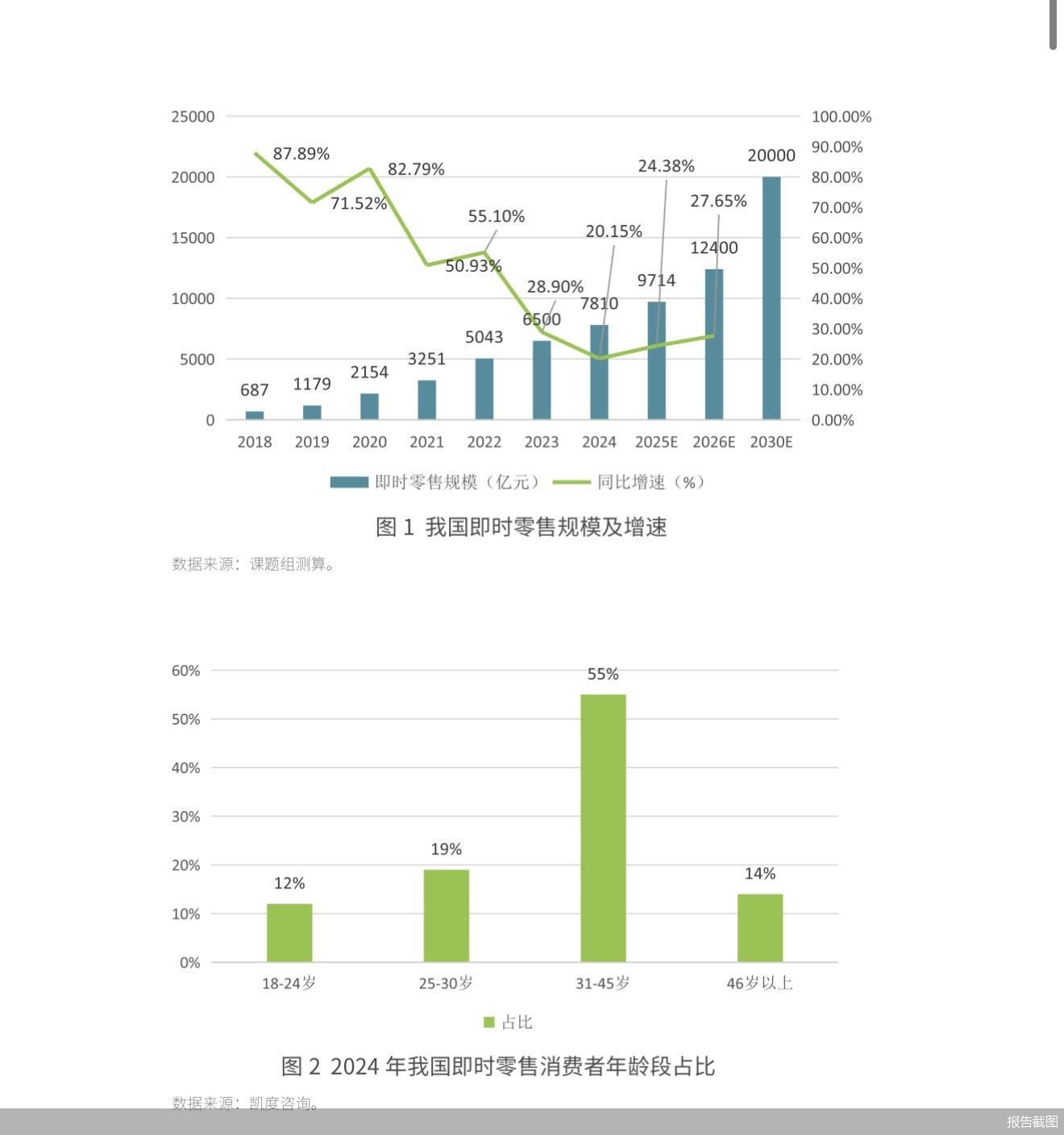
Core Insights - The instant retail industry in China is at a critical juncture, poised to reach a trillion-yuan scale, driven by simultaneous expansion and innovation in business models [1] Market Growth - The instant retail market in China is projected to reach 781 billion yuan in 2024, marking a year-on-year growth of 20.15%, significantly outpacing the growth rates of national online retail and total social consumer goods retail [1] - By 2025, the market size is expected to reach 971.4 billion yuan, surpassing 1 trillion yuan by 2026, and potentially reaching 2 trillion yuan by 2030, with an average annual growth rate of 12.6% during the 14th Five-Year Plan period [1] Demand Characteristics - The demand side is characterized by three main trends: youthfulness, immediacy, and health consciousness. In 2024, the age group of 31-45 years will account for 55% of consumers, a 5% increase from 2023 [5] - As of March 2025, over two-thirds of users on Meituan's instant delivery platform are from the post-90s generation, while over 60% of users on Taobao's instant delivery platform are aged 25-40 by July 2025 [5] - 51.5% of users expect rapid delivery innovations, with 55% of beauty and personal care purchases being for social gatherings and 52.7% for emergency gifts, requiring fulfillment within 30 minutes [5] - Approximately 80% of consumers are willing to pay a premium for health-oriented products, with 70.7% considering zero-additive products more reliable [5] Supply Chain Dynamics - Front warehouses are a key supply chain component, contributing over 50% of transaction volume, with increasing density since 2024, covering a 3-kilometer radius in first- and second-tier cities [5] - Platform-based front warehouses account for nearly 60%, with Meituan planning to exceed 100,000 lightning warehouses by 2027, while self-operated front warehouses represent over 40% [5] Quality Assurance and Service Evolution - By the end of 2024, Meituan's instant delivery service will have partnered with over 5,600 large chain retailers and 570 brand merchants, while Taobao's instant delivery service saw a 110% increase in new brand entries by July 2025 [6] - Instant retail is evolving from mere product transactions to comprehensive life service offerings, focusing on speed, reliability, scenario adaptation, and supply chain collaboration rather than just price competition [6] - Future developments in instant retail will feature comprehensive coverage, multi-scenario applications, AI-driven fulfillment, integration of goods and services, and a focus on green and low-carbon practices [6]
398.24亿元!阿里重大发布
新华网财经· 2025-11-25 12:29
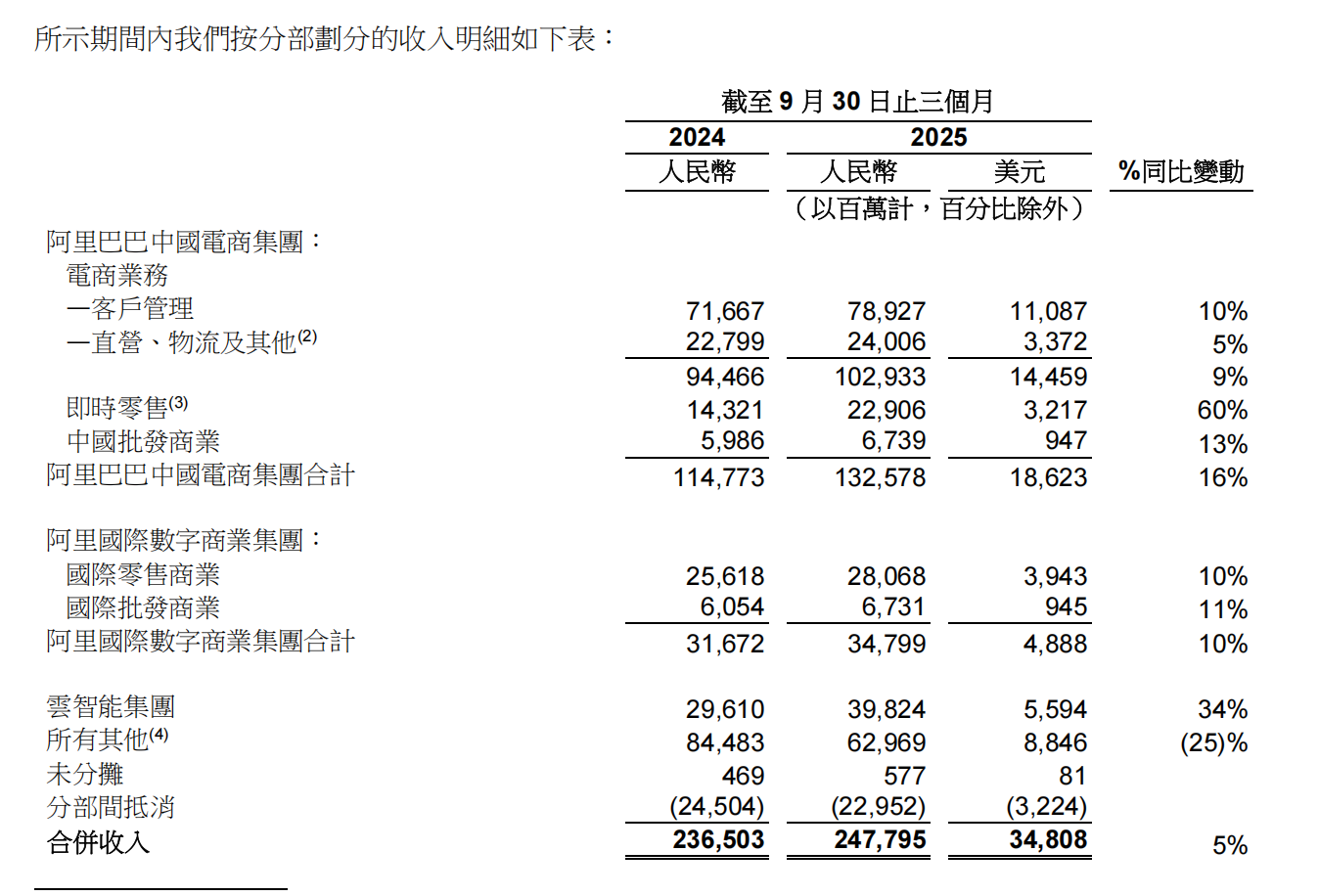
Core Viewpoint - Alibaba Group reported strong financial results for Q2 of FY2026, with revenue reaching 247.795 billion RMB, exceeding market expectations and showing a 15% year-over-year growth when excluding divested businesses [1][2]. Group 1: Financial Performance - Alibaba's total revenue for the quarter was 247.795 billion RMB, with a year-over-year increase of 15% after excluding the impact of sold businesses [1]. - The e-commerce segment, including customer management and instant retail, showed significant growth, with instant retail revenue increasing by 60% [5][6]. - Alibaba Cloud's revenue reached 398.24 billion RMB, marking a 34% year-over-year growth, the highest growth rate recorded [1][4]. Group 2: Strategic Investments - The company continues to invest heavily in AI and cloud technologies, which are expected to drive long-term growth [1][2]. - Alibaba's CEO emphasized the importance of building AI technology and infrastructure platforms, as well as integrating life services with e-commerce [2][4]. Group 3: Business Segments - The customer management revenue for Alibaba's e-commerce group grew by 10%, while the overall e-commerce segment revenue increased by 16% year-over-year [2][6]. - The instant retail business has shown remarkable growth, with significant improvements in user retention and average order value, contributing to the rapid increase in monthly active users on the Taobao app [5][6]. - Alibaba Cloud has maintained a leading position in the AI cloud market, with a reported market share of 35.8% in the first half of 2025 [4]. Group 4: Operational Efficiency - Multiple business units within Alibaba, including Hema, Amap, and Alibaba Health, have shown year-over-year revenue growth, indicating improved operational efficiency [7]. - The launch of the Qianwen App has also contributed to the company's growth strategy, with over 10 million downloads within a week of its public testing [4].


阿里最新业绩公布,三季度经营利润下滑85%
Di Yi Cai Jing· 2025-11-25 12:09
Core Insights - Alibaba's revenue for Q2 of fiscal year 2026 reached 247.8 billion RMB, a 5% year-on-year increase, surpassing market expectations of 245.2 billion RMB [1] - The company's operating profit significantly declined by 85% to 5.365 billion RMB, primarily due to heavy investments in instant retail, user experience upgrades, and advanced technology research [1][4] - Despite the profit decline, Alibaba Cloud's revenue grew by 34% to 39.824 billion RMB, marking a record high growth rate [2][4] Financial Performance - Alibaba's net cash flow from operating activities was 10.099 billion RMB, a 68% decrease compared to 31.438 billion RMB in the same period last year [2] - Free cash flow showed a net outflow of 21.840 billion RMB, contrasting with a net inflow of 13.735 billion RMB in the previous year, attributed to investments in instant retail and cloud infrastructure [2] - Capital expenditures for the quarter amounted to 31.5 billion RMB, with a total of approximately 120 billion RMB spent on AI and cloud infrastructure over the past four quarters [2] Business Segment Performance - Instant retail revenue surged by 60% to 22.906 billion RMB, while Alibaba's e-commerce customer management revenue increased by 10% [2][3] - The adjusted EBITA for the Chinese e-commerce group fell by 76% to 10.497 billion RMB, reflecting the impact of costs associated with instant retail and technology investments [3][4] - The adjusted EBITA for the cloud intelligence group grew by 35% to 3.604 billion RMB, indicating strong performance despite challenges in profitability [4] Strategic Outlook - The company is focusing on long-term investments in new business areas, which may lead to short-term fluctuations in profitability and free cash flow [4] - Alibaba's CFO indicated that the company is prioritizing future growth over immediate profit, suggesting a strategic shift towards sustaining long-term competitive advantages [4]
阿里2026财年Q2营收2478亿超预期,AI与消费业务强劲增长
Xin Lang Ke Ji· 2025-11-25 11:37
Core Insights - Alibaba Group reported Q2 FY2026 revenue of 247.795 billion yuan, exceeding market expectations, with a 15% year-over-year growth after excluding the impact of divested businesses [1] - CEO Wu Yongming stated that the company is in an investment phase, focusing on building AI technology and infrastructure platforms, as well as a large consumer platform that integrates lifestyle services and e-commerce [1] - Strong growth in AI and cloud services, with cloud revenue increasing by 34% year-over-year and AI-related product revenue achieving triple-digit growth for the ninth consecutive quarter [1][2] Financial Performance - Total revenue for the quarter reached 247.795 billion yuan, surpassing market forecasts [1] - Cloud revenue accelerated with a 34% year-over-year increase, driven by robust demand for AI [1][2] - E-commerce customer management revenue (CMR) grew by 10% year-over-year, while instant retail business revenue surged by 60% [2] Strategic Initiatives - Alibaba Cloud launched a comprehensive AI upgrade, introducing a full-stack AI capability that includes foundational models and high-performance infrastructure [2] - The Qwen3-Max flagship model ranked among the top tier globally in various AI tests [2] - The company introduced the Qianwen App, which has already surpassed 10 million downloads within a week of public testing, aiming to enhance both AI to B and to C services [2] Market Expansion - Approximately 3,500 Tmall brands have integrated their offline stores into instant retail as of October 31, enhancing the synergy across Alibaba's ecosystem [2] - During the Double 11 shopping festival, the Taobao App experienced double-digit year-over-year growth in consumers, with nearly 600 brands achieving over 100 million yuan in transactions [2] User Engagement - Gaode, another major application under Alibaba, reached a record high of 360 million daily active users (DAU) in October [3] - The company continues to improve operational efficiency across multiple businesses, with notable revenue growth in Gaode, Hema, and Alibaba Health [3]
阿里季度即时零售收入为229亿元,战略投入致国内电商EBITA降76%
Xin Lang Cai Jing· 2025-11-25 11:37
Core Insights - Alibaba Group reported a significant increase in its instant retail business revenue, reaching 22.906 billion RMB, which represents a 60% growth compared to 14.321 billion RMB in the same period last year [1] - However, the adjusted EBITA for Alibaba's China e-commerce group fell sharply to 10.497 billion RMB, a 76% decline from 44.327 billion RMB year-over-year [1] Financial Performance - Instant retail business revenue: 22.906 billion RMB, up 60% from 14.321 billion RMB [1] - Adjusted EBITA: 10.497 billion RMB, down 76% from 44.327 billion RMB [1]
盘前涨超4%!阿里巴巴Q2营收和云收入均超预期!阿里巴巴Q2营收同比增长4.8%,云业务收入激增34%,即时零售业务收入增60%
美股IPO· 2025-11-25 11:20
Core Viewpoint - Alibaba's Q2 revenue reached 247.8 billion RMB, a year-on-year increase of 4.8%, slightly exceeding market expectations, while adjusted net profit plummeted by 72% to 10.35 billion RMB, indicating significant pressure on profitability [3][4][10]. Revenue and Profitability - The cloud intelligence business was a highlight, with revenue soaring 34% year-on-year to 39.82 billion RMB, surpassing market estimates [3][6]. - Instant retail revenue was 22.91 billion RMB, a 60% increase year-on-year, primarily driven by the launch of "Taobao Flash Purchase" [3][10]. - Adjusted EBITDA decreased by 64% to 17.26 billion RMB, falling short of expectations [4][10]. Business Segment Performance - The Chinese e-commerce segment contributed 132.58 billion RMB in revenue, a 16% increase, while the cloud intelligence segment led with a 34% growth [6][11]. - The international digital commerce group turned profitable with an adjusted EBITDA of 1.62 billion RMB, compared to a loss of 2.91 billion RMB in the same period last year [11]. Investment and Strategic Focus - The company invested approximately 120 billion RMB in AI and cloud infrastructure over the past four quarters, indicating a strong commitment to these areas [8]. - The launch of the "Qianwen" app, which achieved over 10 million downloads in a week, is seen as a strategic move in the AI space [8]. User Experience and Market Strategy - The company has restructured its operations to focus on a "user-first" strategy, integrating various services under the Alibaba China E-commerce Group, which saw a revenue increase of 16% [10]. - Sales and marketing expenses doubled year-on-year, reflecting the company's investment in user experience [10].

阿里Q2财报:正处于投入阶段,创造长期战略价值
Ge Long Hui· 2025-11-25 10:51
依托全栈AI能力,阿里云持续引领中国蓬勃发展的AI云市场。根据Omdia报告,2025年上半年,阿里云在中国AI云市场的份额达35.8%,超过第二到第四名 的总和。近期,NBA、万豪、中国银联、博世等,都与阿里云达成AI合作。 6 t and the state the first Care the state of the station of the station of the station of the station of the station of the station of the station of the station of the states of the states of the states 型博物。 the state of the state of the state of the station of the station of the station of the station of the station of the station of the station of the states of the states of in the manager a ...
阿里财报:2026财年第二季度营收2477.95亿元
Xin Lang Ke Ji· 2025-11-25 10:46
Core Insights - Alibaba Group reported Q2 FY2026 revenue of 247.795 billion yuan, exceeding market expectations, with a year-on-year growth of 15% after excluding the impact of divested businesses [1] - CEO Wu Yongming emphasized the company's focus on building AI technology and infrastructure platforms, as well as a large consumer platform that integrates lifestyle services and e-commerce, creating long-term strategic value [1] - The strong demand for AI has accelerated the revenue growth of the Cloud Intelligence Group, with quarterly revenue increasing by 34% year-on-year, and AI-related product revenue achieving triple-digit growth for the ninth consecutive quarter [1] Financial Performance - Alibaba Cloud's quarterly revenue grew by 34%, with AI-related product revenue maintaining triple-digit year-on-year growth for nine consecutive quarters [1] - The e-commerce customer management revenue (CMR) increased by 10% year-on-year, while instant retail business revenue surged by 60% [2] - The average order price improved, and user retention rates increased, contributing to the rapid growth of monthly active consumers on the Taobao app [2] Strategic Initiatives - The launch of the Qianwen App aims to strengthen Alibaba's presence in both AI to B and to C markets, achieving over 10 million downloads within a week of public testing [2] - Approximately 3,500 Tmall brands have integrated their offline stores into instant retail as of October 31, enhancing collaborative effects [2] - The Gaode app reached a record high of 360 million daily active users in October, following the launch of the "Gaode Street Ranking" feature [2]
《即时零售行业发展报告(2025)》:预计“十五五”期间行业年均增速达到12.6%
Zhong Guo Jin Rong Xin Xi Wang· 2025-11-25 09:49
Core Insights - The report from the Ministry of Commerce Research Institute indicates that China's instant retail market is poised to exceed 1 trillion yuan by 2026 and reach 2 trillion yuan by 2030, with an average annual growth rate of 12.6% during the 14th Five-Year Plan period [1] - Instant retail is becoming a new growth driver in China's retail sector, with a projected market size of 781 billion yuan in 2024, reflecting a year-on-year growth of 20.15%, significantly outpacing the national online retail growth by 12.95 percentage points and the total retail sales growth by 16.65 percentage points [1][2] - The industry is at a critical juncture towards achieving a trillion-yuan scale, emphasizing the need for a healthy ecosystem as a key measure of high-quality development, with major platforms like Meituan Shanguo leading the way in establishing high-standard service systems [1] Market Trends - Approximately 80% of consumers are willing to pay a premium for health-oriented products, indicating a strong consumer focus on health in instant retail [2] - Instant retail platforms are rapidly expanding into county markets, with Meituan Shanguo covering 2,800 counties and cities, and having over 10,000 flash warehouses in lower-tier markets by September 2025 [2] - The growth rate of users, order volume, and transaction value in lower-tier markets exceeds that of high-tier cities, with young users from small towns making up nearly a quarter of the user base and showing a growth rate close to 30% [2] Operational Efficiency - The scale and digital development of front warehouses have significantly enhanced fulfillment efficiency, contributing to over half of the transaction volume in the instant retail ecosystem [2] - Future growth engines for instant retail are expected to be "full-domain penetration" and "multi-scenario expansion," with substantial growth potential in the domestic county market [2] - The integration of artificial intelligence and big data is anticipated to empower various aspects of the business, including product selection, replenishment, delivery, marketing, and after-sales service [2]