
财政政策

Search documents
宝城期货资讯早班车-20250915
Bao Cheng Qi Huo· 2025-09-15 02:08
1. Report Industry Investment Rating No relevant content provided. 2. Core Views of the Report - China's financial aggregates are large, and future monetary policy should focus on optimizing the structure while maintaining reasonable aggregate growth [2][18]. - China's fiscal policy still has sufficient room for maneuver, with a special treasury bond issuance expected to leverage significant credit [3][19]. - The Fed is expected to cut interest rates, but the policy path after September remains uncertain [4][5]. - Industrial product prices are unlikely to rebound sustainably, and PPI may decline again after the fourth quarter [33]. - The domestic bond market is expected to be highly volatile in August - September, and the RMB exchange rate is expected to be moderately strong [34]. 3. Summary by Directory 3.1 Macro Data Overview - GDP growth in Q2 2025 was 5.2% year - on - year, slightly lower than the previous quarter [1]. - In August 2025, the manufacturing PMI was 49.4%, and the non - manufacturing PMI for business activities was 50.3% [1]. - Social financing and credit in August 2025 showed significant changes, with an increase in M1 growth and a narrowing M1 - M2 gap [1][2][18]. - CPI in August 2025 was - 0.4% year - on - year, and PPI was - 2.9% year - on - year [1]. 3.2 Commodity Investment Reference 3.2.1 Comprehensive - China's financial aggregates are large, and future monetary policy will focus on structural optimization [2][18]. - China - US economic and trade talks will discuss issues such as tariffs and TikTok [2]. - China's fiscal policy has sufficient room, with a special treasury bond issuance to leverage credit [3][19]. - The Fed is expected to cut interest rates, but the post - September policy path is uncertain [4][5]. 3.2.2 Metals - Gold and silver prices reached new highs, and Thai gold exports to Cambodia increased [6]. - Metal inventories in the LME showed significant changes, with some increasing and some decreasing [7]. 3.2.3 Coal, Coke, Steel, and Minerals - A second round of coke price cuts is planned, and coal prices have fallen [9]. - Indonesia's seizure of a nickel mine has raised supply concerns [9]. 3.2.4 Energy and Chemicals - China's new LNG device was delivered, and international oil prices rebounded due to supply concerns [10]. - The EU may reduce its dependence on Russian natural gas [10]. - The US natural gas net long position increased, and the WTI crude oil net long position decreased [12]. 3.2.5 Agricultural Products - China's summer grain purchase was progressing smoothly, and US coffee prices rose [13]. - Most agricultural product prices in China declined, and Pakistan plans to purchase sugar [13][14]. - Speculators' net short positions in US soybeans and corn increased [14]. 3.3 Financial News Compilation 3.3.1 Open Market - The central bank adjusted the evaluation method for primary dealers in open - market operations and carried out reverse repurchase operations [16]. - The central bank will conduct a large - scale term reverse repurchase operation to maintain liquidity [16]. - There are large - scale reverse repurchase and treasury cash deposits maturing this week [17]. 3.3.2 Important News - China - US economic and trade talks were held in Spain [18]. - China's financial data showed strong support for the real economy, and there was a shift in household deposits [18][19]. - China's fiscal policy has sufficient room, and debt - related issues are being addressed [19][20]. - China opposes US export control measures and launches investigations [21][22][23]. - Policies to promote private investment and industry stability are being introduced [23][24]. - The real estate industry is in the stage of risk clearance, and banks have adjusted mortgage policies [25]. - Brokerage bond issuance reached a new high, and there were bond - related events and credit rating changes [26][27]. 3.3.3 Bond Market Summary - The inter - bank bond market showed a differentiated trend, with long - term bonds recovering [28]. - The exchange bond market had mixed performances, and convertible bond indices rose [28][29]. - Interest rates in the money market and bond issuance yields showed various changes [29][30][31]. - European and US bond yields generally increased [31]. 3.3.4 Foreign Exchange Market - The on - shore RMB against the US dollar rose, and the US dollar index showed a slight increase [32]. 3.3.5 Research Report Highlights - Industrial product prices are unlikely to rebound sustainably, and PPI may decline again [33]. - The domestic bond market will be volatile, and the RMB exchange rate is expected to be moderately strong [34]. - The market is in a complex situation with different signals from prices [34]. 3.3.6 Today's Reminders - A large number of bonds will be listed, issued, paid, and redeemed on September 15 [35]. 3.4 Stock Market News - The Beijing Stock Exchange will switch stock codes for listed companies [36]. - The pattern of the public fund market has changed, with growth in the bond - holding scale of some institutions [36][37].
惠民生、促消费是宏观政策重点发力方向
Jin Rong Shi Bao· 2025-09-15 02:03
Group 1 - The People's Bank of China reported that as of the end of August, the broad money supply (M2) increased by 8.8% year-on-year, which is 2.5 percentage points higher than the same period last year [1] - The total social financing (TSF) also grew by 8.8% year-on-year, exceeding the previous year's growth by 0.7 percentage points, indicating a moderately loose monetary policy [1] - The manufacturing Purchasing Managers' Index (PMI) rose by 0.1 percentage points in August, with the production index increasing by 0.3 percentage points to 50.8%, signaling accelerated manufacturing expansion [1] Group 2 - The macro policy is focusing on improving people's livelihoods and promoting consumption, with a call for optimizing fiscal expenditure structures and enhancing wealth distribution [2] - Recent policies, such as the trade-in program, have successfully stimulated personal consumption demand, contributing to further release of consumption needs [2] - Cities like Beijing, Shanghai, and Shenzhen have introduced comprehensive real estate regulation policies to better meet residents' housing needs [2] Group 3 - New policies, including childcare subsidies and personal consumption loans, have been introduced to boost consumer confidence and stimulate effective consumption demand [3] - The government is addressing irrational competition in key industries like new energy vehicles and photovoltaics, which will help promote supply-demand balance and stabilize price levels [3] - The macro policy is expected to maintain continuity and stability, with a focus on supporting the real economy and implementing comprehensive measures for economic recovery [3]
宝城期货国债期货早报-20250915
Bao Cheng Qi Huo· 2025-09-15 01:58
Group 1: Report Industry Investment Rating - No relevant content Group 2: Core Viewpoints of the Report - The short - term view of TL2512 is oscillatory, the medium - term view is oscillatory, and the intraday view is weakly oscillatory, with an overall oscillatory view due to the existence of long - term interest rate cut expectations but a low possibility of short - term comprehensive interest rate cuts [1] - The intraday view of financial futures index stock sectors (TL, T, TF, TS) is weakly oscillatory, the medium - term view is oscillatory, and the reference view is oscillatory. In the short term, treasury bond futures will mainly conduct low - level oscillatory consolidation [5] Group 3: Summary by Related Catalogs Variety Viewpoint Reference - Financial Futures Index Stock Sector - For TL2512, the short - term, medium - term, and intraday views are based on the situation that long - term interest rate cut expectations still exist while the possibility of short - term comprehensive interest rate cuts is low [1] Main Variety Price Market Driving Logic - Financial Futures Index Stock Sector - Last Friday, treasury bond futures showed a differentiated trend. 2 - year treasury bond futures oscillated and slightly declined, while 5 - year, 10 - year, and 30 - year treasury bond futures oscillated and rose [5] - Treasury bond futures are mainly affected by monetary policy expectations and the risk appetite of the stock market [5] - In the long run, there are still expectations of interest rate cuts, but in the short term, the upward momentum of treasury bond futures is not strong because the necessity of comprehensive interest rate cuts is not high [5] - The inflation data in August was still weak. The policy side will continue to introduce policies to stabilize demand to promote a moderate rebound in inflation. It is expected that fiscal policies will be intensified in the fourth quarter, which will pose supply - side pressure on treasury bonds [5] - The risk appetite of the stock market is at a high level, siphoning bond - buying funds and suppressing the demand side of treasury bonds, showing the stock - bond seesaw effect [5]
A500ETF基金(512050)高开,连续两日吸金超3亿元
Sou Hu Cai Jing· 2025-09-15 01:42
Group 1 - A-shares opened positively on September 15, with the Shanghai Composite Index rising by 0.14% and the ChiNext Index increasing by 1.05% [1] - The A500 ETF (512050), which tracks the CSI A500 Index, saw a fund inflow of over 300 million yuan in the last two trading days, with 288 million yuan on September 11 and 3.088 million yuan on September 12 [1] - The Chinese government maintains a reasonable debt ratio of 68.7%, with total government debt projected to reach 92.6 trillion yuan by the end of 2024, including 34.6 trillion yuan in national bonds and 47.5 trillion yuan in local government legal debts [1] Group 2 - The A500 ETF (512050) enables investors to easily allocate to core A-share assets, employing a dual strategy of industry-balanced allocation and leading company selection [2] - The ETF covers all 35 sub-sectors of the CSI A500 Index, integrating both value and growth attributes, and is overweight in sectors such as AI, pharmaceuticals, and renewable energy compared to the CSI 300 Index [2]
8月份人民币新增贷款5900亿元
Xin Jing Bao· 2025-09-15 00:39
Core Viewpoint - The financial data for August indicates a robust support from the financial sector to the real economy, with significant increases in social financing and loans, driven by proactive fiscal policies and moderate monetary easing [1][10]. Social Financing - The cumulative increase in social financing for the first eight months of the year reached 26.56 trillion yuan, which is 4.66 trillion yuan more than the same period last year [1]. - In August, new RMB loans amounted to 590 billion yuan, contributing to a total increase of 13.46 trillion yuan in loans for the first eight months [1]. Personal Loans - Household loans increased by 711 billion yuan in the first eight months, with August seeing a rise of 30.3 billion yuan, although this was a year-on-year decrease of 159.7 billion yuan [1][2]. - The growth in personal loans was supported by the summer consumption peak and new housing policies, with short-term consumer loans showing a month-on-month increase of 393.2 billion yuan [2][3]. Corporate Loans - Corporate loans increased by 590 billion yuan in August, a year-on-year decrease of 250 billion yuan but a month-on-month increase of 530 billion yuan [4]. - Short-term corporate loans saw a significant rise, increasing by 70 billion yuan, while medium to long-term loans remained stable with an increase of 470 billion yuan [4][5]. Loan Structure - The balance of various loans reached 269.10 trillion yuan by the end of August, with a year-on-year growth of 6.8% [7]. - Inclusive small and micro loans grew by 11.8%, and medium to long-term loans for the manufacturing sector increased by 8.6%, both outpacing overall loan growth [7][8]. Economic Indicators - The manufacturing PMI rose by 0.1 percentage points to 49.4%, indicating a slight acceleration in production expansion [9]. - The non-manufacturing business activity index also showed expansion, reflecting a stable economic environment [9][10]. Future Outlook - The macroeconomic policies are expected to maintain continuity and stability, with a focus on supporting the real economy through moderate monetary policy and active fiscal measures [10].
透视“十四五”财政账本,民生投入近百万亿
2 1 Shi Ji Jing Ji Bao Dao· 2025-09-14 23:47
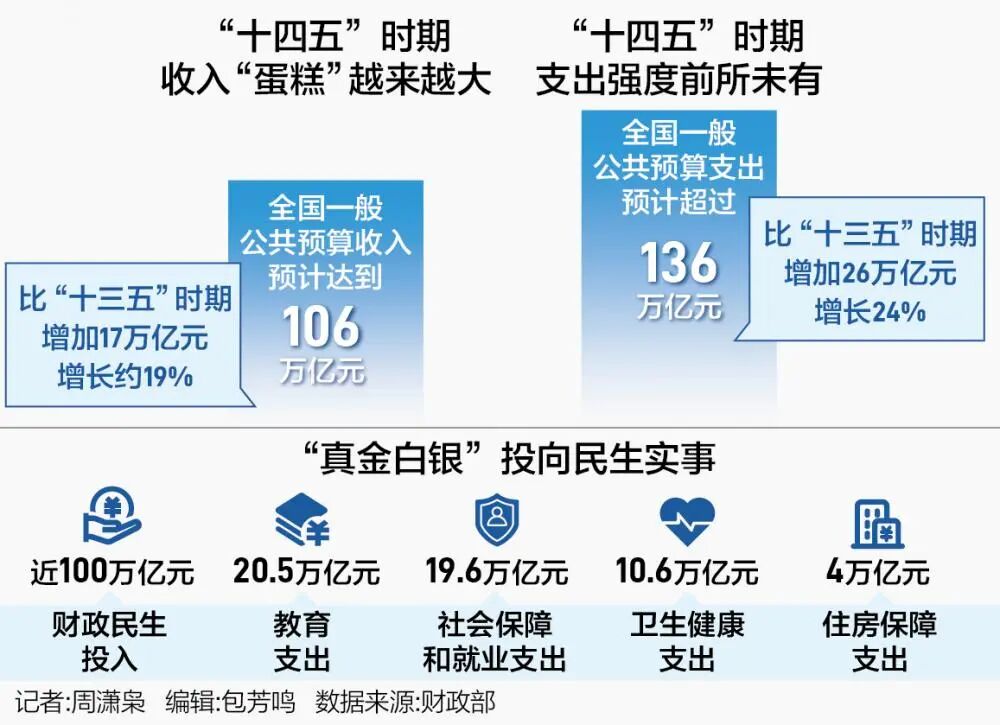
Core Viewpoint - The "14th Five-Year Plan" period has seen significant growth in China's fiscal strength, with a focus on enhancing public welfare and supporting economic development through increased budget allocations and proactive fiscal policies [2][5][7]. Fiscal Revenue and Expenditure - National general public budget revenue is expected to reach 106 trillion yuan, an increase of 17 trillion yuan or approximately 19% compared to the "13th Five-Year Plan" period [1]. - National general public budget expenditure is projected to exceed 136 trillion yuan, marking an increase of 26 trillion yuan or 24% compared to the previous five-year period [1]. Investment in Public Welfare - During the "14th Five-Year Plan," significant investments have been made in key areas such as education (20.5 trillion yuan), social security and employment (19.6 trillion yuan), health care (10.6 trillion yuan), and housing security (4 trillion yuan), totaling nearly 100 trillion yuan in fiscal welfare spending [1][6]. Fiscal Policy and Economic Growth - The fiscal policy has maintained an active orientation, focusing on expanding domestic demand, improving people's livelihoods, and supporting technological innovation [5][7]. - The deficit ratio has increased from 2.7% to 3.8%, with a further rise to 4% in 2023, indicating a proactive fiscal stance [5]. Debt Management and Risk Mitigation - A comprehensive debt management strategy has been implemented, including a total of 12 trillion yuan in measures to address hidden local government debt, with significant reductions in the scale of such debts [10][11]. - By the end of 2024, the total government debt is projected to be 92.6 trillion yuan, with a government debt ratio of 68.7%, which is considered manageable compared to G20 and G7 averages [11]. Future Outlook - The government aims to establish a robust debt management mechanism aligned with high-quality development, ensuring sustainable fiscal practices and enhancing transparency in debt management [12][13].

透视“十四五”财政账本,民生投入近百万亿
21世纪经济报道· 2025-09-14 23:45
Core Viewpoint - The article discusses the achievements and future plans of China's fiscal policy during the "14th Five-Year Plan" period, highlighting significant increases in budget revenues and expenditures, as well as various measures to enhance economic growth and manage debt risks [1][2][5]. Fiscal Performance - During the "14th Five-Year Plan," the national general public budget revenue is expected to reach 106 trillion yuan, an increase of 17 trillion yuan compared to the "13th Five-Year Plan," representing a growth of approximately 19% [1]. - The national general public budget expenditure is projected to exceed 136 trillion yuan, an increase of 26 trillion yuan, or 24% compared to the previous plan [1]. - Key allocations include 20.5 trillion yuan for education, 19.6 trillion yuan for social security and employment, 10.6 trillion yuan for health, and 4 trillion yuan for housing security, totaling nearly 100 trillion yuan in fiscal investment for people's livelihoods [1]. Fiscal Policy and Economic Growth - The fiscal policy has maintained a proactive orientation, focusing on expanding domestic demand, benefiting people's livelihoods, and supporting technological innovation [5][7]. - The deficit ratio has increased from 2.7% to 3.8%, with a further rise to 4% in 2023, and a projected deficit scale of 5.66 trillion yuan for 2025 [5]. - A total of 11.86 trillion yuan in government bonds has been issued, marking a historical high, including special bonds to support state-owned banks [5]. Debt Management - A comprehensive debt reduction initiative was launched, amounting to 12 trillion yuan, which includes increasing local government debt limits and replacing hidden debts [10]. - By mid-2025, over 60% of financing platforms have exited, indicating significant progress in reducing hidden debts [10]. - The total government debt is projected to be 92.6 trillion yuan by the end of 2024, with a debt-to-GDP ratio of 68.7%, which is considered manageable compared to G20 and G7 averages [11]. Future Outlook - The government aims to establish a robust debt management mechanism aligned with high-quality development, ensuring sustainable debt practices and enhancing transparency [12]. - Continued efforts will be made to implement debt reduction measures and improve the management of both hidden and legal debts [12].

中金:年内流动性拐点——8月金融数据点评
中金点睛· 2025-09-14 23:35
Core Viewpoint - The article highlights a decline in the growth rate of social financing (社融) in August, indicating a potential slowdown in economic activity and credit demand, while also noting a stabilization in monetary supply growth [2][12]. Summary by Sections Social Financing and Monetary Supply - In August, new social financing amounted to 2.57 trillion yuan, a year-on-year decrease of 463 billion yuan, with the stock growth rate dropping from 9.0% in July to 8.8%, marking the first decline since November 2024 [2][12]. - The M2 money supply growth rate remained steady at 8.8% in August, halting a four-month improvement trend, while M1 growth increased slightly from 5.6% to 6.0%, although the pace of increase has slowed [2][6]. Credit Demand and Loan Rates - Overall credit demand remains weak, with new short-term loans to enterprises at 70 billion yuan, reflecting a year-on-year increase of 260 billion yuan due to a low base last year. However, medium- and long-term loans to enterprises and both short- and long-term loans to residents saw year-on-year declines [5][9]. - Personal housing loan rates remained at a historical low of 3.1%, while corporate loan rates slightly decreased to 3.1% [8][9]. Government Debt and Fiscal Policy - Government debt has been a significant support for social financing, with net financing reaching 9.02 trillion yuan from January to July, a year-on-year increase of 4.84 trillion yuan. However, new government debt financing in August was 1.37 trillion yuan, a decrease of 250 billion yuan year-on-year [12][15]. - The remaining new government debt quota for September to December is estimated at around 340 billion yuan, significantly lower than the 530 billion yuan net financing in the same period last year, suggesting a likely decline in support for social financing [12][15]. Fiscal Deposits and Future Trends - Despite a decrease in the growth rate of fiscal deposits from 23.9% in July to 16.0% in August, there is still room for further fiscal deposit injections, which have been a key factor in maintaining M2 growth [15]. - The momentum of M1 growth is expected to decline, indicating a potential rapid decrease in M1 year-on-year growth in the fourth quarter [16][19]. - The article suggests that if current policies and credit demand trends continue, there may be a simultaneous decline in the growth rates of social financing, M1, and M2 over the next three quarters [16][19].

每日债市速递 | 资金面变化有限
Wind万得· 2025-09-14 22:58
Group 1: Open Market Operations - The central bank conducted a 7-day reverse repurchase operation on September 12, with a fixed rate and a total amount of 230 billion yuan, at an interest rate of 1.40% [1] - The total amount of reverse repos maturing on the same day was 188.3 billion yuan, resulting in a net injection of 41.7 billion yuan [1] Group 2: Funding Conditions - The overnight repurchase weighted average rate for deposit institutions slightly decreased by less than 1 basis point, remaining at 1.35% [3] - Non-bank institutions borrowed overnight funds using certificates of deposit and credit bonds as collateral, with rates dropping to around 1.40% [3] - The latest overnight financing rate in the US was reported at 4.39% [3] Group 3: Interbank Certificates of Deposit - The latest transaction rate for one-year interbank certificates of deposit in the secondary market was approximately 1.6764% [7] Group 4: Treasury Futures Closing - The 30-year main contract rose by 0.38%, while the 10-year main contract increased by 0.06% [13] - The 5-year main contract saw a slight increase of 0.01%, whereas the 2-year main contract fell by 0.03% [13] Group 5: Fiscal Policy and Economic Indicators - The Minister of Finance announced that the general public budget expenditure is expected to exceed 136 trillion yuan over the "14th Five-Year Plan" period, an increase of 24% compared to the previous plan [14] - The central bank reported that the social financing scale increased by 26.56 trillion yuan in the first eight months of 2025, which is 4.66 trillion yuan more than the same period last year [15] - The broad money (M2) balance reached 331.98 trillion yuan, with a year-on-year growth of 8.8% [15] Group 6: Global Macro - The European Central Bank decided to maintain its current policy, indicating that inflation pressures have been effectively contained and the Eurozone economy remains stable [17] Group 7: Bond Market Events - Recent negative events in the bond market include significant lawsuits and downgrades in implied ratings for various companies, such as Suning and Zhonghai [19]

央行今日开展 6000亿元买断式逆回购操作
Zheng Quan Shi Bao· 2025-09-14 18:02
Group 1 - The People's Bank of China (PBOC) will conduct a 600 billion yuan reverse repurchase operation with a six-month term on September 15 to maintain liquidity in the banking system [1] - Prior to this, the PBOC had already conducted a 1 trillion yuan reverse repurchase operation with a three-month term on September 5, resulting in a net injection of 300 billion yuan for the month [1] - The PBOC has been consistently conducting reverse repurchase operations since June to support market liquidity and stabilize market expectations [1] Group 2 - The bond market sentiment has recently turned pessimistic, leading to increased expectations for the PBOC to resume government bond trading operations [1] - Wang Guogang, a professor at Renmin University, emphasized the importance of government bonds as a tool for coordinating monetary and fiscal policies, advocating for increased issuance of government bonds [2] - The PBOC is expected to enhance its open market operations in government bonds to align with the ongoing proactive fiscal policy [2]