
反内卷

Search documents
2025年四季度经济学人问卷调查:扩内需、反内卷,激活市场活力成为关键路径
Jing Ji Guan Cha Wang· 2026-01-17 14:19
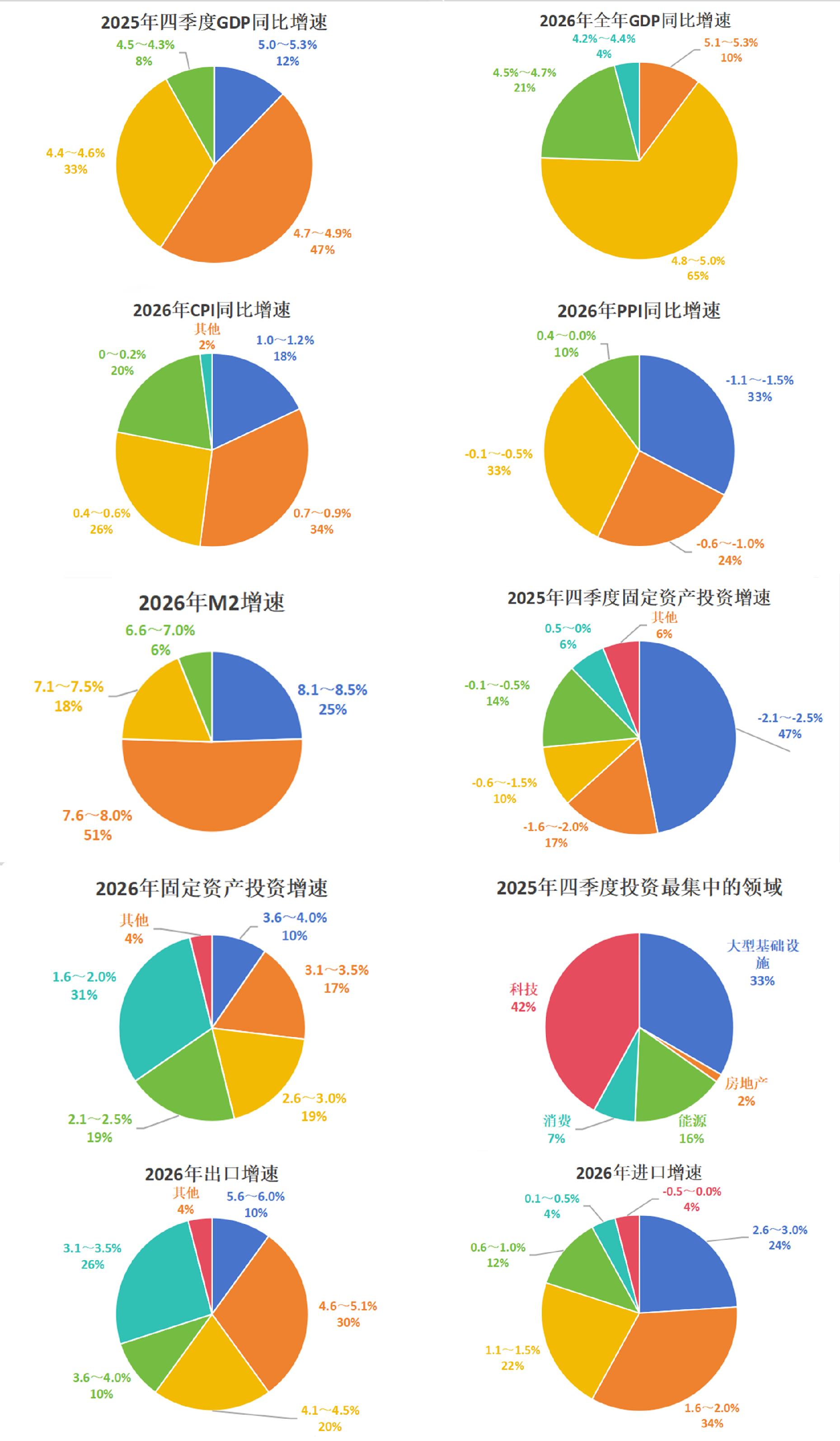
Economic Outlook - China's economy is currently facing a critical period of adjustment, with old problems and new challenges intertwining, necessitating more proactive fiscal policies and moderately loose monetary policies to stimulate domestic demand and promote stable economic growth [1][7][8] - 47% of economists believe that GDP growth in Q4 2025 will be between 4.7% and 4.9%, while 65% expect 2026 growth to be in the range of 4.8% to 5.0% [1][7] Real Estate Market - The real estate market shows signs of stabilization but remains in a deep adjustment phase, with 79% of economists believing that the decline in the real estate market will slow down in 2026, although it has not yet bottomed out [1][16] - 53% of economists predict that housing prices in first- and second-tier cities will drop by 5% to 15% in 2026, while 58% expect a similar decline in third- and fourth-tier cities [16] Investment Trends - Investment remains a key support for economic recovery, with 31% of economists forecasting fixed asset investment growth of 1.6% to 2.0% in 2026, and 42% of investment is expected to focus on technology [15][29] - The report indicates that the real estate market is approaching a critical point of stabilization, with policies aimed at maintaining expectations and improving the quality of housing supply [15][18] Debt and Financial Risks - Local government debt remains a significant concern, with risks stemming from reduced land revenue due to the ongoing downturn in the real estate market [8][9] - 59% of economists anticipate a substantial increase in the government debt-to-GDP ratio globally in 2026, highlighting the need for careful management of local government debt [1][24] Consumer Demand and Employment - There is a pressing need to stimulate consumer demand, with 36% of economists suggesting increasing residents' income as a priority, followed by improving the social security system [30][31] - The unemployment rate among urban youth is rising, with significant pressure on job opportunities for recent graduates in 2026 [31] Global Economic Factors - Geopolitical tensions are viewed as the largest potential disruptor to the global economy in 2026, with 48% of economists identifying this as a key concern [33] - The combination of fiscal expansion to boost demand and monetary policy aimed at reducing costs is expected to dominate macroeconomic policy discussions in 2026 [33][34]

最新研判!夏俊杰:2026年有五大投资机遇,但要警惕这一最大的潜在风险
Zhong Guo Ji Jin Bao· 2026-01-17 14:11
Core Insights - The company anticipates five major investment opportunities for 2026, including undervalued stock revaluation, AI application expansion, consumer recovery, structural opportunities amid "anti-involution," and local market penetration by outbound enterprises [1][3][4] - The company also warns of three significant risks: a potential reversal in AI trends, valuation regression in small-cap stocks, and increased currency volatility affecting overseas investments [1][4] Investment Opportunities - **Undervalued Stock Revaluation**: The company believes that low-valued stocks are due for a systematic revaluation, as the risk-free rate in China has declined significantly over the past three years, and funds may flow into these stocks as deposit maturities approach [3] - **AI Application Expansion**: The focus will shift from AI computing power to applications and end-user devices, with investments in autonomous driving and AI healthcare, while also exploring opportunities in new terminal devices like smart glasses [3][4] - **Consumer Recovery**: With the real estate sector's decline impacting household wealth in 2025, a rebound is expected in 2026 as other asset classes grow, supported by policy measures. High-end consumption and luxury goods are showing early signs of recovery [3] - **"Anti-Involution" Opportunities**: The company suggests selecting industries with simple competitive landscapes and fewer players, while being cautious of sectors with high player counts and cost disparities [4] - **Local Market Penetration by Outbound Enterprises**: Companies that focus on local market services and job creation in regions like Southeast Asia are expected to achieve sustainable growth [4] Risks - **AI Trend Reversal Risk**: The company identifies a potential risk in the AI sector, where failure to open application markets could lead to significant volatility in global tech stocks [4] - **Small-Cap Valuation Regression Risk**: There is a concern that the current high trading volume of small-cap stocks in A-shares may lead to a long-term valuation regression [4] - **Currency Volatility Risk**: Increased fluctuations in global currency exchange rates in 2026 may pose risks to overseas investments, potentially eroding returns [4]
北大光华刘俏:更大力度推动“反内卷” 大力支持企业出海
Zheng Quan Shi Bao Wang· 2026-01-17 04:40
Group 1 - The core viewpoint is that China will implement a resident income increase plan during the "14th Five-Year Plan" period, focusing on enhancing property income and consumer willingness and capacity [1] - The current fiscal policy space allows for an expansionary approach, with suggestions to increase central government debt to support both "investment in goods" and "investment in people" [1] - Recommendations include innovative policy tools to change marginal consumption tendencies, such as issuing consumption vouchers and increasing rural pension standards [1] Group 2 - The recent announcement by the central bank to lower re-lending and rediscount rates by 0.25 percentage points is expected to help repair residents' balance sheets [2] - Structural "rate cuts" can lower financing costs for small and micro enterprises, which account for over 80% of employment, thereby promoting business expansion and increasing employment demand [2] - The push for "anti-involution" policies and support for enterprises going abroad can improve corporate profits and income distribution, ultimately enhancing consumer spending [2] Group 3 - Suggestions to stabilize and recover the real estate market include a new model that utilizes social capital, involving a tripartite reform of housing provident funds, rental housing, and REITs [3] - The establishment of a "real estate mother fund" with participation from market institutions and financial institutions is proposed to facilitate rental housing construction and acquisition [3] - The aim is to create a closed-loop financing model that includes development, nurturing, exit, and redevelopment of rental housing [3]
今年市场的两条主线:AI和地缘、反内卷
Sou Hu Cai Jing· 2026-01-17 01:57
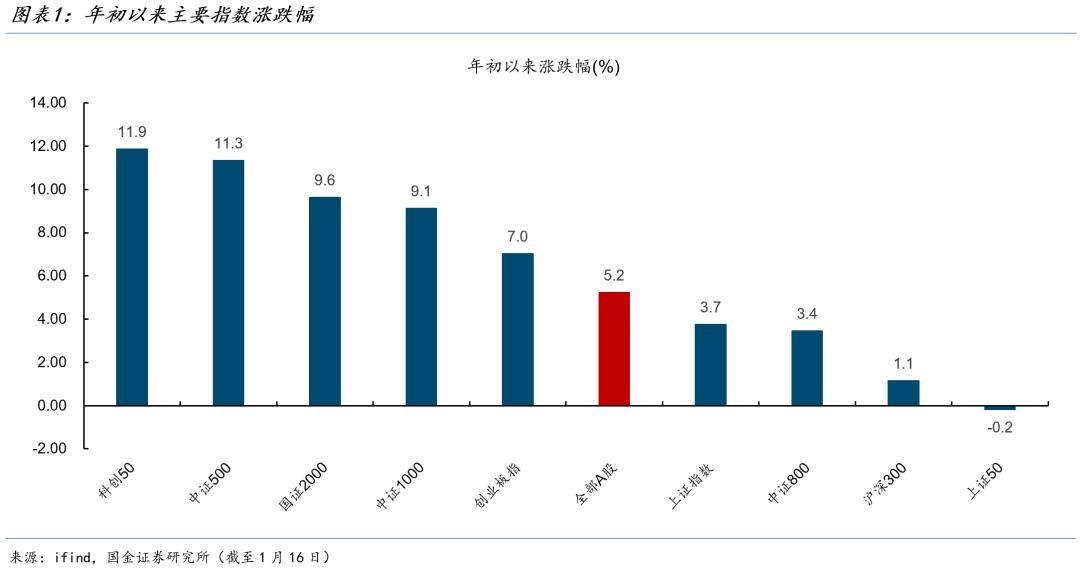
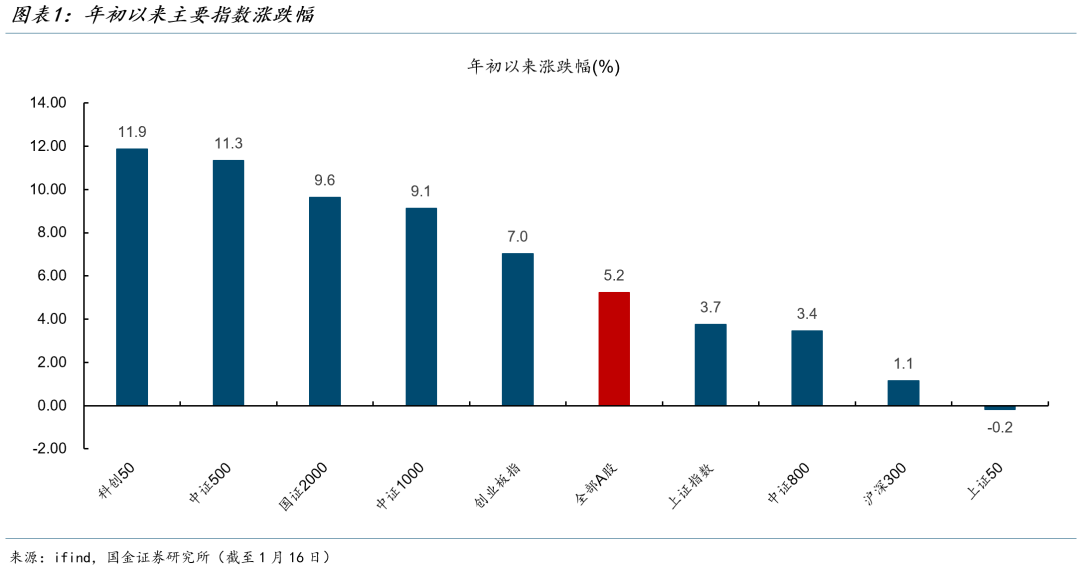
Group 1 - The core theme for A-share pricing in 2026 revolves around AI and geopolitical factors, reflecting the U.S. focus on technology for growth and geopolitical strategies for elections, while another underpriced theme is "anti-involution," corresponding to China's push for reform-driven momentum [1][8] - Since the beginning of 2026, the A-share market has shown a "good start" with a cumulative increase of 5.2% in the Wind All A index and an average daily trading volume exceeding 3 trillion yuan, with the Sci-Tech 50, CSI 500, and National 2000 indices leading the gains at 11.9%, 11.3%, and 9.6% respectively [2] - The leading sectors include media, computer, non-ferrous metals, and military industries, with year-to-date increases of 16.0%, 14.0%, 14.0%, and 9.0%, indicating that the current market focus is on "AI and geopolitical" themes [2] Group 2 - The impact of AI is evident not only in the A-share market but also in marginal changes in the macro economy, with the PPI in December 2025 rising by 0.2% month-on-month, marking the highest increase since 2024, driven in part by AI's contribution to price improvements in non-ferrous and technology sectors [5][8] - In December 2025, prices in the non-ferrous metal mining and smelting industries rose by 3.7% and 2.8% respectively, with AI-driven electricity demand significantly boosting prices for metals like copper, silver, lithium, and cobalt [5] - The prices of external storage devices and integrated circuits increased by 15.3% and 2.4% respectively in December 2025, with high-end AI chips occupying advanced process resources, leading to structural tensions in chip availability [7] Group 3 - The improvement in PPI reflects strategic choices made by China and the U.S. in the current global macro context, which are expected to become two main pricing themes for A-shares in 2026: "AI and geopolitics" and "anti-involution" [8] - The "anti-involution" theme is entering a new phase in 2026, with recent discussions emphasizing the need to address malicious low-price dumping and promote healthy competition [9] - Recent policy changes indicate a clearer execution strategy for "anti-involution," focusing on "quality over price" in industries like photovoltaics and energy storage, with regulatory bodies emphasizing quality standards and price monitoring [10][12] Group 4 - The cancellation of export tax rebates for photovoltaic products and the reduction of tax rates for battery products reflect the national-level implementation of "anti-involution," aimed at allowing competitive companies to raise prices and retain funds for domestic investment [11] - Local governments are shifting their competitive advantages from unsustainable policy incentives to sustainable business environments and professional service capabilities, indicating a broader commitment to "anti-involution" practices [12] - Strengthened regulatory enforcement against monopolistic and unfair competition behaviors signals an acceleration of "anti-involution," aiming to enhance market order and promote a virtuous cycle of quality and pricing in the industry [12]
宋雪涛:今年市场的两条主线
智通财经网· 2026-01-17 01:46
Market Performance - The A-share market has shown a "good start" in 2026, with the total return of the Wind All A index reaching 5.2% and the average daily trading volume exceeding 30 trillion yuan [1] - The leading sectors include technology and small-cap stocks, with the Sci-Tech 50, CSI 500, and National Index 2000 showing cumulative gains of 11.9%, 11.3%, and 9.6% respectively [1] Sector Analysis - The media, computer, non-ferrous metals, and military industries have led the market, with year-to-date gains of 16.0%, 14.0%, 14.0%, and 9.0% respectively, indicating a market focus on "AI and geopolitics" [1] - The AI-driven market trend is extending from upstream computing infrastructure to downstream AI applications, with geopolitical conflicts in regions like Venezuela and Iran catalyzing the non-ferrous and military sectors [1] Economic Indicators - The Producer Price Index (PPI) in China rose by 0.2% month-on-month in December 2025, marking the highest monthly increase since 2024, with AI contributing to this improvement, particularly in non-ferrous and technology prices [3] - Prices in the non-ferrous metal mining and smelting industries increased by 3.7% and 2.8% respectively, driven by rising electricity demand due to AI [3] - In the technology sector, prices for external storage devices and integrated circuits rose by 15.3% and 2.4%, respectively, with high-end AI chips impacting the availability of other chips [3] Policy and Structural Changes - The "anti-involution" policy is gaining traction, contributing to the PPI recovery, with lithium-ion battery manufacturing prices increasing by 1.0% and new energy vehicle manufacturing prices turning from a decline of 0.2% to an increase of 0.1% [4] - The strategic choices made by China and the U.S. in the current global macro context are expected to shape A-share pricing in 2026, focusing on "AI and geopolitics" and "anti-involution" [6] - The "anti-involution" initiative is transitioning from capacity governance to operational entity management, emphasizing quality competition and regulatory compliance [7][8] Government Initiatives - Local governments are shifting their focus from unsustainable policy incentives to sustainable business environments and professional service capabilities in attracting investments [10] - Recent central government actions have intensified the regulation of anti-monopoly and unfair competition, signaling a stronger push for "anti-involution" [10] - The cancellation of export tax rebates for photovoltaic products reflects the national level's commitment to "anti-involution," aiming to enhance the competitiveness of leading enterprises [8]
宋雪涛:今年市场的两条主线
雪涛宏观笔记· 2026-01-17 01:22
Core Viewpoint - The main pricing themes for A-shares in 2026 are centered around AI and geopolitical factors, reflecting the U.S. focus on technology for growth and geopolitical selection, while another theme that has not been fully priced in is "anti-involution," corresponding to China's pursuit of reform for momentum [2][9]. Market Performance - Since the beginning of 2026, the A-share market has shown a "good start" with a cumulative increase of 5.2% in the Wind All A index and an average daily trading volume exceeding 3 trillion yuan. The Sci-Tech 50, CSI 500, and National 2000 indices have led the gains with increases of 11.9%, 11.3%, and 9.6% respectively, indicating that technology and small-cap stocks are outperforming large-cap stocks [4]. - The leading sectors include media, computer, non-ferrous metals, and military industries, with year-to-date increases of 16.0%, 14.0%, 14.0%, and 9.0% respectively, reflecting the current market's focus on "AI and geopolitics" [4]. AI Impact on Economy - AI's influence is evident in both the A-share market trends and marginal changes in the macro economy. In December 2025, China's PPI rose by 0.2% month-on-month, marking the highest monthly increase since 2024, with AI contributing to improvements in PPI, particularly in non-ferrous and technology sectors [6][9]. - In December 2025, prices in the non-ferrous metal mining and smelting industries increased by 3.7% and 2.8% respectively, driven by AI-related electricity demand, which significantly boosted prices of metals like copper, silver, tungsten, tantalum, aluminum, lithium, cobalt, and nickel [6]. Pricing Dynamics - In December 2025, prices for external storage devices and integrated circuits rose by 15.3% and 2.4% respectively, with AI-related high-end chips occupying advanced process resources, leading to structural tensions in chip availability. Samsung and SK Hynix plan to raise server DRAM prices by 60%-70% in Q1 2026, significantly higher than previous cycles [8]. - The implementation of "anti-involution" has also contributed to the month-on-month recovery of PPI, with lithium-ion battery manufacturing prices increasing by 1.0% and the price of complete new energy vehicles turning from a decline of 0.2% to an increase of 0.1% [8]. Strategic Choices - The improvement in PPI reflects strategic choices made by China and the U.S. in the current global macro context, which are expected to become the two main pricing themes for A-shares in 2026. The "AI and geopolitics" theme corresponds to the U.S. seeking new productive forces in a stagflation environment, while the "anti-involution" theme aligns with China's push for reform to drive momentum through fiscal and income distribution reforms [9]. Anti-Involution Developments - The "anti-involution" theme is entering a new phase in 2026, as highlighted by recent policy discussions emphasizing the need to address malicious low-price dumping and promote healthy competition [10]. - The core of "anti-involution" in the industry is "quality over price," with regulatory bodies emphasizing compliance in price competition within the photovoltaic industry and addressing irrational competition behaviors [11]. - Recent policy changes, such as the cancellation of export tax rebates for photovoltaic products, reflect the national-level commitment to "anti-involution," allowing leading companies to raise prices to absorb costs and redirect funds to domestic consumption [12][13]. Regulatory Environment - Strengthened anti-monopoly and anti-unfair competition regulations signal an acceleration of "anti-involution," with the market regulator engaging with leading companies in the silicon material and photovoltaic sectors to prevent collusion and ensure fair competition [14].
全文| 仁桥夏俊杰最新年度交流:2026年股票风景或“中国这边独好”,市场有一点还未被定价充分……
聪明投资者· 2026-01-17 00:05
Core Viewpoint - The article discusses the annual communication meeting of Renqiao Asset, highlighting the reflections and outlooks of the company regarding market performance and investment strategies for 2026, particularly focusing on the potential for systematic revaluation of undervalued stocks and the impact of AI on various sectors [2][3][5][57]. Group 1: Market Reflections - The market in recent years has been rational, with short-term variables fully priced in, yet the rapid decline in China's risk-free interest rates has not led to a corresponding increase in the valuations of low-valued stocks [5][59]. - The company missed the technology stock rally and is reflecting on its investment logic and optimization strategies [3][6]. - The company believes that the low-valued sectors may experience systematic revaluation, similar to the market conditions in the second half of 2014, especially for lesser-known stocks [5][6][62]. Group 2: Investment Strategy - The company employs a contrarian investment strategy, indicating that no industry is off-limits for investment, but acknowledges a historical shortcoming in the technology sector [6][49]. - The company maintains a balanced position between Hong Kong and A-share markets, expecting A-shares to outperform in the latter part of the market cycle [6][7]. - The company has increased its allocation in the pharmaceutical sector, viewing it as a complex industry with various opportunities [7][8]. Group 3: Predictions for 2026 - The company predicts that low-valued stocks will undergo systematic revaluation in 2026, driven by the release of funds from maturing long-term deposits and the ongoing liquidity in the market [59][60][62]. - The company anticipates a decline in the AI computing bubble, with a focus on application areas such as autonomous driving and AI in healthcare, which are expected to present significant opportunities [65][70][76]. - The company expects consumer wealth to stabilize in 2026, leading to a potential recovery in consumer spending, supported by favorable policy shifts [81][84]. Group 4: Sector-Specific Insights - The company highlights the importance of identifying sectors that can successfully implement "anti-involution" strategies, particularly in industries with simpler competitive landscapes, such as aviation and beer [87][91]. - The company notes that the export sector performed well in 2025, but warns of potential risks from currency fluctuations in 2026, suggesting a shift from "safe overseas" strategies to "local service" approaches [102][103].
风电“双海”战略发力 行业经营稳步转暖
Shang Hai Zheng Quan Bao· 2026-01-16 18:34
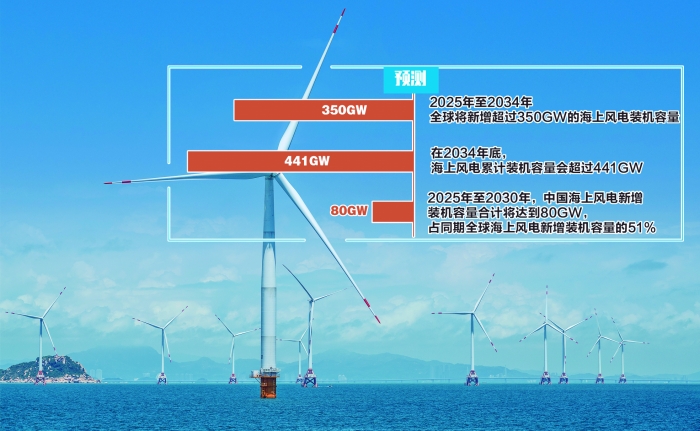
Core Viewpoint - The wind power industry is experiencing a recovery, with signs of improved demand both domestically and internationally, and potential for profit improvement by 2026 [2][3] Group 1: Industry Recovery - The wind power sector is witnessing a rebound, with the cumulative installed capacity of wind and solar power surpassing that of thermal power for the first time by March 2025 [3] - The profitability of the wind turbine segment has shown significant improvement, with a downward trend in bidding prices for wind turbine units from 2022 to 2024 due to intense market competition [3][4] - The average bidding price for wind turbine units in the market is projected to be 1610 RMB/kW by September 2025, indicating a recovery in prices after a bottoming out in August 2024 [5][6] Group 2: Anti-Competition Measures - The wind power industry has recognized the dangers of "involution" competition, leading to initiatives aimed at stabilizing prices and ensuring fair competition [5][6] - A self-regulatory agreement was signed by 12 wind turbine manufacturers at the Beijing International Wind Energy Conference in 2024 to address issues such as malicious defamation and unfair contract terms [5] Group 3: Growth in "Dual Sea" Market - The "dual sea" market, encompassing offshore wind and overseas wind power, is expected to drive continued recovery in the industry [7][8] - The Global Wind Energy Council forecasts that over 350 GW of new offshore wind capacity will be added globally from 2025 to 2034, with China accounting for 51% of this growth [8] - Companies like SANY Heavy Energy and Mingyang Smart Energy are actively expanding in the "dual sea" market, with SANY expecting significant increases in overseas revenue starting in 2025 [9][10] Group 4: Overall Industry Chain Benefits - The entire wind power industry chain is anticipated to benefit from the growth in the "dual sea" market, with increased orders for offshore piles and submarine cables expected in 2026 [11] - European offshore wind projects are projected to release supply chain orders in 2026 and 2027, coinciding with a rise in project conversion rates [11] - Companies are focusing on high-potential markets and products needed for offshore wind and overseas markets, taking advantage of the competitive landscape [11]



宏观专题分析报告:资产定价的双主线
SINOLINK SECURITIES· 2026-01-16 15:14
Market Performance - Since the beginning of 2026, the A-share market has shown a "good start" with a cumulative increase of 5.2% in the Wind All A Index, and the average daily trading volume has exceeded 30 trillion yuan[5] - The leading sectors include media, computer, non-ferrous metals, and military industry, with year-to-date gains of 16.0%, 14.0%, 14.0%, and 9.0% respectively, reflecting the current market focus on AI and geopolitical factors[5] Economic Indicators - In December 2025, China's PPI increased by 0.2% month-on-month, marking the highest monthly increase since 2024, driven by improvements in non-ferrous and technology sector prices[12] - Prices in the non-ferrous metal mining and smelting industries rose by 3.7% and 2.8% respectively, influenced by AI-driven demand for electricity[12] Strategic Trends - The two main strategic lines for A-share pricing in 2026 are AI, reflecting the U.S. focus on technology for growth, and "anti-involution," which corresponds to China's push for reform and high-quality development[3] - The "anti-involution" strategy is entering a new phase, emphasizing "quality over price" and a shift in local government performance perspectives[15] Policy Changes - The cancellation of export tax rebates for photovoltaic products is a national-level manifestation of the "anti-involution" strategy, aimed at promoting price increases among leading companies while eliminating those relying on low prices[18] - Recent regulatory actions against monopolistic practices in the photovoltaic industry signal a commitment to fair competition and the acceleration of "anti-involution" efforts[19] Risks - Potential risks include unexpected geopolitical tensions and slower-than-expected progress in "anti-involution" reforms, which could disrupt market dynamics[4][21]
黑色金属日报-20260116
Guo Tou Qi Huo· 2026-01-16 13:23
Report Industry Investment Ratings - Thread steel: ☆☆☆, indicating a short-term multi/empty trend in a relatively balanced state, with poor operability on the current disk, and it is recommended to wait and see [1] - Hot-rolled coil: ☆☆☆, same as above [1] - Iron ore: ★☆☆, representing a bullish bias, with a driving force for the upward trend, but poor operability on the disk [1] - Coke: ☆☆☆, same as thread steel and hot-rolled coil [1] - Coking coal: ☆☆☆, same as above [1] - Ferrosilicon: ★☆★, the specific meaning is not clearly defined in the given content [1] - Silicomanganese: The rating is not provided in the given content Core Views - The steel market has minor supply-demand contradictions, with a cautious market sentiment. The disk is expected to fluctuate within a range in the short term [2] - The iron ore market has a relatively loose fundamental situation. It is expected to fluctuate in the short term, and attention should be paid to the risk of increased volatility at high levels [3] - The coke market is likely to follow a weak oscillation pattern. It is necessary to observe whether winter storage continues and the impact of relevant policies [4] - The coking coal market is expected to be weak and volatile in the short term, affected by factors such as inventory increase and policy expectations [6] - The silicomanganese market is affected by factors such as inventory structure and cost support. It is necessary to pay attention to relevant impacts and cost changes [7] - The ferrosilicon market is affected by policies and cost factors. The demand has certain resilience, and attention should be paid to relevant impacts and cost support [8] Summary by Directory Steel - Today's disk rose first and then fell. The apparent demand for thread steel increased this week, with a slight decline in production and a slower inventory accumulation rhythm. The demand for hot-rolled coil improved, with a slight increase in production and a continued decline in inventory, but the pressure still needs to be relieved [2] - Steel mill profits have marginally recovered. Due to insufficient downstream carrying capacity, blast furnace复产 has slowed down, and pig iron production has declined [2] - From the perspective of downstream industries, the decline in real estate investment has continued to widen, and the growth rates of infrastructure and manufacturing investment have continued to decline. Overall domestic demand remains weak, but steel exports reached a new high in December [2] - The supply-demand contradiction is not significant, the market sentiment is cautious, and the disk is expected to fluctuate within a range in the short term. Attention should be paid to changes in the overall market trend [2] Iron Ore - Today's disk showed a weak oscillation. On the supply side, global shipments decreased seasonally compared with the previous period, and the phased supply peak has passed. The domestic arrival volume remains high in the short term, and port inventories continue to accumulate [3] - On the demand side, the terminal demand in the off-season has improved compared with the previous period. This week, pig iron production stopped increasing and started to decline, and it is expected to oscillate at a low level in the short term [3] - Steel mill inventories of imported ore have increased but are still at a low level. The expectation of winter storage replenishment demand still exists [3] - The sentiment in the commodity market is fluctuating. The fundamental situation of iron ore itself is relatively loose. It is expected to oscillate in the short term, and attention should be paid to the risk of increased volatility at high levels [3] Coke - The price oscillated downward during the day. The first round of price increase for coke has been proposed and is expected to be implemented next week. Coking profits are average, daily production has slightly decreased, and coke inventories have slightly increased [4] - The overall supply of carbon elements is abundant, and the downstream pig iron production remains at an off-season level. It is necessary to observe whether winter storage continues. The profit level of steel is average, and the sentiment of pressing prices for raw materials is still strong [4] - The coke disk has a premium. The market has certain expectations for coal-related policies. However, affected by the increase in the total inventory of coking coal and the relatively high customs clearance data of Mongolian coal, the price is likely to follow a weak oscillation pattern [4] Coking Coal - The price oscillated downward during the day. Yesterday, the customs clearance volume of Mongolian coal was 1,440 vehicles. The production of coking coal mines has increased significantly, and the spot auction transactions have improved. Driven by the increase in the disk price, the transaction price has increased [6] - The total inventory of coking coal has slightly increased, and the production-side inventory has slightly decreased, reflecting the winter storage actions in the market [6] - The overall supply of carbon elements is abundant, and the downstream pig iron production remains at an off-season level. It is necessary to observe whether winter storage continues. The profit level of steel is average, and the sentiment of pressing prices for raw materials is still strong [6] - The coking coal disk has a premium over Mongolian coal. The market has certain expectations for coal-related policies. However, affected by the increase in inventory and customs clearance data, the price is likely to be weak and volatile in the short term [6] Silicomanganese - The price oscillated downward during the day. Driven by the rebound of the disk, the spot price of manganese ore has increased. Currently, there are structural problems in the port inventory of manganese ore, and the balance is relatively fragile [7] - The smelting end of silicomanganese pursues the most cost-effective option and changes the formula of manganese ore for furnace charging. If the reduction of oxidized ore is large, the demand for cheaper semi-carbonate ore is likely to increase [7] - The spot transaction price of manganese ore has increased last week. The pig iron production has decreased seasonally. The weekly production of silicomanganese has slightly decreased, and the inventory has slightly decreased. Attention should be paid to the relevant impacts of "anti-involution" and observe the cost support [7] Ferrosilicon - The price oscillated downward during the day. Affected by relevant policy documents, the price is relatively strong. The market's expectation of coal supply guarantee has increased, and there is a certain expectation of a decline in power costs and blue carbon prices [8] - The pig iron production has rebounded to a high level. The export demand has decreased to above 20,000 tons, with a marginal impact. The production of magnesium metal has increased month-on-month, and the secondary demand has increased marginally. The overall demand still has certain resilience [8] - The supply of ferrosilicon has decreased significantly, and the inventory has slightly decreased. Attention should be paid to the relevant impacts of "anti-involution" and observe the cost support [8]