经济转型

Search documents
管涛:“十五五”时期资本市场将迎来四大机遇 资管配置能力重要性进一步提升
Sou Hu Cai Jing· 2025-11-27 03:49
Group 1 - The core viewpoint is that the "14th Five-Year Plan" period presents four significant opportunities for China's capital market, including policy dividends from deepened reforms, new momentum from economic transformation, improved institutional foundations, and value reassessment to invigorate market vitality [1][2][3] Group 2 - The first opportunity is the comprehensive deepening of reforms that will release policy dividends, with structural issues needing resolution through high-level opening and reform, which is expected to return economic growth to a reasonable range [2][3] - The second opportunity involves economic transformation that will foster new momentum, with emerging industries and the upgrading of traditional industries expected to create a market space of approximately 10 trillion yuan over the next five years [2][3] Group 3 - The third opportunity is the improvement of capital market systems, emphasizing "investor first" principles and promoting coordinated reforms in investment and financing, which will solidify the foundation for healthy market development [3][4] - The fourth opportunity is the value reassessment that will stimulate market vitality, driven by domestic economic transformation, diversification of resident assets, and global asset rebalancing [3][4] Group 4 - Wealth management institutions are expected to play a larger role in asset allocation, particularly in a low-interest and high-volatility environment, with a focus on four key areas for equity asset allocation over the next five years [4] - Gold is highlighted as having continued allocation value, with its share in private investment potentially increasing from just over 2% to 4-5% due to ongoing economic uncertainties [4] Group 5 - The future investment opportunities arising from transformation and upgrading will require enhanced asset allocation capabilities from wealth management institutions to navigate through economic cycles [4][5]
西媒:德国经济结构正发生深刻转变
Sou Hu Cai Jing· 2025-11-26 08:53
参考消息网11月26日报道 西班牙《经济学家报》网站11月24日发表题为《德国劳动力市场一个被忽略 的数据背后隐藏的经济深刻转变》的文章,作者为马里奥·贝塞达斯。编译如下: 德国的整体经济状况已不再是秘密。强大的工业正受到内部弱点和外部现实的双重打击。外部的"新世 界"摧毁了德国数十年来赖以生存的高附加值出口模式,导致经济陷入瘫痪,政界人士措手不及。 他们急于摆脱困境,尽管柏林试图展现决心或加大投资,但仍然在人们心中埋下了疑虑的种子。社会蔓 延着沮丧情绪。然而,在这层表象之下,德国经济正在发生一场深刻的变革。 当人们看到有关德国工业生存危机的新闻标题时,脑海中浮现的仍然是一个烟囱林立、煤炭堆积如山的 大型工厂的画面。但事实早已不是如此。就像大多数发达经济体一样,服务业在德国国内生产总值 (GDP)中占比较大,目前接近70%,而工业占比仅仅略高于20%。传统工业持续"萎缩",以技术为主的 制造业和服务业都在经历显著的变革。 巴黎国民银行的一项分析指出,2019年底以来欧元区新增的700万个就业岗位中,近四分之一来自技术 和数字领域,德国就是一个典型案例。该银行分析师纪尧姆·德里安指出,"德国或许是这种趋势的最好 ...
买家对半砍价,卖家心态已崩!房地产市场真正的“底”在哪?
Sou Hu Cai Jing· 2025-11-24 19:42
Core Viewpoint - The article discusses the significant decline in housing prices in China, which has shifted from a period of continuous growth to a substantial downturn, with average prices in first and second-tier cities expected to drop by approximately 40% by 2025 compared to their peak in 2021, and some third and fourth-tier cities experiencing declines exceeding 50% [1][3]. Impact of Housing Price Decline - The decline in housing prices has unexpectedly affected consumer sentiment, leading to a decrease in consumption despite lower prices, with retail sales growth dropping to 4.5% in the first three quarters of 2025, while household savings reached a historical high of 151.2 trillion yuan [3][5]. - The phenomenon of "reverse wealth effect" is at play, where falling property values, which constitute nearly 70% of household assets, make residents feel poorer, prompting them to cut back on spending and increase savings [3][5]. Generational Impact - Families that purchased homes during the price peak from 2016 to 2021, particularly those born in the 1980s and 1990s, are facing significant wealth losses, with an estimated total loss of 9 trillion yuan if each property is valued at an average decline of 1 million yuan [5][7]. - Older generations, such as those born in the 1960s and 1970s, who bought properties at lower prices, still retain profits despite the downturn, while younger generations have yet to purchase homes and may benefit from lower entry prices [7]. Market Dynamics and Structural Changes - The real estate market is undergoing a fundamental shift from being an "economic engine" to a "livelihood guarantee," with a focus on housing as a necessity rather than an investment, as indicated by the government's "housing is for living, not for speculation" policy [9][11]. - The urbanization rate in China has increased from 36% in 2000 to 68% in 2025, indicating a shift in market dynamics where the primary concern has moved from availability to quality of housing [9][11]. Changes in Land Supply and Demand - Local governments are adopting a "reduce quantity, improve quality" strategy, with a 20% year-on-year decrease in planned residential land supply for 2025, leading to a widening price gap between core and non-core urban areas [11][13]. - The demand structure is also evolving, with traditional "just need" housing demand softening as purchasing decisions are delayed due to unstable income expectations [11][13]. Transition to Innovation-Driven Economy - The decline in housing prices and the contraction of the real estate sector are seen as corrections to a distorted wealth distribution model, shifting resources from real estate to support the development of the manufacturing sector [15][17]. - Investment in high-tech manufacturing has increased by 22.3% year-on-year in the first nine months of 2025, indicating a significant shift in economic focus [15][17]. Long-term Economic Implications - The transition from a reliance on real estate to an innovation-driven economy is expected to enhance China's position in the global value chain and promote sustainable growth, with a focus on supporting technological self-reliance and high-end manufacturing [17][19]. - Although this adjustment may cause short-term pain, it is anticipated to lead to better resource allocation and high-quality economic development in the long run, as the real estate sector returns to its fundamental role in providing housing [19][21].


沙特王储的美国棋局刚走一步,自家基金的钱袋子,突然就捂紧了
Sou Hu Cai Jing· 2025-11-21 06:28
Core Insights - Mohammed bin Salman is leading a restructuring of Saudi Arabia's Public Investment Fund (PIF) after nearly a decade of high-cost investments with mixed results [1][3] - During a recent visit to Washington, the Crown Prince announced a $1 trillion investment in the U.S., but details on specific investments were not disclosed [1] - The PIF is facing challenges with new investment funding due to previous allocations to poorly performing projects, leading to a significant operational overhaul [1][3] Investment Challenges - The PIF's ambitious projects, such as Neom, have faced delays and difficulties, with many initiatives not meeting their targets [1][3] - The fund's assets are largely tied up in illiquid projects, and there are concerns about the lack of new investment capital [1][3] - The PIF's annual financial reports are limited, raising questions about transparency and the actual liquidity of its assets [1] Strategic Shifts - Under close supervision from the Crown Prince, the PIF is adjusting its investment strategy to focus more on traditional sectors like publicly traded stocks and bonds [3] - The fund aims to double its size to $2 trillion within five years, although the sources of this growth remain uncertain [3] - Recent investments have shifted towards private equity, particularly in artificial intelligence and gaming sectors, indicating a strategic pivot [3][5] Organizational Changes - The PIF has undergone significant staffing growth, now employing over 3,000 individuals, and has reported a 25% increase in revenue last year [5] - The leadership of Yasir Al-Rumayyan is seen as pivotal in this expansion, with a focus on evaluating effective measures and improving upon past mistakes [5] - The PIF is now requiring that new investments only occur when earlier projects yield returns, indicating a more cautious approach to future funding [5] Broader Economic Context - The restructuring of the PIF reflects the broader economic transformation efforts in Saudi Arabia, balancing ambition with the realities of global economic conditions [7] - The government is under pressure to find a sustainable path in the global economic landscape while managing its oil wealth and budget deficits [7]

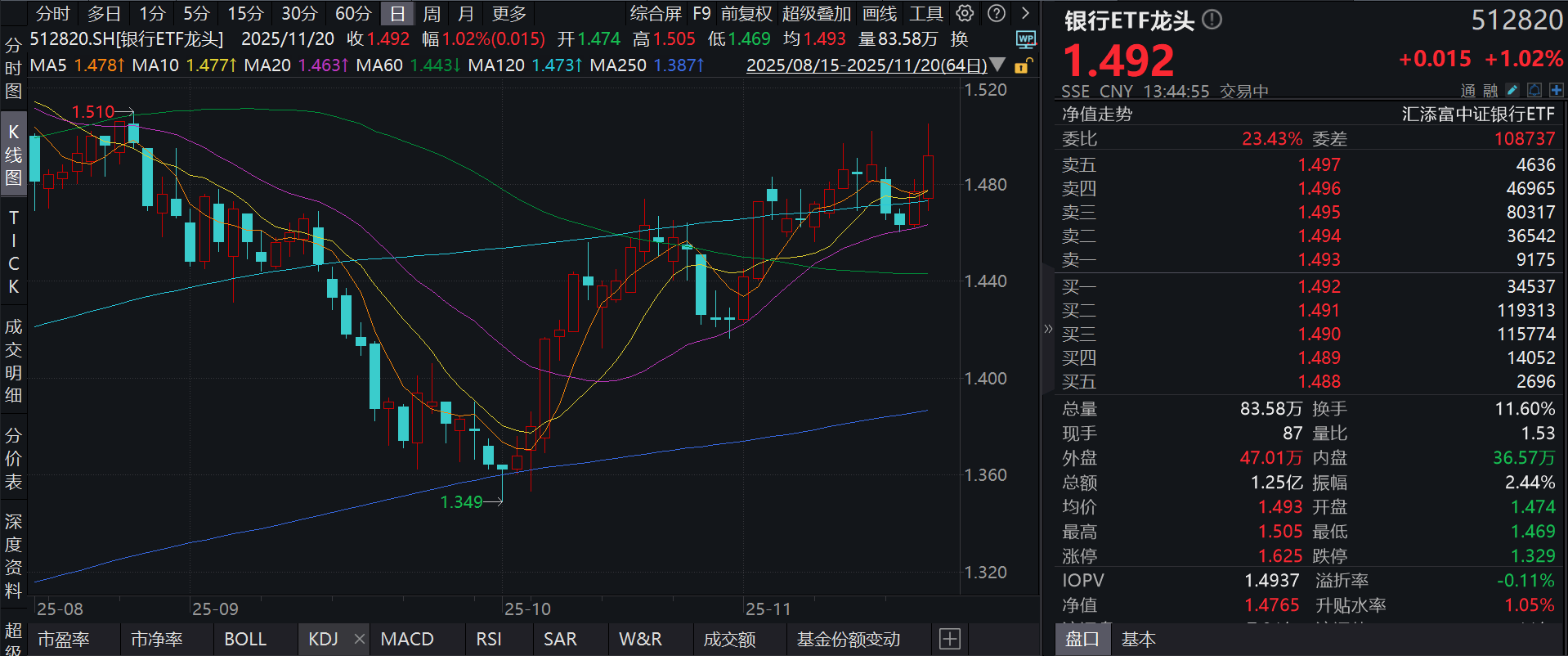
银行板块坚定向上,中国银行、工商银行双双创新高!银行ETF龙头(512820)大幅放量,一度涨近2%!机构:基本面边际企稳,Q3业绩延续改善
Sou Hu Cai Jing· 2025-11-20 06:01
Core Viewpoint - The banking sector in China is experiencing a strong performance, with significant increases in stock prices and market activity, indicating a positive outlook for the industry moving forward [1][3]. Group 1: Market Performance - The China Securities Bank Index rose by 1.07% as of November 20, 2025, with major banks like Bank of China and China Construction Bank seeing increases of 4.33% and 3.36% respectively [1]. - The leading bank ETF (512820) saw a near 2% increase at one point, currently up by 1.02%, with a latest price of 1.49 yuan [1]. - Over the past month, the leading bank ETF has accumulated a rise of 2.71% [1]. Group 2: Financing and Investment Trends - Leveraged funds are increasingly investing in the banking sector, with the latest financing buy amount reaching 6.7961 million yuan and a financing balance of 34.9936 million yuan [3]. - As of November 20, 2025, A-share bank stocks continued to strengthen, with Bank of China surpassing a market capitalization of 2 trillion yuan [3]. Group 3: Industry Transformation - The President of China Merchants Bank stated that the banking industry has transitioned from a phase of scale expansion to one focused on transformation and value creation, emphasizing the need for banks to align with national strategies and market trends [3]. - The continuation of a moderately loose monetary policy and the emphasis on maintaining reasonable interest rate relationships are expected to enhance banks' operational stability and their ability to support high-quality economic development [3]. Group 4: Future Outlook - The core viewpoints for 2026 include a focus on low interest rates and asset scarcity, regulatory cycles, economic transformation, and an investment logic that prioritizes high dividend and defensive assets while also considering banks' growth potential and long-term value [4]. - The banking sector is expected to benefit from a re-evaluation of its "stability anchor," with a focus on stable earnings, dividend attractiveness, and improved asset quality [4]. - There is an anticipated shift in insurance capital preferences towards bank equity, with a target dividend yield of 3.5%-4% seen as a reasonable baseline [4].


波折中寻机!申万宏源黄伟平:2026年债券策略投资展望 重点在2-3季度
Xin Lang Zheng Quan· 2025-11-18 05:23
Group 1 - The core viewpoint of the article emphasizes the shift in the bond market's core contradictions from credit contraction to asset allocation rebalancing, with a focus on the expected differences in 2025 [1] - The bond market's logic for 2025 is driven by expected differences in funding, Sino-U.S. relations, asset allocation, and central bank bond purchases [1] - The current stage of the bond market is characterized by a new focus on "prices + capital flows," with the real estate sector's impact on the economy expected to revert to levels seen around 2015 [1] Group 2 - The debt resolution plan, structured as "6+4+2," is projected to progress to a range of 46%-70% by 2026, alleviating asset scarcity pressures [1] - The logic of redistributing household wealth is gaining attention in the market [1] Group 3 - The main supports for the economy in 2025 are expected to be external demand, production driven by manufacturing, and fiscal expansion of social credit [4] - The focus areas for 2026 include modern industrial systems, technological self-reliance, and building a strong domestic market [5] - The nominal GDP growth rate for 2026 is anticipated to increase due to base effect and inflation improvement, with a fiscal deficit likely to expand moderately to support stable growth and high-quality development [5] Group 4 - The most critical variable for the bond market in 2026 will be the impact of prices throughout the year, particularly in the second and third quarters [6] - Continuous inflation is expected to create a prolonged headwind for the bond market, especially in the second and third quarters, with a focus on the rate of inflation recovery [6]

【列国鉴】记者观察:阿尔及利亚——北非能源大国谋转型
Sou Hu Cai Jing· 2025-11-17 09:55
Core Insights - Algeria, as a major energy-rich country in North Africa, is striving for economic diversification and green development despite facing challenges such as strict visa policies and inflexible decision-making [1][2][3]. Energy Sector - Algeria has proven oil reserves of 1.7 billion tons, ranking 15th globally and 3rd in Africa, and natural gas reserves of 46 trillion cubic meters, accounting for 2.37% of the world's total, ranking 10th globally [1]. - In 2023, Algeria's oil and gas production reached 194 million tons of oil equivalent, with exports of 97 million tons, a 3.5% increase from the previous year [1]. - The country anticipates an average annual growth of 1.3% in oil and gas production from 2024 to 2028, reaching 207 million tons by 2028 [1]. Economic Diversification Efforts - Algeria plans to invest $60 billion from 2025 to 2029 for a comprehensive energy economic transformation, including the construction of 15 solar power plants with a total installed capacity of 3,200 megawatts [3]. - By 2030, Algeria aims for 40% of its domestic electricity demand to be met by renewable energy, with a target of 15,000 megawatts of clean energy generation capacity by 2035 [3]. - The Tandra 200 MW solar power project, built by Chinese companies, is a key initiative to achieve Algeria's 2030 strategic goals, creating approximately 500 local jobs [3]. International Cooperation - Algeria is diversifying its international partnerships, reducing reliance on France, which remains a significant trade partner, with imports from France totaling approximately $5.6 billion and exports around $6.92 billion in 2024 [4]. - The country is expanding its market reach in Asia, initiating industrial cooperation with Malaysia and joining the Treaty of Amity and Cooperation in Southeast Asia in 2025 [5]. - A trilateral agreement with Nigeria and Niger aims to implement a $13 billion trans-Saharan gas pipeline project, enhancing Algeria's role in European energy supply [5]. Challenges in Economic Transformation - Algeria's strict visa policies hinder foreign investment, with only seven countries' citizens allowed visa-free entry [6]. - The economic infrastructure remains relatively weak, with limited availability of diverse goods and lengthy customs clearance processes for imports [6]. - Foreign investors face challenges such as mandatory local partnerships, high tax burdens, and bureaucratic hurdles, which complicate the establishment and operation of businesses in Algeria [6].
长城投研速递:短期市场或延续震荡
Sou Hu Cai Jing· 2025-11-17 09:49
Domestic Macro - In October, major economic indicators showed a decline, with industrial, consumption, and investment growth rates slowing compared to September. The high base from last year's policy stimulus and the misalignment of holidays contributed to short-term disturbances, indicating insufficient domestic demand and external pressure that require policy support [1][7] - The industrial added value in October grew by 4.9% year-on-year and 0.17% month-on-month, while from January to October, it increased by 6.1% year-on-year. Real estate development investment from January to October was 73,563 billion yuan, down 14.7% year-on-year, and new commercial housing sales area decreased by 6.8% year-on-year [7] Foreign Macro - Overseas markets continued to experience fluctuations, particularly in US tech stocks, which affected sentiment in the A-share market. The S&P 500 index rose by 0.08%, while the Nasdaq index fell by 0.45% [8] - Several factors contributed to the ongoing adjustment in US stocks, including the absence of key economic data during the government shutdown, hawkish statements from Federal Reserve officials regarding interest rate cuts, and concerns over the sustainability of debt financing for AI giants [8][9] Bond Market - The bond market is expected to remain in a favorable period despite some pressure on the fundamentals. The central bank has indicated that during this critical economic transition, it is not advisable to overly focus on total data changes [10][15] - The overall liquidity in the market is anticipated to stay relatively loose in the medium term, with the bond market likely to continue benefiting from this environment [15] Equity Market - The market is entering a period of total policy and profit vacuum, with accelerated rotation in the tech sector and increased highlights in low-position consumption and dividends. The high-yield, risk-free financial assets are diminishing, and the influx of new capital is far from over [20] - The Shanghai Composite Index fell by 0.18%, the Shenzhen Component Index dropped by 1.40%, and the ChiNext Index decreased by 3.01% last week, with 20 out of 31 industries showing gains [16][20] Investment Strategy - Emerging technology is expected to be a main focus, with cyclical consumption looking towards transformation. Attention should be given to sectors that have experienced prolonged corrections and significant adjustments [21][22] - Specific directions include technology growth, manufacturing expansion, cyclical consumption, and financial sectors, with a focus on areas such as internet, robotics, semiconductor, and consumer electronics [22]
每日钉一下(普通家庭,如何分享经济增长呢?)
银行螺丝钉· 2025-11-16 13:46
Group 1 - The core concept of fund advisory is to address the issue where funds make profits, but investors do not [4] - Fund advisory services are designed to help investors achieve better returns through professional guidance [5] - The emergence of fund advisory is similar to the role of consultants in other specialized industries, such as healthcare and law [6][7] Group 2 - The economic growth dynamics in China have shifted from low-end manufacturing and real estate to mid-to-high-end manufacturing in recent years [12] - The share of mid-to-high-end manufacturing in exports has been gradually increasing, indicating a transformation in the economic structure [12] - Historical examples from the US, Germany, and Japan show that families can benefit from economic transitions through investments in index funds [13]

投资大家谈 | 摩根资产管理中国主动权益团队季度最新观点
点拾投资· 2025-11-15 11:00
Core Viewpoint - The article discusses the current state of the A-share market, highlighting the potential for continued investment opportunities, particularly in sectors like artificial intelligence, engineering machinery, chemicals, power batteries, and non-ferrous metals, despite the market's recovery being seen as a mere correction after previous declines [2][4]. Market Overview - The A-share market has reached 4000 points for the first time in ten years, with many investors achieving good returns this year [1]. - The overall market valuation remains reasonable and potentially undervalued, indicating room for further recovery as policies take effect and the economy rebounds [2]. Investment Focus Areas - The focus remains on transformative opportunities brought by AI, with ongoing tracking for more investment prospects [2]. - Other sectors of interest include engineering machinery, chemicals, power batteries, and non-ferrous metals, with traditional industries also showing potential [2]. Stock Selection Strategy - The strategy emphasizes selecting growth stocks, particularly those with stable earnings growth despite significant past declines, which may yield excess returns as performance materializes [4]. - The investment approach will prioritize sectors benefiting from economic transformation and consumer spending, as disposable income continues to rise [4]. Economic and Market Outlook - The outlook for the fourth quarter suggests that market opportunities may outweigh risks, with a focus on stock selection as the primary strategy [4]. - Factors such as potential interest rate cuts by the Federal Reserve, domestic liquidity easing, and supportive policies are expected to benefit the overall stock market [6]. Sector-Specific Insights - AI is highlighted as a key area for growth, with expectations for significant advancements in commercialization and applications in various fields [6]. - The lithium battery sector is anticipated to see increased demand, particularly from electric vehicles and energy storage, with a positive outlook for the second half of the year [6]. - Non-ferrous metals, particularly copper and gold, are expected to maintain strong demand and profitability due to favorable supply-demand dynamics [8]. Consumer Trends - The article notes a shift in consumer behavior among younger generations, leading to increased spending and the emergence of new consumption patterns, which could benefit specific sectors [17].