
以旧换新

Search documents
经济动态跟踪:“国补”继续下的消费后劲
Minsheng Securities· 2025-06-19 13:36
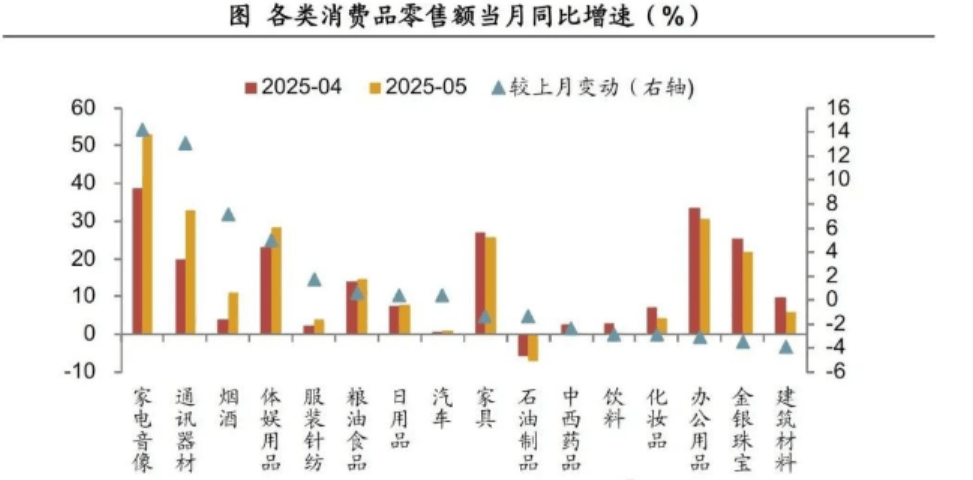
Funding and Policy Overview - The recent pause in the "National Subsidy" ("国补") program was due to the rapid consumption of subsidy funds, which outpaced the issuance of special government bonds[1] - A total of 1,380 billion yuan in central funds will be distributed in batches during the third and fourth quarters, focusing on the implementation of existing funds rather than increasing the 3,000 billion yuan quota[1][4] - As of the end of May, approximately 1,620 billion yuan of the subsidy funds had been allocated, with over half of the expected funds consumed in the first five months[2][3] Impact on Consumer Spending - The "trade-in" subsidy program has significantly boosted retail sales, with May's total retail sales exceeding the trend value by approximately 2.8 percentage points[5] - The year-on-year growth rate for "trade-in" categories in May reached 16.6%, compared to an overall retail sales growth of 8.2%[5][6] - However, due to the rapid consumption of subsidy funds, the growth rate of retail sales may experience downward fluctuations in the coming months[5] Future Considerations - The "trade-in" policy needs to be strengthened in terms of quantity to prevent a decline in consumer momentum, as non-"trade-in" categories only saw a year-on-year growth of 1.6% in May[6] - There is a need for further improvement in policy mechanisms to reduce unfair competition caused by differences in subsidy standards and regional disparities[6] - Risks include potential policy shortcomings, unexpected changes in the domestic economic situation, and fluctuations in exports[6]
“618”电商大促落下帷幕,下单用户数创新高
Bei Jing Ri Bao Ke Hu Duan· 2025-06-19 09:28
Group 1 - The "618" e-commerce promotion has concluded, with multiple platforms reporting record-high order numbers from participating users [1] - JD.com reported that as of June 18, 23:59, the number of orders on its platform during "618" increased by over 100% year-on-year, leading the industry, with total orders exceeding 2.2 billion [1] - Alibaba's Tmall simplified its promotional strategies, achieving double-digit growth in the number of purchasing users throughout the "618" period, with beauty, apparel, home appliances, and 3C digital products leading in transaction scale and growth [1] Group 2 - The "old-for-new" policy, combined with platform discounts and national subsidies, significantly boosted sales in categories like computers, home appliances, and home decor during "618," with photography equipment achieving nearly 100 million yuan in sales and a year-on-year growth of 22.55% [1] - Consumers are increasingly replacing high-energy-consuming old products with smart, low-carbon new ones, reflecting a dual win for the "replacement trend" and "environmental protection" [2] - The "618" and "Double 11" promotions serve as critical windows for observing emerging industry trends, with categories like trendy toys, jewelry, pets, and alcoholic beverages showing high growth during this year's "618" [2]
国泰海通:5月重卡销量增速提升 以旧换新地开始起效
智通财经网· 2025-06-19 08:56
Core Viewpoint - The report from Guotai Junan indicates that the domestic heavy truck sales in May reached 89,000 units, showing a year-on-year increase of 13.6% and a month-on-month increase of 1.3%, driven by the trade-in policy, which is expected to enhance the profitability of heavy truck chain enterprises [1] Group 1: Heavy Truck Sales Performance - In May 2025, the wholesale sales of domestic heavy trucks reached 89,000 units, with a year-on-year increase of 13.6% and a month-on-month increase of 1.3% [1] - Cumulative sales from January to May 2025 amounted to 441,000 units, reflecting a year-on-year increase of 1.9%, exceeding industry expectations [1] - The implementation of the trade-in policy is beginning to show effects, with over half of the provinces and regions completing the policy rollout [2] Group 2: Market Dynamics and Future Outlook - The heavy truck industry is entering a phase of inventory management, and the trade-in policy is expected to significantly boost domestic sales [1] - The forecast for heavy truck sales in 2025 is 1.06 million units, representing a year-on-year increase of 16% [1] - The growth potential in the heavy truck sector is evident in the recovery of domestic market conditions and continued growth in exports [1] Group 3: Segment Performance - In May 2025, the sales of new energy heavy trucks reached 15,100 units, showing a year-on-year increase of 190%, despite a month-on-month decrease of 5% [2] - The sales of natural gas heavy trucks fell below 15,000 units, marking a new low in four months, with a penetration rate dropping from approximately 25% in April to below 23% [2] - The strong performance of new energy heavy trucks is attributed to declining product costs and a more robust trade-in policy [2] Group 4: Market Share and Competition - The market share in May 2025 for major players was as follows: China National Heavy Duty Truck Group (27.7%), Shaanxi Automobile Group (17.4%), Dongfeng Motor Corporation (16.7%), FAW Jiefang (15.5%), and Foton Motor (13.2%), with a combined CR5 of approximately 90.5% [3] - The initial rise of new energy heavy trucks has benefited some second and third-tier manufacturers, but as penetration increases, buyers are focusing more on quality and maintenance, leading to a resurgence of advantages for leading companies [3]

天猫618:453个品牌成交额破亿元 “以旧换新”消费全面爆发
Xin Hua Cai Jing· 2025-06-19 08:52
Group 1 - The core viewpoint of the articles highlights the significant growth in sales and user engagement during the "Tmall 618" event, driven by government subsidies and the "trade-in" consumption model [1][2] - A total of 453 brands achieved sales exceeding 100 million yuan during the period from May 13 to June 18, with user scale and activity reaching new highs [1] - Categories such as home appliances, 3C digital products, and new product launches saw substantial sales increases, with the total sales of subsidized categories rising by 116% compared to last year's "Double 11" [1] Group 2 - The toy and jewelry sectors, along with pet products and alcoholic beverages, emerged as high-growth areas during this year's "Tmall 618," with six toy brands surpassing 100 million yuan in sales [1] - The sports and outdoor product category experienced unexpected growth, with 36 brands exceeding 100 million yuan in sales and 2,196 brands doubling their sales compared to last year [1] - New products were a key driver of brand performance, with overall sales of new products increasing by 153% compared to last year's "618," and 12 new products achieving sales over 100 million yuan [1][2]
国联民生证券:5月内销弹性释放、出口短期走弱 维持空调行业“强于大市”评级
智通财经网· 2025-06-19 08:40
2025年5月空调内销出货双位数增长,规模同期新高;考虑2024年5月内销同比-1%,剔除基数因素看, 2025年5月内销出货量较2023/2019年同期CAGR分别+6%/+5%,稳健增长。终端方面,4-5月龙头安装卡 增长提速,同期基数环比平稳;据奥维监测,3/4/5月空调线上零售量分别同比+13%/+39%/+47%,时值 动销旺季,景气斜率向上,而1-4月零售出货节奏基本一致,产业健康运行。展望后续,2024年6-8月空 调内销量分别同比-16%/-21%/-5%,基数走低,弹性有望进一步释放。 龙头份额向上,二线表现分化 智通财经APP获悉,国联民生证券发布研报称,维持空调行业"强于大市"评级。家用空调5月内销景气 向上,外销短期走弱符合预期。国内出货动销趋势一致,产业健康运行,龙头价格策略积极,份额弹性 显著,美的系表现突出;海外需求/关税不确定性仍较高,消化Q1提前出货影响后,有望逐步修复。2025 年以旧换新放宽主体/数量限制,后续出货基数走低,弹性或进一步释放;龙头2025Q1报表质量优异,海 外新兴市场OBM持续突破,后续经营有支撑,年报分红回购力度多有加大,高质量且高股息。 国联民生证券 ...



值得买科技:品质消费与兴趣消费成为今年618的重要驱动要素
Xin Hua Cai Jing· 2025-06-19 03:07
Core Insights - The core business of the company, "What Worth Buying," has facilitated 42 brands to achieve over 10 million GMV (Gross Merchandise Volume) during the 618 shopping festival, with content publication volume increasing by 17.28% year-on-year [1] - The 618 shopping festival this year, which started on May 13, is the longest in history, focusing on long-term operations and easing shopping pressure, reflecting a shift towards quality and interest-driven consumption [1][2] Group 1: Sales Performance - The top five GMV categories on the "What Worth Buying" platform during the 618 period were mobile communication, home appliances, computer systems, household electrical appliances, and computer accessories [1] - The fastest-growing categories in terms of GMV year-on-year were gaming hardware (180.18%), dining and food (91.37%), office equipment (35.04%), electronic education (33.11%), and smart devices (24.60%) [1] Group 2: Consumer Trends - Consumers are increasingly opting for "upgrading" products with better features and specifications, driven by government subsidies and promotional events [2] - The "old for new" program has significantly boosted sales in categories like computers, home appliances, and home decor, with a year-on-year GMV increase of 12.82% [2] Group 3: Brand Engagement - The LABUBU brand saw a GMV increase of 53.60% on the "What Worth Buying" platform during the 618 period, with a notable spike of 231.91% in interest following a viral auction event [3] - The 618 shopping festival serves as a critical platform for brands and platforms to deepen user connections and test their comprehensive capabilities [3][4] Group 4: Market Outlook - The 618 festival is viewed as a key indicator of consumer resilience and innovation in China, with the explosive growth of interest-driven consumption highlighting the ongoing demand for new business models [4]

深圳:以旧换新累计销售家电和数码产品超千万台
news flash· 2025-06-18 04:25
6月18日,深圳市商务局发布的数据显示,2025年消费品以旧换新相关政策自启动以来,得到消费者踊 跃参与。截至6月16日,通过以旧换新带动汽车销售超7万台,销售金额176亿元。通过以旧换新政策线 上线下(300959)累计销售家电和数码产品1001万台,销售金额191亿元。(人民财讯) ...

618来袭,消费回暖了吗?5月社零数据超预期!中证A500指数ETF(563880)窄幅震荡,指数配置性价比如何
Sou Hu Cai Jing· 2025-06-18 01:57
Group 1 - The core viewpoint of the articles highlights the positive impact of consumption policies such as "trade-in for new" and "national subsidies" on China's retail sales, with a notable year-on-year growth of 6.4% in May, surpassing the previous month's growth of 5.1% [1][2][5] - The increase in retail sales is attributed to the combination of internal demand supporting external demand, as well as the early start of the 618 shopping festival, which stimulated consumer spending [2][5] - The "trade-in for new" policy has significantly boosted sales, with data indicating that it has driven sales of over 1.1 trillion yuan across five major categories by the end of May, with an estimated 300 billion yuan contribution in May alone [2][5] Group 2 - The funding progress for the "trade-in for new" initiative reached approximately 42% by May, indicating a rapid pace of implementation, which aligns with the recent adjustments in subsidy mechanisms [5] - Economic forecasts suggest that the second quarter GDP is expected to maintain strong growth, supported by recent government policies aimed at stabilizing employment and increasing income [5] - The 中证A500指数 ETF (563880) is highlighted as a potential investment opportunity, focusing on leading companies in various sectors, with expectations of strong profit growth and reasonable valuation compared to smaller stocks [2][8]

申万宏源证券晨会报告-20250618
Shenwan Hongyuan Securities· 2025-06-18 01:12
Core Insights - The report highlights the significant increase in the "old-for-new" subsidy policy for consumer goods in 2025, with a total of 3 trillion yuan allocated to support this initiative, which includes a broader range of products compared to 2024 [11][18] - The report emphasizes the strong performance of Alibaba Pictures, which is transitioning to "Damai Entertainment" and focusing on live performances and IP derivatives, indicating a shift from traditional film revenue streams [10][12] Group 1: "Old-for-New" Policy - The 2025 "old-for-new" policy has expanded its subsidy range, now including additional products such as microwaves, water purifiers, dishwashers, and rice cookers, enhancing consumer appeal [11][18] - By the end of May, 162 billion yuan of central government subsidies had been distributed, with a total sales volume of 1.1 trillion yuan for consumer goods under this policy [11][12] - The report notes that the policy has had a varied impact on different consumer goods, with significant growth in home appliance sales, particularly in the central and western regions of China [11][12] Group 2: Alibaba Pictures and Entertainment Sector - Alibaba Pictures plans to rebrand as "Damai Entertainment," focusing on live entertainment and IP derivatives, with 72% of its revenue projected to come from ticketing and content production by FY2025 [10][12] - The report forecasts revenue growth for Alibaba Pictures, estimating revenues of 7.566 billion yuan, 8.684 billion yuan, and 9.739 billion yuan for FY26, FY27, and FY28 respectively, with a target valuation of 31.9 billion yuan [12][15] - The live performance segment is expected to continue its strong growth, with ticket sales projected to reach 57.954 billion yuan in 2024, reflecting a year-on-year increase of 15.37% [15]
开源证券晨会纪要-20250617
KAIYUAN SECURITIES· 2025-06-17 14:41
Macro Economic Overview - The progress of the "old-for-new" subsidy program reached approximately 42% in May, indicating a significant impact on consumer spending [3][4] - Retail sales in May showed a year-on-year increase of 6.4%, driven by the "618" shopping festival and the ongoing effects of the "old-for-new" policy [24][25] - Industrial production maintained a high growth rate of 5.8% year-on-year in May, although the supply-demand structure remains suboptimal [5] Industry Insights Chemical Industry - Polyester bottle chip factories have announced production cuts of about 20%, which may lead to a recovery in processing margins [18][19] - The average operating load of domestic polyester bottle chip facilities is expected to decline from 94.3% in May to around 77% due to these production adjustments [19][21] Food and Beverage Industry - The food and beverage sector is expected to benefit from a steady recovery in consumer demand, with retail sales growth in May exceeding expectations [24][25] - The white liquor industry is currently in a bottoming phase, while the snack sector shows strong growth potential due to channel innovation and product diversification [28] Electric Power Equipment and New Energy - The European electric vehicle market is experiencing a recovery, with May sales of new energy vehicles increasing by 36.2% year-on-year [40][42] - The Chinese low-altitude economy is gaining traction, with significant government support and new projects being signed, indicating potential growth in this sector [30][33] Agriculture, Forestry, Animal Husbandry, and Fishery - The USDA has raised global production estimates for corn, rice, and wheat, while maintaining soybean production forecasts, reflecting a positive outlook for agricultural commodities [35][36][37][38] Banking Sector - The banking sector is cautiously optimistic about retail risks, with the transition period for new regulations approaching, which may impact asset quality [46][47] - The overall non-performing loan ratio remains stable, but there are concerns about rising risks in small and micro enterprises and retail businesses [46][48]