
经济周期

Search documents
中金:股市“三步曲”
中金点睛· 2025-08-29 00:07
Core Viewpoint - The article discusses the recent improvement in the Chinese stock market, emphasizing the importance of understanding the financial cycle perspective to explain the market's positive performance despite ongoing economic downward pressure [2][5]. Group 1: Financial Cycle vs Economic Cycle - The financial cycle adjustment leads to a significant deterioration in balance sheets, while the economic cycle adjustment has a relatively smaller impact on balance sheets [6][9]. - In the financial cycle adjustment phase, the stock market may experience a "reallocation" effect driven by balance sheet changes, whereas in the economic cycle adjustment, the stock market's recovery is more synchronized with economic improvements [12][11]. - The ideal policy mix differs between the two cycles; the financial cycle requires more fiscal stimulus, while the economic cycle relies more on monetary policy [7][30]. Group 2: Three-Step Process of Stock Market Recovery - The recovery of the stock market post-financial cycle adjustment can be divided into three steps: 1. Housing market adjustment and deterioration of private balance sheets, leading to an increase in the proportion of safe assets [3][12]. 2. Policy intervention to stabilize growth and improve private balance sheets, increasing the attractiveness of risk assets relative to safe assets, resulting in a rise in the stock market [3][12]. 3. Economic recovery, transitioning the stock market from being driven by reallocation effects to being driven by earnings [3][12]. Group 3: Factors Supporting Stock Market Rebound - Several factors support the current rebound in the Chinese stock market, including accelerated technological advancements and a correction of overly cautious market expectations regarding the medium to long-term economic outlook [3][47]. - The government's increased focus on the economy, housing market, and stock market has led to a perception that downside risks are limited [3][47]. - The decline in the cost-effectiveness of safe asset allocations has motivated investors to increase their allocation to risk assets, further supporting the stock market [3][47]. Group 4: Comparison with International Experiences - The article draws comparisons with the U.S. financial cycle, noting that the U.S. stock market recovery post-financial cycle adjustment occurred earlier than the recovery of nominal GDP and the housing market [17][15]. - The U.S. experience shows that stock prices may recover before economic indicators due to improvements in corporate balance sheets, even when the economy has not yet shown signs of recovery [11][21]. - Japan's experience illustrates that addressing debt issues is crucial for stock market recovery, as the Japanese market did not stabilize until after significant debt problems were resolved [41][43]. Group 5: Implications for China - The financial cycle adjustment in China is expected to have a lesser impact on various sectors' balance sheets compared to the U.S. and Japan during their respective financial crises [51][56]. - The heavy debt burden on local governments in China poses challenges, but improving balance sheets could support corporate development and enhance stock market potential [56][53]. - The article suggests that the ongoing structural improvements in the Chinese economy, particularly in innovation, may lead to a more resilient market compared to past financial cycle adjustments in other countries [56][58].


4000点,会有一次调整
Sou Hu Cai Jing· 2025-08-25 11:23
Market Overview - The A-share market is experiencing a confirmed bull market, driven by economic cycles, with historical patterns suggesting a bull market approximately every ten years [3][4] - The current bull market is characterized by significant capital inflow and a strong upward trend, with the Shanghai Composite Index expected to challenge the 4000-point mark [1][3] Stock Performance - Stocks in a bull market do not require logical reasoning for their price increases; historical examples show that valuations can become irrational during such periods [4][5] - The stock price of Cambrian has surged, reflecting the market's preference for AI concepts over traditional sectors like liquor, indicating a shift in investor sentiment [4][5] Investment Strategy - Investors are advised to recognize the cyclical nature of the market and to differentiate between investment and speculation, focusing on sectors like new technology, new pharmaceuticals, and new consumption as primary growth areas [6] - Caution is advised for ordinary value investors regarding participation in speculative sectors like chips, as the bull market can lead to irrational behavior and potential losses [5][6] Sector Focus - The AI and semiconductor sectors are expected to be the main drivers of the current bull market, with Cambrian's market capitalization approaching that of major global players like Intel [4][5] - The investment in new pharmaceuticals is highlighted as having a more substantial technological moat compared to the semiconductor sector, suggesting a more stable investment opportunity [5][6]

周期有起伏,人无再少年,怎么解?
Hu Xiu· 2025-08-23 02:27
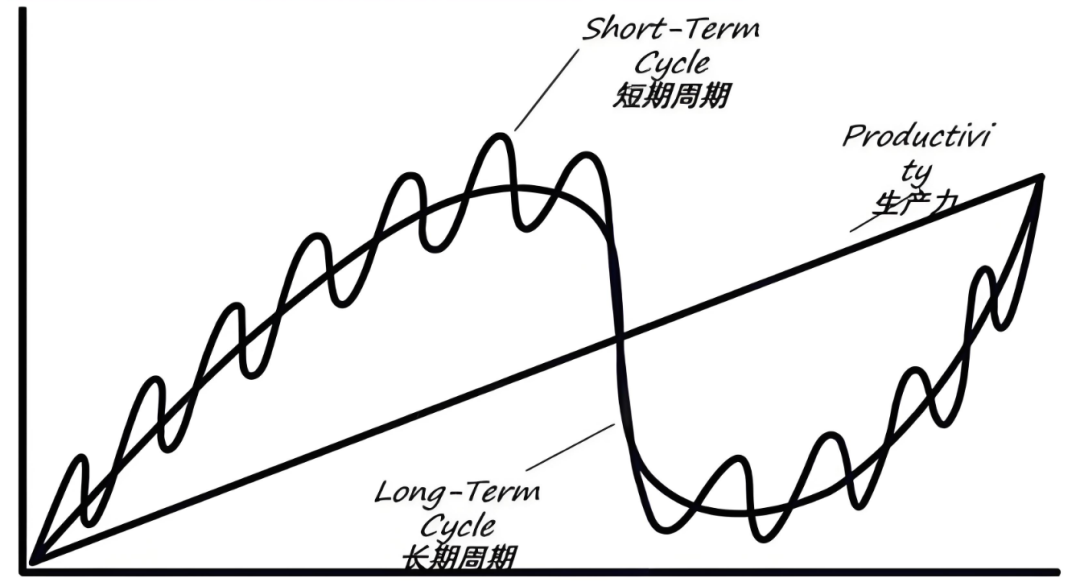
Group 1 - The concept of "Long Debt Cycle" is introduced, which indicates that debt can lead to economic recessions and national bankruptcies, affecting ordinary people [3][5][21] - The short-term debt cycle lasts approximately 6 years, while the long-term debt cycle spans about 80 years, accumulating greater crises over time [10][11][13] - The relationship between credit creation and economic prosperity is highlighted, where increased borrowing leads to higher consumption and investment, but can also result in inflation and subsequent economic downturns [7][8][20] Group 2 - The article discusses the cyclical nature of economic conditions and how they impact individual wealth creation opportunities, particularly during one's productive years [47][48] - It emphasizes that economic cycles are complex and cannot be precisely predicted, making it challenging for investors to navigate [32][36][39] - The notion of "deleveraging" is introduced, distinguishing between harmonious and painful deleveraging processes, which can significantly affect economic stability [22][23][24] Group 3 - The article reflects on how successful individuals often leverage economic cycles to amass wealth, with examples from historical figures who thrived during periods of economic growth [44][46] - It notes that economic downturns do not preclude success, as many individuals achieve success later in life, countering the myth of early success [50][51] - The changing consumer behavior in response to economic conditions is discussed, highlighting a shift towards more meaningful and sustainable consumption patterns [58][61] Group 4 - Investment opportunities arise during economic downturns, as assets may be undervalued when market sentiment is negative [64][65] - The article outlines a three-step approach for investing during cycles: awareness, courage, and preparation, emphasizing the importance of independent thinking and risk management [66][67][69] - The cyclical nature of economies is presented as a source of both challenges and opportunities for investors, reinforcing the need for strategic foresight [64][70]
民生证券:A股“跑赢”美股的来龙与去脉
智通财经网· 2025-08-22 04:45
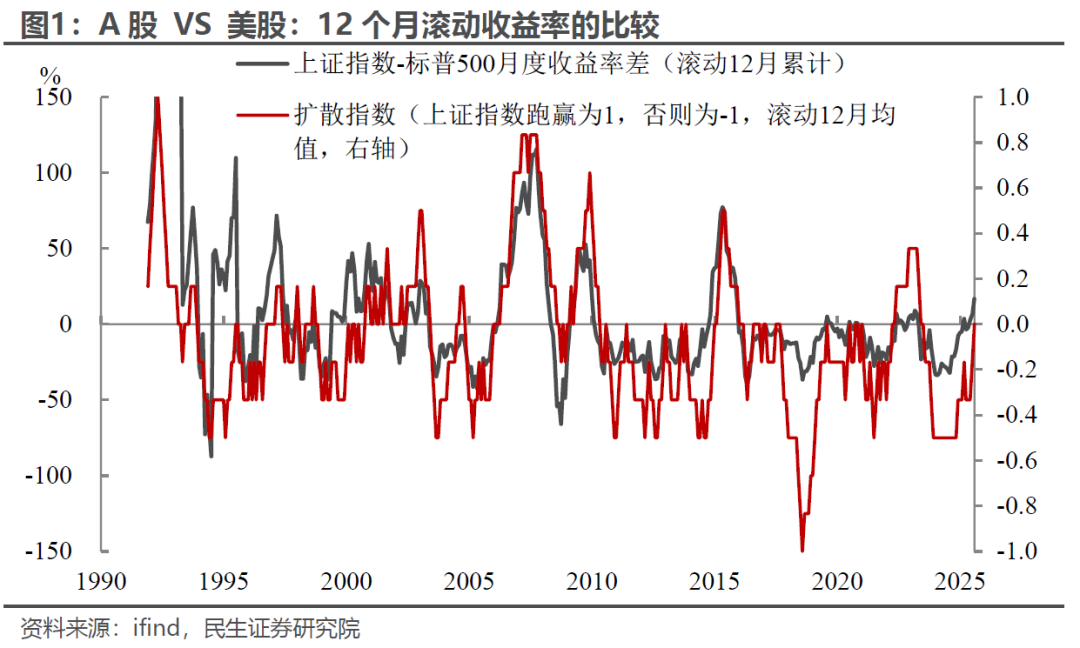
Group 1 - A-shares have outperformed U.S. stocks, with a relative excess return exceeding 15% since the second half of the year, marking the highest level since 2015 [1][3] - The probability of A-shares outperforming U.S. stocks increases when both markets rise together, with A-shares winning approximately 54% of the time in such scenarios [3][5] - Historical analysis shows that A-shares have outperformed U.S. stocks in 10 distinct phases since the early 1990s, with the average duration of these phases being around 10 months [5][6] Group 2 - The main factors influencing A-share performance during winning phases include valuation and earnings contributions, with valuation changes playing a more significant role [6][10] - In winning phases, sectors such as machinery, finance, military, and technology tend to perform better, although specific sector performance can vary by economic conditions [10][12] - A-shares typically outperform during upward phases of the economic cycle, but can also win during U.S. economic downturns if the U.S. market experiences significant corrections [12][17] Group 3 - The current winning phase for A-shares began in June 2025, with the potential for continuation depending on market conditions and policy support [20][21] - Future performance may depend on whether both markets enter a cooling phase, with a greater decline in U.S. stocks, or if A-shares continue to rise independently [21]
洪灏:悲观者正确,乐观者赚钱
Hu Xiu· 2025-08-19 08:36
Core Insights - The current market is experiencing a "slow bull" phase, driven by policy expectations and improved liquidity conditions, despite long-term challenges such as demographic shifts and real estate deflation [3][4] - The A-share market has shown significant upward momentum since the "924 market," with the Shanghai Composite Index reaching a peak of 3745 points, indicating a strong trading environment [1][2] - Liquidity remains a crucial driver for the market, supported by approximately 10 trillion yuan injected by the central bank and the return of overseas funds, alongside a weakening US dollar which enhances the attractiveness of Chinese assets [2][4] Market Dynamics - The market is characterized by a divergence of opinions, with optimists focusing on policy improvements and liquidity, while pessimists highlight structural issues that may hinder long-term growth [1][2] - Despite ongoing concerns about real estate and consumer demand, the short-term liquidity conditions have allowed for a broad-based market rally, with 70%-80% of stocks showing gains [2][3] - The economic cycle has begun to recover since Q4 2022, with a clear upward trend in market sentiment and reduced operational difficulty for investors [3] Investment Opportunities - Investors are encouraged to consider both A-shares and Hong Kong stocks, particularly in sectors like innovative pharmaceuticals and technology, which have shown substantial returns [4] - The Hang Seng Tech Index, while not purely a frontier tech index, has seen significant gains, with some stocks doubling in value shortly after their IPOs [4] - The current environment presents numerous opportunities, but investors should approach the market with a well-defined strategy to navigate the complexities of the ongoing bull market [4]
为什么经济时好时坏?
Hu Xiu· 2025-08-18 09:01
Group 1 - The core concept of the article revolves around economic cycles, which explain the fluctuations in interest rates and economic stability over time [1][4][5] - The article discusses the long-term view of economic history, suggesting that while short-term trends may appear linear, a century-long perspective reveals cyclical patterns [2][3] Group 2 - The "debt spiral" concept is introduced, indicating that economic cycles typically span around 80 years, with significant impacts on individual savings and wealth distribution [4][5] - The article outlines the two phases of the grand debt cycle: the initial phase characterized by cautious monetary policy and credit growth, followed by a later phase where debt reaches unsustainable levels [6][7] Group 3 - During the credit expansion phase, low net debt levels and stable monetary policy lead to increased productivity and asset prices, creating a false sense of security in the market [10][12] - The article highlights the dangers of excessive credit and the resulting debt bubble, warning that when debt repayment burdens rise, it can lead to economic corrections [14][15] Group 4 - The credit contraction phase is marked by reduced investment and consumption, with governments often stepping in to support the economy through increased spending [15][16] - The article emphasizes the limitations of government borrowing and the potential consequences of central banks resorting to money printing, which can erode public confidence and lead to inflation [17][18] Group 5 - The threat of currency devaluation and inflation is discussed, noting that central banks often choose to print money to manage debt crises, which can undermine purchasing power [21][22] - The article uses Japan's experience as a cautionary tale, illustrating how prolonged economic stagnation and mismanagement of debt can lead to significant losses for the populace [23][24] Group 6 - Investment strategies during the deleveraging phase are recommended, suggesting that hard assets like gold and commodities tend to outperform cash and bonds [25][26] - The article advises against blind faith in high-rated bonds during extreme debt monetization, advocating for a shift towards hard assets to protect savings [26]
招商宏观:关税对美国经济的影响几何?
智通财经网· 2025-08-17 03:52
Group 1: Key Features of Trump's Tariff Policy - Trump's tariff policy has three main characteristics: 1) "Threatening" nature with pre-announced tariffs often exceeding market expectations, but actual implementation being relatively moderate 2) Tariffs are implemented in phases, starting with small-scale and limited tariffs before gradually expanding 3) Numerous tariff exemptions and product exclusions slow the average tariff increase, allowing businesses and governments time to adjust [1] Group 2: Impact of Tariffs on the U.S. Economy - The overall economic cycle indicates that prior to Trump's presidency, the rising unemployment rate suggested the U.S. was in the mid to late stages of the economic cycle, with tariffs potentially increasing economic downturn risks and unemployment, but the implementation of the American Rescue Plan has improved mid-term economic prospects [2] - Inflation transmission from tariffs has been slow, influenced by multiple tariff exemptions and importers "rushing to import," with three key factors: 1) Exporters absorbing part of the tariff costs 2) U.S. producers absorbing some price increases 3) Declining energy prices offsetting commodity price increases, although these mitigating factors are diminishing [2] Group 3: Production and Manufacturing Impact - Tariffs have positively influenced domestic manufacturing capacity utilization, with production growth not significantly declining despite tariff shocks, driven by a surge in new and unfilled orders [3] - Key industries such as steel, aluminum, and automotive have seen improved production growth and capacity utilization due to rising import costs, although manufacturing employment has been sluggish, primarily due to structural impacts from AI development [3] Group 4: Future Economic Impact of Tariffs - The transmission of tariff increases to the economy will continue to be delayed, with U.S. manufacturing capacity expanding and companies preparing for new tariff shocks [4] - A significant rise in total tariffs is expected post-August, with anticipated economic growth slowing and inflation rising above 3%, as domestic substitution has limited short-term potential and investment from other countries remains uncertain [4] - The absorption of tariff costs by exporters and domestic producers may have reached its limit, constraining future oil price declines, while the potential for a rate cut in September may be impacted by inflation pressures in Q4 [4]
各行其道,行稳致远
Guotou Securities· 2025-08-16 13:19
- The report mentions the "Four-Wheel Drive Model" as a quantitative model used for analyzing trading opportunities across various sectors[17] - The model identifies potential trading signals based on sector-specific metrics and ETF benchmarks, such as the CSI 931409 (China Securities Shanghai-Shenzhen Innovative Medicine Index) and CSI 931071 (China Securities Artificial Intelligence Index)[17] - The model highlights short-term rebound opportunities in sectors like banking, innovative medicine, and artificial intelligence, based on technical indicators such as low-level stabilization signals and moving average alignments[17]
洪灏:流动性改善驱动市场上行,A/H股下半年仍有空间
2 1 Shi Ji Jing Ji Bao Dao· 2025-08-13 09:18
Group 1 - The core viewpoint is that 70%-80% of stocks and three-quarters of funds have achieved positive returns this year, and the bullish market trend is likely to continue until 2026, driven by improved market liquidity conditions [1] - The A-share market has shown strong performance, with all three major indices reaching new highs for the year, and trading activity has significantly increased [1] - The improvement in liquidity is attributed to the anticipated interest rate cuts by the Federal Reserve and domestic central bank operations injecting liquidity, which benefits risk assets [1][2] Group 2 - The correlation between changes in foreign exchange reserves and the CSI All A Index indicates that a significant amount of capital that was previously held overseas is beginning to flow back into China, particularly since 2025 [2] - Historical patterns suggest that the dollar cycle lasts about 17 years, and if the dollar enters a new down cycle, it may be favorable for non-dollar assets such as Chinese assets, gold, and commodities [2] - The economic cycle in China is in a recovery phase, with M2 starting to recover since September 2024, which aligns with the upward movement of the large-cap stock index [2] Group 3 - In the short to medium term, as long as liquidity improves and the economic cycle does not shift, market risk appetite is expected to remain positive, particularly during the policy announcement window in September and October [3] - The Hong Kong stock market is also expected to have upward potential in the second half of the year, driven by the "northbound capital southward" trend, with significant policy support enhancing market sentiment [3] - The scale of southbound capital in the first half of the year has already exceeded the total for the previous year, indicating strong investor interest in the Hong Kong market [3]
美国经济究竟处在什么位置?
2025-08-11 14:06
Summary of Key Points from Conference Call Records Industry Overview - The records discuss the **U.S. economy** and **China's trade dynamics**, particularly in relation to the **Belt and Road Initiative** and the impact of U.S. fiscal policies on global capital expenditure cycles. U.S. Economic Insights - U.S. fiscal policy is experiencing cyclical expansion, particularly during the third to sixth years of a presidential term, significantly influencing global capital expenditure cycles and indirectly affecting the global economy through domestic industry and U.S. stock performance [1][4] - Post-pandemic, U.S. consumer spending has reached historical highs, while the savings rate has dropped to historical lows, indicating a close relationship between personal consumption expenditures, fiscal policy, and stock market performance, suggesting a potential economic recession starting in 2027-2028 [1][6] - Employment in private education, healthcare services, leisure, and hospitality has significantly increased, while manufacturing and mining sectors have contracted, reflecting structural shocks from the pandemic and advancements in artificial intelligence [1][8][9] - The U.S. stock market is expected to have upward momentum before the midterm elections, but a significant downturn is anticipated between 2027 and 2030, coinciding with structural employment issues leading to a negative feedback loop in the economy [1][10] China Trade Dynamics - As of May 2025, exports to Belt and Road countries accounted for half of China's total exports, with growth rates significantly outpacing those to non-Belt and Road countries, highlighting the increasing support of the Belt and Road strategy for China's foreign trade [3][13] - In the first five months of 2025, China's export share slightly increased from 13.9% to 14.0%, with expectations of exceeding 14% for the entire year despite challenges such as U.S. tariffs [12] - The July 2025 import and export data showed strong performance, with exports reaching $321.78 billion, a year-on-year increase of 7.2%, and imports at $223.54 billion, up 4.1% [14] - Key contributors to China's export growth include electromechanical products and high-tech products, with integrated circuits experiencing a 29.2% year-on-year increase in July, driven by global AI demand [16] Employment Trends in the U.S. - The U.S. unemployment rate has shown a slight increase compared to 2022, indicating potential recession signs, but the overall economic condition remains stable, suggesting a recession may not occur until 2027-2028 [7] - Employment growth has been notable in private education and healthcare sectors due to increased demand post-pandemic, while manufacturing and mining sectors have faced declines due to structural changes [8][9] Future Outlook - The U.S. economy is expected to maintain strength through 2026, with a significant downturn anticipated post-2027, emphasizing the importance of the current trading window [10] - China's trade performance is expected to face challenges in the second half of the year due to high base effects from the previous year, but the Belt and Road Initiative may continue to provide support [18] Additional Insights - Traditional export categories such as textiles, bags, and clothing have shown poor performance, indicating a shift in trade dynamics [19] - The U.S. continues to exert a drag on China's exports, while ASEAN and EU countries provide substantial support, with July exports to ASEAN and the EU growing by 16.6% and 9.24%, respectively [20]