去美元化

Search documents
每日机构分析:1月30日
Sou Hu Cai Jing· 2026-01-30 11:42
Group 1: U.S. Economic Outlook - If Kevin Warsh is nominated as the next Federal Reserve Chair, the U.S. Treasury yield curve is expected to steepen, driven by short-term yields declining faster than long-term yields [1] - Conversely, if Rick Rieder from BlackRock is nominated, the yield curve may flatten as long-term yields decrease more rapidly than short-term yields [1] - Regardless of the nomination outcome, market reactions are anticipated to be temporary as the new chair will need to persuade other committee members [1] Group 2: Emerging Markets Performance - Developed economies are facing fiscal and policy risks, while emerging markets are experiencing strong capital inflows, continuing the trend from late 2025 [2] - Emerging market equities are projected to achieve their best monthly performance since November 2022, with UBS Global Wealth Management forecasting further gains [2] - In January, 15 out of 22 emerging market currencies in the MSCI index appreciated, and the Bloomberg Emerging Market Local Currency Government Bond Index has returned approximately 2% this year [2] Group 3: Euro and ECB Concerns - Analysts from Deutsche Bank express concerns about the European Central Bank's apprehension regarding the appreciation of the euro, which could further lower inflation [2] - ECB officials are wary of the negative effects of a strong euro and are reluctant to allow significant appreciation [2] Group 4: Gold and Precious Metals Market - Analysts indicate that gold prices surged in January, with a peak increase of nearly $1,300 per ounce, but signs of a market top are emerging [3] - As the market anticipates the appointment of a new Federal Reserve Chair, gold prices are under pressure, with a potential further decline expected [3] - The recent sharp drop in precious metals is speculated to trigger deeper corrections, as the market lacks clear catalysts for such a rapid decline [3] Group 5: Japan's Economic Forecast - Analysts from ING predict a moderate economic recovery in Japan by Q4 2025, with a projected GDP growth of 0.2% quarter-on-quarter, reversing a previous contraction [4] - Economic activity in Japan has shown signs of slowing, with retail sales in December falling more than expected and manufacturing activity likely remaining subdued [4]

【招银研究|House View】国内经济圆满收官,黄金长牛逻辑未变——招商银行研究院House View(2026年2月)
招商银行研究· 2026-01-30 11:37
Asset Allocation Recommendations - The article provides a detailed asset allocation table indicating the monthly trends and recommendations for various asset classes over the next six months. The recommendations include high allocation for cash and certain equity sectors, while suggesting lower allocations for others like commodities and certain bonds [9][10]. Investment Strategy Suggestions - The investment strategy table outlines specific recommendations for different asset categories, emphasizing a balanced approach. It suggests maintaining cash positions while considering stable low-risk financial products and short-term bond funds. For equities, it highlights a focus on A-shares and sectors benefiting from AI and manufacturing [10]. U.S. Economic Overview - The U.S. economy is described as being in a state of "overheating expansion," with projected GDP growth rates significantly above market expectations. The article notes a potential GDP annualized growth of 5.4% by Q4 2025, driven by strong consumer spending, investment, and exports [12][13][14][15]. Employment and Labor Market - The unemployment rate in the U.S. is reported to have peaked, with a slight decline to 4.4% in December 2025. However, job growth remains weak, with non-farm payrolls adding only 50,000 jobs in December, indicating a mismatch in the labor market [18][22]. Inflation Trends - U.S. inflation is described as being stable, with the CPI recorded at 2.7% in December 2025. Factors contributing to this stability include weak durable goods consumption and a focus on managing oil prices. The article warns of potential inflation risks stemming from increased capital expenditures related to AI [27][28]. Federal Reserve Policy - The Federal Reserve's recent decision to pause interest rate cuts is highlighted, with indications that future decisions will depend on economic data. The article discusses the political pressures faced by the Fed and the potential implications of upcoming leadership changes [28][29][34]. International Economic Focus: Japan - The article shifts focus to Japan, where political instability and proposed tax cuts are raising concerns about fiscal sustainability. The potential impact of these policies on Japan's credit rating and financial markets is discussed [39][44]. Commodity Market Insights - The article discusses the outlook for commodities, particularly gold, which is expected to remain in a bull market due to geopolitical tensions and ongoing monetary policy support. However, it also cautions about potential short-term volatility [69][70]. Chinese Economic Performance - China's economy is reported to have successfully completed its 14th Five-Year Plan, with GDP surpassing 140 trillion yuan and a nominal growth rate of 4%. The article notes a strong contribution from net exports, while domestic demand remains weak [75][79].


金价暴跌!
Sou Hu Cai Jing· 2026-01-30 11:14
Core Viewpoint - The international gold and silver prices experienced a significant drop on January 29, with gold falling below $5200 per ounce and silver below $110 per ounce, leading to panic selling among investors [2][4][11]. Market Reaction - Following the price drop, the precious metals sector opened lower on January 30, with several companies, including Zhongjin Gold and Silver Nonferrous, hitting their daily limit down [2][5]. - The market saw a collective decline, with gold reported at $5146 per ounce and silver at $105 per ounce during the morning session on January 30 [2]. Price Movements - The gold price had previously surged over 20% since the beginning of the year, while silver prices had increased by over 60% [6]. - On January 29, silver prices briefly exceeded $120 per ounce, and gold prices surpassed $5500 per ounce before the sharp decline [6]. Fund Responses - Several gold and silver funds announced suspensions and purchase limits due to the rapid price increases, including Guotou Silver LOF and Huatai-PineBridge Gold LOF [6][7]. - The Guotou Silver LOF fund indicated it would suspend trading if the market price did not stabilize [6]. Market Dynamics - The sharp decline was attributed to a combination of technical factors, market sentiment, and changes in margin requirements by exchanges, leading to a feedback loop of selling pressure [8][9]. - The volatility was exacerbated by algorithmic trading and a high level of speculative investment in silver, which is more sensitive to market fluctuations compared to gold [14]. Investment Strategy - Experts recommend that ordinary investors should avoid trying to time the market and instead focus on a disciplined investment approach, emphasizing long-term strategies and risk management [3][15]. - The importance of using appropriate investment tools, avoiding leverage, and maintaining a balanced portfolio allocation to precious metals is highlighted [15].
黄金需求静态极限:购买力模型锚定远期空间
Guo Tai Jun An Qi Huo· 2026-01-30 10:31
1. Report Industry Investment Rating There is no information about the report industry investment rating in the provided content. 2. Core Viewpoints of the Report - The report constructs a gold purchasing power model to estimate the extreme high point of the gold price quantitatively by analyzing the relationship between the gold price and the purchasing power of various parties. The model shows that the total gold purchasing power can explain 87.49% of the gold price changes [2][39]. - When the existing gold purchasing power reaches the theoretical future value, the model predicts that the gold price could reach about $9,982 per ounce in an ideal market environment. Considering the current spot price of $5,500 per ounce, the gold price may have an upside potential of about 113.43%, reaching approximately $11,738 per ounce, with an expected increase of about $6,238 per ounce [3][55]. 3. Summary by Relevant Catalogs 3.1 Based on Lasso Model of Gold Purchasing Power Factor Pricing Analysis 3.1.1 Data Explanation - The time range of the model data is from January 2015 to November 2025, using monthly data. The main purchasing power factors of gold are the allocation and trading behaviors of four entities: global central banks, gold ETFs, net long positions, and the gold reserves of stablecoins [12]. 3.1.2 Global Central Banks - Global central banks' continuous gold purchases support the long - term value of London gold. They buy gold for reasons such as diversifying foreign exchange reserves, hedging inflation, and geopolitical risks. Due to differences in statistical caliber and data concealment, the real scale of central bank gold purchases is estimated through multiple channels, including the London OTC market, direct purchases from domestic producers, and transactions with the IMF [15][16]. 3.1.3 Gold ETFs - The global gold ETF holdings are an important real - time indicator of the London gold price. When ETFs increase their holdings, it means investors indirectly buy gold through fund shares, and the issuers need to increase physical gold reserves accordingly [21]. 3.1.4 Net Long Positions - The COMEX net long position reflects international speculative capital's sentiment towards gold, and an increase usually indicates a bullish expectation, which can push up the COMEX futures price and affect the London gold price through the arbitrage mechanism. Domestic futures companies' net buy orders reflect domestic investors' trading preferences [23][25]. 3.1.5 Cryptocurrencies - The scale of cryptocurrencies linked to physical gold, such as gold stablecoins (PAXG, XAUt) and the USDT with a 5% gold reserve, is increasing. Their gold reserves contribute to the total demand for gold [29][30]. 3.1.6 Model Establishment - After single - factor regression analysis, all four purchasing power factors have a significant impact on the gold price. Considering the problem of multicollinearity, the Lasso regression model is selected. The model has a good prediction accuracy, and the purchasing power factors can explain 87.49% of the gold price changes [32][38][39]. 3.1.7 Fitting Effect - The model's fitting value is highly consistent with the actual London gold price, but there are still some deviations in 2025 due to data blind spots and missing information [42][45]. 3.2 Based on the Model's Long - Term Valuation Outlook for the Gold Price 3.2.1 Outlook for Purchasing Power Factors - **Global Central Banks**: Many central banks are increasing their gold reserves. If China and other major gold - increasing countries reach the global average level of gold in foreign exchange reserves, the total increase in gold reserves could be about 3,000 tons. If foreign official holdings of US Treasuries are replaced by gold, the gold reserves could increase by 27,000 tons [46][47]. - **Gold ETFs**: The future growth of gold ETFs can be evaluated from two aspects: reaching the historical peak and following the gold allocation ratio theory of Ray Dalio. There is potential for an increase of about 392 tons based on the allocation ratio and about 424 tons based on the historical peak [49][50]. - **Cryptocurrencies**: The gold reserves of USDT, PAXG, and XAUt are expected to increase by about 900 tons in the next three years if the current growth momentum is maintained [51]. - **Net Long Positions**: In the medium - term, the gold net long position has the potential to return to or exceed the historical peak, with an increase potential of about 300 tons [54]. 3.2.2 Gold Price Upside Potential - In an ideal market environment, the model predicts that the gold price could reach about $9,982 per ounce, with an upside potential of about 113.43% compared to the 2025 prediction. The expected long - term price is about $11,738 per ounce, with an expected increase of about $6,238 per ounce. Central bank gold purchases have the most significant driving effect on the gold price [55][56]. 3.3 Summary - Global central bank gold purchases, cryptocurrency gold reserves, and net long positions are positively correlated with the gold price, while global gold ETF holdings are negatively correlated. The model shows that the gold price may have an upside potential of about $6,238 per ounce in an ideal situation, but the prediction is subject to market changes [58][59].
格隆汇十大核心ETF本月跑赢市场近5%,有色金属ETF涨超21%,科创芯片ETF、化工ETF分别涨18%、11%
Ge Long Hui· 2026-01-30 09:48
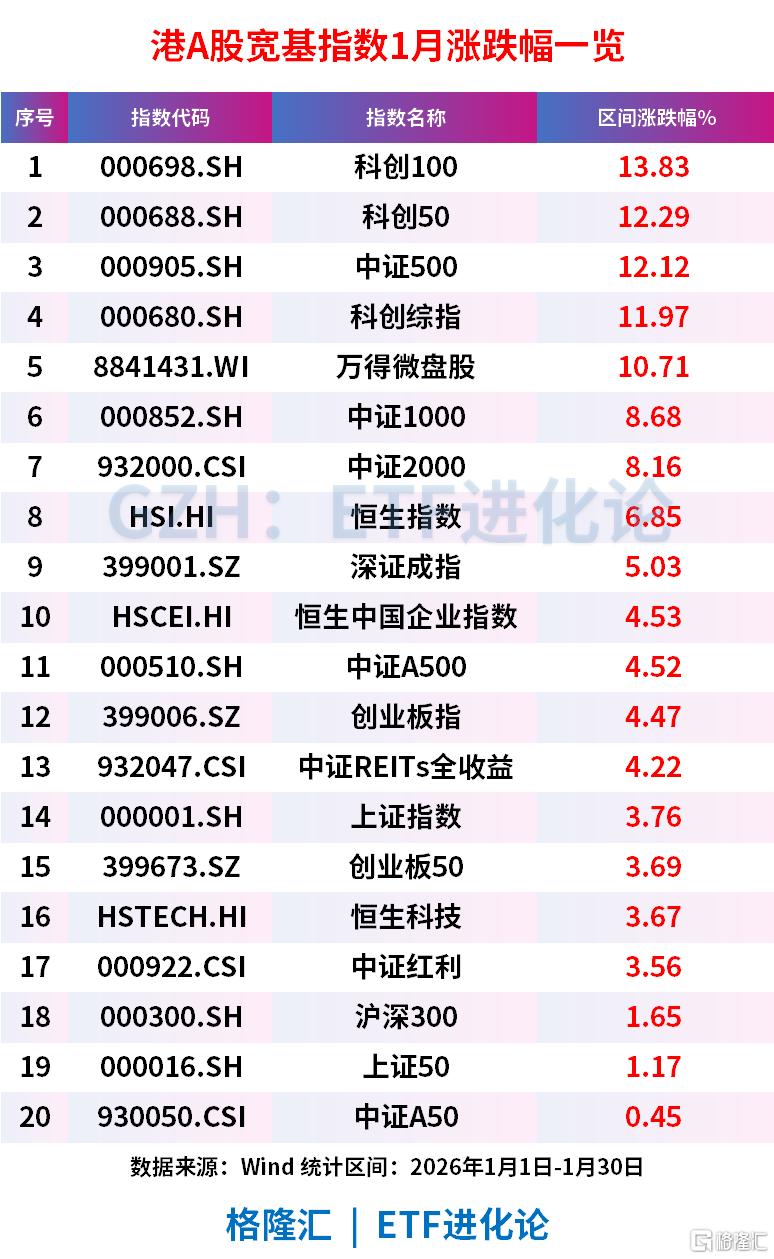
Core Viewpoint - The last trading day of January saw a significant market drop, primarily driven by the sharp decline in the metals sector, leading to the largest single-day drop in the index since 2026, with the Shanghai Composite Index falling by 2% at one point before closing down 0.96% [1] Market Performance - In January, growth-oriented indices performed well, with the Sci-Tech 100, Sci-Tech 50, and CSI 500 rising by 13.83%, 12.29%, and 12.12% respectively [1][3] - Blue-chip indices showed relatively weaker performance, with the CSI A50 and Shanghai 50 increasing by only 0.45% and 1.17% respectively [1][4] ETF Performance - The top ten core ETFs in January recorded a 6.51% increase, outperforming the CSI 300 index by 4.86 percentage points [6] - The metals ETF was the best performer, rising by 21.38% in January, with significant net inflows of 172.45 billion yuan [7] - The chip ETF and chemical ETF also performed well, increasing by 18.06% and 11.41% respectively [6] Metals Sector Insights - The metals sector experienced a comprehensive surge, with precious metals reaching historical highs and industrial metals also seeing significant price increases [7] - Key factors driving this performance include supply constraints, demand from AI and renewable energy sectors, geopolitical tensions increasing safe-haven demand, macro liquidity easing, and sustained central bank gold purchases [8] Chemical Sector Insights - The chemical sector showed strong performance in January, with the chemical ETF rising by 11% [9] - The sector's growth is attributed to a combination of supply-side adjustments, demand shifts, and macroeconomic conditions, indicating a transition to a new cycle of value reassessment [10] - Policies aimed at curbing excessive capacity expansion and promoting high-quality growth are expected to support the sector's recovery [10]
有色板块大跌,把握后续低吸机会
Mei Ri Jing Ji Xin Wen· 2026-01-30 09:37
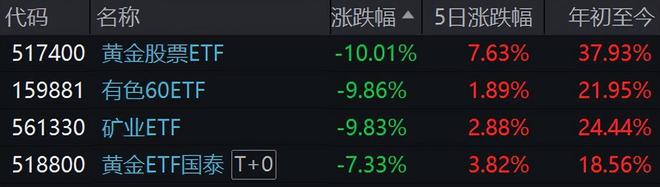
Core Viewpoint - The recent significant decline in various ETFs related to gold and metals is attributed to a retreat in global macro sentiment, leading to sharp price fluctuations in gold and silver [1][3] ETF Performance Summary - Gold Stock ETF (517400) decreased by 10.01% with a year-to-date increase of 37.93% - Nonferrous 60 ETF (159881) fell by 9.86% with a year-to-date increase of 21.95% - Mining ETF (561330) dropped by 9.83% with a year-to-date increase of 24.44% - Gold ETF Guotai (518800) declined by 7.33% with a year-to-date increase of 18.56% [1] Price Fluctuation Analysis - Spot gold experienced a daily fluctuation of nearly $500, closing at $5,377.16 per ounce after a V-shaped recovery [1] - Spot silver also exhibited significant volatility during the same period [1] Market Sentiment and Investor Behavior - The market is witnessing a shift in sentiment, with some investors comparing gold and silver to "internet stocks," indicating a speculative rather than value-storing approach [3] - The increase in margin requirements for gold futures by the CME has dampened short-term bullish sentiment among leveraged investors [3] Long-term Outlook for Gold - The long-term outlook for gold remains strong, supported by its financial attributes and the ongoing trend of de-dollarization [4][5] - Central banks globally continue to increase their gold reserves, with notable increases from countries like China and Poland [5] Geopolitical Risks and Market Dynamics - Rising geopolitical risks in the Middle East are expected to sustain market demand for safe-haven assets like gold [6] - The upcoming Chinese New Year may lead to liquidity concerns, potentially increasing market volatility [6] Investment Recommendations - Investors are advised to consider long-term investment opportunities in gold-related ETFs, particularly the Gold ETF Guotai (518800) and Gold Stock ETF (517400) for potential valuation recovery [7][8]
贵金属周报:流动性扰动贵金属短期波动加剧,谨防大幅回调风险-20260130
Guang Fa Qi Huo· 2026-01-30 09:14
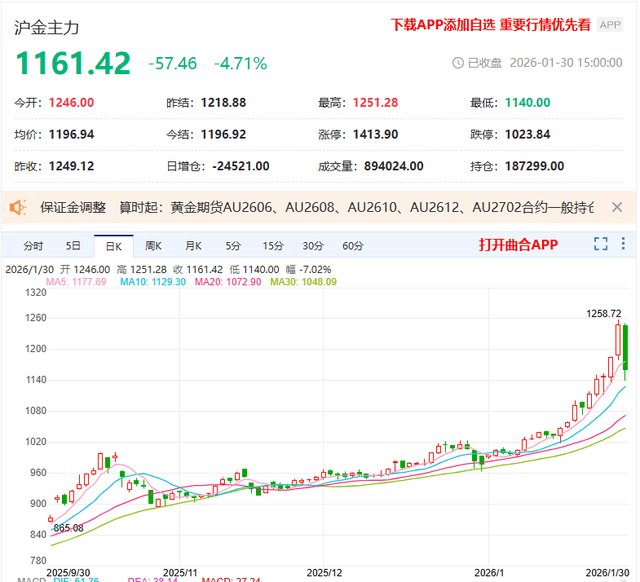
Report Industry Investment Rating - Not provided Core Viewpoints - In the short term, due to the approaching Spring Festival holiday in February, market sentiment may be more cautious, and capital reduction may bring correction pressure. Geopolitical situations in the Middle East and South America, the announcement of the Fed Chair candidate, and the release of US economic data may cause uncertainty in precious metals. With reduced liquidity, market fluctuations may be more intense, and investors are advised to operate cautiously and use options to protect long - position profits. In the long term, although the Fed's monetary policy is short - term cautious, the long - term easing expectation remains unchanged. Trade frictions, geopolitical risks, and the "de - dollarization" trend will support the price of precious metals [7][10]. Summary by Related Catalogs Market Performance - This week, driven by macro - geopolitical concerns and capital sentiment, precious metal prices rose significantly. However, due to tightened market liquidity caused by US stock fluctuations, concentrated long - position stop - profits led to a sharp short - term decline in precious metals. On Friday, the main contract of Shanghai gold AU2604 ended its "five - consecutive - day rise" with a 4.71% drop, and the main contract of Shanghai silver AG2604 dropped 6.03%. Platinum and palladium futures were more affected by the decline in commodity and stock markets, with the main contract PT2606 dropping 11.79% and PD2606 dropping 11.87% [1]. Driving Factors Impact of US Stock Market - The release of Q4 2025 earnings reports of US technology companies showed that Microsoft's large AI capital expenditure without corresponding business growth led to concerns about the mismatch between high valuations and investment returns. Its stock price dropped over 10% on Thursday, with a market value loss of $420 billion. This triggered a chain reaction in the financial market, causing a general decline in US stocks. Precious metals and other commodities experienced a "flash crash" due to concentrated long - position stop - profits. International gold prices dropped over 8% and international silver prices dropped over 12% [2]. Physical Delivery and Supply - The previous sharp rise in silver prices was related to the tight physical supply. The industrial and investment demand for silver increased, causing the visible inventories in New York and Shanghai to reach new lows. However, after the COMEX silver January contract expired with a 50 - million - ounce physical delivery on Thursday, the delivery demand for the February contract decreased. In the London spot market, the silver ETF holdings decreased, and the market lending rate dropped to a recent low, indicating a temporary withdrawal of long - position forces. In China, the silver inventories in the two Shanghai exchanges continued to decline, with the SHFE silver inventory decreasing by 26.4 tons on Friday, reaching a new low in over 10 years [5]. Market Outlook - In 2025, global gold demand reached a record high of 5002 tons, with investment demand becoming the largest source. Central bank gold purchases slowed down by one - fifth to 863 tons, while investment demand increased by 84% to 2175 tons. Gold ETF holdings increased by 801 tons, and the purchase of gold bars and coins rose by 16% to 1374 tons, a 12 - year high [7].
银河期货铂镍月报-20260130
Yin He Qi Huo· 2026-01-30 08:59
| S | | --- | | 第一部分 前言概要 2 | | | --- | --- | | 【行情回顾】 2 | | | 2 | | | 【市场展望】 | 2 | | 【策略推荐】 2 | | | 第二部分 行情复盘 3 | | | 一、行情回顾 | 3 | | 第三部分 宏观面因素 5 | | | 一、美元指数弱势表现或有转向 5 | | | 第四部分 基本面情况 6 | | | 一、铂、钯基本面 | 6 | | (一)铂钯供需平衡 | 6 | | (二)铂金、钯金原生供应弹性有限,回收供应将有趋势增长 8 | | | (四)铂金、钯金需求 | 12 | | 免责声明 | 15 | 有色板块研发报告 铂钯月报 2026 年 1 月 30 日 情绪遇冷后行情盘整 基本面强弱格局依旧 第一部分 前言概要 【行情回顾】 2026 年 1 月,铂钯价格主要受宏观情绪、地缘风险与产业预期三重 因素驱动,逻辑主线清晰。美国宏观数据的坚韧没能带动美元的走强, 地缘危机和特朗普政府的言论导致贵金属板块集体获得强劲的避险与 "去美元化"买盘推动。基本面而言,铂金处于结构性短缺格局,表现 坚挺;钯金则因需求疲软面临过剩压力 ...
太刺激了,黄金过山车
Sou Hu Cai Jing· 2026-01-30 08:48
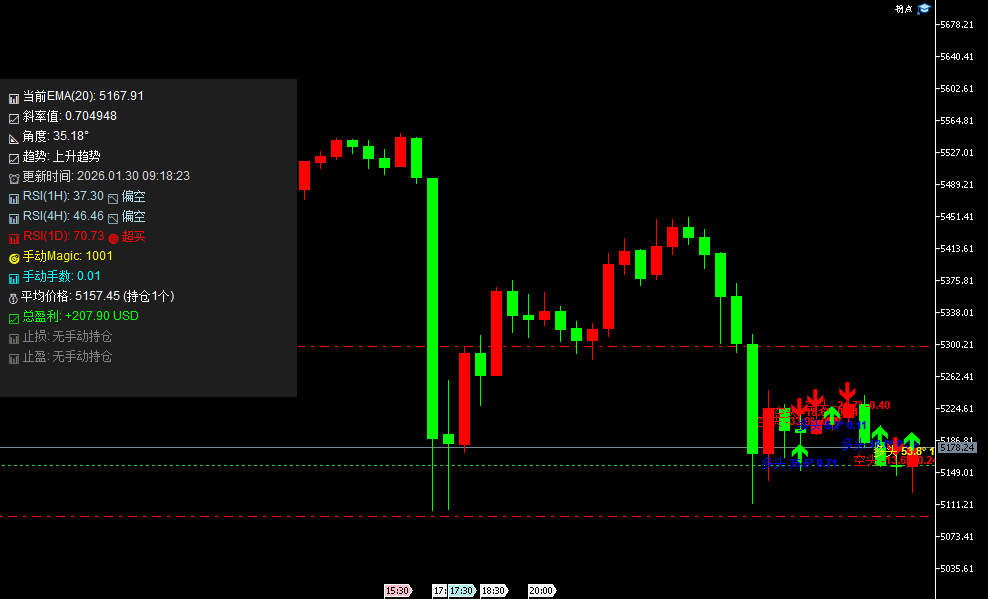
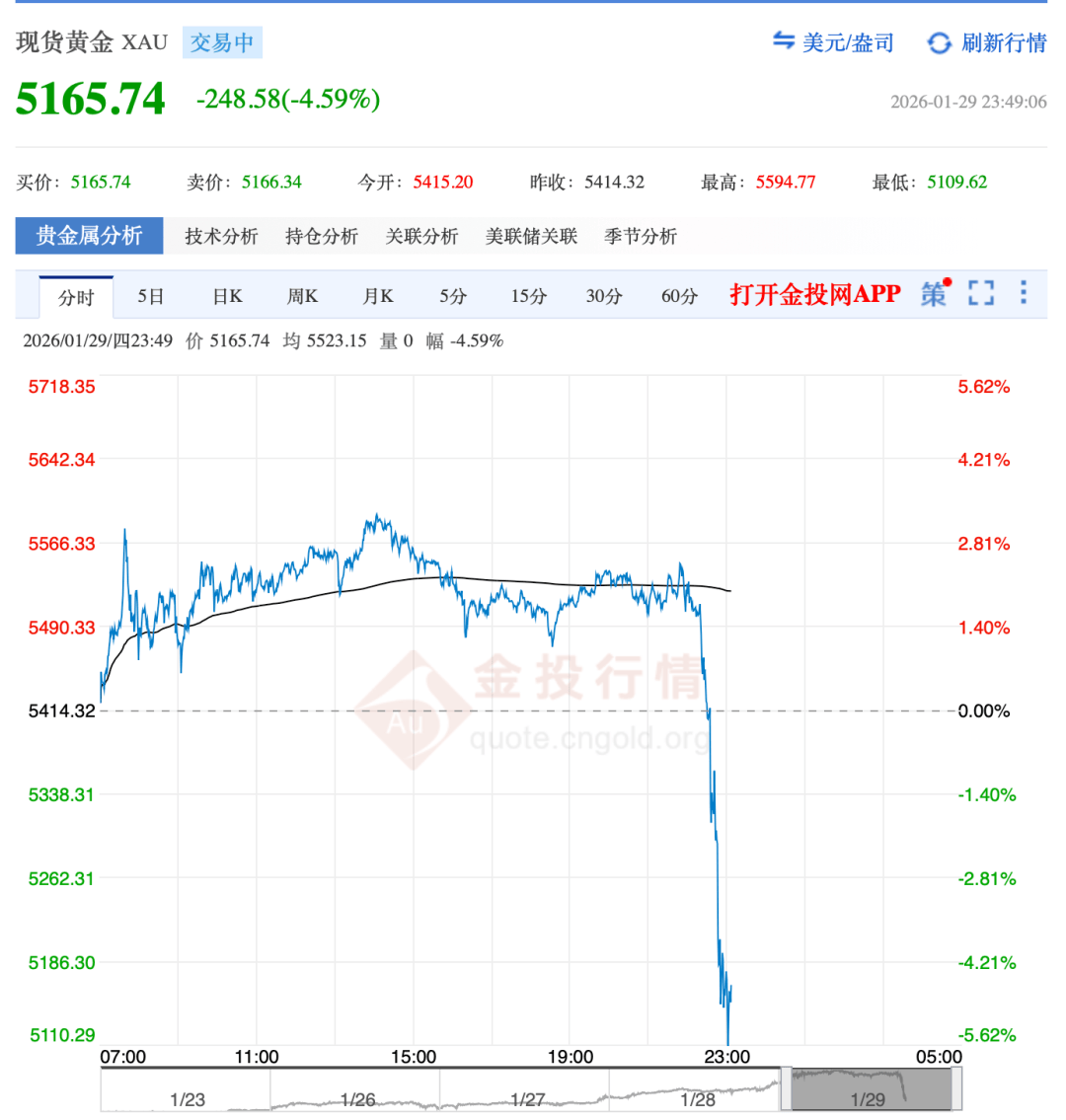
真的太刺激了,黄金昨天白天暴涨,飙到5700美元,晚上暴跌,跌至5100美元,这种过山车的行情,心 脏真是受不了,钱包也受不了。有人白天买了1万块钱的黄金,晚上就亏了3000块钱,这不妥妥的庄家 收割行情嘛。 不过,华尔街仍然还是高喊看涨。 瑞银集团公开表示,把今年前三季度黄金价格预期上调至每盎司6200美元,到2026年底预计回落至5900 美元,另外,金价最多可能达到7200美元。 短期来看,金银当前处于高波动状态,价格整体呈现宽幅震荡。从宏观和基本面来看,美联储货币政策 宽松利率回落的趋势并未发生改变,中长期包括主权国家赤字问题、地缘风险以及去美元化驱动的央行 购金等因素并未改变,白银的供需矛盾也持续存在,贵金属价格的长期核心驱动因素仍保持稳健。 期货公司观点 广发期货: 当前数据显示美国就业和通胀持续放缓但部分领域在美联储降息提振下有所改善,尽管美联储未来在衡 量就业的通胀目标问题上仍有分歧短期趋于谨慎,但贸易摩擦和地缘风险的担忧驱动资金提前配置使金 价中长期上涨空间,在全球主流机构持续上调贵金属价格预测的情况下,部分机构投资者选择提前"抢 跑"配置贵金属,对价格形成支撑。市场或将更多受到美国经济数据 ...
香港第一金:黄金上演500美元“过山车”!历史高位巨震后何去何从?
Sou Hu Cai Jing· 2026-01-30 07:33
Core Viewpoint - The gold market is at a critical juncture, experiencing extreme volatility after a significant price fluctuation, with current trading between $5100 and $5400 per ounce, down from nearly $5600, indicating a crossroads between long-term narratives and short-term volatility [2] Long-term Support Factors - Iran's announcement of live-fire military exercises in the Strait of Hormuz continues to escalate tensions in the Middle East, which is a core source of risk-averse sentiment [2] - President Trump is expected to announce a new Federal Reserve chair next week and has called for significant interest rate cuts, raising concerns about the Fed's independence and expectations for future easing, which has weakened the dollar and supported gold prices [2] - The World Gold Council reported that global central banks purchased a net 230 tons of gold in Q4 last year, with demand expected to continue into 2026; UBS has raised its gold price target significantly to $6200 per ounce [2] Short-term Risk Factors - The recent price fluctuation of nearly $500 and significant year-to-date gains indicate that the market is severely overbought, with any minor disturbance potentially triggering profit-taking [2] - To manage risk, the CME has raised margin requirements for gold futures, and similar measures have been adopted by domestic institutions like the Shanghai Futures Exchange, increasing trading costs and suppressing short-term speculation [2] - The current price surge has exceeded fundamental support, leading to a market dominated by uncertainty, which could result in a "long squeeze" scenario [2] Market Analysis - Following the recent volatility, the market requires consolidation to find a new balance [2] - Current trading range is between $5100 and $5400, with short-term resistance at $5500-$5550 and historical resistance at $5600; key support is at $5316 [3] - The core trend support levels are at $5183 and $5000, with a significant bearish signal indicating a loss of upward momentum, suggesting a high-level consolidation phase [4] Personal Strategy - A potential buying opportunity may arise if gold prices pull back to the $5130-$5150 range, targeting $5230-$5300-$5400; conversely, if prices rise to around $5400, a selling opportunity may be considered, targeting $5300-$5200 [4] - The long-term bullish foundation for gold remains intact, driven by de-dollarization and credit reassessment, but the short-term market is currently characterized by extreme volatility driven by emotions and leverage [4]