地缘政治风险

Search documents
金价飙升至历史新高,突破每盎司4700美元
Shang Wu Bu Wang Zhan· 2026-01-21 15:36
当前,美欧关系趋紧引发对潜在贸易战的担忧,持续影响投资者对这一贵金属的避险需求。金价在2025 年初始于每盎司2640美元左右,至2025年4月已攀升至3200美元。随后价格保持平稳直至8月底,继而再 度上扬,并在10月中旬突破4300美元关口。 目前全球主要黄金生产国包括中国、澳大利亚、美国、南非、秘鲁、俄罗斯和印度尼西亚。 据"加纳网"1月20日报道,受地缘政治风险及美联储降息预期影响,国际黄金价格在2026年开年持续走 强,并于1月20日突破每盎司4700美元,创历史新高。 2026年前20个交易日,黄金涨幅已达9.5%。自特朗普一年前开启第二任期以来,金价累计上涨超过 70%。同期,白银在2026年前两周上涨约20%,收益表现显著优于往年。 (原标题:金价飙升至历史新高,突破每盎司4700美元) ...
黄金冲破4800美元:世界正在用真金白银投票
Sou Hu Cai Jing· 2026-01-21 13:38
根据证券时报报道,现货黄金首次突破4800美元/盎司整数关口。这一价格在此后的交易时段持续攀升,截至21日下午,现货黄金已接近4880美元/盎司, 日内涨幅达2.45%。 与此相呼应的是,COMEX黄金期货价格同步上涨,盘中最高触及4880.9美元。 格陵兰危机 黄金本轮上涨的直接催化剂已清晰显现。东方金诚研究发展部高级副总监瞿瑞分析认为,近日金价再创新高主要源于围绕格陵兰岛争端引发的美欧贸易冲 突。 现货黄金在1月21日站上4800美元/盎司,盘中最高触及4854美元/盎司。截至当天下午,价格继续攀升至4879.454美元/盎司,日内涨幅扩大到2.45%。 黄金价格的飙升已将国内多家品牌金饰价格推至接近每克1500元的历史高位。 历史时刻 1月21日,全球资本市场的目光聚焦在了一组数据上。黄金价格自上周连续上涨后,于今日再次刷新历史纪录。 上周末,美国总统特朗普宣布将从2月1日起对丹麦等八个欧洲国家加征关税,直到相关方就美国"全面、彻底购买格陵兰岛"达成协议。欧盟随后准备对价 值约1080亿美元的美国商品征收报复性关税。 这场围绕格陵兰岛引发的贸易冲突被市场视为可能对双方经济造成重大冲击的地缘政治风险事件, ...

黄金强势突破4700美元历史高位!避险情绪升温,投资者该怎么上车更稳?
Sou Hu Cai Jing· 2026-01-21 12:54
Group 1 - The core viewpoint is that gold prices have surged to historical highs, driven by three main factors: expectations of interest rate cuts by the Federal Reserve, continuous gold purchases by global central banks, and rising geopolitical risks [3][4][5] Group 2 - The first driving force is the increasing expectation of interest rate cuts by the Federal Reserve, which diminishes the attractiveness of the dollar and leads to a natural flow of funds into gold as a risk-averse asset [3] - The second driving force is the sustained high levels of gold purchases by central banks over the past two years, treating gold as a strategic reserve, which supports the market and instills confidence [4] - The third driving force is the escalation of geopolitical risks, which heightens uncertainty and boosts safe-haven sentiment, making gold a preferred asset during unstable times [5] Group 3 - Historical patterns indicate that greater risks lead to stronger gold performance, as seen during the 2008 financial crisis and the 2020 pandemic, where economic turmoil and liquidity easing resulted in significant gold price increases [7] Group 4 - Ordinary investors have three main ways to participate in the gold market: bank gold accumulation, which has lower fees and moderate liquidity; gold ETFs, which are cost-effective and highly liquid; and physical gold bars, which have slightly higher premiums and lower liquidity [9] Group 5 - Practical advice for entering the gold market includes building positions gradually due to price fluctuations, setting profit-taking and stop-loss levels, and maintaining a long-term perspective as gold is more suitable for asset allocation rather than short-term trading [11]
每日核心期货品种分析-20260121
Guan Tong Qi Huo· 2026-01-21 12:53
Report Summary 1. Report Industry Investment Rating No relevant information provided. 2. Core Viewpoints - The domestic futures market showed mixed performance on January 21, 2026, with some commodities rising and others falling. Different commodities have different supply - demand situations and price trends affected by various factors such as policies, geopolitical events, and seasonal factors [5][6]. 3. Summary by Commodity Metals - **Copper**: Prices showed a pattern of opening low and closing high. In 2026, smelter profits have narrowed, and the supply of refined copper is expected to decline in January. The downstream demand is weak, but policy subsidies and the New Year peak season may improve the situation. The increase in copper prices before the Spring Festival is limited without significant positive stimuli [8]. - **Carbonate Lithium**: Prices opened low and went high, showing an overall upward trend. The exchange adjusted the trading rules. Although the fundamentals are weakening, the demand for energy - storage batteries is still strong. With the expected resumption of production and strong export demand, the strong trend continues [10]. - **Stainless Steel and Platinum**: Rose more than 2% on January 21, but no detailed analysis provided in the report [5]. - **Gold and Silver**: Gold futures had significant capital inflows, while silver futures had capital outflows. Gold prices rose more than 3% on January 21 [5][6]. - **Tin**: Rose more than 5% on January 21, but no detailed analysis provided in the report [5]. Energy - **Crude Oil**: OPEC+ decided to maintain the production plan, and the US crude inventory increased. Although the demand concern has eased, the global crude oil supply is still in a surplus situation. Geopolitical risks such as the situations in Iran and Venezuela need to be monitored, and the price is expected to fluctuate [11][13]. - **Asphalt**: The supply is at a relatively low level, and the demand is affected by factors such as weather and funds. The situation in Venezuela may affect the raw material supply of domestic refineries. The price is expected to fluctuate, and it is recommended to use reverse arbitrage [14]. Chemicals - **PP**: The downstream开工率 is at a relatively low level, and the supply has increased with new capacity. The cost has decreased due to the easing of the Iranian situation. The supply - demand pattern improvement is limited, and it is expected to fluctuate weakly. The L - PP spread is expected to narrow [15]. - **Plastic**: The开工率 is at a relatively high level, but the downstream demand is weak, especially for agricultural films. With new capacity coming on - stream, it is expected to fluctuate weakly, and the L - PP spread is expected to narrow [16][18]. - **PVC**: The supply is relatively stable, but the downstream demand is weak. The export situation is affected by the cancellation of export tax rebates. The inventory is high, and the price is expected to fluctuate strongly in the 03 - 05 contracts [19]. - **Urea**: The price opened high and went high. The supply is stable, and the demand from agriculture and compound fertilizer factories is increasing. The inventory is decreasing, and the price is expected to be easy to rise and difficult to fall [22]. Others - **Coking Coal**: The supply has increased, and the inventory has shifted from upstream to downstream. The downstream demand is mainly supported by winter storage. The price is expected to fluctuate [20][21]. - **Futures Index Contracts**: The performance of stock index futures and bond futures varied. The IF and IC and IM contracts rose, while the IH contract fell slightly. Among bond futures, the TS contract fell slightly, and the TF, T, and TL contracts rose [6].
今日1月20日:金价冲到4600美元,2026年或重演15年规律,该买还是等?
Sou Hu Cai Jing· 2026-01-21 11:36
Core Viewpoint - The current surge in gold prices, reaching $4600 per ounce, is driven by central banks accumulating gold at an unprecedented rate, contrasting with the speculative behavior of retail investors seen in the past [1][3][5]. Group 1: Historical Context - In 2011, gold prices peaked at $1920 per ounce due to quantitative easing and economic uncertainty, leading to a rapid rise followed by a significant decline as the Federal Reserve raised interest rates [3][5]. - The current gold price increase is influenced by similar factors such as anticipated interest rate cuts and geopolitical tensions, but the driving force is now central banks rather than retail investors [5][6]. Group 2: Central Bank Activity - Central banks, including the People's Bank of China, have been consistently increasing their gold reserves, with China adding approximately 38 tons in December 2025, marking 14 consecutive months of accumulation [5][6]. - In the third quarter of 2025, global central banks purchased over 370 tons of gold, the highest recorded for that period, indicating a strategic long-term trend rather than a short-term reaction [5][6]. Group 3: Market Dynamics - The current market dynamics show a strong, sustained demand for gold driven by central banks, providing a "safety net" for gold prices, unlike the previous speculative-driven market [8]. - The relationship between gold prices and U.S. interest rates remains significant, with expectations of further rate cuts in 2026 potentially enhancing gold's attractiveness as a low-cost asset [8][9]. Group 4: Geopolitical and Economic Factors - Ongoing geopolitical conflicts, particularly in the Middle East, contribute to a persistent demand for gold as a safe-haven asset, appealing to both institutional and individual investors [9][11]. - Concerns about inflation and the volatility of commodity prices further solidify gold's position as a hedge against economic uncertainty [11]. Group 5: Investment Strategies - For individual investors, purchasing gold jewelry may not be the best investment strategy due to high premiums; instead, gold ETFs are recommended for their liquidity and lower costs [11][12]. - Investment in physical gold bars should focus on minimizing additional costs, avoiding high-priced collectible items, and ensuring proximity to market prices [12][13]. - Caution is advised against high-leverage gold futures and dubious online investment schemes, which pose significant risks [13][15]. Group 6: Long-term Perspective - Historical patterns indicate that many investors have lost money in gold due to poor timing and emotional trading; a more strategic, planned approach is essential for successful investment [16]. - Gold should be viewed as a stabilizing asset within a diversified portfolio, rather than a primary wealth-building tool, with recommended allocations not exceeding 30% of total assets [15][16].

山金期货贵金属策略报告-20260121
Shan Jin Qi Huo· 2026-01-21 11:19
Report Investment Rating - No investment rating for the industry is provided in the report. Core Viewpoints - The short - term safe - haven situation has changed with the decline of trade - war safe - haven demand and the rise of geopolitical risks. The weakening US employment and moderate inflation still support the expectation of interest rate cuts. [1] - The geopolitical risks have increased due to Trump's statement on the Greenland issue and the strong responses from European countries. [1] - In terms of the monetary attribute, the US December CPI increase met expectations, but household food and rent expenditures rose. The US December employment growth almost stagnated, and the unemployment rate decline alleviated concerns about the deterioration of the labor market. The market expects the Fed not to cut interest rates in January 2026 with a probability of around 95%, and the next possible rate cut may be in June. [1] - Regarding the commodity attribute, the Polish central bank plans to buy up to 150 tons of gold. Silver is supported by tight supply. Platinum has strong demand expectations for platinum - based catalysts in the hydrogen energy industry. Palladium has short - term demand resilience but faces long - term structural pressure in the fuel - vehicle market. [1] - It is expected that precious metals will show short - term volatile strength, medium - term high - level volatility, and long - term step - up trends. [1] Summary by Related Catalogs Gold - Strategy: Conservative investors should wait and see, while aggressive investors can buy on dips. Good position management and strict stop - loss and take - profit are recommended. [2] - Price: Comex gold active contract closed at $4769.10 per ounce, up 3.65% from the previous day and 3.80% from the previous week. London gold was at $4747.80 per ounce, up 1.73% from the previous day and 2.70% from the previous week. [2] - Position and Inventory: Comex gold position was 527,455 hands, up 9.46% from the previous week. LBMA gold inventory was 8598 tons, unchanged from the previous week. [2] Silver - Strategy: Conservative investors should wait and see, while aggressive investors can buy low and sell high. Good position management and strict stop - loss and take - profit are recommended. [4] - Price: Comex silver active contract closed at $89.95 per ounce, up 5.63% from the previous week. London silver was at $93.01 per ounce, up 2.43% from the previous day and 10.63% from the previous week. [4] - Position and Inventory: Comex silver position was 151,513 hands, down 1.13% from the previous week. The total visible inventory was 42,214 tons, down 0.90% from the previous week. [4] Platinum - Strategy: Conservative investors should wait and see, while aggressive investors can buy low and sell high. Good position management and strict stop - loss and take - profit are recommended. [6] - Price: NYMEX platinum active contract closed at $2272.90 per ounce, down 2.03% from the previous day but up 17.68% from the previous week. The platinum main contract on the GQEX closed at 686.95 yuan per gram, up 4.46% from the previous day and 26.60% from the previous week. [7] - Position and Inventory: NYMEX platinum active contract position was 18,095 hands, down 32.56% from the previous day and 21.89% from the previous week. NYMEX platinum total inventory was 21 tons, up 4.80% from the previous week. [7] Palladium - Strategy: Conservative investors should wait and see, while aggressive investors can buy low and sell high. Good position management and strict stop - loss and take - profit are recommended. [10] - Price: NYMEX palladium active contract closed at $1821.00 per ounce, down 7.28% from the previous day but up 5.57% from the previous week. The palladium main contract on the GQEX closed at 529.05 yuan per gram, down 8.54% from the previous day but up 11.01% from the previous week. [10] - Position and Inventory: NYMEX palladium active contract position was 21,860 hands, up 0.86% from the previous day and 2.30% from the previous week. NYMEX palladium total inventory was 6 tons, up 3.49% from the previous week. [10] Key Fundamental Data of Precious Metals - Fed Indicators: The upper limit of the federal funds target rate is 3.75%, down 0.25% from the previous value. The Fed's total assets are $6632.72 billion, up 0.00% from the previous value. [11] - US Economic Indicators: GDP annualized year - on - year growth rate is 2.30%, up 0.30% from the previous value; annualized quarter - on - quarter growth rate is 4.30%, up 0.50% from the previous value. [11] - Geopolitical and Market Indicators: The geopolitical risk index is 295.76, up 62.59% from the previous day and 86.38% from the previous week. The VIX index is 20.09, up 6.63% from the previous day and 25.72% from the previous week. [13]


全球狂飙,机构集体强烈看涨
Ge Long Hui· 2026-01-21 10:19
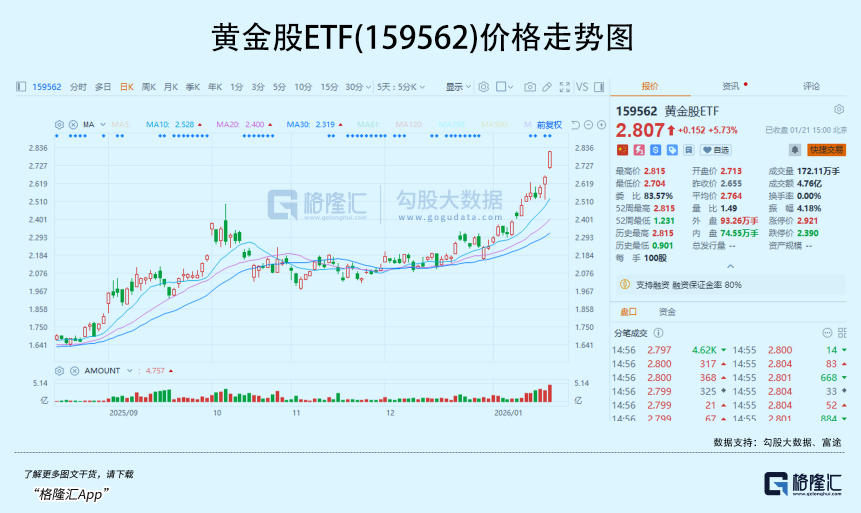
Group 1 - The international gold market has experienced an unexpected strong rally since the beginning of 2026, with gold prices rising from $4,340 per ounce to a historical peak of $4,891.1 per ounce, marking a cumulative increase of 12.7% in less than 20 days [1] - Domestic gold futures also surged, with the main contract price rising by 4.61% to surpass 1,100 yuan per gram [1] - Gold stocks have seen a significant increase, with over ten gold stocks, including Zhaojin Mining and Chifeng Jilong Gold Mining, hitting the daily limit [2] Group 2 - The gold ETF (159562) rose by 5.73% today, with a cumulative increase of 25.82% over the past 13 trading days, reaching a new historical high [3] - The market is increasingly optimistic about gold prices reaching the previously considered unattainable $5,000 per ounce mark, as institutions frequently adjust their target prices upward [5] Group 3 - The surge in gold prices is driven by multiple factors, including geopolitical risks, monetary policy, central bank allocations, and the reconstruction of dollar credit [7] - Recent geopolitical tensions, particularly the U.S. trade actions against Denmark and other countries, have led to a significant influx of safe-haven investments into gold [8] - Denmark's announcement to sell approximately $1 billion in U.S. Treasury bonds marks a significant move in the context of escalating geopolitical tensions [9] Group 4 - Historical data shows a significant upward trend in gold prices during Trump's presidency, with prices rising from approximately $1,204 per ounce at his inauguration in January 2017 to about $4,880 per ounce by January 2026, reflecting a cumulative increase of 78.75% [10] - The acceleration of U.S. debt has raised concerns about the potential risks associated with dollar reserves, prompting central banks globally to increase their gold holdings [12] Group 5 - The global demand for gold bars and coins increased by 18% year-on-year in 2025, reaching 1,250 tons, the highest since 2011 [17] - China's gold market ETF saw a net inflow of approximately 118 billion yuan (about 190 tons) in 2025, accounting for 26.6% of global gold ETF inflows [18] Group 6 - Institutions are increasingly optimistic about the future performance of gold, with several major financial institutions raising their target prices for gold significantly [21] - Goldman Sachs has raised its end-of-2026 gold price forecast from $4,300 to $4,900 per ounce, citing structural central bank purchases and expected interest rate cuts as key support factors [21] - Domestic institutions also share a positive outlook, with predictions for gold prices to reach around $4,950 to $5,000 per ounce [22]




银河期货沥青日报-20260121
Yin He Qi Huo· 2026-01-21 09:58
研究所 沥青研发报告 沥青日报 2026 年 01 月 21 日 沥青日报 | | | 第一部分 | 相关数据 | | | | --- | --- | --- | --- | --- | --- | | | 名称 | 2026/01/20 | 2026/01/19 | 涨跌 | 涨跌幅 | | | | 期货价格与持仓 | | | | | | BU2603(主力) | 3139 | 3142 | -3 | -0.10% | | 研究员: | BU2604 | 3152 | 3151 | 1 | 0.03% | | 吴晓蓉 | BU2605 | 3153 | 3082 | 71 | 2.30% | | 期货从业证号: | SC2603 | 437.0 | 437.4 | -0.4 | -0.09% | | F03108405 | Brent首行 | 63.27 | 63.82 | -0.5 | -0.86% | | 投资咨询从业证号: | 主力合约持仓/万手 | 19.1 | 19.2 | -0.1 | -0.51% | | Z0021537 : 021-65789108 | 主力合约成交/万手 | 11.9 ...
1月21日上期所沪金期货仓单较上一日持平
Jin Tou Wang· 2026-01-21 08:06
Core Viewpoint - The Shanghai Futures Exchange reported stable gold futures inventory, with increased demand for gold driven by geopolitical tensions and expectations of monetary easing by the Federal Reserve [1]. Group 1: Market Data - Total gold futures inventory at the Shanghai Futures Exchange is 99,990 kilograms, unchanged from the previous day [1]. - The opening price for gold futures was 1,063.00 CNY per gram, reaching a high of 1,101.92 CNY and a low of 1,060.10 CNY, with a current price of 1,092.30 CNY, reflecting a 3.69% increase [1]. - Trading volume was 350,273 contracts, with open interest at 207,266 contracts, and a daily increase in open interest of 21,302 contracts [1]. Group 2: Market Influences - Concerns over international trade and geopolitical risks have heightened, particularly due to the U.S. tariff policies regarding Greenland, leading to increased safe-haven demand for gold [1]. - Recent U.S. economic data has reinforced market expectations for two interest rate cuts by the Federal Reserve later this year, alongside concerns about the Fed's independence, which has bolstered expectations for a more accommodative monetary policy [1].
美国再现股债汇三杀,格陵兰关税引担忧
日经中文网· 2026-01-21 08:00
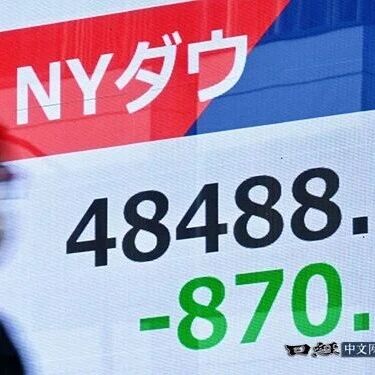
Core Viewpoint - The U.S. stock market experienced significant declines, with the Dow Jones Industrial Average dropping 870 points to close at 48,488 on January 20, driven by geopolitical tensions and rising interest rates [2][4]. Group 1: Market Performance - On January 20, the Dow Jones Industrial Average fell by 870 points, marking a significant drop from the previous weekend [2]. - The market saw a decline of over 900 points during the day, reaching a new low not seen in two days, with major companies like Nvidia, Amazon, and 3M experiencing substantial losses [5]. - The VIX, known as the "fear index," rose to the 20 range, reaching its highest level since November 2025, indicating increased market volatility [5]. Group 2: Interest Rates and Currency - The 10-year U.S. Treasury yield increased by 0.09% to 4.31%, reflecting upward pressure on bond prices [6]. - The U.S. dollar index fell by over 1% compared to the previous weekend, contrasting with the decline in U.S. asset prices [6]. Group 3: Geopolitical Factors - President Trump announced plans to impose tariffs on eight European countries until the U.S. secures Greenland, leading to heightened geopolitical risks and a sell-off in stocks [2]. - European responses to the tariff announcements were negative, contributing to market uncertainty [2]. Group 4: Commodity Trends - In contrast to the declining asset prices, gold saw increased buying interest, with New York futures prices rising to the $4,770 range, up approximately 4% from the previous trading day [6]. Group 5: Investment Recommendations - UBS Global Wealth Management suggested that despite short-term volatility risks, global stock markets may rise, recommending that investors with low stock ratios consider increasing their investments [6].