美联储降息

Search documents
黄金涨上天,最大的受害者出现了,现在还能接盘吗?
Sou Hu Cai Jing· 2025-10-23 01:05
Core Viewpoint - The recent surge in gold prices has been unprecedented, with prices rising from $3,300 to $4,300 per ounce in less than two months, marking an increase of over 30% [2]. Price Movement - Gold prices have increased by 66% this year and have doubled since the beginning of last year, with a staggering 168% rise compared to the starting point in October 2022 [2]. Impact on Consumers - The rising gold prices have significantly affected young couples planning to marry, with gold jewelry prices exceeding 1,200 yuan per gram. The cost of a 100-gram gold jewelry set has escalated from approximately 50,000 yuan three years ago to at least 120,000 yuan today [4]. Investment Perspectives - Long-term analysis suggests that while gold is a hard currency and a store of value, it is not an ideal long-term investment due to its historical tendency to underperform against inflation [6]. - In contrast, short-term analysis indicates that gold has strong explosive potential, with historical surges occurring during significant economic events [6]. Historical Context - The current gold price surge is compared to three previous significant increases: the 1970s post-Bretton Woods, the 2001-2011 surge following 9/11 and the subprime mortgage crisis, and the ongoing rise since October 2022 [6]. Underlying Causes - The primary reason for the current gold price increase is the Federal Reserve's interest rate cuts, although this alone does not fully explain the magnitude of the rise [8]. - A more direct cause is the increasing gold purchases by central banks, driven by a lack of trust in the current monetary system and a growing demand for safe-haven assets [10]. Market Sentiment - The decline in confidence in U.S. Treasury bonds, traditionally viewed as a safe asset, has led investors to seek alternatives like gold [11][13]. - The geopolitical landscape and increasing international competition have heightened the demand for gold as a hedge against uncertainty [13]. Future Outlook - The future of the gold market hinges on two critical factors: the trajectory of international relations and the market's trust in U.S. Treasury bonds [15]. - Short-term risks include potential profit-taking following significant price increases and the outcomes of upcoming U.S.-China trade negotiations [15].


美联储一降息,银行利息和金价都坐不住了!普通人的钱该往哪放?
Sou Hu Cai Jing· 2025-10-21 05:16
Core Viewpoint - The recent interest rate cut by the Federal Reserve has led to a significant increase in gold prices, reaching over $3,700 per ounce, prompting discussions about the implications for savings and investment strategies [1][3]. Group 1: Impact of Federal Reserve's Rate Cut - The Federal Reserve's decision to cut interest rates has resulted in lower deposit interest rates at banks, with some rates dropping from around 4% to just above 3% [3][5]. - The reduction in interest rates decreases the opportunity cost of holding gold, making it a more attractive investment option as it does not generate interest [5][6]. - A weaker dollar, resulting from the rate cut, increases the price of gold, which is priced in dollars, leading to higher demand for gold as a safe haven asset amid economic uncertainty [6][10]. Group 2: Market Reactions and Predictions - Experts suggest that the gold price may continue to rise due to the ongoing low interest rate environment, with predictions of a prolonged period of increasing gold prices [3][6]. - There is a cautionary note regarding the stock market, as the anticipated benefits from the rate cut may already be priced in, potentially leading to a "buy the rumor, sell the news" scenario [8]. - The relationship between the dollar, oil prices, and gold is highlighted, indicating that both the dollar's strength and oil prices are crucial factors influencing gold's market dynamics [10][11]. Group 3: Long-term Considerations - The ongoing geopolitical tensions and the actions of global central banks, such as China's continued accumulation of gold, suggest a growing concern over the stability of the dollar and its credit system [13][15]. - The potential for rising oil prices could alter the current dynamics, impacting the strength of the dollar and subsequently the price of gold [11][15]. - The overall uncertainty in the market prompts individuals to reconsider their investment strategies, weighing the safety of cash savings against the potential benefits of diversifying into gold or other assets [15].
美联储降息开启全球新周期,支付宝指数+平台成指数基金布局利器
Sou Hu Cai Jing· 2025-10-20 15:23
Core Viewpoint - The Federal Reserve's interest rate cuts have initiated a global easing cycle, creating new investment opportunities in the domestic market, with the potential for more flexible monetary policy tools from the central bank to maintain reasonable liquidity [1] Group 1: Investment Opportunities - The declining interest rate environment is favorable for the valuation of growth stocks, with indices like the Sci-Tech 50 and ChiNext expected to benefit [1] - Domestic policies aimed at stabilizing growth continue to support resilient sectors such as consumption and infrastructure [1] - The implementation of policies to expand service consumption is expected to boost new business models in digital services and smart consumption [1] Group 2: Investment Strategies - The Alipay Index Fund and its "Index+" platform provide intelligent and convenient tools for investors to allocate assets in the domestic market [1] - Investors can utilize index-based investment strategies to share in the economic transformation while effectively mitigating individual stock risks [2] - The dynamic optimization mechanism of index funds ensures that investors hold shares in the most representative quality companies [2] Group 3: Platform Advantages - The Alipay Index+ platform offers three main advantages: 1. One-click asset allocation to avoid individual stock risks, with historical data showing that tech growth sectors typically perform well post-Fed rate cuts [3] 2. Smart investment strategies that help smooth costs and manage short-term volatility through automatic adjustments [3] 3. Low fees and transparent operations enhance long-term returns, with management fees generally below 0.5% compared to 1.5% for active funds [5] Group 4: Market Context - The current domestic market is at a critical stage of transformation and upgrading, with the Alipay Index Fund covering numerous indices that represent China's economic development direction [1] - The comprehensive implementation of the registration system is expected to bring more quality enterprises to the A-share market [2] - The focus on index investment allows ordinary investors to participate in the growth of the technology sector as a whole rather than relying on individual companies [5]

美联储降息,港股流动性迎利好,港股通50ETF(159712)涨超2.3%
Sou Hu Cai Jing· 2025-10-20 05:32
Group 1 - The core viewpoint is that the Hong Kong stock market is experiencing liquidity easing due to the Federal Reserve's interest rate cuts, which may attract international capital to increase allocation in this market [1] - The logic behind this trend is the decline in global risk-free interest rates, leading to asset repricing and capital reallocation [1] - The Hong Kong stock market, as an offshore financial center for China, has a valuation level lower than most major global indices and is highly sensitive to global liquidity [1] Group 2 - Historical data indicates a correlation between foreign capital flow and the interest rate differential between China and the U.S. [1] - Currently, the proportion of foreign capital allocated to Chinese assets is at a historical low, suggesting that valuation gaps and improved policy expectations may drive a systematic return of foreign capital [1] - The Hong Kong Stock Connect 50 ETF (159712) tracks the Hong Kong Stock Connect 50 Index (930931), which selects 50 large-cap, liquid stocks from the Hong Kong market, covering both new economy and traditional industry leaders [1]
A股三季度哪些赛道表现比较好?四季度该如何布局?
Sou Hu Cai Jing· 2025-10-16 21:19
Core Viewpoint - The A-share market in Q3 2025 has seen a significant focus on technology and high-end manufacturing sectors, driven by the explosive growth of the AI hardware industry and favorable monetary policies [3][4]. Group 1: Market Trends - The technology and high-end manufacturing sectors, represented by communications, electronics, power equipment, and non-ferrous metals, have become the focal point for capital [3]. - The AI hardware industry, including chips and servers, has experienced explosive growth, attracting significant investment [3]. - The banking sector has seen a decline of 10.19%, marking it as the only industry to fall in Q3, while traditional sectors like real estate and consumer goods have shown weak performance [3]. Group 2: Q4 Strategy Shifts - There is a consensus that technology growth will continue in Q4, but caution is advised regarding high trading congestion leading to volatility [4]. - Internal theme shifts within the technology sector are expected, with a focus on upstream computing hardware and downstream applications like AI in healthcare and intelligent driving [4][5]. - The "anti-involution" and cyclical resonance strategies are highlighted, with supply-side optimization in chemicals and machinery benefiting from global manufacturing recovery [5]. Group 3: Defensive Asset Allocation - The CSI Dividend Index offers a yield exceeding 4%, with sectors like electricity and coal providing bond-like attributes during a declining interest rate cycle [6]. - Historical data suggests that low-valuation dividend strategies have a high success rate in Q4 [6]. Group 4: Dynamic Strategy - A balanced approach is recommended, focusing on AI applications, robotics, and innovative pharmaceuticals while being cautious of overheating in computing hardware [8]. - The "dumbbell strategy" emphasizes selecting cyclical stocks with rigid supply and improving demand, alongside consumer stocks benefiting from the "anti-involution" trend [9]. Group 5: Policy Catalysts - Expectations around the "14th Five-Year Plan" may highlight new themes such as digital economy and elderly care, potentially driving market focus [10]. - Continued interest rate cuts by the Federal Reserve could provide further opportunities for technology and precious metals in the Hong Kong market [11].

创新药出海产业周期+海外流动性宽松周期,四季度恒生创新药ETF(159316)配置机遇备受关注
Sou Hu Cai Jing· 2025-10-16 02:25
Group 1 - The total amount of contracts for Chinese innovative drug patents going overseas exceeded $100 billion from January to September, representing a year-on-year increase of 170% [1] - A series of overseas pharmaceutical academic conferences will be held in October and November, including the ESMO conference in Berlin from October 17 to 21, where Chinese innovative drug companies and laboratories will showcase their latest achievements [1] - The fourth quarter is expected to be a peak season for business development in innovative drugs, suggesting continued attention to the performance of Chinese pharmaceutical companies going abroad [1] Group 2 - On September 18, the Federal Reserve announced a 25 basis point interest rate cut, with Chairman Powell's speech interpreted as a signal for further rate cuts, leading to a 100% probability of rate cuts according to current federal funds futures contracts [1] - Historically, during interest rate cut cycles, global pharmaceutical and biotech assets have performed well; since September 18, the NBI in the US has increased by 7%, and biotech companies in Europe and South Korea have also performed well [1] - In contrast, Hong Kong's innovative drug sector, which has strong fundamentals, has underperformed, indicating potential medium to long-term investment opportunities in this sector [1]
提振市场情绪!对冲基金巨头Paul Tudor Jones:纳指年底前会上涨 金银是趋势更强的“贬值交易”
美股IPO· 2025-10-15 04:34
Core Viewpoint - Paul Tudor Jones predicts a potential strong rally in the Nasdaq index towards the end of the year, contingent on positive earnings from major tech companies and resolution of trade conflicts by the end of October [3][6]. Group 1: Market Outlook - The period from late October to early November is identified as a critical turning point for the Nasdaq index, with the possibility of a strong year-end rally if the index remains robust [3][4]. - Jones emphasizes that the upcoming market phase could either represent the final "peak phase" of a bull market or a time of accumulating top risks [3][4]. - The expectation of interest rate cuts by the Federal Reserve is a key factor supporting the tech sector, with projections of rates dropping from the current 4%-4.25% range to around 2.5% next year [6][7]. Group 2: Concentration Risk - Jones warns about concentration risk in the market, noting that individual investors' stock allocations are at historical highs, with approximately 35% of the S&P 500's gains driven by just seven stocks [9][10]. - He acknowledges his current lack of long positions in stocks, opting to wait one to two weeks before making any decisions [4][10]. Group 3: Currency Devaluation and Alternative Assets - The trend of currency devaluation has shifted towards investments in gold and Bitcoin, which are expected to demonstrate their value when true debt crises arise [5][12]. - Jones describes the current global economic environment as one of widespread fiat currency devaluation, with central banks being pushed towards accommodative policies [7][12]. - He anticipates a resurgence of inflation within the next 18 months, driven by artificially low funding costs and abundant liquidity, which could lead to significant price increases in gold, silver, and cryptocurrencies [12][14].

涨超稀土和有色,矿业ETF(561330)是怎么练成的?
Sou Hu Cai Jing· 2025-10-15 02:49
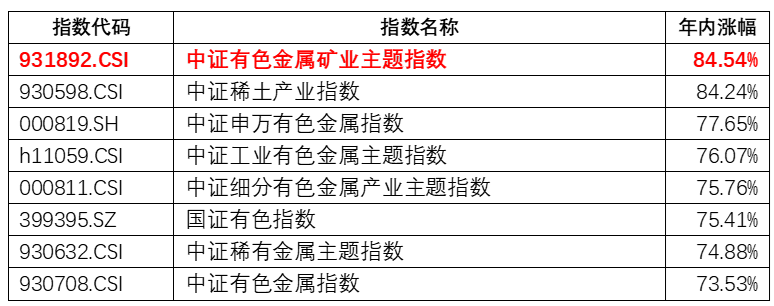
Core Viewpoint - Recent US-China trade tensions and China's export controls on rare earths have reignited market interest in the non-ferrous metals sector, particularly in mining ETFs, which have significantly outperformed traditional non-ferrous metal ETFs this year [1][3]. Performance Summary - The year-to-date performance of various indices shows that the CSI Non-ferrous Metal Mining Theme Index has increased by 84.54%, surpassing other indices including the CSI Rare Earth Industry Index at 84.24% and the CSI Industrial Non-ferrous Metal Theme Index at 76.07% [2]. Market Dynamics - The non-ferrous sector's fundamentals present long-term investment value, with mining ETFs focusing on companies with substantial non-ferrous metal resource reserves, demonstrating stronger price elasticity in the current macroeconomic environment [3]. - Recent developments, including detailed export controls on rare earths and renewed US tariffs, alongside the Federal Reserve's interest rate cuts, have collectively strengthened the mining sector [5]. Sector Composition - The mining ETF (561330) has a significant focus on gold, copper, and rare earths, with these three categories accounting for 56% of its total composition [4]. - The top ten holdings in the mining ETF are all leading resource companies, collectively representing over 57% of the ETF, indicating a high concentration of resource-rich firms [4]. Supply Chain Influences - Recent accidents at major copper mines, such as Escondida and Grasberg, have disrupted supply, with expectations of a 35% decrease in copper production by 2026 compared to previous forecasts [6]. - The overall outlook for the non-ferrous metal industry remains positive, driven by supply disruptions and favorable macroeconomic conditions, including the potential for rising gold prices due to geopolitical tensions and monetary policy changes [6].
国信金属 | 金属行业Q4投资策略:多金属战略属性持续增强,推动价值重估
Sou Hu Cai Jing· 2025-10-13 14:57
Group 1: Industrial Metals - The copper market is experiencing upward price movement due to large copper mine production cuts, with the current phase being a Federal Reserve rate cut cycle. The supply disruptions in industrial metals are expected to lead to stable price increases, enhancing profits for listed companies in the industry. However, a rapid increase in copper prices may suppress downstream demand, leading to inventory accumulation during peak seasons, which is a signal of potential price peaks. Continuous monitoring of inventory changes is necessary [1][14][30] - The aluminum market is approaching a production peak in China, while foreign construction progress is slow. The next two years are expected to see peak production for China's electrolytic aluminum. The domestic aluminum supply-demand balance is fragile, and any increase in demand or supply disruptions could lead to shortages [1][32][38] Group 2: Precious Metals - Gold prices have reached new highs, driven by signals from Federal Reserve Chairman Powell's speech at the Jackson Hole global central bank conference, indicating rising employment risks and slowing GDP growth. The Fed's recent rate cut aligns with market expectations, and further cuts are anticipated. Global central banks are continuously increasing their gold reserves, suggesting a potential upward trend in gold prices through 2025 [3][11] Group 3: Energy Metals - The implementation of a quota system in the Democratic Republic of Congo is expected to create a significant shortage in the global cobalt market over the next two years, leading to a long-term price increase. The lithium market is currently in a state of relative balance, with supply disruptions not fully resolved but demand expectations rising [4][5][12] Group 4: Minor Metals - The strategic importance of minor metals is increasing, with export controls on rare earths tightening. The price of rare earth minerals has seen significant increases, with prices for certain products rising by 37% quarter-on-quarter. Tungsten prices are also expected to rise due to increased demand and supply constraints [6][13][15] Group 5: Tin - Global visible tin inventories have significantly decreased, with a peak of 22,763 tons in May 2024, followed by a reduction to below 9,000 tons by the end of 2022. This trend indicates a tightening supply situation in the tin market [2][41][52]
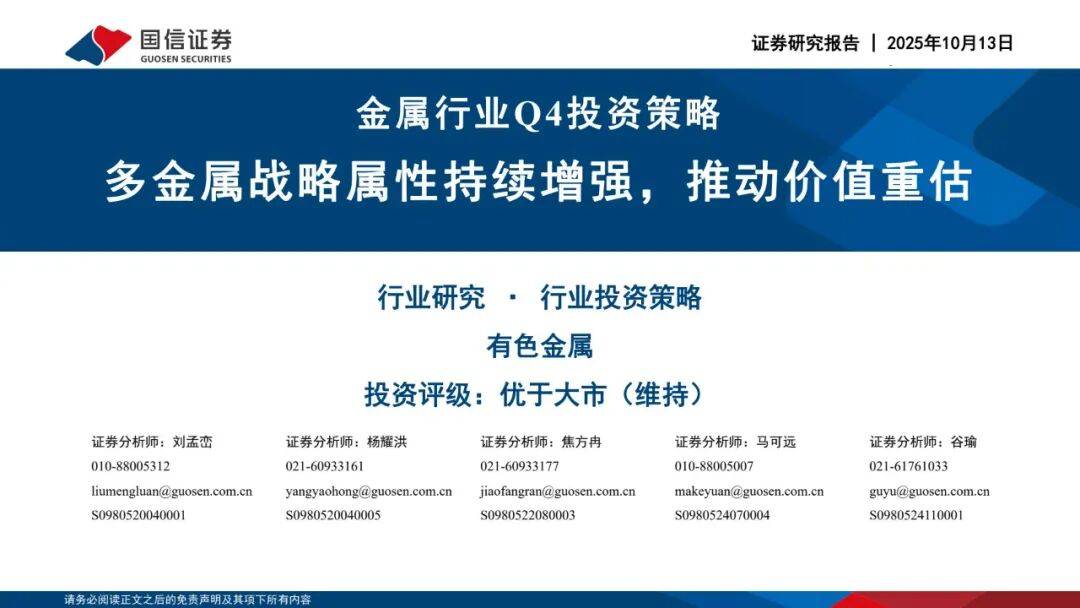
金属行业Q4投资策略:多金属战略属性持续增强,推动价值重估
Guoxin Securities· 2025-10-13 12:33
Core Views - The multi-metal strategic attributes continue to strengthen, driving value reassessment in the non-ferrous metal industry [1] - The investment rating remains "outperform" [2] Tin Market Analysis - Global exchange visible inventory has significantly decreased, with a peak of 22,763 tons in May 2024, followed by a reduction to below 9,000 tons by the end of 2022 [5][73] - The price of tin is expected to rise due to the limited number of new global tin mining projects, with most expected to come online after 2027 [51] Precious Metals - Gold prices have reached new highs, driven by signals from the Federal Reserve regarding potential interest rate cuts, with expectations for further increases in gold prices through 2025 [5] Energy Metals - The implementation of a quota system in the Democratic Republic of Congo is expected to lead to a long-term bull market for cobalt prices [6] - Lithium prices are rebounding, supported by strong demand in the global energy storage market, with supply disruptions still present [6] Minor Metals - The strategic attributes of minor metals are strengthening, with rare earth export controls tightening and significant price increases observed [6] - Tungsten prices are expected to rise due to increased demand and supply constraints [8] Industrial Metals - Copper prices are expected to rise due to large copper mine production cuts, with a focus on monitoring inventory changes [7][9] - Aluminum production in China is nearing its peak, with a fragile balance in the market that could shift to shortages if demand increases [7][32] Recommended Investment Targets - The report recommends a diversified portfolio including companies such as Zijin Mining, Luoyang Molybdenum, and China Northern Rare Earth [6]