
美联储降息

Search documents
降息促进全球资金再配置,关注港股科技
Mei Ri Jing Ji Xin Wen· 2025-10-13 01:21
Core Viewpoint - The Federal Reserve's interest rate cuts are likely to lead to a global reallocation of funds, benefiting Chinese assets amid a backdrop of restructuring in the global monetary system, characterized by a depreciation of the dollar and a reversal of innovative narratives [1] Group 1: Impact of Federal Reserve's Actions - Interest rate cuts by the Federal Reserve are expected to enhance global liquidity, potentially putting downward pressure on the dollar's exchange rate, which may further facilitate global fund reallocation [1] - Proper policy responses could allow Chinese assets to benefit from the dual dividends of accelerated fragmentation and diversification of the global monetary system [1] Group 2: Opportunities in Chinese Assets - Fragmentation is likely to accelerate the repatriation of funds to China, while diversification may drive a rebalancing of global funds, with some capital possibly flowing into Chinese capital markets [1] - In the context of renminbi appreciation and reinforced by the Fed's rate cuts, there is optimism for a "catch-up" rally in Hong Kong stocks, shifting focus from "takeout narratives" to "AI narratives" [1] Group 3: Investment Products - The Hong Kong stock market technology sector is highlighted, particularly ETFs that cover the entire technology supply chain and focus on leading internet companies [1]
美联储降息后,最利好的资产出现了?
大胡子说房· 2025-10-11 05:38
Core Viewpoint - The article highlights that silver has outperformed other asset classes, including gold, following the Federal Reserve's interest rate cuts, with a year-to-date increase of 48% as of mid-September, reaching a peak price of $42.96 per ounce, the highest in 14 years [1][2]. Group 1: Silver's Performance and Market Dynamics - Silver's significant price increase is attributed to its unique market characteristics, including a less developed derivatives market compared to gold, leading to higher volatility and susceptibility to market squeezes [1][2]. - The industrial demand for silver, particularly in solar panels and electric vehicles, is driving its price up, with projections indicating a substantial increase in demand due to the energy transition [2]. - The silver market has experienced a supply shortage for five consecutive years, a rare occurrence that has contributed to its price surge [2]. Group 2: Economic Context and Future Outlook - The article discusses the broader economic concerns regarding the U.S. debt-driven economy, suggesting that the real threat is not debt default but currency devaluation, drawing parallels with countries like Argentina and Turkey [3][4]. - It posits that as the global dollar-based debt system faces challenges, gold and silver may serve as alternative hard currencies, reflecting the declining real value of the dollar [4][5]. - The expectation is that if the Federal Reserve continues to lower interest rates, both gold and silver will likely see further price increases, with silver potentially rising to over $60 per ounce [2][5].


调整就是机会!节后机构大动作调仓,行业主题ETF被爆买,这三只更是疯狂吸金超20亿元
Sou Hu Cai Jing· 2025-10-11 02:28
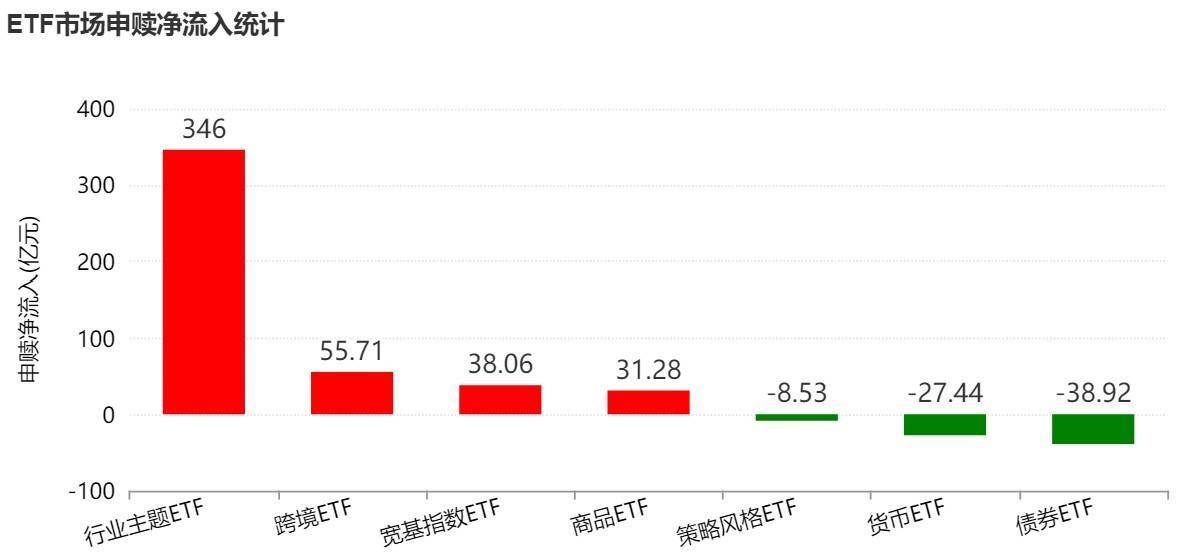
Group 1 - The core viewpoint of the article highlights a significant net inflow of approximately 431 billion yuan into stock ETFs and cross-border ETFs in the Shanghai and Shenzhen markets after the holiday [1][3] - The Shanghai Composite Index closed at 3897.03 points, with a weekly increase of 0.37%, while the Shenzhen Component Index closed at 13355.42 points, with a weekly decrease of 1.26% [3] - The total trading volume for the week in the Shanghai and Shenzhen markets reached 5.17 trillion yuan, with the Shanghai market accounting for 2.35 trillion yuan and the Shenzhen market for 2.82 trillion yuan [3] Group 2 - Industry-themed ETFs such as those focused on semiconductor technology, batteries, and non-ferrous metals received strong capital inflows, while communication and pharmaceutical-related ETFs faced significant outflows [2][12] - Specifically, the semiconductor ETF saw a net inflow of 30.61 billion yuan, the battery ETF received 24 billion yuan, and the non-ferrous metals ETF attracted 21.73 billion yuan [12] - In contrast, the communication ETF, pharmaceutical ETF, and 5G communication ETF experienced net outflows of 10.06 billion yuan, 2.59 billion yuan, and 2.36 billion yuan, respectively [15] Group 3 - The top ten large-cap index ETFs saw a total net inflow of 88.32 billion yuan, with both the CSI 300 ETF and the STAR 50 ETF each receiving over 27 billion yuan [7] - The STAR 50 ETF alone had a net inflow of 51.95 billion yuan, while the CSI A500 ETF experienced a net outflow of 64.24 billion yuan [8] - The battery ETF's share increased by 21.7 billion units, reaching a new high of 157.68 billion units, indicating renewed investor interest in the sector [16] Group 4 - The non-ferrous metals sector saw a significant increase of over 4% post-holiday, with the non-ferrous metals ETF nearing 10 billion yuan in assets, also marking a new high [18] - The article notes that the recent surge in gold prices is attributed to various factors, including U.S. government shutdown concerns and ongoing expectations of Federal Reserve rate cuts [20] - Analysts suggest that the current monetary easing environment and domestic policies aimed at optimizing production factors will support rising metal prices and improve market expectations [20][23]
美联储降息后,最利好的资产出现了?
大胡子说房· 2025-10-10 11:05
Core Viewpoint - The article highlights that silver has outperformed other asset classes, including gold, following the Federal Reserve's interest rate cuts, with a year-to-date increase of 48% as of mid-September, reaching a peak price of $42.96 per ounce, the highest in 14 years [1][2]. Group 1: Silver's Performance and Market Dynamics - Silver's significant price increase is attributed to its unique market characteristics, including a less developed derivatives market compared to gold, leading to higher volatility and susceptibility to market squeezes [1][2]. - The industrial demand for silver, particularly in solar panels and electric vehicles, is driving its price up, with projections indicating a substantial increase in demand due to the energy transition [2]. - The silver market has experienced a supply shortage for five consecutive years, a rare occurrence that has contributed to its price surge [2]. Group 2: Economic Context and Future Outlook - The article discusses the broader economic concerns regarding the U.S. debt-driven economy, suggesting that the real threat is not debt default but currency devaluation, drawing parallels with countries like Argentina and Turkey [3][4]. - It posits that as the dollar's value declines, gold and silver will serve as hard currencies to temporarily replace some functions of the dollar during the transition to a new monetary system [4]. - Predictions indicate that silver prices could rise to over $60 per ounce in the coming years, especially if the Federal Reserve continues to lower interest rates [2][5]. Group 3: Investment Recommendations - The article advises investors to include gold and silver in their asset allocation strategies, emphasizing their potential to withstand economic downturns and benefit from the Fed's monetary policies [5]. - It suggests that despite the recent price increases, there remains an opportunity for further investment in these precious metals as the economic landscape evolves [5].

10月铁矿月报:供应端干扰,铁矿或先扬后抑-20251010
Xin Shi Ji Qi Huo· 2025-10-10 05:48
新世纪期货铁矿月报 商品研究|铁矿月报 黑色产业链组 电话:0571-85103057 邮编:310000 地址:杭州市拱墅区万寿亭 13 号 网址 http://www.zjncf.com.cn 铁矿 2025.6 月月报——铁矿 石价格的"短多长空":需求 淡季的市场逻辑 强运行 铁矿 2025.8 月月报——重要 10 月铁矿月报—— 供应端干扰,铁矿或先扬后抑 观点摘要: 库存: 目前钢厂利润收缩,高产量承压。铁矿石供应仍维持高位,需 求在钢材库存持续增加情况下有转弱预期,节前没有超额补库,关 注国庆节后成材库存去化情况。 铁矿 2025.7 月月报——"反 内卷"吹响号角,短期矿价偏 总结: 部分自媒体报道称因铁矿石定价争议升级,对禁止进口 BHP 等 矿山矿石的消息产生新的担忧,但中国钢厂并没有收到相关通知, 另外西芒杜事故也影响了市场情绪,后续关注供应端的实际影响情 况。钢厂盈利面有所走低,但依旧处于近年偏高水平,日均铁水产 量也维持在高位,短期很难看到负反馈,节后核心仍在钢材需求, 若十月钢材需求不及预期,从而钢材库存持续累积,钢价下跌带动 利润走低,导致钢厂减产进而形成负反馈。目前铁矿石交易 ...
A股行业中观景气跟踪月报(2025年9月):关注新能源、存储、有色和化工等涨价品种-20251009
Shenwan Hongyuan Securities· 2025-10-09 13:45
Core Insights - The report highlights a slight recovery in the manufacturing PMI to 49.8% in September 2025, indicating improved conditions in new orders and procurement, while non-manufacturing sectors show a decline in price and inventory sentiment [2][9] - The report emphasizes the high-level economic activity in sectors such as non-ferrous metals and transportation equipment manufacturing, while also identifying potential recovery opportunities in pharmaceuticals, food and beverage, and light industry sectors [4][5] Industry Analysis - **Manufacturing Sector**: The manufacturing sector shows a mixed performance with a PMI of 49.8%, indicating a slight recovery. New orders and procurement volumes have improved, but price and inventory sentiment have declined [2][9] - **High-frequency Indicators**: Industries experiencing high growth include metal products, machinery repair, non-ferrous metal mining and smelting, and transportation equipment manufacturing. Conversely, industries like pharmaceuticals, food manufacturing, and textiles are facing challenges [4][5] - **Supply Side**: The report notes low growth in finished goods inventory and a decrease in long-term supply pressure in sectors such as oil and gas extraction, non-metallic mineral products, and pharmaceuticals [4][5] - **Consumer Sector**: Retail sales growth for discretionary items continues to decline, but demand for durable goods is expected to be supported by new government subsidies. The automotive sector shows stronger export growth compared to domestic sales [4][5] - **Advanced Manufacturing**: The report indicates a recovery in prices for photovoltaic and lithium battery materials, with optimistic production expectations for energy storage and power batteries [5] - **Technology Sector**: The export price decline for optical modules has slowed, while domestic chip production and sales are accelerating, indicating a positive trend in the technology sector [5] - **Financial Sector**: The report highlights a decrease in non-performing loan rates and an increase in insurance premium income, suggesting a recovery in the financial sector [5] - **Real Estate Chain**: The report notes a widening decline in real estate investment, sales, and construction starts, with cement prices stabilizing at low levels [5] - **Commodity Prices**: The report discusses the stabilization of coal and oil prices, with a new upward trend in metal prices supported by a weak dollar and geopolitical factors [5]
金价上涨的秘密
投资界· 2025-10-09 06:36
Core Viewpoint - The article discusses the significant rise of gold prices and the implications for the global monetary order, particularly focusing on the increasing role of the Chinese yuan as a potential alternative to the US dollar in international trade and finance [3][4][5]. Group 1: Gold Price Surge - On October 7, 2025, gold prices reached a historic high of $4000 per ounce, marking an increase of over 50% within the year [3]. - This surge is attributed to the Federal Reserve's decision to restart interest rate cuts and a notable decline in the US dollar index, which has dropped nearly 10% this year [3]. - The rise in gold prices reflects a broader market sentiment seeking alternatives to the dollar amid geopolitical tensions and economic uncertainties [3][4]. Group 2: Yuan's Internationalization - As of Q1 2025, the yuan accounted for 2.12% of global foreign reserves, ranking sixth, significantly lower than the dollar (57.74%) and euro (20.06) [4]. - Despite China's growing economic influence, the yuan's international status does not yet match this influence, indicating a need for a multi-faceted approach to enhance its global role [4][5]. - A notable shift is occurring, with an increasing number of enterprises opting for yuan settlements in cross-border transactions, surpassing dollar settlements for the first time in Q2 2025 [5][6]. Group 3: Market Dynamics - A survey conducted by Renmin University revealed that 68% of enterprises used yuan for cross-border trade settlements in Q4 2024, with 71% citing asset security as the primary reason [6][9]. - The yuan's appeal is growing due to its perceived stability and usability, as companies seek to avoid reliance on the dollar [9][10]. - The influx of foreign capital into Chinese assets, particularly after the Fed's interest rate cuts, indicates a shift in investor sentiment towards the yuan [9][10]. Group 4: Infrastructure Development - The establishment of the Digital Yuan International Operation Center in Shanghai aims to enhance the yuan's usability in cross-border transactions, supporting a more integrated financial infrastructure [12][14]. - The center's launch is part of a broader strategy to create a transaction-driven infrastructure for the yuan, moving from policy-driven to market-driven adoption [12][15]. - The digital yuan's infrastructure is designed to facilitate seamless transactions, ensuring compatibility with existing systems while enhancing liquidity and efficiency [14][15]. Group 5: Future Prospects - The article emphasizes the need for a dual-driven model of "yuan + digital currency" to enhance the yuan's role in global trade and finance [18]. - The transition of the yuan from a "optional" asset to a "must-have" currency in global markets requires comprehensive financial reforms and international collaboration [18][19]. - The evolving global monetary landscape suggests that the yuan is positioned to play a significant role in reshaping future financial systems, driven by market choices rather than mere policy directives [19].

联储降息后的分歧
2025-10-09 02:00
Summary of Conference Call Notes Industry Overview - The discussion revolves around the **U.S. economy** and its various indicators, particularly in the context of recent **Federal Reserve interest rate cuts** and their implications for the market. Key Points and Arguments Economic Data Divergence - The U.S. economy shows a clear divergence in data: while the **employment market is deteriorating** (unemployment rate at a cycle high and negative non-farm employment growth), other indicators such as **production, income, consumption, and GDP** remain robust. The second quarter GDP data was significantly revised upwards, with **personal consumption expenditures (PCE)** contributing notably [2][5] Future Economic Outlook - The future trajectory of the U.S. economy leans towards marginal weakening or stabilization, with a low risk of recession due to the Federal Reserve's rapid intervention, which has reduced the likelihood of a financial crisis evolving into a systemic crisis [2][6] Aging Population Impact - The aging population in the U.S. is increasing, with wealth concentration shifting towards older demographics. Their consumption is more linked to asset income from the stock market and real estate rather than the employment market, suggesting that consumption resilience is more dependent on stock market performance than on employment figures [2][9] Interest Rate Cuts and Market Reactions - The Federal Reserve recently cut rates by 25 basis points, bringing the federal funds rate to a range of **4% to 4.25%**. This has led to increased market divergence regarding future rate paths and economic outlooks, with Treasury yields rising post-cut [3][4] Financial Conditions and Asset Prices - The impact of rate cuts on the U.S. economy has changed over time. Currently, various asset prices reflect rate cut expectations quickly, and the **financial conditions index** is a crucial indicator for observing the effects of rate cuts. However, the marginal improvement in this index is limited, indicating constrained improvements in the real estate and credit markets [2][10] Monetary and Fiscal Policy Predictions - The current monetary policy remains insufficiently accommodative, with about **100 basis points** gap from neutral rates. The fiscal deficit is expected to remain high, around **5.96%** in 2025, which could hinder overall consumption and economic growth [11] Stock Market Outlook - The stock market shows less divergence compared to Treasuries and the dollar, with a strong consensus on its stability. However, potential risks remain, and investors should closely monitor macroeconomic indicators for timely strategy adjustments [7][8] AI Industry's Economic Contribution - The AI sector's capital expenditure has reached a historical peak in its contribution to GDP. A slowdown in this growth could exert pressure on the stock market, necessitating attention to guidance from major tech companies regarding capital expenditures [4][16] Treasury Yield Predictions - The forecast for Treasury yields suggests a continued decline, with expectations that the **10-year Treasury yield** will drop below **4%** by the end of 2026, influenced by the ongoing rate cut cycle and marginal economic weakening [12][14] Dollar Index Fluctuations - The dollar index is expected to fluctuate between **95-102**, with limited chances of breaking above **105**. This scenario is favorable for the Chinese yuan, which is likely to appreciate even if the dollar rises slightly [15] Other Important Insights - The Federal Reserve's rate cuts are expected to influence domestic markets through sentiment, liquidity improvements, and policy transmission channels. There is potential for new stimulus measures in the near future, which could support the A-share market [17]
合成氨、苯胺等涨幅居前,建议关注进口替代、纯内需、高股息等方向 | 投研报告
Zhong Guo Neng Yuan Wang· 2025-10-09 01:47
Group 1 - The core viewpoint of the report highlights the significant price increases in synthetic ammonia, lithium battery electrolytes, aniline, and anhydrous hydrofluoric acid, while other products like natural gas and sulfuric acid experienced notable declines [1][2][3] - As of September 26, Brent crude oil prices reached $70.13 per barrel, up 5.17% from the previous week, while WTI crude oil prices were at $65.72 per barrel, up 4.85% [1][3] - The report anticipates that the central value of international oil prices will stabilize between $65 and $70 by 2025 [1][3] Group 2 - The report identifies key investment opportunities in sectors such as glyphosate, fertilizers, import substitution, domestic demand, and high-dividend assets [4] - It suggests focusing on the glyphosate industry, which is showing signs of recovery with decreasing inventory and rising prices, recommending companies like Jiangshan Co., Xinfeng Group, and Yangnong Chemical [4] - The report emphasizes the importance of domestic chemical fertilizer industries, particularly nitrogen and phosphate fertilizers, which are expected to maintain stable demand, recommending companies like Hualu Hengsheng and China Heart Link Fertilizer [4] Group 3 - The chemical industry is currently experiencing mixed performance, with some sectors like lubricants exceeding expectations, while overall industry performance remains weak due to past capacity expansions and weak demand [3][4] - The report highlights the potential for growth in the lubricating oil additive sector and suggests companies with strong competitive positions and growth potential, such as Ruifeng New Materials and Baofeng Energy [4] - The report also notes that the three major oil companies in China are expected to remain attractive due to their high asset quality and dividend yields in the context of rising international oil prices [4]
比特币冲高后回落 超17万人爆仓
Bei Jing Shang Bao· 2025-10-08 15:36
Group 1 - Bitcoin experienced significant price fluctuations, reaching a high of $126,080 before dropping to around $122,444, with an overall increase of over 8% in October [1] - The price of Bitcoin has surged by 95.4% over the past year, following a series of increases from $9,500 at the beginning of 2025 to multiple key levels above $10,000 [1] Group 2 - Key factors influencing Bitcoin's price include the approval of Bitcoin spot ETFs, support from political figures like former President Trump, and the recent interest rate cuts by the Federal Reserve [2] - The recent U.S. government shutdown has led to increased investor interest in Bitcoin as a safe-haven asset, reflecting a shift in liquidity expectations [2] Group 3 - Bitcoin's price movements have shown a correlation with gold, as both are viewed as safe-haven assets amid rising market volatility [3] - The total liquidation amount due to market volatility reached approximately $645 million, indicating a significant number of liquidations, although the amount is lower compared to previous high-volatility periods [3] Group 4 - Market sentiment towards both gold and Bitcoin is bullish, with analysts predicting Bitcoin could reach $181,000 within 12 months, driven by ongoing investor demand [4] - The potential for further price increases in Bitcoin is supported by new ETF inflows and the impact of the government shutdown, with short-term predictions suggesting a rise to $135,000 [4]