美联储降息

Search documents
行业比较与配置系列(2025年10月):10月行业配置关注:高景气持续与困境反转的线索
CMS· 2025-09-28 14:01
Core Insights - The report highlights the ongoing high prosperity in certain sectors and the potential for recovery in struggling areas, focusing on industries such as non-ferrous metals, power equipment, machinery, automotive, electronics, and media [2][4][5]. Market Performance and Economic Indicators - In the past month, the market experienced slight fluctuations upward, with the overall indices showing mixed results, particularly in the technology TMT sector and midstream manufacturing, which saw improved prosperity [2][4][17]. - Economic data indicated a general slowdown, with production outpacing demand, and various sectors showing different levels of performance [4][18]. Sector Recommendations - **Non-Ferrous Metals**: Supply disruptions and seasonal demand are expected to drive prices higher, particularly for industrial metals like copper and aluminum, as well as small metals such as rare earths [5][16]. - **Power Equipment**: The solid-state battery industry is advancing, and the solar power sector is benefiting from increased demand and improved pricing structures [5][16]. - **Machinery**: The humanoid robot sector is poised for growth due to domestic technological advancements and supportive policies [5][16]. - **Automotive**: The automotive industry is entering a recovery phase with improved supply-demand dynamics and supportive government policies [5][16]. - **Electronics**: The consumer electronics sector is entering a peak season, driven by innovation and strong demand for AI-related products [5][16]. - **Media**: The gaming sector is experiencing structural recovery, supported by content optimization and AI technology [5][16]. Economic and Sectoral Trends - The report notes that the market is entering a bullish phase, with significant sector rotation expected, particularly in technology-driven areas [4][5][7]. - Analysts have raised profit expectations for several industries, including steel, military electronics, and insurance, indicating a positive outlook for these sectors [7][12]. Trading Dynamics - Recent trading activity has shown a divergence across sectors, with high turnover in consumer electronics and automotive parts, while sectors like oil and gas have seen lower trading volumes [5][7]. - The report emphasizes the importance of monitoring policy impacts and fundamental recovery in the coming months, particularly in technology innovation as a growth driver [7][12].
美联储降息风向,泰珀警示再降两次风险,中国市场潜力凸显
Sou Hu Cai Jing· 2025-09-28 14:00
Group 1 - David Tepper expressed concerns about current valuations, indicating a shift in sentiment compared to his previous preference for Chinese assets [1][2] - As of Q2 2025, Appaloosa Management held approximately $6.45 billion in U.S. equities, with Alibaba representing over 12% of the portfolio, while increasing Nvidia's position significantly [1][2] - Tepper highlighted the risks associated with multiple interest rate cuts, suggesting that a weakening dollar and rising inflation could disrupt market stability [2][3] Group 2 - Tepper noted that while Chinese companies have attractive price-to-earnings ratios, the uncertainty surrounding policies and liquidity poses significant risks [2][3] - He advised investors to diversify their portfolios and not to concentrate too heavily on any single investment, especially in the context of potential policy fluctuations [3][4] - Tepper's cautious approach reflects a balance between recognizing opportunities in Chinese assets and the historical lessons learned from past market volatility [4]
港股科技“三剑客”,谁更强?
Xin Lang Cai Jing· 2025-09-28 11:41
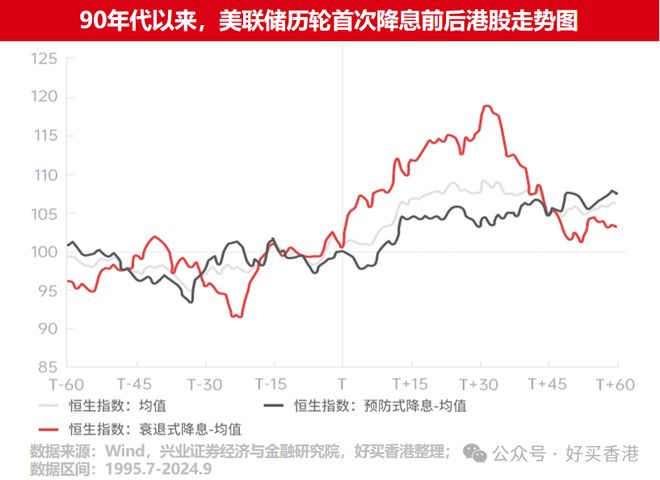
Group 1 - The core viewpoint of the article is that the Federal Reserve's interest rate cuts are expected to positively impact global equity assets, particularly the Hong Kong stock market, which is anticipated to present significant investment opportunities due to its offshore nature and high elasticity [1][3][6] - Historical data indicates that the Hong Kong technology sector tends to perform well during periods of preventive interest rate cuts by the Federal Reserve, suggesting a favorable outlook for tech investments in Hong Kong [3][6] - The initiation of the Federal Reserve's preventive interest rate cut cycle has led to improved liquidity, which boosts market sentiment and valuation recovery, while also enhancing actual returns through currency exchange gains [6][10] Group 2 - The improvement in liquidity has prompted a global asset reallocation, with Hong Kong stocks being particularly sensitive to capital flows, thus attracting overseas investments, especially in the technology and pharmaceutical sectors [7][10] - The valuation of Hong Kong stocks is currently at a low point compared to A-shares and U.S. stocks, indicating substantial room for value recovery, with the profitability of listed companies showing improvement driven by new economic factors [10][12] - The appreciation of the Renminbi, in the context of a weakening U.S. dollar, presents an opportunity for investors in Hong Kong technology assets to benefit from both stock price and currency gains [10][12] Group 3 - The article highlights three key indices in the Hong Kong technology sector: the Hang Seng Technology Index, the CSI Hong Kong Stock Connect Technology Index, and the CSI Hong Kong Stock Connect Internet Index, each with distinct characteristics and investment focuses [11][12] - The Hang Seng Technology Index includes 30 leading technology companies, primarily in the internet sector, while the CSI Hong Kong Stock Connect Internet Index focuses solely on internet-related companies, particularly in AI applications [11][12] - The CSI Hong Kong Stock Connect Technology Index has a broader coverage, including various innovative sectors such as internet, innovative pharmaceuticals, smart vehicles, and semiconductors, making it a diversified investment option [11][12] Group 4 - All three indices are currently at historically low valuation levels, with the CSI Hong Kong Stock Connect Technology Index showing a price-to-earnings (PE) ratio below the 20th percentile of the past five years, indicating a higher safety margin and cost-effectiveness for investors [13][16] - Year-to-date performance shows significant gains across all three indices, with the CSI Hong Kong Stock Connect Technology Index leading with a 58% increase, driven by its diverse exposure to innovative sectors [13][16] - The article suggests that investors should consider their risk preferences when selecting among these indices, as the current environment of global liquidity easing and technological restructuring presents compelling long-term investment opportunities in the Hong Kong market [16]

国庆假期前存补库需求 铁矿石后市维持看涨格局
Jin Tou Wang· 2025-09-26 07:56
Group 1 - The domestic futures market for black metals is experiencing a downward trend, with iron ore futures showing a decline of 1.74% as of the latest trading session [1] - Steel mills have resumed production, leading to strong demand for iron ore driven by profit incentives, with iron water output returning to previous levels [1] - Global iron ore shipments have recently decreased, particularly due to disruptions in Australian shipments, while port inventory is being depleted rapidly [1] Group 2 - Despite a rebound in iron ore imports and domestic production in the second quarter, the year-on-year decline in the first eight months remains unchanged [2] - The absolute amount of iron ore port inventory is lower than the same period last year, indicating a supportive supply-demand balance for prices in the short term [2] - The recent Federal Reserve interest rate cut has improved market sentiment, and the combination of steel mill production resumption and pre-holiday inventory replenishment is expected to lead to a strong oscillation in iron ore prices [2]
搞懂美联储降息=抓牢钱袋子!3大效应影响全球资产, A股机会在哪?
Sou Hu Cai Jing· 2025-09-26 07:04
Core Viewpoint - The Federal Reserve's interest rate decisions, particularly rate cuts, significantly impact global liquidity and financial markets, given the dollar's central role in the international monetary system [3][5]. Group 1: Impact of Federal Reserve Rate Cuts - The core objective of a rate cut is to lower the "risk-free rate," which is typically represented by U.S. Treasury yields, thereby influencing the entire financial market through three main effects [6]. - Liquidity Effect: Rate cuts release liquidity, stimulating investment and consumption, although actual effects depend on the economic environment [7]. - Asset Pricing Effect: Lower risk-free rates increase asset valuations, as seen in the Capital Asset Pricing Model (CAPM), where a decrease in the discount rate raises the intrinsic value of equities [8]. - Exchange Rate Effect: Rate cuts can lead to a depreciation of the dollar, prompting capital flows to higher-yielding emerging markets, although actual currency movements are influenced by various factors [10]. Group 2: Market Reactions and Expectations - Market expectations play a crucial role; if investors anticipate a rate cut, the positive effects may already be priced in, leading to a muted market reaction post-announcement [12]. - The lag effect of monetary policy means that the impacts of rate cuts are not immediate, requiring time for the economy to adjust [13][14]. - Consumer behavior may shift as lower deposit rates encourage spending and investment, while businesses may take time to assess market conditions before increasing investments [15][17]. Group 3: Stock Market Dynamics - The U.S. stock market may have short-term upward potential, driven by a self-reinforcing cycle of rising stock prices leading to increased consumer spending and economic growth [19]. - However, the effectiveness of rate cuts in boosting the stock market depends on the economic cycle; in a recession, rate cuts may signal worsening conditions rather than improvement [19]. - For A-shares and Hong Kong stocks, the direct benefits of rate cuts include potential capital inflows, but market reactions may vary based on pre-existing expectations and structural economic issues [21][22]. Group 4: Sector-Specific Opportunities - The AI technology sector is highlighted as a key area for investment, with significant potential for growth and innovation, despite broader market fluctuations [21][22]. - The competition in AI investment is likened to an arms race, indicating a robust trend that is likely to continue regardless of economic cycles or monetary policy changes [22].

原油季度报告:宏观预期改善或提供反弹动力
Hong Yuan Qi Huo· 2025-09-26 02:46
分析师:范智颖 从业资格号:F03117807 投资咨询从业证书号:Z0022690 研究所 Tel:010-82292099 Email:fanzhiying@swhysc.com 相关研究 [原ta油ble季_r度ep报ort告date] 2025 年 9 月 宏观预期改善或提供反弹动力 风险提示:地缘局势变动,关税政策调整,OPEC+政策调整。 | 一、 | 行情回顾 4 | | --- | --- | | 1、 | 行情回顾:先跌后涨再横盘 4 | | 2、 | 观点回顾 5 | | 二、 | 宏观分析:美国宏观经济存在改善预期 6 | | 1、 | 美联储鸽派托底经济预期 6 | | 2、 | 中长期预期相对较好 8 | | 3、 | 管理基金净多持仓偏低 8 | | | 三、基本面分析:过剩预期或有调整 10 | | 1、 | 供给端:OPEC+实际增产低于计划,美页岩油增产意愿有限 10 | | 2、 | 需求端:需求预期并不差 11 | | 3、 | 库存:美国油品库存压力不大,中国补储缓解过剩压力 14 | | 4、 | 风险:可能的风险在地缘局势变动 15 | | | 四、总结与展望 17 ...
看多金属全面牛市,铜、铝、稀土、锑等更新
2025-09-26 02:28
Summary of Key Points from Conference Call Industry Overview - The conference call discusses the metals market, particularly focusing on rare earths, antimony, and copper, indicating a bullish outlook for these sectors in the upcoming months and years [1][2][3]. Rare Earth Market - The rare earth market is expected to enter a price increase cycle in the second half of the year and the first half of next year, with neodymium oxide prices potentially exceeding 700,000 yuan by year-end [1][3]. - Despite recent price adjustments, the order volume remains robust, indicating strong demand [3]. - Recommended stocks in the rare earth sector include China Rare Earth and Northern Rare Earth, which are currently seen as good investment opportunities due to their favorable price-to-value ratio [4]. Antimony Market - The antimony market is positively influenced by U.S. companies receiving significant orders from the Department of Defense, which may lead to a convergence of domestic and international price differences [5]. - Domestic antimony prices have reached a low point, and if export restrictions are eased, prices could potentially break previous highs. Key stocks to watch include Huayu Mining, Huaxi Nonferrous, and Hunan Gold [5]. Copper Market - The Freeport Indonesia copper mine's suspension is projected to significantly impact copper production, with a reduction of 200,000 tons expected in Q4 2025 and 270,000 tons in 2026 [6]. - This reduction leads to a downward revision of global copper production growth, which is now expected to be negative this year, with only modest growth next year [6]. - Current copper inventories are low, and strong downstream demand is expected to support price increases, with domestic copper prices already surpassing 82,000 yuan and potentially reaching 90,000 yuan if supply-demand dynamics remain unchanged [8][9]. - The Federal Reserve's interest rate cuts are not expected to pressure copper prices as they have in previous cycles, with current manufacturing PMI data indicating expansion [9]. Aluminum Market - The aluminum market shows strong fundamentals, with national inventories decreasing and increased demand from downstream sectors such as automotive, electricity, and construction [11]. - The average cost of electrolytic aluminum is expected to decline due to oversupply of alumina, which could enhance profit margins for companies in this sector [12]. - The outlook for the electrolytic aluminum sector remains optimistic, with recommendations for investment based on the anticipated cost reductions and profit increases [12]. Investment Recommendations - Key investment targets include Zijin Mining and Luoyang Molybdenum, which are expected to benefit from production expansions and rising commodity prices [10]. - Other notable stocks include Jincheng Mining, Zangge Holdings, Western Mining, Tongling Nonferrous, and Jiangxi Copper, as well as China Nonferrous Mining and Zijin Mining in the Hong Kong market [10].
A股:大盘突然放量下跌,是主力利好兑现出货,还是强势洗盘?
Sou Hu Cai Jing· 2025-09-25 17:09
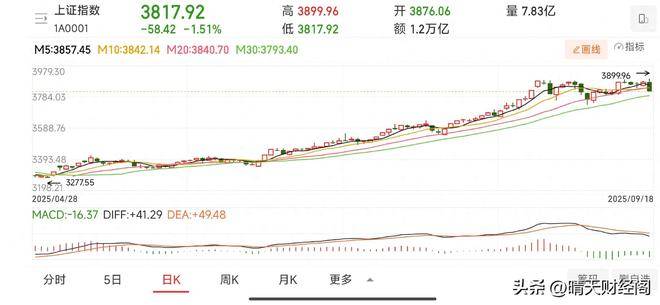
Group 1 - The Shanghai Composite Index experienced a significant drop from 3899 points to 3820 points, breaking through key psychological support levels of the 10-day and 20-day moving averages, causing concern among investors [1] - Despite a net outflow of 110 billion in main funds, the market saw an influx of 600 billion in new capital, indicating a contrasting narrative in market dynamics [1] - The trading volume reached an astonishing 3 trillion, which often correlates with market corrections, suggesting a potential manipulation of market temperature by major funds to prevent congestion from short-term capital inflows [3] Group 2 - The financial sector, particularly securities and banking stocks, showed clear signs of control, as they declined in unison, hinting at a deliberate strategy to manage market conditions [3] - Historical patterns indicate that after the last four Federal Reserve rate cuts, the market typically undergoes a significant washout, suggesting that the current downturn may be a planned reshuffling rather than a trend reversal [3] - The outlook for RMB assets remains positive, bolstered by the anticipated influx of liquidity from the Federal Reserve's rate cuts, which is expected to benefit both Hong Kong and A-share markets [3]
螺矿产业链周度报告-20250925
Zhong Hang Qi Huo· 2025-09-25 13:28
1. Report Industry Investment Rating No relevant content provided. 2. Core Views of the Report - Steel prices rebounded with oscillations this week, supported by the cost side. The Fed's interest - rate cut expectation was fulfilled, having a small impact on the black market. The article in Qiushi Journal boosted the coking coal price, providing cost support for steel. Steel's off - season trading is nearly over, but fundamental pressure remains, and steel is expected to fluctuate within a range. Track the demand improvement after price increases [5][67]. - Iron ore prices fluctuated at a high level this week. Supply: shipping increased but arrivals decreased, and port inventories declined. Demand: hot metal production remained high, pre - holiday restocking demand provided support, and the US easing cycle was favorable for risk assets. However, downstream steel demand showed no obvious improvement, and price increases require fundamental support. Short - term ore prices are expected to continue to oscillate strongly, with attention to adjustment pressure after the end of restocking at the end of the month [5][69]. 3. Summary by Directory 3.1 Report Summary - **Market Focus**: China and the US reached a basic framework consensus on resolving the TikTok issue. Xi Jinping's article on promoting the unified market was published. The Fed cut the federal funds rate by 25 basis points to 4.00% - 4.25%, and is expected to cut twice more this year [5]. - **Key Data**: China's August industrial and consumption data missed expectations; US August industrial and retail data were better than expected. In early September, key steel enterprises' daily crude steel output increased by 7.2% [5]. - **Main Views**: Steel is expected to oscillate in a range, and iron ore is expected to oscillate strongly in the short term [5]. 3.2 Multi - Empty Focus - **For Steel (Thread)**: Bullish factors include positive market sentiment from the Qiushi article, cost support from rising raw material prices, and improved demand and reduced inventory pressure. Bearish factors are the market adjustment after the Fed's rate cut and weakening economic data in August, and the decline in hot - rolled coil apparent demand [8]. - **For Iron Ore**: Bullish factors are positive market sentiment, cost support, high hot metal production, and pre - holiday restocking demand. Bearish factors are the market adjustment after the Fed's rate cut, weakening economic data in August, and increased iron ore shipping [9]. 3.3 Data Analysis - **Macro**: The article in Qiushi Magazine boosted industrial product sentiment. The Fed cut rates, and the market expected another cut in October. August's social financing and economic data were weak, and policies are needed [10][12][18]. - **Terminal**: Real estate investment and sales were weak. August's auto production and sales were stable, with new - energy vehicles growing rapidly. August's excavator production and sales increased, and ship exports grew [24][29][32]. - **Supply**: In the first eight months, China's crude steel and pig iron production decreased year - on - year [33]. - **(Thread)**: Spot prices rose slightly, and the basis shrank. The steel mill profitability rate decreased. Blast furnace开工率 increased, and electric furnace开工率 decreased. Steel output decreased slightly. Thread apparent demand improved seasonally, and hot - rolled coil demand fluctuated. Thread inventory decreased, and hot - rolled coil inventory increased. The coil - to - thread spread declined [35][37][43]. - **(Iron Ore)**: Spot prices fluctuated slightly, and the basis widened. In August, imports increased slightly, and shipping increased this week. Arrivals decreased this week. Hot metal production was high. Port inventory decreased, and dredging increased. Steel mills are still restocking [51][55][58]. 3.4后市研判 - **Steel**: Steel is expected to oscillate in a range, and the demand after price increases needs to be tracked [67]. - **Iron Ore**: Iron ore is expected to oscillate strongly in the short term, and attention should be paid to the adjustment pressure after the end of restocking [69].
美联储降息后,投资者的下一个焦点是啥?
Sou Hu Cai Jing· 2025-09-25 07:20
Core Viewpoint - The Federal Reserve's recent interest rate cut has shifted investor focus from whether rates will be lowered to the stability of the U.S. economy and its impact on the stock market's performance at historical highs [3]. Group 1: Economic Outlook - The Fed's decision to cut rates was supported by Chairman Powell, overcoming internal disagreements, and the market anticipates up to three more cuts by March next year [3]. - A recent Bank of America survey indicates that 67% of fund managers believe in a "soft landing" for the economy, while only 10% fear a recession [4]. Group 2: Historical Context - Historical data shows that global and European stock markets typically benefit from Fed rate cuts, especially when no recession follows, leading to stronger stock performance [5]. - Barclays' strategist Emmanuel Cau found that in past instances of rate cuts without subsequent recession, European stocks often outperformed U.S. stocks [5]. Group 3: Market Sentiment and Concerns - Despite overall optimism, some market participants express caution regarding the sustainability of the current market rally, noting that rate cuts do not guarantee immediate stock market gains [6]. - Concerns arise about the sources of upward momentum in the market, as institutional investors are heavily invested, and stock buybacks are slowing down [7]. - The current market rally is largely driven by a few "star stocks," indicating a narrow breadth of market participation, which raises concerns about overall market health [8]. Group 4: Investment Strategy Recommendations - Strategists suggest diversifying investments beyond the U.S. market, as historical trends indicate that global markets benefit from Fed rate cuts [9]. - There is a recommendation to consider European and other international stocks as potential opportunities, especially given their performance relative to U.S. stocks during similar economic conditions [9].