日常消费零售

Search documents
2026年一季度A股大数据排行榜
Wind万得· 2026-04-01 05:45
Market Performance - In Q1 2026, A-share market showed significant style differentiation, with the CSI 1000 index being the only broad index to rise, up by 0.32%, while major indices generally declined [1][3] - The Shenzhen Component Index, ChiNext Index, and Wind All A Index saw slight declines of 0.35%, 0.57%, and 1.15% respectively, while the Shanghai Composite Index fell by 1.94% and the CSI 300 dropped by 3.89% [3] - The North Exchange 50 performed the weakest, with a substantial decline of 13.34% in Q1 2026 [3] Industry Performance - Among 35 industries classified by Wind, 9 recorded gains in Q1 2026, with the oil and petrochemical and coal industries leading, rising by 18.27% and 17.64% respectively [5] - Utilities, building materials, and electrical equipment also performed well, with increases of 8.78%, 8.26%, and 6.02% respectively [5] - Consumer and financial real estate sectors faced significant declines, with discretionary retail down by 14.90% and non-bank financials down by 14.84% [5] Style Performance - In Q1 2026, small and mid-cap value and growth styles outperformed, while large-cap styles faced pressure [8] - Mid-cap value style was the strongest, with a cumulative increase of 7.50%, while mid-cap growth rose by 5.73% [8] - Large-cap growth index fell by 2.77%, and large-cap value index declined by 4.53% [8] Concept Performance - Energy and power infrastructure concepts led the market in Q1 2026, with the ultra-high voltage concept rising by 32.39% [10] - Fiberglass and oil and gas extraction indices also saw significant gains, exceeding 30% [10] - Other concepts like optical communication, shipping selection, TOPcon batteries, and rare metals selection rose over 20% [10] Company Listings - As of the end of Q1 2026, there were 5,496 listed companies in the A-share market, an increase of 26 from the end of 2025 [13] - The Shanghai main board had the highest number of listed companies at 1,703, accounting for 30.98% of the total [15] Market Capitalization - The total market capitalization of A-shares was 118.81 trillion yuan at the end of Q1 2026, a slight decrease of 0.1% from the end of 2025 [17] - The Shanghai main board's market capitalization was 62.94 trillion yuan, representing 52.93% of the total [19] Trading Volume - A-share market trading remained active in Q1 2026, with total trading volume reaching 144.5 trillion yuan, a quarter-on-quarter increase of 22.15% and a year-on-year increase of 66.28% [21] - The average daily trading volume was 25.97 billion yuan, up 29.43% quarter-on-quarter and 69.04% year-on-year [21] Margin Financing - As of the end of Q1 2026, the margin financing balance was 26.17 billion yuan, an increase of 2.41% from the end of 2025 and a year-on-year increase of 36.12% [25] Top Gainers and Losers - In Q1 2026, Hangzhou Electric Co. led the gainers with a cumulative increase of 253%, followed by Xuelang Environment at 232% and Tianzhong Precision at 210% [27] - The biggest loser was Tianpu Co., which fell by 55%, with Rongke Technology and Jin Hao Medical both down by 49% [27] Market Valuation - As of the end of Q1 2026, the highest P/E ratio among A-share boards was on the Sci-Tech Innovation Board at 195.68 times [43] - The lowest P/E ratio was in the financial sector at 7.72 times [47] IPO Activity - In Q1 2026, the A-share market saw 35 IPOs, a year-on-year increase of 29.63% [50] - The total fundraising from IPOs was 29.78 billion yuan, up 79.61% year-on-year [52] - The automotive and parts industry led with 6 IPOs, while the medical devices and services sector had 5 [55]


中国银河策略:地缘风险叠加关税风险,港股节后行情怎么看?
Jin Rong Jie· 2026-02-23 07:57
Market Performance - During the week from February 16 to February 20, the Hong Kong stock market experienced fluctuations with the Hang Seng Index declining by 0.58% to 26,413.25 points, the Hang Seng Tech Index falling by 2.78% to 511.50 points, and the Hang Seng China Enterprises Index decreasing by 0.81% to 8,959.56 points [1][6][30] - Among the primary sectors, 8 sectors saw gains while 3 sectors experienced losses. The energy, materials, and industrial sectors had the highest increases, rising by 3.65%, 2.27%, and 1.03% respectively. Conversely, the consumer discretionary, consumer staples, and communication services sectors faced the largest declines, dropping by 1.86%, 1.50%, and 0.13% respectively [1][7][30] Market Liquidity - Due to the Spring Festival holiday, the Hong Kong stock market only operated for half a day on February 16, with a trading volume of HKD 850.56 billion. On February 20, the trading volume was HKD 1,654.61 billion, which is lower than the previous week's average daily trading volume of HKD 2,406.43 billion. The short-selling amount was HKD 237.27 billion, accounting for 14.43%, significantly higher than the previous week's average of 12.56% [2][13][15] Valuation and Risk Premium - As of February 20, 2026, the PE and PB ratios of the Hang Seng Index were 12.09 times and 1.23 times, respectively, placing them at the 79% and 55% percentiles since 2010. The Hang Seng Tech Index had PE and PB ratios of 21.51 times and 2.83 times, respectively, at the 18% and 49% percentiles since 2010 [3][17][22] - The risk premium of the Hang Seng Index was calculated at 4.19%, which is at the 5% percentile since 2010, while the risk premium based on the 10-year Chinese government bond yield was 6.48%, at the 42% percentile since 2010 [3][19][21] Investment Outlook - The geopolitical risks in the Middle East are rising, which may lead to increased volatility in energy and precious metals sectors. The U.S. is exerting pressure on Iran, with potential military actions being considered [4][9][30] - The consumer sector is currently valued relatively low, and with increasing consumer promotion policies, there is potential for growth in this sector [4][30] - The technology sector remains a long-term investment focus, with reduced valuation pressure following recent corrections, and is expected to rebound due to accelerated AI model updates and applications [4][30]

银河证券:全球地缘政治不确定性加剧 预计港股窄幅震荡
智通财经网· 2026-01-19 00:24
Group 1 - The report from Galaxy Securities indicates that the expectation for a short-term interest rate cut by the Federal Reserve has decreased, and global geopolitical uncertainties are increasing, leading to a forecast of narrow fluctuations in the Hong Kong stock market [1] - The technology sector is highlighted as a long-term investment focus, benefiting from multiple positive factors such as price increases in the supply chain, domestic substitution, and accelerated AI applications [1] - The consumer sector is expected to continue benefiting from policy support, with future attention needed on the implementation of policies and improvements in consumer data [1] Group 2 - In the past week, the Hong Kong stock market showed strong performance, with the Hang Seng Index rising by 2.34%, the Hang Seng Tech Index by 2.37%, and the Hang Seng China Enterprises Index by 1.90% [2] - Among the primary industries, nine sectors increased while two decreased, with materials, consumer staples, and information technology leading the gains at 4.31%, 3.91%, and 3.60% respectively [2] - The average daily trading volume on the Hong Kong Stock Exchange was HKD 301.69 billion, an increase of HKD 28.58 billion from the previous week [2] Group 3 - As of January 16, 2026, the PE and PB ratios of the Hang Seng Index were 12.20 times and 1.24 times, respectively, reflecting increases of 0.44% and 0.52% from the previous week [3] - The risk premium for the Hang Seng Index is at 3.95%, which is significantly below the three-year rolling average, indicating a low-risk appetite among investors [3] - The premium index for the Hong Kong-Shanghai Stock Connect has decreased to 120.43, placing it at the 17th percentile level since 2014 [3]
2025年度A股大数据排行榜
Wind万得· 2025-12-31 22:50
Market Overview - In 2025, the A-share market exhibited a comprehensive upward trend, with major indices showing an average increase of over 10%. The growth was particularly pronounced in growth sectors, with the ChiNext Index, North Exchange 50, and Sci-Tech 50 indices each rising by over 30% [1][3]. - The structural characteristics of the market were evident, with technology and resource sectors leading the performance. The optical module (CPO) index surged by over 180%, while indices for optical chips, copper-clad laminates, optical communications, and optical circuit switches all exceeded 100% growth [1][3]. A-share Index Performance - The ChiNext Index led the gains in 2025 with a cumulative increase of 49.57%. The North Exchange 50 and Sci-Tech 50 indices followed with increases of 38.80% and 35.92%, respectively. Other indices such as the Shenzhen Component Index, Wind All A, and CSI 1000 also saw gains exceeding 20% [3]. A-share Industry Performance - Among the 35 industries classified by Wind, 31 recorded increases in 2025. The non-ferrous metals industry topped the list with a cumulative increase of 92.20%. Hardware equipment and industrial trade sectors also performed well, with increases of 62.39% and 54.65%, respectively. Conversely, the daily consumer retail sector saw a decline of 6.42% [5]. A-share Hot Concepts - The optical module (CPO) index was the strongest performer in 2025, with a cumulative increase of 181.28%. Other notable performers included optical chips (130.78%), copper-clad laminates (129.58%), optical communications (125.58%), and optical circuit switches (112.55%). The rare metals, copper industry, and rare earth indices also showed significant growth, with increases of 119.85%, 103.64%, and 98.97%, respectively [9]. A-share Market Capitalization - By the end of 2025, the total market capitalization of the A-share market reached approximately 118.91 trillion yuan, marking a 26.6% increase from the end of 2024 [15]. - The Shanghai main board had the highest number of listed companies at 1,699, accounting for 31.06% of the total. The Shenzhen main board followed with 1,490 companies (27.24%), while the ChiNext and Sci-Tech boards had 1,393 and 600 companies, representing 25.47% and 10.97%, respectively [13]. Financing and Investment Trends - As of the end of 2025, the A-share margin trading balance was reported at 25.553 billion yuan, reflecting a 5.21% increase from the third quarter and a year-on-year increase of 35.91% [22]. - The top gainers in terms of stock price included Weiwei New Materials, which saw a cumulative increase of 1,820%, followed by Tianpu Co., with a 1,645% increase. Conversely, Shijin Technology led the decline with a 51% drop [24]. IPO Activity - In 2025, the A-share market saw a total of 112 IPOs, representing a 9.8% increase year-on-year. The fourth quarter alone accounted for 36 IPOs, up 9.1% from the previous year [49]. - The total fundraising from IPOs in 2025 reached 130.83 billion yuan, a significant increase of 97.4% year-on-year, with the fourth quarter alone raising 54.86 billion yuan, up 165.0% [51].

港股IPO“堵了”?
3 6 Ke· 2025-12-18 08:39
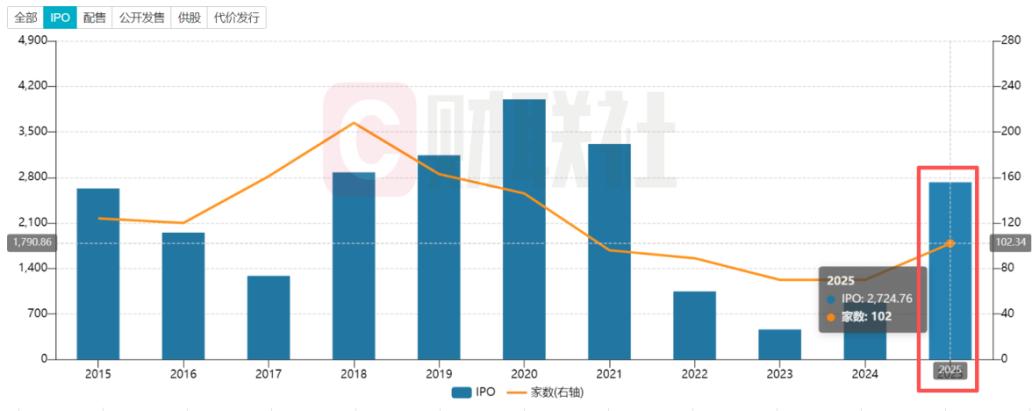
Core Viewpoint - The Hong Kong IPO market is expected to experience explosive growth in 2025, leading the global fundraising scale while the number of companies waiting to list continues to rise, creating a "backwater" phenomenon [1] Group 1: IPO Market Overview - As of December 17, there are 298 companies in the IPO hearing process, with 28 new additions in December alone, significantly surpassing the 18 from the same period in November [1] - In 2025, the Hong Kong IPO market has completed 102 listings, raising a total of 2724.76 million HKD, a year-on-year increase of 226.62%, marking a four-year high [1] - The Hong Kong Stock Exchange has become the top global exchange for IPO fundraising, with a total of 34.3 billion USD raised as of December 7, outpacing other major exchanges [7] Group 2: Industry Distribution of IPOs - The technology and innovation-driven sectors dominate the upcoming listings, with software services and hardware accounting for approximately 35% of the total [2] - The pharmaceutical and biotechnology sector has six companies focusing on high-barrier areas such as innovative drugs and cancer treatment, driven by both policy support and market demand [2] - Consumer services and daily retail make up about 25%, with traditional industries upgrading through differentiated positioning and omnichannel strategies [2] Group 3: Underwriting and Sponsorship - CITIC Securities (Hong Kong) and CICC lead the underwriting market, sponsoring 83 and 80 companies respectively, while Huatai Securities (Hong Kong) ranks third with 47 [3] - The top ten underwriting institutions by fundraising amount include CICC (628.94 million HKD), CITIC Securities (Hong Kong) (466.84 million HKD), and Morgan Stanley (254.16 million HKD) [11][12] Group 4: Concerns and Regulatory Actions - There are growing concerns regarding the quality of new stock applications and the potential "blood-sucking" effect on the secondary market due to the surge in IPOs [5] - The Hong Kong Securities and Futures Commission and the Stock Exchange have expressed concerns over declining application quality and non-compliance issues [5] - Research indicates a weak positive correlation between primary market financing activity and secondary market performance, suggesting that the two markets may influence each other positively [6]
中国银河证券:市场风险偏好下降 港股风格切换加速
智通财经网· 2025-11-16 08:57
Market Performance - The Hong Kong stock market showed mixed performance from November 10 to November 14, with the Hang Seng Index rising by 1.26% to 26,572.46 points, while the Hang Seng Tech Index fell by 0.42%, and the Hang Seng China Enterprises Index increased by 1.41% [1][2] - Among the primary sectors, seven sectors saw gains while four experienced declines, with real estate, healthcare, and consumer goods leading the gains at 5.58%, 5.13%, and 4.74% respectively [2] Liquidity Analysis - The average daily trading volume on the Hong Kong Stock Exchange was HKD 233.12 billion, an increase of HKD 2.59 billion from the previous week, while the average short-selling amount decreased by HKD 1.11 billion to HKD 28.36 billion [3] - The net inflow of southbound funds totaled HKD 24.77 billion, a decrease of HKD 13.91 billion compared to the previous week [3] Valuation and Risk Appetite - As of November 14, the Hang Seng Index had a PE ratio of 12.05 and a PB ratio of 1.24, reflecting increases of 1.53% and 1.44% respectively, placing it at the 86% and 91% percentile levels since 2019 [4] - The risk premium for the Hang Seng Index was recorded at 4.16%, which is significantly below the three-year rolling average [4] Investment Outlook - The market is expected to maintain a cautious risk appetite, with a rotation of hot sectors anticipated, leading to a potential continuation of a volatile trading environment [5] - Investment recommendations include focusing on cyclical stocks that may rebound due to changing supply-demand dynamics and dividend stocks as a defensive strategy amid uncertainties regarding U.S. Federal Reserve interest rate policies [5]
1114 港股日评:港股整体调整,恒生科技承压-20251115
Changjiang Securities· 2025-11-15 13:50
Core Insights - The Hong Kong stock market experienced an overall adjustment, with the Hang Seng Technology Index leading the decline, down 2.82% to 5812.8 [2][5] - The total market turnover reached HKD 232.79 billion, with net inflows from southbound funds amounting to HKD 12.887 billion [5] - Concerns over global semiconductor demand recovery were heightened due to disappointing earnings from a Japanese storage giant, negatively impacting the hard technology sector [5] Market Performance - The Hang Seng Index fell by 1.85% to 26572.46, while the Hang Seng China Enterprises Index decreased by 2.09% to 9397.96 [2] - In the A-share market, the Shanghai Composite Index declined by 0.97%, and the CSI 300 Index fell by 1.57% [2] - Among the sectors, Agriculture, Forestry, Animal Husbandry, and Fishery (+1.03%) and Computer (+0.03%) were the top gainers, while Retail (-3.88%) and Non-ferrous Metals (-3.56%) were the biggest losers [2] Sector Analysis - The hard technology sector, including semiconductors and hardware, faced downward pressure due to concerns about the recovery of storage chip demand following poor earnings reports [5] - Conversely, the daily consumer retail sector saw a rise driven by strong earnings reports from major weighted stocks, boosting investor confidence [5] Future Outlook - Potential growth areas for the Hong Kong stock market include AI technology and new consumption trends, which are expected to drive market increases [5] - Continuous inflow of southbound funds is anticipated to enhance marginal pricing power in the Hong Kong market [5] - The transition from loose monetary policy to loose credit in China, along with potential further interest rate cuts in the U.S., could support the Hong Kong market's upward trajectory [5]
港股速报 | 港股全线下挫 中兴通讯H股跌超12%
Mei Ri Jing Ji Xin Wen· 2025-10-17 08:45
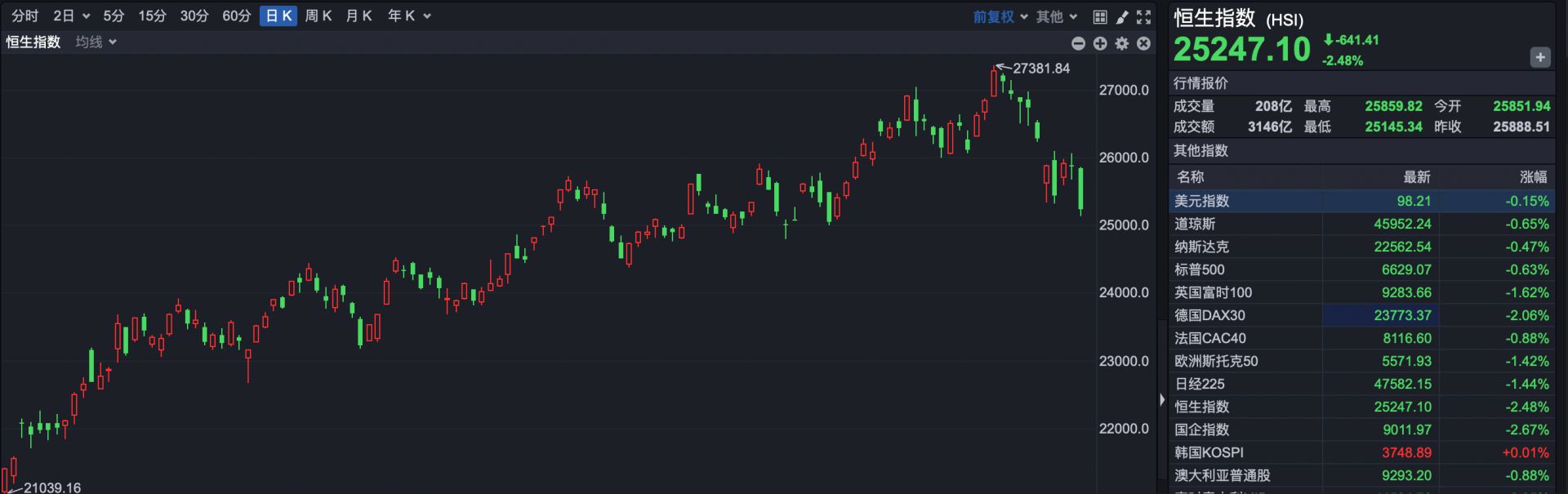
Market Overview - The Hong Kong stock market experienced a significant decline, with the Hang Seng Index closing at 25,247.10 points, down 641.41 points, representing a drop of 2.46%, marking the lowest closing since September 5 [1] - The Hang Seng Tech Index closed at 5,760.38 points, down 243.18 points, a decrease of 4.05%. Since the peak on October 2, the index has seen a cumulative decline of over 14% [3] Company Focus - ZTE Corporation's H-shares (00763.HK) fell over 12%, with an intraday maximum drop of 14%. The A-shares (000063.SZ) hit the daily limit down [5] - New consumption concept stocks also saw declines, with companies like Weilang Meishi (09985.HK) and Blukoo (00325.HK) dropping over 6%, while Nayuki Tea (02150.HK) and Pop Mart (09992.HK) fell over 4% [8] Sector Performance - All sectors in the Wind Hong Kong secondary industry index declined, with semiconductors, hardware equipment, and defense industries experiencing the largest drops [7] - Specific sector declines included: - Defense and military down 5.18% - Hardware equipment down 5.51% - Semiconductor down 3.55% [8] Other Notable Stocks - Tech stocks also faced declines, with Baidu, Alibaba, Meituan, and Kuaishou all dropping over 4%. Xiaomi and Bilibili fell over 3%, while Tencent decreased by over 1% [9] - Apple-related stocks, such as Q Technology, saw a drop of over 9%, and solar energy stocks continued their downward trend, with Sunshine Energy falling over 5% [9] Capital Flow - As of market close, southbound funds net bought over 6.3 billion HKD in Hong Kong stocks [9] Market Outlook - Short-term outlook for the Asia-Pacific market appears bleak due to increased uncertainty in news, leading to heightened risk aversion. Without new positive catalysts, the market may continue to experience volatility [11] - In the medium to long term, with the Federal Reserve entering a rate-cutting cycle, a "double easing" effect between China and the U.S. is expected, which may lead to sustained capital inflow and a gradual bullish trend for Hong Kong stocks [11]

港股波动加剧,把握美联储议息窗口机会
Yin He Zheng Quan· 2025-09-07 06:19
Core Insights - The report highlights the increased volatility in the Hong Kong stock market and suggests seizing opportunities during the Federal Reserve's interest rate decision window [1] - Analysts expect a general upward trend in the Hong Kong market, driven by improving corporate earnings and favorable policy signals [40] Market Review - During the week from September 1 to September 5, the Hong Kong stock indices showed collective strength, with the Hang Seng Index rising by 1.36% to 25,417.98 points, the Hang Seng Tech Index increasing by 0.23% to 5,687.45 points, and the Hang Seng China Enterprises Index up by 1.22% to 9,057.22 points [4][5] - Among the ten sectors, all but the telecommunications services sector saw gains, with healthcare, materials, and utilities leading the way with increases of 7.06%, 5.42%, and 2.79% respectively [5][12] Liquidity and Fund Flow - The average daily trading volume on the Hong Kong Stock Exchange was HKD 315.79 billion, a decrease of HKD 41.59 billion from the previous week [12] - Southbound funds recorded a net inflow of HKD 33.06 billion, an increase of HKD 10.88 billion compared to the previous week [12] Valuation and Risk Premium - As of September 5, the Hang Seng Index's PE and PB ratios were 11.5 times and 1.18 times, respectively, reflecting increases of 1.23% and 1.24% from the previous week, positioning them at the 85% and 82% percentiles since 2019 [18][20] - The risk premium for the Hang Seng Index was calculated at 4.6%, indicating a favorable valuation environment [20][25] Investment Outlook - The report suggests focusing on sectors with high earnings growth but relatively low valuations, such as consumer discretionary, daily consumer goods, and utilities [40] - It also highlights sectors benefiting from favorable policies, including the AI industry chain and consumer sectors, as well as high-dividend financial sectors that may provide stable returns amid uncertainties [40]
大涨行情下,多只基金业绩告负,什么情况?
券商中国· 2025-08-31 09:54
Core Viewpoint - The article discusses the phenomenon of fund managers "dodging the bull market" amidst a strong market rally, highlighting the challenges faced by active equity products in outperforming indices despite a high percentage of positive returns [1][4]. Group 1: Fund Performance - As of August 29, 98.48% of active equity products recorded positive returns, yet 68 funds underperformed, indicating a mismatch between fund strategies and market trends [2][4]. - The A-share and Hong Kong markets have shown significant structural characteristics, with sectors like innovative drugs, humanoid robots, and artificial intelligence performing well, while others like coal and retail have lagged [4][5]. Group 2: Investment Strategy - Funds that did not align their holdings with market hotspots faced severe "missed opportunities," with some managers adhering strictly to their investment themes, such as coal or high-dividend stocks, leading to underperformance [5][6]. - High cash positions during market uptrends can result in underperformance, as seen with several funds maintaining low positions despite rising indices [5][6]. Group 3: Future Opportunities - Analysts suggest that the previously overlooked dividend and consumer sectors may become new focal points for investment as they offer stability amidst market volatility [8][9]. - The "self-pleasing consumption" trend is gaining traction, driven by changing consumer behaviors and preferences, indicating potential growth in related markets [9][10]. Group 4: Market Dynamics - The article notes that as new high-growth stocks emerge, there may be a valuation reassessment, leading to increased market volatility [8][9]. - The current market environment is seen as suitable for dividend stocks, which can provide a safety net for investors amid fluctuations [8][9].