有色金属冶炼及压延加工

Search documents
输入性通胀:推升成本压力
GUOTAI HAITONG SECURITIES· 2026-03-31 12:41
Group 1: Manufacturing Sector Insights - The manufacturing PMI for March 2026 is 50.4%, an increase of 1.4 percentage points from the previous month, marking a return to the expansion zone after two months[7] - The new orders index and production index are at 51.6% and 51.4%, respectively, both above the critical point, indicating strong demand recovery[13] - Small and medium-sized enterprises' PMIs have significantly improved, with small enterprises at 49.0% (up 1.5 percentage points) and medium enterprises at 49.3% (up 4.5 percentage points) from the previous month[10] Group 2: Price and Cost Pressures - The main raw material purchase price index is at 63.9%, up 9.1 percentage points, while the factory price index is at 55.4%, up 4.8 percentage points, indicating rising input costs due to geopolitical tensions[16] - The procurement volume index has risen to 50.9%, reflecting increased purchasing activity driven by demand recovery[18] - The inventory indices for raw materials and finished products are at 47.7% and 46.7%, respectively, indicating a slowdown in inventory depletion[18] Group 3: Non-Manufacturing Sector Performance - The non-manufacturing business activity index is at 50.2%, up 0.5 percentage points, with significant internal differentiation in the service sector[20] - The construction business activity index is at 49.3%, up 1.1 percentage points, but still indicates a low level of activity, with new orders at 43.5%[23] - Consumer services sectors such as retail and hospitality are below the critical point, suggesting a need for policy support to boost consumer confidence[20] Group 4: Risks and Future Outlook - Rising raw material prices may squeeze profit margins for downstream enterprises, potentially suppressing future investment and production willingness[26] - The ongoing geopolitical tensions in the Middle East remain a critical variable, with sustained high oil prices likely to exacerbate cost pressures in downstream industries[26] - Real estate demand needs to be stimulated, and geopolitical risks could disrupt market stability[27]
【权威解读】3月份中国采购经理指数重回扩张区间
中汽协会数据· 2026-03-31 09:13
Core Viewpoint - In March 2026, China's Purchasing Managers' Index (PMI) returned to the expansion zone, indicating a recovery in economic sentiment with manufacturing PMI at 50.4%, non-manufacturing business activity index at 50.1%, and composite PMI output index at 50.5% [1]. Group 1: Manufacturing PMI - The manufacturing PMI rose to 50.4% in March, reflecting increased market activity as companies resumed operations post-Spring Festival [2]. - Both production index and new orders index improved, reaching 51.4% and 51.6% respectively, indicating accelerated production activities and improved market demand [2]. - Large, medium, and small enterprises all saw a rise in PMI, with large enterprises at 51.6%, medium at 49.0%, and small at 49.3%, showing significant improvement in sentiment for smaller firms [2]. Group 2: Key Industries - High-tech manufacturing PMI stood at 52.1%, marking 14 consecutive months above the critical point, indicating a positive development trend [3]. - Equipment manufacturing and consumer goods industries also showed expansion with PMIs of 51.5% and 50.8% respectively [3]. - The price index for major raw materials surged, with purchasing price index at 63.9% and factory price index at 55.4%, reflecting a significant increase in market prices [3]. Group 3: Non-Manufacturing PMI - The non-manufacturing business activity index rose to 50.1%, indicating an improvement in the non-manufacturing sector [5]. - The service sector's business activity index reached 50.2%, with certain industries like telecommunications and financial services showing strong growth [5]. - The construction industry also saw an improvement, with a business activity index of 49.3%, reflecting a recovery in construction projects post-holiday [5]. Group 4: Composite PMI - The composite PMI output index increased to 50.5%, indicating an overall positive trend in production and business activities across sectors [6]. - The manufacturing production index and non-manufacturing business activity index contributed to this increase, standing at 51.4% and 50.1% respectively [6].


3月PMI数据解读
清华金融评论· 2026-03-31 08:00
Group 1: Manufacturing PMI Insights - In March, the Manufacturing Purchasing Managers' Index (PMI) rose to 50.4%, indicating a return to the expansion zone, driven by increased market activity post-Spring Festival [4] - Both production index and new orders index improved, reaching 51.4% and 51.6% respectively, reflecting accelerated production activities and improved market demand [4] - Large, medium, and small enterprises all showed PMI increases, with large enterprises at 51.6%, medium at 49.0%, and small at 49.3%, indicating a general improvement in economic conditions [4][5] Group 2: Sector-Specific Performance - High-tech manufacturing PMI reached 52.1%, marking 14 consecutive months above the critical point, indicating a positive development trend [5] - The equipment manufacturing and consumer goods sectors also saw PMIs of 51.5% and 50.8%, respectively, both entering the expansion zone [5] - The price indices for major raw materials and factory prices significantly increased to 63.9% and 55.4%, respectively, due to rising commodity prices and increased procurement activities [5] Group 3: Non-Manufacturing PMI Insights - The Non-Manufacturing Business Activity Index rose to 50.1%, showing an improvement in the non-manufacturing sector's economic conditions [7] - The service sector's business activity index reached 50.2%, with significant growth in sectors like rail transport and financial services, while retail and hospitality lagged behind [7] - The construction sector's business activity index improved to 49.3%, with a positive outlook for future activities as indicated by a business activity expectation index of 50.5% [7] Group 4: Comprehensive PMI Overview - The Comprehensive PMI Output Index increased to 50.5%, indicating an overall improvement in production and business activities across sectors [8] - The manufacturing production index and non-manufacturing business activity index contributed to this increase, standing at 51.4% and 50.1% respectively [8]

2026年有色金属趋势展望:资源博弈与科技革命加速格局重塑,战略资源价值攀升
材料汇· 2026-02-11 15:23
Group 1 - The core viewpoint of the article is that the prices of non-ferrous metals are expected to rise significantly in 2025 due to tariff impacts, interest rate cuts, and geopolitical factors, with specific metals like tungsten and gold showing the highest price increases [4][9]. - In 2025, the price increases for precious metals are projected to exceed 100%, while industrial metals are expected to rise by approximately 30% [4][5]. - The overall revenue and profit trends in the non-ferrous metals industry are closely aligned with price movements, with significant growth in both revenue and profits anticipated for 2025 [9]. Group 2 - The article highlights that the cumulative revenue for the non-ferrous metal mining sector is expected to reach 424.74 billion yuan, reflecting a year-on-year increase of 12.7%, while operating profits are projected to grow by 36.1% [9]. - The non-ferrous metal smelting and processing industry is expected to see cumulative revenue of 9.77339 trillion yuan, with a year-on-year profit increase of 22% [9]. - The performance of various sub-sectors within the non-ferrous metals industry, such as precious metals and industrial metals, is expected to reflect the overall profit trends, with precious metals showing the highest profit growth [9]. Group 3 - The article discusses the outlook for gold prices, indicating that there is a basis for upward movement due to factors such as ongoing central bank purchases and fiscal expansion in major economies [14][15]. - The article notes that the trend of central banks increasing gold reserves is strengthening, with gold surpassing U.S. Treasury bonds as the largest reserve asset globally [15]. - The anticipated continuation of the interest rate cut cycle in 2026 is expected to further support gold prices, alongside geopolitical uncertainties that may drive demand for safe-haven assets [19]. Group 4 - The article outlines the supply-side dynamics for copper, indicating that the U.S. tariff policies and inventory levels are influencing price volatility [27][30]. - It is projected that global copper mine supply will see marginal increases in 2026, with significant contributions expected from major mining projects [30][31]. - The demand for copper is expected to be bolstered by the growth of data centers and energy storage applications, which are projected to significantly increase copper consumption [36][40]. Group 5 - The article reviews the lead market, indicating that prices are expected to remain stable within a narrow range due to weak supply and demand dynamics [45][67]. - The supply of lead is anticipated to improve in 2026, with new projects coming online, although the actual increase may be limited by raw material availability [51][54]. - The demand for lead is expected to be supported by policies promoting battery recycling and the growth of electric vehicle sales, although overall growth may be modest [65][66]. Group 6 - The zinc market is characterized by a mixed performance, with domestic prices showing a decline while international prices are rising due to supply disruptions [71][73]. - The article indicates that the supply of zinc is expected to increase gradually, but the growth rate may slow down in 2026 due to various factors affecting mining operations [73][74]. - Demand for zinc is projected to improve marginally in 2026, although traditional demand remains weak [73].

深夜,缅甸发生6.0级地震!锡价大涨
Qi Huo Ri Bao· 2026-02-03 23:27
Group 1 - The core viewpoint of the news is that the tin market is experiencing significant volatility due to a combination of recent price corrections, external economic factors, and a natural disaster in Myanmar, a key tin-producing country [1][3][4]. Group 2 - The recent panic selling in the non-ferrous metals sector has led to a notable decline in tin futures, with the main contract dropping to 383,340 yuan/ton, a decrease of 6.7% [1]. - Following the panic selling, there was a recovery in the night trading session, with the main tin futures contract rising by 6.64% [1]. - A 6.0 magnitude earthquake occurred in Myanmar, which is the third-largest tin producer globally, contributing 15% to 20% of the world's supply, raising concerns about potential impacts on tin mining operations [3]. - The recent decline in tin prices is attributed to profit-taking after reaching historical highs, concerns over AI market bubbles following disappointing earnings from tech giants, and a shift in market sentiment towards a stronger dollar [4]. - The current supply-demand situation for tin is tight, with limited availability in the spot market, but there is an increase in purchasing sentiment from downstream sectors after the price correction [4]. - Analysts indicate that while the supply of tin is expected to improve with increased imports and production from Myanmar, demand from traditional sectors remains weak, although emerging sectors like electric vehicles and AI servers may provide long-term support for tin prices [5].

四川宏达股份有限公司 关于完成工商变更登记并换发营业执照的公告
Zhong Guo Zheng Quan Bao - Zhong Zheng Wang· 2026-02-03 22:38
Core Points - The company has completed the registration changes and obtained a new business license following the approval of changes to its registered capital, amendments to the Articles of Association, and the cancellation of the supervisory board [1] - The registered capital of the company is now 2.6416 billion yuan [1] - The company operates in various sectors including fertilizer production, hazardous chemicals management, food additives production, and mining [1] Company Information - The company is named Sichuan Hongda Co., Ltd. and is classified as a listed joint-stock company [1] - The legal representative of the company is Qiao Shengjun [1] - The company was established on June 30, 1994, and is located in Shifang Town, Sichuan Province [1] Business Scope - The company is involved in the production and sale of fertilizers, hazardous chemicals, food additives, and feed additives [1] - It also engages in the mining and processing of mineral resources, as well as the sale of various metal and non-metal products [1] - The company is authorized to conduct business activities that require approval from relevant authorities [1]

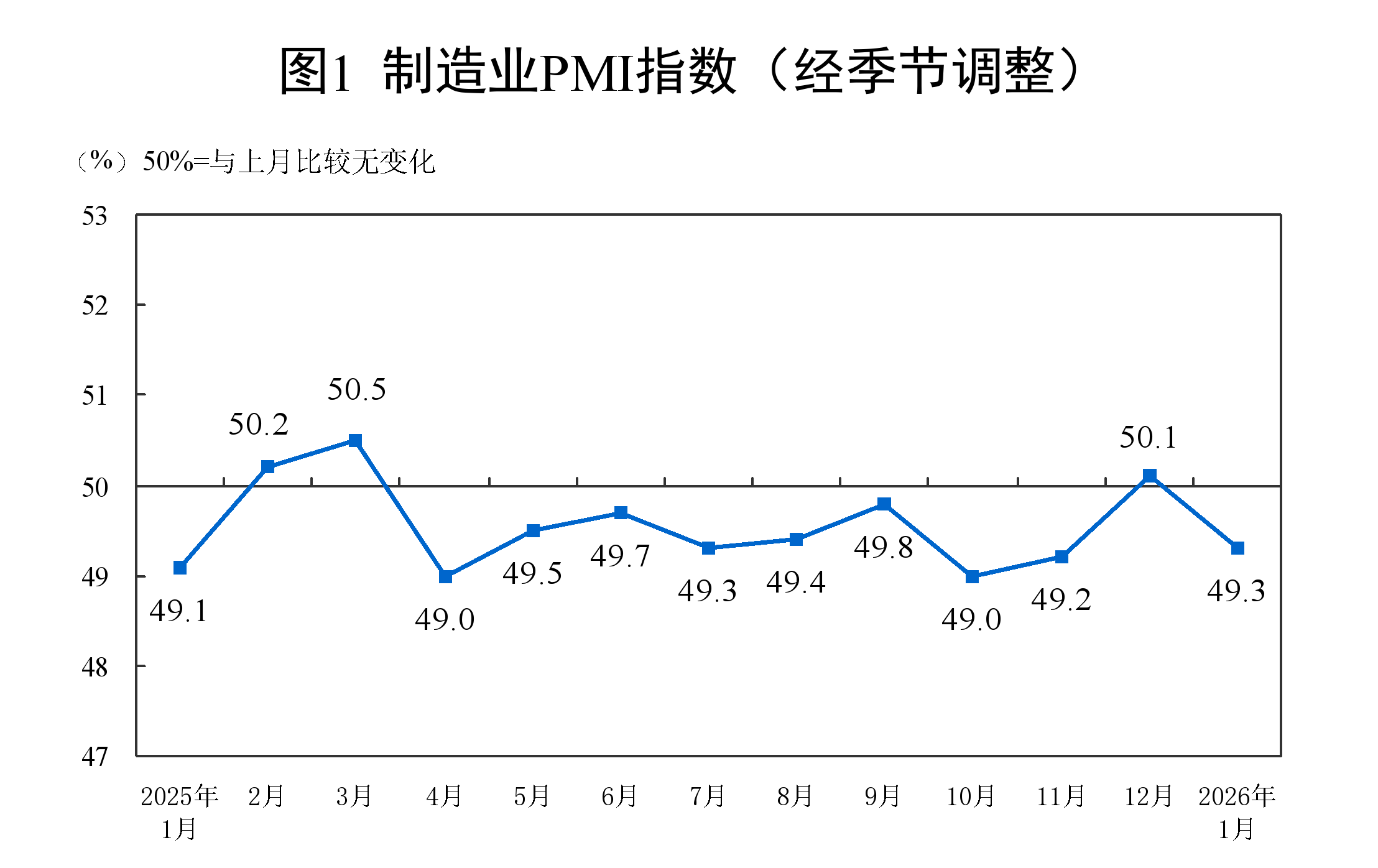
1月份制造业PMI为49.3%
Ren Min Ri Bao Hai Wai Ban· 2026-02-02 01:48
Group 1 - The manufacturing Purchasing Managers' Index (PMI) for January is 49.3%, a decrease of 0.8 percentage points from the previous month, indicating a decline in manufacturing activity due to seasonal factors and insufficient market demand [2] - The production index stands at 50.6%, indicating continued expansion in manufacturing production, while the new orders index is at 49.2%, reflecting a drop in market demand [2] - Certain industries such as agricultural processing and aerospace have production and new orders indices above 56.0%, indicating strong demand, while sectors like petroleum and automotive show indices below the critical point, suggesting a slowdown in market demand [2] Group 2 - The main raw materials purchasing price index and the factory price index are at 56.1% and 50.6%, respectively, both showing increases from the previous month, with the factory price index rising above the critical point for the first time in nearly 20 months [3] - Large enterprises maintain a PMI of 50.3%, indicating continued expansion, while medium and small enterprises show PMIs of 48.7% and 47.4%, reflecting a decline in their economic performance [3] - High-tech manufacturing leads with a PMI of 52.0%, remaining above 52.0% for two consecutive months, while consumer goods and high-energy industries show lower PMIs of 48.3% and 47.9%, indicating a decrease in their economic conditions [3] Group 3 - The production and business activity expectation index is at 52.6%, indicating optimism among enterprises, particularly in agricultural processing and food industries, which have indices above 56.0% [4] - The non-manufacturing business activity index for January is 49.4%, a decrease of 0.8 percentage points from the previous month, indicating a decline in overall non-manufacturing activity [4] - The service industry business activity index is at 49.5%, down 0.2 percentage points, with sectors like financial services showing high activity indices above 65.0%, while the real estate sector drops below 40.0%, indicating weak performance [4]
1月份中国采购经理指数有所回落
Guo Jia Tong Ji Ju· 2026-02-02 01:05
Group 1: Manufacturing Sector - The manufacturing Purchasing Managers' Index (PMI) decreased to 49.3% in January, indicating a decline in economic sentiment compared to the previous month [1][2] - The production index remained above the critical point at 50.6%, suggesting continued expansion in manufacturing production, while the new orders index fell to 49.2%, indicating a drop in market demand [2] - Large enterprises maintained a PMI of 50.3%, indicating ongoing expansion, while small and medium-sized enterprises saw declines in their PMIs to 48.7% and 47.4%, respectively [3] - High-tech manufacturing continued to lead with a PMI of 52.0%, reflecting a positive development trend in this sector [3] - The price indices for major raw materials and factory prices rose to 56.1% and 50.6%, respectively, indicating an overall improvement in market price levels [2] Group 2: Non-Manufacturing Sector - The non-manufacturing business activity index fell to 49.4%, reflecting a decrease in overall economic sentiment in this sector [1][4] - The service industry business activity index was at 49.5%, with significant activity in financial services, while the real estate sector's index dropped below 40.0%, indicating weak sentiment [4] - The construction industry experienced a notable decline, with its business activity index at 48.8%, influenced by adverse weather and the upcoming holiday [4] - Despite the decline in current activity, the service industry business activity expectation index rose to 57.1%, indicating increased confidence among service sector enterprises [4] Group 3: Composite PMI - The composite PMI output index was recorded at 49.8%, showing a slight decrease from the previous month, indicating a general slowdown in production and business activities [1][5] - The manufacturing production index and non-manufacturing business activity index were 50.6% and 49.4%, respectively, contributing to the overall composite PMI output index [5]
价格继续抑制需求
CAITONG SECURITIES· 2026-02-01 06:45
Group 1: Economic Indicators - The manufacturing Purchasing Managers' Index (PMI) for January is 49.3%, down 0.8 percentage points from the previous month, indicating a return below the growth threshold[3][7]. - The new export orders index and new orders index for January are 47.8% and 49.2%, respectively, down 1.2 and 1.6 percentage points from last month, both remaining below the growth threshold[5][13]. - The production expansion speed has slowed, with the manufacturing PMI at 50.6%, down 1.1 percentage points from the previous month, still above the growth threshold[16]. Group 2: Inventory and Pricing Dynamics - The finished goods inventory index for January is 48.6%, up 0.4 percentage points from last month, slightly above seasonal levels; the raw materials inventory index is 47.4%, down 0.4 percentage points, below seasonal levels[17][21]. - The price scissors difference between raw material purchase prices and factory prices is 5.5%, up 1.3 percentage points from last month, indicating further compression of profit margins for enterprises[20][23]. - The main raw material purchase price index is 56.1%, up 3.0 percentage points from last month, reflecting significant price increases in the commodity market[20]. Group 3: Demand Weakness and Risks - External demand is weakening due to changes in trade policies and a decline in the U.S. consumer confidence index, which fell from 94.2% to 84.5%, the lowest since May 2014[15]. - Internal demand is also showing signs of weakness, with the difference between new orders and new export orders dropping from 1.8% in December 2025 to 1.4% in January 2026[15]. - Risks include potential underperformance of domestic policy measures, unexpected changes in international geopolitical situations, and measurement errors in PMI indicators related to anti-involution industries[40].
1月制造业PMI49.3%,制造业市场价格总体改善
2 1 Shi Ji Jing Ji Bao Dao· 2026-02-01 02:29
Core Viewpoint - The manufacturing Purchasing Managers' Index (PMI) in China for January is reported at 49.3%, indicating a decline of 0.8 percentage points from the previous month, reflecting a downturn in manufacturing activity [1][5][8]. Manufacturing PMI Analysis - The decline in manufacturing PMI is attributed to seasonal factors as some industries enter a traditional off-peak period, coupled with insufficient market demand [1][8]. - The production index stands at 50.6%, indicating continued expansion in manufacturing production, while the new orders index is at 49.2%, showing a decrease in market demand [6][8]. - High-tech manufacturing PMI remains strong at 52.0%, indicating sustained positive development in related industries [1][8]. Price Index Improvement - The overall price level in the manufacturing sector has improved, with the main raw materials purchasing price index at 56.1% and the factory price index at 50.6%, both showing increases from the previous month [2][14]. - The factory price index has risen above the critical point for the first time in nearly 20 months, suggesting a general improvement in manufacturing market prices [2][14]. Employment and Inventory Trends - The employment index is reported at 48.1%, indicating a slight decline in hiring conditions within the manufacturing sector [12]. - The raw materials inventory index is at 47.4%, reflecting a continued decrease in major raw material stocks, while finished goods inventory has increased, suggesting accelerated production activities ahead of the Spring Festival [13][12]. Future Expectations - The production and business activity expectation index is at 52.6%, remaining above the critical point, although it marks the lowest level since the second half of 2025 [15]. - There is a noted concern regarding the decline in new export orders, which fell to 47.8%, indicating a contraction in external demand and potential challenges for future manufacturing activity [7][15].