第六代移动通信

Search documents
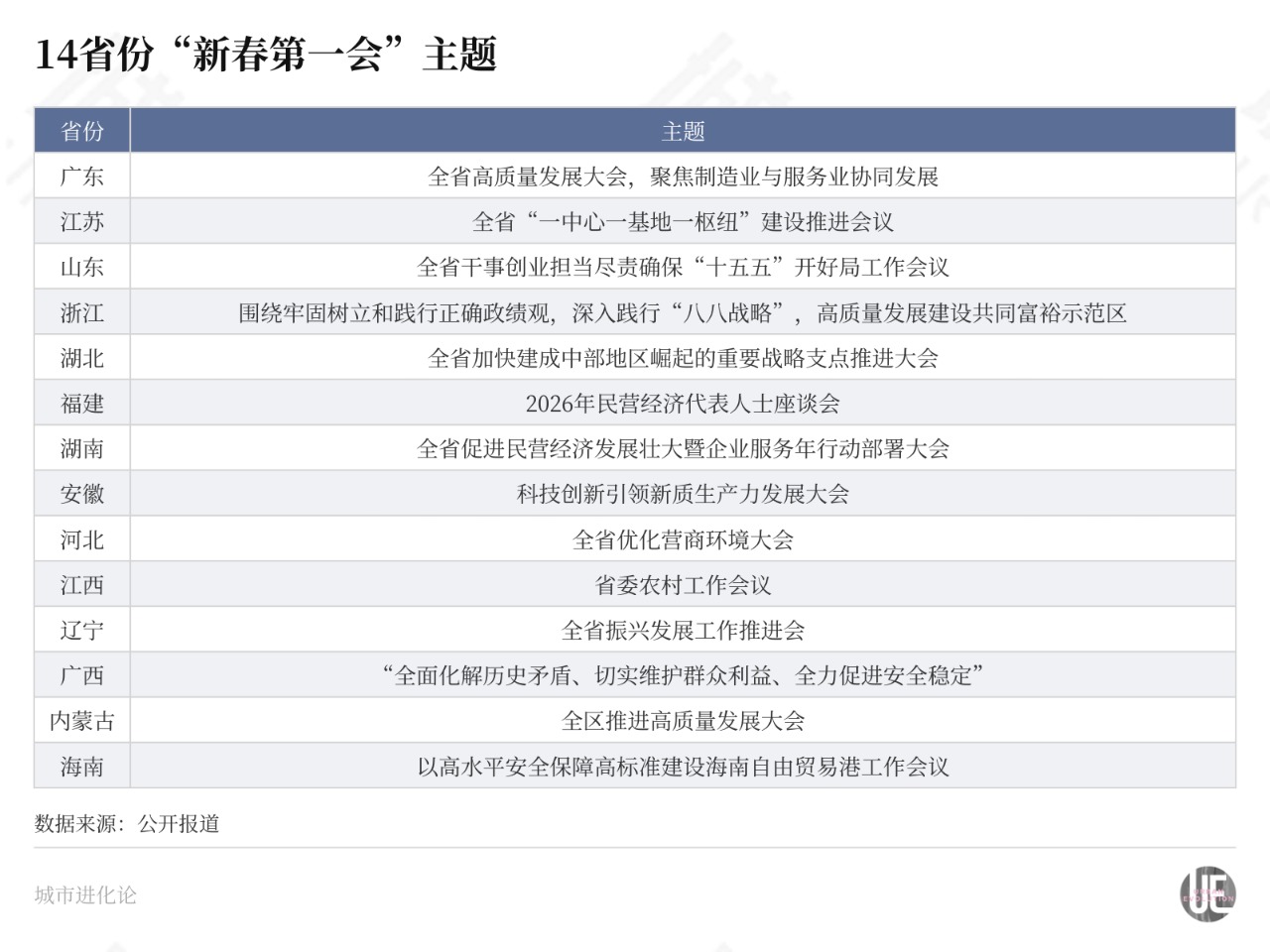
14省份“新春第一会” 传递出哪些信号?
Mei Ri Jing Ji Xin Wen· 2026-02-24 14:32
Core Insights - The "New Spring First Meeting" held across various provinces serves as a significant indicator for observing development trends and setting strategic directions for the year, particularly at the start of the "14th Five-Year Plan" [1] Group 1: Industry Upgrades - Guangdong's focus on the synergy between manufacturing and service industries highlights the importance of a modern industrial system as a foundation for China's modernization, with a GDP of 14.58 trillion yuan, maintaining the top economic position for 37 consecutive years [3][4] - The need for Guangdong to ascend the "smile curve" of industry, emphasizing advanced R&D and precise brand marketing, is crucial for overcoming current challenges in high-quality development [4][5] - Other provinces like Anhui and Hubei are also prioritizing technological innovation and new industries, with Anhui targeting quantum technology and biomanufacturing as future growth points [6][7] Group 2: Strategic Implementation - Hubei's strategic focus on becoming a key support point for central region development emphasizes specific goals such as increasing the number of large enterprises and enhancing infrastructure [7][8] - Liaoning's emphasis on project-driven growth aims to address investment declines and stimulate economic activity through effective project management and collaboration across industries [9] Group 3: Private Economy - The importance of a favorable business environment is underscored as a core competitive advantage for regional high-quality development, particularly in older industrial bases [10] - Provinces like Hebei and Hunan are actively working to improve their business environments, with Hebei aiming for a significant increase in private sector contributions to GDP by 2025 [12][13] - Fujian's initiatives to enhance the business environment have led to substantial growth in private enterprises, contributing significantly to innovation and economic activity [14]

专题报告:多因素推动春季躁动北证或迎新趋势
Yin He Zheng Quan· 2026-02-08 15:22
Performance Insights - The proportion of companies with positive revenue growth on the North Exchange is high, indicating a stronger seasonal rally in spring. In 2025, 62% of companies reported positive revenue growth, while 48% reported positive net profit growth[12][14]. - The spring rally in 2025 saw a significant increase of +40.17% in the North Exchange 50 Index, supported by optimistic performance expectations[12][15]. Liquidity Factors - Improved liquidity is a key driver for the seasonal rally, with trading volumes in 2024 and 2025 starting from two consecutive days of increased trading volume. The average daily trading amount reached over 100 billion yuan in these years[16][17]. - The North Exchange's trading volume has shown significant fluctuations, but the North Exchange 50 Index's volatility has been relatively small, suggesting stable liquidity conditions[22]. Valuation Trends - Valuations have experienced a phase of correction before seasonal rallies, with the North Exchange's overall price-to-earnings ratio dropping from 55 times in September 2025 to 47 times currently, providing a foundation for potential rallies[26]. - Historical data shows that prior to the spring rallies, valuations were at relatively low levels, which attracted more investments and facilitated valuation recovery[23][26]. Market Dynamics - The spring rally is influenced by multiple factors, including concentrated policy expectations, thematic investment opportunities, and performance-driven market sentiment[5][6]. - The North Exchange has shown a decreasing "see-saw effect" with the Shanghai and Shenzhen markets, indicating a growing recognition and acceptance of the North Exchange among investors[17]. Investment Recommendations - Focus on sectors such as new energy, embodied intelligence, and emerging industries with unique business models that are scarce in the A-share market[15]. - Emphasize companies with strong financial indicators, high growth potential, and significant R&D investments to capitalize on the expected spring rally[15].
“十五五”期间地区生产总值年均计划增长5%左右 江苏:奋力书写“强富美高”新篇章
Shang Hai Zheng Quan Bao· 2026-02-03 18:19
Core Insights - Jiangsu aims for an average GDP growth of around 5% during the "15th Five-Year Plan" period, with a focus on high-quality development and integration of technological and industrial innovation [6][7] - The province's GDP reached 14.2 trillion yuan during the "14th Five-Year Plan," with an average annual growth of 5.7% and significant contributions from manufacturing and service sectors [3][4] - Jiangsu plans to invest heavily in infrastructure, targeting 240 billion yuan in transportation, 45 billion yuan in water conservancy, and 170 billion yuan in energy by 2026 [7] Economic Performance - Jiangsu's GDP per capita reached 167,000 yuan, with public budget revenue exceeding one trillion yuan during the "14th Five-Year Plan" [3] - The manufacturing sector accounted for 33.5% of the GDP, while the service sector contributed 54% [3] - The province has maintained the highest level of new loans in the country for four consecutive years, with a strong presence in the stock market [3] Innovation and Technology - Jiangsu's R&D investment intensity reached 3.38%, with an average of 34.2 high-value invention patents per ten thousand people [3] - The province has established six national technology innovation centers and over 480 joint innovation centers with enterprises [3] - Plans for 2026 include the establishment of 10 provincial concept verification centers, 30 benchmark incubators, and 10 provincial manufacturing pilot platforms to enhance innovation [7] Industrial Development - Jiangsu has deepened the "1650" industrial system construction, with 14 national advanced manufacturing clusters and a strategic emerging industry fund exceeding 200 billion yuan [4] - The province aims to enhance the international competitiveness of its manufacturing base by focusing on high-quality development in key industries [4][8] - Future industries such as quantum technology, biomanufacturing, and hydrogen energy are prioritized for development [8]

新兴产业和未来产业“十五五”如何开局,工信部划出重点
2 1 Shi Ji Jing Ji Bao Dao· 2026-01-21 13:03
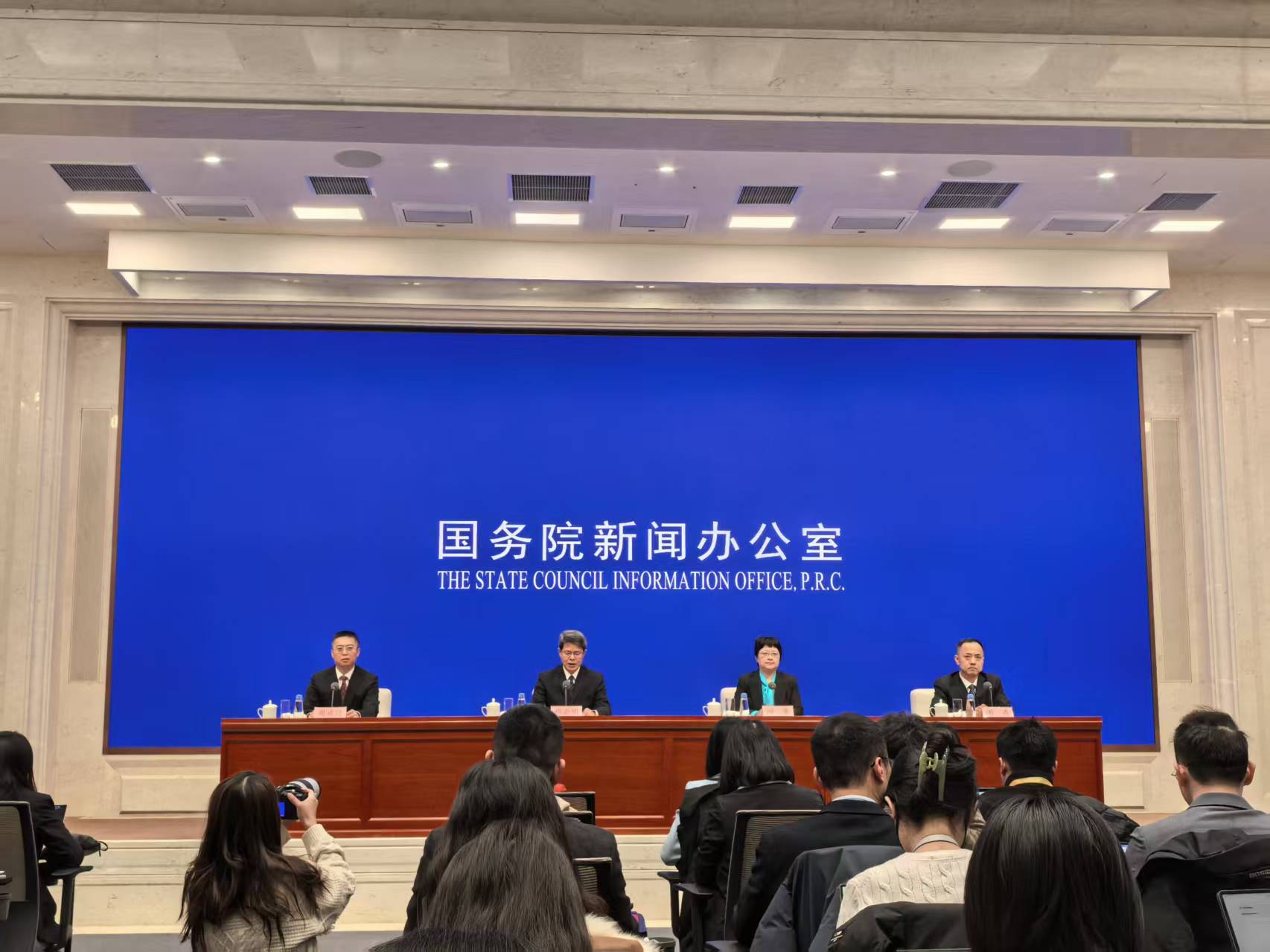
Core Viewpoint - The press conference highlighted China's industrial and information technology development goals for 2025, focusing on emerging industries and future technologies, with an emphasis on new materials, humanoid robotics, and 6G technology [1][4][8]. Emerging Industries - The Ministry of Industry and Information Technology (MIIT) aims to implement actions to develop and strengthen emerging industries, creating new momentum for growth [1][4]. - New materials were specifically mentioned as a key area, with a focus on advanced basic materials, strategic materials, and AI-integrated materials [1][6]. - By 2025, the industrial added value of key sectors like integrated circuits and electronic materials is expected to grow by 26.7% and 23.9% respectively [4]. Future Industries - The MIIT plans to promote future industries such as embodied intelligence and 6G technology, with significant investments in R&D and application ecosystems [1][7][10]. - The first phase of 6G technology trials has resulted in over 300 key technology reserves, with the second phase already initiated [10]. - Humanoid robotics is expected to drive the development of the embodied intelligence sector, with over 140 domestic companies and more than 330 humanoid robot products launched by 2025 [8][9]. Economic Contribution - The industrial and information sectors contributed over 40% to economic growth, with a manufacturing value-added growth of 5.9% year-on-year [4]. - The telecommunications business volume increased by 9.1%, indicating robust growth in the sector [4]. Investment and Innovation - The MIIT has facilitated over 55 billion yuan in new materials entering the market, supporting significant projects like the Shenzhou 21 manned spacecraft and C919 aircraft [6]. - The government is committed to enhancing the innovation capacity and development efficiency of the new materials industry through policy support and funding [6]. AI Development - By 2025, the number of AI companies in China is projected to exceed 6,000, with the core industry scale expected to surpass 1.2 trillion yuan [11]. - The launch of the national AI industry investment fund, with a scale of 60 billion yuan, aims to accelerate the development of AI technologies and applications [11][12]. Support for SMEs - The MIIT will optimize the business environment for small and medium-sized enterprises (SMEs) and implement measures to support their growth [13]. - A three-year action plan will be executed to cultivate specialized and innovative SMEs, enhancing their development mechanisms [13].
10亿,复旦科创旗下投资基金完成备案
FOFWEEKLY· 2026-01-06 10:05
Group 1 - The core viewpoint of the article is the successful launch of the Fudan Innovation Investment Fund, which has completed its private fund product filing and is now operational [1] - The total scale of the Fudan Innovation Investment Fund is 1 billion yuan, co-founded by Fudan Innovation Mother Fund, Shanghai Future Industry Fund, and Jing'an Capital, with additional investors including Zhejiang Longsheng Group and Anhui Jinbiandan Equity Investment [1] - The fund will focus on strategic emerging industries such as life health, artificial intelligence, integrated circuits, new energy, and new materials, as well as future industries like quantum technology, biomanufacturing, hydrogen energy, nuclear fusion energy, brain-computer interfaces, embodied intelligence, and sixth-generation mobile communication [1]

把握未来五年中国经济蕴藏的新机遇
Jing Ji Ri Bao· 2025-12-30 23:58
Core Viewpoint - The "14th Five-Year Plan" outlines strategic opportunities and challenges for China's economic and social development, emphasizing high-quality growth and a focus on various key sectors [2][3]. Economic Opportunities - The plan identifies numerous new opportunities, including the development of a modern industrial system and the strengthening of the real economy, with specific mentions of sectors such as mining, metallurgy, chemicals, and advanced technologies [3]. - The goal is to achieve significant results in high-quality development, with economic growth maintained within a reasonable range and an increase in domestic consumption driving economic growth [2][3]. Economic Challenges - Challenges include unbalanced development, insufficient effective demand, and pressures on employment and income growth, which need to be addressed to convert challenges into opportunities [4]. - The plan sets a target for per capita GDP to reach the level of moderately developed countries by 2035, requiring an average annual GDP growth of approximately 4.17% from 2025 to 2035 [4]. Consumer Income and Spending - The plan aims to increase residents' income through various channels, including wage, operational, property, and transfer income, with a focus on enhancing the share of labor remuneration in national income distribution [7][11]. - There is an emphasis on improving the structure of income distribution to promote a more reasonable allocation of income among residents [7]. Investment and Consumption - The plan suggests that increasing government spending on social welfare and implementing direct consumer support policies will enhance residents' consumption capacity [8][11]. - The importance of stabilizing the stock market to increase residents' property income and subsequently boost consumption is highlighted [14]. Capital Market Development - The stability of the capital market is crucial for enhancing investor confidence and ensuring sustainable income growth, which in turn affects consumer behavior [14][15]. - Encouraging long-term funding sources for technological innovation is essential for fostering a robust capital market and supporting economic growth [15][18]. Technological Innovation and Global Competitiveness - The plan emphasizes the need for China to cultivate high-quality listed companies with international competitiveness, particularly in the technology sector, to participate in global competition [18]. - The focus is on creating a favorable investment environment for companies to grow and attract long-term capital into the market [18].
登高稳行:成长乘势聚力,价值重构红利
Sou Hu Cai Jing· 2025-12-23 04:17
Group 1 - The core focus of China's economic policy in 2026 will shift towards technological self-reliance and new productivity paradigms, moving away from the traditional real estate and investment-driven growth model [1] - The report emphasizes the importance of integrating resources through a new type of national system, focusing on key technologies such as integrated circuits, industrial mother machines, and high-end instruments, while also planning for future industries like quantum technology and sixth-generation mobile communications [1] - The structural transformation aims to enhance the security of the industrial chain and create a high-quality supply system, fostering a virtuous cycle among technology, industry, and finance to inject long-term growth momentum into the capital market [1] Group 2 - The logic of stimulating domestic demand is undergoing a profound shift, transitioning from physical consumption driven by subsidies for appliances and automobiles to service consumption as the new engine [1] - China's service consumption currently accounts for less than 50%, significantly lower than the nearly 70% in the United States, indicating substantial room for improvement [1] - The aging population is driving the "silver economy," while younger generations prefer experiences and spiritual satisfaction, further reinforcing the structural upward trend in service consumption, supported by intensive policy initiatives [1] Group 3 - The global liquidity environment is expected to improve significantly in 2026, with the Federal Reserve potentially initiating an unexpected rate-cutting cycle due to increasing fiscal pressures and political cycles [2] - The weakening of the US dollar will create favorable conditions for global risk assets, particularly emerging market equities, benefiting both A-shares and Hong Kong stocks [2] - Domestic policies focusing on technology and consumption will provide valuation support, potentially leading to a market value reconstruction trend, with quality growth and high-dividend leaders showing investment value [2]

申万宏源证券晨会报告-20251222
Shenwan Hongyuan Securities· 2025-12-22 00:41
Group 1: Market Overview - The Shanghai Composite Index closed at 3890 points, with a daily increase of 0.36% and a monthly change of 0.03% [1] - The Shenzhen Composite Index closed at 2465 points, with a daily increase of 0.98% and a monthly change of -0.34% [1] - Large-cap indices showed a slight increase of 0.3% yesterday, while mid-cap and small-cap indices increased by 0.91% and 0.8% respectively [1] Group 2: Industry Performance - The decoration and renovation industry saw a daily increase of 3.33%, but a decline of 7.79% over the past month, while it increased by 30.51% over the past six months [1] - The energy metals sector increased by 3.26% yesterday, with an impressive 85.77% increase over the past six months [1] - The general retail sector increased by 3.22% yesterday, with an 8.93% increase over the past month and an 18.79% increase over the past six months [1] Group 3: Notable Declines - The components sector experienced a decline of 0.74% yesterday, with a 3.46% increase over the past month and a significant 69.42% increase over the past six months [1] - The other electronics sector declined by 0.68% yesterday, with a 42.32% increase over the past six months [1] - State-owned large banks saw a decline of 0.67% yesterday, with a 7.66% increase over the past six months [1]


中央经济工作会议后,市场如何表现?
Soochow Securities· 2025-12-13 11:08
Core Insights - The report indicates that the 2025 Central Economic Work Conference is more focused on "structural adjustment," suggesting a potential for a structural market trend in the upcoming year [4][6][26] - Historical patterns show that years emphasizing "stabilizing growth" typically lead to stronger market performance, favoring large-cap stocks over small-cap and value stocks over growth stocks [2][10] - Conversely, years focused on "structural adjustment" tend to exhibit market volatility, with large-cap stocks remaining flat while small-cap stocks weaken [2][10] Summary by Sections Historical Performance Post-Central Economic Work Conference - The report categorizes past conferences into two themes: "stabilizing growth" and "structural adjustment," with specific years identified for each theme [1][2] - Years with a "stabilizing growth" focus include 2014, 2018, 2019, 2021, 2022, and 2024, characterized by economic slowdowns and policies aimed at maintaining stability [1][2] - Years emphasizing "structural adjustment" include 2013, 2015, 2016, 2017, 2020, and 2023, where the focus was on addressing structural issues and risks [2] Market Behavior and Style Preferences - In "stabilizing growth" years, the market index typically strengthens, with large-cap stocks outperforming small-cap stocks and value stocks outperforming growth stocks [2][10] - In "structural adjustment" years, the market tends to be more volatile, with large-cap stocks showing flat performance and small-cap stocks declining [2][10] Industry Performance Insights - The report notes that the focus of the Central Economic Work Conference influences the following year's market trends, with specific industry policies guiding investment directions [3][4] - For instance, the emphasis on "innovation-driven" policies in 2012 led to a TMT boom in 2013, while the focus on "new consumption" and "new infrastructure" in 2018 shaped market trends in 2019 [3] 2025 Conference Insights - The 2025 conference highlights a "supply strong, demand weak" scenario, indicating a need to balance supply and demand dynamics [4][6] - The report suggests that monetary policy will prioritize economic stability and reasonable price recovery, which could lead to improved corporate profitability if inflation expectations rise [6] - Expanding domestic demand is a key focus, with policies aimed at increasing consumer income and stabilizing investment to counteract previous declines in fixed asset investment growth [6] Market Outlook and Sector Allocation - The report anticipates a structural market trend in 2025, with specific sectors recommended for investment, including AI applications, semiconductor, and renewable energy sectors [7] - The report emphasizes the importance of monitoring macroeconomic conditions and policy developments to inform investment strategies in the upcoming year [7]
明年经济工作怎么干?中央政治局会议释放六大信号
2 1 Shi Ji Jing Ji Bao Dao· 2025-12-08 11:59
Group 1 - The core viewpoint of the meeting is to maintain a stable yet progressive economic approach, emphasizing the need for proactive fiscal and monetary policies to enhance macroeconomic governance and address current economic challenges [1][5][9] - The meeting highlighted the importance of expanding domestic demand and optimizing supply, with a focus on developing new productive forces tailored to local conditions and advancing the construction of a unified national market [6][7][8] - The meeting underscored the necessity of innovation-driven growth, aiming to cultivate new economic drivers and enhance the quality of development through increased investment in technology and manufacturing [8][9] Group 2 - The meeting called for the implementation of more proactive fiscal policies and moderately loose monetary policies, continuing the approach established in previous meetings [5][6] - It was noted that the macroeconomic policy environment for 2026 is expected to maintain a "wide fiscal, wide monetary" framework, with fiscal policy playing a crucial role in stabilizing growth and structural adjustments [6][7] - The meeting emphasized the need to address key risks in specific sectors, including real estate and local government debt, while ensuring the stability of employment, enterprises, markets, and expectations [9][10]